Why Ravens and Crows Are Earth’s Smartest Birds

Their brains may be tiny, but birds have been known to outsmart children and apes.

Until the 21st century, birds were largely dismissed as simpletons. How smart can you be with a brain the size of a nut?

And yet the more we study bird intelligence, the more those assumptions are breaking down. Studies have shown, for instance, that crows make tools, ravens solve puzzles, and parrots boast a diverse vocabulary.

Birds make good use of the allotted space for their tiny brains by packing in lots of neurons—more so than mammals, in fact. (Read: “Think ‘Birdbrain’ Is an Insult? Think Again.”)

But what actually qualifies a bird as smart? The definition should be broader than it is, scientists say.

“Being able to fly to Argentina, come back, and land in the same bush—we don’t value that intelligence in a lot of other organisms,” says Kevin McGowan, an expert on crows at the Cornell Lab of Ornithology in Ithaca, New York. “We’ve restricted the playing field to things we think only we can do.”

But if we’re talking about standard intelligence—ie. mimicking human speech or solving problems—“it always comes down to parrots and corvids,” McGowan says.

RAVENS

Members of the corvid family (songbirds including ravens, crows, jays, and magpies, to name a few) are among the most intelligent birds, though common ravens may have the edge on tackling tough problems, according to McGowan.

  
WATCH THIS CLEVER RAVEN OUTSMART A TRASH CAN

A study published in 2017 in the journal Science revealed that ravens even pre-plan tasks—a behavior long believed unique to humans and their relatives. (Related: “We Knew Ravens Are Smart. But Not This Smart.”)

In the simple experiment, scientists taught the birds how a tool can help them access a piece of food. When offered a selection of objects almost 24 hours later, the ravens selected that specific tool again—and performed the task to get their treat.

“Monkeys have not been able to solve tasks like this,” Mathias Osvath, a researcher at Sweden’s Lund University, said in a previous interview.

CROWS

While crows do nearly as well as ravens solving intelligence tests, McGowan stresses that crows have an uncanny memory for human faces—and can remember if that particular person is a threat.

“They seem to have a good sense that every person is different and that they need to approach them differently.”
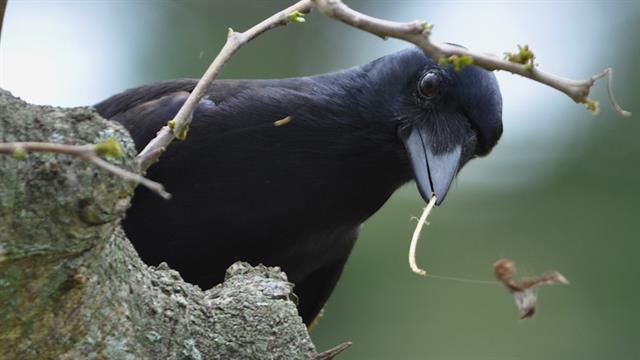
TOOL-MAKING CROWS ARE EVEN SMARTER THAN WE THOUGHT

For instance, crows are warier of new people than ravens are—but conversely are more comfortable with humans they had interacted with before, according to a study published in 2015 in the journal Behavioral Ecology and Sociobiology.

“The crows around here, they know my face,” says McGowan. While at first the birds living near the lab seemed to dislike McGowan for approaching their nests, they love him now that he’s started leaving the birds healthy treats. (Read more about how ravens hold grudges against humans.)

“They know my car, they know my walk, they know me 10 miles away from where they’ve ever encountered me before. They’re just amazing that way.”

In a now well-known study published in 2015 in the journal Animal Behaviour, researchers donned masks and, while holding dead, taxidermied crows, laid out food in areas frequented by crows in Washington State.

Almost universally, the crows responded by scolding the people—and even alerting other crows in the vicinity. When the researchers returned weeks later wearing the same masks, but empty-handed, the crows continued to harass them and were wary of the area for days after. (Read: “Do Crows Hold Funerals for Their Dead?”)

AFRICAN GREY PARROTS

While many species of parrots have a penchant for human speech, the African grey parrot is the most accomplished.

“There’s a lot going on in those little walnut brains of theirs,” says McGowan. “And they live so long that they can amass a lot of intelligence and a lot of memories.”

In the 1950s, Harvard comparative psychologist Irene Pepperberg began teaching an African grey parrot, Alex, English sounds. Before he died prematurely in 2007, Alex mastered roughly a hundred words, could use them in context, and even grasped the concepts of same, different, and zero.

Now Pepperberg is working with another African grey, Griffin, at Harvard University. Griffin can label shapes and colors, and is working on the concept of zero.

COCKATOOS

Cockatoos are the first animal observed making musical instruments.

COCKATOOS BECOME DRUMMERS TO PICK UP CHICKS

When courting, male palm cockatoos of Australia use twigs and seed pods to create drumsticks. Each male has a unique musical style—a rhythm of his own that he creates by beating the tools against hollow trees.

Though palm cockatoos don’t dance while drumming, other species have exhibited a gift for boogying to a beat.

Video of Snowball, a captive sulphur-crested cockatoo, jamming to the Backstreet Boys took the Internet by storm a few years ago. (Watch:
Snowball the Cockatoo Can Dance Better Than You.”)

Snowball’s performance is a delight to watch, but it also helped scientists discover that birds can follow a beat. By speeding the song up and down, they determined that Snowball actually does have a sense of tempo and rhythm.

GREAT-TAILED GRACKLES

Though corvids and parrots get most of the credit for being brainy, McGowan says, “There are sleeper birds out there” that we haven’t fully appreciated.

Great-tailed grackles, for instance, belong to the same family as blackbirds and orioles—a group not often considered particularly smart.
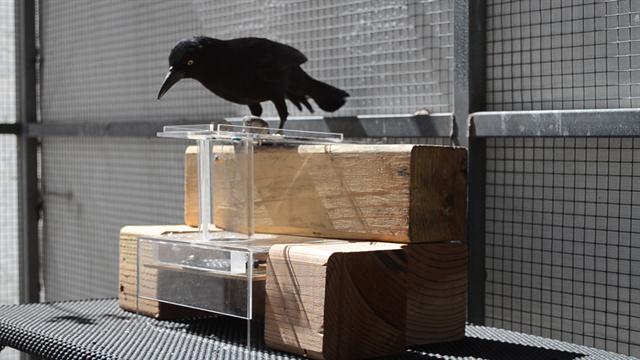
SEE HOW GRACKLES SOLVE TRICKY PUZZLES

Yet when presented with classic tests given to crows and ravens, great-tailed grackles passed with flying colors. (Read: “Watch Clever Birds Solve a Challenge from Aesop’s Fables.”)

According to the study, published in 2016 in PeerJ, the grackles were given puzzles containing food as a prize. Not only did they learn to solve the problem, when the rules of the puzzle changed, the birds nimbly adapted their strategies.

What’s more, each grackle approached the puzzle in a different way, demonstrating individual styles of thinking—a quality they share with us humans.

THE YEAR OF THE BIRD

In 1918 Congress passed the Migratory Bird Treaty Act to protect birds from wanton killing. To celebrate the centennial, National Geographic is partnering with the National Audubon SocietyBirdLife International, and the Cornell Lab of Ornithology to declare 2018 the Year of the Bird. Watch for more stories, maps, books, events, and social media content throughout the year.

Migratory Bird Treaty Act under threat

1/18/2018 | 0

The declining Golden-winged Warbler is one of many species protected by the
Migratory Bird Treaty Act. Photo by By Jayne Gulbrand/Shutterstock

In 1916, the United States and Canada reached a landmark agreement to
protect migratory birds, many of which were being hunted to the brink for
fashion or food. The Migratory Bird Treaty became U.S. federal law in 1918
as the Migratory Bird Treaty Act, one of the nation’s earliest and most
influential pieces of environmental legislation. Passed in the nick of time,
the act saved herons, egrets, waterfowl, and other birds from going the
route of the Passenger Pigeon and other now-vanished species.

Now the act itself is under attack, facing proposed changes that would undo
the safeguards it provides for birds. The U.S. House of Representatives is
considering an amendment eliminating protection for migratory birds that
fall victim to oil spills, wind turbines, and other energy infrastructure.
The language is part of a bill called the SECURE Act, HR 4239. In addition,
the Department of the Interior has drafted a new legal interpretation of the
law, changing a long-standing policy that the act covers these deaths.

The act does not put too heavy a burden on industry. It encourages energy
companies to adopt best-management practices, like covering oil pits with
screens to keep birds from being trapped and killed. In practice,
enforcement of the act has only occurred when companies failed to adopt such
practices — and ignored government warnings.

In a remarkable show of support for keeping the act strong, a bipartisan
group of 17 high-ranking officials from previous administrations sent a
letter to the interior secretary opposing the change. The new interpretation
“needlessly undermines a history of great progress, undermines the
effectiveness of the migratory bird treaties, and diminishes U.S.
leadership,” they wrote.

Migratory birds have inherent value. They also drive economic growth.
Birders spend millions of dollars on wildlife-watching equipment, backyard
birding supplies, and birding tours. Birds also provide essential services
to people, from natural control of insect pests to crop pollination.

According to the 2016 State of the Birds Report, a third of North America’s
bird species are in decline. Now is the time to increase protections for
migratory birds, not undercut the Migratory Bird Treaty Act and other
bedrock laws that sustain them.

Sign the American Bird Conservancy’s petition opposing changes to the
Migratory Bird Treaty Act

A version of this article will appear in the April 2018 issue of
BirdWatching magazine.

This story was provided by American Bird Conservancy, a 501(c)(3),
not-for-profit organization whose mission is to conserve native birds and
their habitats throughout the Americas.

https://www.birdwatchingdaily.com/blog/2018/01/18/migratory-bird-treaty-act
threat/

Illegal trade of parrots rampant in China

http://www.ecns.cn/cns-wire/2017/05-10/256844.shtml


2017-05-10

Scarlet macaws in an exposition park. (Photo/Beijing News)

Scarlet macaws in an exposition park. (Photo/Beijing News)

(ECNS) — The illegal trade of parrots is rampant in China, with the price of highly popular rare species exceeding 1,000 yuan ($145), Beijing News reports.

Chinese law only allows for the purchase of parrots by zoos or the exchange of the birds between breeding bases and forbids any other form of transaction, so it is illegal to sell parrots to customers, said an industry insider.

In 2009, the sun conure or sun parakeet was listed by the International Union for Conservation of Nature (IUCU) as one of the most endangered species globally, being under second class state protection in China. China doesn’t allow artificial breeding of sun conures, not to mention trade of the bird on the market.

However, it is hugely popular among Chinese bird keepers.

Many Taobao vendors sell sun conures at a price of around 50 yuan, while the bird is usually sold for between 300 and 500 yuan on other e-commerce platforms and via online flea markets, the paper said.

In a market near Beijing’s 3rd Ring Road, a vendor suggested an underground trade of sun conures, because “the bird isn’t allowed to be traded here in the market”.

It usually took the vendor a week to source the bird, at a price of 2,000 yuan a pair. “Because transport costs are high and supervision has now been beefed up, prices will naturally be higher,” said the vendor.

Zou Chuangqi, general manager of a parrot-breeding company in South China’s Fujian Province said parrots for exhibition or appreciation need frequent disinfection by spraying liquid medicine on their beaks and noses to prevent bird flu.

Li Li, head of Beijing Heibao Wildlife Protection Station, said poor disinfection or epidemic protection could cause the spread of bird flu as cases are increasing.


Wind Energy And Birds FAQ — Part 1: Understanding The Threats

https://abcbirds.org/wind-energy-threatens-birds/

ABC often receives questions regarding wind energy development and its impacts on birds and other wildlife. In this three-part series, Michael Hutchins, Director of ABC’s Bird-Smart Wind Energy Campaign, answers some of the more frequently asked questions about threats: How does wind energy threaten birds? What bird species are most threatened? How does the threat of wind energy compare to that of climate change?

See a full list of references at the end of the post and stay tuned for the second post in this series, scheduled for publication in mid-April.

How does wind energy threaten birds and bats?

Properly sited wind turbines are relatively bird friendly, especially when compared to fossil fuels. However, they are far from benign. Wind turbines and their associated infrastructure — notably power lines and towers — are among the fastest-growing threats to birds and bats in the United States and Canada. At the end of 2016, there were more than 52,000 operating, commercial-scale wind turbines in the United States and many more are currently under construction3.

Raptors, such as this Golden Eagle, are among the birds most threatened by wind energy development. Photo by David Lamfrom

Raptors, such as this Golden Eagle, are among the birds most threatened by wind energy development. Photo by David Lamfrom

We estimate that hundreds of thousands of birds and bats die every year when they accidentally collide with turbine blades9, 172526. Fragile-bodied bats can even succumb to the pressures created when the giant turbine blades pass through the air, a phenomenon known as barotrauma10.

Associated power lines and towers, which carry the electrical power generated by wind turbines into the grid19, kill an additional 8 to 57 million birds every year through collisions and electrocutions18. Furthermore, wind energy development can also contribute to habitat loss and road and other infrastructure construction, all of which can have significant impacts on birds7, 27.

When it comes to wind energy, siting is everything. The risks are, of course, much greater when wind turbines are placed in areas attracting large concentrations of birds and bats12. When wind energy projects are located in or near major migratory routes, stopover sites, or key breeding or foraging areas, the losses are expected to be great. ABC believes that such high-risk areas should be avoided at all costs. However, state and federal regulatory agencies have not done a very good job of keeping wind projects away from these high-concentration bird areas4.

Do we know exactly how many birds are killed by wind turbines and wind energy infrastructure every year?

Unfortunately, the answer is no. All we have at present are very rough and potentially biased estimates9, 172526 that are based on an accumulation of studies from individual, unidentified wind energy facilities.

The reason? The wind industry treats these data as trade secrets and generally does not share them with the public or concerned conservation organizations. Some wind energy developers have even sued to hide these data from the public2, 14. Hawai’i is currently the only state that requires mortality data be collected by independent, third-party experts and makes the information available to the public on request13.

Biologists estimate that millions of birds are killed every year by wind turbines and the power lines and infrastructure that supports the wind energy industry. Photo by Marijs / Shutterstock

Biologists estimate that millions of U.S. birds are killed every year by wind turbines and the power lines and infrastructure that supports the wind energy industry. Photo by Marijs / Shutterstock

These estimates that are made public — all of which range in the hundreds of thousands of birds and bats killed annually — are based on non-standardized data that were collected and reported by paid consultants to the wind industry. This is a direct conflict of interest15 that may lead to a reporting bias in favor of the wind companies (meaning, the numbers of killed birds and bats may be under-reported).

There are also methodological challenges. Dead birds are difficult to find under wind turbines, and studies have shown that even trained observers can easily miss them. Additionally, predators are known to locate and remove carcasses, which can also lead to underestimates of the number of bird and bat carcasses documented15.

Deaths due to collisions or electrocutions at power lines and towers associated with wind energy development are even more difficult to estimate, as there are thousands of miles of power lines, some in remote locations, that are seldom or never monitored for bird deaths18.

Finally, many of these estimates are several years old and are likely now out of date. In the years since many of these data were collected, wind energy companies have built many more turbines, power lines, and other infrastructure. This suggests that the toll on birds and bats is now much greater.

The fact that the energy companies are allowed to self-report their own violations of the Endangered Species Act (ESA), Migratory Bird Treaty Act (MBTA) and Bald and Golden Eagle Protection Act (BGEPA) is a violation of the first principle of scientific integrity — that is, those that have a vested interest in the outcome should not be the ones collecting and reporting their results to regulatory agencies1, 5.

Are certain species of birds more impacted by wind energy than others?

Knowing the number and type of species affected by wind projects depends on the ability to detect birds at the site in question at some point during their life-cycle. This is a challenge for all of the reasons previously mentioned — reporting is voluntary, inconsistent, and out of date.

That said, we do know that many species of birds are impacted by wind turbines25 and that those species that are most susceptible to turbine collisions and/or displacement are raptors, night-migrating songbirds, and grassland birds.

The overhead turbines and power lines associated with wind energy give predators a place to sit and watch for prey such as Greater Sage-Grouse, increasing the threat of predation for these grassland birds. Photo by Tom Reichner/Shutterstock

Turbines and power lines associated with wind energy give predators a place to sit and watch for prey such as Greater Sage-Grouse, increasing the threat of predation for these grassland birds. Photo by Tom Reichner/Shutterstock

Of these, grassland birds may not be as susceptible to collisions as raptors and night-migranting songbirds. However, some species, such as Greater Sage-Grouse, are stressed and displaced by tall structures where their predators can roost. This can influence the birds’ reproductive success and prevent genetic interchange between populations, thus threatening the species’ long-term survival16, 20, 22, 2428.

Raptors — though they have excellent vision — have their eyes focused on the ground looking for prey and do not detect the approach turbine blades, and night-time migrants do not see the blades.

Doesn’t climate change pose a bigger threat to birds than wind turbines? Aren’t wind turbines better than the alternatives of coal or natural gas?

Climate change certainly poses a significant threat to wildlife and their habitats, and wind power is viewed as a major player in our efforts to combat climate change.

However, there are plenty of reasons to be skeptical.  Back in the 1950s and ’60s, hydroelectric dams were viewed as a source of clean, renewable energy.  Now they are being torn down due to their unintended environmental impacts11. A recent study even suggests that hydroelectric dams may contribute to climate change6.

The same goes for biofuels, which are now being seen as a contributor to climate change, rather than a viable source of clean, renewable energy23. Poorly sited wind turbines could be next in line for enhanced scrutiny.

Wind energy offers some environmental benefits over other forms of energy, but is not without its own risks. Photo by Marijs / Shutterstock

Wind energy offers some environmental benefits over other forms of energy, but is not without its own risks. Photo by Marijs/Shutterstock

Unfortunately, many individuals — and even some conservation organizations — have embraced wind energy completely without asking the hard questions about its environmental impacts. The wind industry and its proponents have contributed to this situation themselves, downplaying its impacts on wildlife3 while simultaneously overselling the industry’s ability to mitigate associated problems8. At the same time, industry players have worked behind the scenes to try to minimize state and federal regulations and to attack important environmental legislation, such as the Migratory Bird Treaty Act21.

Wind turbines are a cleaner source of energy than fossil fuels. This is true. But does this mean wind energy developers should be less regulated than others in the energy sector? Should they be allowed to kill tens of thousands of federally protected birds and bats annually with impunity? We at ABC believe the answer to these questions is “no.”

In response to this very question, we at ABC developed the concept of “Bird-Smart” wind energy development. Put simply, this term is used to describe wind energy projects that are designed to minimize bird fatalities to every extent possible12. Bird-Smart wind energy:

  • ensures turbines are located away from high bird collision risk areas;
  • employs effective (tested) mitigation to minimize bird fatalities;
  • conducts independent, transparent, post-construction monitoring of bird and bat deaths to help inform mitigation; and
  • calculates and provides fair compensation for the loss of ecologically important, federally protected birds.

Editor’s note: Learn more about Bird-Smart wind energy, and look for the next installment in our wind energy FAQ series for more information.

Animal Protection Group Shuts Down US Senator Inhofe’s Pigeon Shoot

– Pigeon Supplier Leaves with Crates of Live Pigeons

LONE WOLF, OK – SHowing Animals Respect and Kindness (SHARK) shut down a live pigeon shoot fundraiser held Friday afternoon by US Senator Jim Inhofe (R-OK), the international animal protection group reported. SHARK said it will also monitor an Inhofe Dove Hunt Saturday if it goes on as scheduled.

According to SHARK, the story begins at the Quartz Mountain Lodge in Lone Wolf, OK, which was the sign-in location for Senator Inhofe’s pigeon shoot.  Activists followed the procession of vehicles when they left the lodge to go to the shooting area.  The Inhofe party went through extreme measures to lose SHARK, including driving the rear cars at extremely slow speeds on the highway to block the activists.

Inhofe’s team successfully lost the activists – except for one car, which eventually led the rest of the activists to the shoot, which was located down 10 miles of washboard dirt roads. The shoot site was located off of N2113 road in Lone Wolf.

Once SHARK launched its Angel drone, the shooting of birds stopped. Almost immediately vehicles started leaving. A trickle quickly became a flood, as was video documented. This included the person who supplied the pigeons. He left with many still living birds in his vehicle. The entire pigeon shoot was over.

“This a major victory,” said SHARK President Steve Hindi. “In 2014, when our investigator was at the event undercover, the shoot lasted more than an hour and forty-five minutes and there were ten shooting stations. This year there were only six shooting stations and the shoot was only about forty-five minutes long. All of this represents a dramatic reduction in shooters and time spent killing since SHARK first exposed Inhofe’s cruel fundraiser. Clearly the pressure is on Inhofe and we will not be letting up.”

Bi-State Sage-Grouse Lawsuit Filed!


March 10, 2016
Online Messenger #331
Yesterday, Western Watersheds Project and our allies at the Center for Biological Diversity, Desert Survivors, and WildEarth Guardians filed a lawsuit over the U.S. Fish and Wildlife Service’s failure to afford Endangered Species Act protection for the Bi-State population of greater sage-grouse. These genetically-distinct sage-grouse occur only on the California-Nevada border north and south of Mono Lake and face multiple threats to their survival.

The Service’s September 2015 finding that the Bi-State sage-grouse did not warrant protection was an abrupt about-face from its 2013 decision to protect the bird. That itself was a hard-fought outcome of a 2010 lawsuit, and now, we’re in court again seeking meaningful conservation for a population that remains at risk while the agency dithers.

In refusing to protect the bird, the Service relied upon new funding for measures in the Bi-State Action Plan. But that would fund activities on a mere 40,000 acres of private lands – less than one percent of the bird’s habitat.

Most of the 4.5 million acres of Bi-State sage-grouse habitat is on public lands, the bulk of which are grazed by livestock. Not a single federal land management plan has been amended to protect Bi-State sage-grouse, and the few proposed amendments will not conserve the bird. Ongoing livestock grazing on public lands will continue to threaten the grouse’s survival – from nest trampling, fenceline deaths, increased predation, vegetation composition changes, increased invasive species proliferation and increased fire risks.

Yesterday’s challenge seeks to remand the recent decision back to the Service so it can make an objective decision based on science, not politics.

Thanks to Stanford Law Clinic and the Center for Biological Diversity for representing us in this case.

The complaint is available online here.

Birders rejoice as Oregon standoff comes to close

http://www.oregonlive.com/environment/index.ssf/2016/02/birders_rejoice_as_oregon_stan.html#incart_story_package

With David Fry’s surrender to FBI agents Thursday morning, birders and environmentalists breathed a collective sigh of relief.

They’d grown increasingly anxious watching as the armed standoff at the Malheur National Wildlife refuge that began Jan. 2 dragged on for weeks and then for more than a month. Fry was among a group of four holdouts who dug in after the departure of most occupiers Jan. 26 and 27.

With each passing day, the standoff posed a greater threat to the spring migration that draws millions of shorebirds, waterfowl and songbirds to the 187,000-acre bird sanctuary.

“This couldn’t have ended soon enough,” said Harv Schubothe, president of the Oregon Birding Association.

Spring thaw is just around the corner, and Schubothe worried what might happen if U.S. Fish and Wildlife Service personnel couldn’t be present to direct the flow of melting water. He feared northbound swans, geese and sandhill cranes might arrive at Malheur to find dry meadows where wetlands should be. Unmanaged melt of this year’s copious snowpack could also cause flooding that might breach levies and wash out roads.

The standoff also threatened the Harney County Migratory Bird Festival, an April event that offers a major tourism boost for the county.

When the last occupier exited the refuge Thursday morning, all those threats disappeared. Their minds eased, refuge supporters turned to the formidable task of moving on and mending relationships frayed by the occupation.

“There’s a consensus that we never want this to happen again,” said Chris Gardner, who serves on the board of the nonprofit Friends of Malheur National Wildlife Refuge. “We want to make sure the refuge and Burns and the Harney County community are in partnership going forward, so it doesn’t happen again.”

For Gardner’s group, the occupation came with an upside. Bird lovers and environmentalists angry about the standoff channeled their feelings into action. The Friends of Malheur grew from 40 members to more than 700 over the course of the occupation. The group took in more than $25,000 in donations.

“Our treasurer has just gotten flooded with envelopes,” Gardner said.

The 41-day standoff began when Idaho businessman Ammon Bundy led a band of militants in an unannounced seizure of the refuge headquarters. Bundy’s insurrection fizzled on Jan. 26 when he and other occupation leaders were arrested on a highway north of Burns. LaVoy Finicum, a spokesman for the occupation, died in the encounter.

Known among birders and environmentalists as the crown jewel of the national wildlife refuge system, the vast preserve surrounding Malheur Lake is a rare source of abundant water in the arid Great Basin and a crucial point along the Pacific Flyway. Its importance to migratory birds can’t be understated, Schubothe said.

“The number of different species that depend on that oasis is just astounding,” he said.

In a way, the occupation leaders had fortuitous timing. Malheur’s wetlands are relatively empty in winter, with fewer birds present save the occasional hawk, quail, raven or owl. But the refuge comes alive in the spring as hundreds of species ranging from grebes and pelicans to warblers and finches arrive to feed and breed in its wetlands.

The standoff has likely ended with enough time for refuge staff to prepare for the migration, but cleaning up the occupiers’ mess could continue for weeks or months.

In a statement Thursday, Fish and Wildlife officials said they’ll be working to “assess and repair damages.”

In addition to the big task of managing water, refuge staff have been kept from the mundane duties of checking fish screens that keep invasive carp from tightening their grip on the refuge habitat, fixing fences and getting contracts in place for the summer.

“All that stuff that goes into making a place like Malheur function optimally, that’s stuff you can’t do on the spot,” said Bob Sallinger, conservation director for the Audubon Society of Portland. “You need to be prepping throughout the year.”

Sallinger quietly visited the bird sanctuary weeks into the occupation. Hoping to avoid the flurry of protests, counter-protests and news cameras, he brought little more than his binoculars and a bird list.

“I felt it was important to see for myself,” he said.

The swans had already arrived and the first sandhill cranes were coming in. Other waterfowl will arrive soon.

Although Sallinger was alone during his visit, other birders are planning trips to Malheur now that the occupiers have left. Hundreds have answered the environmental groups’ call for volunteers to assist in the cleanup effort.

Alan Contreras, a Eugene educational administrator and avid birder who began visiting the refuge as a child, plans to be among those returning this spring.

A lifelong Oregonian whose roots in the state go back to 1871, Contreras, 60, had taken the refuge occupation personally. He resented its out-of-stater leaders, who seemed to feel they had more right to the land than he did.

“I have asked my family to place my ashes there when the time comes,” he said. “It’s that kind of place.”

–Kelly House

Malheur National Wildlife Refuge is for the birds

12196349_10153256579521188_5652107754797511661_n

“Malheur’s for the birds”

That’s the slogan that read across a T-shirt I wore back in the late ’70s, when I worked there for the summer in the maintenance department for the Malheur Field Station. A branch of Oregon’s Pacific University, the “Field Station” was where they held month-long courses in botany and ornithology.

I also took their anthropology/wilderness survival course, called, “Aboriginal Life Skills of the Northern Great Basin.” There, we learned how the Paiutes lived off the land, hundreds of years before ranchers claimed it for themselves and their ubiquitous cows. Their armed takeover of the Malheur National Wildlife Refuge headquarters building is apparently part of an effort to re-assert their “constitutional rights.”

As an avid birdwatcher, I know the refuge and its headquarters well. Possibly second only to Yellowstone National Park for biodiversity, wildlife can be found throughout the refuge. The Wildlife Department headquarters office is practically a required stop for die-hard birders, due to the oasis-like edge effect the treed property has in the midst of an otherwise contiguous sagebrush habitat.

Say’s the Portland Audubon Society of the unique national refuge:

This area is one of the premiere sites for birds and birding in the U.S. The refuge consists of over 187,000 acres of habitat which include wetlands, riparian areas, meadows, and uplands.

 Location: In the center of the southeast quarter of the state, 30 miles south of Burns in central Harney County.

Description: This area is one of the premiere sites for birds and birding in the U.S. The refuge consists of over 187,000 acres of habitat which include wetlands, riparian areas, meadows, and uplands. Refuge lands are configured in roughly a “T” shape, 39 miles wide and 40 miles long.

Ornithological Highlights: Malheur’s varied habitats, abundant resources, and location on the Pacific Flyway are utilized by a variety of migratory and resident birds. Over 320 species of birds have been observed at Malheur, including numerous watch-listed species such as Western Snowy Plover, Long-billed Curlew, Franklin’s Gull, Short-eared Owl, Greater Sage-Grouse, Bobolink, Trumpeter Swan, and Brewer’s Sparrow.

The refuge’s riparian habitat supports the highest known densities of Willow Flycatcher, up to 20% of the world’s population of White-faced Ibis, and significant breeding populations of American White Pelican and Greater Sandhill Crane. Breeding populations on the refuge also include a variety of gulls and terns and hundreds of pairs of various duck species. The first Oregon breeding record of Cattle Egret came from Malheur Lake in the mid-1980s. Black-crowned Night-Heron pairs nesting on the refuge generally number in the hundreds.

During migration, the Refuge regularly supports hundreds of thousands of waterfowl and tens of thousands of shorebirds, including a significant proportion of the total populations of several species. Malheur Refuge is also a winter concentration point for raptors of many species.

Thousands of birders come to the refuge annually to take part in the spectacle, whether they come for the waterfowl, songbirds, or both. Due to the high birder coverage and concentrated bird habitat Malheur Headquarters may have the highest all-time bird list of any single location in Oregon.

For more information on Malheur, please see the Technical Site Report in the National IBA database.

Links:

Yes, contrary to the cow-pushers who are now trying to take it over again, this time from the rest of the US citizens, Malheur’s for the birds…and for us bird watchers too.

South Carolina Congressman Wants to Neuter Migratory Bird Treaty Act

http://www.bornfreeusa.org/weblog_canada.php?p=4945&more=1

Canadian Blog

by Barry Kent MacKay,
Senior Program Associate

Born Free USA’s Canadian Representative

 by 06/19/15

Hudsonian Godwit

I’m a Canadian, so I’m not entirely familiar with how things work legislatively in the bustling and powerful nation to the south of me. But, what I do know is that there is a Republican congressman from South Carolina who wants to place a rider on an appropriations bill that “prohibits the federal government from prosecuting any person or corporation for violating the Migratory Bird Treaty Act.”

The Act, first passed in 1918, has the word “treaty” in it because it is an agreement between two separate, sovereign nations—Canada and the U.S.—and there is a reason for such a mutual understanding.

Look at the word “migratory.” Just four years before the law came into effect, the once most abundant bird species in North America had become extinct, and others were gone or on the verge. It was recognized even then, and all the more so now, that apart from any moral or aesthetic consideration, these birds performed valuable utilitarian services (such as the non-toxic control of insects) and that the health of the environment depended on the diversity of wildlife.

Even as the great Industrial Revolution rolled out of Europe and across America, it was as true then as it is now that the very foundation of our lives, and our ability to do commerce, depends on the viability—the health—of the environment from which we have sprung, and upon which we ultimately and totally depend. No gram of food, drop of water, or breath of air exists but for the workings of the nonhuman, “natural” world. And, we are corrupting all of that at an alarming rate.

How can people who don’t realize that get elected to high office?

A large percentage of protected species are essential to Canadian interests, but how can we protect them when they are migrating to, or through, the U.S.? People continue to kill even the most benign and beautiful of songbirds; or simply mow down habitat; or shoot hawks, herons, Hudsonian godwits, or hummingbirds.

What is particularly incomprehensible is that this unscientific, unneighborly, unilateral decision should come at a time when we are seeing so much loss not only in birds, but in other wildlife species, in America and worldwide. Wildlife species that were abundant in my childhood are now being listed as threatened or endangered. Even still, common species are not as common. In the 1970s, a drive from my home to Lake Simcoe, about 45 miles to the north, was filled with sightings of Savannah sparrows, bobolinks, thrashers, vesper sparrows, meadowlarks, kestrels, barn swallows, and so on. Now, I can make that drive in the absence of seeing any of them; they are not necessarily endangered yet, but they are clearly in serious decline.

Meanwhile, what was once Eurasia’s most abundant bird species, the yellow-breasted bunting, has seen a 90% decline in population since 1980. It is a migratory songbird, roughly the size of our native song sparrow—but it lacks protection. Robins and rails, sandpipers, and shrikes need protection wherever they occur, and they know nothing of politically chosen borders.

The yellow-breasted bunting has been over-hunted in regions, especially China, where there is nothing like the Migratory Bird Treaty Act or legislation to enforce it.

We can’t keep destroying what is so essential to us, even those who see no inherent value in the song of a hermit thrush, the dramatic stoop of a falcon, the cheerfully bright colors of a goldfinch or tanager, or the drama of a flock of scoters flying in a string just over the breaking waves in the low light of a coastal dawn.

I understand that the president and the senate have the ability to veto the bill, but it seems a shame to promote such divisiveness in the first place. I can only hope, for the sake of all, that compassion prevails.

Keep Wildlife in the Wild,
Barry

The girl who gets gifts from birds

http://www.bbc.com/news/magazine-31604026

The girl who gets gifts from birds

Eight-year-old Gabi Mann sets a bead storage container on the dining room table, and clicks the lid open. This is her most precious collection.

“You may take a few close looks,” she says, “but don’t touch.” It’s a warning she’s most likely practised on her younger brother. She laughs after saying it though. She is happy for the audience.

Inside the box are rows of small objects in clear plastic bags. One label reads: “Black table by feeder. 2:30 p.m. 09 Nov 2014.” Inside is a broken light bulb. Another bag contains small pieces of brown glass worn smooth by the sea. “Beer coloured glass,” as Gabi describes it.

Each item is individually wrapped and categorised. Gabi pulls a black zip out of a labelled bag and holds it up. “We keep it in as good condition as we can,” she says, before explaining this object is one of her favourites.

There’s a miniature silver ball, a black button, a blue paper clip, a yellow bead, a faded black piece of foam, a blue Lego piece, and the list goes on. Many of them are scuffed and dirty. It is an odd assortment of objects for a little girl to treasure, but to Gabi these things are more valuable than gold.

Gifts given by the crows

She didn’t gather this collection. Each item was a gift – given to her by crows.

She holds up a pearl coloured heart. It is her most-prized present. “It’s showing me how much they love me.”

Gabi’s relationship with the neighbourhood crows began accidentally in 2011. She was four years old, and prone to dropping food. She’d get out of the car, and a chicken nugget would tumble off her lap. A crow would rush in to recover it. Soon, the crows were watching for her, hoping for another bite.

As she got older, she rewarded their attention, by sharing her packed lunch on the way to the bus stop. Her brother joined in. Soon, crows were lining up in the afternoon to greet Gabi’s bus, hoping for another feeding session.

Gabi’s mother Lisa didn’t mind that crows consumed most of the school lunches she packed. “I like that they love the animals and are willing to share,” she says, while admitting she never noticed crows until her daughter took an interest in them. “It was a kind of transformation. I never thought about birds.”

In 2013, Gabi and Lisa started offering food as a daily ritual, rather than dropping scraps from time to time.

Each morning, they fill the backyard birdbath with fresh water and cover bird-feeder platforms with peanuts. Gabi throws handfuls of dog food into the grass. As they work, crows assemble on the telephone lines, calling loudly to them.

Gabi feeding birds in her garden

It was after they adopted this routine that the gifts started appearing.

The crows would clear the feeder of peanuts, and leave shiny trinkets on the empty tray; an earring, a hinge, a polished rock. There wasn’t a pattern. Gifts showed up sporadically – anything shiny and small enough to fit in a crow’s mouth.

One time it was a tiny piece of metal with the word “best” printed on it. “I don’t know if they still have the part that says ‘friend’,” Gabi laughs, amused by the thought of a crow wearing a matching necklace.

When you see Gabi’s collection, it’s hard not to wish for gift-giving crows of your own.

“If you want to form a bond with a crow, be consistent in rewarding them,” advises John Marzluff, professor of wildlife science at the University of Washington. He specialises in birds, particularly crows and ravens.

Crow on feeder

What food is best? “A few peanuts in the shell,” he says. “It’s a high-energy food… and it makes noise when you throw it on the ground, so they hear it and they quickly habituate to your routine.”

Marzluff, and his colleague Mark Miller, did a study of crows and the people who feed them. They found that crows and people form a very personal relationship. “There’s definitely a two-way communication going on there,” Marzluff says. “They understand each other’s signals.”

The birds communicate by how they fly, how close they walk, and where they sit. The human learns their language and the crows learn their feeder’s patterns and posture. They start to know and trust each other. Sometimes a crow leaves a gift.

But crow gifts are not guaranteed. “I can’t say they always will (give presents),” Marzluff admits, having never received any gifts personally, “but I have seen an awful lot of things crows have brought people.”

Not all crows deliver shiny objects either. Sometimes they give the kind of presents “they would give to their mate”, says Marzluff. “Courtship feeding, for example. So some people, their presents are dead baby birds that the crow brings in.”

Read More: http://www.bbc.com/news/magazine-31604026