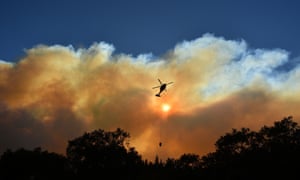
November, 2018: a helicopter passes by the sun as it makes a water drop in the Feather River Canyon, east of Paradise, California. Photograph: Josh Edelson/AFP via Getty Images
In addition to providing updated guidelines on which images our editors should use to illustrate the climate emergency, we have updated our style guide to introduce terms that more accurately describe the environmental crises facing the world. Our editor-in-chief, Katharine Viner, said: “We want to ensure that we are being scientifically precise, while also communicating clearly with readers on this very important issue”. These are the guidelines provided to our journalists and editors to be used in the production of all environment coverage across the Guardian’s website and paper:
1.) “climate emergency” or “climate crisis” to be used instead of “climate change”
Climate change is no longer considered to accurately reflect the seriousness of the overall situation; use climate emergency or climate crisis instead to describe the broader impact of climate change. However, use climate breakdown or climate change or global heating when describing it specifically in a scientific or geophysical sense eg “Scientists say climate breakdown has led to an increase in the intensity of hurricanes”.
2.)“climate science denier” or “climate denier” to be used instead of “climate sceptic”
The OED defines a sceptic as “a seeker of the truth; an inquirer who has not yet arrived at definite conclusions”. Most “climate sceptics”, in the face of overwhelming scientific evidence, deny climate change is happening, or is caused by human activity, so ‘denier’ is more accurate.ot “global warming” ‘Global heating’ is more scientifically accurate. Greenhouse gases form an atmospheric blanket that stops the sun’s heat escaping back to space.
4.) “greenhouse gas emissions” is preferred to “carbon emissions” or “carbon dioxide emissions”. Although carbon emissions is not inaccurate, if we’re talking about all gases that warm the atmosphere, this term recognises all of the climate-damaging gases, including methane, nitrogen oxides, CFCs etc.
5.) Use “wildlife”, not “biodiversity” We felt that ‘wildlife’ is a much more accessible word and is fair to use in many stories, and is a bit less clinical when talking about all the creatures with whom we share the planet.
6.) Use “fish populations” instead of “fish stocks”
This change emphasises that fish do not exist solely to be harvested by humans – they play a vital role in the natural health of the oceans.
The update to the Guardian’s style guide, originally announced earlier this year, followed the addition of the global carbon dioxide level to the Guardian’s daily weather pages – the simplest measure of how the mass burning of fossil fuels is disrupting the stable climate. To put it simply, while weather changes daily, climate changes over years and decades. So alongside the daily carbon count, we publish the level in previous years for comparison, as well as the pre-industrial-era baseline of 280ppm, and the level seen as manageable in the long term of 350ppm.
In order to keep below 1.5C of warming, the aspiration of the world’s nations, we need to halve emissions by 2030 and reach zero by mid century. It is also likely we will need to remove CO2 from the atmosphere, perhaps by the large-scale restoration of nature. It is a huge task, but we hope that tracking the daily rise of CO2 will help to maintain focus on it.
Viner said: “People need reminding that the climate crisis is no longer a future problem – we need to tackle it now, and every day matters.”
We hear the ice before we see it. The first sound is a scraping whine as a chunk of ice etches its way down the hull of the ship. The shelves creak as the cabin starts to shake. Out the window, I see a piece of ice floating 10m (33ft) or so away – a bluish, three-humped blob about a metre (3ft) across. It bobs up and down in the waves.
Then a few more rounded and weathered chunks appear. Another one hits the hull with a heavy clonk, and we hear it bounce below the waterline three or four times as it moves down the side of the vessel.
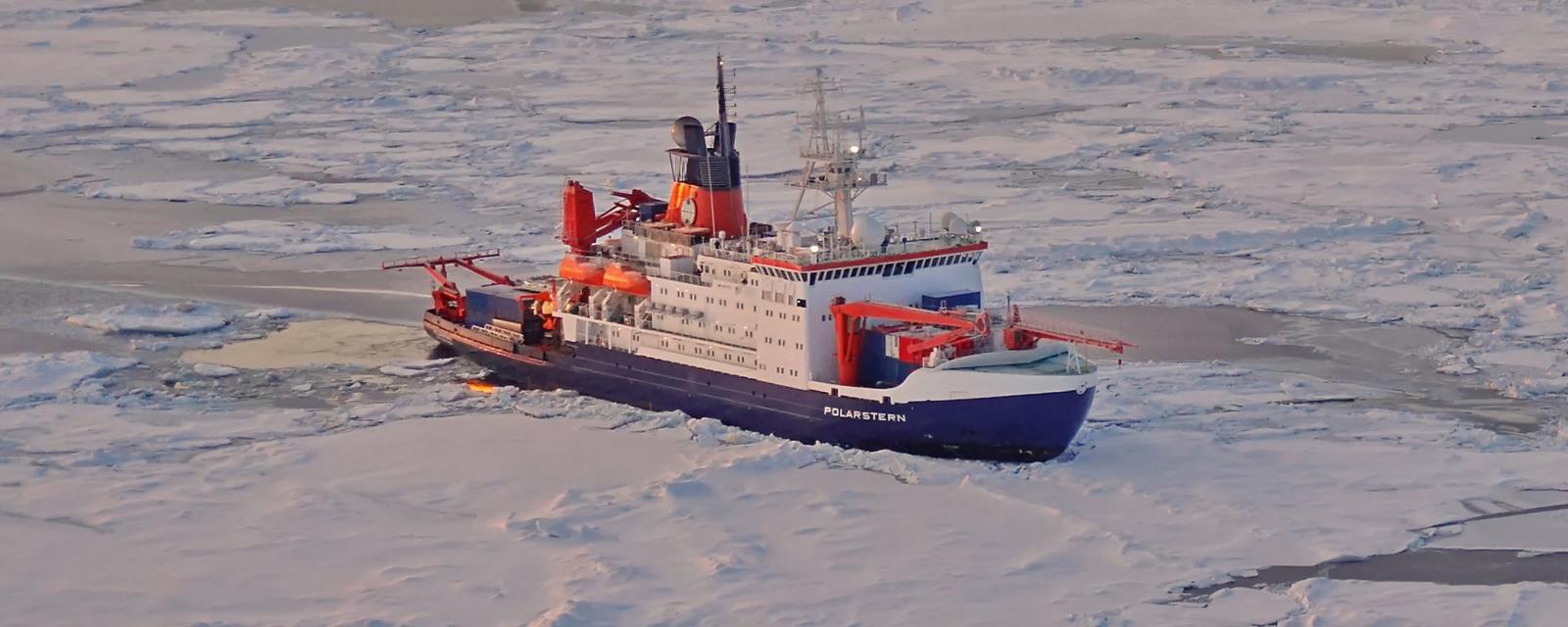
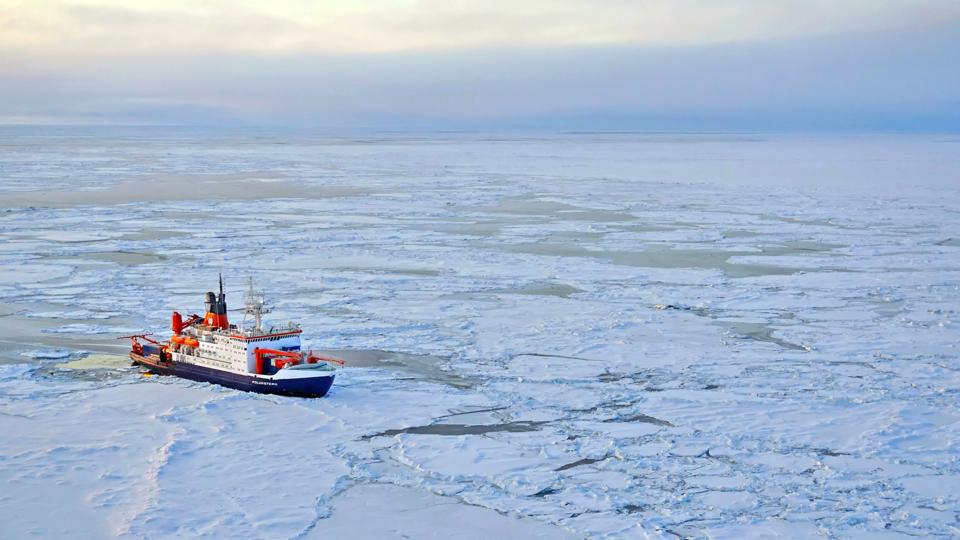
The ship I’m on – the German icebreaker Polarstern – is making its way north to the edge of the Arctic sea ice to find a floe to moor itself too. There, more than a hundred scientists will set up a floating city on the ice. The expedition, known as Mosaic, seeks to build the first detailed profile of the Arctic environment year-round by spending a year trapped in the sea ice. (Read more about the Mosaic mission to the Arctic.)
The first obstacle standing in their path, however, is the ice itself. Not thick, impassable ice that leaves the Arctic Sea impenetrable at the height of winter, but rather the lack of it. They need a substantial floe strong enough to support the research base they are hoping to build.
But the ice is getting less extensive each year, and it is also getting thinner. The strong ice necessary to support large infrastructure – not least a runway and a 30m (98ft) tall meteorology tower to be used by Mosaic – is growing scarce. Climate change has lent an urgency to the mission.
Mooring the ship to an ice floe that is too thin is risky as it could easily break up in storms or the ocean currents (Credit: Sebastian Grote/AWI)
“This may be one of the last years we can do this kind of expedition,” says Matt Shupe of the University of Colorado, who first began planning the mission 10 years ago and now leads its atmospheric research programme. He is one of hundreds of scientists taking part in the expedition in the hope of unravelling exactly what impact global warming is having in the Arctic, and what the consequences will be for the wider world as the environment around the North Pole changes. I am one of the few journalists to be invited to witness the work they are doing.
It is our fifth day at sea when we first meet ice, high within the Arctic Circle at a latitude of around 81 degrees north. Ahead of the ship is the first stretch of dense ice that Polarstern must navigate. This tendril of frozen ocean extends down from the ice cap, brushing past a trio of remote Siberian islands. We skirt past the islands, aiming for a narrow band of less densely packed ice that should give us easier passage. From there, we head a little further east before the Polarstern turns north to crush its way into the densest, central ice.
“When we first came to the North Pole with Polarstern, we needed another icebreaker to assist us through the ice,” says expedition leader Markus Rex of the Alfred Wegener Institute. “Last time, the ship just cut through the ice easily alone.”
Sometimes this elastic-looking ice becomes milky and whitish, flexing with the shape of the wavelets
After hearing the impact of the first isolated lumps of ice bashing into the hull, I start listening out for our first full-on icebreaking. I become aware of tiny sounds and vibrations in the ship, going to the window to check each time. “When you hear it, you’ll know it,” says my cabinmate, Nicole Hildebrandt, a zooplankton researcher at AWI.
Out on the deck, the chunks of ice become gradually more frequent and larger, their irregular shapes below the waterline sometimes bright turquoise. Others are brown, coated underneath rotten ice rich in diatoms, algae and occasionally sediment. In the open water between these stretches of ice, the waves have died down from four metres high (13ft) to almost nothing, giving the ocean a glassy surface.
In the open stretches, I start to notice strange structures just below the surface. They look like jellyfish – translucent and almost invisible – suspended just below the surface of the water. This is the seawater starting to freeze. It stretches out in broad fronds in the direction of the wind. Sometimes this elastic-looking ice becomes milky and whitish, flexing with the shape of the wavelets.
On the bridge of the Polarstern, volunteers take turns looking out for the changing ice conditions while the crew search for the right floe to moor to (Credit: Esther Horvath/AWI)
As we travel further in, Stefan Hendricks, one of the expedition’s ice team, asks for volunteers for the ice watch, to log observations of the amount and types of ice we pass through. I sign up for a daily slot. On the bridge, Hendricks tells me the names for the different kinds of ice that I have been noticing. They have poetic names: frazil, shuga and nilas ice. Then there is pancake, grease and cake ice.
As sea water freezes, it first forms crystal discs known as frazil, eventually forms a suspension in the water known as grease ice, which creates an iridescent sheen like an oil slick. Waves and wind can compress the ice crystals together to form pancake ice that floats on the ocean surface. As these pancakes grow bigger they become cakes. On calmer seas, the frazils grow to form a continuous expanse of dark, glassy layer of ice, like a windowpane on top of a black sea. Shuga ice is slushy mess created by spongey white lumps that bob in the water.
We travel past most of these different types, but looking out from the bridge windows across this forming ice-scape, I scan fruitlessly for elusive frost flowers that Hendricks tells me can occasionally be spotted.
We feel the ship fall heavily back to level and then tilt briefly to the other side, accompanied by the sound of large pieces of ice booming into the hull below
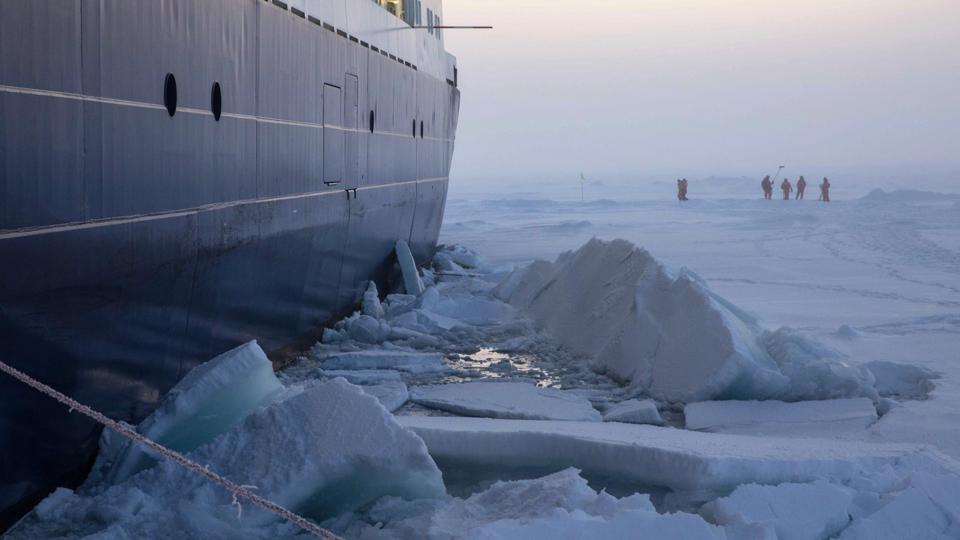
When we eventually encounter thicker ice on the fifth day, the sensation of the ship breaking through is indeed unmistakeable. From the centre of the ship in the Red Saloon, the faint sound of scraping along the hull grows a little louder and the ship begins to judder. Then the ship hits a large section of ice and pitches sideways, sending my coffee climbing diagonally up one side of the glass mug it is in.
Those of us in the saloon lean over to keep our balance. After what could be 10 seconds or so, we feel the ship fall heavily back to level and then tilt briefly to the other side, accompanied by the sound of large pieces of ice booming into the hull below. We encounter these very large pieces of ice a few times an hour, usually catching us off-guard, amid the more constant gnawing, shaking and bumping through the thinner ice.
The Polarstern needs to find a stable ice floe on which to set up its research base before the long winter darkness sets in (Credit: Markus Rex/AWI)
Researchers at Russia’s Arctic and Antarctic Research Institute have been tracking likely ice floes for Mosaic in the Central Arctic Ocean all through the summer. They have been using data from several satellites, hoping to find those which have survived the storms and melting. Before departure in Tromsø, on the Norwegian coast, Rex showed me images of the target region he had in mind. It was a region at around 85 degrees north and 135 degrees east.
“There we will find our sweet spot,” he says, pushing his glasses up to his forehead and looking at an app on his phone. The screen shows black and white specks – how the ice shows up in the images. He points out a darker oval in the image – the darker the ice appears, the thinking goes, the thicker and more robust the ice should be. The ice in the target region is looking like it will be 80cm thick, according to the data available. “We’d prefer one metre, one metre 20 (3 to 4ft) – but 80cm can work,” says Rex.
There is a week or so budgeted to find the right floe. Once safely moored, the ice will freeze around Polarstern, trapping the vessel and its crew in place so they will drift with the floe on an unpredictable path across the polar region, creeping on average from east to west through the year. But, choose a bad floe, or even a good floe in the wrong place, and the camp is at risk of collapse. “It’s the only real decision, the only degree of freedom we have,” says Rex.
What happened to N-ice would be really, really bad. We need to avoid that – Markus Rex
In the Blue Saloon, a formal room named for the colour of its carpet and chairs, the leaders of the expedition meet to discuss the preliminary results of their search. They sit at a large round table, books on Soviet Arctic research and polar wildlife on glass-fronted shelves behind them. Rex reopens his laptop and pulls up a map of the Central Arctic.
“This is the statistics of how the drift will happen based on the selection of our starting point,” he says, pointing to a spaghetti diagram of multicoloured lines across the map. Each line represents the drift trajectory of ice at a given starting point for the past 12 years, based on tracking features in the ice from day to day. Rex fiddles with the settings on the app and the team around the table lean in to see, setting a starting point of 120 degrees east and 85 degrees north.
“A large fraction ends up in the N-ice area,” he says, with a glance around the table. “And you know what happened to N-ice.”
N-ice was a smaller scale Norwegian Arctic drift expedition in 2015, whose floes kept breaking up as they drifted into the warm Atlantic swell. It meant that the group had to disband their camp and relocate several times. “What happened to N-ice would be really, really bad. We need to avoid that. We can’t allow drift trajectory that goes into that area,” says Rex. “We can’t completely rule it out, and we might end up in an N-ice-like situation but we don’t want that.”
Large cracks can appear in the sea ice within a few hours and then can disappear again almost as quickly in the fast changing Arctic environment (Credit: Sebastian Grote/AWI)
Rex tweaks the parameters again, to a starting point around 135 degrees east, 85 degrees north. “This is more the type of drift we want,” he says. Many of the colourful squiggles work their way up over the North Pole and down towards the western side of the Fram Strait. But some of the lines are curtailed, ending their year’s drift still stuck at the North Pole. “There is a large uncertainty still, as we see,” says Rex. “One of these trajectories gets into a danger zone off the coast of Greenland.”
The team flick through different scenarios. Some starting points end up in dangerous areas, while others meander out of the High Seas and into the Russian Exclusive Economic Zone, where the team does not have permission to do research.
But ensuring the ship doesn’t drift into a problematic area is only one of the factors that will determine the success of the expedition. Another is the resupply missions for the ship, which will also be used to exchange crew and scientists on board. None of the team is staying for a full year, with most only there for one leg of the expedition. If Polarstern drifts too far into thick winter ice, or out of range of the supply aircraft – two research planes and Russian long-range helicopters among them – then the scientists risk being cut off.
With all these requirements in mind, a spot at 135 east and 85 north soon appears to be the only region that stands a likely chance of meeting the mission’s requirements. “It’s not guaranteed,” says Rex. “Nothing is guaranteed on this expedition.”
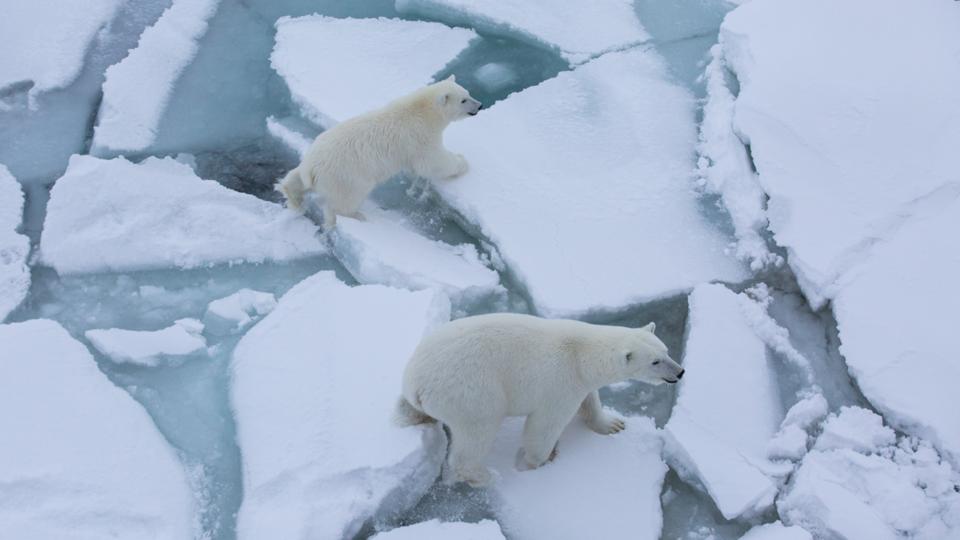
The thin ice that has posed problems for the expedition could also be a growing issue for the polar bears that live in the Arctic (Credit: Esther Horvath/AWI)
Greta Thunberg, a 16-year-old from Sweden, has become the face of climate-change activism.
Thunberg launched the Fridays For Future movement — or School Strike for Climate — last year. It encourages students to skip school to demand action on climate change from their governments.
The teenager was nominated for the 2019 Nobel Peace Prize, but the award went to Ethiopian Prime Minister Abiy Ahmed, who brokered his nation’s peace with the neighboring Eritrea.
While Thunberg has remained silent about the snub so far, the Nobel Committee’s selection has sparked an outcry on social media.
One peace expert told The Washington Post that Thunberg was passed over because there “isn’t scientific consensus that there’s a relationship between climate change — or resource scarcity, more broadly — and armed conflict.”
On Friday, Ethiopian Prime Minister Abiy Ahmed was awarded the Nobel Peace Prize.
The Swedish climate activist Greta Thunberg had been a favorite for the prestigious award. Had she won, Thunberg would have become the youngest person ever to win a Nobel Peace Prize. Instead, the Pakistani activist Malala Yousafzai remains the youngest-ever Nobel laureate, having won the award in 2014 when she was 17 years old.
Thunberg launched the Fridays For Future movement — or School Strike for Climate — last year. It encourages students to skip school to demand action on climate change from their governments. The movement earned her a nomination for this year’s peace prize in March.
Instead of the teenager, however, the Nobel Committee said it selected Ahmed for his “efforts to achieve peace and international cooperation and for his decisive initiative to resolve the border conflict with neighbouring Eritrea.”
The prime minister worked out the principles for a peace agreement to end the long stalemate between the two countries, the committee added.
Other frontrunners included New Zealand Prime Minister Jacinda Ardern for her decisive response to the Christchurch mass shootings in March and the Brazilian indigenous chief Raoni Metuktire for his efforts to protect the Amazon.
Thunberg’s fans are not happy
Thunberg, who is fairly communicative on Twitter and Instagram, has been unusually silent since the announcement. (Granted, that might have something to do with the fact that she’s in Denver preparing for this week’s Fridays For Future climate strike.)
Thunberg entered the global spotlight over the past year as the leader of a youth movement that’s pushing governments and corporations to address the climate crisis. She launched Fridays For Future when she was in ninth grade by staging a strike for two weeks outside the Swedish parliament. Now Thunberg spends every Friday on strike.
In March, more than 1 million young people in 123 countries skipped school and took to the streets to support Thunberg’s cause. Six months later, on September 20, she was joined by an estimated 4 million people in 161 countries during the largest climate-change demonstration in history.
Some of the teenager’s most vocal critics, including the conservative host Piers Morgan of “Good Morning Britain,” jumped in to fill Thunberg’s silence with remarks of their own about the Nobel Committee’s decision.
“How DARE they actually give it to someone who forged peace?!!!!” he tweeted.
Morgan was poking fun at Thunberg’s iconic speech at the United Nations General Assembly last month, in which she chastised world leaders who she said were looking to her for hope regarding climate change. “How dare you,” Thunburg thundered. “You have stolen my dreams and my childhood with your empty words.”
But many of Thunberg’s fans also took to social media to express their disappointment about the committee’s decision.
Since Thunberg was nominated for the Nobel prize in March, her followers and fan base have continued to grow. Some of those supporters, while disappointed by her snub, were quick to mention the teenager’s impact on the climate debate.
Anirudh Narayanan@UhKneeRude
Even though @GretaThunberg didn’t win the peace prize this time round, the awareness and sense of responsibility she has inspired around the world is an award far greater! #Thankyougreta the fight has only just begun though! Let’s take the powers to school about #ClimateChange
Norwegian Socialist MP Freddy André Øvstegård, who was among those who nominated Thunberg for the award, told The Guardian that she “has launched a mass movement which I see as a major contribution to peace.”
“We have proposed Greta Thunberg because if we do nothing to halt climate change, it will be the cause of wars, conflict, and refugees,” he said.
One peace expert told The Washington Post, however, that it was not entirely a surprise the Nobel Committee passed over Thunberg in favor of Ahmed, despite the teenager’s overwhelming popularity.
The head of the Peace Research Institute Oslo, Henrik Urdal, told The Post that he left Thunberg off the Nobel Peace Prize shortlist he suggested to the prize committee because there “isn’t scientific consensus that there is a linear relationship between climate change — or resource scarcity, more broadly — and armed conflict.”
Thunberg at the United Nations. Reuters
But that doesn’t mean climate change isn’t linked to peace. The US Pentagon classifies climate change as a “threat multiplier,” meaning it can worsen other sources of instability and conflict. Heat waves, hurricanes, and other climate-change-related consequences like sea-level rise can exacerbate competition for natural resources and ethnic tensions.
Thunberg’s possible prize would not have been the first awarded for work that increases climate-change awareness — 12 years ago, former US Vice President Al Gore and the United Nations’ Intergovernmental Panel on Climate Change took home the honors.
But Urdal added that such a pick was less likely today because the Nobel Committee had been sticking far more closely to the vision of Alfred Nobel, the Swedish businessman who founded the awards.
According to Nobel, the Nobel laureate needed to be a figure who had advanced the “abolition or reduction of standing armies.”
Unfortunately for Thunberg and her supporters, her climate activism apparently didn’t fit that bill.
Google helps bankroll more than a dozen organisations that have pushed against moves to stop climate change. Illustration: Guardian Design
Google has made “substantial” contributions to some of the most notorious climate deniers in Washington despite its insistence that it supports political action on the climate crisis.
Among hundreds of groups the company has listed on its website as beneficiaries of its political giving are more than a dozen organisations that have campaigned against climate legislation, questioned the need for action, or actively sought to roll back Obama-era environmental protections.
The list includes the Competitive Enterprise Institute (CEI), a conservative policy group that was instrumental in convincing the Trump administration to abandon the Paris agreement and has criticised the White House for not dismantling more environmental rules.
Google said it was disappointed by the US decision to abandon the global climate deal, but has continued to support CEI.
Google is also listed as a sponsor for an upcoming annual meeting of the State Policy Network (SPN), an umbrella organisation that supports conservative groups including the Heartland Institute, a radical anti-science group that has chided the teenage activist Greta Thunberg for “climate delusion hysterics”.
SPN members recently created a “climate pledge” website that falsely states “our natural environment is getting better” and “there is no climate crisis”.
Google has defended its contributions, saying that its “collaboration” with organisations such as CEI “does not mean we endorse the organisations’ entire agenda”.
It donates to such groups, people close to the company say, to try to influence conservative lawmakers, and – most importantly – to help finance the deregulatory agenda the groups espouse.
A spokesperson for Google said it sponsored organisations from across the political spectrum that advocate for “strong technology policies”.
“We’re hardly alone among companies that contribute to organisations while strongly disagreeing with them on climate policy,” the spokesperson said. Amazon has, like Google, also sponsored a CEI gala, according to a programme for the event reported in the New York Times.
CEI has opposed regulation of the internet and enforcement of antitrust rules, and has defended Google against some Republicans’ claims that the search engine has an anti-conservative bias.
But environmental activists and other critics say that, for a company that purports to support global action on climate change, such tradeoffs are not acceptable.
“You don’t get a pass on it. It ought to be disqualifying to support what is primarily a phoney climate denying front group. It ought to be unacceptable given how wicked they have been,” said Sheldon Whitehouse, a Democratic senator from Rhode Island who is one of the most vocal proponents of climate action in Congress.
“What all of corporate America should be doing is saying if you are a trade organisation or lobby group and you are interfering on climate, we are out. Period,” he added.
On its website, Google says it is committed to ensuring its political engagement is “open, transparent and clear to our users, shareholders, and the public”.
But the company declined to answer the Guardian’s questions on how much it has given to the organisations.
On a webpage devoted to “transparency”, it describes the groups – among hundreds of others, including some progressive advocates such as the Center for American Progress – as having received “substantial” contributions.
Apart from CEI, they include the American Conservative Union, whose chairman, Matt Schlapp, worked for a decade for Koch Industries and shaped the company’s radical anti-environment policies in Washington; the American Enterprise Institute, which has railed against climate “alarmists”; and Americans for Tax Reform, which has criticised companies who support climate action for seeking out “corporate welfare”.
It has also donated undisclosed sums to the Cato Institute, which has voiced opposition to climate legislation and questioned the severity of the crisis. Google has also made donations to the Mercatus Center, a Koch-funded thinktank, and the Heritage Foundation and Heritage Action, a pressure group that said the Paris agreement was supported by “cosmopolitan elites” and part of Barack Obama’s “destructive legacy”.
Bill McKibben, a prominent environmentalist who has been on the frontline of the climate crisis for decades, said Google and other companies were engaged in a “functional greenwashing” given the contradiction in their public pronouncements and private donations. He said Google and other technology companies had also not used their own lobbyists to advocate for change on climate.
“Sometimes I’ll talk to companies and they will be going on and on about their renewable server farm or natural gas delivery, and I say thank you, but what we really need is for your lobbying shop in Washington to put serious muscle behind it. And they never do,” McKibben said. “They want some tax break or some regulations switch and they never devote the slightest muscle behind the most important issue of our time or any time.”
A spokesperson for Google said: “We’ve been extremely clear that Google’s sponsorship doesn’t mean that we endorse that organisation’s entire agenda – we may disagree strongly on some issues.
“Our position on climate change is similarly clear. Since 2007, we have operated as a carbon neutral company and for the second year in a row, we reached 100% renewable energy for our global operations.”
The company said it called for “strong action” at the climate conference in Paris in 2015 and helped to sponsor the Global Climate Action summit in San Francisco last year.
But that position is at odds with the support it gives to CEI.
The group’s director of energy and environment policy, Myron Ebell, helped found the Cooler Heads Coalition 20 years ago, a group of libertarian and rightwing organisations that have sowed the seeds of climate denial with funding from the fossil fuel industry.
When Donald Trump was elected to the White House in 2016, Ebell joined the transition team and advised the new president on environmental issues, successfully lobbying Trump to adhere to a campaign promise and abandon the Paris agreement.
Kert Davies, the founder of the Climate Investigations Center, a research group that examines corporate campaigning, said Ebell had led the anti-climate-action crusade for decades.
“They’re extremists,” he said, referring to the Cooler Heads Coalition. “They are never finished,” he said. “Myron has taken a lot of credit for Trump’s actions and is quite proud of his access.”
Recently, however, Ebell – who declined a request for an interview – has criticised the White House for not rolling back environmental protections aggressively enough, even though the Trump administration has gutted every major environmental act established under Obama.
His wishlist now includes reversing a 2009 finding by the Environmental Protection Agency that CO2 and other greenhouse gases endanger the health and welfare of Americans.
CEI said it “respects the privacy of its donors” and declined to answer questions about Google. A CEI spokesperson told the Guardian: “On energy policy, CEI advances the humanitarian view that abundant and affordable energy makes people safer and economies more resilient. Making energy accessible, especially for the most vulnerable, is a core value.”
One source who is familiar with Google’s decision-making defended the company’s funding of CEI.
“When it comes to regulation of technology, Google has to find friends wherever they can and I think it is wise that the company does not apply litmus tests to who they support,” the source said.
Only within the past decade have researchers warmed to the possibility of abrupt shifts in Earth’s climate. Sometimes, it takes a while to see what one is not prepared to look for.
Spencer Weart directs the Center for History of Physics at the American Institute of Physics.
How fast can our planet’s climate change? Too slowly for humans to notice, according to the firm belief of most scientists through much of the 20th century. Any shift of weather patterns, even the Dust Bowl droughts that devastated the Great Plains in the 1930s, was seen as a temporary local excursion. To be sure, the entire world climate could change radically: The ice ages proved that. But common sense held that such transformations could only creep in over tens of thousands of years.
In the 1950s, a few scientists found evidence that some of the great climate shifts in the past had taken only a few thousand years. During the 1960s and 1970s, other lines of research made it plausible that the global climate could shift radically within a few hundred years.
In the 1980s and 1990s, further studies reduced the scale to the span of a single century. Today, there is evidence that severe change can take less than a decade. A committee of the National Academy of Sciences (NAS) has called this reorientation in the thinking of scientists a veritable “paradigm shift.” The new paradigm of abrupt global climate change, the committee reported in 2002, “has been well established by research over the last decade, but this new thinking is little known and scarcely appreciated in the wider community of natural and social scientists and policymakers.” 1
Much earlier in the 20th century, some specialists had evidence of abrupt climate change in front of their eyes. The evidence was meaningless to them. To appreciate change occurring within 10 years as significant, scientists first had to accept the possibility of change within 100 years. That, in turn, had to wait until they accepted the 1000-year time scale. The history of this evolution gives a good example of the stepwise fashion in which science commonly proceeds, contrary to the familiar heroic myths of discoveries springing forth in an instant. The history also suggests why, as the NAS committee worried, most people still fail to realize just how badly the world’s climate might misbehave.
“Limiting global warming to 1.5°C would require rapid, far-reaching and unprecedented changes in all aspects of society.” First sentence of IPPC Special Report on 1.5C Summary for Policy Makers.
Michael Mann: “A new normal makes it sound like we have arrived in a new position, and that’s where we’re going to be. But if we continue to burn fossil fuels … we are going to … get worse and worse droughts, and heat waves, and super storms, and floods, and wildfires.”
Kate Marvel: “The whole idea that everything’s going to work out isn’t really helpful because it isn’t going to work out ” said Kate Marvel a climate scientist at the NASA Goddard Institute for Space Studies. Climate change is going to worsen to a point where millions of lives, homes, and species are put at risk she said.
A woman who disrupted a town hall set up by New York Rep. Alexandria Ocasio-Cortez on Thursday night turns out to be a part of a far-right conservative group known for these kinds of tactics. Rep. Ocasio-Cortez held a town hall meeting in Corona, New York. During the town hall a young woman stood up and began speaking anxiously about climate change, becoming more and more agitated, as she nihilistically rambled about how “we got to start eating babies.” She took off her jacket to reveal a T-shirt emblazoned with the phrase “Save the planet. Eat the children.” Video of this interaction was sent around the internets and conservatives everywhere pointed to it as proof that Rep. Ocasio-Cortez and her supporters were unstable, unrealistic, and to use our current president’s description, “wack job(s).”
One of Ocasio-Cortez’s constituents loses her mind over climate change during AOC’s townhall, claims we only have a few months left: “We got to start eating babies! We don’t have enough time! … We have to get rid of the babies! … We need to eat the babies!”
Rep. Ocasio-Cortez had initially tried to plead for compassion for the woman, like any decent human being might when confronted with someone who seems to be very obviously in crisis both mentally and emotionally.
Alexandria Ocasio-Cortez
✔@AOC
·
Hey everyone!
We had a fabulous town hall tonight & I’ll be highlighting some moments from it.
At one point I was concerned there was a woman in crisis & want to ensure we treat the situation compassionately.
Let’s not mock or make a spectacle. &let’s work on Medicare for All!
Alexandria Ocasio-Cortez
✔@AOC
This person may have been suffering from a mental condition and it’s not okay that the right-wing is mocking her and potentially make her condition or crisis worse. Be a decent human being and knock it off.
Now, the Washington Post reports that a Twitter account handled by the “LaRouche PAC—which was founded by conspiracy theorist Lyndon H. LaRouche Jr.” took credit for the woman’s actions. You see, according to the Post, LaRouche Jr.’s death didn’t bring an end to his fringe conspiracy theories or the small but intense cult around him. When LaRouche died in February of this year, one description of LaRouche’s acolytes under him, sticks out.
Mr. LaRouche was said to exert strong control over the personal lives of his disciples. In interviews over the years, many former members likened him to a cult leader who was obsessed with their sexual desires and challenged their mental toughness.
It’s interesting that the far right, with Trump and Republicans in tow, seem to always be guilty of the exact charges they dish out: conspiratorial, nihilism, corruption, lawlessness, and an unwillingness to be held accountable for their actions that may ultimately destroy our country’s democracy.
QUEENS, New York — A seemingly troubled woman at a town hall hosted by Democratic New York Rep. Alexandria Ocasio-Cortez in her district stood up to demand the congresswoman support drastic measures to combat climate change, such as “eating babies.”
“We’re not going to be here for much longer, because of the climate crisis,” the woman pleaded. “We only have a few months left. I love that you support the Green Deal, but it’s not gonna get rid of fossil fuel. It’s not going to solve the problem fast enough. A Swedish professor said we can eat dead people, but it’s not fast enough! So, I think your next campaign slogan needs to be this: We’ve got to start eating babies.”
Many of Ocasio-Cortez’s constituents appeared confused by the woman’s declarations.
Removing her jacket to reveal a T-shirt with the phrase “Save the planet Eat the Children,” the woman continued, “We don’t have a enough time. There’s too much Co2.”
“All of you!” she went on, turning to those around her, “You’re a pollutant! Too much Co2. We have to start now. Please — you are so great. I’m so happy that you are supporting a Green New Deal, but it’s not enough. Even if we were to bomb Russia, it’s not enough. There’s too many people, too much pollution. So, we have to get rid of the babies. That’s a big problem. Just stopping having babies just isn’t enough. We need to eat the babies. This is very serious. Please give a response.”
Staffers of the New York congresswoman approached the woman toward the end of her remarks, as attendees in the room became increasingly uncomfortable.
Vegan climate activist Greta Thunberg recently paid a visit to Esther the Wonder Pig, a famous pig that helped her dads Steve Jenkins and Derek Walter go vegan. Thunberg came to the United States via sailboat from her native Sweden last month to speak at the Climate Action Summit in New York City and support Fridays For Future, a movement she founded to demand action on the global climate crisis. Thunberg continued her North American tour by driving an electric car, lent to her by actor Arnold Schwarzenegger, to Canada to attend the climate strike in Montreal last Friday. While in Canada, Thunberg shared a cupcake with Esther at her Southern Ontario home, a moment commemorated by a photo of the two changemakers.
“We were gonna change the world together, but she took my last cupcake so the future of our alliance is uncertain,” Esther’s Facebook page captioned the photo. Thunberg has received backlash from conservatives that do not share her views on the climate crisis and Esther’s page was not safe from commenters looking to disparage the teenager. “This is a picture of a sixteen year old girl that is under more pressure than any of us can likely even fathom, enjoying a quiet day with a pig she loves, with cupcakes and a smile on their faces,” Esther’s Facebook page responded to one such commenter. “No matter what you think of our view on animals or Greta’s view on the climate, if you can’t see the joy in their faces and appreciate the fact that she came here to relax and smile (the same reason you all do) then I’m sorry we have failed you in our mission to promote kindness for all kinds.”
Want more of today’s best plant-based news, recipes, and lifestyle?
Get our award-winning magazine!
‘I’m hoping it’s not too little too late,’ says Mamalilikulla First Nation chief councillor
CBC News ·
The Mamalilikulla First Nation delivered salmon to grizzly bears in their traditional territories where they are known to feed. (File pictures/Canadian Press)
When Richard Sumner saw how emaciated the grizzly bears were in his neck of the woods, he knew something had to be done.
Sumner, chief councillor of the Mamalilikulla First Nation, says the creeks and streams on the nation’s territory, which encompass the islands off the northeast coast of Vancouver Island between Alert Bay and Knight Inlet, are no longer rich with salmon, and resident bears are starving and travelling outside traditional hunting grounds in a desperate effort to find food.
So the Mamalilikulla people fed them.
The nation’s Guardian Watchmen Manager, Jake Smith, had a local hatchery donate approximately 500 salmon carcasses and members of the nation took the fish to estuary areas where grizzlies are known to feed.
“I’m hoping it’s not too little too late,” said Sumner in a phone interview on CBC’s On The Island, adding there are many other areas of British Columbia where bears that depend on salmon are hungry.
He said grizzlies are starting to travel between all the small islands in the area and are even making their way over to Vancouver Island in search of fish, something that rarely happened in the past.
“The lack of salmon is not a natural thing,” said Sumner, who blamed human activity such as deforestation and over-fishing for reducing salmon stocks to perilous levels.
Sumner said while he understands humans should not interfere with wild animals, the Mamalilikulla people are the stewards of their territory and according to Sumner, the alternative was to watch the bears die.
“We just hope we can get enough bulk on them to last the winter,” said Sumner.
Some of the 400 members of the Mamalilikulla nation are suffering too.
“Nobody has any fish in their freezer or any canned fish for the winter,” he said. “It’s been a real disastrous year.”
Sumner does not know if more fish will be available for future deliveries.
Sumner said he is meeting Thursday with a bear biologist and provincial authorities to discuss the issue further.
To hear the complete interview with Richard Sumner, see the audio link below:
A FOOTBALL coach in Italy has been sacked for a vile rant calling 16-year-old climate change activist Greta Thunberg a “w***e” who is old enough to “take a pounding”.
Tommaso Casalini was given the axe from his role at Serie D side US Grosseto 1912 for his sick attack after Thunberg delivered a passionate speech at the UN.
2
Tommaso Casalini was sacked as coach of the Italian Serie D side
But Casalini was far from impressed and used a Facebook post to slam her intervention.
He wrote: “This w***e! A 16-year-old can take a pounding, she’s at the right age.”
US Grosseto 1912 play in the country’s fourth tier and local media report the club sacked the manager shortly after the post was made.
The club wrote: “Unione Sportiva Grosseto 1912 communicates the dismissal of the assistant trainer, the very young Tommaso Casalini for behaviour that does not keep in line with the one laid out by the company that values morals over management skills.”
After his dismissal from the club, Casalini made a second post apologising and assuring he regretted the entire incident.
Casalini wrote: “I would like to publicly apologize to everyone, starting with Greta Thunberg, for the post I wrote on Facebook last week, containing the phrase: ‘This w***e! A 16-year-old can take a pounding, she’s at the right age.’
“It was a post written in a moment of anger against the young Swedish activist, with absolutely the wrong language and with content that I regret. I have never thought or could never really think about those things, especially with regards to a minor.
“However, when one makes a mistake, it is right that one takes responsibility for that mistake, so I willingly accept the decision of U.S. Grosseto to remove me from my role as assistant coach of the Giovanissimi A, and I apologise to the club for the obvious embarrassment provoked by my gesture.”
2
Tommaso Casalini responded to Greta Thunberg’s speech at the UN climate summitCredit: Reuters

















 Exposing the Big Game