Rising heat weakens jet stream, frees Arctic cold to fly south


Thanks to an economy long dependent on fossil fuels, the atmophere has become an increasingly effective heat trap. Overnight temperatures are still cooler than daytime temps, but they’re rising faster than daytime temps are, so the difference between night and day is shrinking.

It’s the same story for the Arctic and points south. The Arctic is still cooler than points south, but it’s warming faster, so the difference between up there and down here is shrinking. This is making a difference to the Northern Hemisphere’s jet stream, weakening it, which, in turn, is setting cold Arctic air masses free to fly south.
The polar vortex is the name of cold Arctic air normally swirling around the North Pole. With a weakened and more widely meandering jet, we get what you see here
Polar-Vortex-529px.png

=================================================

The poorest half of the world population is responsible for only around 10% of total global emissions attributed to individual consumption.”

<<https://www.oxfam.org/sites/www.oxfam.org/files/file_attachments/mb-extreme-carbon-inequality-021215-en.pdf

The Midwest is colder than Antarctica, Alaska, and Siberia right now

North American cities will be some of the coldest places in the world this week

Photo by Mario Tama / Getty Images

Saying that the upper half of North America is cold right now would be like saying that the Sun is hot. A polar vortex has caused extremely cold winds to sweep across the country, promising record-low temperatures, with highs still well below freezing.

How cold is that? Not that many places are likely to beat the coldest inhabited place on Earth, Oymyakon in Russia, which is expected to see lows in the negative 40s Fahrenheit this week. But plenty of Midwestern cities are going to be chillier than areas in the Arctic, Antarctic, and even other planets. Here is a list of places that will be warmer than the Midwest over the next couple of days.

ALASKA

While the Midwest shivers, Alaska has actually canceled its Willow 300 Sled Dog Racebecause it’s too warm. (The 300 Sled Race is a qualifier for the famous Iditarod.) Warm — which here means “above-freezing” — temperatures have led to pockets of open water on the trail, which would make the race dangerous. Similarly, the Yukon Quest race has been shortened because there’s just not enough snow.

SIBERIA

The low in Siberia is about 4 degrees Fahrenheit today. Milwaukee? Negative 20. Major bragging rights, but at what cost?

MOUNT EVEREST BASE CAMP

Early on Wednesday, Indianapolis was already negative 10 degrees Fahrenheit, according to the Indianapolis Star. In contrast, Everest’s base camp (which, to be clear, is not the peak of Everest) was a positively balmy negative 2 degrees.

ANTARCTICA

By Thursday morning, Chicago is likely to reach its coldest-ever temperature of negative 27 degrees Fahrenheit, with a high of negative 15 degrees Fahrenheit, according to CNN. In comparison, Antarctica’s Priestley Glacier, which is part of the continent’s Deep Freeze Range, will have a low of negative 7 degrees and a high of 6 degrees.

MARS

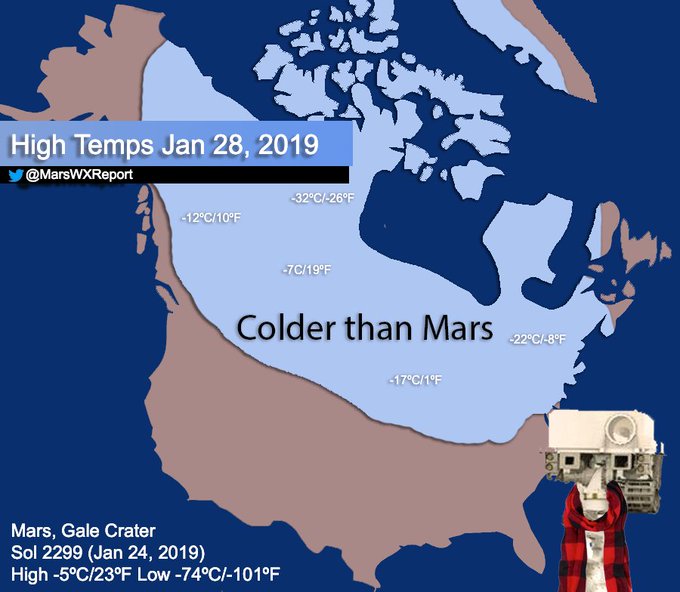
Mars Weather@MarsWxReport

High temps today across Canada and the upper midwest of the US didn’t reach Mars last reported high.

1,796 people are talking about this

To be fair, the Mars reading that Chicago and Madison are currently beating is a daily high, and it was recorded by one instrument on the Curiosity rover. Other places on Mars are probably colder. In fact, the last recorded low on Mars was negative 99.4 degrees Fahrenheit — way colder than the Midwest, but still pretty impressive.

The dramatic temperatures we’re seeing this week are not an indication that global warming has slowed. A study last year found that extreme winter weather events like these are linked to a warming Arctic. That means that even as average temperatures rise, people living in those areas need to adjust to sudden cold snaps.

The situation is so dire that experts who have worked in the Arctic and Antarctic are giving advice to Midwesterners on how to stay warm. Stay dry and combine layers of wool and silk, Akiko Shinya, an Antarctic researcher and the chief fossil preparator at Chicago’s Field Museum tells the Chicago Tribune.

But no matter how cold it is in Chicago, Minnesota, or Wisconsin — even if it’s colder than some places on Mars — we need to keep things in perspective: at least we’re not with the spacecraft New Horizons, which has been plunging farther and farther into the Solar System. It’s somewhere near the Kuiper Belt, which has a temperature hovering not above zero, but above absolute zero, which is the lowest theoretical temperature possible. Take notes, #PolarVortex 2020. Time to start setting goals.

Trump used the polar vortex to mock global warming. This map shows how wrong he is.

Trump tweeted, “What the hell is going on with Global Warming?” Well, it’s still happening.

It’s freaking cold out there, America. But you don’t need a Vox explainer to know that. You knew it the second you woke up. Knew it in that dreadful moment just before peeling off the blankets, when you thought, “This is the warmest and most comfortable I’ll feel all day.”

A mass of polar air is descending over the Midwestern United States. Chicago might hit a low of minus 22 degrees Fahrenheit on Wednesday. It’s a dangerous, potentially deadly situation. “This is not a case of ‘meh, it’s Iowa during winter and this cold happens,’” the Des Moines office of the National Weather Service warned.

This forecast is not, however, evidence against climate change. Let’s say it again: This forecast is not evidence against climate change.

Yet the president of the United States, who has consistently expressed skepticism over climate change, and whose administration has deliberately made backward progress on the issue, could not help himself (complete with “Waming” typo):

Donald J. Trump

@realDonaldTrump

In the beautiful Midwest, windchill temperatures are reaching minus 60 degrees, the coldest ever recorded. In coming days, expected to get even colder. People can’t last outside even for minutes. What the hell is going on with Global Waming? Please come back fast, we need you!

120K people are talking about this

(If this feels familiar, it’s because President Trump often tweets out this sentiment — I could keep linking — when it’s cold out.)

Yes, it can be weirdly cold in parts of the United States while global temperatures are still warmer than average. Remember, weather and climate are two different things. Weather is what we’re experiencing in the moment; climate is the broader trends that make certain weather experiences more or less likely.

Here’s one simple recent map from University of Maine’s Climate Change Institute that proves Trump wrong.

University of Maine Climate Change Institute

It shows daily temperature anomaly — or how different global temperatures were compared to a baseline from 1979 to 2000 — around the whole world. Overall, the world on January 29 was 0.3°C warmer on average, compared to the baseline. That’s true despite the fact parts of North America are 10-plus degrees below average.

And it doesn’t change the fact that 2018 was the fourth-hottest year on record, or that there’s a massive heat wave currently overtaking much of Australia, or that Arctic sea ice continues to disappear at an alarming rate. This year could still end up being the hottest year on record, as forecasters anticipate an El Niño cycle picking up.

Here’s the take-home lesson: You shouldn’t look out your window to determine if you believe climate change is real.

https://www.vox.com/science-and-health/2019/1/29/18202010/polar-vortex-2019-trump-tweet-wrong

Climate Friendly Diets Are Healthier

Eating less red meat and more plant-based protein is better for the climate and for people’s health.

By Alexa Lardieri, Staff WriterJan. 24, 2019, at 6:00 a.m.
A healthy vegan/vegetarian lunch bowl of salads, grains, seeds, vegetables, avocado slices and a rich peanut-miso sauce.

A low-carbon diet consists of less red meat and dairy, and more beans, whole grains and plant-based proteins.(ENRIQUE DÍAZ/7CERO/GETTY IMAGES)

PEOPLE WHO FOLLOW A planet-friendly, diet eat healthier than those who don’t.

Food production is a major contributor to climate change, and a study published Thursday in the American Journal of Clinical Nutrition found that people who adhere to a climate-friendly diet, one that has a lower carbon footprint, eat healthier than those who don’t.

Diego Rose, lead author and a professor of nutrition and food security at Tulane University’s School of Public Health and Tropical Medicine, said in a press release that people who follow a diet that has a low carbon footprint “were eating less red meat and dairy, which contribute to a larger share of greenhouse gas emissions and are high in saturated fat, and consuming more healthful foods like poultry, whole grains and plant-based proteins.”

Researchers examined the diets of 16,000 Americans and ranked them by the amount of greenhouse gas emissions per 1,000 calories consumed. They also rated the nutritional value of the diets using the U.S. Healthy Eating Index.

The study discovered that people following diets that had a low carbon footprint ate an overall healthier diet. However, these diets did contain some low-emission foods that aren’t healthy, such as sugars and refined grains, the press release states. Additionally, the climate-friendly diets also contained lower amounts of important nutrients, such as iron, calcium and vitamin D.

Diets that had the most impact on the planet accounted for five times the emissions of those in the lowest-impact group. The diets consisted of more beef, veal, pork, game, dairy and solid fats per 1,000 calories than the diets with low carbon footprint.

Martin Heller, co-author and researcher with the University of Michigan’s Sustainable Systems Center at the School for Environment and Sustainability, tells U.S. News that adopting a diet with a low carbon footprint is “beneficial for health and the environment” and that it doesn’t take drastic measures to make a difference.

RELATED CONTENT

Scientists Push Vegetarian Diet to Save the…

Heller says that one of the biggest changes people can make is to replace beef with plant-based alternatives, such as beans, peas and lentils, as well as meat alternatives, even choosing chicken over beef “is a significant benefit.”

The reason is that the production of red meat has one of the largest effects on the environment due to the amount of work it takes to produce it. A cow requires a lot more resources than a chicken, or plants, to produce the same amount of calories. Cows require much more feed, and they produce methane, mostly in the form of burps, which is a powerful greenhouse gas.

Rose echoed this sentiment in the press release, saying that Americans can have both “healthier diets and reduce our food-related emissions,” and doing so “doesn’t require the extreme of eliminating food entirely.” Just a small shift from red meat to chicken “could reduce our carbon footprint and improve our health at the same time.”

‘Tipping point’ risk for Arctic hotspot

News.

‘Tipping point’ risk for Arctic hotspot

A rapid shift under way in the Barents Sea could spread to other Arctic regions, scientists attending a conference in Norway have warned. The Barents Sea is said to be at a “tipping point”, BBC News explains, changing from an Arctic climate to an Atlantic climate as the water warms. The Arctic Ocean has a surface layer of freshwater “which acts as a cap” on a layer of warmer, saltier water below. “But now in the Barents Sea there’s not enough freshwater-rich sea ice flowing from the high Arctic to maintain the freshwater cap,” BBC News reports.

BBC News Read Article
Scientists warn climate change could reach a ‘tipping point’ sooner than predicted as global emissions outpace Earth’s ability to soak up carbon

A new study warns that if greenhouse gas emissions continue at current rates, Earth’s vegetation may not be able to keep up. “Once plants and soil hit the maximum carbon uptake they can handle, warming could rapidly accelerate”, MailOnline writes. The study from Columbia University’s School of Engineering and Applied Science investigates how changes in soil moisture affect its capability to act as a “carbon sink”. Currently, “plants and soil around the world absorb roughly a quarter of the greenhouse gases that humans release”, the New York Times explains. But “when the soil is dry, plants are stressed and can’t absorb as much CO2 to perform photosynthesis”. And with warmer conditions microorganisms in the soil become more productive and “release more CO2”. The researchers found that although “plants and soil could absorb more CO2 during the wetter years, it did not make up for their reduced ability to absorb CO2 in the years when soil was dry”. Carbon Brief has also covered the study.

MailOnline Read Article
UK team drills record West Antarctic hole

Scientists have succeeded in cutting a 2km hole through the West Antarctic Ice Sheet to its base using a hot-water drill, BBC News reports. The team then collected sediment from the bottom of the hole and “deployed a series of instruments”. The researchers from the British Antarctic Survey hope that the data collected can help them determine how fast Antarctica might lose its ice in a warming world. Dr Andy Smith, who led the team, commented: “There are gaps in our knowledge of what’s happening in West Antarctica and by studying the area where the ice sits on soft sediment, we can understand better how this region may change in the future and contribute to global sea-level rise.”

BBC News Read Article
US coal retirements in 2019 to hit at least 6GW

2019 will see the retirement of nearly 6GW of coal power in the US, while 49GW of new power generation capacity will be added to the grid, according to the latest figures from S&P Global Market Intelligence, which is highlighted by CleanTechnica. In a related story, E&E News reports that a group of US utilities and other power producers say they may have to shut down their coal-fired power plants if a court rolls back a Trump administration extension to the deadline for closing some coal ash dumps. Their filing to the US Court of Appeals follows a legal challenge brought by environmental groups to the administration’s changes last July to the Obama-era regulations governing coal ash disposal, the article explains.

In other coal news, the Australian Financial Review reports that Jeremy Grantham, the “legendary British hedge fund manager” who founded GMO, has said that thermal coal is “dead meat”. Bloomberg investigates how a “loophole” lets Norway’s $1 trillion sovereign wealth fund boost its coal exposure. Meanwhile, Forbes says that China’s “coal reliance is not falling nearly as fast as some like to claim”. Chinese coal demand “hasn’t been falling in the absolute sense”, the piece argues, continuing: “China approved nearly $6.7bn worth of new coal mining projects in 2018, and production increased 5.2% to 3.55bn tonnes”.

CleanTechnica Read Article

Pentagon Confirms Climate Change Is A National Security Threat, Contradicting Trump

The military walks a fine line between the White House’s official climate denialism and the stark realities of a warming planet.
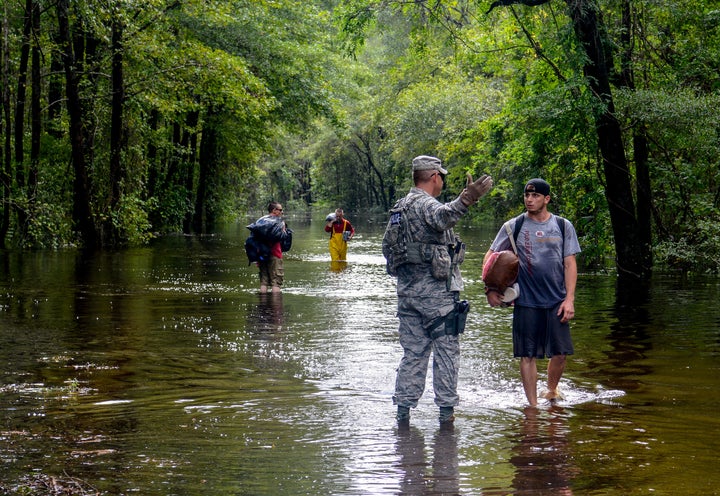
A U.S. Air Force member assigned to the South Carolina Air National Guard assists citizens during evacuation efforts after Hu

U.S. ARMY NATIONAL GUARD VIA GETTY IMAGES
A U.S. Air Force member assigned to the South Carolina Air National Guard assists citizens during evacuation efforts after Hurricane Florence hit in September 2018.

More than a year after President Donald Trump nixed climate change from his administration’s list of national security threats, the Pentagon has released an alarming report detailing how dozens of U.S. military bases are already threatened by rising seas, drought and wildfire.

“The effects of a changing climate are a national security issue with potential impacts to Department of Defense missions, operational plans, and installations,” states the 22-page document, which was published Thursday.

The congressionally mandated analysis looked at a total of 79 military installations around the country. The Defense Department found that 53 sites are currently vulnerable to repeat flooding. Langley Air Force Base in Virginia, for example, has experienced 14 inches of sea level rise since 1930. Additionally, more than half of the 79 bases are at risk from drought, while nearly half are vulnerable to wildfire.

These climate impacts are expected to pose a risk to several other installations over the next two decades, and the report notes that “projected changes will likely be more pronounced at the mid-century mark” if climate adaptation measures are not taken.

While the report is a clear recognition of the immediate threat that climate change poses to the nation’s military infrastructure, it makes no mention of the greenhouse gas emissions driving the crisis. It also doesn’t mention some of the most recent climate-related devastation to military bases, including the estimated $3.6 billion in damages that Camp Lejeune in North Carolina suffered during Hurricane Florence last year.

President Donald Trump removed any reference to climate change from the White House's National Security Strategy report in 20

BLOOMBERG VIA GETTY IMAGES
President Donald Trump removed any reference to climate change from the White House’s National Security Strategy report in 2017.

The Pentagon’s assessment comes just over a year after Trump eliminated any reference to climate change from the White House’s 2017 National Security Strategy report, breaking with two decades of military planning.

Even then, there was dissonance between the Defense Department and the White House.

A week earlier, Trump had signed the National Defense Authorization Act, which devoted about 870 words to the “vulnerabilities to military installations” over the next two decades and warned that rising temperatures, droughts and famines might lead to more failed states ― which are “breeding grounds of extremist and terrorist organizations.” “Climate change is a national security issue,” the legislation said, quoting then-Defense Secretary Jim Mattis; Gen. Joseph Dunford, the chairman of the Joint Chiefs of Staff; and four other former top military commanders. And it said that the Air Force’s $1 billion radar installation on a Marshall Islands atoll “is projected to be underwater within two decades.”

Yet a month later, in January 2018, the Pentagon followed Trump’s lead and scrubbed its National Defense Strategy of all references to climate change.

In Thursday’s report, the Defense Department describes climate change as “a global issue” and says it is “continuing to work with partner nations to understand and plan for future potential mission impacts.”

Subscribe to the Politics email.
How will Trump’s administration impact you?

The department said in a statement to HuffPost that the report delivers a “high-level assessment of the vulnerability of DOD installations.”

“DOD must be able to adapt current and future operations to address the impacts of a wide variety of threats and conditions, to include those from weather, climate and natural events,” Pentagon spokeswoman Heather Babb said by email. “DOD will focus on ensuring it remains ready and able to adapt to a wide variety of threats ― regardless of the source ― to fulfill our mission to deter war and ensure our nation’s security.”

The department did not respond to HuffPost’s questions about any White House role in the report.

Oddly, the new analysis omits the Marine Corps. It also doesn’t identify the top 10 military bases within each service branch that are most vulnerable to climate impacts, a requirement of the defense bill that Trump signed into law in December 2017.

“They don’t have the prioritization of impact. That’s confusing,” said John Conger, a former principal deputy under secretary of defense in the Obama administration and current director of the research group Center for Climate and Security.

Conger said he expects that Congress will tell the Pentagon to go back and fulfill its request.

Climate change was first publicly recognized as a major concern for the Pentagon in May 1990, when the U.S. Naval War College issued a 73-page report, titled “Global Climate Change Implications for the United States,” which found that “Naval operations in the coming half century may be drastically affected by the impact of global climate change.”

The issue gained prominence under President George W. Bush, despite that administration’s embrace of climate change denialism. In October 2003, the National Defense University published a report stating that “global warming could have a chilling effect on the military.”

Today, the military still walks a fine line when discussing climate issues, particularly given that many congressional Republicans reject the realities of human-driven warming. Officials at Naval Station Norfolk in Virginia, the world’s largest naval station, have admitted to avoiding language such as “sea level rise” when requesting maintenance funds to raise docks, according to journalist Jeff Goodell’s recent book The Water Will Come.

Sen. Jack Reed (D-R.I.), the ranking member on the Senate Armed Services Committee, called the new report “inadequate” and criticized the Trump-era Defense Department for “treating climate change as a back burner issue.”

“President Trump’s climate change denial must not adversely impact the security environment where our troops live, work, and serve,” Reed said in a Friday statement. “Whether the Trump Administration wants to admit it or not, climate change is already costing the Department significant amounts of taxpayer resources and impacting military readiness.”

The most dangerous climate feedback loop is speeding up

In Siberia, the carbon-rich permafrost warmed by 1.6°F in just the last decade.

AWI permafrost scientists investigate the eroding coastline at the Siberian island Sobo-Sise. CREDIT: Alfred Wegener Institute.
AWI PERMAFROST SCIENTISTS INVESTIGATE THE ERODING COASTLINE AT THE SIBERIAN ISLAND SOBO-SISE. CREDIT: ALFRED WEGENER INSTITUTE.

The carbon-rich permafrost warmed “in all permafrost zones on Earth” from 2007 to 2016, according to a new study.

Most ominously, Siberian permafrost at depths of up to 30 feet warmed a remarkable 1.6°F (0.9°C) in those 10 years, the researchers found. The permafrost, or tundra, is soil that stays below freezing (32°F) for at least two years.

Permafrost warming can “amplify global climate change, because when frozen sediments thaw it unlocks soil organic carbon,” warns the study, which was released Wednesday by the journal Nature Communications.

The thawing releases not only carbon dioxide but also methane (CH4) — a far more potent greenhouse gas — thereby further warming the planet. And as the planet continues to warm, more permafrost will melt, releasing even more greenhouse gases in a continuous feedback loop.

Thawing permafrost is an especially dangerous amplifying feedback loop because the global permafrost contains twice as much carbon as the atmosphere does today .

Normally, plants capture CO2 from the air during photosynthesis and slowly release that carbon back into the atmosphere after they die. But the Arctic permafrost acts like a very large carbon freezer — and the decomposition rate is very low. Or, rather, it was.

Humanity is leaving the freezer door wide open. As a result, the tundra is being transformed from a long-term carbon locker to a short-term carbon un-locker.

2017 study found the Alaskan tundra is warming so quickly it had become a net emitter of CO2 ahead of schedule. That study was the first to report a major portion of the Arctic had already become a net source of heat-trapping emissions.

The lead author, Dr. Roisin Commane, told ThinkProgress at the time, “We’re seeing this much earlier than we thought we would see it.”

The new study released on January 16 is the first “globally consistent assessment of permafrost temperature.” Four dozen researchers from around the world found that the ground temperature tens of feet below the surface “increased in all permafrost zones on Earth” — in the Northern Hemisphere, the mountains, and Antarctica.

“My take home [on the new study] is that the anecdotal site thawing that I heard about this winter is part of a region-wide warming that seems to be accelerating faster in this decade than in previous decades,” Dr. Commane told Inside Climate News.

That’s no surprise given that “Arctic air temperatures for the past five years (2014-18) have exceeded all previous records since 1900,” as the National Oceanic and Atmospheric Administration reported in its annual Arctic Report Card last month.

The only surprise is that the world continues to ignore this gravest of threats to humanity, even as it speeds up, triggers amplifying feedbacks, and rapidly approaches a climate death spiral.

How much can forests fight climate change?

15 JANUARY 2019

Trees are supposed to slow global warming, but growing evidence suggests they might not always be climate saviours.

Gabriel Popkin

https://www.nature.com/articles/d41586-019-00122-z
Kapur trees (Dryobalanops aromatica) in Malaysia avoid overlapping crowns as they grow, which creates a jigsaw-puzzle pattern when viewed from below. Credit: Stuart Franklin/Magnum
PDF version
When it comes to fighting global warming, trees have emerged as one of the most popular weapons. With nations making little progress controlling their carbon emissions, many governments and advocates have advanced plans to plant vast numbers of trees to absorb carbon dioxide from the atmosphere in an attempt to slow climate change. But emerging research suggests that trees might not always help as much as some hope.

Forest schemes got a big boost from the 2015 Paris climate accord, which for the first time counted all countries’ efforts to offset their carbon emissions from fossil-fuel use and other sources by planting or protecting forests. China aims to plant trees over an area up to four times the size of the United Kingdom. California is allowing forest owners to sell credits to CO2-emitting companies, and other US states are considering similar programmes, which could motivate projects that establish new forests and protect existing ones. The European Union is moving towards allowing countries to include forest planting in their plans to fight climate change; some nations in the bloc have also pledged billions of dollars to tropical forest programmes.

Many scientists applaud the push for expanding forests, but some urge caution. They argue that forests have many more-complex and uncertain climate impacts than policymakers, environmentalists and even some scientists acknowledge. Although trees cool the globe by taking up carbon through photosynthesis, they also emit a complex potpourri of chemicals, some of which warm the planet. The dark leaves of trees can also raise temperatures by absorbing sunlight. Several analyses in the past few years suggest that these warming effects from forests could partially or fully offset their cooling ability.

Such concerns have prompted vigorous debate among scientists about how forests in different regions have warming or cooling effects. Nobody denies that trees are good for the environment; after all, forests provide a host of benefits, and harbour much of the world’s terrestrial biodiversity. And no researchers are suggesting cutting down existing forests or curtailing efforts to combat deforestation. But as governments, corporations and non-profit organizations advance ever-more ambitious programmes to slow climate change, some scientists warn against relying on forests as a solution to global warming until a better understanding emerges. Researchers are involved in major campaigns to collect data using aeroplanes, satellites and towers in forests to sample the full suite of chemicals that trees emit, which can affect both climate and air pollution.

At the same time, some researchers worry about publishing results challenging the idea that forests cool the planet. One scientist even received death threats after writing a commentary that argued against planting trees to prevent climate change.

The questions are multiplying as more scientists enter the debate. At the same time, increasingly dire warnings about climate change — and the potential for huge amounts of money to go towards planting forests — have made working out how trees affect climate a matter of urgency. “People want an answer; they want to be able to say, ‘this is what we should do’,” says Gordon Bonan, a geoscientist at the National Center for Atmospheric Research in Boulder, Colorado. When it comes to forests and their ability to cool the climate, he says, “there are a lot of misstatements or overplaying of what can be done.”

Carbon sponges
If tree-planting programmes work as advertised, they could buy precious time for the world to reduce its reliance on fossil fuels and replace them with cleaner sources of energy. One widely cited 2017 study1 estimated that forests and other ecosystems could provide more than one-third of the total CO2 reductions required to keep global warming below 2 °C through to 2030.

Although the analysis relies on big assumptions, such as the availability of funding mechanisms and political will, its authors say that forests can be an important stopgap while the world tackles the main source of carbon emissions: the burning of fossil fuels. “This is a rope that nature is throwing us,” says Peter Ellis, a forest-carbon scientist at The Nature Conservancy in Arlington, Virginia, and one of the paper’s authors.

The first inkling that plants suck CO2 from the air dates back to the 1780s, when Swiss pastor Jean Senebier grew plants under different experimental conditions. He suggested that plants decompose CO2 from the air and incorporate the carbon, an idea corroborated by subsequent discoveries about the mechanisms of photosynthesis.

More than two centuries later, Senebier’s insights form a key component of plans to combat the accumulation of CO2 in the atmosphere. The rationale is that trees can lock up carbon in their wood and roots for decades or even centuries. The 1997 climate treaty known as the Kyoto Protocol allowed rich countries to count carbon storage in forests towards their targets for limiting greenhouse-gas emissions. In practice, few nations did so because of the agreement’s unwieldy accounting mechanisms and other factors. Later negotiations laid out a framework for enabling wealthy countries to pay poorer tropical countries to reduce emissions from deforestation and to increase carbon in forests. The framework was formalized under the 2015 Paris agreement, which required countries to commit to reduce greenhouse-gas emissions; more than 50 nations have pledged to add tree cover or protect existing forests (see ‘Where are the trees?’).

Source: X.-P. Song et al. Nature 560, 639–643 (2018).
Such schemes required firm data on how much carbon is locked up in forests. In the past few decades, scientists have worked to create national estimates of carbon loss and gain from vegetation by studying field plots and by combing through satellite data. In 2011, an international group led by researchers at the US Department of Agriculture’s Forest Service concluded that forests globally are a large carbon sink, taking more carbon out of the air through photosynthesis and wood production than they release through respiration and decay2.

That doesn’t mean that all forests cool the planet, however. Researchers have known for decades that tree leaves absorb more sunlight than do other types of land cover, such as fields or bare ground. Forests can reduce Earth’s surface albedo, meaning that the planet reflects less incoming sunlight back into space, leading to warming. This effect is especially pronounced at higher latitudes and in mountainous or dry regions, where slower-growing coniferous trees with dark leaves cover light-coloured ground or snow that would otherwise reflect sunlight. Most scientists agree, however, that tropical forests are clear climate coolers: trees there grow relatively fast and transpire massive amounts of water that forms clouds, two effects that help to cool the climate.

More-recent studies have branched out to include other ways in which forests can influence climate. As trees live, grow and die, scientists have learnt, they are in constant conversation with the air, swapping carbon, water, light and a bewildering array of chemicals that can interact with the climate.

Atmospheric chemist Nadine Unger, then at Yale University in New Haven, Connecticut, conducted one of the first global studies examining one part of this exchange: the influence of volatile organic compounds, or VOCs, emitted by trees. These include isoprene, a small hydrocarbon that can warm the globe in several ways. It can react with nitrogen oxides in the air to form ozone — a potent climate-warming gas when it resides in the lower atmosphere. Isoprene can also lengthen the lifetime of atmospheric methane — another greenhouse gas. Yet isoprene can have a cooling influence, too, by helping to produce aerosol particles that block incoming sunlight.

Unger ran an Earth-system model that estimated the effects of chemical emissions from forests. Her results suggest that the conversion of forests to farmland throughout the industrial era might have had little overall impact on climate3. Clearing forests liberated carbon stored in trees, but increased Earth’s albedo (leading to cooling) and decreased emissions of VOCs that can both cool and warm.

As a corollary, Unger suggested that reforestation would also have uncertain climate effects. Trees in tropical and temperate zones emit huge quantities of isoprene that is not accounted for in most forestry schemes. Higher-latitude boreal forests emit mostly terpenes, which help to cool the climate by forming aerosols that can block sunlight and promote the formation of cloud particles — although Unger didn’t attempt to quantify this cloud-seeding effect. She acknowledged that her study was a first step, and called for increased monitoring of forest chemicals and their atmospheric interactions.

She followed up on her research paper by writing an opinion piece in TheNew York Times entitled ‘To Save the Planet, Don’t Plant Trees’, which argued that the large uncertainties around the extent to which forests cool or warm the climate made tree planting a risky strategy for fighting climate change. The article, and especially the headline (which Unger did not write), triggered a tsunami of complaints from researchers, who disputed the science and said the piece threatened to undermine years of research and advocacy. A group of 30 forest scientists wrote a responseon the environmental news website Mongabay, saying, “We strongly disagree with Professor Unger’s core message.”

At 304 metres high, the Zotino Tall Tower Observatory measures gases and aerosols above taiga forest in central Siberia. A similar tall tower in the Amazon makes measurements above the tropical rainforest.Credit: Michael Hielscher/MPI
Unger says she received death threats, and that some colleagues stopped speaking to her. Some scientists, however, agreed that it was important to look at the impacts of forest VOCs. Subsequent studies have both supported and contradicted Unger’s 2014 analysis. A team led by Dominick Spracklen and Catherine Scott, atmospheric chemists at the University of Leeds, UK, ran a model that included how aerosols from forests can seed clouds, which reflect sunlight. They concluded that the net effect of VOCs from forests is to cool the global climate4.

Unger, in turn, questions some of Scott and Spracklen’s assumptions. Unger, who is now at the University of Exeter, UK, and Spracklen are discussing using a common experimental design to try to resolve their differences.

They and other researchers say that such studies are hamstrung by sparse data sets on forest emissions. “In my opinion, we still don’t know enough” to say what effect forest VOCs have, says Alex Guenther, an atmospheric scientist at the University of California, Irvine.

The latest findings are piling on even more complexity. Ecologist Sunitha Pangala at Lancaster University, UK, spent much of 2013 and 2014 in the Amazon rainforest, where she placed gas-measuring chambers around the trunks of more than 2,300 trees. “What we were really surprised about was the magnitude at which these trees are emitting methane,” says Pangala. She and Vincent Gauci at the Open University in Milton Keynes, UK, and their colleagues reported in 2017 that trees account for around half of the Amazon’s total methane emissions5. Researchers had previously assumed that methane leaked into the air directly from the soil, where it is produced by microbes. The new work suggests that trees could be another conduit for that microbial methane, potentially explaining why more methane has been detected above tropical wetlands than has been measured emanating from soil alone.

In a study first published last October, Gauci and other colleagues added another wrinkle when they found both methane and nitrous oxide, also a greenhouse gas, leaking from trees in upland forests6.

The global significance of these findings is still unclear. Pangala and Gauci both estimate that the cooling effect of trees taking up carbon greatly outstrips the warming from tree emissions of methane and nitrous oxide. But Kristofer Covey, an environmental scientist at Skidmore College in Saratoga Springs, New York, has found methane leaking from non-wetland trees in temperate forests7, and argues that such emissions could, in some places, diminish the climate benefits of trees more than researchers and environmentalists realize. “That’s a really painful message,” he says.

The recent explosion of results underscores the need for a full account of the impacts of forests, says Unger. “As long as we understand that tropical trees are taking carbon dioxide out of the atmosphere, we must also accept that they’re putting methane and VOCs into the atmosphere.”

Action stations
Scientists who champion forests say that although more research is always good, existing results are mature enough to support the use of forests to fight climate change, especially given the urgency of the problem. “We can’t necessarily afford to hold off on those things; we have to begin taking some action,” says Jason Funk, an environmental scientist in Chicago, Illinois, who served as an adviser and observer to the Paris agreement.

Researchers are now turning to sophisticated computer models and using larger and more-comprehensive data sets to nail down exactly what forests in different places do to the climate. In some cases, the results have been sobering. Last October, a team led by ecologist Sebastiaan Luyssaert at the Free University of Amsterdam modelled a variety of European forest-management scenarios8. The researchers concluded that none of the scenarios would yield a significant global climate impact, because the effects of surface darkening and cloud-cover changes from any added forests would roughly eliminate their carbon-storage benefits.

To estimate the climate impact of planting forests in different parts of the United States, ecologist Christopher Williams at Clark University in Worcester, Massachusetts, is combining global satellite data collected over more than a decade with carbon-sequestration figures based on data from the US Forest Service. He has found in preliminary work that adding trees to the US west coast and to regions east of the Mississippi River makes sense, climatically speaking. But albedo changes make forest planting in the Rockies and the southwestern United States a bad deal for the climate in most cases, because the conifers that thrive in those regions are dark and absorb more sunlight than do underlying soils or snow. He hopes to turn this research into a standardized methodology that forest managers can use to assess a project’s climate impact.

Getting planners to adopt such methods could prove challenging, however. Williams has found that some resist considering albedo effects, including representatives of companies hoping to sell carbon credits for forest projects. “Even other scientists sometimes have disbelief in the magnitude of the albedo effect, or even its existence,” he says.

“I have heard scientists say that if we found forest loss cooled the planet, we wouldn’t publish it.”

More data about the climate impacts of forests could come from long-term studies that track the gases and chemicals that trees emit and absorb. Researchers are using a 325-metre tower in the Amazon to monitor carbon, water and other chemical fluxes over a roughly 100-square-kilometre area of intact rainforest northeast of Manaus in Brazil. A companion tower in Siberia does the same.

Teams have erected smaller research towers to collect similar samples at hundreds of sites around the globe amid different types of forest; a tower in Norway, for example, will soon be the first in that country to start taking data in a forest. But many important areas have not yet been covered. Two NASA instruments launched in the past year — the Global Ecosystem Dynamics Investigation and the Ice, Cloud, and Land Elevation Satellite-2 — should soon provide a more consistent global picture of forests’ carbon stores.

Scientists who debate the climate impacts of forests are eager to get their hands on these data. And even those who are firmly convinced that forest projects can fight climate change welcome the added rigour of more-comprehensive studies. Ellis, for one, acknowledges that the analysis he co-authored1 considered albedo effects only crudely; the team did not consider VOCs and methane emissions from trees.

“We need to more honestly account for these other effects and be more careful about how we strategize,” says Ellis. “We’re using a blunt tool, when it would be much more preferable to use a sharper one.”

Does Organic Agriculture Contribute to Climate Change?

Does Organic Agriculture Contribute to Climate Change?

Organic agriculture seems like it would be better for the environment than conventional. But a new study suggests it produces more carbon dioxide.

Which is better for the environment: organic or conventional agriculture? For consumers trying to make sound food choices, it’s an important question. A new international study finds that organic agriculture actually contributes more to climate change than conventional farming does. The study argues that since organic agriculture requires slightly more land for the same yield, organic systems lead to more deforestation, which in turn results in more carbon dioxide emissions. But measuring environmental impact is extremely complicated.

Back in 2010, Nadia El-Hage Scialabba and Maria Müller-Lindenlauf, of the Food and Agriculture Organization of the United Nations (FAO), took an in-depth look at the climate impacts of organic agriculture. F.A.O.’s Codex Alimentarius Commission defines organic agriculture as:

a holistic production management system that avoids use of synthetic fertilizers, pesticides and genetically modified organisms, minimizes pollution of air, soil and water, and optimizes the health and productivity of interdependent communities of plants, animals and people.

Organic agriculture still uses fertilizers and pesticides, but not synthetic ones. And when it comes to climate, the F.A.O study suggests, the fertilizer issue is key.

Conventional agriculture relies on nitrogen fertilizers, produced through a process involving copious amounts of ammonia and methane. Nitrogen fertilizers in turn, release some degree of nitrous oxide, an extremely potent greenhouse gas, with a much greater warming potential per unit released than carbon.

Organic farms bypass the need for chemical fertilizers by planting legumes. Organic farms also tend to store more carbon in the soil, slightly offsetting other greenhouse gas emissions, though, as the F.A.O. study notes, the carbon storage is likely not permanent. Plus, organic farms may burn more fossil fuels through machinery when weeds are removed mechanically.

As for the suggestion that organic agriculture requires slightly more land for the same yield, it depends on the crop. Conventional dairy production, for example, produces much more milk per cow. But there is hardly any yield difference when it comes to organic vs. conventional rice. In some cases, the same crop may have different yields-per-area in the developing world vs. the developed world—organic yields are often higher in developing countries. This is because, as the F.A.O. report notes, some of the ecologically sound practices are difficult to scale up to industrial levels, and work better at smaller scales.

On the other hand, grass-fed livestock requires a lot more space than feedlots, often leading to deforestation.

Many conscious consumers want a definitive answer about whether conventional or organic farming is better, when in fact, both have effects on the climate. There are also other concerns that go into consumer choices, such as animal welfare. And, as Stefan Wirsenius, one of the authors of the international study, says, “The type of food is often much more important. Eating organic beans or organic chicken is much better for the climate than to eat conventionally produced beef.”