ANCHORAGE, Alaska (KTUU) – Changing sea ice conditions are forcing polar bears to adapt. New research shows that a growing percentage of polar bears are coming to land and becoming dependent on human provisions for food, while those that stay on the dwindling sea ice to continue natural polar bear behavior may be floating on an ecological trap.
The USGS researchers used GPS collars with a camera, accelerometor and other scientific tools to track and analyze the bears’ behaviors.
Researchers with the USGS Alaska Science Center have noticed the behavioral changes in polar bears on the Southern Beaufort Sea over the last 15 years and more recently a team began studies to determine which behavior was better for the bears. The researchers used GPS collars with video cameras and an accelerometer to track the bears, calculate how much energy they used, and compare the energy requirements of coming to land during summer months versus staying on the sea ice.
“Going into it we thought it’s surely going to be more energetically expensive to come to shore, because often times bears are staying on the sea ice until the last possible minute before they come to shore,” Todd Atwood, a research wildlife biologists with USGS said. “In some cases bears are swimming 400, 500 kilometers to get to land. Swimming is a lot more energetically expensive than walking. So we expected them burn through a lot more energy to get to land, and that’s what we found.”
By pairing the GPS camera collar with a tri-axial accelerometer, the researchers were able to estimate how much energy bears used for different behaviors by calculating overall dynamic body acceleration.
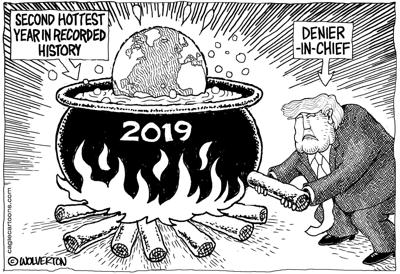
US President Donald Trump’s position on climate change has been in the spotlight again, after he criticised “prophets of doom” at the World Economic Forum in Davos.
At the event, which had sustainability as its main theme, and activist Greta Thunberg as its star guest, Mr Trump dismissed “alarmists” who wanted to “control every aspect of our lives” – while also expressing the US’s support for an initiative to plant one trillion trees.
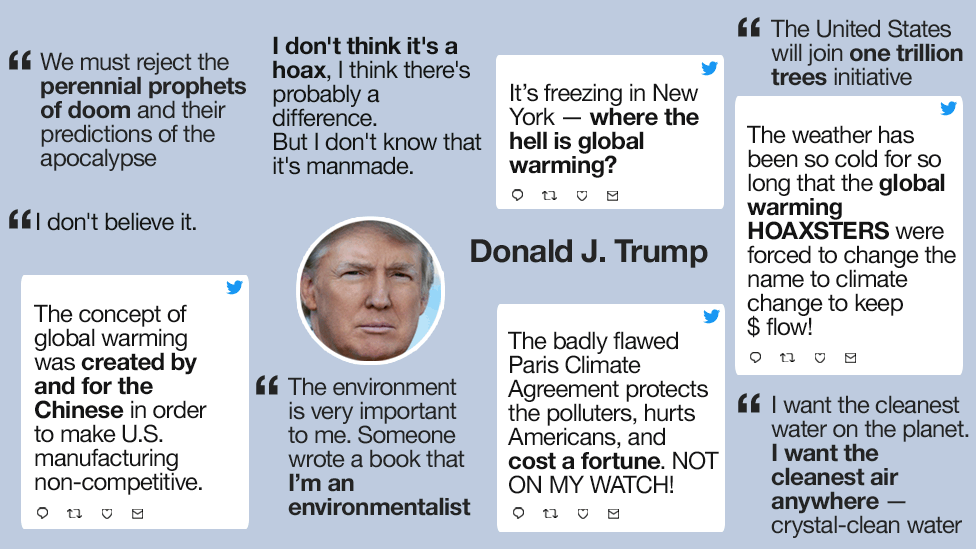
If you judge the president based on his words alone, his views on climate change appear contradictory – and confusing.
He has called climate change “mythical”, “nonexistent”, or “an expensive hoax” – but also subsequently described it as a “serious subject” that is “very important to me”.
Still – if you sift through his multitude of tweets and statements, a number of themes emerge.
In 2009, Mr Trump actually signed a full-page advert in the New York Times, along with dozens of other business leaders, expressing support for legislation combating climate change.
“If we fail to act now, it is scientifically irrefutable that there will be catastrophic and irreversible consequences for humanity and our planet,” the statement said.
But in the years that followed, he took an opposite approach on Twitter, with more than 120 posts questioning or making light of climate change.
In 2012, he famously said climate change was “created by and for the Chinese in order to make US manufacturing non-competitive” – something he later claimed was a joke.
He regularly repeated claims that scientists has rebranded global warming as climate change because “the name global warming wasn’t working” (in fact, both terms are used, but experts at Nasa have argued that climate change is the more scientifically accurate term).
And he also has dozens of tweets suggesting that cold weather disproves climate change – despite the World Meteorological Organization saying that the 20 warmest years on record have been in the past 22 years.
He has tweeted less about climate change in recent years – and, since being elected president, he has adopted an ambiguous, inconsistent stance in interviews and speeches.
But even when he acknowledges the significance of climate change, he tends to frame it in terms of clean air and water (which are not directly related to climate change), or the cost to business:
“I think there is some connectivity [between human activity and climate change]. There is some, something. It depends on how much. It also depends on how much it’s going to cost our companies.” – NYT interview, November 2016.
“I don’t think there’s a hoax. I do think there’s probably a difference. But I don’t know that it’s man-made… I don’t wanna give trillions and trillions of dollars.” – CBS interview, October 2018
“Climate change is very important to me. I’ve done many environmental impact statements in my life, and I believe very strongly in very, very crystal clear clean water and clean air.” – December 2019
“Nothing’s a hoax about that. It’s a very serious subject… I want the cleanest air, I want the cleanest water. The environment is very important to me. I also want jobs. I don’t want to close up our industry because somebody said you have to go with wind.” – January 2020
So what does Trump actually believe?
Commentators have suggested that Mr Trump tends to conflate climate change with environmentalism more generally.
“He doesn’t really understand what climate change is about,” says Professor Michael Gerrard, an environmental law professor at the University of Columbia.
Media captionClimate change: How 1.5C could change the world
Meanwhile, Joseph Goffman, executive director of Harvard’s Environmental Law Programme, argues that Mr Trump “believes nothing on climate change – he’s a climate nihilist”.
Mr Trump’s position is based on his need to appeal to “the part of the Republican establishment that rejects climate policy,” Mr Goffman, who previously worked as Democratic staff director on the Senate environmental committee, adds.
“He’s not going to win running on the environment,” Mr Pinion says. “In America, climate is not an issue, so the reason it is not an issue for President Trump is because he cares about winning. And the reason Democrats are OK with it not being a priority for them, is because they want to beat him.”
“Ultimately it doesn’t matter what President Trump believes, what matters is what he’s doing – we need to recognise climate change is not a priority of his administration.”
What has Trump done on climate change?
The Climate Deregulation Tracker, run by the Sabin Center for Climate Change Law, has documented more than 130 steps the Trump administration has taken to scale back measures to fight climate change.
High-profile rollbacks include:
Deciding to withdraw from the Paris climate agreement, which committed the US and 187 other countries to keep rising global temperatures below 2C.
Replacing President Barack Obama’s Clean Power Plan, which would have limited carbon emissions from coal and gas-fired power plants, with the Affordable Clean Energy rule, which had weaker regulations
Attempting to freeze the fuel efficiency standards imposed on new vehicles, and prevent California from setting its own emissions rules
“He’s completely halted and reversed the momentum that was built up during the Obama administration in fighting climate change,” Prof Gerrard says.
While withdrawing from the Paris Agreement was “terrible symbolically”, the agreement had “virtually no specifics on what the US had to do”, so other rollbacks, especially the attempt to limit fuel economic standards of cars, were more damaging, he adds.
Media captionGreta Thunberg and Donald Trump gave very different speeches at Davos
Dan Costa worked at the Environmental Protection Agency for more than 30 years, including as the National Director of the Air, Climate & Energy Research Program.
He said he noticed an “anti-science stance” once the Trump administration’s team took over.
“One of the folks who came as part of the transition team said ‘if climate change is such a bad thing, why are so many people moving to Arizona? Anyway, you can turn up the air conditioning.'”
He noticed that budget documents from the president’s office and Congress began to refer to his Air, Climate & Energy Research Program (ACE) as the Air and Energy research programme instead.
“There was a fair amount of anxiety and self censorship… people would start to keep the word ‘climate’ out of titles,” he said, adding that he also noticed a policy of “benign neglect” where many employees were not replaced after they left.
In 2018, Mr Trump made headlines after he cast doubt on the government’s own National Climate Assessment.
When asked about the findings that climate change would have a devastating economic impact, Mr Trump said: “I don’t believe it.”
Prof Costa said some in the EPA responded with “derisive laughter” when they heard this. “Everybody knows that what he says doesn’t necessarily reflect what he really thinks.”
A softer tone?
The Trump administration’s actions have widely rolled back on climate change measures. But some have seen a recent shift in his tone, as he has described himself as “an environmentalist” several times in the past few months.
AFP
I’m an environmentalist. I am. I want the cleanest water on the planet. I want the cleanest air anywhere.”
“We’ve seen him really soften his rhetoric on the issue of climate change. He’s no longer talking about it being a hoax, and he’s talking about his care for the environment,” says Quillan Robinson, government affairs director at the American Conservation Coalition.
His group is led by young Republicans who want more to be done on the environment – and he argues that, while Mr Trump often talks about climate change in more general environmental terms, it was still a “promising sign”.
“We would like him to come out and talk about where the scientific consensus is at… at the same time, talking about it in terms of clean air and water appeals to broader factions of the country, so it’s something people can get behind.”
Not everyone agrees there is a shift in Mr Trump’s rhetoric – Prof Gerrard argues that it is “sporadic, and not substantive… the administration continues to go all out on repealing regulations”.
But if Mr Trump does change his tone – or his actions – on climate change in the future, it is likely to be for political reasons.
A Pew survey last year found that 52% of young Republicans felt the government was doing too little to reduce the effects of climate change, while a Monmouth University poll found that almost two thirds of Republicans now believe in climate change – a 15% increase from just three years ago.
“The trajectory of the GOP of old consider climate change a hoax, but the future of the GOP is comprised of individuals who take the issue just as seriously as Democrats,” says Mr Pinion.
“You can find ways to win elections by slimmer and slimmer margins, but we are quickly arriving at the day when a party that does not have solutions on climate change is not going to be viable with the overall majority of the electorate.”
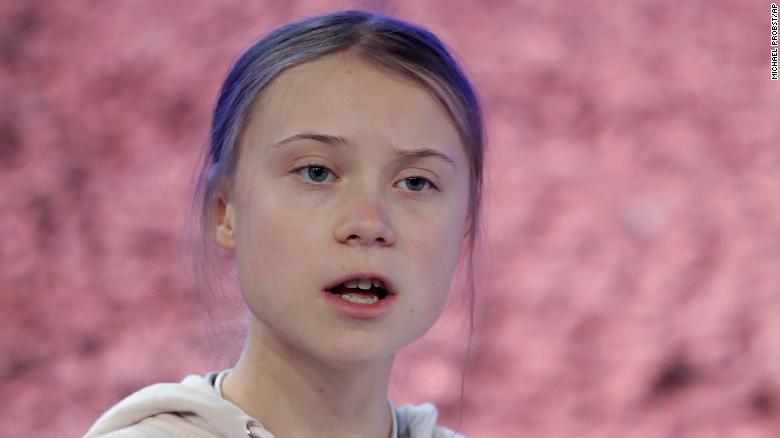
Davos, Switzerland (CNN Business)Greta Thunberg took the stage at the World Economic Forum Tuesday to admonish world leaders for doing “basically nothing” to reduce carbon emissions despite evidence of a looming climate catastrophe.
Speaking just hours before President Donald Trump’s appearance at the annual gathering of the world’s political, business and financial elite, the teen activist said awareness of the climate crisis had shot up but in other respects, not much had changed.
“Pretty much nothing has been done since the global emissions of CO2 has not reduced,” Thunberg said. “[I]f you see it from that aspect, what has concretely been done, if you see it from a bigger perspective, basically nothing … it will require much more than this, this is just the very beginning.”
Asked what she wanted to see in the future, Thunberg said “that we start listening to the science and that we actually start treating this crisis as the crisis it is.”
Sponsor content by BP
Can we meet energy demand and reduce emissions?
How do we reduce emissions while meeting the needs of a world with growing energy demands?
Thunberg said she’s spent a year trying to publicize the findings of a 2018 Intergovernmental Panel on Climate Change report that shows countries can only release another 420 gigatons of carbon dioxide in order to have the best chance at keeping the rise in global temperatures to under 1.5 degrees. At current levels, that amount will be emitted within roughly eight and a half years.
“I don’t think I have seen one media outlet or person in power communicating this or what it means,” Thunberg said. “I know you don’t want to report on this. I know you don’t want to talk about this. But I assure you I will continue to repeat these numbers until you do.”
Since appearing on the sidelines of last year’s Davos meeting, Thunberg’s profile has taken off and she was named Time’s “Person of the Year.” Conference participants lined up to get into the discussion Tuesday, with many holding phones aloft to take pictures as she took the stage.
Thunberg acknowledged the attention but said that wasn’t nearly enough.
“I’m not the person who can complain about not being heard — I’m being heard all the time,” she said during a panel with other youth activists.
Sustainability and climate change are top issues at this year’s Davos meeting. On Tuesday, Thunberg repeated her call for all companies, banks, institutions and governments to abandon the fossil fuel economy.
“Immediately end all fossil fuel subsidies and immediately and completely divest from fossil fuels. We don’t want these things done by 2050, or 2030 or even 2021 — we want this done now,” she said.
In his speech, Trump announced that the United States would be joining an initiative to restoring a trillion trees by 2050, but said that “to embrace the possibilities of tomorrow, we must reject the perennial prophets of doom and their predictions of the apocalypse.”
Speaking again shortly after Trump, Thunberg said “planting trees is good” but nowhere near enough.
“Let’s be clear: we don’t need a low carbon economy; we don’t need to lower emissions. Our emissions have to stop if we are to have a chance to stay below the 1.5 degree target,” she said.
“Our house is still on fire. Your inaction is fueling the flames by the hour,” Thunberg added. “We are still telling you to panic, and to act as if you loved your children above all else.”
While reforms need to be made at the federal, state and local government levels, our individual actions ― at least in the aggregate (tell your friends to do these things, too!) ― can make a difference. We asked environmentalists and climate change activists to share a few ways that each of us can reduce our carbon footprint and combat climate change.
Here are 10 useful suggestions:
1. Cut back on air travel — entirely if you can.
The idea of curbing your air travel, if not giving it up outright, was brought into the spotlight when Swedish climate change activist Greta Thunbergrefused to fly to speaking engagements. She has traveled to events around Europe mainly by train and sailed from the U.S. to Portugal to attend the United Nations climate meeting in Madrid in December.
Critics of air travel usually point to the environmental damage done by international air travel, but domestic flights aren’t much better. As The New York Times reported recently, take one round-trip flight between New York and California, and you’ve contributed about 20% of the greenhouse gases that the typical car emits over the span of an entire year.
So when reducing air travel, don’t forget the domestic flights you likely take with more frequency ― a wedding here, an industry conference there.
“The antidote to air travel is to choose adventures closer to home, exploring your own state, arriving at destinations by train, bus or the family car,” said Erin Rhoads of The Rogue Ginger, one of Australia’s popular eco-lifestyle websites.
“The other benefits of this are learning the history about the country you are on in greater depth, supporting local towns off the beaten track, discovering hidden gems and creating new memories all while saving money,” she added.
For unavoidable flights, consider purchasing carbon offsets through airlines, online travel bookers and independent sellers like Terrapass. With your purchase, you fund environmental projects aimed at reducing greenhouse gas emissions, thus, in theory, reducing your personal carbon footprint.
FREEMIXER VIA GETTY IMAGES
Traveling by train is a more environmentally sound way to travel.
2. Avoid all single-use disposable plastic items.
Plastics help protect and preserve goods while reducing weight in transportation ― but the benefits pretty much end there. Plastics originate as fossil fuels and emit greenhouse gases from creation to disposal, according to a May 2019 report, “Plastic & Climate: The Hidden Costs of a Plastic Planet,” released by the Center for International Environment.
Recycling plastic alone won’t cut it; you have to stop buying it, too. Avoid single-use disposable plastic as much as you can, said Jay Sinha, the co-founder of the online store Life Without Plastic.
“Do a little personal plastic audit of your current plastic use and assess where you’re at,” he said. “Buy in bulk rather than purchasing packaged foods. Eliminate your takeout plastic waste by carrying your own non-plastic mug, water bottle, utensils, straw, food container, reusable bag. Try living a zero-waste lifestyle ― new zero-waste bulk stores are popping up all over to help you out.”
3. Eat local and go vegetarian or vegan.
There’s no way around it: A meat-heavy diet is not great for the environment. The production of one calorie of animal protein requires more than 10 times the fossil fuel input needed for a calorie of plant protein. Then, there’s the carbon footprint of the refrigeration required to extend the longevity of foods when they’re being shipped, the transportation of goods to and from airports, and the packaging, Rhoads said.
Minor tweaks to your diet can make a huge impact ― if more of us do it.
“Select vegetables and fruit grown locally in your country by visiting farmers markets, signing up to a CSA [community-supported agriculture] box or asking your local supermarket to stock local fruit and vegetables, preferably without the packaging,” she said. “Increasing your local protein staples from plants like beans and legumes grown in your state or country is the most sustainable diet choice, and your health and the planets will be better for it.”
THOMAS BARWICK VIA GETTY IMAGES
Buy local as much as possible and keep your diet veggie-based.
4. Cancel your Amazon Prime subscription and cut back on online purchases overall.
This one might be a bit of a challenge for those of us who’ve gotten used to quick-and-easy Amazon buys. But that overnight or two-day delivery speediness comes at an enormous cost to the environment.
“If a FedEx Priority Overnight truck is dispatched to your suburban neighborhood just to bring you the socks you ordered ― even though you could have waited for [slower] ground delivery or bought them somewhere locally while buying other things ― that’s a significant greenhouse gas emissions tab you are creating unnecessarily,” Sinha said.
Gay Brown, a personal environmental health adviser and author of “Living With a Green Heart: How to Keep Your Body, Your Home, and the Planet Healthy in a Toxic World,” put it even more simply.
“Every time you order something, it has to be pulled by a human, boxed, wrapped, shipped, flown, or trucked, and delivered by more humans. Each of these people have to have used public or private transportation to get [to] their jobs and are using more transportation to get to you,” she said.
The domino effect from your selecting two-day delivery is huge, so if at all possible, buy those socks locally.
5. Ditch the car.
The decision to drive somewhere is a mindless thing for most of us: We hop in, maybe put our destination in Google Maps, and head from point A to point B. Over time, though, all those miles rack up. The average American drives 13,473 miles per year. If you aimed to plant trees to offset all your carbon emissions from driving, you would need around 37 trees a year, according to Carbonify.com.
It’s time to be more mindful of your driving. Avoid all unnecessary car trips and cluster errands for efficiency, Brown said.
“As a Californian for 35 years, I avoid going out to the store or running errands by car if there isn’t a few stops in that area,” she said. “My favorite mode of transportation is to walk. I like being out in the environment and
feeling the weather. A good rule of thumb is if your destination is one walkable mile or less from your dwelling, opt to walk instead of drive.”
Other non-driving options besides walking? Bike (though admittedly, that can be difficult in big cities with narrow bike lanes), take the train or hop on the bus.
HINTERHAUS PRODUCTIONS VIA GETTY IMAGES
Walking, rather than driving, to destinations near you can make a dent in greenhouse gas emissions.
6. Reconsider the number of kids you’d like to have.
In 2009, scientists suggested that having a child is one of the worst things you can do for the environment, especially among the world’s wealthiest people. Americans and other rich nations produce the most carbon emissions per capita, even as those in the world’s poorest nations suffer the most from severe climate change.
While the decision to have children is deeply personal, its impact on the planet is becoming a topic of public conversation again. Given the state of the environment, many believe it’s worth reevaluating ideas about family planning. If you were thinking of having, say, three or more children, could you be just as happy with two? It’s even more worthwhile to consider adoption.
“Population is the number one environmental crisis that no one is addressing,” Brown said. “I think two children is a great idea because you are not adding to the population too much. A friend of mine says that Harry and Meghan have decided to have two for this exact reason. I think that’s a great idea.”
7. Give composting a chance.
Kathryn Kellogg, author of “101 Ways to Go Zero Waste,” considers composting the most effective tool “in the save-the-world tool belt.”
That’s because Americans waste an unbelievable amount of food and most of it ends up in a landfill. In New York City, for instance, the average household will dispose of 650 pounds of organic waste in one year.
“You think food would break down since it’s dumped into a giant hole in the ground, but it doesn’t because landfills aren’t aerated for proper decomposition,” Kellogg said. “Instead, all of that oxygen-deprived organic matter releases methane, and methane is 30 times more powerful than CO2.”
Composting is a good way to combat wastefulness. And Kellogg said not to worry about critters or bad odors; she’s been composting for years and hasn’t had any visitors or awful stench.
“If you have a backyard, you have it pretty easy. You can have a tumbler bin, an enclosed bin that stands alone, a worm bin, or you can even do trench composting,” she said.
Trench composting is when you dig a hole at least a foot deep, put your food scraps in and bury them. (It’s also a safe way to compost pet waste.) Kellogg said you want to make sure your hole is deep enough so that animals passing by won’t be tempted to dig anything up.
“Also, if you have a small balcony, a tumbler compost bin would work just fine since you don’t have to have any sort of ground for that,” she said.
8. Don’t rush out to buy new clothes and shop secondhand whenever you can.
The fashion industry is responsible for 10% of annual global carbon emissions, according to the World Bank. The water used to manufacture clothing has drained rivers and lakes around the world, destroying ecosystems. Look in your closet and drawers, and you’ll no doubt see your personal contribution to this particular problem.
Rectify your fast-fashion buying ways by wearing the clothes you do have instead of running out to purchase a new outfit for every occasion, said Lindsay Miles, a waste educator and author of “Less Stuff: Simple Zero-Waste Steps to a Joyful and Clutter-Free Life.”
“Using what we have and making stuff last might not be as sexy or Instagrammable as buying a shiny new stainless steel reusables kit or purchasing a wardrobe full of new ethical fashion, but that’s what is going to help the environment most,” Miles said.
If you’re really hankering to shop, consider going secondhand. Consignment stores and eBay aren’t the only options worth exploring if you’re sustainably minded. Online resale platforms like Depop,ThredUP, The RealReal and Relovv are worth a look, too. But since any online option requires shipping, a vintage store in your area should be your first go-to.
“This isn’t to say we never buy anything new ever again ― hello, brand new underwear ― we just need to dial it right back,” Miles said. “By doing this, not only are you reducing demand and stemming the flow of new stuff when you buy secondhand (because you’re reducing demand for new) but you’re helping keep existing items in use for longer, maximizing their potential and making the best use of the resources that were used.”
YOSHIURARA VIA GETTY IMAGES
When you do need to shop, consider secondhand stores and online resale platforms.
9. Hold more meetings online.
If you’re in a managerial position at work and your employees are far-flung (they have long local commutes or live in distant cities), suggest video conference calls over in-person meetings. Brown said she used to log 250,000 air miles a year for work travel but now does most everything ― especially one-on-one meetings ― via Google Hangouts, Skype or FaceTime.
“I do allow myself to fly for important dates like big events like conferences,” she said. “If I happen to be in a city where I’ve had virtual meetings and I’ve never met the people I’m doing business with, I will reach out to try to meet the person(s) for a coffee or something casual to develop a personal relationship. If I’m making a lot of new business relationships, I will do a quarterly trip to one area to do a ‘geographic’ swoop to ‘press the flesh.’”
10. Talk about this stuff regularly with your friends and family, and get involved politically.
If you tried any of the suggestions above and found it a lot easier than you’d expected, tell your friends and family about it. Personal stories are often the most effective in persuading others to give change a chance.
Of course, this isn’t all on you. Encourage your local elected officials to implement bigger, more substantial changes in your city or district, said Crystal Chissell, vice president of operations and engagement at Project Drawdown, a nonprofit that researches how global warming can be reversed.
“Gather a group to write to or visit your elected officials to let them know you care and expect them to work with experts to explore solutions,” she said. “We will be less overwhelmed by our awareness of the problem when we each recognize our power to collectively solve it, share the tasks and enjoy working together for our common good. We’ll need strong bonds with others to face the challenges ahead.”
Researchers at Oxford University have developed GWP*, a new climate metric that accurately measures the impact of methane emissions on global warming – recontextualising the debate surrounding ruminant methane emissions and climate change.
ffinlo Costain, host of FAI Farm’sFarm Gate podcast interviewed Myles Allen and John Lynch from Oxford University to explore their new method of measuring the impacts of methane on climate change. GWP* is a new metric for global warming potential that measures the change in emission rates for methane instead of measuring emissions by volume. According to their research, GWP* gives a more accurate picture of the influence greenhouse gases have on the world’s climate than existing measures, which assign gases a nominal CO2 equivalent number.
Current climate measures, like GWP100, categorise ruminant-emitted methane and agricultural activities among the greatest contributors to climate change. GWP100 reaches this conclusion by comparing the total amount of emissions and extrapolating the potential impacts on the global climate. According to Roland Bonney, co-founder of FAI Farms and Benchmark Holdings plc, many farmers and farm organisations feel unfairly demonised by these conclusions and public reaction to them. Allen and Lynch echo this view and assert that the GWP100 metric doesn’t capture the full relationship between emissions and climate change.
Bonney asserts that raising ruminants sustainably can be part of the solution to climate change. Raising cattle and sheep in a mixed rotation system, ensuring they are grass-fed and that they have access to natural pastureland can reduce greenhouse gas emissions significantly. In his view, how we farm has a greater impact on global climate than what we choose to eat.
The differences between methane and carbon dioxide
Though both methane and CO2 contribute to climate change, they impact global temperatures differently. Humans emit more carbon dioxide than any other greenhouse gas and it remains the largest contributor to climate change. Though some CO2 can be absorbed by the ocean or be fixed in plant biomass, the bulk of human emissions go into the atmosphere. According to Allen, the CO2 left in the atmosphere causes a persistent warming effect over thousands of years, making its impact more cumulative than other gasses. Unless humans ramp up efforts to remove carbon, it will remain in the environment.
In contrast, methane is emitted in smaller quantities. The gas has a stronger warming effect than CO2, but it breaks down quickly. This means that after a few decades, the methane will be out of the atmosphere and any warming affects will cease.
When describing the different impacts of the gases, Lynch compared the impacts of methane emissions to drinking excessively and getting a hangover – the immediate effects will set you back, but as long as you don’t drink to excess again, the pain and nausea will dissipate. Carbon dioxide, on the other hand, is more akin to lead poisoning – exposure will cause immediate negative effects, and sustained exposure will cause significant damage in the future.
Metaphors aside, comparing one tonne of emitted CO2 to one tonne of emitted methane (CH4) doesn’t give researchers an accurate picture of the gases’ warming potential. Allen’s research indicates that for methane to have the same warming effect as CO2, humans would need to increase methane emissions by multiple tonnes per year and maintain that emissions level indefinitely. In his view, it’s more appropriate to compare the emission rates of methane with a single tonne of emitted carbon dioxide – the central aim of the new GWP* measure. The new metric will also give more accurate climate forecasting than the current GWP100 standard.
GWP* appears to capture these subtleties more effectively than GWP100. Researchers at the SRUC found that measuring the warming impact of farms with a traditional carbon calculator overestimated the impact of farm emissions on climate. When they used GWP* to analyse the same farm data however, methane emissions fell by 75 percent, halving the total climate impact of agricultural emissions.
Ruminant methane and GWP*
In Allen’s analysis, methane’s contribution to climate change is historic – we are feeling the effects of methane pulses from 50 years ago when the global ruminant herd increased. Ruminants contribute to global methane emissions as the herd expands. A new source of methane will have a huge effect, but a sustained source won’t be as impactful. If the herd remains stable or declines (which is happening currently), the methane they produce won’t add to the warming that’s already occurred. Allen argues that the methane produced by the world’s ruminants is keeping global temperatures at stasis – it isn’t contributing to warming or cooling either way.
GWP* allows researchers to differentiate between new sources of methane and existing ones, meaning that fluctuations in the global ruminant herd can be accurately accounted for. According to Lynch, analysing discrete methane sources makes GWP* more accurate and prevents overestimates of the gas’s climate effects.
In Allen’s view, removing all ruminants in order to tackle methane emissions wouldn’t provide a huge climate benefit. Culling ruminants would only give the climate a temporary pulse of cooling – a temporary reduction of 0.1 degrees at the absolute maximum. That’s the equivalent of a few years’ worth of warming from CO2 emissions. Instead of focusing solely on ruminant emissions, activists should also account for methane leakages in Britain’s natural gas infrastructure. Both Lynch and Allen agreed that eliminating CO2 emissions would do more to counteract climate change than simply reducing methane produced by ruminants.
Refocusing on carbon
Allen told Costain that though reducing methane would help the climate, tackling carbon emissions from the fossil fuel industry is more pressing. The emissions from this sector are “additional” to the world’s existing carbon cycle and cause present and future warming events. Unless the UK and other countries enact zero net carbon emissions policies, global climate change will continue. Lynch echoed these sentiments, saying that carbon emissions needed to be removed or offset to stabilise global temperatures.
Media captionOur Planet Matters: Climate change explained
Scientists say global warming could have a catastrophic effect on the planet.
Human activities have increased carbon-dioxide emissions, driving up temperatures. Extreme weather and melting polar ice are among the possible effects.
What is climate change?
The Earth’s average temperature is about 15C but has been much higher and lower in the past.
There are natural fluctuations in the climate but scientists say temperatures are now rising faster than at many other times.
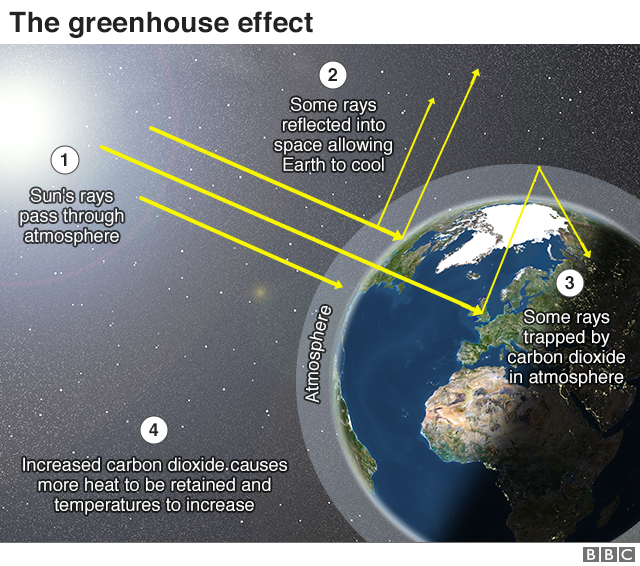
This is linked to the greenhouse effect, which describes how the Earth’s atmosphere traps some of the Sun’s energy.
Solar energy radiating back to space from the Earth’s surface is absorbed by greenhouse gases and re-emitted in all directions.
This heats both the lower atmosphere and the surface of the planet. Without this effect, the Earth would be about 30C colder and hostile to life.
Scientists believe we are adding to the natural greenhouse effect, with gases released from industry and agriculture trapping more energy and increasing the temperature.
This is known as climate change or global warming.
What are greenhouse gases?
The greenhouse gas with the greatest impact on warming is water vapour. But it remains in the atmosphere for only a few days.
Carbon dioxide (CO2), however, persists for much longer. It would take hundreds of years for a return to pre-industrial levels and only so much can be soaked up by natural reservoirs such as the oceans.
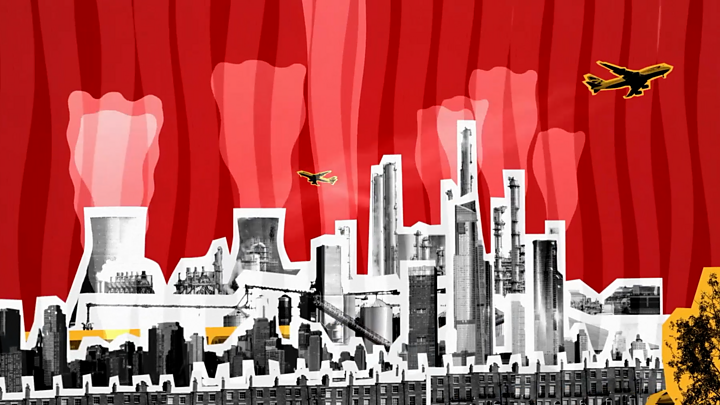
Most man-made emissions of CO2 come from burning fossil fuels. When carbon-absorbing forests are cut down and left to rot, or burned, that stored carbon is released, contributing to global warming.
Since the industrial revolution began in about 1750, CO2 levels have risen more than 30%. The concentration of CO2 in the atmosphere is higher than at any time in at least 800,000 years.
Other greenhouse gases such as methane and nitrous oxide are also released through human activities but they are less abundant than carbon dioxide.
What is the evidence for warming?
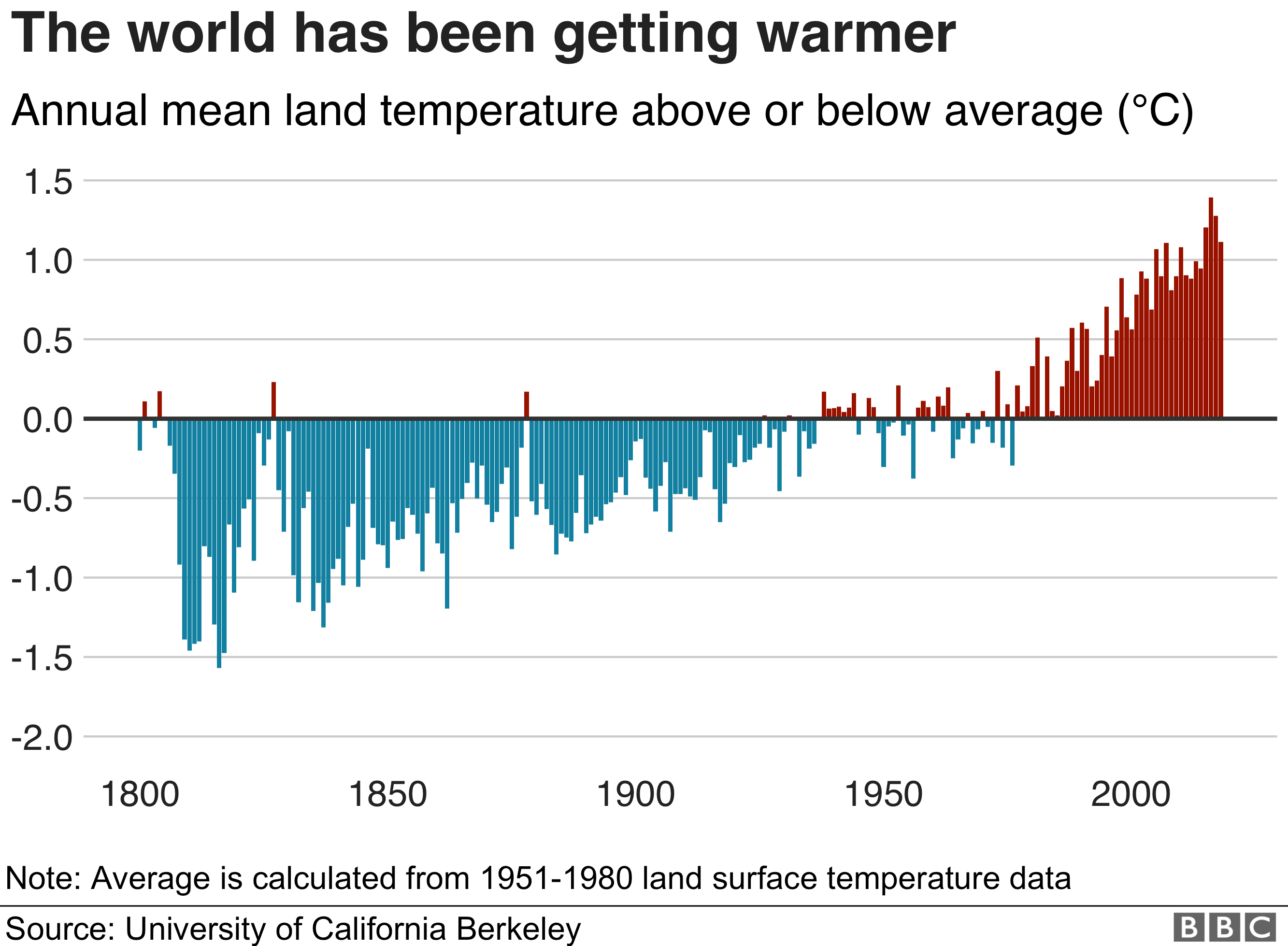
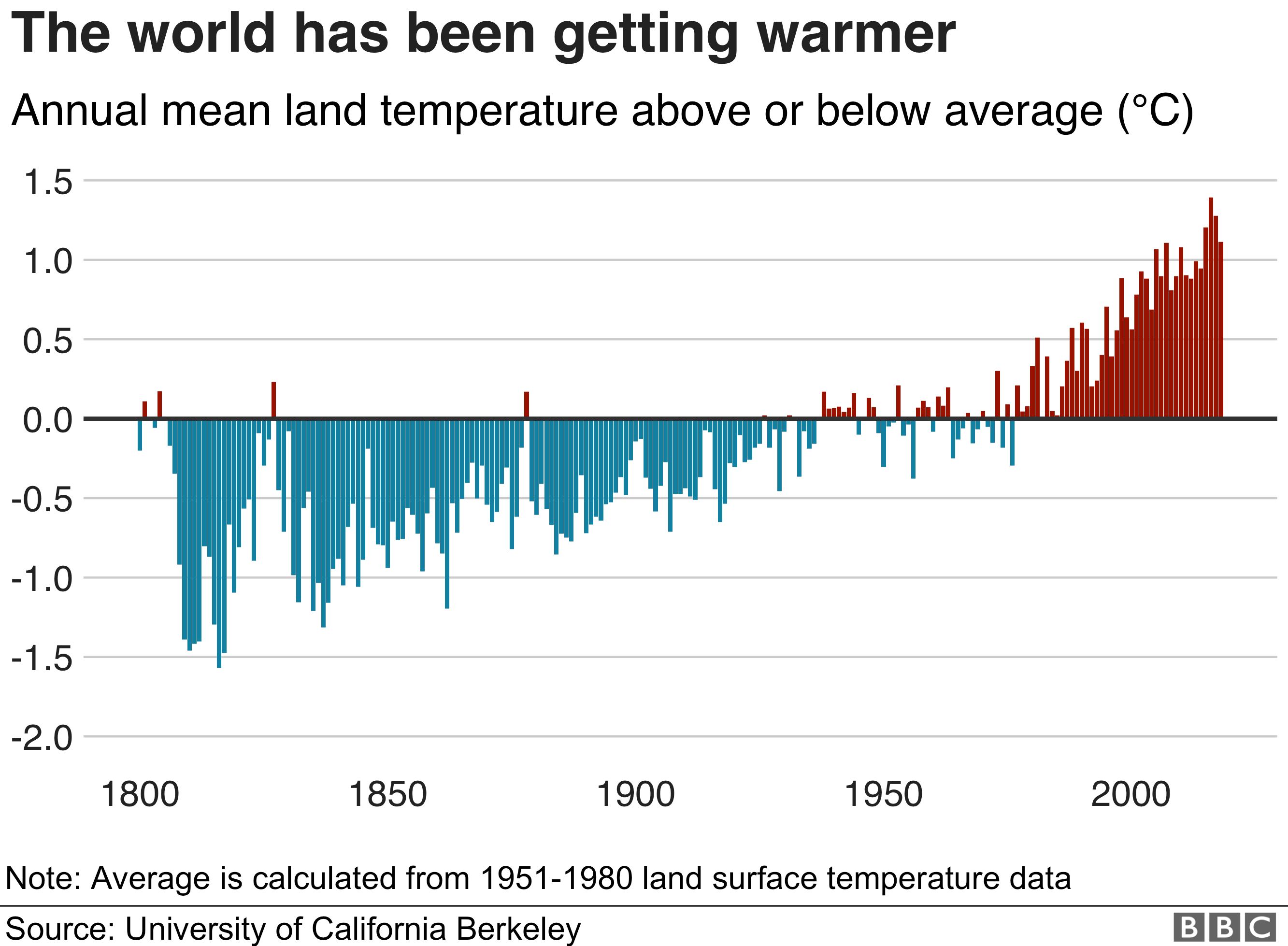
The world is about one degree Celsius warmer than before widespread industrialisation, the World Meteorological Organization (WMO) says.
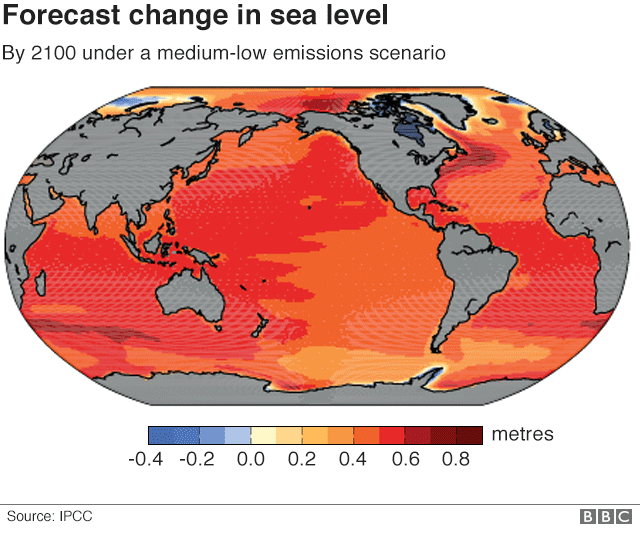
Across the globe, the average sea level increased by 3.6mm per year between 2005 and 2015.
Most of this change was because water increases in volume as it heats up.
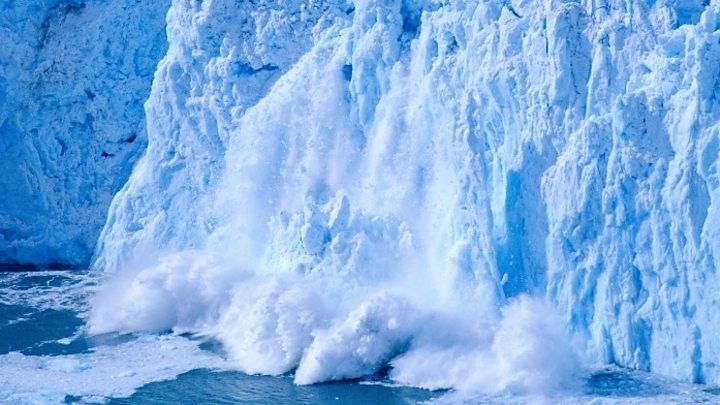
However, melting ice is now thought to be the main reason for rising sea levels. Most glaciers in temperate regions of the world are retreating.
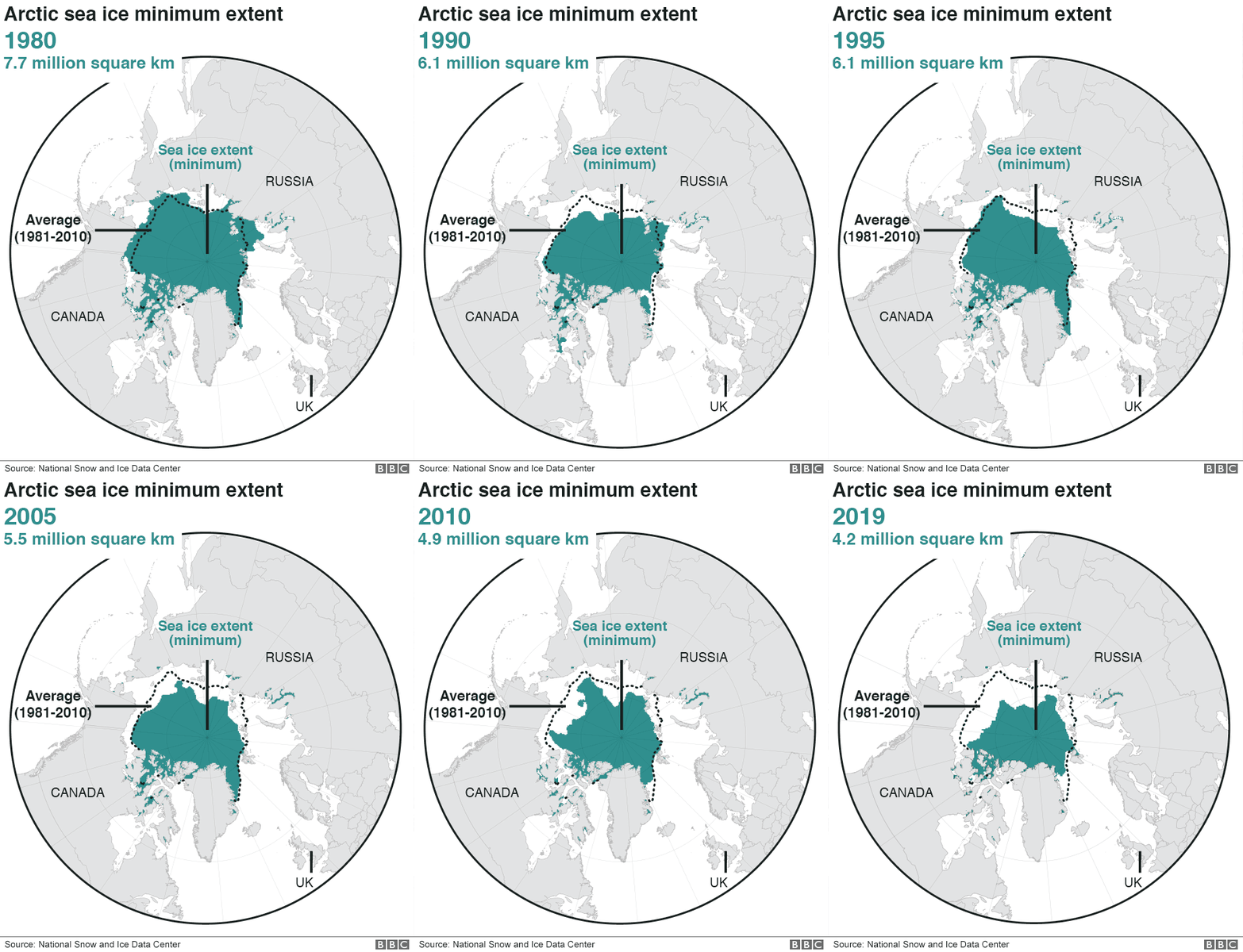
And satellite records show a dramatic decline in Arctic sea-ice since 1979. The Greenland Ice Sheet has experienced record melting in recent years.
Satellite data also shows the West Antarctic Ice Sheet is losing mass. A recent study indicated East Antarctica may also have started to lose mass.
The effects of a changing climate can also be seen in vegetation and land animals. These include earlier flowering and fruiting times for plants and changes in the territories of animals.
How much will temperatures rise in future?
The change in the global surface temperature between 1850 and the end of the 21st Century is likely to exceed 1.5C, most simulations suggest.
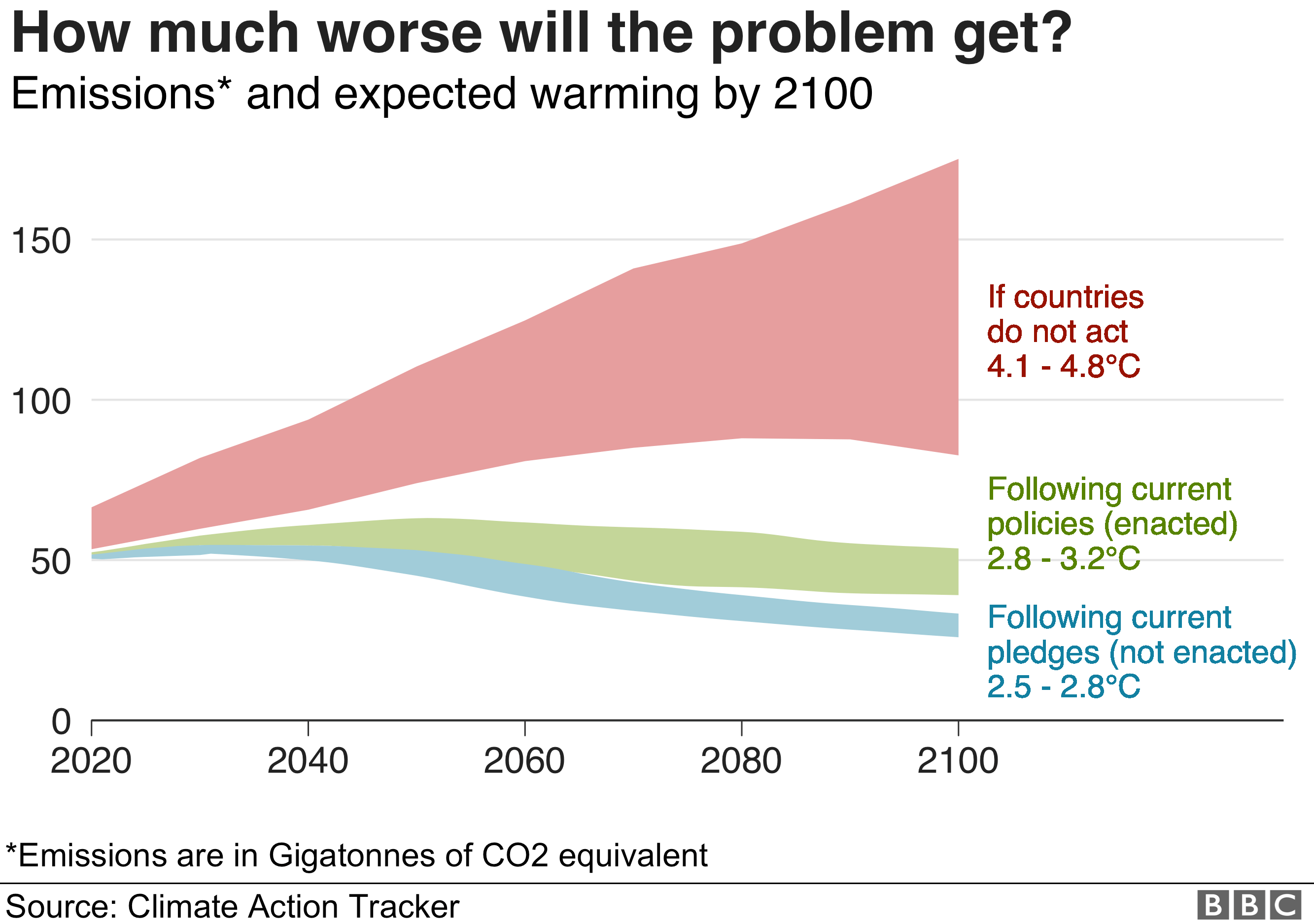
The WMO says that if the current warming trend continues, temperatures could rise 3-5C by the end of this century.
Temperature rises of 2C had long been regarded as the gateway to dangerous warming. More recently, scientists and policymakers have argued that limiting temperature rises to 1.5C is safer.
Media captionClimate change: How 1.5C could change the world
An Intergovernmental Panel on Climate Change (IPCC) report in 2018 suggested that keeping to the 1.5C target would require “rapid, far-reaching and unprecedented changes in all aspects of society”.
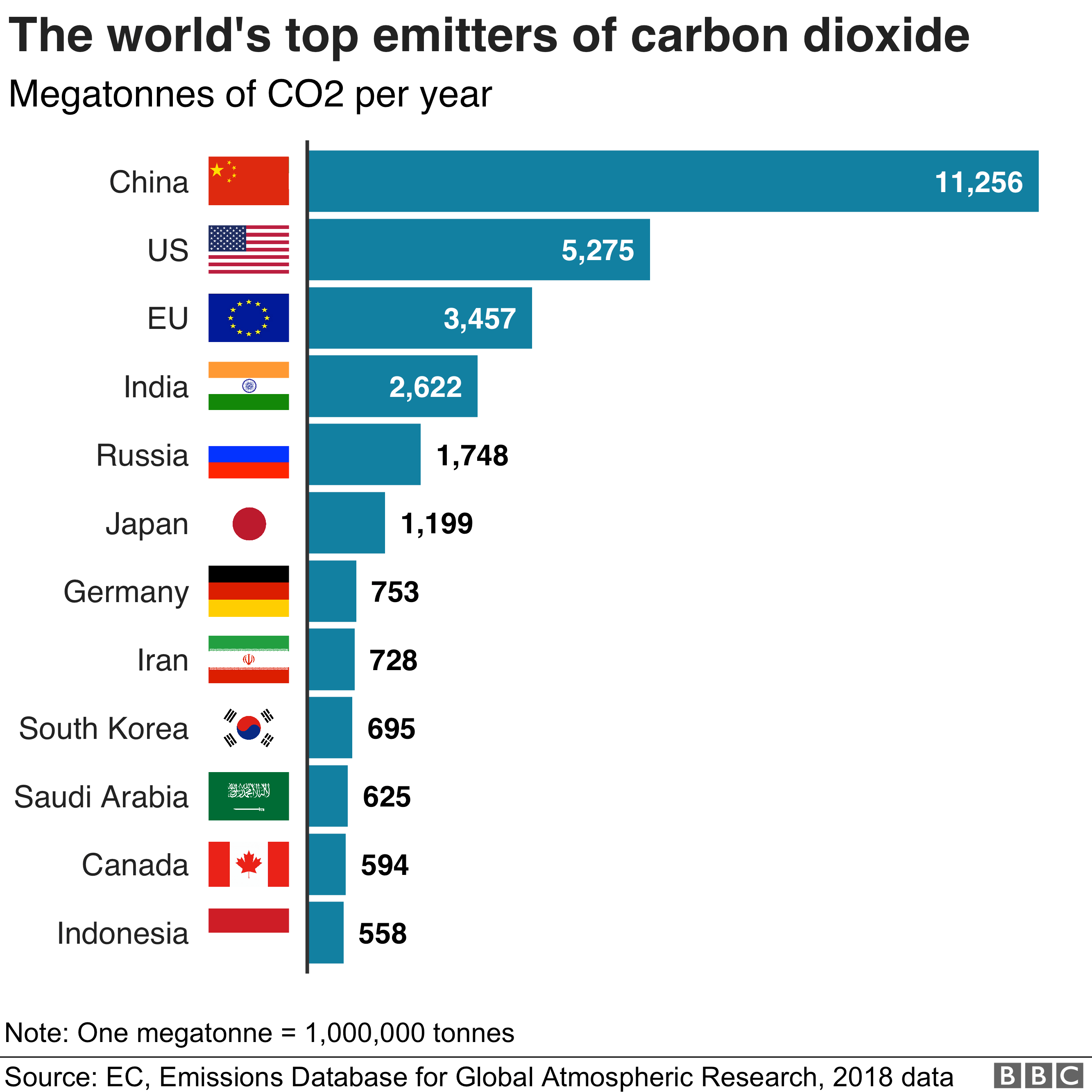
The UN is leading a political effort to stabilise greenhouse-gas emissions. China emits more CO2 than any other country. It is followed by the US and the European Union member states, although emissions per person are much greater there.
But even if we now cut greenhouse-gas emissions dramatically, scientists say the effects will continue. Large bodies of water and ice can take hundreds of years to respond to changes in temperature. And it takes CO2 decades to be removed from the atmosphere.
How will climate change affect us?
There is uncertainty about how great the impact of a changing climate will be.
It could cause freshwater shortages, dramatically alter our ability to produce food, and increase the number of deaths from floods, storms and heatwaves. This is because climate change is expected to increase the frequency of extreme weather events – though linking any single event to global warming is complicated.
Media captionMatt McGrath explains why we should care about climate change
As the world warms, more water evaporates, leading to more moisture in the air. This means many areas will experience more intense rainfall – and in some places snowfall. But the risk of drought in inland areas during hot summers will increase. More flooding is expected from storms and rising sea levels. But there are likely to be very strong regional variations in these patterns.
Poorer countries, which are least equipped to deal with rapid change, could suffer the most.
Plant and animal extinctions are predicted as habitats change faster than species can adapt. And the World Health Organization (WHO) has warned that the health of millions could be threatened by increases in malaria, water-borne disease and malnutrition.
Media captionHow temperatures have risen since 1884
As more CO2 is released into the atmosphere, uptake of the gas by the oceans increases, causing the water to become more acidic. This could pose major problems for coral reefs.
Global warming will cause further changes that are likely to create further heating. This includes the release of large quantities of methane as permafrost – frozen soil found mainly at high latitudes – melts.
Responding to climate change will be one of the biggest challenges we face this century.
Media captionChina needs to tackle climate change – Attenborough
“The moment of crisis has come” in efforts to tackle climate change, Sir David Attenborough has warned.
According to the renowned naturalist and broadcaster, “we have been putting things off for year after year”.
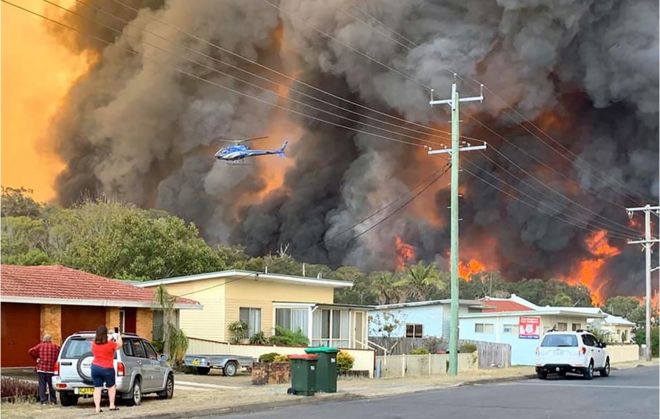
“As I speak, south east Australia is on fire. Why? Because the temperatures of the Earth are increasing,” he said.
Sir David’s comments came in a BBC News interview to launch a year of special coverage on the subject of climate change.
Scientists say climate change is one of several factors behind the Australian fires; others include how forests are managed and natural patterns in the weather.
Sir David told me it was “palpable nonsense” for some politicians and commentators to suggest that the Australian fires were nothing to do with the world becoming warmer.
“We know perfectly well,” he said, that human activity is behind the heating of the planet.
What does Sir David mean by ‘the moment of crisis’?
He’s highlighting the fact that while climate scientists are becoming clearer about the need for a rapid response, the pace of international negotiations is grindingly slow.
The most recent talks – in Madrid last month – were branded a disappointment by the UN Secretary-General, the British government and others.
Decisions on key issues were put off and several countries including Australia and Brazil were accused of trying to dodge their commitments.
“We have to realise that this is not playing games,” Sir David said.
“This is not just having a nice little debate, arguments and then coming away with a compromise.
“This is an urgent problem that has to be solved and, what’s more, we know how to do it – that’s the paradoxical thing, that we’re refusing to take steps that we know have to be taken.”
It said that emissions of the gases heating the planet – from power stations and factories, vehicles and agriculture – should be almost halved by 2030.
Image copyrightGETTY IMAGESImage captionAustralia has been badly hit by bushfires
Instead the opposite is happening.
The release of those gases is still increasing rather than falling and the key gas, carbon dioxide, is now in the atmosphere at a level far above anything experienced in human history.
As Sir David put it: “Every year that passes makes those steps more and more difficult to achieve.”
Why does this matter right now?
This year is seen as a vital opportunity to turn the tide on climate change.
The UK is hosting what’s billed as a crucial UN summit, known as COP26, in Glasgow in November.
Ahead of that gathering, governments worldwide are coming under pressure to toughen their targets for cutting emissions.
Assuming they are delivered as promised (and there’s no guarantee of that), there could still be a rise in the global average temperature of more than 3C by the end of the century, compared to pre-industrial levels.
The latest assessment by the UN’s Intergovernmental Panel on Climate Change (IPCC) lays bare the dangers of that.
It suggests that a rise of anything above 1.5C would mean that coastal flooding, heatwaves and damage to coral reefs would become more severe.
And the latest figures show that the world has already warmed by just over 1C.
What happens next?
As things stand, further heating looks inevitable.
“We’re already living in a changed world,” according to Professor Ed Hawkins of the University of Reading, a scientist whose depictions of global warming have often gone viral on social media.
He uses bold coloured stripes to show how much each year’s temperature is above or below average – different shades of red for warmer and blue for colder.
Media captionOur Planet Matters: Climate change explained
The designs now adorn T-shirts, scarves and even a tram in Germany.
At the moment, Prof Hawkins uses dark red to denote the highest level of warming, but regions such as the Arctic Ocean have seen that maximum level year after year.
Such is the scale of change that he’s having to search for new colours.
“I’m thinking about adding dark purple or even black”, he told me, to convey future increases in temperature.
“People might think climate change is a distant prospect but we’re seeing so many examples around the world, like in Australia, of new records and new extremes.”
What else is on the environmental agenda this year?
The natural world, and whether we can stop harming it.
While most political attention will be on climate change, 2020 is also seen as potentially important for halting the damage human activity is having on ecosystems.
Sir David has a blunt explanation for why this matters: “We actually depend upon the natural world for every breath of air we take and every mouthful of food that we eat.”
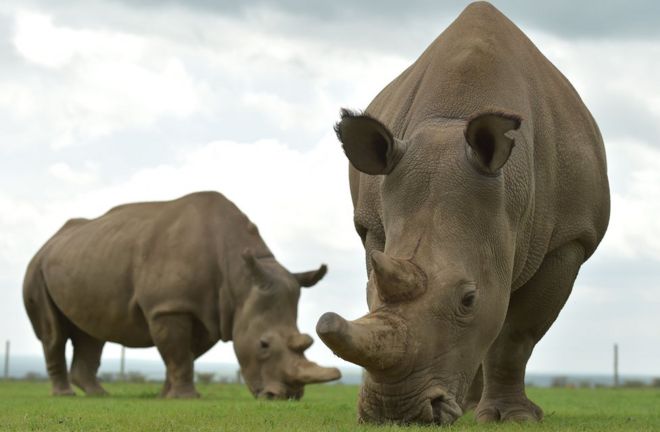
Image copyrightGETTY IMAGESImage captionThe northern white rhino (seen here) is down to just two animals, making it “functionally” extinct
A landmark report last year warned that as many as one million species of animals, insects and plants are threatened with extinction in the coming decades.
A more recent study found that the growth of cities, the clearing of forests for farming and the soaring demand for fish had significantly altered nearly three-quarters of the land and more than two-thirds of the oceans.
One of the scientists involved, Prof Andy Purvis of the Natural History Museum in London, says that by undermining important habitats, “we’re hacking away at our safety net, we’re trashing environments we depend on”.
He points to the impact of everything from the use of palm oil in processed food and shampoo to the pressures created by fast fashion.
And while the need for conservation is understood in many developed countries, Prof Purvis says “we’ve exported the damage to countries too poor to handle the environmental cost of what they’re selling to us”.
The gathering in Kunming takes place in October, a month before the UN climate summit in Glasgow, confirming this year as crucial for our relations with the planet.
The United States House of Representatives on Dec. 18, 2019, approved two Articles of Impeachment against President Donald J. Trump. I believe a third article is needed, that of “Worsening of the Climate Crisis.”
The House of Representatives determines what constitutes “high crimes and misdemeanors,” and harm to the country is one practical criterion. Certainly, Article I and Article II describe significant potential harm to the United States. But Article III describes definitive injury to our country now, and the potential for devastating injury in the future. I propose the revision below of the Articles of Impeachment.
ARTICLE I: ABUSE OF POWER
ARTICLE II: OBSTRUCTION OF CONGRESS
ARTICLE III: WORSENING OF THE CLIMATE CRISIS
(1) Scientific Reality Denial. The heart of Article III is President Trump’s rejection of the science of climate change. The greenhouse effect was discovered in 1859. Upon that foundation was built a massive body of peer-reviewed scientific literature, establishing the details of man-made (anthropogenic) climate change. This science is accepted by essentially every reputable climatologist on Earth, hundreds of global scientific bodies, the U.S. military, most world religions and 197 nation signatories to the Paris Agreement. Yet President Trump rejects climate science and claims, without proof, that climate change is a “Chinese hoax.” This denial of climate change, a concept as well established as the theory of gravity, has resulted in many harmful Trump administration policies.
(2) Paris Agreement Withdrawal. President Trump filed his intent to remove the United States from the Paris Agreement, effective Nov. 4, 2020. The United States thus lost its international leadership role in dealing with the climate crisis and has sabotaged recent climate summits, including COP25 in Madrid. The United States has become a climate pariah under President Trump.
(3) Clean Power Plan Repeal. President Trump’s halting the rollout of this plan killed the United States’ most powerful strategy to cut the greenhouse gas (GHG) emissions that produce global warming. With Trump’s ineffective Affordable Clean Energy replacement power plan, an additional 1,700 Americans will also die annually from air pollution.
(4) Corporate Average Fuel Economy Standards Weakening. By reducing these vehicle fuel-efficiency standards, President Trump would increase GHG emissions, increase dangerous tailpipe pollution, increase lung disease and cost citizens more in larger gasoline purchases. In the United States, 53,000 die annually from tailpipe pollution, according to a Massachusetts Institute of Technology study.
(5) Refrigerant Prohibition Repeal. President Trump stopped enforcement of a 2015 rule that prevented the use of the refrigerant hydrofluorocarbon, a greenhouse gas that is 5,000 times more potent than carbon dioxide over 20 years.
(6) Methane Emissions Reporting Cancellation. President Trump cancelled a requirement that oil and gas companies report their methane emissions. Measurement of methane is crucial in detecting leaks, which can lead to technologies to decrease the leaks. After carbon dioxide, methane is the second most important GHG and has 84 times greater warming potential than carbon dioxide over 20 years.
(7) Endangered Species Abandonment. President Trump withdrew protection of endangered marine mammals and sea turtles on the West Coast. This action was especially destructive at a time when we are experiencing the sixth mass extinction, with loss of 3 billion birds in North America since 1970, for example.
(8) Massive Ocean Extraction Proposal. President Trump proposed opening most of America’s coastal waters for offshore oil and gas drilling. This action benefits only the fossil-fuel coffers while extracting fuels we must not burn and exposing our pristine waters to the risk of another devastating Deepwater Horizon oil spill.
(9) Extensive Additional Deregulation. The examples of harmful deregulation above are only a few of 80 instances of Trump deregulation found in research by Harvard and Columbia law schools and analyzed by the New York Times. Some of these examples are now law, some have been rejected by the courts and others are under litigation.
In summary, President Trump is deemed unfit for office given the high crimes and misdemeanors described in Articles I, II and III. In our modern era, in which science and technology are critical for a functioning society, President Trump’s rejection of science is a dangerous incompetence. The gold standard of climate science, the Intergovernmental Panel on Climate Change, states that the impacts of climate change are already evident, will multiply this century and will become devastating if global mean temperature increase is more than 1.5 degree Celsius. To prevent this temperature increase, the world must slash GHG emissions approximately 7% each year. In contradiction of this requirement, U.S. emissions rose 3.4% in 2018 under President Trump. This increase is not surprising as all the examples of deregulation above will increase greenhouse-gas emissions, as they benefit the fossil-fuel industry and other corporations.
California and Australia are scorched by hellish wildfires, Africans suffer famine from climate-worsened drought and sea-level rise is drowning homes of the Bangladeshi. Meanwhile, President Trump adopts policies that will enrich himself and the fossil-fuel industry, while inflaming this climate crisis. By the criterion of presidential harm to the United States (and the world), President Trump must be removed from office.
The heat in the world’s oceans reached a new record level in 2019, showing “irrefutable and accelerating” heating of the planet. Photograph: Modis/Terra/Nasa
Oceans are clearest measure of climate crisis as they absorb 90% of heat trapped by greenhouse gases
The heat in the world’s oceans reached a new record level in 2019, showing “irrefutable and accelerating” heating of the planet.
The world’s oceans are the clearest measure of the climate emergency because they absorb more than 90% of the heat trapped by the greenhouse gases emitted by fossil fuel burning, forest destruction and other human activities.
The new analysis shows the past five years are the top five warmest years recorded in the ocean and the past 10 years are also the top 10 years on record. The amount of heat being added to the oceans is equivalent to every person on the planet running 100 microwave ovens all day and all night.
Hotter oceans lead to more severe storms and disrupt the water cycle, meaning more floods, droughts and wildfires, as well as an inexorable rise in sea level. Higher temperatures are also harming life in the seas, with the number of marine heatwaves increasing sharply.
The most common measure of global heating is the average surface air temperature, as this is where people live. But natural climate phenomena such as El Niño events mean this can be quite variable from year to year.
“The oceans are really what tells you how fast the Earth is warming,” said Prof John Abraham at the University of St Thomas, in Minnesota, US, and one of the team behind the new analysis. “Using the oceans, we see a continued, uninterrupted and accelerating warming rate of planet Earth. This is dire news.”
“We found that 2019 was not only the warmest year on record, it displayed the largest single-year increase of the entire decade, a sobering reminder that human-caused heating of our planet continues unabated,” said Prof Michael Mann, at Penn State University, US, and another team member.
Advertisement
The analysis, published in the journal Advances In Atmospheric Sciences, uses ocean data from every available source. Most data is from the 3,800 free-drifting Argo floats dispersed across the oceans, but also from torpedo-like bathythermographs dropped from ships in the past.
The results show heat increasing at an accelerating rate as greenhouse gases accumulate in the atmosphere. The rate from 1987 to 2019 is four and a half times faster than that from 1955 to 1986. The vast majority of oceans regions are showing an increase in thermal energy.
This energy drives bigger storms and more extreme weather, said Abraham: “When the world and the oceans heat up, it changes the way rain falls and evaporates. There’s a general rule of thumb that drier areas are going to become drier and wetter areas are going to become wetter, and rainfall will happen in bigger downbursts.”
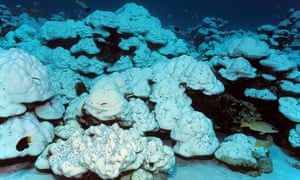
Bleached coral on the Great Barrier Reef, Australia. Photograph: Helmut Corneli/Alamy Stock Photo
Hotter oceans also expand and melt ice, causing sea levels to rise. The past 10 years also show the highest sea level measured in records dating back to 1900. Scientists expect about one metre of sea level rise by the end of the century, enough to displace 150 million people worldwide.
Dan Smale, at the Marine Biological Association in the UK, and not part of the analysis team, said the methods used are state of the art and the data is the best available. “For me, the take-home message is that the heat content of the upper layers of the global ocean, particularly to 300 metre depth, is rapidly increasing, and will continue to increase as the oceans suck up more heat from the atmosphere,” he said.
“The upper layers of the ocean are vital for marine biodiversity, as they support some of the most productive and rich ecosystems on Earth, and warming of this magnitude will dramatically impact on marine life,” Smale said.
The new analysis assesses the heat in the top 2,000m of the ocean, as that is where most of the data is collected. It is also where the vast majority of the heat accumulates and where most marine life lives.
The analysis method was developed by researchers at the Chinese Academy of Sciences in Beijing and uses statistical methods to interpolate heat levels in the few places where there was no data, such as under the Arctic ice cap. An independent analysis of the same data by the US National Oceanographic and Atmospheric Administration shows that same increasing heat trend.
Reliable ocean heat measurements stretch back to the middle of the 20th century. But Abraham said: “Even before that, we know the oceans were not hotter.”
“The data we have is irrefutable, but we still have hope because humans can still take action,” he said. “We just haven’t taken meaningful action yet.”
Australia is burning. The bushfires have devastated the continent since September and continue to ravage the country at an alarming pace. Photos and videos of charred animals—unable to escape the overwhelming blazes—have gone viral.
One inane tactic that officials have come up with to combat the problem includes shooting up to 10,000 thirsty camels from helicopters, just because they drink large amounts of water.
MORE THAN A BILLION ANIMALS HAVE ALREADY DIED, AND AUSTRALIAN OFFICIALS WANT TO ADD THOUSANDS MORE INDIVIDUALS TO THE DEATH TOLL—INDIVIDUALS WHO ARE JUST AS MUCH RESIDENTS OF SOUTH AUSTRALIA AS ITS HUMAN INHABITANTS AND WHO ARE JUST AS DESERVING OF MAKING IT OUT OF THE AUSTRALIAN FIRES ALIVE.
In the video below, a bystander recorded dozens upon dozens of dead, burned animals scattered along roads:
This Is Climate Change, and We Must Take Action Like Never Before
Many blame climate change for exacerbating the wildfires, which have burned more acres than recent Amazon rainforest and California fires combined. Around the world, prolonged heat and drought have extended seasonal wildfire periods.
All the while, the U.N. has stated that meat consumption must decrease by as much as 90% in order for us to avoid the most catastrophic effects of climate change. To put it in perspective, the carbon emissions from all of the world’s planes, trucks, ships, and cars are equivalent to the emissions from animal agriculture!
WIRED
✔@WIRED
Kangaroos hop uphill in smoky New South Wales to escape the smoke and raging fires in Australia. The country’s bushfires have scorched millions of acres, putting millions of people and animals at risk.
We can (and must) fight climate change. By far, the easiest way is for people to stop eating animals and go vegan right now. It requires zero governmental initiative or promises from some giant corporation. It only involves choosing to leave animals out of the shopping cart on that trip you’re already making to the grocery store.
GOING VEGAN CAN HELP PREVENT ANIMALS FROM BEING BURNED ALIVE IN A WILDFIRE OR BEING SLIT ACROSS THE THROAT IN A SLAUGHTERHOUSE.
It’s estimated that, at a minimum, about 800,000 million animals have been killed in Australia’s fires. This is about the same number of land animals who are horrifically slaughtered every few days just so that people can eat their flesh.
No matter if it’s a kangaroo trapped in a barbed-wire fence after running from a scorching fire or cows screaming for their lives as they’re hoisted up by chains to bleed out from their wounds, every one of these animals feared for their lives and did all that they could to stay alive.
The Best Time to Go Vegan Was Yesterday—the Next-Best Time Is Right Now
Many of us feel relatively powerless when facing mass extinctions, rising sea levels, and record-breaking fire seasons, but we actually have a great deal of power to change things if we harness it.
This is exactly why being vegan isn’t some fad diet. It’s a revolutionary action. It’s us exclaiming, “We will not let this planet and countless sensitive animals die on our watch!”
Join the vegan movement today and ask everyone you know to do the same. The Earth itself depends on it.

















 Exposing the Big Game