(CNN)As customers strolled the aisles of a Kroger supermarket in Indiana they were joined by an unexpected visitor.
Brigitte Dan, who also goes by her Vietnamese name Von, was shopping for some dinner items with her mother and two children on Saturday night. The family was waiting at the meat department in the Zionsville store when a large brown animal came barreling toward them.
“I saw a huge deer run frantically toward me, at first I thought it was a German Shepard, so I pushed my kids out of the way but soon realized it was a deer!,” Dan told CNN in an online message.
Dan captured video of the animal sliding along the floor as it turned down an aisle. At one point, the deer even jumped over the meat counter.
“The store did have a surprise visitor last night, entering through the front door,” Eric Halvorson, a Kroger spokeperson, told CNN. “As far as I know, this is a first for our division.”
“I hope, in her time near the meat case, the deer noticed our expanded selection of plant based protein products.”
Dan said the store staff and police tried to catch the deer but she eventually made it back outside.
Come November, a month of holiday travel and bad weather, we’ll see busy roads and busier schedules. And according to the annual report on animal collisions by North Carolina’s Department of Transportation, it’s also a very dangerous time to be a deer.
For the years 2016 to 2018, November sees the most animal-related car crashes, with the month alone accounting for 21.9% of the total combined reported animal-related crashes. While the gathered data does not differentiate between the kinds of animals involved in these crashes, data analyses show that approximately 90% of all reported animal-related crashes involve deer.
The annual report contains information such as what months and times of day (or night) the most animal-related crashes occur, and which counties experience the greatest number of them.
Wake County sees the most crashes out of the 100 counties, with 822 in 2017, having a population of 1.072 million in 2017. While this yields one animal-related crash per 1,304 people, population is far from the only factor. Places with fewer roads and drivers see significantly fewer animal-related crashes, a story common in the western part of the state.
As for Watauga, while our 2017 figure was a mere 77 crashes (less than a tenth of Wake County), this is still one crash per 715 people. So while Wake County is far and away the most animal-unfriendly from a raw numbers perspective, Watauga is still a little more deadly per capita. Of course, any number of factors outside population may play into the figure, from how frequently our roads are traveled to nighttime visibility, to road culture. Likewise, more traffic through a particular county may increase the likelihood of animal-related crashes in that area.
Given Watauga’s close relationship to nature, the danger of animal collisions is all the more pronounced. Deer presence on roads is heightened during fall and early winter months, due to the hunting and mating seasons – by no coincidence are the months of October through January the most crash-prone, containing 56.6% of the year’s total animal-related crashes. Furthermore, the evening hours between 5 PM and midnight account for half of these crashes.
Fortunately for Watauga, the injuries suffered from these crashes have been non-fatal, with 7 injuries between 2016 and 2018 (out of a total of 220 incidents).
As November draws near, the Department of Transportation offers helpful tips to motorists that may decrease the risk to both themselves and the animals during their travels:
In heavily wooded areas, and areas with deer crossing signs, slow down, especially during late hours.
Wear a seat belt. Most deer-vehicle related injuries occurred while drivers or passengers were not wearing a seat belt.
Bridges, overpasses, railroad tracks, streams, and ditches see the most deer activity. Be especially vigilant around these areas.
When possible, drive with high beams on, and watch for eyes reflecting in the headlights.
Deer travel in groups. If you see just one, be on the lookout for another.
To scare oncoming deer, slow down and blow your horn in one long blast. Do not rely on deer whistles or reflectors, as these are unproven to be effective.
Maintain a safe distance between your vehicle and others. If a car ahead of you hits a deer, you could also become involved in the crash.
Do not swerve to avoid deer. This could cause a more serious crash with other vehicles, or cause your vehicle to flip.
Lastly, if you do strike a deer, do not touch it. Frightened and wounded deer can injure you or itself further. If possible, pull the car off the road and call 911.
So when traveling for the holidays, be mindful of the heightened deer activity, both for their safety and for yours. The annual report by the North Carolina Department of Transportation can be found here.
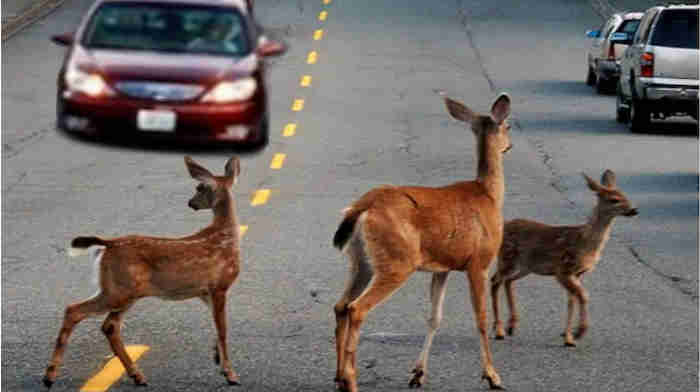
“Man killed by tiger at San Francisco Zoo.” “Teenager mauled by shark off Hawaii beach.” “Pit bull attacks neighbor.” These types of incidents get massive media coverage but are very rare occurrences. Deer on the other hand don’t get near the press, but are much more dangerous.
Deadliest animals to humans
If someone had asked you “What is the most dangerous creature you might encounter in the US, what would you answer? Without reading the title of this article, would you have guessed deer? I doubt it. Sharks? Snakes? Bees? Marc Siegel’s comments are quite appropriate, “Media obsession not only misinforms but also diverts attention from the real danger.” 1
Here’s a recent example from Science Daily: “The animals most commonly responsible for human fatalities are farm animals, insects (hornets, wasps, and bees) and dogs.” 2 Note no mention of deer.
Here’s a table listing animals most dangerous to humans 3. Again, no mention of deer.
Animals most dangerous to humans
Animal
Humans Killed Per Year
Mosquitoes
1,000,000
Snakes
50,000
Dogs
25,000
Tsetse flies
10,000
Scorpions
3,250
Crocodiles
1,000
Here’s what you may not have heard: Up to 1.5 million cars collide with deer annually in the United States, killing more than 200 Americans, causing approximately 10,000 injuries, and resulting in almost a billion dollars worth of damages. By these numbers, deer are roughly two hundred times deadlier than sharks. 4
While the National Highway Traffic Safety Administration (NHTSA) keeps annual figures for car-deer accidents, the figures lack a measure of exactness and certainty because there currently is not standardization in the reporting of deer-related accidents throughout the country, and because what constitutes a ‘reportable accident’ varies so much between states. Also, with a portion of drivers on the road uninsured, unlicensed or driving under the influence, many more deer collisions probably go unreported. 5
Here are the top five states for claims from a collisions with deer, elk, moose or caribou in 2018. 6
Top five states for claims from a collisions with deer, elk, moose or caribou in 2018
Rank
State
2018 odds
1
West Virginia
1 in 46
2
Montana
1 in 57
3
Pennsylvania
1 in 63
4
Wisconsin
1 in 72
5
Iowa
1 in 73
In 2017, the total deer population in the United States was an estimated 33.5 million, down from 38.1 million in 2000. Yet even at their current population, deer are ravaging ecosystems across the country. 7
Scientists estimate that when white people first arrived in Wisconsin, the northern forests of the state held four to eight deer per square mile. As a result of human intervention, there are now roughly 25 to 30 deer per square mile in parts of northern Wisconsin, and double that in some middle and southern countries. The same challenge extends to many other parts of the country.
In Virginia, state officials estimate that deer densities in Fairfax County parks, not far form Washington DC, have reached more than 100 animals per square mile. Scientists in New York and Pennsylvania have turned up ecological impacts from whitetails as well, prompting groups such as the Nature Conservancy to argue that high deer numbers may pose a greater threat to forests in the eastern United States than climate change. 8
Deer devoured countless wildflowers close to extinction and devastated saplings of cedar, hemlock and oak. All of this eating, amounting to more than 2,000 pounds of plant matter per deer per year might account for widespread declines of North American songbird populations, which rely on many of the plants upon which deer gorged themselves.
Another issue is ticks that carry Lyme disease and a faster spread of threats such as chronic wasting disease (CWD) which attacks the nervous system of deer and causes them to lose weight and eventually die. The misshapen protein that causes CWD hasn’t been shown to affect humans, but concerns over it are leading some hunters to avoid certain areas or give up the sport entirely. That, in turn, could make it harder for the remaining hunters, already an aging and dwindling group, to keep the herd in check. Nationally, the number of hunters dropped 16 percent from 2011 to 2016. The level of hunting in 2016 was the lowest measured in the past 25 years. 8
What to do?
Until scientists discover a way to deer-proof our roadways, the best advice for avoiding them is to take it slow in rural wooded areas in the evening hours, especially on winding roads with blind approaches.
References
Marc Siegel, False Alarm: The Truth About the Epidemic of Fear, (John Wiley & Sons, New York, 2005)
Protesters in front of Marineland theme park. Photograph: Tara Walton/Toronto Star via Getty
A controversial theme park in Canada is facing renewed criticism following the deaths of three animals in recent weeks, triggering fresh calls from activists for the attraction to be shut down.
Officials at Marineland, which sits on the Canadian side of Niagara Falls in Ontario, said two deer were killed in a stampede allegedly caused by a father and son taunting the animals. The incident, which occurred last weekend when the attraction opened for the season, has prompted staff to temporarily close the deer park area.
Days after the stampede, the park also announced the results of a postmortem on one of its walruses which died in April, citing a heart attack as the cause of death for the 18-year-old animal named Apollo. Apollo is the fourth walrus to die in the park over the last two years, leaving it with only one remaining animal – a female called Smooshi.
Speaking of the deer deaths, Marineland said: “We are all upset by this terrible act against innocent animals. In order to protect our animals, we are closing the deer park to make modifications to prevent this type of incident from ever happening again.” It added that this was the first time such an incident had occurred.
Deer sit around the perimeter of Marineland’s deer park. Photograph: Tara Walton/Toronto Star via Getty Images
But Phil Demers, a former animal trainer at the park who has become Marineland’s most vocal critic, rejected the park’s explanation, claiming that a move to reopen the deer park to visitors after years of closure could cause panic among the animals.
Advertisement
“There’s been countless incidences of patrons stressing out the animals. [Marineland] took a gamble. They opened it for the first time in years,” he said.
Marineland has increasingly become a target for activists, who argue the park has a moral responsibility to release the animals it keeps in captivity. The park dismissed protests outside its gates over the opening weekend as a “small group of annual demonstrators [who] continue to seek to damage Marineland at all costs”.
The park was the focus of a 2012 investigation by the Toronto Star, which interviewed a number of employees alleging incidences of animal neglect. The park is contesting the claims.
“Marineland is in what can only be described as a significantly worse condition than when I spoke out in 2012. There has been exactly no investment in improvement to the animal life support systems whatsoever,” said Demers.
Marineland has vigorously denied the claims and has been in a legal battle with Demers over the last seven years, alleging he attempted to steal a walrus – an allegation he calls “absurd”.
Despite pressure from critics, the park continues to house an estimated 51 beluga whales. It also has five bottle-nosed dolphins and a single orca named Kiska.
A male beluga whale at Marineland. Photograph: Denis Cahill/AP
Proposed legislation in the Canadian parliament – dubbed the “Free Willy bill”– is likely to receive royal assent in the coming weeks and would ban the captivity of cetaceans, including orcas, dolphins and beluga whales across the country. The province of Ontario previously passed similar legislation, which banned the acquisition of large marine mammals, but allowed Marineland to keep its whales.
Ever since the park’s owner, John Holer, died last year, the company – Holer Family Amusements – has been at a “crossroads”, the Niagara Falls mayor, Jim Diodati, told the Toronto Star, as it explores a possible expansion of the park, or sale of its land to developers.
An adorable friendship is blossoming in the town of Loomis, Washington. Meet the deer and bunny who resemble Bambi and Thumper.
Author: Emily Gilbert
Published: 5:20 PM PDT May 16, 2019
Updated: 6:05 PM PDT May 16, 2019
LOOMIS, Wash. — Perhaps the movie wasn’t the end for Disney’s Bambi and Thumper. A small herd of deer and their rabbit companion have been spotted in Loomis, Washington.
KING 5 viewer Darlene Wilbourn said the animals visit her mother’s yard every day. In the heartwarming video, you can see the bunny follows a few of the deer around as they lay in the sun.
There doesn’t seem to be any other bunnies as part of the group, but the deer don’t seem to mind. One deer chews peacefully as the bunny sits between its front legs. Another deer even appears to touch noses with the smaller animal.
It seems that Disney’s duo has come to life in Washington.
Share your photos and videos with KING 5 on our Facebook page, or by tagging your Twitter and Instagramposts with #k5spring.
Warning: The Facebook post below may be considered disturbing.
TULSA COUNTY, Okla. – A man has pleaded guilty and was ordered to pay more than $10,000 in fines and restitution after game wardens found an illegal deer trap on a Tulsa County property.
According to game wardens, in fall 2018, Game Warden Brandon Fulton was patrolling in a secluded area of Tulsa County when he noticed a “snare-style trap made using a tree near a residence.”
Fulton contacted the owner and informed him “it would be illegal to use such a trap on anything, including large animals such as deer. The snare had no sign of hair or blood on or around it,” game wardens said on Facebook.
The trap was removed by the owner.
Months later, on January 2, 2019, Fulton was patrolling the same area and noticed a trap-style net hanging from a tree on the same property.
Fulton noticed there were deer tracks and corn on the ground under the net, which had blood and deer hair in it, officials say. He also noticed a remote motion sensor pointed toward the net along with a release rope running from the net through a window in the home to trigger the trap.
A person in the home told Fulton the trap was built for wolves.
Officials said a search warrant was issued for the property and two illegal deer were found along with photo and video evidence of the crimes.
Game wardens say evidence showed “deer were being trapped alive, tied up, then taken into a building and killed.”
The maker of the trap, who was not identified, was charged with several violations of state law and commission regulations.
He did plead guilty to all charges and paid $10,300 in fines and restitution.
Where and how far deer roam will be learned from the five-year predator project conducted in Grant, Iowa and Dane counties.
Photo by Jerry Davis
Deer continue to look for “greener grass” after a difficult winter. Sometimes that food is close to homes.
Photo by Jerry Davis
Deer 6204 spent most of her life within a few miles of her birth site. Each red dot represents a location sent from a GPS unit on her adult collar.
Three years ago when the Southwest Wisconsin CWD, Deer, and Predator Project began, those connected and interested were eager for results, even anecdotal leanings.
But science usually doesn’t move like that; wait until all the data is in, scrutinize it, and then see if the general hypothesis has been supported, or not. Maybe the support will be something entirely different.
About 200 adult deer have been captured and collared each winter, with a fourth winter to begin December 2019. In addition, fawns (neonates) were hand-captured each spring and will be again this spring. Coyotes and bobcats were live-trapped and collared, too.
Of course many of the collared deer die each year, so the total number goes down, particularly during hunting season.
All these animals are being followed as long as they live, then the cause of death is determined, if possible. Did the deer die of disease, hunting, vehicle accident, predator catch or starvation, for example?
Other information is collected at the time of capture and when the deer dies, too. The data points on maps gives scientists the locations of the animals when the GPS collar sends it back to a database.
Here’s some information on one deer, captured when it was a day old, May 24, 2017, and then net captured Feb. 1, 2018, when the fawn collar was replaced by the adult deer collar.
The deer died in March 2019, but the cause of her death is still under investigation. One might guess starvation in this case, but wait for the necropsy to determine the official cause. Death could be the result of several causes, too.
A release to the landowner of data points where she spent the last year of her life looks like a bad case of measles in a 3.5-square-mile landscape, with most of the scores being in 1 square mile. She died less than a half-mile of her two capture sites, which were a few hundred yards apart.
The data will continue to fill computer files for years to come, with some samples still in cold storage until money, time and expertise become available.
Blood samples, chronic wasting disease tests, weight, likely age, general health, along with gender, and some fecal samples. Data points can be used to determine likely fawning of does and association of bucks with other deer.
Most collared deer will not have their entire life history on a computer, but those who do not still provide information in the study: What percent of the deer die, and at what age, from various causes?
Hunters who take possession of a collared deer also receive the data points of the animal’s whereabouts from capture (collaring) to death.
When Rachel Howatt’s beloved husky Koda got loose in late December, she spent a lot of time searching the woods near her home to no avail. But eventually, a few days later, the trustworthy pup showed up back at home in Manitoba, in Ontario, Canada, like nothing ever happened.
“We definitely searched for her, but in the end she just came back,” Howatt told The Dodo. “She is really smart, so I didn’t doubt she could find her way home.”
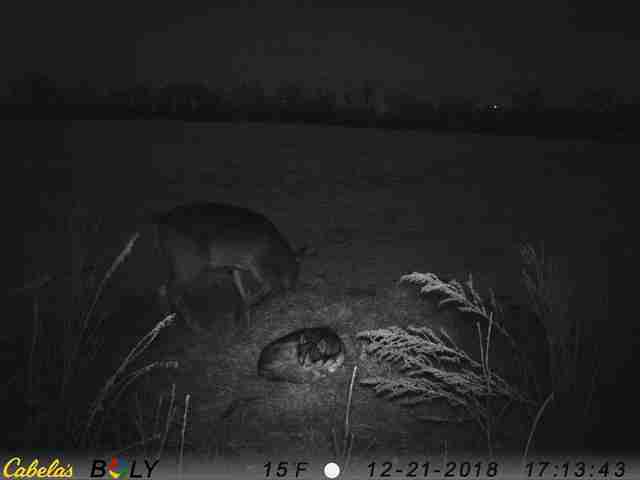
It wasn’t until a few days later that Howatt thought to check with her neighbor, who has a trail camera in the woods by their home, to see if Koda had been spotted at all. Sure enough, Koda had been picked up on the camera — and she wasn’t alone.
Rachel Howatt
Huddled up right next to her, eating and napping with her, was a male deer.
For the entire evening, Koda is shown playing with and sitting next to the buck, who didn’t seem bothered at all that there was a dog with him.
Rachel Howatt
“It was quite something,” Howatt said. “Based on the time they spent on frame, it looked like they spent over 12 hours together. There’s also another photo where there’s two bucks in the picture with her.”
Rachel Howatt
This isn’t the first time wild deer have come to befriend a wayward animal. Deer have been known to take in runaway cows and even cats as their own when they meet in the woods.
While Howatt will do her best to keep Koda from running off in the future, she has a feeling that the dog will want to go back out to the woods to reunite with her wild friend.
Rachel Howatt
“Huskies have such a free spirit,” Howatt said. “It doesn’t surprise me at all that Koda was trying to make a new friend.”
As gray wolves continue to make a strong comeback in Washington state, their presence can’t help but impact other animals—particularly the ones these large carnivores target as prey.
White-tailed deer and mule deer, two distinct species common in Washington, are among wolves‘ favorite catch. Wolves will chase deer great distances—sometimes upwards of 6 miles (10 kilometers)—in search of a satisfying meal. How these two deer species respond to the threat of being pursued by wolves in the early years of this predator’s return could shed light on changes to their behavior and numbers.
To help answer this question, researchers from the University of Washington and other institutions monitored the behavior and activity of wolves and deer in Washington for three years. They found that mule deer exposed to wolves, in particular, are changing their behavior to spend more time away from roads, at higher elevations and in rockier landscapes.
“In any particular ecosystem, if you have a predator returning, prey are unlikely to all respond similarly,” said senior author Aaron Wirsing, an associate professor in the UW School of Environmental and Forest Sciences. “We show that wolves don’t have a uniform effect on different deer species.”
Their results were published Dec. 11 in the journal Oecologia.
An adult gray wolf is caught on a wildlife camera in eastern Washington in 2015. Credit: University of Washington
Wolves were completely wiped out from Washington early last century, but began returning to the state from Idaho, Montana and Canada about a decade ago. The latest estimates now show about 200 wolves in packs across eastern Washington.
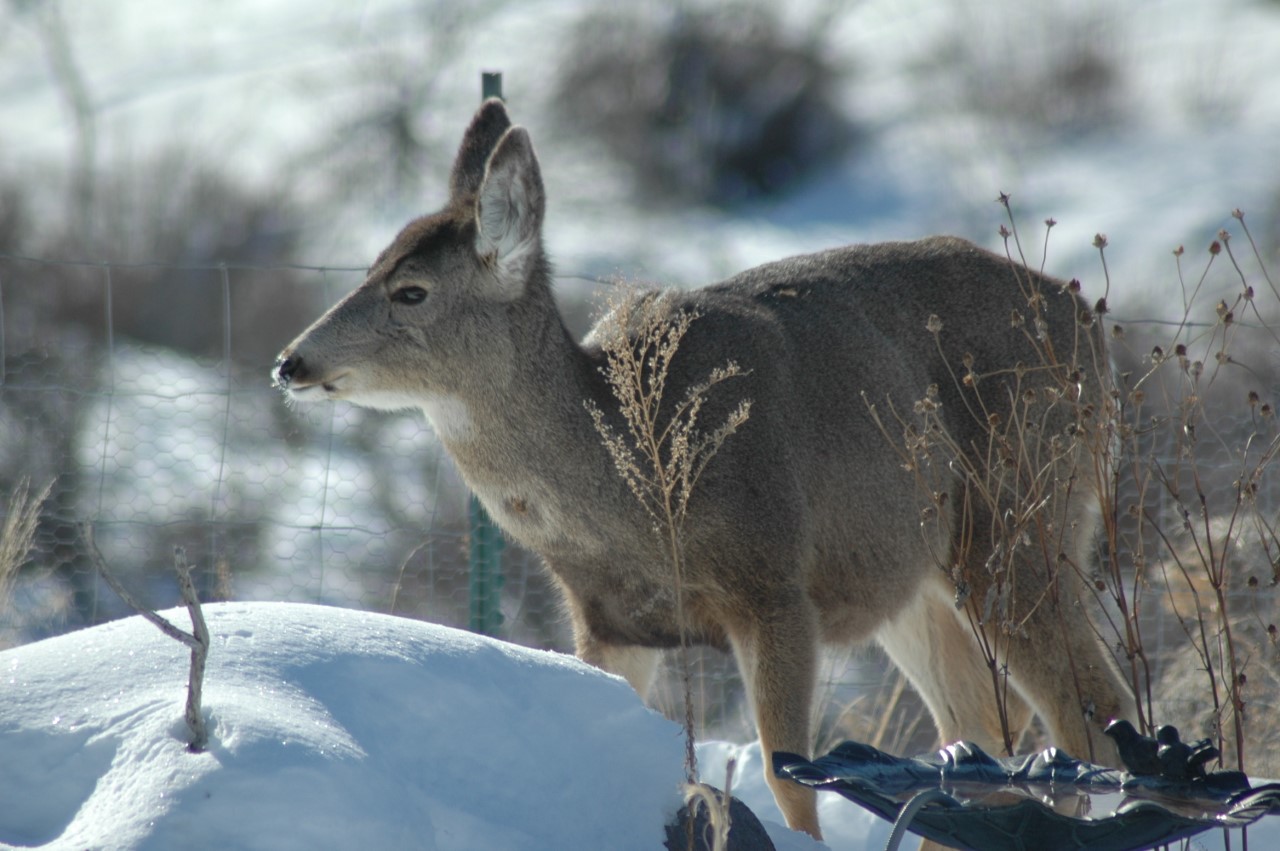
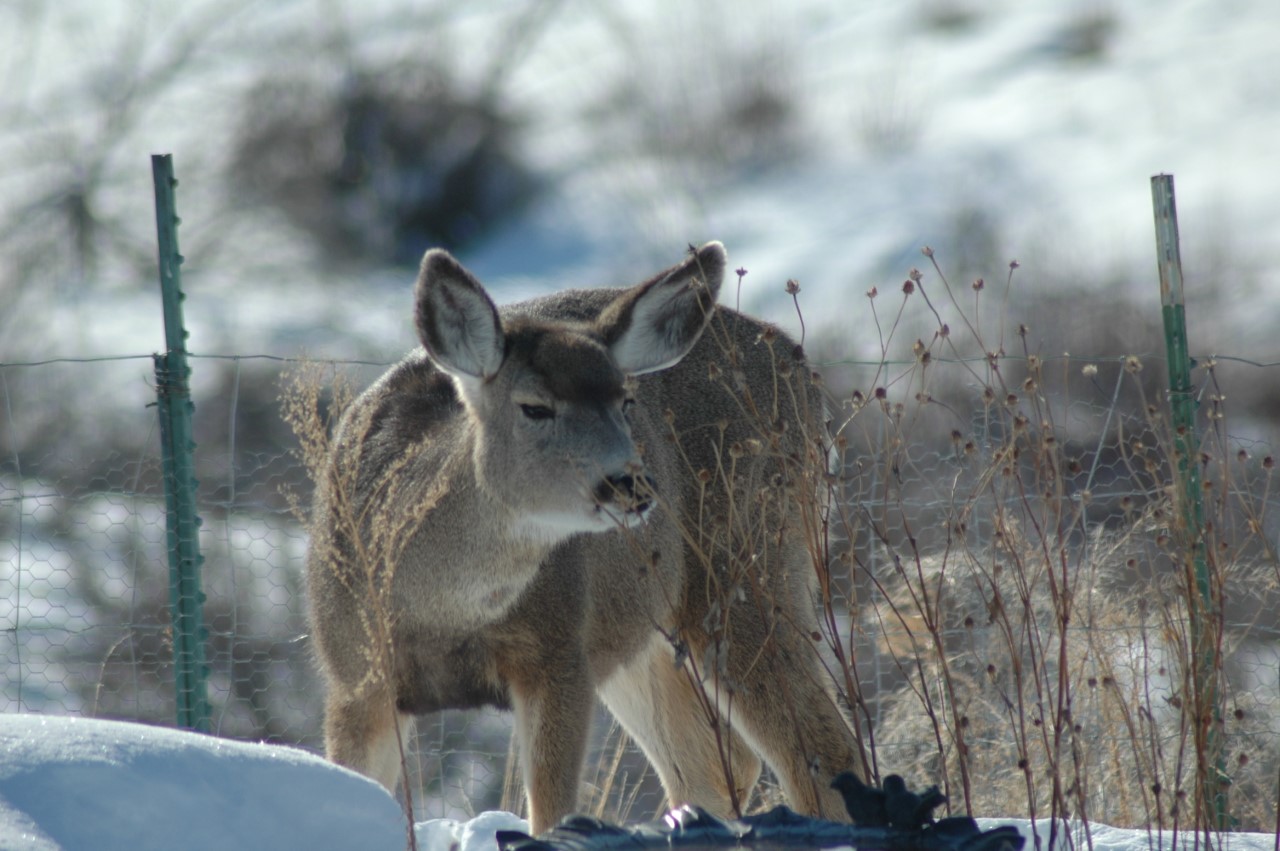
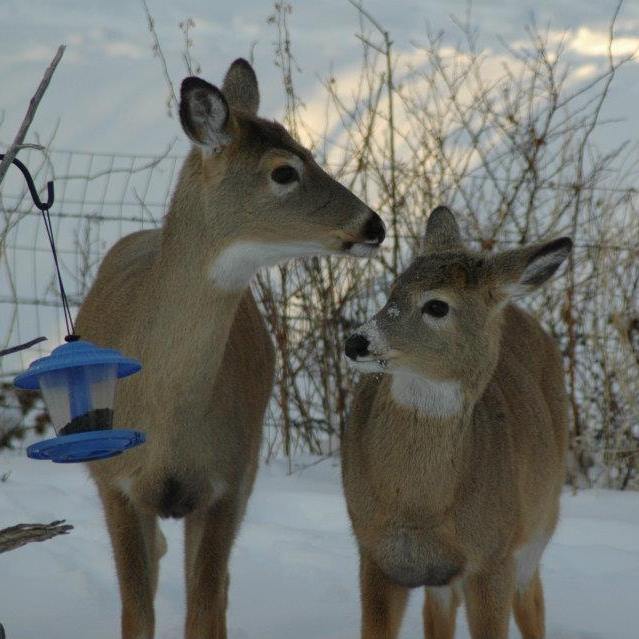
Both white-tailed and mule deer are important food for gray wolves. While they might look similar to an untrained eye, white-tailed deer and mule deer are very different animals: Mule deer are bigger, with large, dark ears and a black-tipped tail. White-tailed deer are smaller animals, boasting an unmistakably long tail with a white underside that stands straight up when alarmed.
Aside from their physical characteristics, the two species differ in how they escape from predators. When chased, mule deer “stot,” a quick bound with all four legs touching the ground at the same time. This bounding gait helps them negotiate all types of terrain and can give them an agility advantage over predators in rocky, uneven areas where it might be hard to run.
By contrast, white-tailed deer sprint away from predators and rely on spotting them early enough to try to outrun them.
Keeping these known escape tactics in mind, the research team focused on the “flight behavior” of deer living in areas where wolves have returned and in areas without wolves. The researchers chose four distinct study areas, all near the small town of Republic, Washington. All four areas are home to both species of deer, but only two were occupied by known wolf packs at the time of the investigation.
A pair of wolves run across the landscape in eastern Washington in 2016. Credit: University of Washington
In partnership with the Colville Tribes and the U.S. Forest Service, researchers set up wildlife cameras, captured and put collars on wolves and deer, and monitored the data from all of the collars over three years, from 2013 to 2016. This endeavor involved complex coordination and a dedicated team of UW students who were always ready to respond should an animal enter one of the traps.
“That part of eastern Washington is really special,” said lead author Justin Dellinger, who completed the work as a UW doctoral student and now works at the California Department of Fish and Wildlife. “There is huge diversity of large mammals, including all of the native prey populations like big horn sheep, moose and deer. And now we’re starting to see a full complement of native predators, like wolves, here as well.”
Overall, the researchers found that mule deer in gray wolf areas changed their behavior to avoid wolves altogether—mainly by moving to higher, steeper elevations, away from roads and toward brushy, rocky terrain. Alternately, white-tailed deer that favor sprinting and early detection as ways to escape from predators were more likely to stick to their normal behavior in wolf areas, sprinting across open, gently rolling terrain with good visibility—including along roads.
“Mule deer faced with the threat of wolves are really changing their home ranges, on a large scale,” Wirsing said. “They appear to have shifted kilometers away from where they had been prior to the return of wolves, generally going up higher where the terrain is less smooth and where wolves are less likely to hunt successfully.”
These larger shifts among mule deer could affect hunting opportunities. Indeed, some hunters in eastern Washington have already reported seeing mule deer higher on ridges where they are less accessible than in past years, Wirsing said. Hunting for white-tailed deer likely won’t change to the same degree with the presence of wolves, the results suggest.
Long term, changes among mule deer in wolf areas could affect other parts of the ecosystem, and perhaps reduce the number of deer-vehicle collisions. These possible impacts are tantalizing fodder for future studies, Wirsing added.


 “Man killed by tiger at San Francisco Zoo.” “Teenager mauled by shark off Hawaii beach.” “Pit bull attacks neighbor.” These types of incidents get massive media coverage but are very rare occurrences. Deer on the other hand don’t get near the press, but are much more dangerous.







 Exposing the Big Game