Deer Are People Too
1

LAKEWAY, Texas — A Lakeway woman is facing criminal mischief and harassment charges, months after her cell phone video of deer stuck in a trap set by workers the city of Lakeway hired to control overpopulation went viral.
RELATED | Viral video of Lakeway deer control program reignites outrage
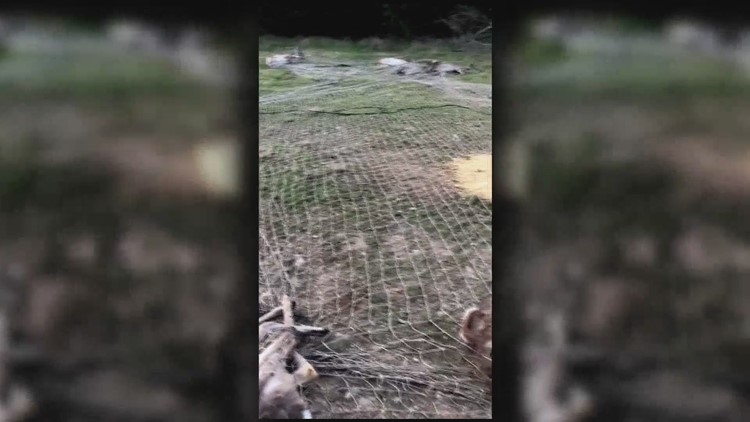
In the video, which was taken on March 8, you can see deer stuck under the net, with some of them bleating as they try to move around.
Ashlea Beck, a Lakeway resident, shot the video after her children discovered the trap near her home.
WARNING: The following video may be graphic to some viewers:
At one point in the video, you can hear her ask the workers, “Why are you doing this?”
Angry with what she saw, Beck cut part of the net and released two deer.
“I think they should do it away from kids, away from families,” Beck told KVUE in an interview on March 14.
Months later, Texas Parks and Wildlife has charged Beck with criminal mischief and harassment. A TPWD spokesperson sent KVUE the following statement:
“Ms. Beck interfered with lawful efforts to trap and remove white-tailed deer, causing damage to private property in the process. It is a violation of the Sportsman’s Rights Act to intentionally interfere with another person lawfully engaged in the process of hunting or catching wildlife, or intentionally harass, drive, or disturb any wildlife for the purpose of disrupting lawful hunting.”
Citizen Advocates for Animals of Lakeway president Rita Cross told KVUE she thinks Beck’s punishment is too harsh.
“She was in shock, she was trying to protect her kids and the deer, and she released two of them when she cut the net,” Cross said.
Cross thought TPWD would give Beck a warning or a fine.
“But they didn’t. They teamed up with the city of Lakeway, and they teamed up with the trapper himself, and they all agreed that she should be charged,” Cross said.
Neither Beck nor her attorney wanted to speak to KVUE about the charges. But in a post on a GoFundMe page Cross made to help pay for Beck’s attorney’s fees, Beck wrote the following comment:
“I was shocked and extremely disappointed by how Texas Parks & Wildlife and the City of Lakeway have handled this whole situation. My hope is that something good will come out of this, that changes will be made that prevent this from happening to someone else. Our city should be a safe place for families and animals alike.”
Cross just wants what she calls animal cruelty out of the city of Lakeway.
“Not just hiding them in some quiet, out-of-the-way location, but that we don’t deserve it in this city,” she said. “The deer don’t deserve the treatment that they get.”
Beck is facing two class B misdemeanor charges. Each carries 180 days in jail or a $2,000 fine.
City of Lakeway officials told KVUE in March they were done trapping deer for the rest of 2018.
|
Deer in a residential community in Yantis, Texas, are being netted and killed in a misguided attempt to reduce their population. Every minute spent trapped is a terrifying eternity for these easily frightened prey animals, who can badly injure themselves in frantic attempts to get free. Families of deer are torn apart, leaving young and weak animals vulnerable to starvation and dehydration. Your voice is needed now.
Video: One Year Later, Rescued Bears Swim, Play, and Bob for ApplesAfter enduring a decade of deprivation and frustration, Ben and Bogey are now free to play and explore the lush environment around them. See video footage of the bears at The Wild Animal Sanctuary in Colorado, where they’re currently hibernating (wait until you see them playing and swimming!), and then learn how you can help other bears who are still languishing at roadside zoos or forced to perform.
Dogs Are Desperately ColdWinter’s chilliest weeks are still ahead of us—and dogs forced to live outside are suffering tremendously.
|
https://www.wvlt.tv/content/news/Deer-disease-found-in-Tennessee-counties-503415131.html

NASHVILLE, Tenn. (AP) — Wildlife officials in Tennessee are implementing an emergency plan after at least 13 cases of chronic wasting disease were discovered in deer.
WTVF-TV reports the sick deer were found in Fayette and Hardeman counties in Tennessee.
The Tennessee Fish and Wildlife Commission says chronic wasting disease has no known risk to the health of humans or livestock. It says CWD is a deadly neurological disorder that affects deer.
In response to the cases, the agency is enacting a plan for hunters in Fayette, Hardeman and McNairy counties.
The station reports deer hunted in those counties must remain there, except meat with all the bones removed, antlers with no tissue attached, tanned hides and finished taxidermy products.
Starting Dec. 29, hunters killing deer in the CWD zone are required to check for testing at sampling and check stations with the counties.
OKLAHOMA CITY – With deer-gun season fast approaching, does the thought of a zombie deer scare you a little bit? “It does and that’s one of the symptoms too, the way they act,” said Altus hunter, Mike Howeth.
OK, we are not talking about deer turning into mindless monsters that will eat your brains, we are talk about chronic wasting disease or CWD.
“Chronic wasting disease is a neurological disease that effects deer, elk, and moose. It is always a fatal disease that effects the brain,” said Micah Holmes of the OK Dept. of Wildlife Conservation.
CWD creates small holes in brain tissue. It causes the infected animal to act erratically; think mad cow disease for deer.
“If someone sees a deer that is acting abnormally, turning around in circles, that is slobbering, that just looks out of the ordinary,” said Holmes.
So far the Department of Wildlife has tested over 10,000 deer since 1999 for CWD.
The disease has yet to be detected in Oklahoma but positive tests have come back from every adjacent state: Texas, Colorado, Arkansas, Kansas and Missouri.
Just because the Wildlife Department hasn’t confirmed cases here in Oklahoma, it doesn’t mean they aren’t prepared.
“We are actively looking for it, actively monitoring it, and we have a CWD response plan that we are updating right now,” said Holmes.
Now there is some confusion about eating a deer that could be CWD positive.
“CWD transmission has not been documented in humans or livestock,” said Holmes.
But the Wildlife Department is still warning hunters to be careful with carcasses. Hunters should be on the lookout for odd behavior.
“Hunters/anglers are our eyes and ears out there so we encourage people to call us if they see something out of the ordinary,” said Holmes.

A deadly disease that’s threatening deer herds across the country is prompting South Carolina wildlife officials to reconsider which products hunters are allowed to use to lure trophy bucks.
The state Department of Natural Resources wants to introduce a regulation that would ban hunters from using scent lures that contain natural deer urine, according to Charles Ruth, a certified wildlife biologist and big game program coordinator with the wildlife agency.
“It would take about a year for us to file the regulation and go through the legislative process, but we’d like to see a ban on natural urine products by the 2019 deer hunting season,” Ruth told the Greenville Journal during a recent phone interview.
Many hunters use buck and doe urines to lure deer to their location or cover their scent, but the foul-smelling liquid is thought to contribute to the spread of chronic wasting disease, according to Ruth.
Chronic wasting disease is a contagious, neurological illness affecting deer, elk, and moose populations throughout North America, according to Ruth. That includes the white-tailed deer, a popular game species in South Carolina. Greenville County hunters alone harvested more than 3,000 white-tailed deer in 2017.
“We haven’t detected signs of chronic wasting disease in South Carolina yet, but we don’t want to look back several years from now and wonder if we did everything possible to prevent it,” Ruth said.
Since it was first documented in a captive mule deer in Colorado about 35 years ago, CWD has slowly spread to more than two dozen states and a number of Canadian provinces, according to SCDNR.

Ruth said the disease, which has no treatment or cure, is caused by deformed proteins called prions that replicate upon ingestion and attack the animal’s central nervous system, ultimately killing it.
“The incubation period for chronic wasting disease can range from a year to five years,” he said. “But if a deer contracts the disease, it’s going to eventually die. There’s no question about it.”
Scientists believe CWD prions likely spread from deer to deer through feces, saliva, blood, or urine, either through direct contact or indirectly through environmental contamination of soil, food, or water, according to Ruth. Once a deer contracts the disease and dies, its tissues become vectors. The prions can only be destroyed by burying them in a landfill or through incineration.
While there has never been a documented case of a human contracting the disease, the Centers for Disease Control and Prevention recommends that people do not consume meat from an infected animal.
Natural scent lures pose a risk to South Carolina’s deer population, because they are often produced by facilities that collect urine over a grate system, which doesn’t prevent contamination from feces or saliva, according to Ruth.
Collection facilities also have no way of knowing whether or not their deer are disease-free, because there is no certified live-animal test for CWD, nor is there a way to test urine for prions once it’s been collected, according to Ruth. These facilities also generally don’t treat their urine-based products with chemicals or heat to kill the infectious proteins, because these treatments would secondarily destroy the desired scent characteristics.
Several states, including Alaska, Arizona, Virginia, and Vermont, have enacted outright bans on urine-based attractants, while others have drafted regional bans and/or rewrote rules to allow only synthetic lures. These bans, however, have been met with opposition from some hunters — who dribble the foul-smelling fluid on foliage near their tree stands — and manufacturers, who market products like “Cold Blue” and “Buck Bomb.”
Ralph Brendle, owner and president of River Bend Sportsman’s Resort in Spartanburg County, said the proposed regulation to ban urine-based attractants in South Carolina wouldn’t likely impact his business. “We don’t use scent lures of any kind. We just hunt them naturally in the woods,” he said. “The only thing we do is set out some bait every now and then.”
Brian Sullivan, co-owner and manager of Toney Creek Hunting Plantation in Anderson County, said his company currently uses urine-based attractants for guided deer hunts but won’t likely seek out an alternative if South Carolina enacts the ban. “Synthetic lure doesn’t work nearly as good,” he said. “I’d just prefer not use it.”
Ruth said the proposed regulation to ban urine-based lures in South Carolina would need to be passed by the General Assembly and signed into law by the governor before it could be enforced. If approved, it would become one of many regulations instituted by the wildlife agency over the years to combat the spread of CWD.

In an effort to help prevent the disease from entering South Carolina, SCDNR has banned the commercial transport of deer and other related species, such as elk and moose, since many cases of CWD have been linked to captive animals, according to Ruth.
The agency also continues to maintain regulations restricting the importation of whole carcasses or parts containing nervous system tissue from deer and elk harvested in the U.S. states and Canadian provinces where CWD has been documented, according to Ruth. If hunters dispose of these carcass parts in South Carolina, the disease agent could potentially infect deer in that area.
Ruth said South Carolina is far from any state where the disease has been diagnosed, but SCDNR has tested more than 6,000 deer from all 46 counties since 2002 and developed a response plan that’s designed to contain the spread of CWD should an outbreak occur.
Current research shows that CWD outbreaks can lead to significant declines in deer populations over time. In Wisconsin, for instance, the prevalence of the disease among adult male deer — those 2 ½ or older — has seen an annual growth rate of 23 percent since it was discovered in 2002.
John Quinn, an associate professor of biology at Furman University, said scientific understanding of the ecology and transmission of CWD in free-ranging wildlife is limited, but a major decline in South Carolina’s white-tailed deer population due to such a fatal disease would likely have ecological consequences.
The white-tailed deer is considered to be a keystone species, one whose very activities have an immediate effect on both the landscape and the natural habitats of other animals in the wild, according to Quinn.
White-tailed deer not only serve as prey for coyotes and other predators, but their feeding habits and preferences can affect the variety, quality, and structure of plants in a habitat, Quinn explained. While chronic browsing can kill or hinder the growth of preferred plants in an ecosystem, deer avoidance of non-native, invasive plant species can cause them to become more prevalent and spread faster.
“A loss of deer populations is going to change forest understory,” Quinn said.
Quinn said a decline in South Carolina’s white-tailed deer population would also likely lead to fewer hunters, which in turn would mean less dollars for SCDNR, which collects a large portion of its funding from hunting-license sales and federal excise taxes on firearms, ammunition, and other hunting equipment.
Deer hunting generates more than $200 million annually for the state’s economy, according to Ruth. South Carolina sells more than 700,000 recreational licenses each year to residents and out-of-state hunters and fishermen.
Recreational and commercial hunting licenses can be purchased online at dnrlicensing.sc.gov. Deer hunting on private lands in Game Zones 1 and 2, both of which include parts of Greenville County, runs through Jan. 1, 2019.
For more information, visit www.dnr.sc.gov.
http://komonews.com/news/local/arrows-removed-from-oregon-deer-shot-through-face-body

Oregon State Police investigating after deer shot with arrows (photo from Oregon State Police)
PORTLAND, Ore. (AP) – Oregon State Police say authorities have removed arrows from two deer, one of which was shot through its face.
The Oregonian/OregonLive reported Thursday that the deer in the Shady Cove area were shot illegally. Authorities began receiving calls about the deer last week.
The adult doe and a yearling doe, shot through the head and body, have been released in good health and without visible infection.
A reward for information leading to the arrest or citation of those responsible for the shooting has been bumped to $2,600.
Steve Niemela, Rogue District Wildlife Biologist, said the deer have a very good chance of survival.
Citizen Advocates for Lakeway Deer (CALD)—a grassroots organization of residents of Lakeway, Texas—has unveiled never-before-seen video footage of the city’s handling of so-called “surplus” deer. The footage exposes for the first time how the animals, who are lured into traps, are netted, are pinned to the ground, have their antlers sawed off, and are then hauled upside down into a trailer. They’re ultimately transported to slaughter.
After being driven 80 miles, the animals are shot in the head and butchered.
A Lakewood police detective admitted that “any animal that gets a net dropped on ’em … gets its horns cut off … gets picked up and put in a trailer upside down, that’s traumatized, you know?”
One trapped deer had previously been shot with an arrow. He lay bleeding, caught in the netting. Instead of ending the wounded deer’s suffering, the workers sawed off his antlers and dragged him away to the trailer.
Lakeway spent more than $28,000 in 2013–14 on this traumatizing practice, even though trapping is an ineffective method of wildlife control. Killing backfires because the resultant spike in the food supply accelerates breeding among survivors and newcomers. Even the detective admitted, “I’ve seen this going on for 10 years, and Lakeway is still covered with deer. It’s … not going to eliminate ’em, you know.”
And deer families are torn apart, with orphaned young left to starve. Despite widespread opposition, the city has continued with this year’s trapping program.
You Can Help Stop This!
CALD has collected the signatures of more than 1,000 Lakeway residents who are calling on the city to end the deer-trapping program, conduct a census of the deer population, and implement humane means of managing wildlife issues.
Please urge Lakeway officials to halt the trapping and slaughter of deer, and share these humane deer-control tips with them.
Please send polite comments to:
Steve Jones
City Manager
stevejones@lakeway-tx.gov
Please feel free to use our sample letter, but remember that using your own words is always more effective.

A herd of deer walk through a wildlife crossing in the snow.
Wildlife bridges and underpasses led to a dramatic decline in animal-related car crashes, …
For full story, visit:
Animals are using Colorado’s wildlife crossings, reducing collisions, CDOT says
Dear Editor,
A much more fitting title for Noah Comet’s editorial, “If you love deer, you must go hunting” would have been, “If you love driving blindly, pedal to the metal, you must shoot a deer before you hit one with your precious car.”
Indeed, the gist of the piece seemed to be: ‘Our monstrous automobiles are here to stay, so everything else best get out of the way–before we run them over. Come to think if it, as much as hunting is costly and barbaric, we might as well just shoot them first. We’ll say we’re doing them a favor.’
Nowhere does the editorial ask us to drive more defensively or dare to ask drivers to slow the heck down, before someone (or something, if you prefer) ends up dead.
But ironically and as much as I hate to admit it, I found myself agreeing with an occasional line. For instance, the notion that ‘there are too many deer’ is, as Mr. Comet rightly points out, a “ludicrous argument.” His line that, “Deer haven’t overpopulated; we have” says it all.
Jim Robertson
President, Committee to Abolish Sport Hunting




 Exposing the Big Game