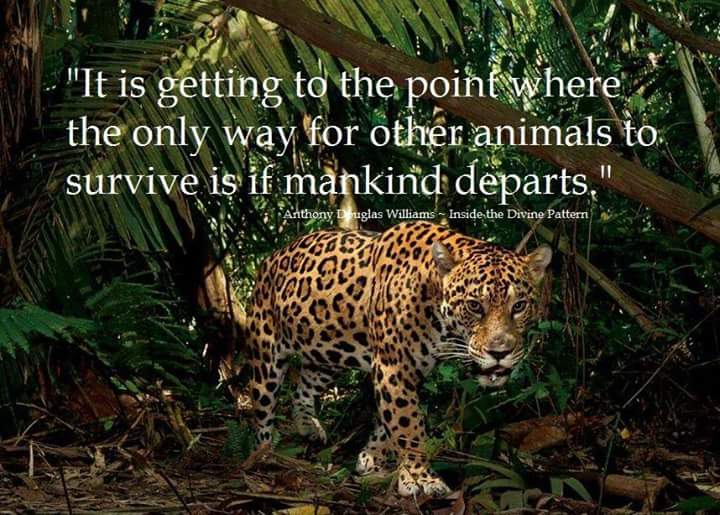
Getting to be About Departure Time, Man?
Image
3

From John A. Livingston’s Rogue Primate in the chapter “The Exotic Ideology:”
“As the rogue primate overran the world in the late Pleistocene and early recent times, not all of the accompanying baggage was hardware. There were tools and weapons, to be sure, both of which improved to such an extent over time that the Pleistocene mega fauna before them. Destructive as the new hardware was, however, the new software—the accompanying knowledge of how-to-do-it –was downright devastating. Storable, retrievable, transmissible technique made the conquest possible, on any ‘natural’ timescale, virtually overnight. Technology, as an aspect of culturing, changed much more rapidly than the methods of avoidance used by prey species. It was no contest.
“After the peak extermination between 30,000 years ago and the most recent withdrawal of the ice, and after world human colonization was roughly complete about 1,000 years ago, the non-human world entered a period of relative calm. Humans having established their beach-heads (initially at considerable cost to the most vulnerable indigenous forms), there impact may have lessened—temporarily. After the initial painful adjustments to the human presence, at least some elements of Nature, especially in extreme latitudes, appear to have been able to cope, for a while. This post-Pleistocene Camelot lasted about 500 years.
“By this time, the radiation of human populations into a variety of environments meant that cultural prostheses were now evolving independently of one another. Like Darwin’s Galapagos finches on the scattered and isolated islands of their archipelago, human societies had developed distinct differences. Cultural separateness, like reproductive isolation, produced new concepts. Descended as they were from a common ancestor, the various human populations (‘ecotypes’) retained their biological inheritance, including their domesticated dependence on how-to-do-it, but the particular content of their ideologies (including how to apprehend the nature of reality) became profoundly different from society to society.” …
 baby sea turtle trying to make it to the seaLOS ANGELES, CA – JUNE 8, 2016: Today, on World Oceans Day, Sea Shepherd Conservation Society is proud to announce its latest campaign to defend, conserve and protect our oceans.
The campaign, Operation Jairo II, will span three countries including the United States, Honduras and Costa Rica to protect endangered sea turtles. The launch comes on the heels of Sea Shepherd’s announcement of its first full-length feature film, Why Just One?, chronicling the organization’s successful 2015 Operation Jairo campaign.
The crowd-funded documentary Why Just One? raised its goal of $18,000 in one day to complete the production and has a star-studded list of names supporting it. Like its predecessor, Operation Jairo II is named after Jairo Mora Sandoval, a Costa Rican turtle defender who was brutally murdered on May 31, 2013 while attempting to protect leatherback turtle nests.
There are seven species of sea turtles in the world. Four have been identified as “endangered” or “critically endangered,” and two are classed as “vulnerable,” by the IUCN Red List of Endangered species. Sea turtles are some of the oldest living creatures, one of the few who’ve watched dinosaurs evolve and become extinct. They are now facing the same fate as their predecessors.
“This species which has survived so much, may not survive us,” commented Sea Shepherd founder Captain Paul Watson.
Sea Shepherd Conservation Society is requesting donations to fund Operation Jairo II by asking fans to become monthly donors. To donate, visit http://my.seashepherd.org/DAC.

Operation Jairo II will launch in Ft. Lauderdale, Florida on July 15 until September 1, with volunteers working to protect green, loggerhead, and leatherback sea turtles. Sea Shepherd will work with Sea Turtle Oversight Protection (S.T.O.P.) to protect sea turtle nests and guide hatchlings to the sea, away from the commercial lighting that disorients them.
The Honduras campaign will be held in Utila from August 1 to November 1, where Sea Shepherd volunteers will protect hawksbill, green, and loggerhead sea turtles. Partnering with Bay Island Conservation Association (B.I.C.A.), Sea Shepherd will protect nesting females and nests from poachers. The Honduran Navy will provide security for beach patrols.
From September 1 to December 1, Operation Jairo II will move to Costa Rica where ground campaign volunteers will work in Jaco to protect primarily olive ridley and green sea turtles. The Jaco police are teaming with Sea Shepherd volunteers to protect nesting females and nests from poachers. Nests will be relocated to a hatchery run by the Jaco police force.
Campaign volunteers will conduct weekly beach cleanups in all three locations.
Click here to volunteer for Operation Jairo II. Email the completed application to campaigns@seashepherd.org

Earlier this year the Sportsmen’s Heritage and Recreational Enhancement (SHARE) Act (H.R. 2406) passed the US House of Representatives. The sponsor of this bill is Senator Lisa Murkowski, (R-AK), who first introduced it in September, 2015. The SHARE Act is an outright assault on animal welfare and conservation. Having passed the House, it now has reached the floor of the Senate, and, knowing it is extremely controversial, some of members of Congress are trying to bury it within another seemingly harmless Bill. They have attached this extreme anti-wildlife bill as an amendment to the Energy Policy Modernization Act (S.2012). If this bill is passed, the damage to wildlife and conservation will be dramatic and far-reaching.
The Animal Welfare Institute is fighting the passing of this bill, which would be a clear assault on wildlife worldwide. On May 20 they contacted members and humanitarians to ask for their help. Now you can make your voice heard and help stop it by simply clicking on this link and navigating to the “Contact Your Legislators” box to send an email to your State Senator. By simply typing in your address, the name of your senator will pop up. You can even personalize your letters in a box provided by AWI, who will then forward your email for you.
What will the SHARE Act do, should it be passed into legislation? Here’s a quick list:
1. Slaughter of elephants will be ramped up; elephants will lose their current protection by the US Fish and Wildlife Service to crack down on the illegal ivory trade and poaching would multiply.
2. Polar bears will be again under attack. Although they were listed under the Endangered Species Act, the SHARE Act will grant a waiver to trophy hunters to allow importation of polar bear carcasses.
3. Bison living in Grand Canyon National Park would be shot and killed if the National Park Service is compelled to allow this as part of their management plan.
4. Wolves who are federally protected in Wyoming and in the Great Lakes region would have that protection removed, allowing them to be hunted and trapped.
5. Migratory birds would also be allowed to be shot; right now they are protected.
Further, trapping would be defined as a form of hunting. The steel-jawed leg-hold traps and other forms of torturous snares would become legal. This imperils not only wildlife but also public safety and companion animals. There are other parts of this legislation which will jeopardize everything conservationists have long championed. There is nothing ‘sportsman’-like about this Bill, if you truly care about life, animals and the environment. Here again is the link should you wish to voice your opinion to your State senator. AWI is continually fighting against the exploitation of threatened and endangered species, and encourages humane, non-lethal wildlife management.
Follow this Worldwide Animal Issues Examiner on Facebook and Twitter for updates.
The grizzly bears that inhabit the Greater Yellowstone Ecosystem have played an important role in one of the nation’s greatest endangered species success stories. Since 1975, the bears have been beneficiaries of the Endangered Species Act that enabled the grizzly population to beat all odds after teetering on the brink of extinction. It grew from 136 bears in 1975 to around 700 in 2016, although estimates range from 674 to 839.
On March 3, 2016, the United States Fish and Wildlife Service announced its proposal to delist the Yellowstone area grizzlies, which includes Grizzly 399, from the federal threatened species list. It is expected to make a final decision by the end of 2016.
50,000
The number of grizzly bears that roamed between the Pacific Ocean and the Great Plains during Lewis and Clark Expedition, 200 years ago.
674-839
The approximate number of grizzly bears in the Greater Yellowstone Ecosystem according to the National Park Service in 2016. No one knows the exact number.
150
The number of grizzlies that live within the boundaries of Yellowstone National Park in 2016.
More than 524
Of Greater Yellowstone Ecosystem grizzlies live outside Yellowstone National Park.
22,500 square miles
Is the range of the Yellowstone area grizzly bears, which has doubled since 1975 – that’s an area larger than Massachusetts, Rhode Island and New Hampshire combined.
37
Grizzly bear populations were present in the lower 48 states in 1922.
31
Grizzly bear populations were extirpated by 1975.
136
Grizzlies lived in the Greater Yellowstone Ecosystem in 1975.
10
is number of years it takes a female grizzly to replace herself in the population.
1,000
Grizzly bears live in the Northern Continental Divide Ecosystem, which stretches from Kalispell, Mont., all the way up into Canada and includes Glacier National Park.

The Senate Committee on Environment and Public Works today added several poison pill provisions to the so-called Bipartisan Sportsmen’s Act, S. 659, which already threatened the interests of wildlife, conservation and public lands, but now is an even more extreme measure.
Among other harmful provisions, the bill now strips wolves of their federal protections in four states under the Endangered Species Act, subverting the judicial process and subjecting hundreds of wolves to hostile state practices such as baiting, hound hunting, and painful steel-jawed leghold traps. It also blocks federal wildlife officials from making decisions about cruel and inhumane predator control practices on Alaska’s national wildlife refuges.
In response to the EPW vote, Wayne Pacelle, president and CEO of The Humane Society of the United States said: “This was already an awful bill, but now it’s an appalling one — undermining the federal courts and removing federal protections for endangered wolves, denying proper oversight of toxic lead in the environment, blocking carefully considered rulemaking to protect animals on national wildlife refuges, among other destructive provisions. This bill is a grab bag of miscellaneous items that the trophy hunting lobby cannot secure in free standing bills, and Congress should give it a quick, clean kill shot.”
A few of the harmful provisions included in S. 659 are as follows:
Wolves
Just last month, Congress rejected a rider to the end-of-year spending bill that would have removed Endangered Species Act protections for gray wolves in the Great Lakes states and Wyoming. Today, the committee adopted by voice vote an amendment by Senator Barrasso, R-WY, to accomplish the same. This proposal would both subvert judicial processes and undermine the ESA, one of our nation’s bedrock environmental laws. When wolves were delisted in 2012, 20 percent of the Wisconsin population was wiped out in three hunting seasons, including 17 entire family units. In a three year period, more than 1,500 wolves were killed in the Great Lakes states alone. It is clear that federal oversight is necessary to provide adequate protections for gray wolves as required by the ESA.
AK Predator Control
An amendment proposed by Senator Dan Sullivan, R-AK, and adopted on a straight party-line vote would prohibit the U.S. Fish and Wildlife Service from issuing a rule and going through a public process on cruel predator control methods like the trapping and baiting of wolves and bears in Alaska’s national wildlife refuges.
Lead
The bill contains troubling provisions that relate to the use of lead ammunition, at a time when non-toxic ammunition is available to all hunters, and is less harmful to wild animals, land, and human health. The committee rejected a common sense amendment by Senator Barbara Boxer, D-CA, that would have narrowed the exemption for sport fishing equipment from the Toxic Controlled Substances Act to focus on lead content. Senator Boxer’s amendment would have required periodic reports by the Environmental Protection Agency on the health impacts of lead in fishing equipment.
Polar Bears
A provision of the bill would roll back the Marine Mammal Protection Act and provide a sweetheart deal to help 41 wealthy polar bear trophy hunters import the heads of rare polar bears they shot in Canada. The animals were not shot for their meat, but just for trophies and bragging rights. It’s the latest in a series of these import allowances for polar bear hunters, and it encourages trophy hunters to kill rare species around the world and then wait for a congressional waiver to bring back their trophies. The committee today rejected an amendment by Sen. Boxer that offered a sensible middle ground on this issue, and would have allowed the import of 41 questionable polar bear trophies, while making absolutely clear that the one-time carve-out is not intended to set a precedent.

States, Feds agree to at least 600 Yellowstone-area grizzlies
By | December 7, 2015
The Wyoming Game and Fish Department would recommend no hunting of mother grizzly bears with cubs-of-the-year at their side if and when it proposes a hunting season, an agency spokesman said Monday.
The state anticipates adopting regulations that follow “standard wildlife practices,” such as the prohibition against hunting mothers with cubs, Game and Fish spokesman Renny MacKay said. Wyoming could manage Yellowstone-area grizzly bears if and when federal protections are lifted as federal wildlife officials anticipate.
“It is something we would be willing to bring forward to the commission,” MacKay said of the prohibition. “We do that with mountain lions, we do that with black bears.”
Wyoming also is committed to a grizzly population that includes well-distributed females of reproductive age. That’s one of the federal benchmarks for determining whether the Yellowstone ecosystem grizzly still needs protection under the Endangered Species Act.
“That’s something Wyoming is absolutely committed to maintain,” MacKay said.
Several aspects of the delisting process still have to play out, including release by the U.S. Fish and Wildlife Service of a conservation plan, a proposed rule and population-monitoring documents. Wyoming, Idaho and Montana also would have to adopt state regulations if they want to have hunting seasons.
Wyoming’s Game and Fish Commission, a body appointed by the governor, is charged with setting such regulations and seasons in Wyoming.
“Ultimately, if Wyoming takes over management of grizzly bears again, we have to ensure a recovered population,” MacKay said. “That’s at the heart of all of this. We want the flexibility to be able to adjust to changing conditions, changing populations and changing science.”
Sierra Club doesn’t like the idea of a 600-bear trigger before “discretionary mortality” ceases, said Bonnie Rice, senior representative for the organization’s Greater Yellowstone/Northern Rockies campaign.
“We disagree with driving down the population,” she said Monday. “Six hundred bears is well below the current estimate, so that is of great concern to us in terms of [potentially] reducing the population by over 100 bears.”
She and other conservationists still see threats to grizzlies, including that Yellowstone-area bears are an isolated population. Having fewer bears would decrease the chance of naturally connecting Yellowstone grizzlies with other populations, she said.
“One of the biggest things for us is linkage zones,” Rice said.
She’s also worried how states will balance and coordinate on the number of bears killed and how any multi-state limits might be enforced. “We don’t have that framework yet,” she said.
Other groups also reacted. “Once again we see Director Ashe cutting deals for political expediency instead of following the science,” Bethany Cotton, wildlife program director for WildEarth Guardians, said in a statement. “The Endangered Species Act is incredibly effective at recovering imperiled species, and will do so for grizzlies across their range, but only if they retain protections until the science clearly demonstrates recovery.”
Genetic isolation from other populations worries Western Watersheds Project, a spokesman for that group said in a statement. “Recovery isn’t a math equation, it’s a geography question,” said Josh Osher, Montana director for the group. “The states’ tentative agreement with the Service fails to ensure connectivity throughout the species’ range and fails to address the livestock operations that are the root cause of lethal conflict for the grizzly bear.”
The country’s top wildlife official wrote state game chiefs in September agreeing the Yellowstone-area grizzly bear population could decline to 600 — 114 fewer than today’s count of 714 — once federal protections are lifted.
U.S. Fish and Wildlife Service Director Dan Ashe’s Sept. 24 letter to Wyoming, Idaho and Montana officials was confirming the minimum number of bears and other measures the four agencies had agreed to at that point. Until the 600-bear trigger is reached, “discretionary mortality” of grizzly bears — which could include hunting — could continue.
Ashe and state officials are negotiating a complex agreement that would see the bear removed from protections of the Endangered Species Act and put under state management. Such a move would open the door to grizzly bear hunting in the three states but not in Yellowstone and most of Grand Teton national parks.
Details of the talks have been closely guarded, and state and federal officials have not confirmed details of the September letter obtained by WyoFile over the weekend.
Ashe and the three state wildlife directors met twice in September, Ashe wrote, at which time they hammered out the details. “Based on these two meetings, I believe we have a mutually understood process that will allow the Service to proceed with a proposed delisting proposal…” to remove the Yellowstone grizzly from ESA protection, Ash’s letter said.
The bottom-line number is one of several trigger points set in the letter. When bears number between 600 and 673, annual female bear losses — including through expected hunting seasons — would be limited to 7.6 percent, and to 15 percent of the male population. More liberal losses — 10 percent female and 22 percent male — would be allowed when there are more than 747 bears, the letter states.
But federal and state agencies did not wrap up all aspects of post-delisting grizzly bear management in September, and Ashe’s letter acknowledges that. One point of discussion appears to be whether matters usually left to states — like prohibiting the shooting of a mother bear with cubs by its side — could be required by the federal government before turning over authority.
“States have agreed to consider additional regulatory mechanisms that will be part of individual state management plans/regulations…” Ashe said in the letter. Those state regulations would be referenced in the U.S. Fish and Wildlife Service delisting rule, bringing them under federal jurisdiction, the letter says.
“We’re looking at regulatory mechanisms that would be included in a new conservation strategy,” Wyoming Game and Fish Chief Game Warden Brian Nesvik said in a Nov. 12 interview with WyoFile. “That’s where the discussions have occurred. What needs to be identified in a delisting rule? What is under the purview of the three states?”
Wyoming wouldn’t manage grizzlies down to a minimum number, whatever that turns out to be, Nesvik said in November. In that interview, he said no final number had been agreed to. “We have not discussed that to this point,” he said.
Wyoming’s wolf plan hews closely to the minimum population requirements set by the federal government. But wolves, as a species, reproduce faster than grizzly bears.
“I do not believe the Fish and Wildlife Service is interested in that same type of set of circumstances,” Nesvik said. “That has been part of the discussion. They’re interested in a different approach with bears.” Wyoming would “manage for a viable grizzly bear population well above the recovery criteria.”
Wyoming knows how to set big game and trophy hunting seasons, he said. “I think we would rely pretty heavily on our track record,” Nesvik said. For example, with black bears and mountain lions, “there’s certainly more [hunting] opportunity than there’s ever been,” he said.
“We would look to be able to manage grizzly bears in a manner consistent with the values we’ve held with those other species,” he said. “The public still needs to weigh in. The Game and Fish Commission has been very considerate of the fact the way we do business in this state is we include the public.”
Three critical pieces are necessary for delisting: a conservation strategy outlining long-term sideboards to ensure grizzly survival, an official proposed rule that sets administrative and legal parameters, and a document on population monitoring. After those are ushered through federal rulemaking and possible litigation, states would take over.
Federal and state officials are meeting in Missoula, Montana, for three days starting Tuesday when Wyoming Game and Fish Director Scott Talbott is scheduled to give a delisting presentation and update.
— This story has been updated to reflect that Wyoming Game and Fish Department Director Scott Talbott is on the agenda for an update on grizzly delisting, not Brian Nesvik. Talbott is on the IGBC agenda with Matt Hogan, deputy regional director of the USFWS — Ed.
In August at the Speak for Wolves Conference in West Yellowstone, Project Coyote Founder and Executive Director Camilla Fox led a team of panelists to discuss the pervasive and cruel practice of “wildlife killing contests” that award prizes to those who kill the most and largest animals including coyotes, bobcats, foxes and even wolves – often on public lands. Conference attendees also got a sneak peek of Project Coyote’s film trailer that will help expose this unconscionable practice and empower citizens to take action to end it.
 |
Challenging New Mexico’s War on Wolves, Bears and CougarsIn late August, Science Advisor Dave Parsons spoke out on behalf of Project Coyote at a rally and a public hearing as part of a coalition opposing the New Mexico Game Commission’s new rule allowing increases in cougar trapping and bear hunting. The Commission also denied a federal request to release more Mexican Gray Wolves into New Mexico. |
 |
Federal Endangered Species Act Under ThreatThe U.S. Fish and Wildlife Service has proposed draconian changes to the long standing regulations for citizen petitions for adding species to the Endangered Species Act’s list of threatened and endangered species. The proposed changes would make it difficult if not impossible for most citizens and conservation organizations to file petitions. Project Coyote will submit a comment letter endorsed by members of our Science Advisory Committee opposing the proposed changes. The deadline for comments is September 18. |
Diets rich in beef and other red meat can be bad for a person’s health. And the practice is equally bad for Earth’s biodiversity, according to a team of scientists who have fingered human carnivory—and its impact on land use—as the single biggest threat to much of the world’s flora and fauna. Already a major cause of extinction, our meat habit will take a growing toll as people clear more land for livestock and crops to feed these animals, a study in the current issue of Science of the Total Environment predicts.
“It’s a colossally important paper,” says Gidon Eshel, a geophysicist at Bard College in Annandale-On-Hudson, New York, who studies how human diets affect the environment, and who was not part of the study. Researchers have struggled to determine the full impacts of meat consumption on biodiversity, Eshel says. “Now we can say, only slightly fancifully: You eat a steak, you kill a lemur in Madagascar. You eat a chicken, you kill an Amazonian parrot.” That’s because species-rich habitats are being converted to pasture and feed crops as the human appetite for meat swells.
But others disagree that livestock production is the leading cause of habitat loss. “They’ve created [a] stickman to be knocked down,” says Clayton Marlow, a grassland ecologist at Montana State University, Bozeman, “without accomplishing anything for either the ecosystem or the poor.”
Previous studies have explored links between modern livestock production and climate change, water pollution, and the loss of some herbivores and top predators such as wolves and lions. “But how is it impacting other species?” asks Brian Machovina, an ecologist at Florida International University in Miami, and the paper’s lead author.
To find out, he and his colleagues looked at studies that identified the world’s biodiversity hotspots—those areas that contain the highest percentage of endemic plant and animal species. Most are located in tropical nations. Then, the researchers picked out countries that are most likely to expand their industrial livestock operations, and determined where and how much land will be lost to grazing and growing crops to feed livestock. Using data from the Food and Agriculture Organization and other studies about the production of cattle, pigs, and chickens in these countries from 1985 to 2013 and the amount of land the livestock required, they extrapolated the likely future expansion of agricultural lands. Finally, they created maps of overlap.
Many of the places expected to see the greatest shift in land use from forest to livestock are in 15 “megadiverse” countries, which harbor the largest number of species, Machovina says. “By 2050, given current trends, these countries will likely increase the lands used for livestock production by 30% to 50%”—some 3,000,000 square kilometers—the researchers estimate.
The habitat loss is so great that it will cause more extinctions than any other factor, the study notes, particularly when coupled with other deleterious effects of livestock production, including climate change and pollution. “These changes will have major, negative impacts on biodiversity,” Machovina says. “Many, many species will be lost.”
The trend toward meat-eating is already having an impact, the scientists say.
Citing other studies, they note that more than three-quarters of the land previously cleared in the Amazon region is now used either as pasture for livestock or to raise feed crops for domestic and international markets. And the rapid deforestation there continues: Another 1898 square kilometers of forest were removed over the last year. Further, more than half of the Amazon’s Cerrado, a woodland savanna ecosystem known for its rare species, has also been cleared for raising cattle and soy. Habitats have also been—and continue to be—lost throughout Central and Latin America for the same reasons, the scientists say, who see a similar future for Africa.
By revealing where the most flora and fauna will disappear as lands are converted to agriculture for meat production, “the study equips us with a means to quantify the costs of our dietary choices in terms of species loss,” Eshel says.
The study also “suggests potential solutions that merit serious consideration,” notes ecologist David Tilman from the University of Minnesota, Twin Cities, who was not part of the work. To stop the loss of biodiversity, Machovina and his colleagues recommend that people limit meat consumption to 10% of their calories; eat more fruits and vegetables; replace beef—the most land-hungry meat—with pork, chicken, and fish; and change livestock production practices. But Tilman warns this won’t be easily done. “The challenge is to find solutions that meet human needs and simultaneously protect remaining natural habitats.”
Meeting the challenge of “feeding the world’s growing population with a shrinking land base” can’t be done without “intensive animal and crop production,” says Marlow, who argues that the real problem facing biodiversity is the loss of arable land to development such as urban and slum sprawl. He adds that developing countries are adopting industrialized livestock production because it’s efficient and “the only way we can feed the world’s growing population.”
Posted here:http://voices.nationalgeographic.com/2015/06/15/breach-the-snake-river-dams/ by Carl Safina of The Safina Center on June 15, 2015
By Kenneth Balcomb, guest essayist
Note: In this guest essay, long-time killer whale researcher Ken Balcomb shows how obsolete but still salmon-killing dams are helping cause the decline of killer whales due to food shortage in the Northwest. The dams do feed us one thing: propaganda. As Ken wrote to me, “I was flabbergasted that the dams are closed to photography, and that their wasteful secret is downplayed in the mainstream propaganda fed to the public.” For more on the dams, see my book Song for the Blue Ocean. For more on Ken and the whales he has spent his life loving and studying, see my soon-to-be-released book Beyond Words; What Animals Think and Feel, which will hit bookstores on July 14. — Carl Safina
I have studied the majestic southern resident killer whales of the Pacific Northwest for forty years (approximately one productive lifespan – whale or human), during which time much has been learned and shared with the world about this iconic endangered population. They are now arguably the best known whales in the world! But, that was not always the case. The common response in the 1960‘s and 1970‘s to my announcement that I was studying whales was, “Why?” “What good are they?”
My best response was to point out that as top marine predators whales are indicators of the health of that environment in which they live – the ocean – and that is also an environment upon which humans depend. Now, with growing numbers of people appreciating the whales’ natural role in the marine environment, and better understanding their ecological requirement for specific food—Chinook salmon in this case—to survive, the conversation has moved toward a strategy of how best to provide that food. There is currently an active discussion about removal of the Snake River dams to save fish, or whales. The issue of whether dams should be breached to provide this food for the whales has now arrived. Would that be reasonable? Are we sure that will work?
I don’t consider this lightly. I tend to consider the status quo of institutions and structures to be enduring and worthy of protection, even if only as displays of the truly amazing feats our species has achieved in the course of human evolution and ingenuity. Not all of our feats have been without unforeseen consequence, however; and, most tend to crumble over time anyway. Dams require maintenance, and they eventually fill with sediment.
Until recently, dam removal was against my conservative nature. And it still seems to be counter to our government’s intent. This is in spite of clear evidence that the salmon-eating population of “killer” whales that I am studying is on a path to extinction along with significant populations of their main food resource—Chinook salmon—huge numbers of which formerly spawned and returned to the Snake River, and fed whales in the Pacific Ocean and humans, before the dams were built.
I had to see for myself what was going on in the Snake River watershed currently. So last week my brother and I drove up the highway to visit the dams on the Columbia River and upstream, sightseeing and taking photos and videos along the way and learning about the current passage of remnant populations of salmon.
But when we got to the McNary and Ice Harbor dams just below the Snake River and on it, it seemed as if an iron curtain had come down and we were prevented from taking any photographs, or even carrying cameras and cell phones behind the fences surrounding the dam structures. It was as if something was being hidden from view. And, it was. There was no point in our continuing upstream to Lower Monumental, Little Goose and Lower Granite dams to take photographs and videos of fish passage, because that was not allowed.

In truth, already well known to others but not to me, these four Snake River dams are obsolete for their intended purposes and are being maintained at huge taxpayer expense for the benefit of a very few users. Plus, they are salmon-killers in a former river (now a series of lakes) that historically provided spawning and rearing habitat for millions of Chinook salmon. And, they now doom all technological attempts to bolster these salmon populations to expensive failure.
Even many of the Army Corps of Engineers’ internal documents recommend that returning the river to natural or normative conditions may be the only recovery scenario for Snake River fall Chinook salmon, and it will also benefit other salmon populations.
You and I are paying for this economic and ecological blemish with our tax dollars spent to maintain structures and negative return on investment in power generation, “barge” transportation, and recreation. The question I would now ask is “Why?” and “What good are they?”

Removal can be done inexpensively and doing so makes perfect ecological sense. The technological fixes for the dams have not improved wild salmon runs, and there is nothing left to try. There are no fixes for the deadly lakes behind the dams. As a nation, we are dangerously close to managing the beloved southern resident killer whale population to quasi-extinction (less than 30 breeding animals) as a result of diminishing populations of Chinook salmon upon which they depend. There are only about eighty of these whales now remaining (including juveniles and post-reproductive animals), down from nearly 100 two decades ago and down from 87 when they were listed as “Endangered” in 2005.
If you really want to have healthy ecosystems with salmon and whales in the Pacific Northwest future, and save tax/rate payer money at the same time, please contact or mail your thoughts to your elected representatives in support of a Presidential mandate to begin the return of the Snake River ecosystem to natural or normative conditions by the end of the current presidential administration. The time is now!
When they are gone it will be forever. Returning the Snake River to natural condition will help salmon and whales, and save money. Please do not wait until all are gone. Call or write your representatives today!
Ken Balcomb, 11 June 2015
Senior Scientist, Center for Whale Research
 Exposing the Big Game