Exposing the Big Game

Forget Hunters' Feeble Rationalizations and Trust Your Gut Feelings: Making Sport of Killing Is Not Healthy Human Behavior

Exposing the Big Game

Plane crashes & slaughterhouses: who suffers more?

Plane crashes & slaughterhouses: who suffers more?

(Beth Clifton collage)

Helpless in a cage

by Karen Davis,  Ph.D.,  president,  United Poultry Concerns

On January 8,  2020,  passenger flight 752, headed from the Iranian capital of Tehran to the Ukrainian capital of Kiev,  was shot down by the Islamic Revolutionary Guard Corps of Iran, killing all 176 occupants,  including 167 passengers. The jet continued flying for several minutes before turning back toward the airport.

Reported The New York Times,  “The plane,  which by then had stopped transmitting its signal,  flew toward the airport ablaze before it exploded and crashed quickly.”  (1)

One can only imagine being strapped in a plane that is about to crash,  being,  in the final moments before death,  a conscious individual,  helpless in a cage.

(Beth Clifton collage)

Is the terror of the chickens any less?

In considering such circumstances, is it impertinent to compare this experience with that of chickens (any animals) hanging face down on a slaughter line as they move toward a large rotating knife that will cut their throats?

Is the terror of the chickens any less palpable in those final moments than the terror of the airline passengers hurled helplessly toward their own deaths?

Even granting the terror the chickens must be feeling,  there are those who are outraged by the very idea of comparing anything a chicken might feel with the feelings of a human being,  for the simple reason that,  no matter what,  the feelings and nature of humans are considered “superior to” and vastly “more important than” those of any other sentient species – a view not shared by Sea Shepherd Conservation Society founder Paul Watson,  as he made clear in a recent essay,  nor by me. (2)

(Beth Clifton photo )

“Superior suffering”

Probably,  if questioned,  few people,  even those who grant that other animals can form lasting emotional relationships amongst themselves,  would concede that their experiences could equal the range and depth of human social and familial experience.

In the following discussion,  I address the question of “superior suffering” by focusing on an aircraft catastrophe that took place nearly twenty years ago in American skies.  My suggestion at the time––that slaughterhouse chickens could suffer as much as human beings in situations involving the utmost pain and fear in the victims––evoked a controversy that continues to this day as to “who suffers more.” (3)

(Faye McBride photo)

September 11, 2001 – The worst suffering ever?

For many Americans,  the worst, most unjust suffering to befall anyone happened on September 11,  2001.  Mark Slouka, in his essay “A Year Later,”  in Harper’s Magazine, puzzled over “how it was possible for a man’s faith to sail over Auschwitz,  say,  only to founder on the World Trade Center.”

How was it that so many intelligent people he knew,  who had lived through the 20th century and knew something about history,  actually insisted “that everything is different now,”  as a result of 9/11,  as though,  Slouka marveled, “only our sorrow would weigh in the record”?  (3)

People who said they would never be the same again seldom said that about other people’s and other nations’ calamities.

In saying that the world as a result of the 9/11 attack was “different now,”  they didn’t mean that “before the 9/11 attack I was blind,  but now I see the suffering that is going on and that has been going on all around me,  to which I might be a contributor, God forbid.”  No, they meant that an incomparable and superior outrage had occurred. It happened to Americans. It happened to them.

(Beth Clifton collage)

I dissent

Following the 9/11 attack,  I published a letter in 2001 that raised consternation.  Without seeking to diminish the horror of 9/11,  I wrote that the nearly 3,000 people who died in the attack arguably did not suffer more terrible deaths than animals in slaughterhouses suffer every day.  (4)

Using chickens as an example, I observed that in addition to the much larger number of chickens who were killed on 9/11, and the horrible deaths they endured in the slaughter plants that day,  and every day,  one had to account for the misery of their lives leading up to their deaths,  including in the terror attack they suffered hours or days before they were killed,  blandly described as “chicken catching.”

(Beth Clifton photo)

We have a plethora of palliatives

I compared all this to the relatively satisfying lives of the majority of human victims of 9/11 prior to the attack,  adding that we humans have a plethora of palliatives,  ranging from proclaiming ourselves heroes and plotting revenge against our enemies to the consolation of family and friends and the relief of painkilling drugs and alcoholic beverages.

Moreover,  whereas people can make some sense of their own tragedy,  being members of the species that inflicted it,  chickens by contrast have no cognitive insulation,  no compensation for their suffering,  and thus no psychological relief.

The fact that they are forced to live in systems that reflect our dispositions,  not theirs,  and that these systems are inimical to their nature,  as revealed by their behavior,  physical breakdowns,  and other indicators,  shows that they are suffering in ways that equal and could even surpass anything we have known.

(Beth Clifton collage)

“Not speciesist” to superiorize human suffering – Peter Singer

I wrote my rebuttal in response to comments by philosopher Peter Singer, who in a review of Joan Dunayer’s book,  Animal Equality:  Language and Liberation,  challenged her contention that we should use equally strong words for human and nonhuman suffering or death.  (6, 7)

Singer wrote:  “Reading this suggestion just a few days after the killing of several thousand people at the World Trade Centre,  I have to demur.  It is not speciesist to think that this event was a greater tragedy than the killing of several million chickens,  which no doubt also occurred on September 11,  as it occurs on every working day in the United States.

“There are reasons,” Singer wrote,  for thinking that “the deaths of beings with family ties as close as those between the people killed at the World Trade Center and their loved ones are more tragic than the deaths of beings without those ties;  and there is more that could be said about the kind of loss that death is to beings who have a high degree of self-awareness,  and a vivid sense of their own existence over time.”

(Beth Clifton collage)

“Tragedy” versus raw suffering

There are reasons for contesting this statement of assumed superiority of the human suffering over that of the chickens in slaughterhouses, starting with the fact that it is not lofty “tragedy” that is at issue,  but raw suffering.

Moreover, there is evidence that the highly social chicken,  endowed with a “complex nervous system designed to form a multitude of memories and to make complex decisions,”  as avian expert Lesley J. Rogers put it in her book The Development of Brain and Behaviour in the Chicken,  has both self-awareness and a sense of personal existence over time.

Not only have we humans broken these birds’ ties with their own mothers,  families,  and the natural world,  but who are we to say that chickens living together in the miserable chicken houses could not have formed ties?

(Beth Clifton photo)

Chickens form close personal attachments

The chickens at United Poultry Concerns (the sanctuary I run) form close personal attachments.  Even chickens exploiters admit that they do.

Rogers,  quoted above,  pointed out that studies of birds,  including chickens, “throw the fallacies of previous assumptions about the inferiority of avian cognition into sharp relief.”

It is reasonable to assume that animals in systems designed to exploit them suffer even more,  in certain respects,  than do humans who are similarly exploited,  comparable to the way that a cognitively challenged person might experience dimensions of suffering in being rough-handled,  imprisoned,  and shouted at , that elude individuals capable of conceptualizing the experience.

(Beth Clifton collage)

Suffering with conceptualization

Indeed,  one who is capable of conceptualizing one’s own suffering may be unable to grasp what it feels like to suffer without being able to conceptualize it; of being in a condition that could add to,  rather than reduce, the suffering.

It is in this quite different sense from what is usually meant,  when we are told it is “meaningless” to compare the suffering of a chicken with that of a human being,  that the claim resonates.

Biologist Marian Stamp Dawkins says that other animal species “may suffer in states that no human has ever dreamed of or experienced.”

Humpty, Ronald, & UPC

Humpty Dumpty, Ronald McDonald, & United Poultry Concerns battery cage display.  (Merritt Clifton collage)

Cognitive distance from animal suffering

But even if it could be proven that chickens and other nonhuman animals suffer less than humans condemned to similar situations,  this would not mean that nonhuman animals do not suffer profoundly,  nor does it provide justification for harming them.

Our cognitive distance from nonhuman animal suffering constitutes neither an argument nor evidence as to who suffers more under horrific circumstances, humans or nonhumans.

Even for animal advocates, words like “slaughter,”  “cages,”  “debeaking,”  “forced molting” and the like can cause us to forget that what have become routine matters in our minds – like “the killing of several million chickens that occurs on every single working day in the United States,”  in Peter Singer’s reality-blunting phrase––is a fresh experience for each bird who is forced to endure what these words signify.

(Beth Clifton collage)

Cognitive distance can be reduced

That said, our cognitive distance can be reduced.  Vicarious suffering is possible with respect to the members of not just one’s own species,  but also to other animal species,  to whom we are linked through evolution. .

Reams of data are not necessary. We need only enlist our basic human intelligence to imagine,  for example,  how a grazing land animal, such as a sheep, must feel in being forcibly herded onto a huge,  ugly ship and freighted from Australia to Saudi Arabia or Iraq,  jammed in a filthy pen while floating sea-sickeningly in the Persian Gulf on the way to being slaughtered.

John Woolman & friend.

Our Curse Laid on Chickens

John Woolman,  a New Jersey Quaker,  in the 18th century noted the despondency of chickens on a boat going from America to England and the poignancy of their hopeful response when they came close to land.  Behind them lay centuries of domestication,  preceded and paralleled by their vibrant,  autonomous life in the tropical forests.  Ahead lay a fate that premonition would have tried in vain to prevent from coming to pass.

There is no fate worse,  no suffering worse,  no injustice worse,  than what has befallen chickens in their encounter with human beings.

For chickens,  every torturing second of being alive in our grasp is as bad as it gets.  I therefore submit that the continuous,  unrelieved suffering of chickens and other intensively farmed animals compares in magnitude,  intensity, and injustice with the suffering of human beings in horrific plane crashes and similar episodes of massive violence.
Factory Farm Conditions Are Unhealthy for Animals and Bad for People, Too

In 2014, the Review on Antimicrobial Resistance, commissioned by the U.K. government and Wellcome Trust, estimated that 700,000 people around the world die each year due to drug-resistant infections. A follow-up report two years later showed no change in this estimate of casualties. Without action, that number could grow to 10 million per year by 2050. A leading cause of antibiotic resistance? The misuse and overuse of antibiotics on factory farms.

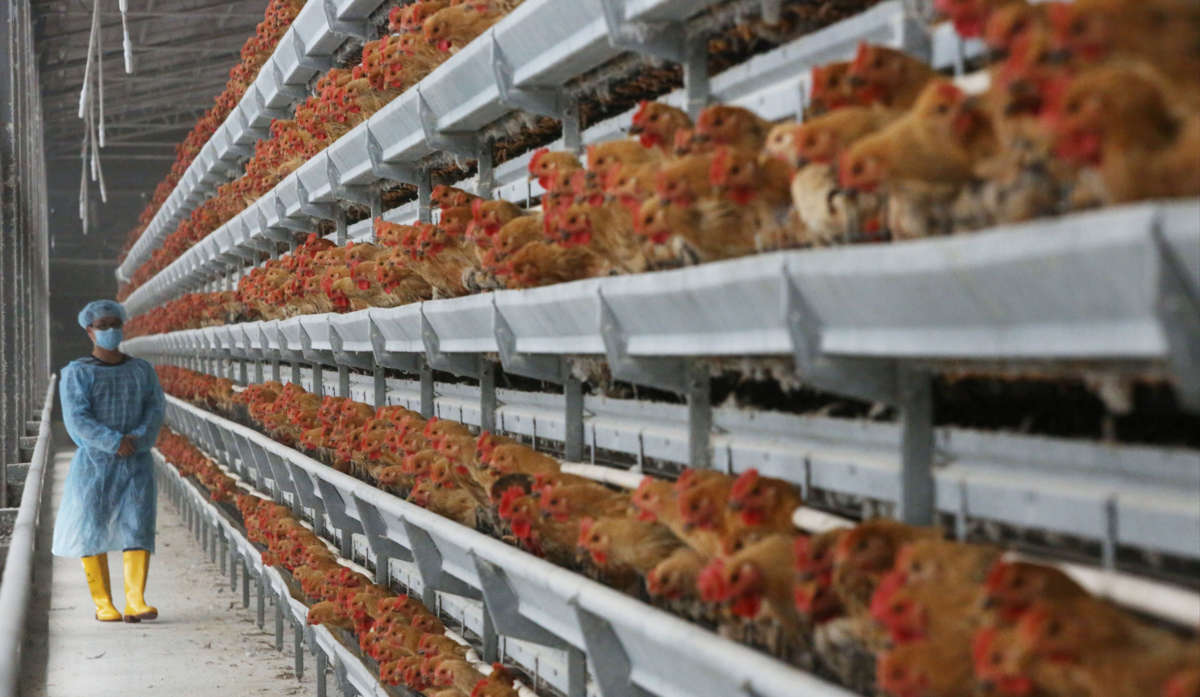
Flourishing antibiotic resistance is just one of the many public health crises produced by factory farming. Other problems include foodborne illness, flu epidemics, the fallout from poor air and water quality, and chronic disease. All of it can be traced to the current industrial approach to raising animals for food, which puts a premium on “high stocking density,” wherein productivity is measured by how many animals are crammed into a feeding facility.

Oversight for the way factory farms operate and manage waste is minimal at best. No federal agency collects consistent and reliable information on the number, size and location of large-scale agricultural operations, nor the pollution they’re emitting. There are also no federal laws governing the conditions in which farm animals are raised, and most state anti-cruelty laws do not apply to farm animals.

For example, Texas, Iowa and Nebraska have excluded livestock from their animal cruelty statute and instead created specific legislation aimed at farm animal abuse that makes accepted or customary husbandry practices the animal welfare standard.

After New Jersey created similar legislation, the New Jersey Society for the Prevention of Cruelty to Animals sued the New Jersey Department of Agriculture, claiming that “routine husbandry practices” was too vague. The New Jersey Society won, and as a result, the state’s Department of Agriculture has created more specific regulations.

In North Carolina, any person or organization can file a lawsuit if they suspect animal cruelty, even if that person does not have “possessory or ownership rights in an animal.” In this way, the state has “a civil remedy” for farm animal cruelty.

Still, the general lack of governmental oversight of factory farms results in cramped and filthy conditions, stressed-out animals and workers, and an ideal setup for the rampant spread of disease among animals, between animals and workers, and into the surrounding environment through animal waste.

Antibiotic Resistance

The problem: In 2017, nearly 11 million kilograms of antibiotics — including 5.6 million kilograms of medically important antibiotics — were sold in the U.S. for factory-farmed animals. Factory farms use antibiotics to make livestock grow faster and control the spread of disease in cramped and unhealthy living conditions. While antibiotics do kill some bacteria in animals, resistant bacteria can, and often do, survive and multiply, contaminating meat and animal products during slaughter and processing.

What it means for you: People can be exposed to antibiotic-resistant bacteria by handling or eating contaminated animal products, coming into contact with contaminated water or touching farm animals, which of course makes a farmworker’s job especially hazardous. Even if you don’t eat much meat or dairy, you’re vulnerable: Resistant pathogens can enter water streams through animal manure and contaminate irrigated produce.

Developments: The European Union has been much more aggressive than the U.S. in regulating antibiotic use on factory farms, banning the use of all antibiotics for growth promotion in 2006. But the U.S. is making some progress, too. Under new rules issued by the Food and Drug Administration (FDA), which went into effect in January 2017, antibiotics that are important for human medicine can no longer be used for growth promotion or feed efficiency in cows, pigs, chickens, turkeys and other animals raised for food.

Additionally, 95 percent of medically important antibiotics used in animal water and feed for therapeutic purposes were reclassified so they can no longer be purchased over the counter, and a veterinarian would have to sign off for their use in animals. As a result, domestic sales and distribution of medically important antimicrobials approved for use in factory farmed animals decreased by 43 percent from 2015 (the year of peak sales) through 2017, reports the FDA.

However, the agency still allows routine antibiotic use in factory farms for disease prevention in crowded and stressed animals, so these new rules aren’t nearly enough, says Matthew Wellington, antibiotics program director for the U.S. Public Interest Research Group Education Fund.

“The FDA should implement ambitious reduction targets for antibiotic use in the meat industry, and ensure that these medicines are used to treat sick animals or control a verified disease outbreak, not for routine disease prevention,” Wellington said in a statement, according to the Center for Infectious Disease Research and Policy.

National Resources Defense Council Senior Attorney Avinash Kar agrees. “Far more antibiotics important to humans still go to cows and pigs — usually when they’re not sick — than to people, putting the health of every single one of us in jeopardy.”

Water and Pollution

The problem: Livestock in this country produce between 3 and 20 times more waste than people in the U.S. produce, according to a 2005 report issued by the Environmental Protection Agency (EPA). That’s as much as 1.2-1.37 billion tons of manure a year. Some estimates are even higher.

Manure can contain “pathogens such as E. coli, growth hormones, antibiotics, chemicals used as additives to the manure or to clean equipment, animal blood, silage leachate from corn feed, or copper sulfate used in footbaths for cows,” according to a 2010 report by the National Association of Local Boards of Health. Though sewage treatment plants are required for human waste, no such treatment facility exists for livestock waste.

Since this amount far exceeds what can be used as fertilizer, animal waste from factory farms typically enters massive, open-air waste lagoons, which spread airborne pathogens to people who live nearby. If animal waste is applied as fertilizer and exceeds the soil’s capacity for absorption, or if there is a leak or break in the manure storage or containment unit, the animal waste runs off into oceans, lakes, rivers, streams and groundwater.

Extreme weather increases the possibility of such breaks. Hurricane Florence, for example, flooded at least 50 hog lagoons when it struck the Carolinas last year, and satellite photos captured the damage.

Whether or not the manure is contained or spread as fertilizer, it can release many different types of harmful gases, including ammonia and hydrogen sulfide, as well as particulate matter comprised of fecal matter, feed materials, pollen, bacteria, fungi, skin cells and silicates, into the air.

What it means for you: Pathogens can cause diarrhea and severe illness or even death for those with weakened immune systems, and nitrates in drinking water have been connected to neural tube defects and limb deficiencies in newborns (among other things), as well as miscarriages and poor general health. For infants, it can mean blue baby syndrome and even death.

Gases like ammonia and hydrogen sulfide can cause dizziness, eye irritation, respiratory illness, nausea, sore throats, seizures, comas and death. Particulate matter in the air can lead to chronic bronchitis, chronic respiratory symptoms, declines in lung function and organic dust toxic syndrome. The Centers for Disease Control and Prevention (CDC) reported that children raised in communities near factory farms are more likely to develop asthma or bronchitis, and that people who live near factory farms may experience mental health deterioration and increased sensitization to smells.

Developments: It is difficult to hold factory farms accountable for polluting surrounding air and water, largely for political reasons. The GOP-controlled Congress and the Trump administration excused big livestock farms from reporting air emissions, for instance, following a decade-long push for special treatment by the livestock industry.

The exemption indicates “further denial of the impact that these [emissions] are having, whether it’s on climate or whether it’s on public health,” says Carrie Apfel, an attorney for Earthjustice. In a 2017 report from the EPA’s Office of the Inspector General, the agency admitted it has not found a good way to track emissions from factory farms and know whether the farms are complying with the Clean Air Act.

No federal agency even has reliable information on the number and locations of factory farms, which of course makes accountability even harder to establish.

Foodborne Illness

The problem: The United States has “shockingly high levels of foodborne illness,” according to an investigation jointly conducted by the Bureau of Investigative Journalism and The Guardian, and unsanitary conditions at factory farms are a leading contributor.

Studying 47 meat plants across the U.S., investigators found that hygiene incidents occur at rates experts described as “deeply worrying.” One dataset covered 13 large red meat and poultry plants between 2015 and 2017 and found an average of more than 150 violations a week, and 15,000 violations over the entire period. Violations included unsanitary factory conditions and meat contaminated with blood, septicemic disease and feces.

“The rates at which outbreaks of infectious food poisoning occur in the U.S. are significantly higher than in the UK, or the EU,” Erik Millstone, a food safety expert at Sussex University told the Guardian.

Poor sanitary practices allow bacteria like E. coli and Salmonella, which live in the intestinal tracts of infected livestock, to contaminate meat or animal products during slaughter or processing. Contamination occurs at higher rates on factory farms because crowded and unclean living conditions increase the likelihood of transmission between animals.

It also stresses out animals, which suppresses their immune response, making them more susceptible to disease. The grain-based diets used to fatten cattle can also quickly increase the risk of E. coli infection. In poultry, the practice of processing dead hens into “spent hen meal” to be fed to live hens has increased the spread of Salmonella.

What it means for you: According to the CDC, roughly 48 million people in the U.S. suffer from foodborne illnesses annually, with 128,000 hospitalizations and 3,000 deaths each year. Salmonella accounts for approximately 11 percent of infections, and kills more people every year than any other bacterial foodborne illness.

Developments: In January 2011, President Obama signed the Food Safety Modernization Act (FSMA), the first major piece of federal legislation addressing food safety since 1938. FSMA grants the FDA new authority to regulate the way food is grown, harvested and processed, and new powers such as mandatory recall authority.

The FSMA “basically codified this principle that everybody responsible for producing food should be doing what the best science says is appropriate to prevent hazards and reduce the risk of illness,” according to Mike Taylor, co-chairman of Stop Foodborne Illness and a former deputy commissioner for foods and veterinary medicine at the FDA. “So we’re moving in the right direction.”

However, almost a decade later, the FSMA is still being phased in, due to a shortage of trained food-inspectors and a lack of funding. “Congress has gotten about halfway to what it said was needed to successfully implement” the Act, Taylor said.

The Flu

The problem: Both the number and density of animals on factory farms increase the risk of new virulent pathogens, according to the U.S. Council for Agriculture, Science and Technology. In addition, transporting animals over long distances to processing facilities brings different influenza strains into contact with each other so they combine and spread quickly.

Pigs — susceptible to both avian and human flu viruses — can serve as ground zero for all sorts of new strains. Because of intensive pig farming practices, “the North American swine flu virus has jumped onto an evolutionary fast track, churning out variants every year,” according to a report published in the journal Science.

What it means for you: These viruses can become pandemics. In fact, viral geneticists link the genetic lineage of H1N1, a kind of swine flu, to a strain that emerged in 1998 in U.S. factory pig farms. The CDC has estimated that between 151,700 and 575,400 people worldwide died from the 2009 H1N1 virus infection during the first year the virus circulated.

Breast, Prostate and Colon Cancer

The problem: Factory farms in the U.S. use hormones to stimulate growth in an estimated two-thirds of beef cattle. On dairy farms, around 54 percent of cows are injected with recombinant bovine growth hormone (rBGH), a growth hormone that increases milk production.

What it means for you: The health effects of consuming animal products treated with these growth hormones is an ongoing international debate. Some studies have linked growth hormone residues in meat to reproductive issues and breast, prostate and colon cancer, and IGF-1, an insulin-like growth hormone, has been linked to colon and breast cancer. However, the FDA, the National Institutes of Health and the World Health Organization have independently found that dairy products and meat from cows treated with rBGH are safe for human consumption.

Because risk assessments vary, the EU, Australia, New Zealand, Japan, Israel and Argentina have banned the use of rBGH as a precautionary measure. The EU has also banned the use of six hormones in cattle and imported beef.

Developments: U.S. Department of Agriculture guidelines allow beef products to be labeled with “no hormones administered” and dairy products to be labeled “from cows not treated with rBST/rBGH” if the producer provides sufficient documentation that this is true. Consumers can use this information to make their own decisions about the risks associated with hormone-treated animal products.

What You Can Do

You can vote for local initiatives that establish health and welfare regulations for factory farms, but only a tiny number of states, including California and Massachusetts, are even putting relevant propositions on the ballot.

Another option is to support any of the nonprofits that are, in lieu of effective government action, taking these factory farms to task. The Environmental Working GroupEarthjustice and the Animal Legal Defense Fund are among those working hard to check the worst practices of these factory farms. Another good organization is the Socially Responsible Agricultural Project, which works with local residents to fight the development of factory farms in their own backyards.

Buying humanely raised animal products from farms and farmers you trust is another way to push back against factory farming. Sadly, products from these smaller farms make up only a fraction of the total. In the U.S., roughly 99 percent of chickens, turkeys, eggs and pork, and 70 percent of cows, are raised on factory farms.

You can support lab-grown “clean” burgers, chicken and pork by buying it once it becomes widely available. Made from animal cells, the process completely spares the animal and eliminates the factory farm. “The resulting product is 100 percent real meat, but without the antibiotics, E. coliSalmonella, or waste contamination,” writes the Good Food Institute.

In the meantime, you can register your objection to factory farming by doing your bit to reduce demand for their products. In short, eat less meat and dairy, and more plant-based proteins.

More than $13 billion has been invested in plant-based meat, egg and dairy companies in 2017 and 2018 alone, according to the Good Food Institute, and Beyond Meat’s initial public offering debut in May marked the most successful one since the year 2000.

Lest you think that what you do on your own can’t possibly make a difference, consider one of the major drivers behind all this new investment: consumers are demanding change.

“Shifting consumer values have created a favorable market for alternatives to animal-based foods, and we have already seen fast-paced growth in this space across retail and foodservice markets,” says Bruce Friedrich, executive director of the Good Food Institute.

This article was produced as part of a partnership between Stone Pier Press and Earth | Food | Life, a project of the Independent Media Institute. An earlier version appeared on Stone Pier Press.

Fixing Livestock Emissions Metrics

Are we looking at the livestock industry's GHG emissions holistically—and can a new framework help turn livestock into a solution for climate change?

IN IOWA, POLITICIANS PROTECT THE MEAT INDUSTRY BY MAKING ANIMAL RIGHTS ACTIVISTS CRIMINALS

This video includes graphic images some readers may find disturbing.

The meat industry depends, more than anything else, on walls. The walls of farms and slaughterhouses prevent consumers from seeing what the production of their food really looks like. They prevent journalists and activists from exposing unethical, even criminal acts within. They enable corporations to paint happy, bucolic pictures of their operations that bear no resemblance to the reality of modern-day factory farming.

To get inside those walls, over the last two decades, dozens of activists have gone undercover, finding employment on factory farms and wearing concealed cameras, shooting hundreds of hours of footage over the course of months on the job. They have documented the routine acts of mistreatment and abuse of animals that are an inherent part of raising livestock for slaughter with maximum profit in mind.

The videos they have produced have made an enormous impact on the industry, grabbing headlines, pushing consumers away from meat, compelling retailers to pull products from shelves, and even causing government regulators to temporarily shutter some farms.

In Iowa, an ag-gag law passed in 2011 was struck down earlier this year by a federal judge. But thanks to the political power it wields in the state, the meat industry did not have to wait long to see the law resurrected. Just two months after the court’s decision, Iowa’s legislature passed a brand new ag-gag bill, and its newly elected governor, Kim Reynolds, signed it into law.

Our short documentary tells the story of one undercover investigator whose footage is at the center of Iowa’s ag-gag backlash.

On World Day for Farmed Animals, Let’s Honor Who They Are

The amount of pain and suffering these animals endure is incalculable.

Posted Oct 02, 2019

Over 150 million animals are killed for food around the world every day—just on land. That comes out to 56 billion land animals killed per year in the U.S. alone. Including wild-caught and farmed fishes, we get a daily total closer to 3 billion animals killed.” 

October 2 is World Day for Farmed Animals. On the website for the annual recognition of what these billions of nonhuman animal (animal) beings go through at the hands of humans before they’re brutally killed for unnecessary meals we read:

“Each year, an estimated 70 billion cows, pigs, chickens, turkeys, and other sentient land-based animals are caged, crowded, deprived, drugged, mutilated and macerated in the world’s factory farms. Then they are brutally slaughtered for our dinner table. Countless aquatic animals are caught and suffocated by vast trawler nets, so we can have our fish fillet or tuna fish salad.”

When fishes and other water animals are thrown into the equation—billions of these sentient beings also are farmed animals—the number easily swells to trillions of animal beings killed each year on food farms and in the wild.

Slaughtering sentience: How much pain per pound do these animals suffer?

“…the question is not, Can they reason? nor, Can they talk? but, Can they suffer? Why should the law refuse its protection to any sensitive being?… The time will come when humanity will extend its mantle over everything which breathes…”  —Jeremy Bentham

It’s a sad fact that the amount of pain and suffering these animals endure before they’re killed truly is incalculable. So-called “food animals,” including fishes and other aquatic animals, are intelligent and sentient, feeling beings. (See “It’s Time to Stop Pretending Fishes Don’t Feel Pain.”) When someone eats animals and animal products, they’re consuming a good deal of pain and suffering. While many people are led to believe that consuming dairy is OK, because the animals are kept alive, dairy animals also deeply suffer when they’re used and abused as “milk machines.” (See “The Scary Facts of Dairy Violate the Five Freedoms” and “The Mistreatment of Female ‘Food Cows’ Includes Sexual Abuse.”)

It’s also important to recognize that “being smart” really isn’t a factor in how much animals, including humans, suffer. It’s what they feel that’s important. (See, for example, “Are Pigs as Smart as Dogs and Does It Really Matter?” and references therein.) A young girl once asked me if so-called “food animals” suffer like her companion dog suffers when he’s in pain. When I said, “Yes, they do,” she blanched and almost started crying.

At another talk I was asked, “How much pain per pound do these animals suffer?” and I said that it was really impossible to calculate any meaningful number, but it’s a good question to get discussions going about what these animal beings endure in their relatively short and horrific lives.

Those who choose to eat other animals and animal products also endure a good deal of cognitive dissonance. On many occasions, I hear people lament something like, “Oh, I know they suffer, but I really like my _____.” You can fill in the blank with meat, beef, pork, bacon, chicken, fish, lobster, and so on. (See “‘Oh, I know animals suffer, but I love my steak'”: The self-serving resolution of the ‘meat paradox.‘”)

I often hear people say that farmed animals aren’t treated all that bad and that there are regulations and laws that adequately protect them. However, it’s a fact that the regulations and laws that supposedly protect farmed animals are incredibly weak and weakly enforced, and egregious violations are very common.

Far too much lip service is given to protecting these amazing and fascinating animals. And it’s because people—including those who use them and eat them—know that there is incredible and inexcusable suffering among the trillions of food animals who wind up in humans’ mouths that regulations and laws exist in the first place. If these animals didn’t suffer, there would be no reason to protect them. Current regulations allow for more than 1,100 pigs to be slaughtered per hour.

Even with iconic animal welfarist Dr. Temple Grandin’s work to help farmed food animals along, the amount of pain and suffering farmed food animals endure is reprehensible, and, of course, avoidable. Only an extremely tiny percentage of these sentient beings may, in fact, benefit, as they trod along her so-called “stairway to heaven” on their way to the killing floor while hearing, seeing, and smelling the slaughter of others. Their lives before their death sentence are actualized—right after birth, as they mature, and when they’re shipped to slaughterhouses as if they’re unfeeling objects—and are inarguably, brutally horrific. (See “Stairways to Heaven, Temples of Doom, and Humane-Washing” and “My Beef With Temple Grandin: Seemingly Humane Isn’t Enough.”)

The language we use to refer to other animals really matters. On World Day for Farmed Animals, let’s honor all nonhumans who are used for food. It’s really a matter of who we eat, rather than what we eat, when it comes to the sentient nonhumans who wind up in our mouths. A few years ago, after I gave a talk and asked people to consider who they are choosing to eat rather than what they were eating, I learned that five people changed their meal plans because the word who made them realize “they were eating pain and suffering.”

Asking people to change their meal plans isn’t some sort of “radical animal rights” move, as some claim it to be. In fact, it’s all about decency. It’s about showing respect and compassion and honoring who these individuals really are: namely, deeply feeling sentient beings. We need a Golden Rule for how we treat other animals based on decency. Silence isn’t golden; it’s deadly.

It’s high time to phase out food animals and animal products once and for all. All of these animal beings need all the help they can get and then some. World Day for Farmed Animals is a perfect time to honor and to respect who these fascinating beings truly are.

References

https://www.psychologytoday.com/us/blog/animal-emotions/201910/world-day-farmed-animals-lets-honor-who-they-are

China’s pork prices to hit record level in 2019 due to African swine fever, even as imports surge, report says

  • Rabobank forecasts that prices will surpass the previous record seen in 2016 in the fourth quarter, hitting 30 yuan (US$4.36) per kilogram
  • Official data shows that domestic prices rose 30 per cent in June as production continues to slide after over 1 million pigs were culled

TOP PICKS

Economy

China hits back at Trump criticism of its WTO ‘developing country’ status

29 Jul 2019

ESince the first African swine fever outbreak in Liaoning province in August 2018, the disease has affected animals across the country, forcing China to cull more than 1.1 million pigs from an estimated herd of 350 million. Photo: Reuters

Since the first African swine fever outbreak in Liaoning province in August 2018, the disease has affected animals across the country, forcing China to cull more than 1.1 million pigs from an estimated herd of 350 million. Photo: Reuters

China’s pork prices will reach a record level by the fourth quarter of 2019 due to the impact of African swine fever on domestic production, even as imports continue to surge, according to a Rabobank report.

Pork prices rose by nearly 30 per cent in June compared with a year earlier, according to the Ministry of Agriculture and Rural Affairs, with the spread of African swine fever showing no sign of abating, causing domestic production to plunge.

“China’s pork and hog prices are likely to break the previous record high in 2016 by the fourth quarter,” said Pan Chenjun, the report’s author and a senior analyst for animal protein at Rabobank.

Prices for other meats, including chicken, are also expected to rise substantially, putting further pressure on the discretionary spending of Chinese consumers.

China’s pork and hog prices are likely to break the previous record high in 2016 by the fourth quarterPan Chenjun

Pan forecasts that the wholesale price for pork will reach 30 yuan (US$4.36) per kilogram, while hogs will reach 22 yuan. Wholesale prices for pork in June stood at 21.59 yuan a kilogram.

Pork prices hit record levels three years ago after farmers held back pigs from slaughter to rebuild herds after widespread culling in 2014 when prices were low.

Rabobank projected that China’s 2019 output will slump by 25 per cent, with an additional 10 to 15 per cent decline in both the nation’s herd and its pork production in 2020.

The Dutch bank, in its third-quarter report on pork, said that there will be “more shipments expected in the second half of 2019”, which will add to China’s already surging pork imports in the first half of the year in an attempt to fill the gap created by the falling domestic production.

Pan said that Chinese pork imports were likely to exceed 3 million tonnes in 2019, more than triple the 1.19 million tonnes last year, according to data from the General Administration of Customs. In June, imports soared 62.8 per cent to 160,467 tonnes, bringing the total for the first half of the year to 818,703 tonnes, according to customs data.

Given that China is the world’s largest pork producer and consumer, the devastating impact of African swine fever on pig herds has taken a toll on global markets for pork and related commodities. Its smaller pig population will mean that China will need to import less soybeans for pig feed, compounding the uncertainties surrounding the commodity already created by the US-China trade war.

Rabobank said many pig producers in exporting countries also remain cautious about expanding their production despite a rising global trade, increasing pressure on supply and prices globally in 2020.

To meet its growing protein supply deficit, China has also bought more chicken meat from abroad, albeit under its own strict import restrictions. Imports of frozen chicken meat soared 107.8 per cent to 71,921 tonnes in June compared with a year ago. Increasing demand is expected to push up chicken prices, where a 50 per cent gain in 2019 “would not be surprising”, said Pan.

China began to import more pork in March when domestic wholesale prices started to rise.

Imports of US pork

– which fell 75 per cent to 1,609 tonnes between July and December 2018 after China retaliated with tariffs in response to US duties on Chinese goods – have rebounded. Since January, imports from the US have more than tripled from 5,788 tonnes to 17,603 tonnes in May.

Since the first African swine fever outbreak in Liaoning province in August 2018, the disease has affected animals across the country, forcing China to cull more than 1.1 million pigs from an estimated herd of 350 million. Photo: AP

US pork imports to China face a 62 per cent tariff, but Bloomberg has cited unnamed sources saying that Beijing has approved duty waivers for some Chinese companies.

Global markets have adjusted to expectations that an agreement to end the trade war is unlikely in the short-term. However, Rabobank thinks the resumption of negotiations between the world’s two largest economies in Shanghai on Tuesday and Wednesday could result in China reviewing its tariffs on US pork imports.

Diseases like African swine fever will continue to negatively affect global animal protein output, according to the Rabobank report. Chinese domestic pork production will take more than five years to recover from the outbreak, due to the challenges of restocking that include a lack of solutions to prevent disease and the need for additional investment to restock herds, it said.

The decline comes at a time when demand for pork and meat from the growing middle class populations in China, India and other emerging economies in Southeast Asia is rising.

Dirk Pfeiffer, a professor of veterinary medicine and life science at City University of Hong Kong, said pig producers eager to capitalise on rising demand for meat and pork by China’s middle class, a result of the “economic success of mainland China”, did not invest properly in infrastructure to protect against disease.

“And how are you going to roll that back now? Pork prices have now gone up, that means many of the people will buy chicken instead. So farmers may increase chicken production, then we may have more bird flu,” Pfeiffer said.

Pork prices have now gone up, that means many of the people will buy chicken instead. So farmers may increase chicken production, then we may have more bird fluDirk Pfeiffer

African swine fever will also put downward pressure on middle-class consumer spending, which Beijing is counting on to help boost growth in an economy that is expanding at its slowest pace in nearly three decades. China’s middle class accounts for around 400 million people, or 28.6 per cent of the 1.4 billion population.

Economists at Capital Economics warned that Chinese consumption growth will be weighed down in the near term by consumer price inflation which is set to reach an eight-year high, due in large part to rising pork prices resulting from African swine fever.

“This will drag down real income growth and likely lead to a further deterioration in consumer sentiment,” they said in a report this month.

China’s consumer price index

rose 2.7 per cent in June compared to a year-earlier, driven by higher food prices in pork and fruits, according to the National Bureau of Statistics.

Since the first African swine fever outbreak in Liaoning province in August 2018, the disease has affected animals across the country, forcing China to cull more than 1.1 million pigs from an estimated herd of 350 million.

Rabobank pointed out that Chinese data showed that sow, or mother pig, inventory had dropped 26.7 per cent and the number of hogs had fallen 25.8 per cent at the end of June compared with a year ago. But it believes that the herd losses in specific regions are much worse, down by 40 to 60 per cent since last August. For 2019, the bank expects the total herd loss to exceed 50 per cent.

“No one in the world knows what to do exactly, because what we have [in China] is 50 per cent of the [world’s] pig population … and it’s on less than half the space of the country,” added Pfeiffer. “That is such an amount of biomass that there is just no quick fix.”

This article appeared in the South China Morning Post print edition as: Pork prices to hit record level in 2019 due to swine fever

The Green New Deal Must Include Regenerative Agriculture and an End to Factory Farming

by

https://www.commondreams.org/views/2019/07/18/green-new-deal-must-include-regenerative-agriculture-and-end-factory-farming

A millennial perspective on why the way we farm and how we consume food must be part of the conversation when it comes to the climate crisis

“A unique opportunity to address climate change can be found in our agriculture sector,” writes Kruger, “an area which must be made sustainable if we’re going to survive.” (Photo: PeopleImages/iStock)

This week, a petition signed by more than 100,000 people was delivered to Congress, outlining issues that should be addressed in Representative Alexandria Ocasio-Cortez (D-NY) and Senator Ed Markey’s (D-MA) Green New Deal. This petition shows overwhelming support for the Green New Deal, and calls for more attention to be brought to how our food system can be reformed to combat climate change. With the food and farming sector being the United States’ largest employer, and the country being one of the highest contributors toward climate change, citizens are calling for action to be taken to protect our world.

As someone in their mid-twenties, I have grown up seeing how climate change is actively impacting me and my community. Here in California, I expect droughts in the summer and extreme wildfires or mudslides in the fall; learning from a young age to always conserve water because the next shortage is just around the corner. Young activists from all across the U.S. have seen similar changes in their home states, and we recognize that our future depends on action being taken to stop the climate crisis before it is too late.

“Disinvestment from factory farms is necessary, not only from a climate standpoint, but from a larger human and environmental health perspective as well.”

A unique opportunity to address climate change can be found in our agriculture sector—an area which must be made sustainable if we’re going to survive. Climate scientists have identified agriculture as one of the largest contributors to climate change. This an opportunity to shift agricultural practices away from the large scale, conventional farms that currently dominate our food system to a regenerative, locally-focused, small-scale system that values the welfare of the land and those who work it. CFS has identified several focus points that should be implemented with the passing of the GND resolution to cut back greenhouse gas emissions and create a healthier, more sustainable food system.

1. Invest in regenerative, local agriculture

The future of agriculture lies in the shifting of practices away from large scale monocultures towards small and medium-sized diversified farms. We must wean away from the mass amounts of toxic chemical pesticides and fertilizers being used, and instead integrate regenerative practices such as cover cropping, the use of compost, and the implementation of hedgerows as alternatives that not only add nutrients into the soil, but provide many other ecosystem services. Among these, regenerative agriculture protects biodiversity, including the native bees and pollinators that are currently being decimated by conventional agriculture. Our “Regenerating Paradise” video series covers many practices currently being practiced in Hawai’i—including several that can be implemented nationwide—to reduce carbon emissions and protect our soils. Implementing these practices can sustain our food production all while sequestering carbon, protecting pollinators, and promoting on-farm biodiversity.

Switching to these regenerative agriculture practices will not be easy, but it will be beneficial. Despite research showing the vast benefits that come from cover cropping and other regenerative practices, farmers have been slow to start implementing them. Government and university grants, technical assistance, and further research should be funded to help promote these practices, transition farms, and aid the continuous education of farmers and farmworkers. This investment will have far-reaching effects on farms—preserving native pollinator habitat, sequestering carbon, and providing climate-smart food to local communities.

2. Cut meat consumption and shut down environmentally-harmful animal factory farms

Disinvestment from factory farms is necessary, not only from a climate standpoint, but from a larger human and environmental health perspective as well. Large scale animal operations pollute the water, lead to a higher risk of disease in humans, and contribute large amounts of methane and other greenhouse gases into the air. Cutting back meat consumption, purchasing meat from local sources, and shifting toward plant-based sources of protein are all ways that individuals can help. More people than ever, especially young people, have recognized the harmful impacts of meat consumption and we are turning toward a flexitarian diet, vegetarianism, and veganism as a way to cut back on our carbon footprint. The government has the opportunity to support this effort on a larger scale by providing financial support and technical assistance to ranchers to help them transition to pasture-based and integrated livestock operations that reduce livestock’s impact on climate change and help sequester carbon in the soil.

CFS’s recently launched EndIndustrialMeat.org, a website that highlights some of the negative impacts that come with factory farming, including the vast amount of carbon released into the air and heavy metals being drained into the ground; serious consequences that disproportionately affect rural populations and disadvantaged communities. The GND’s goal to secure clean air and water, healthy food, and a sustainable environment for all communities mean that shutting down these harmful operations is imperative.

3. Reverse the trend of consolidation within the agriculture sector

For decades now, there has been increasing consolidation of seed, livestock, and other agriculture-related companies. These mega-corporations have purchased vast quantities of land and set the rules for how a farm has to run, undercutting disadvantaged farmers and farmworkers, and wrecking rural communities. GND policies can be used to break up these mega-farms, and empower local communities to take back the food system. Breaking up these predatory mega-farms would not only reinvigorate the economies of rural areas, but it would also give these communities access to the healthy, climate-friendly food necessary to slow the rate of climate change.

The growth of small and medium-sized farms would allow farmers and farmworkers to set fair wages and provide safe and humane conditions for themselves and a future for their children. Doing so would not only allow current farmers to continue their operations, but also would open the door for young farmers to have access to the land, resources, and funds needed to operate for a viable, sustainable farm.

4.  Support young and disadvantaged farmers

Finally, we must utilize the GND to support disadvantaged and young farmers, paving the way for a climate-friendly food future. For a long time, people have been turning away from farming, instead opting for job opportunities found in cities. For the past several years, there has been a renewed interest in working the land in a regenerative, holistic manner. We must support these new farmers, along with the farmworkers who have been subjugated to the abuses of industrial agriculture, to forage a community-focused, regenerative food system.

The principles of equity and justice outlined in the GND must guide our transition away from industrial monocultures, and toward a food system that supports and uplifts disadvantaged groups, providing the economic assistance and infrastructure needed to improve these communities, and ultimately improving our economy as a whole. Likewise, many young and disadvantaged farmers have limited access to the equipment and mentorship needed to run a successful farm enterprise. Having grants and training programs available to take on the huge costs of tractors, land, and resources necessary to start a farm should be central to the Green New Deal.

Young people have paved the way for the Green New Deal and our future depends on immediate action being taken to stop climate change. Not only will this resolution allow for the huge changes needed to prevent climate change, but will allow for new opportunities for farmers. While the challenge ahead of us won’t be easy, there are many things that can be done to mitigate current greenhouse gas emissions that aren’t being implemented. The GND is an opportunity to reform our way of farming to allow for huge cuts to current emissions, all while creating a more equitable food system.

I lectured about the public health dangers of industrial farming. But what I saw went beyond my fears

.. Visiting one was far worse than I imagined

APRIL 20, 2019 6:00PM (UTC)
Excerpted and adapted from “Our Symphony with Animals: On Health, Empathy and Our Shared Destinies” by Aysha Akhtar. Published by Pegasus Books. © Aysha Akhtar. Reprinted with permission.
https://www.salon.com/2019/04/20/i-studied-factory-farms-for-years-visiting-one-was-far-worse-than-i-imagined/?fbclid=IwAR0qzRUvQyipHFsAthJ1yyp_6dvahNy_eu9-yAUpqy_nYjQbcqh1jn4wkoI
I was giving a talk at a conference in Oklahoma about the public health dangers of industrial animal farming, or “factory farming” as it is commonly called. Each year, more than 64 billion animals are raised and killed for food globally. In the United States alone, 1 million animals are slaughtered every hour. Largely because of increased demand for cheap animal products, intensive animal operations have replaced most traditional farming practices world- wide. The transformation of animal agriculture is so dramatic that it has been dubbed the “livestock revolution.” This unprecedented change in the human relationship with animals has led to not only more animal suffering than ever before in human history but also to devastating harms to human health.

At the conference, I presented data showing how animal agriculture (and the resultant high consumption of animal products) causes more greenhouse gas emissions than the entire transportation sector. It also pollutes our land and water and increases our risks of cancers, obesity, strokes, and infectious diseases like salmonella, E. coli, and bird flus. Throughout my presentation, a solemn-looking woman with short, auburn hair and glasses kept shaking her head in disagreement. When I ended my talk and opened the floor for questions, the woman went on the attack. She disputed everything I said. There are no environmental hazards, no infectious disease risks, no animal welfare problems.

“Have you ever visited one of these farms?” she demanded, with evident anger.

I told her I had not because these places are not open for the public’s viewing. But my data came from reputable studies published by institutions like the Johns Hopkins Bloomberg School of Public Health and the Food and Agriculture Organization of the United Nations. The evidence is so strong, the American Public Health Association called for a moratorium on factory farms.

The woman, Jean Sander, was dean of the Oklahoma State University’s Center for Veterinary Health Sciences. “You need to visit our farms,” she replied. “They are nothing like what you say.”

Three months later, I take Jean up on her offer. The farms are worse than anything I’ve read.

On a dismal morning in late November, I meet Dr. Sander at the parking lot of a Sonic fast food restaurant in Bristow, Oklahoma. After we greet each other and complain about the weather, I get into her car. We head out to visit an egg-laying farm about a half hour away. This farm is not the place Jean initially set up for my visit. She was originally going to take me to see a “broiler” farm, where chickens are produced for meat, which is contracted by Tyson Foods. The Tyson chicken facility is one of Oklahoma’s largest.

But a few days before my flight to Tulsa, the Tyson facility manager backed out. He informed Jean that an undercover investigation at a chicken facility in Tennessee recently caught the attention of news reporters. As a result, he was not letting any outsiders in his buildings. The undercover investigators videotaped farm employees beating sick chickens with spiked clubs. Like the Oklahoma facility, the one in Tennessee was also contracted by and supplied chickens to Tyson Foods.

The only reason I am being allowed in is because of Jean. Her affiliation with Oklahoma State University, one of the largest agricultural schools in the country, has placed Jean in a position to know many of the animal farm managers in Oklahoma. They view her as an ally. And thanks to my connection with Jean, they must have seen me as nonthreatening. Even so, it took months for Jean to find facilities that would open their doors to us.

Herbert Wendell walks up to us and shakes our hands with fervor. With his ruddy cheeks and cheerful welcome, he immediately reminds me of my father-in law. Herbert comes from a family of crop farmers and was the first to move into animal agriculture. In 1957, he bought one chicken that started his egg-laying business. Since then, the number of chickens has grown to about thirty thousand.

After a few minutes of greeting, Jean hands me a disposable coverall, pair of booties, and gloves. They are meant to keep us from inadvertently introducing infectious agents into the facility as part of a biocontainment plan—methods that clearly don’t work, given how often bird and swine flu epidemics sweep across industrial farms in the United States. Jean and I cover ourselves. We then follow Herbert and his granddaughter inside the nearest of the two animal sheds and . . . oh my god!

I hide my face so the others don’t see me gag. I’m worried I’ll offend Herbert if I vomit.

With great effort, I swallow the bile pooling at the back of my throat and straighten up. Slowly, my other senses kick in. Touch first. Flies land on my face. I swat ineffectually at my forehead, nose, ears. Next comes sound. Not the individual noises of calls, clucks, and squawks. But a roar. A singular shout.

Jean tells me that the standard of practice used to be to allow 54 square inches per bird in a cage. Now they’re moving to 60 to 65 square inches per bird as an animal welfare gesture. Sixty-five square inches is about two-thirds the dimension of a single sheet of letter-sized paper. A hen is forced to live her entire life in the space of my laptop screen, but this is considered, by the agricultural industry, as progress.

As we walk down the rows, I breathe through my mouth to somewhat ease the stench. The birds scurry and climb on top of one another to hide near the back of the cages. They’re terrified of us. I’m scared too. Scared that they will crush one another, which Herbert tells me, has happened. Up closer, I see raw, red exposed areas on most of the birds, where their feathers rubbed off against the wires entrapping them. I can’t imagine how painful that must be.

Since birds crowded like this commonly go mad and peck one another to death, these birds were debeaked, a practice whereby workers grab baby chicks in one hand and thrust their beaks between hot, steaming blades. Workers cut off anywhere from one-third to two-thirds of chicks’ beaks while they’re fully conscious. The industry calls this “trimming their beaks.” But slicing chickens’ beaks off with a heated blade or a scissor device, as is frequently done, is not like trimming your nails. Birds’ beaks are sensitive, highly innervated and able to feel pain and other sensations. It would be like having your toes cut off without anesthesia. Not only do chickens rely on their beaks for many functions, having their beaks severed causes them immense, acute, and, often, lifelong pain.

As we walk about, Herbert describes how the facility functions. Conveyer belts run along the span of the building, automatically collecting the eggs that fall under the chickens. Trenches alongside the cages hold feed pellets. It’s all mechanized. No human hand need ever touch a bird until the time of her death. This, then, is a chicken’s life. To huddle in a cage cowering on top of another for one and a half years until someone kills you.

Jean reminds me this is a small facility. Average-size farms house 100,000 birds. The largest may contain 200,000. I am so overwhelmed by the smell of filth and fear, I can’t fathom what those larger factories must be like.

Maggots. Hundreds, thousands of maggots squirming about the ground. I jump and lift my legs. Squashed maggots are stuck on the bottom of my bootie-covered sneakers. As I hop on each leg to inspect my feet, I slip.

And down I go.

When I look back at this moment, the image that comes to mind is a scene in the movie Poltergeist (the original, of course), when the earth beneath the haunted family’s house erupts and releases the screaming skeletons and gaping skulls buried beneath. In the downpour of a raging storm, the mother desperately tries to rescue her children trapped inside the house. As she runs into their backyard screaming for help, her foot slips along the edge of a large, muddy pit. She slides into a pool of death.

The trouble with meat: Why climate scientists are targeting beef

Taoiseach’s comments on eating less meat draw ire from farming industry but he has science on his side

The average amount of meat consumed per person per year globally has nearly doubled in the past 50 years. File photograph: H Armstrong Roberts/ClassicStock/Getty

The average amount of meat consumed per person per year globally has nearly doubled in the past 50 years. File photograph: H Armstrong Roberts/ClassicStock/Getty

Taoiseach Leo Varadkar is not the first politician or international figure to commit to reducing their meat consumption in making a contribution to tackling climate change.

At Fine Gael’s think-in on Monday, in response to a question on what he was doing to reduce his carbon footprint, Mr Varadkar said he was “trying to eat less meat – both for health reasons and for reasons of climate change”.

He defended these remarks in the Dáil on Tuesday after angry criticism from a number of opposition TDs who said the farming sector is already under threat from Brexit.

In the Irish context, he joined ranks with former president Mary Robinson, a prominent climate justice campaigner.

Not all politicians have been so clear. In October, UK climate minister Claire Perry told BBC News it was not the government’s job to advise people on a climate-friendly diet. She would not say whether she herself would eat less meat. She was accused by Friends of the Earth of a dereliction of duty as they insisted ministers must show leadership on this difficult issue.

Already, Mr Varadkar has been accused of not acting in the national interest and of undermining a €12 billion agriculture industry notably by rural TDs such as Danny Healy-Rae and Michael Fitzmaurice. Irish Cattle & Sheep Farmers’ Association president Patrick Kent described his comments as “reckless in the extreme”.

The economic stakes are high. In 2018, meat and livestock exports amounted to €3.97 billion. The reality of climate change would suggest, however, the cost of consumption as usual will be many times more.

A definitive study by a team led by Dr Marco Springmann at the University of Oxford concluded huge reductions in meat-eating were essential to avoid dangerous climate change.

Analysing the food system’s impact on the environment, it said western countries needed to reduce beef consumption by 90 per cent – Ireland is among the top consumers of beef in Europe; estimated annual per-capita consumption is 19kg.

The research found enormous changes to farming were needed to avoid destroying the planet’s ability to feed the expected 10 billion population by 2050. In contrast, Ireland has been justifying rapid expansion of its beef and dairy sectors on the basis of global population growth, and insisting (correctly) it is among the most carbon-efficient countries in the world in doing so.

Great damage

Food production already causes great damage to the environment, via greenhouse gases from livestock; deforestation and water shortages from farming, and vast ocean dead zones from agricultural pollution. But its impact will get far worse as the world population rises and global income triples, enabling more people to eat meat-rich western diets, the Oxford study concluded.

The animal agriculture industry is not only vulnerable to the observed and predicted effects of climate change (just look at how extreme weather triggered fodder crises of late); it is also a key contributor to the problem.

Farming of animals for meat and dairy products accounts for 16.5 per cent of global carbon emissions. The animal sector is responsible for a third of all anthropogenic methane and two-thirds of nitrous oxide emissions – potent greenhouse gases that trap more heat than carbon dioxide.

Ireland and New Zealand are unique in the world in having most carbon emissions coming from agriculture rather than heavy industry – while reducing emissions from the former is notoriously difficult. As meat consumption climbs steeply, it is likely to increase emissions and reduce biodiversity, other studies suggest.

High levels of meat consumption have been linked to increased risk of colorectal cancer and cardiovascular disease. The average amount of meat consumed per person per year globally has nearly doubled in the past 50 years.

There are indications some countries may have reached “peak meat”, with consumption rates falling slightly. However, middle-income countries, particularly China and others in east Asia, are still seeing a rise.

Moderates are not suggesting everyone should become vegetarian or vegan (though it is indisputable these diets are better for the environment, contribute less to climate change, and are healthier) or that governments should mandate limits on meat consumption.

They contend, however, the climate impact of what you eat and drink must be taken into account – and there is an ethical requirement on most global citizens to shift the balance away from meat.

https://www.irishtimes.com/news/environment/the-trouble-with-meat-why-climate-scientists-are-targeting-beef-1.3759264?fbclid=IwAR3sr6hIIpTcLu-IBeYdrLTek1OPeTfPwiiK_lM7eV-beG5n6_j1V3KPVNw#.XD-gfV_qL-I.facebook

‘It’s God’s plan’: the man who dreams of bringing intensive chicken farming to Africa

A US mega-farm, a Christian backer and Africa’s oldest industrial chicken producer are bringing the world’s super birds to reform central Africa’s food market and feed the poor

by 

On the evening of 7 August 2018, a KLM charter flight left Amsterdam, landing 11 hours later at Kilimanjaro airport in northern Tanzania. Its young occupants were nodded through immigration and driven 50 miles to their new home, close to some of Africa’s most famous game parks.

These were no tourists hoping to see lions in the nearby Serengeti. The 2,320 little cockerels and 17,208 hens on the plane were a flock of European-bred pedigree Cobb 500 chickens, the world’s most popular breed. Their destination: a remote 200-hectare mega-farm under construction in the windy foothills of snow-capped Mount Kilimanjaro.

Here, where wildlife and nomadic tribes have always roamed, Tyson, the world’s second-largest food company, has set up with Irvine’s, Africa’s oldest industrial chicken producer. With the backing of a devout Christian businessman, Donnie Smith, the three partners aim to revolutionise food production in central Africaand “save” people from hunger by growing chickens on an American scale. The little chicks and hens are the expeditionary force of an army of Cobb 500s to follow.

Irvine’s $20m (£15m) parent stock laying eggs on the high plains below Mount Kilimanjaro is just the start. In a year’s time they expect to be sending 500,000 fertilised eggs a week to a sister hatchery on the Tanzanian coast, where millions of one-day-old chicks will be sold to local farmers. In a few years they could be rearing and exporting 40m or even 50m broilers a year to neighbouring Kenya, Rwanda, the Democratic Republic of the Congo and other African countries.

No one knows if they will flood the market and undermine local producers, or if they will improve food security in countries where millions of people regularly go hungry.

But they should make money. There is an insatiable appetite for chicken meat in African cities, and only a handful of industrial farms across the continent competing with imports from the US, Europe or Brazil.

Tyson sees central Africa as a promising new market. The corporate behemoth, which turns over $38bn (£30bn) a year, says it is “faith-friendly” and rooted in Christian values. It processes and sells about 11bn chickens a year worldwide, according to Bloomberg.

And for Donnie Smith (below left), the genial former chief executive of Tyson, from Tennessee, the Kilimanjaro plant is “God’s plan”.

Donnie Smith, former CEO of Tyson

Smith, who spent 35 years with Tyson, says he feels impelled by his faith to feed the world’s poor. He has already set up a small chicken charity in Rwanda that offers loans to small farmers to buy a few hundred birds. His mission now is to bring chickens to Africa on a grand scale.

“I am a Christian. I feel a call to use my poultry background and put that to work. Poultry is the most efficient converter of feed to meat; no religions are against eating poultry. If you want an impact on the poor, providing them with high-quality, affordable protein from chicken is the best way.

“Why Africa? The need is tremendous. I have travelled in sub-Saharan Africa and in the largest population centres you see fairly rapid progress, but [not] in rural areas. All my experience tells me that God wants me to work in Africa,” he says.

Nature’s Arnie Schwarzeneggers

The farm looks like aliens have landed. Planet Cobb sees giraffes on their way between national parks pass many low, 120 metre-long, 12 metre-wide, shiny white structures; Maasai pastoralists in woven red shuka blankets drive their cattle over land dotted with steel masts, tanks and towers. The snows of Kilimanjaro glisten above the clouds.

As happens all over Africa, many households in the few nearby villages keep chickens for eggs or to eat on occasional celebrations. But unlike the bright white Cobb 500s in their sealed sheds, these birds are scrawny, gaudy and all shapes and sizes. They look spectacular and taste strong.

In contrast, the Cobbs are nature’s Arnie Schwarzeneggers – all jutting chests, rippling thighs, big feet and bland flesh. These meat machines have been highly bred for 100 years to grow fast, bulk up their breasts and to eat only small quantities of cheap soya and maize.

Irvine’s new farm and hatchery in Dar es Salaam
Irvine’s farm
  • Irvine’s $20m farm and hatchery in Dar es Salaam

Today, the Cobb 500 is an industrial marvel. A parent hen will lay on average 192 eggs in its short 15-month life, more than twice as many as any backyard bird; and a young Cobb 500 broiler can grow from a day-old chick to a 2kg bird ready for the pot in just 33 days.

The Cobb is now the chicken that ate the world, identically bred in 120 countries and the first choice of most of the world’s big poultry farmers and fast-food chains from McDonald’s to Wendy’s, KFC and Zaxby’s.

No one has counted, but there are probably far more Cobb 500s alive than there are humans. The UN’s Food and Agriculture organisation (FAO) estimated in 2011 that there were 19bn chickens across the globe. Of those bred for their meat, nearly half are thought to be Cobbs. In the next few years chicken is expected to overtake pork and beef to become the world’s most popular meat. Cobb flesh by then could be in the diet of billions of people.

The multinational company Cobb-Vantress, which has developed the bird and is owned by Tyson, declined to speak to the Guardian. But, says Hal Herzog, a US author and anthro-zoologist: “Once its feathers are plucked, its feet and head chopped off, its gut scraped out and its blood drained, 73% of a Cobb 500’s carcass will be eviscerated yield.

“A broiler chicken’s bones cannot keep up with the explosive growth of its body.” He says that unnaturally large breasts may torque a chicken’s legs, causing lameness, ruptured tendons and twisted legs.

But the Cobb 500 is the likely future of food. With scientists urging people to eat less meat to reduce greenhouse gas emissions, Cobb broilers are proving to have the best carbon footprint of all land-based animals. According to one calculation, kilo for kilo, a broiler emits five times less CO2 equivalent than lamb, and is environmentally better than cheese.

‘These birds live like kings and queens’

Adult breeding Cobb 500 chickens in a room containing 9,000 birds at Irvine’s farm in Kilimanjiro

To get the best, soft white meat from a Cobb 500 you need more than genetics, says Enzo Faglioni, the young Brazilian vet who is Irvine’s breeder operation manager at the farm. “You must minutely control the birds’ environment. They must be as comfortable as possible at all times, and be treated like babies,” he says. “These birds live like kings and queens.”

He accepts that commercial poultry farms have made welfare mistakes in the past, but says the lessons have been learned. No antibiotics are used unless there is an outbreak of illness, and no hormones are pumped into their feed.

To go inside the sealed, dark, windowless Kilimanjaro chicken sheds you must shower twice, brush your teeth, wash your hair and wear special clothes. When the doors are opened, there are identical white chickens as far as the eye can see.

Young Cobb 500 chicks drink from a mechanical water dispenser and are ready to be sold to local chicken farms
Each room contains around 9,000 birds and is strictly light and temperature controlled
Tumaini Kisirieli Kinyaha herds chicks to keep them active and prevent them from crowding in groups.
Stephano Erinest Mushi repairs the mechanical chicken feeder at Irvine’s farm
  • From top left: young Cobb chicks drink from a mechanical water dispenser; each room contains about 9,000 birds; herding chicks to keep them from crowding in groups; repairing the mechanical chicken feeder

There is a deep rumble of tens of thousands of clucks, interspersed with the crowing of many hundreds of cocks, and a whiff of ammonia. But random checks show no lameness, blisters or sores. The birds are not aggressive and look content. The mortality rate over their 15-month lifetime is said to be about 5%, far less than in the average European or American broiler house.

It is only when you get down on floor level that the large Cobb cocks attack. Feet out, wings flapping and beaks thrusting, they come at you hard. It hurts and all you can do is yell and run.

‘The need is great’

“This is how Africa can feed itself,” says Smith. The continent’s population is going to double to 2 billion people in the next 30 years and chicken is needed to provide the protein to avoid malnourishment and stunting, he says. “Chickens are good for the environment, too, because they need less land, less food and less water [than cattle and pigs] to produce the same amount of meat.

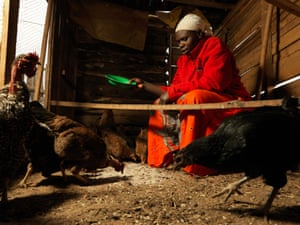
Villager Rahema Rashid feeds her free-range poultry

“We’re not there yet but we are making chicken more affordable. I don’t think that we will undermine other producers or traditional breeds. You will see two food systems running side by side.

“I believe that chicken will become the most affordable, complex protein on the African continent. We know what the future is going to look like and this is it. We want to access the future in Africa because the need is so great.”

Food security will be strengthened by improving the availability of broiler chicken products, confirms Anne Mottet, a livestock development officer for the FAO. But she emphasises the importance of small-scale operations. “Overall you want diversity of production sources. It’s more resilient than putting all your eggs in one basket. The more small-scale producers you have, the more resilient you are.”

Is sub-Saharan Africa ready for unchecked corporate concentration and the pollution and potential animal welfare problems that have plagued broiler-chicken production in Europe and the US?

Yes, says the Tanzanian government, which struggles to feed its fast-urbanising population and is a target for chicken imports from Europe and Brazil. Nearly a million people needed food aid in the country last year and Tanzania adds 1.6 million people a year. By 2035 its population will have grown by another 32 million.

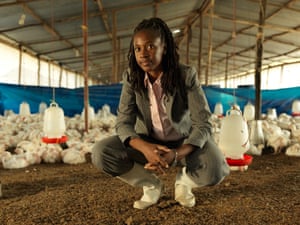
Rose Sweya, owner of Kingchick chicken farm in Kigamboni district, Dar es Salaam

“Definitely we are ready,” says Rose Sweya (left), a young Dar es Salaam chicken farmer who is eager to buy thousands of Donnie’s day-old Cobbs to fatten up. She says she welcomes competition and that the demand for chicken is insatiable.

“People desperately need protein and chicken is the best way to get it. The population is growing fast so the demand is rocketing. Eating chicken was rare when I grew up. It was seen as the food of high-class people. We had it for celebrations, and on special occasions like Christmas. For most people it is still quite rare,” she says.

With British aid, her company, Kingchick, is investing heavily in four poultry farms and a processing plant. She expects to employ another 20 or more women and could be selling 2,000 Cobbs a week within a year.

“There was always this mentality that frozen supermarket chicken was not good and that village chicken was best. But this is changing. ”

Locally grown chickens in a market in Arusha, Tanzania
  • Locally grown chickens in a market in Arusha, Tanzania

Yet the arrival of the Cobbs is a mixed blessing for the villagers near the farm. It has provided well-paid work for some, but Maasai herders have complained that the farm’s high fences restrict their access to traditional pasture land. This, says Faglioni, has been resolved.

“Industrial-scale farming goes hand in hand with development,” he says. “We are changing the way that people eat and how they see the world. People here are proud that they are producing safe food for the country. They have money and can buy better food. We are offering a better way of life for both chickens and people.”