Fisherman charged for underwater assault on scuba diver

Jul 31, 2014 http://www.hawaiinewsnow.com/story/26168287/fisherman-charged-for-underwater-assault-on-scuba-diver

 KONA, HAWAII (HawaiiNewsNow) –

Charges have now been filed in the scuba scuffle caught on tape in the waters off Kona.

Hawaii County Prosecutors have charged fisherman Jay Lovell with terroristic threatening in the second degree. He is accused of ripping the regulator out of Rene Umberger’s mouth eliminating her ability to breathe.

Lovell was collecting reef fish last May for the aquarium trade. Umberger is an environmentalist against the practice and says the incident isn’t stopping her from documenting aquarium fishermen.

“Violence is never appropriate but also people who are out there trying to expose and document the destructive practices on the reefs aren’t going to be intimidated by this kind of activity. Stooping to violence only hurts the cause it doesn’t help their cause,” said Rene Umberger, Reef Consultant and Diver.

The incident stirred debate around the country. Umberger says it helped people learn that aquarium fish do not always come from farms and has bolstered support against the trade.

Meanwhile Jay Lovell’s brother says he will fight the charges.

“Jay is actually looking forward to the court so all the facts of the case can actually come out. The fact that these people are targeting the industry, they’ve been threatening for over a year,” said Jim Lovell, Jay’s brother, who is also a reef fisherman. “They provoked us, they caused it, it’s on their table. It’s on their agenda and this is what they want to do.”

Jay Lovell’s court date on the misdemeanor charge is September 2nd.

images

Shark Hunters: A Reprehensible Celebration of Torture

http://www.psychologytoday.com/blog/animal-emotions/201407/shark-hunters-reprehensible-celebration-torture

This NBCSN series shows horrific suffering and regrettable celebration of pain

Plastic in Our Oceans

images

Another reason to bring your own bag to grocery store:

…estimates show that in the next 20 years there could be a pound of plastic for every two pounds of fish in the sea...

From Ocean Conservancy

Last week, I spoke to a packed room at the U.S. State Department’s “Our Ocean” conference. This landmark event, hosted by Secretary of State John Kerry, brought together international government leaders, expert scientists, and global activists like Leonardo DiCaprio to discuss the future of our ocean.

My message was simple: The avalanche of plastic reaching our ocean is as destructive as it is unnecessary. It can be stopped.

Plastics can kill animals like sea turtles, seals, and whales [not to mention, thousands of sea birds]. Once in the ocean, much of the plastic breaks into bite sized pieces animals are eating those pieces, along with the toxic pollutants that plastic adsorbs.

If we do not respond, estimates show that in the next 20 years there could be a pound of plastic for every two pounds of fish in the sea.

In rapidly growing countries, plastic consumption is outpacing waste management. Travel to places like the Philippines, and you’ll see houses built up right to the water’s edge. With no alternative in place, inevitably waste ends up in rivers and streams, and water becomes invisible below a sea of trash.

I believe we have a solution to stop the avalanche but not without your help, and we have to act fast.

We must stop trash at its source — before it enters the ocean. To do that, we need to work with companies and governments in industrializing countries to build critical waste management systems. If we do, we can keep trash out of the ocean and provide billions of people the sanitation they deserve.

At Ocean Conservancy, we are launching a major campaign to work with the most innovative international companies and make this happen.

5 Reasons Not to Eat Fish

Sea Lion Photo Copyright Jim Robertson

Sea Lion Photo Copyright Jim Robertson

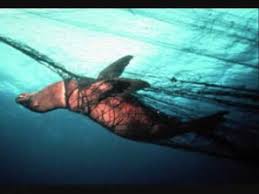
5. Seals and sea lions are scapegoated and shot by commercial fishermen and their lackeys who blame the marine mammals for dwindling fish populations. It’s the same “all here for us” mentality that ranchers and trophy hunters use to justify killing wolves.


Painting by  Barry K. MacKay

Painting by Barry K. MacKay

4. Cormorants are culled by the thousands, by both commercial and sport fishing interests unwilling to share “their” resources. Last April, sport fishermen in South Carolina shot over 11,000 cormorants for the crime of eating fish; and the U.S. Government is currently planning $1.5 million-a-year program that would arm federal trappers with silenced rifles and night-vision scopes to shoot thousands of Columbia River cormorants during their nesting season .


Featured Image -- 62263. Live fish sequester carbon. The sea absorbs about half of the billions of tons of CO2 humans produce…, but only if there’s plenty of phytoplankton, fish and other organisms living in it.


imagesH3BR7A8G

2. Bykill, including pelagic sea birds, turtles, marine mammals, and non-target fish species, accounts for 50% or more of some fisheries’ take. Many fisheries around the world throw away more fish than they keep.


images1. Fish are sentient beings too, no less deserving of compassion than any other species humans claim as their food. Flying in the face of what is considered popular opinion, fish have good memories, build complicated structures and show behaviour seen in primates – as well as feel pain like any other vertebrates. 


“Fish Are Sentient and Must Be Included in Our Moral Circle”

http://www.psychologytoday.com/blog/animal-emotions/201406/fish-are-sentient-and-emotional-beings-and-clearly-feel-pain

Fish are Sentient and Emotional Beings and Clearly Feel Pain

By Marc Bekoff, Ph.D. on June, 19, 2014 in Animal Emotions

Fish deserve better treatment based on a review of scientific data on their cognitive and emotional lives. According to the author, “the extensive evidence of fish behavioural and cognitive sophistication and pain perception suggests that best practice would be to lend fish the same level of protection as any other vertebrate.” Fish must be included in our moral circle. Read More

What Happened to the Salmon

10349141_711297352262704_1510602528179153356_n
“What kind of person can cut an ancient forest to bloody stumps, bulldoze the meadows to mud, spray poison over the mess that’s left, and then set smudge fires in the slash? And when the wounded mountainside slumps into the river, floods tear apart the waterfalls and scour the spawning beds, and no salmon return, what kind of person can pronounce it an act of God — and then direct the bulldozers through the stream and into the next forest, and the next? I hope there’s a cave in hell for people like this, where an insane little demon hops around shouting, ‘jobs or trees, jobs or trees,’ and buries an ax blade in their knees every time they struggle to their feet.”
-Kathleen Dean Moore
…and then take it out on the seals and sea lions for feeding on the fish, as they’ve always done. This is what happened to the salmon spawning beds around here.

Crafty Cod Use Tool to Get Food: Nothing Fishy About It

http://www.psychologytoday.com/blog/animal-emotions/201405/crafty-cod-use-tool-get-food-nothing-fishy-about-it

The more we learn about other animals the more fascinating they are

Nothing to Be Proud Of, Part 2

In an earlier post entitled, “Nothing to Be Proud Of,” I hinted at the regrettable fact that I used to fish. I promised that details would be forthcoming, but I realize now that this subject is worthy of a series of posts, starting with…

I’ve always been an “animal” person. The household dog, Jake—a German shepherd malamute mix—was my best friend and constant companion. He was my canine connection with the wolf, which I considered my “totem” animal.

But I wasn’t a one note wildlife advocate; I cared about all the animals of the land, sky and sea. Yet I subscribed to the all too common misconception that human beings had to eat meat. The food pyramid of the era in which I grew up (the 1960s and ‘70s) was as old as the mummified pharos and as outdated as the antiquated Egyptian practices of slavery and human sacrifice.

I was a self-taught naturalist and bird watcher, but I never aspired to be a nutritionist. I thought vegetarianism was a practice followed mostly by Eastern mystics, yogis, Hari Krishnas and the occasional hippie. And I was similarly ignorant about the intelligence of fish. Accepted “science” of the time held fish well below the surface of air-breathing, and therefore “aware,” animals. (Even today, grocery stores advertise “meat and fish,” as if fish flesh is somehow different from the flesh of we mammals.)

At the risk of sounding like an editor from Field and Stream, some of my fondest memories of my father centered around fishing at our family cabin. I was put off by power boating, but instead enjoyed taking the row boat out at first light while the lake was calm as glass and fish were jumping at the surface. As the morning fog lifted, motor boats would invariably break the calm, dragging water skiers around and around, while the fish would dive for cover.

Of course I could have left my fishing gear behind and just enjoyed rowing the boat across the lake, but at the time I went along with accepted thought and considered fish as “food,” perhaps even a more natural and environmentally sound choice than farm animals (I hadn’t even heard the term “factory farmed” yet).

I know now, after witnessing fish swim off trailing hook, line and sinker or flapping in piles on the decks of commercial gill net boats, that fishing is in no way a sound practice. Contrary to archaic, and perhaps wishful thinking on the part of fishermen, fish are part of the animal kingdom and share the same basic responses to pain as birds and mammals.

According to an article in Veganism and Nonviolence, by Gentle World: From salmon making the long journey from river to ocean andimages back, to goldfish swimming circles around a small pond, the inner lives of fishes are a mystery that scientists are only beginning to unravel. One of the key elements they are searching for is the extent to which each fish is sentient or, more specifically, how they process what we would call a “painful” sensation (such as a hook cutting into their lip.)
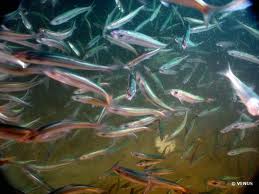
On this journey, scientists have discovered that fish have nerve structures that are anatomically very similar to those of humans and many other species of animals. Among these common structures are receptor cells called nociceptors, which are found throughout animals’ bodies and are activated by stimuli expected to cause damage to bodily tissues. Tellingly, some species of fish have upwards of 58 different nociceptors located in their lips alone*.

As in human anatomy, these nociceptors are wired by nerve fibers to the central nervous system (the spinal cord and brain.) When the pain centers in the brain are activated by signals from the nociceptors, they trigger the body to respond to the potentially harmful or life threatening events that may be happening.

Fish anatomy is so complex that they have even evolved the same “pain-blocking” substances (endorphins) as humans.** It is theorized that endorphins help animals to tolerate pain from severe injuries in order to help them escape from a predator. This leaves us with the question: Why would fish have endorphins in their bodies if they couldn’t feel pain? And why is there still a debate over their sentience?