The EU’s three-year-old ban on seal fur will remain intact after the bloc’s highest court threw out a legal challenge by the Canadian Inuit and the country’s fur trade.
The case had been brought by Inuit community group, Inuit Tapiriit Kanatami (ITK), and the Fur Institute of Canada, with both organizations claiming that their livelihood depends on the trade.
Continuing reading here:
http://euobserver.com/economic/119959
Category Archives: Fur
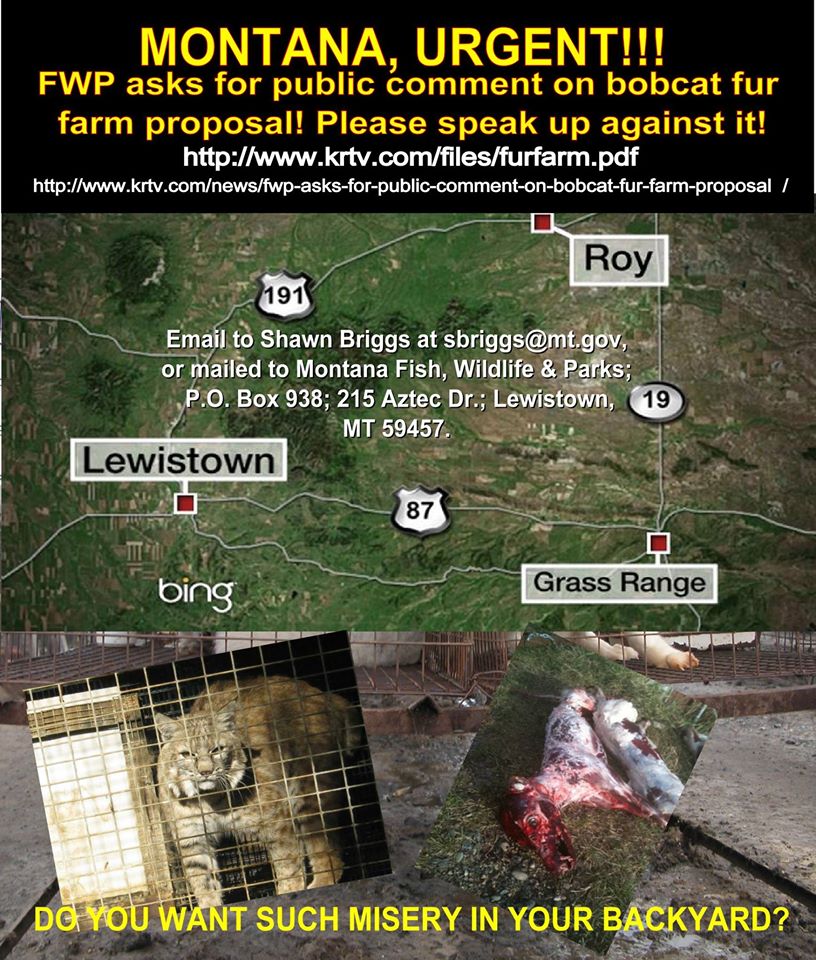
URGENT: Speak Out Against Proposed Bobcat Fur Farm!
Action Alert here: http://www.peta.org/action/action-alerts/urgent-speak-proposed-bobcat-fur-farm/?utm_campaign=Montana+Fur+Farm&utm_source=PETA+E-Mail&utm_medium=Alert
Montana Fish, Wildlife & Parks (FWP) is currently taking public comments on its Schultz Fur Farm Environmental Assessment, which recommends the permitting of a bobcat farm near Roy, Montana, where bobcats would be captive-bred and then sold to the cruel fur industry. Comments are due by August 29, so your voice is needed immediately!
In the wild, bobcats roam vast natural territories that can span 25 square miles, foraging for food, raising their young, and frolicking with family members. These animals are highly sensitive and elusive beings who avoid human contact at all cost. If Larry Schultz’s farm is permitted, bobcats would spend the majority of their short lives in small wire cages commonly seen in the unscrupulous fur industry. Intensive confinement prevents animals from being able to take more than a few steps in any direction or feel the earth beneath their feet. Many animals go insane under these conditions and will mutilate themselves and cannibalize their cagemates. Reportedly, bobcats have killed their young on Schultz’s fur farm in North Dakota.
Please urge the FWP to deny Schultz’s permit. Remind the agency that fur farms are cruel to animals and bad for the environment. And please forward this alert widely!
Action Alert here: http://www.peta.org/action/action-alerts/urgent-speak-proposed-bobcat-fur-farm/#ixzz3AUFFxSfO
Bobcat fur farm wants to move to Montana
GREAT FALLS – The owners of a commercial bobcat fur farm are looking to
relocate from the bustling oilfield region in western North Dakota to a
quieter area in central Montana.
Montana Fish, Wildlife and Park is taking public comments on the proposed
150-foot-by-140-foot animal facility where bobcats would be housed in
separate pens inside the facility near Roy in Fergus County.
Larry Schultz, who owns the business with his wife, says the facility would
raise bobcats for their furs, which would be sold in the commercial fur
industry worldwide.
Schultz says that bobcat fur is used for trim, hats and coats in some
countries.
Schultz says noise and dust from oil drilling near their farm in Arnegard in
western North Dakota isn’t good for raising bobcats.
http://www.kxlf.com/news/fwp-asks-for-public-comment-on-bobcat-fur-farm-prop
osal/
Once-extinct on Olympic Peninsula, fisher population rebounds
By LYNDA V. MAPES The Seattle Times
August 11, 2014 – 1:04 pm EDT
First released into Olympic National Park in 2008 in an effort to repopulate the native carnivore, they now range from Neah Bay to Ocean Shores, from Port Townsend to Olympia, preliminary data from remote cameras and hair snags confirm.
It’s a spectacular turnaround for an animal believed to be locally extinct for at least 80 years. Over-trapping of fishers for their luxuriant, lush brown coats and loss of the big, old-growth trees in which fishers like to lounge and den caused populations to plummet. The state closed the trapping season for fishers in the 1930s.
The National Park Service with other partners began a relocation effort in 2008, in an effort to bring the animals back. From 2008 to 2010, 90 fishers were moved from central British Columbia to the Sol Duc and Elwha Valleys.
The population today isn’t known, and the question remains as to whether births are keeping pace with losses, building a population that is self-sustaining over the long term.
But the indications from a monitoring effort by federal, state and tribal biologists so far are promising. “I’m cautiously optimistic,” said Patti Happe, chief of the wildlife branch for Olympic National Park.
Tracking in such remote, wild country is tricky. The batteries in radio collars initially fitted to the animals are all dead by now, so biologists in 2013 began utilizing remote, motion-triggered cameras pointed at survey stations, including hair snags, baited with chicken drumsticks. The hair samples allow scientists to analyze fisher DNA to track the growing family tree of the initial, founder population.
Some of the new kits have ranged as far as 43 miles from their mothers’ home territory, and cameras have found fishers using habitat where the radio-collared animals were never tracked, documenting that the fishers continue to gain ground.
Sharp toothed and clawed, fishers are related to minks, polecats and martens. They hunt the small mammals that are abundant in the Olympics.
The cameras mounted to detect fishers also documented a menagerie of teaming wildlife in the Olympics: Some 43 species of animals in 2013 were captured on camera in more than 37,000 images, from spotted skunks to coyotes, cougars, bobcats, raccoons, black-tailed deer, elk, flying squirrels, mountain beavers, snowshoe hares, mice and wood rats. Black bear were the single most frequently spotted animal.
Fishers do face perils in their new home. Cougars, bobcats and coyotes take their toll. Several fishers were apparent road kill, including one carcass recovered along Highway 101 on the outskirts of Port Angeles.
Two fishers were released from live traps by a licensed trapper seeking bobcats.
But with an abundant source of food in the forests, fishers are expected to do well. Wolves are now the only mammal still missing from the original suite of life in the Olympics, after being shot and trapped to local extinction in the early 1900s. Wolves are slowly recolonizing Washington wild lands but are not yet known to have reached the Olympic Peninsula.
Fishers once occupied coniferous forests at low to middle elevations throughout much of the Western U.S. The goal of the relocation program is to restore fishers to the Olympic National Park within 10 years.
Radio-tracking initiated in the first phase of the project documented the fishers’ far-ranging travels, including one female released in the Elwha Valley at Altair campground in January 2008. She was the first animal set loose in a public event, where school children cheered as she sprang to freedom from her carrying box.
Biologists followed her “on the air” thanks to her radio collar for 2½ years, from the Elwha Valley to the northeastern portion of the Olympic Peninsula. She settled down in the upper Dosewallips in the summer of 2008, making it home until March 2009.
After a two-month walkabout in the southeastern Olympics, she cruised back down to the lower Elwha, back where she first sprang from her box. There she stayed through June 2010.
She went off the air in 2014, when the batteries on her collar died. But she is perhaps still out there, rewilding her bit of the Olympics.
Information from: The Seattle Times, http://www.seattletimes.com
Urgent: Comment Against MT Fur Farm
Bad luck, celebs, you won’t be allowed into Mahiki if you’re wearing fur
|
|
|
|
|
Royal favourite Mahiki has risked riling its clientele after becoming the first nightclub in London to ban fur.
Patrons at the Mayfair nightspot will be greeted by a new neon sign donated by People for the Ethical Treatment of Animals, featuring the word “fur” with a slash through it.
Clubbers who are wearing fur will be refused entry, and other guests will be given “No Fur” badges at the door.
Campaigner Meg Mathews is behind the initiative and will be training the venue’s staff in how to spot fur items —as opposed to faux fur, which is allowed — judging by look and feel.
She will host an evening at the club, where visitors have included Kate Middleton, Prince Harry, Princesses Beatrice and Eugenie, tomorrow night, manning the door to check customers. The club plans to retain the policy.
Wrapped up: a Gucci model in fur (Picture: Splash) She said: “I love the idea of being able to show how fabulous being fur-free can be. Mahiki is one of the coolest spots in London, so it was my first choice for hosting a night to promote compassion in fashion.

“I don’t care who you are — if you’re wearing fur, you’re heartless, and you’re not coming in.”
Once a major taboo, attitudes to fur have seemed to become more lax recently as it has appeared in catwalk shows for the likes of Gucci.
But Mathews added: “Twenty years after PETA’s famous ‘I’d Rather Go Naked Than Wear Fur’ campaign began, wearing fur is now viewed with disgust. You can always find a few people who don’t care, and there will always be people so desperate for attention that they wear it just to raise eyebrows — but you can’t have any respect for someone who hears about the gassing, beating and electrocution of animals and then decides to go out wearing something made that way.
“There are so many great designers working with cruelty-free fabrics, and that’s what we should be celebrating during fashion season.”
Socialite and jewellery designer Mathews may have her hands full — celebrities spotted leaving Mahiki wearing what appeared to be fur have included Lindsay Lohan and Rihanna.
Kate Moss is a fan and last week Rita Ora was seen in a £30,000 Fendi coat made from mink and beaver fur.
PETA spokeswoman Mimi Bekhechi said: “Anyone who wants to be ‘in’ needs to know that fur is most definitely ‘out’.
“The hottest trend in fashion is compassion, so we applaud Mahiki for taking a stand against real fur.”
Yes, Joe Namath Wore a Fur Coat to the Super Bowl
Still more backsliding?
Now I’m really glad I didn’t watch the Super Bowl. And let’s not forget what…I mean who the ball is made of.
From the Urban Dictionary, Definition of fur hag:
Someone who wears a ridiculous amount of fur, and doesn’t care that it supports murder.
http://mashable.com/2014/02/02/joe-namath-fur-coat-super-bowl/

New York Jets legend Joe Namath resurrected his famous flashy duds for Super Bowl XLVIII. Broadway Joe showed up on the sidelines in a fur coat reminiscent of his playing days.
The former quarterback often wore a full-length fur coat on the bench in the 1960s and ’70s — a practice that has since been banned by the NFL. The eye-catching duds had Twitter talking and wondering when the wrath of PETA will hit.
Petitions to the NFL
…should include one to Stop Joe Namath and other footballers from wearing fur!
|
||||||||||||||||||||||||||||||||||||||||||||||||||||||||||||||||||||
|
||||||||||||||||||||||||||||||||||||||||||||||||||||||||||||||||||||
|