



The following is an open letter by an anonymous reader…
The Fish and Wildlife Commission’s recent choice for the Director of the Washington Department of Fish and Wildlife (WDFW) is an inappropriate choice for Washington.
The new director is from the Idaho Department of Fish and Game, which is known for its brutal archaic wildlife management style. They support many practices, which have been banned here by state initiatives because of the cruelty involved. These practices include bear baiting, hounding, and the use of steel-jaw traps. They promote the killing of wolves in all kinds of despicable ways and put little emphasis on protecting endangered species.
The primary mandate for WDFW is to protect, preserve, and perpetuate our state’s wildlife. The Commission’s choice of director is inconsistent with this mandate and is ill suited for our state. I fear for the future of our wildlife.


December 5, 2014
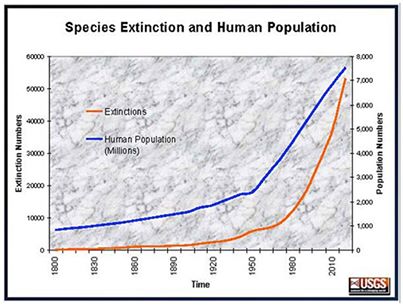
One of the most difficult challenges of the 21st Century is how to sustain life on our ever more crowded planet for many generations into the future. It’s a daunting task because it requires us to confront issues ranging from population growth to climate change to the importance of biodiversity in our ecosystem.
On the biodiversity front, the state of Washington has an immediate opportunity to create a paradigm shift within the Department of Fish and Wildlife (DFW) by hiring a visionary director who will lead the state toward a sustainable future for all species.
The department’s current director, Phil Anderson, is retiring at the end of this year after slightly more than five years in the position. The state’s independent nine-member Washington Fish and Wildlife Commission will select Anderson’s successor.
It’s a critical appointment that should not be rushed.
Since its creation in 1890 as a Fish Commission, the department has been focused on animals people hunt, fish and eat. Much later, species protected by the Endangered Species Act were added to the mix.
It wasn’t until 1921 that the Legislature abolished the Fish Commission and created a separate Department of Fisheries that focused on salmon caught commercially, and a Department of Game and Game-Fish. In 1987, the Department of Game was changed to the Department of Wildlife. And in 1994, state lawmakers merged the two departments into one Department of Fish and Wildlife, overseen by a commission that sets policy and goals.
It’s questionable whether these two cultures – fish and wildlife – have ever been effectively merged. And there is lingering tension between the biologists who see the value of all species and the hunters, fishers and ranchers who want wildlife managed to serve their own interests. Some current and former employees say that tension is the reason a recent survey of state agencies ranked morale in the DFW near the bottom, just above the Department of Corrections.
If the Fish and Wildlife Commission selects a change-agent who understands the important role of biodiversity in sustaining human life, it would bring the department back together and re-energize its legion of passionate young biologists.
Other states, such as Missouri and Florida, have moved away from the antiquated fish and game model to focus on protecting all species. Young biologists today recognize that less charismatic animals play a key role in our planet’s ecosystem and that we can no longer futilely attempt to pack all the nature we need into parks. We must preserve diverse wildlife in diverse ecosystems.
But the DFW seems to be moving in the opposite direction. That is evident in the department’s mismanagement of wolf hunts in northeastern Washington, where it catered to the small percentage of ranchers who refuse to abide by the state’s wolf conservation plan.
It’s important for the public and elected leaders to voice their concern to the commission – it meets Dec. 12 -13 in Olympia – that the DFW should join the broader effort toward sustainable living for all creatures, great and small.
http://www.theolympian.com/2014/12/05/3457683_state-dfw-needs-visionary-leadership.html?sp=/99/109/&rh=1#storylink=cpy or http://tinyurl.com/qf78vvg
Wildlife Conservation & Management Funding in the U.S.
By Mark E. Smith and Donald A. Molde
October 2014
EXECUTIVE SUMMARY
The authors present a novel approach to help answer the question “Who really pays for wildlife in the U.S?” Using public information about budgets of various conservation, wildlife advocacy, and land management agencies and non-profit organizations, published studies and educated assumptions regarding sources of Pittman-Robertson Act and Dingle-Johnson Act federal excise monies from the sale of sporting equipment, the authors contend that approximately 95% of federal, 88% of non-profit, and 94% of total funding for wildlife conservation and management come from the non-hunting public. The authors further contend that a proper understanding and accurate public perception of this funding question is a necessary next step in furthering the current debate as to whether and how much influence the general public should have at the wildlife policy-making level, particularly within state wildlife agencies.
Read the full paper here: Smith Molde Wildlife Conservation & Management Funding in the US Oct14 FINAL
June 2014 by Marc Bekoff and Daniel Ramp
Killing and harming animals in the name of conservation is not just unethical, it is counterproductive
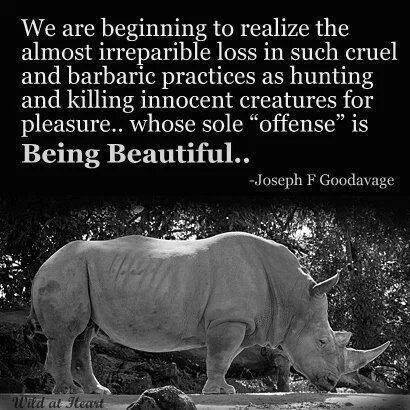
EARLIER this year, a hunter based in Texas paid $350,000 for the dubious privilege of being allowed to kill a male black rhino in Namibia. The rhino, Ronnie, was past reproductive age and deemed to be a danger to other wild rhinos. Profits from the hunting permit are supposed to be ploughed back into conservation in the country.
A few weeks later, keepers at Copenhagen Zoo in Denmark killed Marius, a healthy young male giraffe, publicly dissected him and fed his remains to the zoo’s carnivores because he didn’t fit into their breeding programme. Several offers to rehouse him were declined on the grounds that the facilities were unsuitable.
The same zoo later killed four healthy lions because a male lion they wanted to introduce to a female may have attacked them. Then Dählhölzli zoo in Bern, Switzerland, killed a bear cub over fears his father would kill him.
These cases made headlines and caused global outrage. But they are just the tip of the iceberg. Zoos often kill healthy animals considered surplus to their needs: around 5000 a year in Europe alone. This isn’t euthanasia, or mercy killing, but “zoothanasia”.
The killing of “surplus” animals is just one example of people making life-and-death decisions on behalf of captive and wild animals. These are difficult decisions and various criteria are used, but almost without exception human interests trump those of the non-human animals.
Often, for example, animals are harmed or killed “in the name of conservation”, or for the “good of their own (or other) species”. The result is unnecessary suffering and, commonly, a failure to achieve sustainable and morally acceptable outcomes.
Increasingly, scientists and non-scientists are looking for more compassionate solutions. Compassionate conservation, a rapidly growing movement with a guiding principle of “first do no harm”, is just such an approach. It is driven by a desire to eliminate unnecessary suffering and to prioritise animals as individuals, not just as species. It is also a route to better conservation.
Although one of us, Marc Bekoff, has been writing about the importance of individual animals in conservation for more than two decades, it took an international meeting at the University of Oxford in September 2010 for compassionate conservation to get a big push. There have since been three more meetings. NGOs are becoming interested and a Centre for Compassionate Conservation has been established at the University of Technology, Sydney, Australia.
One sign that the influence of compassionate conservation is growing is that conservationists are questioning the ethics of producing captive pandas as ambassadors for their species. These animals have no chance of living in the wild and their existence is increasingly seen as indefensible.
Biologists are also re-evaluating the merits of reintroduction projects. The reintroduction of wolves into Yellowstone National Park, for example, resulted in numerous wolves dying or being killed “for the good of other wolves”. The surviving wolves also lack protection, especially when they leave the park. As a result, scientists are concerned that the project is failing.
Other reintroduction projects are being similarly reappraised. A team at the University of Oxford assessed 199 such programmes and found potential welfare issues in two-thirds of them, the most common being mortality, disease and conflict with humans.
Urban animals also get into the mix. Marc was recently asked to apply the principles of compassionate conservation to a project in Bloomington, Indiana, which proposed to kill numerous deer even when no one knew if they were causing a problem. In Cape Peninsula, South Africa, non-lethal paintball guns are being used to reduce conflicts between baboons and humans.
Compassionate conservation is also offering solutions to previously intractable conflicts. Innumerable wolves, coyotes, dogs, foxes and dingoes are killed by livestock farmers, often by trapping or poisoning. A recent study showed that poisoning dingoes by dropping tainted meat from aeroplanes changes the dynamics of the ecosystem and reduces biodiversity.
Management of this problem is being revolutionised by the use of guard animals such as Maremma sheepdogs, donkeys and llamas. These guardians bond with the livestock and protect them, not only reducing losses but also costing considerably less than shooting programmes. Even colonies of little penguins in Australia are now protected from foxes by Maremma sheepdogs.
Compassionate conservation is also changing the way researchers tag animals. This is an integral part of conservation as it enables scientists to identify individuals and estimate population sizes. But it is often harmful or painful and can reduce the animals’ fitness, which compromises the usefulness of the data collected. More researchers are now using methods that don’t stress animals or alter their behaviour, such as unobtrusive tags or remote camera traps.
There is often conflict between those interested in animal welfare and those interested in conservation, with the latter viewing concern for the well-being of individuals as misplaced sentimentalism. It is not.
Compassion for animals isn’t incompatible with preserving biodiversity and doing the best science possible. In fact, it is a must. Mistreatment of animals often produces poor conservation outcomes and bad science. It is also immoral. Only through compassion can we advance global conservation.
This article appeared in print under the headline “Cruel to be kind?”
Marc Bekoff is professor emeritus of ecology and evolutionary biology at the University of Colorado, Boulder. He edited Ignoring Nature No More: The case for compassionate conservation (University of Chicago Press). Daniel Ramp is director of the Centre for Compassionate Conservation at the University of Technology, Sydney
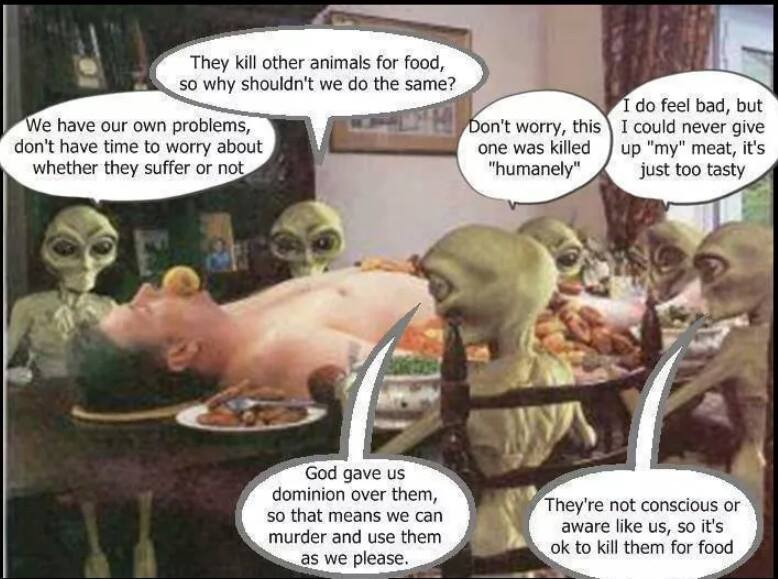
This photo (allegedly taken in late November, 1947, near Roswell, New Mexico) recalls some of the most common feeble rationalizations humans use to justify the killing and consumption of the other beings with whom we share this planet.
Another equally feeble rationalization just cropped up in a letter to the editor of the Las Vegas Sun, using the twisted logic that since all animals are going to die someday, we might as well kill and eat them.
The letter, entitled, “Hunting, trapping to manage wildlife,” by the president of the Southern Nevada Coalition “for Wildlife,” starts out attacking animal rights activists and defending trappers and hunters:
“The litany of attacks on trappers and hunters by animal rights activists lately are usually based on the claim that trapping and hunting are inhumane. One needs to ask the question: compared to what? Compared to the standards of Walt Disney productions where Bambi and his deer family think and talk things over and where Lion Kings rule? Perhaps so, but in the real world of nature and wildlife, it is a different story.
“Every wild animal will die someday. If animal rights activists think wild animals die comfortably in their beds surrounded by loving family members, they are sadly mistaken. Disease, starvation, dehydration and predation are the most probable causes, and in the absence of management tools like hunting and trapping, entire wildlife populations suffer horribly.
“That is the reason the entire wildlife management profession and every conservation association support regulated hunting and trapping.
“Professionals know that regulated hunting and trapping are far more humane than letting nature run its course unimpeded. The animal rights activists beg to differ, but how is it more humane to allow (or mandate) that wild animals must die by disease, starvation or predation, or, much worse, allow (or mandate) entire populations to suffer this way when there is a much better way?”
A better way? That’s assuming a lot, such as that an unaware animal is killed outright with one clean shot (which almost never happens). And how is trapping an animal and letting it struggle until a human returns to finish it off ever humane?!
Yes all animals are going to eventually die someday, but usually when that day happens, nature steps in and prepares the individual for it through a process that includes shock, withdrawal and the gradual shutting down of the senses. Hospice professionals know the process well; it’s outlined in handouts they share with anyone who is caregiving for the dying.
Ending a healthy life (human or otherwise), before he or she have had the chance to fulfill their life’s journey, is murder, no matter how you rationalize it.
The pro-human predation letter ends with the line: “Since 1937, it’s been proved that regulated hunting and trapping programs are the essential tools of modern wildlife management.” Humans can just thank their lucky stars that no bigger brained beings have rationalized away their existence…yet.

It’s like the 1% vs. the 99% ratio. This graph came from an opinion piece entitled, “Who Owns the Wildlife?” which starts out:
More and more we as a society are facing problems with how wildlife of all types are managed in the United States. We see increasing conflicts and polarization between hunting and anti-hunting groups. On the one side, invoking the pioneer tradition of our ancestors, hunting groups contend that the right to hunt is undeniable and is essential to the sound management of our wildlife resources. On the other hand, anti-hunting groups contend that the need to kill wildlife animals is no longer justified and hunting represents a next to barbaric act against living, feeling animals.

On one side, hunters contend that because they pay the bills for the management of wildlife resources through their licenses and a federal excise tax on their hunting equipment, they are the only ones who should have a say in how wildlife are managed. On the other side, anti-hunters argue that moral objections to the slaying of innocent animals overrides any priority as to who has a say in these matters.
And the arguments go on and on….

The hunter population has gotten out of control and it’s time to do something about it.
Certain do-gooders have envisioned a policy of targeting only the males and displaying their manly parts above the fireplace or barn door as trophies. Other self-appointed regulators submit that that would unfairly skew the sex ratio of the species, especially in light of the rapidly increasing epidemic of female hunters. They suggest the best way to ease the overpopulation of hunters is to sell tags for both sexes. To recruit more hunter hunters, children aged ten or younger would be encouraged to join in the cull.
But, unfortunately, the notion that we can control their numbers through regulated harvest is a myth. The more you take down, the more their survivors breed to make up for their losses.
Things have been the way they are for so long that most people just accept them. But when you stop and think about it, having hunters be in charge of the wildlife departments is like appointing pedophiles to run the PTA. We must never lose sight of the fact that hunters have ulterior motives for our precious wildlife.
When hunters say they “care” about animals, well, they mean it in a lustful, self-serving sort of way. And when they use words like “love” and “respect,” they sound about as sincere as a spousal abuser, rapist or pedophile referring to the objects of their obsession.
Hunters have no business “managing” wildlife. They can’t seem to understand that the objects of their obsession are sentient beings with needs, wants and life experiences of their own. And every time game departments disrespect Mother Nature by calling for another “management action,” they are renouncing her healing ability and cheating her out of one more chance to restore her time-tested balance.

Text and Wildlife Photography ©Jim Robertson, 2014.


 Exposing the Big Game