Exposing the Big Game

Forget Hunters' Feeble Rationalizations and Trust Your Gut Feelings: Making Sport of Killing Is Not Healthy Human Behavior

Exposing the Big Game

Grieving orca still swimming with her dead calf in Northwest

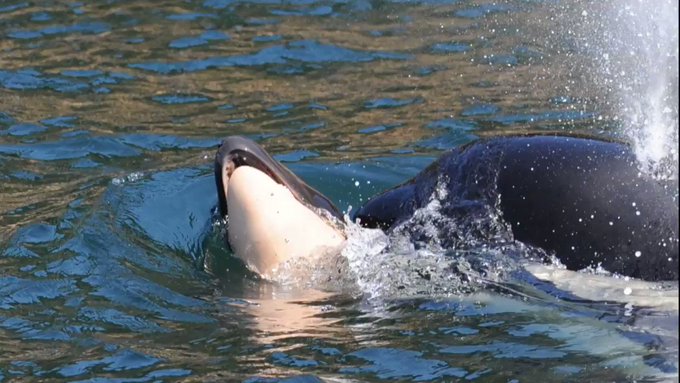
FILE - In this file photo taken Tuesday, July 24, 2018, provided by the Center for Whale Research, a baby orca whale is being pushed by her mother after being born off the Canada coast near Victoria, British Columbia. Whale researchers are keeping close watch on an endangered orca that has spent the past week carrying and keeping her dead calf afloat in Pacific Northwest waters. The display has struck an emotional chord around the world and highlighted the plight of the declining population of southern resident killer whales that has not seen a successful birth since 2015.(Michael Weiss/Center for Whale Research via AP)© The Associated Press FILE – In this file photo taken Tuesday, July 24, 2018, provided by the Center for Whale Research, a baby orca whale is being pushed by her mother after being born off the Canada coast near Victoria, British Columbia. Whale researchers are keeping close watch on an endangered orca that has spent the past week carrying and keeping her dead calf afloat in Pacific Northwest waters. The display has struck an emotional chord around the world and highlighted the plight of the declining population of southern resident killer whales that has not seen a successful birth since 2015.(Michael Weiss/Center for Whale Research via AP)SEATTLE — An endangered orca is still clinging to her dead calf more than two weeks after her newborn died.

Michael Milstein, a spokesman with NOAA Fisheries, says researchers on Wednesday spotted the 20-year-old whale known as J35 carrying her dead young off the tip of Washington’s Olympic Peninsula.

The calf died July 24 and the image of the mother whale clinging to the dead calf has struck an emotional chord worldwide.

Milstein says researchers with Fisheries and Ocean Canada also spotted another member of the same pod — the 3 ½-year old whale J50 that is emaciated. The ailing orca was swimming with her mom Wednesday.

A team of experts led by NOAA Fisheries have been searching for the young whale to assess her health and potentially give her medication.

Orcas now taking turns floating dead calf in apparent mourning ritual

Whale Museum in Washington releases audio of the mourning mother communicating with her pod

Mother orca J-35 has been balancing body of its dead calf on its nose for more than a week. (Soundwatch NMFS Permit #21114/Whale Museum )

35 comments

Listen6:00

Members of a pod of endangered killer whales now appear to be taking turns floating the body of a newborn calf that died more than week ago.

As It Happens reported on Friday about J-35, a mother orca from B.C.’s endangered killer whale population that has been balancing her dead calf on her nose near San Juan Island, Wash.

It’s now been more than a week and the mother whale is still carrying the calf’s remains — sparking concerns among researchers that she’ll tire herself out.

“We do know her family is sharing the responsibility of caring for this calf, that she’s not always the one carrying it, that they seem to take turns,” Jenny Atkinson, director of the Whale Museum on San Juan Island, told As It Happens guest host Piya Chattopadhyay.

“While we don’t have photos of the other whales carrying it, because we’ve seen her so many times without the calf, we know that somebody else has it.”

New audio released

The Whale Museum released an audio recording on Monday of the mother communicating with her pod.

“You’re hearing them communicate with one another. They’re using a series of calls and whistles to communicate. And then you’ll hear a clicking noise. That’s echo-location,” Atkinson said.

“They use it to pick up their food source as well as map their underwater environment.”

As It Happens
Orca pod in conversation
 LISTEN

00:00 00:20

The Whale Museum recorded the sound of the killer whale pod communicating to each other off San Juan Island, using geo-location to alert each other to potential obstacles and food sources. 0:20

She said it’s possible the sounds are related to their mourning of the calf — but researchers can’t know for sure.

“We picked up some calls earlier in the week and we hear things that sounded more like a very urgent call,” she said. “If you think of going to a wake for a family, things can go on for multiple days and the grief is still deep, but the emotions kind of soften.”

A whale funeral

That’s exactly what Atkinson believes the whales are doing with the calf — holding their own version of a wake or a funeral.

“Ceremonies can go on for days to honour and mourn the loss of a loved one,” she said. “I think that what you’re seeing is the depth of importance of this calf and the grief of the mother and the family.”

This July 25 photo shows the orca mother, J-35, balancing her dead baby on her nose trying to keep it afloat. (Ken Balcomb/Centre for Whale Research)

Anthropologist Barbara King, who studies animal emotion, agrees the whale’s behaviour is likely a display of grief.

There is a body of evidence that shows whales and dolphins mark the passing of their dead, King told CBC’s On The Coast.

Sometimes they will surround dead companions, showing curiosity or exploration, King said. Other times, it goes further: they keep vigils around the bodies of dead podmates or keep them afloat.

“It’s not anthropomorphic to use this label for them,” King said. “Grief and love are not human qualities. They’re things we share with some other animals.”

Population in crisis

The southern resident killer whale population consists of three orca pods that live around the coast of Oregon, Washington and Vancouver Island.

Their numbers are dwindling and they haven’t have a successful birth since 2015.

After the death of a 23-year-old orca June, the total number of southern resident killer whales is down to 75, the lowest it’s been since the early ’80s. The population has dropped by eight since 2016.

CBC News

@CBCNews

This orca mother has been holding her dead calf afloat for more than a week in a “heartbreaking” ritual.

Read more at http://www.cbc.ca/1.4731063?cmp=FB_Post_News 

Their decline is attributed largely to a lack of available chinook salmon, their primary food source.

Researchers are already worried that another young whale in the pod — J-50 — could be the next to die. The four-year-old is becoming increasingly emaciated.

“I don’t see how she can survive,” Dave Ellifrit of the Center for Whale Research, told the Seattle Times.

In May, Canada’s federal government announced plans to cut the allowable catch of chinook by 25 to 35 per cent.

In June, it announced further measures to help the endangered population, including reducing underwater vessel noise and better monitoring of pollution.

Human empathy

Atkinson said it’s not hard to see why people have had such visceral reactions to images of J-35 and her calf.

“Watching what she’s going through, most people have been through some level of grief and have had some situation that this touches, because they can understand losing a child, losing a calf, and how heart-wrenching that is,” she said.

“And then not to be able to do anything when humans like to take action. We like to be able to do stuff. Sometimes the hardest thing is just to sit back and give respect and be a witness to a situation.”

Written by Sheena Goodyear. Interview with Jenny Atkinson produced by Samantha Lui.

Mourning orca mother carries dead calf for sixth day

https://komonews.com/news/local/mourning-orca-mother-carries-dead-calf-for-fifth-day

The mother of an orca calf that was born and died Tuesday carries her baby, unwilling to let it go. It is another in a series of unsuccessful pregnancies for the southern-resident orcas. (Ken Balcomb, Center for Whale Research)

AA

A mourning orca whale continued to carry her dead calf for a sixth straight day on Saturday.

J35, a member of the critically endangered southern resident family of orcas, gave birth to her calf Tuesday only to watch it die within half an hour.

Since then, she’s been carrying the calf’s body around on her nose, diving to pick it up again when it falls off. She was last sighted in the early evening on Saturday in Canadian waters.

Scientists have documented grieving behavior in other animals with close social bonds in small, tightly knit groups, observed carrying newborns that did not survive.

Seven species in seven geographic regions covering three oceans have been documented carrying the body of their deceased young, including Risso’s dolphin in the Indian Ocean; the Indo-Pacific bottle-nosed dolphin and the spinner dolphin in the Red Sea; and pilot whales in the North Atlantic.

But more than 24 hours of grieving is a rare occurance, says Deborah Giles, research scientist for University of Washington Center for Conservation Biology and research director for the nonprofit Wild Orca.

“It is horrible. This is an animal that is a sentient being,” Giles told the Associated Press. “It understands the social bonds that it has with the rest of its family members. She carried the calf in her womb from 17 to 18 months, she is bonded to it and she doesn’t want to let it go. It is that simple. She is grieving.”

J35’s news came just as researchers were also tracking a 4-year-old in the southern residents that is emaciated, and whose survival may be in doubt due to loss of body fat.

Researchers have been growing more concerned about the fate of the southern residents, who face three major challenges to their survival as a species: toxins, vessel traffic and lack of adequate food (their primary food source being chinook salmon).

The most recent census of the orcas has found that they number just 75 in the area, across three southern resident pods. For the last three years there have been no new calves born to the shrinking killer whales in the Pacific Northwest.

For researchers who work closely with the southern residents, their continued decline is painfully apparent.


U.S. House approves bill to allow killing sea lions

WASHINGTON – The U.S. House passed a bill Tuesday that would allow tribal managers and government fish managers to kill limited numbers of sea lions in the Columbia River to improve the survival of endangered salmon and steelhead populations.

The legislation passed by a vote of 288 to 116.

Under the bill, designated officials would be able to remove some California and Stellar sea lions from specific areas where they are posing the most harm to endangered native fish runs.

The bill is sponsored by U.S. Rep. Jaime Herrera Beutler, R-Wash., and U.S. Rep. Kurt Schrader, D-Ore.

“For the salmon and steelhead fighting to make it upstream, today’s vote in the U.S. House significantly improves their chances of survival,” Beutler said after passage of the bill.

“The passage of my bipartisan bill signals a return to a healthy, balanced Columbia River ecosystem by reining in the unnatural, overcrowded sea lion population that is indiscriminately decimating our fish runs.”

Beutler said supporters of the bill are “not anti-sea lion,” adding, “We’re just for protecting a Pacific Northwest treasure – salmon, steelhead, sturgeon and other native fish species iconic to our region.”

A companion bill is moving through the U.S. Senate now, sponsored by U.S. Sen. Jim Risch, R-Idaho, and U.S. Sen. Maria Cantwell, D-Wash.

Joe Stohr, acting director of the Washington State Department of Fish & Wildlife, supported the passage of the bill.

“We appreciate today’s action by the House of Representatives and the efforts of Representatives Herrera Beutler and Schrader to secure the bill’s passage. Sea lion predation on salmon is a complex issue, and we thank them for recognizing the need for action to help recover threatened and endangered populations in the Columbia River.”

Shark fisheries hunting dolphins, other marine mammals as bait: Study

Act would dismantle marine mammal protection

There is distressing news on the front page of the Monday, April 2, Los Angeles Times, which is relevant to animals off coasts all over the US. The headline and subheading read: “Sea life at risk as U.S. seeks to ease oil rules; Bills would speed up permits for seismic blasts and dismantle safeguards for whales.”

Environmental reporter Rosanna Xia opens with:

“The search for offshore oil begins with a boom.

“Before the oil rigs arrive and the boring begins, operators need to fire intense seismic blasts repeatedly into the ocean to find oil deposits.

“For decades, environmental rules that protected whales and other marine life from this cacophony have limited the location and frequency of these blasts — preventing oil companies from exploring, and therefore operating, off much of the nation’s coasts.

“Now these safeguards are quietly being dismantled.

“The push to overhaul seismic survey rules has not attracted the same public attention as the Trump administration’s interest in opening coastal waters to dozens of new drilling leases or downsizing protected marine areas. But it too could have wide implications beyond enabling new oil operations.

“Winding their way through Congress are two bills that supporters say would create jobs, reduce permitting delays and clear the way for naval activities and coastal restoration.

“But environmentalists call them a thinly veiled oil industry wish list that would upend established protections and fast-track the permitting process for oil exploration off the Atlantic, much of Alaska and even California.”

We are told of the bills, which are called the Streamlining Environmental Approvals Act:

“They target core provisions of the Marine Mammal Protection Act, which regulates seismic blasts used to locate oil and gas. The noise, scientists say, can disorient and damage the hearing of whales and dolphins so badly that they lose their ability to navigate and reproduce.”

The lengthy article also lets us know:

“There has been little movement on the bills since the SEA Act passed committee in January. But opponents are concerned it could be folded last-minute into this year’s military reauthorization or another must-pass bill.”

Front page coverage helps make that at least a little bit less likely. You can comment right below the article, which you will find on line at http://www.latimes.com/local/lanow/la-me-marine-mammal-oil-drilling-20180402-story.html OR https://tinyurl.com/ydcal3v9 . And you can send appreciative letters to the editor that speak up for animals to letters@latimes.com
The article opens the door for them. Always include your full name, address and phone number when sending a letter to the editor.


Gov. Inslee to sign executive order on orca protections

AP file photo

AA

SEATTLE (AP) – Washington Gov. Jay Inslee is set to establish an executive order calling for state actions to protect the unique population of endangered orcas that spend time in Puget Sound.

The fish-eating whales have struggled due to lack of food, pollution and noise and disturbances from vessels. There are now just 76, a 30-year low.

Inslee’s executive order will direct state agencies to take immediate steps and identify long-term solutions to help the whales. It would set up a task force to come up with recommendations.

Inslee is rolling out the order at a news conference Wednesday morning in Seattle.

The Legislature passed a supplemental budget Friday that includes money for increased patrols to keep boaters at a distance from the orcas and money to boost hatchery production of fish that the orcas prefer.

Orca Learns to Say ‘Hello’

By Nathaniel Scharping | January 31, 2018 11:52 am
(Credit: By David Pruter/Shutterstock)

(Credit: David Pruter/Shutterstock)

“Hello!” says the human. “Hello!” pipes the orca right back.

It’s not a children’s movie, but an actual orca emitting human(ish) words. An international team of researchers has taught Wikie, a 14 year-old killer whale in France, to mimic certain simple bits of speech, a discovery that gives them insight into wild orca dialects.

Repeat After Me

In all, Wikie learned six words, in addition to five orca sounds that she didn’t know before. The phrases included “hello,” “ah ha,” “one, two,” “Amy,” and “bye, bye.” She even nailed a few on her first try, though one took as many as 17 attempts to get right. The researchers taught her to “speak” by using a “copy” command that she had learned previously, though it had always been used to indicate that she should imitate physical actions, not sounds.

Audio Player

In a paper published Wednesday in Proceedings of the Royal Society B, the researchers detail how they first refreshed her memory on the “copy” command, and then had her repeat sounds made by her three year-old calf Moana, before progressing to unfamiliar killer whale noises. When Wikie demonstrated her imitation abilities with those sounds, the researchers moved on to human words.

When asked to say both “hello” and “one, two, three,” Wikie was able to say the phrases right back on the first try. The other words gave her a little more trouble, though she was able to repeat them with some practice. Still, Wikie was better at producing some sounds than others, though the researchers were nevertheless impressed by her ability to make human sounds given that orcas’ vocal systems look very different than ours. When asked to repeat the sounds, there was a fair amount of variability in her vocalizations, something the researchers say could be due to the simple difficulty of producing the sounds or even different levels of motivation between sessions.

Audio Player

Say What?

After recording her speech, the researchers had six independent judges listen to Wikie’s vocalizations to confirm that she was imitating the human sounds well enough to be understood. While the sounds may be accurate, there’s no evidence that Wikie actually understands what any of it means. Instead, it’s simply a demonstration of orcas’ ability to learn and repeat new sounds, a skill that may be at the heart of some puzzling behavior observed in the wild.


Researchers have long tracked pods of killers whales by their dialects. Each pod produces unique calls, and this research reveals that these vocalizations are passed down through learning, rather than being a genetic trait. Researchers suspected this was the case, but hadn’t gathered enough evidence of orcas learning and mimicking sounds.

Some species, though not many, can learn to repeat human sounds. Belugas and bottlenose dolphins have been observed doing it, as well as elephants. How, and why they are able to do so varies, though the researchers do note that Wikie was producing the sounds in the open air, as opposed to under water as she normally would. This could add another layer of difficulty, though it also raises questions as to whether she would learn and repeat sounds differently underwater.

How Do We Oppose Murderous Psychopaths?

by Captain Paul Watson:

In 2003, Sea Shepherd brought the issue of the dolphin slaughter to worldwide attention. In October of that year we sent photographer Brooke MacDonald to Taiji. Her pictures appeared on the cover of newspapers around the world and her video was aired on CNN.

Yet the killing continued.

In November two Sea Shepherd volunteers including Sea Shepherd Global Director dove into the Cove, cut the nets and freed 16 Pilot whales. They were both arrested and spent a month in prison and were fined $8,000.

And the killing continued.

In 2009 Louie Psihoyos and Ric O’Barry made a documentary film called The Cove. It won the Academy Award for best documentary film and exposed the horror of Taiji to hundreds of thousands of people.

Yet the killing continued.

Sea Shepherd’s Cove Guardians were on the ground every year since 2009. Seven years for six months, a total of 42 months on the ground, livestreaming, witnessing, filming, photographing, protesting, monitoring – watching dolphins die and unable to do anything to physically stop it.
During that time we sent in hundreds of volunteers.

After yet after 14 years the only dolphins saved were the 16 freed when Sea Shepherd cut the nets in 2003.

Since 2014 Japan has been denying entry to Sea Shepherd Cove Guardians eliminating 100% of our Cove Guardian leaders and most of the volunteers.

This year, Japan has made Sea Shepherd tactics subject to charges of terrorism. Under the new laws, 2 people with a camera may be charged with terrorism.

This is, to put it bluntly – insane!

These official decisions have convinced me that we are dealing with a psychopathic attitude where every single obstacle is being thrown into the path of anyone who opposes the mass slaughter of dolphins in Taiji.

Since September 1st, Sea Shepherd has received some criticism for not being in Taiji this season. This criticism is quite unfair. How can the Cove Guardians be in Taiji when they can’t even get into Japan? And how can they expect us to send inexperienced volunteers into a position where they will be charged with an act of terrorism just for being there?

Some critics say that the Dolphin Project is there, so why is Sea Shepherd not there?

It is true that Ric O’Barry has been banned from Japan but very few Dolphin Project Cove Monitors have been denied entry – yet. Sea Shepherd is happy that Dolphin Project people can be on the ground but I predict their freedom to do so will soon be greatly diminished.

The Japanese government wants to remove observers.

The thugs in Taiji are psychopaths completely lacking compassion and empathy for the dolphins. The attached image screams the word – psychopath!

The politicians enabling the mass slaughter are also psychopaths lacking empathy and compassion.

Being on the ground in Taiji now is a fruitless endeavor. Years of documentation and live-streaming have not made a difference. The killing continues and the killers become more entrenched in their ruthlessness to the point that their very identity as Japanese is equated with the merciless massacre of dolphins.

It has become painfully evident to me that they simply have a perverse lust for killing. They do it for money AND they do it because they enjoy it. We can see it in their eyes, this lust for inflicting gross suffering and death.

The Dolphin drives are an organized highly ruthless slave trade. Slavery is where the money is, the meat trade is minor by comparison. They could enslave dolphins without killing any and still make a huge profit. The reason they don’t do so is very simple – they like to kill.

What has been going down in Taiji can only be understood as a form of collective insanity. We cannot expect reason, compassion, pity, empathy and kindness will have any influence on the minds of psychopathic individuals and collectively Taiji has become a community of psychopaths backed up by the not surprising psychopathic politicians, passing laws against compassion, empathy, kindness and pity.

Because of this I came to the realization that continuing to be in Taiji, with the increasingly difficult possibilities of even being there, was becoming very unproductive.

We have achieved nothing since 2003, not a single dolphin saved since 2003. Yes, we have raised awareness throughout the world but Japan does not care what the rest of the world thinks or feels.

Sea Shepherd is not abandoning our opposition to the despicable cruelty and killings. We are simply changing strategies and developing new tactics.

We have 14 years of documentation so there is little that continues to happen that we have not already captured on film. We need to get these images out to the public – in Japan.

We need to develop a Japanese website and Japanese social media. We need to make the Japanese people at least as aware as the rest of the world. We need to develop economic strategies aimed at Japan with a special focus on the Olympics in 2020. We need to research legal options.

Unfortunately we’ve done all that we practically and strategically can accomplish on the ground in Taiji.

We are refocusing and planning for a new strategy.

The Cove Guardians were heroic, steadfast and I appreciate the efforts of each and every person who spent time on the ground there. They suffered harassment and abuse including numerous abuses from the police and fishermen and most importantly they had to endure the trauma of witnessing the monstrous acts of cruelty and murder.

They did all that could have been done within the context of having to do so within Japanese territory under the ever present watch of the police and rejection from border guards.

When I first organized the Cove Guardians I felt confident that it could have success but I did not take into account the one factor that makes it difficult to overcome such a heartless behavior and makes it impossible to deal with the situation in any meaningful way.

That factor is insanity. We can’t reason or appeal to the heart of a Psychopath because we have been looking for something that does not exist – their heart!

We must develop a new and effective approach.

Uncover Photo

The Laws Of Ecology And The Survival Of The Human Species

08/05/2016 04:04 pm ET | Updated Aug 05, 2016

The Laws Of Ecology And The Survival Of The Human Species

I was raised in a small fishing village on the Passamaquoddy Bay in New Brunswick, Canada and I still vividly remember the way things were in the Fifties. The way things were then is not the way things are now.

I’m not talking about technological, industrial or scientific progress. I’m referring to the health and stability of eco-systems. What was once strong is now weak. What was once rich in diversity is now very much the poorer.

I have been blessed, or perhaps cursed, with the gift of near total recall. I see the images of the past as clearly as the days that were. As a result it has been difficult for me to adapt to diminishment. I see the shells on the beaches that are no longer there, the little crabs under the rocks, now gone, the schools of fishes, the pods of dolphins, the beaches free of plastic.

I began traveling the world in 1967 — hitch-hiking and riding the rails across Canada; joining the Norwegian merchant marine; crossing the Pacific and Indian Oceans; traveling through Japan, Iran, Mozambique and South Africa, working as a tour guide in Turkey and Syria, co-founding the Greenpeace Foundation in 1972 and, in 1977, founding the Sea Shepherd Conservation Society.

2016-08-04-1470340589-1361975-seashepherdfoundercaptainpaulwatson903.jpg

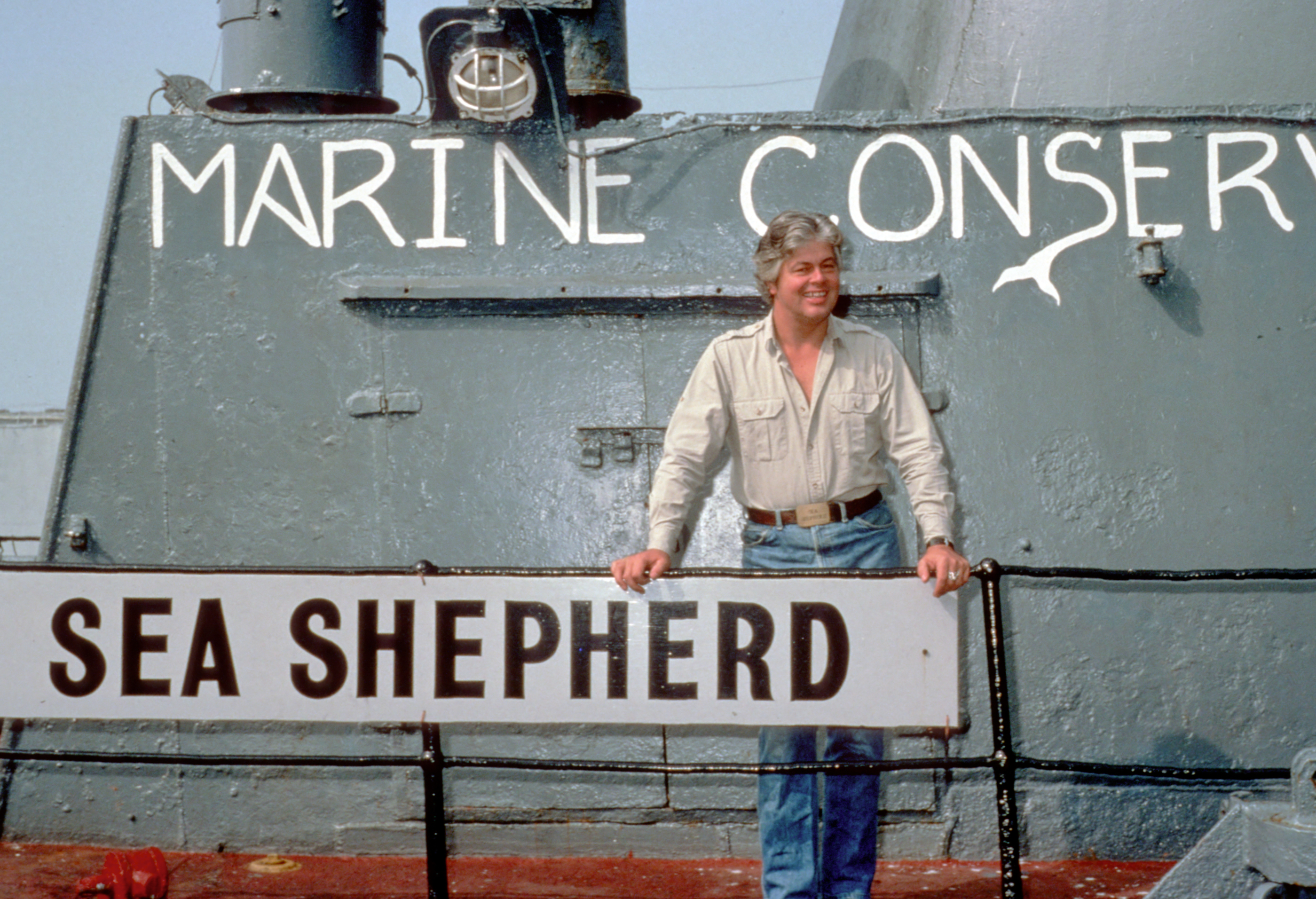
Sea Shepherd founder Paul Watson some forty years ago when he founded the non-profit.

Many things that I saw then no longer exist – or have been severely damaged, changed and diminished.

In the Sixties we did not buy water in plastic bottles. In the Sixties the word ‘sustainable ‘was never used in an ecological context, and except for Rachel Carson, there were very few with the vision to see into the future, where we were going, what we were doing.

But slowly, awareness crept into the psyche of more and more people. People began to understand what the word ecology meant. We saw the creation of Earth Day, and in 1972, the first global meeting on the environment in Stockholm, Sweden that I covered as a journalist.

Gradually, the insight into what were doing became more prevalent and to those who understood, the price to be paid was to be labeled radicals, militants, and a new word – eco-terrorist.

The real “crime” of eco-terrorism was not burning down a ski lodge, toppling a power line or spiking a tree. Such things are only outbursts of desperation and frustration. The real crime of eco-terrorism was having thought, perception, and imagination. In other words, the questioning of the modern economic, corporate and political paradigm.

The word eco-terrorism should be more accurately used for the destruction caused by progress like the Union Carbide disaster in Bhopal or the BP Deep Water Horizon spill in the Gulf of Mexico.

2016-08-04-1470340757-6508043-anoilrig756.jpg

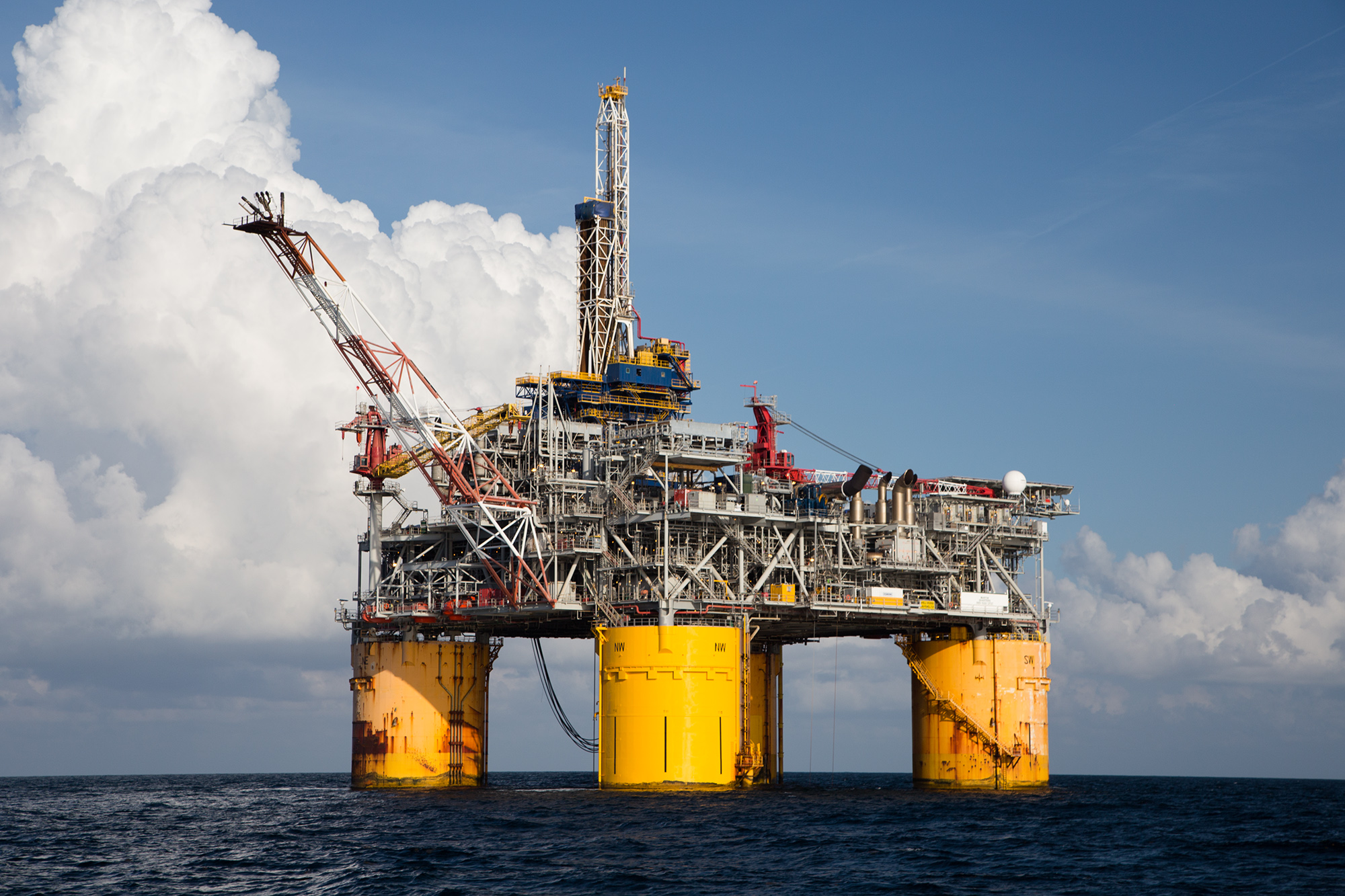
Picture of an oil rig taken during Sea Shepherd’s Operation Toxic Gulf in 2014.

In the Seventies, the late Robert Hunter, along with Roberta Hunter, Dr. Patrick Moore, David Garrick, Rod Marining and myself observed and wrote down the three laws of ecology. What we realized was that these laws are the key to the survival of biodiversity on the planet and also the key to the survival of the human species. We realized that no species could survive outside of the three basic and imperative ecological laws.

The law of diversity: The strength of an eco-system is dependent upon the diversity of species within it.

The law of interdependence: All species are interdependent with each other.

The law of finite resources: There are limits to growth and limits to carrying capacity.

The increase of population in one species leads to the increase in consumption
of resources by that species. This leads to diminishment of diversity of other species, which in turn leads to diminishment of interdependence among species.

For example, increasing diminishment of phytoplankton populations in the sea is causing diminishment of many other species as well as a 40% diminishment in oxygen production since 1950. Diminishment of whale populations has contributed to the diminishment of phytoplankton populations because whale feces are a major source of nutrients (esp. iron and nitrogen) for phytoplankton.

The planet simply cannot tolerate 7.5 billion (and growing) primarily meat and fish eating necrovores. The killing of 65 billion domestic animals each year is contributing more greenhouse gases to the planet than the entire transportation industry. The industrial stripping of life from the sea is causing unprecedented biodiversity collapse in marine eco-systems.

Ecological systems globally are collapsing from coral reefs to rainforests because humanity is exploiting resources far beyond the capacity of eco-systems to create and renew natural resources.

Diminishment of eco-systems is also leading to the breakdown of human social structures causing global conflict in the form of wars and domestic violence. Terrorism is not the cause of society’s problems, it is merely a symptom.

Humans are compromised by medieval paradigms like territorial dominance, hierarchical desires and superstitious beliefs combined with primitive primate behavior like greed and fear.

2016-08-04-1470345289-7416340-bloodbathinleynarclaimedfourpregnantfemales377.jpg

Sea Shepherd’s 2010 Faeroe Islands Dolphin Defense Campaign: Operation Grindstop. Photo credit: Sea Shepherd /Sofia Jonsson

The fishing village that I lived in as a child is no longer a fishing village. The relative innocence of our lives as children of the Fifties and Sixties is no more. The African bush, the Arctic tundra, the marine reserve of the Galapagos Islands, the Great Barrier Reef, the Amazonian rainforests that I once traveled through are no longer what they recently were.

Humans have this amazing ability to adapt to diminishment. It’s a trait that was exceptionally useful when we lived as hunter-gatherers. We adapted to food shortages, to changes in the weather and to the world as it evolved around us. Today we are trying to adapt to the destruction brought on by ourselves and that adaption is taking the form of more and more control by governments and corporations and a blind reliance on corporate technologies.

We no longer have the empathy we once felt. I vividly remember the events of October 23rd, 1958. I was seven years old on the day of the Springhill Mine Disaster in Nova Scotia. 75 men died and 99 were rescue. I remember crying for the fate of people I did not know and feeling excited every time a miner was brought to the surface alive. I no longer have that capacity. Perhaps I lost it when I became an adult, or perhaps society no longer has room for such emotions.

Disaster happened and we grieved for people we did not know. A few weeks ago nearly 100 people were viciously murdered within a few kilometres of where I live when a deranged man mowed them down with a large truck in Nice, France. Last week, a priest was beheaded in France. Every week brings us more stories about mass killings in the Middle East, Africa, America etc. It’s a worldwide pain-fest of chaos and violence and yet it is met with complacency for the most part and a predictable Facebook posting of — “say a prayer for Paris, or Orlando, or Nice, or Beirut, or Istanbul” in a litany of self-indulgent adaptation to tragedy, before being quickly forgotten.

This is not the world of my childhood. We remembered the horrors of World War II with real emotion. I remember talking with both World War I and World War II veterans and feeling their pain. Today it’s just another short-term item on the news, in a world that seeks to escape through movies, celebrities, video games and increasingly more fanatical religious fervor.

Here is the reality. As human populations increase, the consumption of resources increases with it. But because resources are finite and the rate of renewables is overcome by demand, this can only lead to one result — the collapse of resource availability.

And because we are literally stealing resources from other species, this will lead to
diminishment of species and habitats, which will contribute to even more resource diminishment.

2016-08-04-1470342962-4408964-draggingontotheship273.jpg

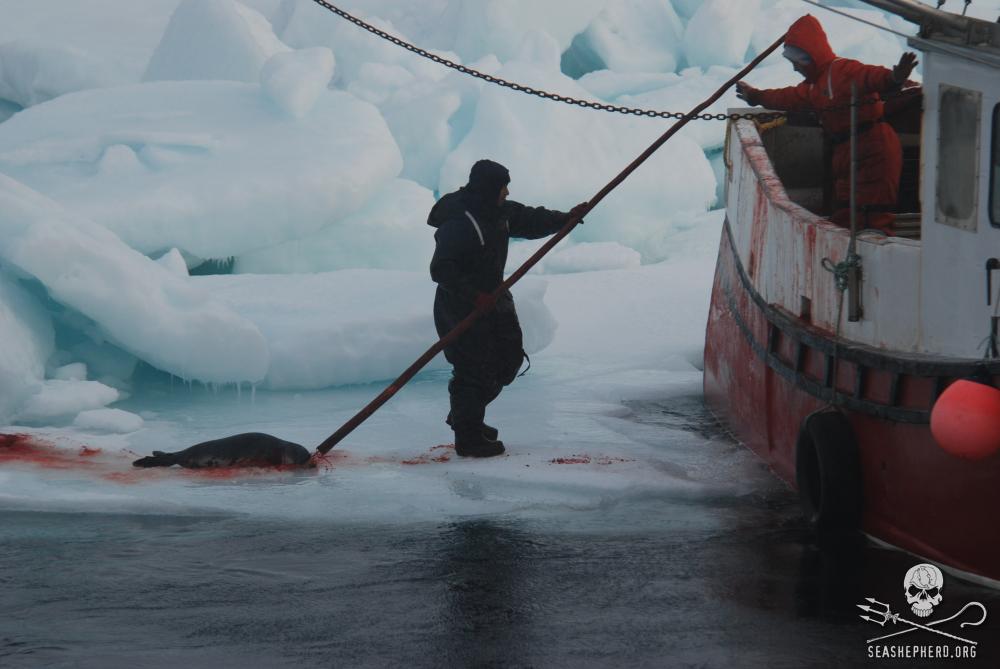
Sea Shepherd’s 2008 Seal Defense Campaign photographs the murder and carcass dragging of a seal. Photo credit: Sea Shepherd / Greg Hager

At COP 21, I called for an end to worldwide government subsidies for industrialized fishing and at least a 50-year moratorium on commercial industrialized fishing. That solution was not given a moment’s thought at a conference that did not even take into account the imperative role of the Ocean in addressing climate change.

My opinion of COP 21 is that governments were not looking for solutions. They were looking for the appearance of solutions. They certainly did not want to hear about solutions from people like me. They want solutions that are accompanied by jobs and profit. The one thing they do not want is any form of economic sacrifice.

I also do not believe that the majority of humanity — certainly not the leadership — understand the true gravity of the situation. There are six viewpoints concerning climate change: 1. Denial 2. Acceptance, with the view of it being a positive development. 3. Acceptance with the belief that science and technology will save the day. 4. Acceptance, but refusal to fully appreciate the consequences. 5. Apathy. 6. Acceptance with the resolve to find real solutions.

Those who are in denial have vested self interests in doing so, motivated primarily by greed or ignorance. My old Greenpeace colleague Patrick Moore sees climate change as an opportunity for longer growing seasons and better weather. (He lives in Canada and I don’t think he’s really thought it through.) Others like Elon Musk see our salvation in science, in moving off-world or developing artificial eco-systems on Earth. Most responsible world leaders recognize the problem but are too politically-impotent to address it with realistic solutions because those solutions would not be politically popular. And as with everything, the majority of the world is apathetic and too self-absorbed with entertaining themselves (developed world) or surviving (underdeveloped world).

On this path we are on now, the future is somewhat predictable. More resource wars, more poverty, more accumulation of wealth by the minority of privileged people, more disease, more civil strife and with the collapse of biodiversity – global mass starvation, and pestilence.

The rich tapestry of all our cultures and all our achievements in science and the arts hangs by threads linked to biodiversity.

If the bees are diminished, our crops are diminished. If the forests are diminished, we are diminished. If phytoplankton dies, we die! If the grasses die, we die!

We exist because of the geo-engineering contributions of millions of diverse species that keep our life support systems running. From bacteria to whales, from algae to the redwoods. If we undermine the foundations of this planetary life-support system, all that we have ever created will fall. We will be no more.

We made the mistake of declaring war on nature, and because of our technologies it looks like we are going to win this war. But because we are a part of nature, we will destroy ourselves in the process. Our enemy is ourselves and we are slowly becoming aware of that indisputable fact. We are destroying ourselves in a fruitless effort to save the image of what we believe ourselves to be.

In this war, we are slaughtering — through direct or indirect exploitation — millions of species and reducing their numbers to dangerously low levels while at the same time increasing human numbers to dangerously high levels.

2016-08-04-1470343170-9873528-dolphinoffalandintestines645.jpg

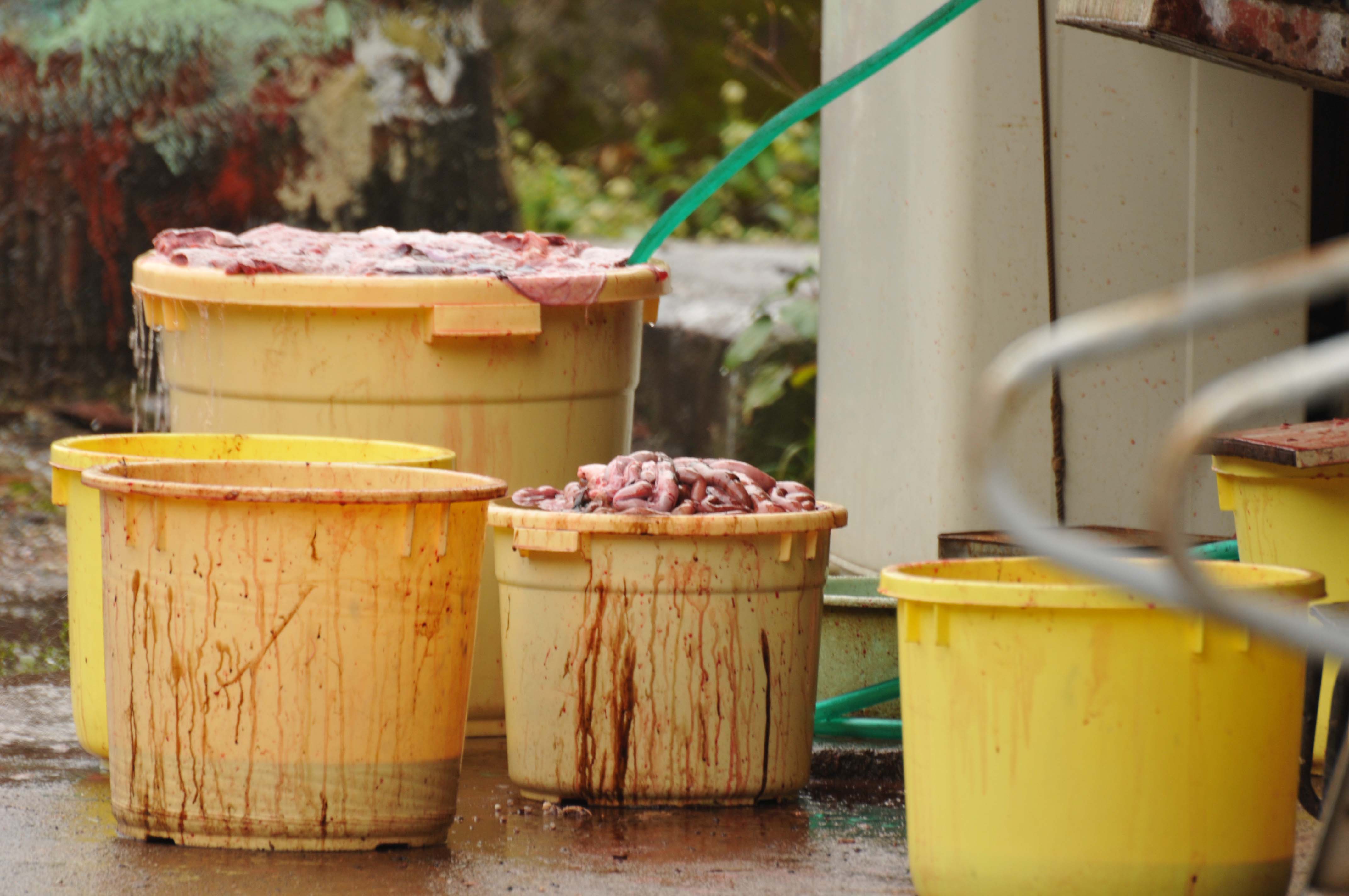
Dolphin offal and intestines photographed during the 2011-12 Taiji Dolphin Defense Campaign. Photo credit: Sea Shepherd / Christoph Heylen

We are fighting this war against nature with chemicals, industrialized equipment, ever increasing extraction technologies (like fracking) and repression against any and all voices that rise up in dissent.

In our wake over the past two centuries we have left a trail of billions of bodies. We have tortured, slain, abused and wasted so many lives, obliterated entire species; and reduced rich diverse eco-systems to lifeless wastelands as we polluted the seas, the air and the soil with chemicals, heavy metals, plastic, radiation and industrialized farm sewage.

We were once horrified by the possibility of a Chernobyl or a Fukushima. But the accidents happened and we adapted and accepted. Now we are complacent.

In the process we are becoming sociopathic as a species. We are losing the ability to express empathy and compassion. We idolize soldiers, hunters, and resource developers without giving a thought to their victims. We revel in violent fantasies hailing two-dimensional fantasy killers as heroes. We have become increasingly more Darwinian in our outlook that the weak (other species) must perish so that the strong (ourselves) may survive. We forget that Darwinism recognizes the laws of ecology and we cannot pick and choose when it comes to the laws of nature. In the end nature controls us, we do not control nature.

The consequences of our actions are not going to happen centuries from now. They are going to happen within this century. Oceanic ecosystems are collapsing — now! The planet is getting warmer — now! Phytoplankton is being diminished — now!

To be blunt — the planet is dying now, and we are killing it!

From what I have experienced and from what I see there is only one thing that can prevent us from falling victim to the consequences of ignoring the laws of ecology.

We must shake off the anthropocentric mindset and embrace a biocentric understanding of the natural world. We can do this because we have wonderful teachers in indigenous communities worldwide who have lived biocentric lifestyles for thousands of years just as our species all once did. We need to learn to live in harmony with other species.

We need to establish a moratorium on industrialized fishing, logging and farming.

We need to stop producing goods that have no intrinsic value — all the useless plastic baubles for entertainment and self-indulgence. We need to stop mass-producing plastic that is choking our global seas. We need to stop injecting poisons into the soil and dumping toxins into the sea. We need to abolish cultural practices that destroy life for the sole purpose of entertaining ourselves.

Of course it won’t be easy but do we really want the epitaph for our species to be, “Well we needed the jobs?”

Without ecology there is no economy.

I am not a pessimist and I’ve never been prone to pessimistic thoughts. There are solutions. We see people of compassion, imagination and courage around us working to make this a better world — devoting themselves to protecting species and habitats; finding organic agricultural alternatives; and developing more eco-friendly forms of energy production. Innovators, thinkers, activists, artists, leaders and educators — these people are among us and their numbers are growing.

It is often said that the problems are overwhelming and the solutions are impossible. I don’t buy this. The solution to an impossible problem is to find an impossible solution.

It can be done. In 1972, the very idea that Nelson Mandela would one day be President of South Africa was unthinkable and impossible — yet the impossible became possible.

It’s never easy but it is possible and possibilities are achieved through courage, imagination, passion and love.

I learned from the Mohawks years ago that we must live our lives by taking into account the consequences of our every action on all future generations of all species.

If we love our children and grandchildren we must recognize that their world will not be our world. Their world will be greatly diminished and unrecognizable from the world of our childhoods. Each and every child born in the 21st Century is facing challenges that no human being has ever faced in the entire history of our species:

Emerging pathogens from the permafrost. (Just this summer, an anthrax virus from a recently thawed reindeer carcass broke out killing 1,500 reindeer and hospitalizing 13 people in Russia.) Eruptions of methane opening huge craters in the earth in Siberia, mass-accelerated extinction of plants and animals, pollution, wars and more wars, irrational violence in the form of individual, religious and state terrorism, the collapse of entire eco-systems.

This is not doom and gloom fear mongering. It is simply a realistic observation of the consequences of our deliberately ignoring of the laws of ecology. I call it the Cassandra Principle.

Cassandra was the prophetess of ancient Troy whose curse was the ability to see the future and to have everyone dismiss her prophecies. No one listened to her, instead they ridiculed her. Yet she was right. All that she predicted came to pass and Troy was destroyed.

Years ago I had a critic in the media label me as a doom and gloom Cassandra. I replied, “Maybe, but don’t forget one thing. Cassandra was right.”

2016-08-04-1470346349-3492535-sscsgalapagosdirectorseanohearngimenezonasharkfinningarrestoperation226.jpg

Sea Shepherd’s Galapagos Director Sean O’Hearn-Gimenez on a shark finning arrest operation om 2007.

And over the years I have made predictions (that were ridiculed and dismissed) that have come true. In 1982 I publicly predicted the collapse of the North Atlantic Cod fishery. It happened a decade later. In 1978 I predicted the destruction of one half of the African elephant population in Defenders magazine. I was wrong. Some two thirds of the population have been destroyed. In 1984, I predicted ecological destruction by salmon farms including the spreading of viruses to wild salmon populations. Every prediction was based on observation with reference to the laws of ecology and every prediction was dismissed.

Nothing has changed. Today I am predicting the death of worldwide coral reef eco-systems by 2025, the total collapse of worldwide commercial fishing operations by 2030; and the emergence of more virulent viral diseases in the coming decades. It does not take any exceptional foresight to predict that war will be the major business of the next half-century, as well as the rise of more authoritarian governments.

Recently my old friend Rod Marining, also a co-founder of Greenpeace, said to me: “The transformation of human consciousness on a mass scale can not happen, unless there are two factors. First, a huge mass visual death threat to survival of our species, and two, the threat of the loss of a people’s jobs or their values. Once theses two factors are in place humans begin to transform their thinking over night.”

I have seen the future written in the patterns of our behavior, and it is not a pleasant future, in fact it is not much of a future at all.

The four horses have arrived. As death sits astride the pale horse, the other three horses of pestilence, famine and war and terrorism are stampeding at full gallop toward us while our backs are turned away from them. And when they trample us, we may look up from our latest entertainment triviality to see ourselves in the dust of the ecological apocalypse.

I also see the possibility of salvation. By listening to the words and observing the actions of indigenous people. By looking into the eyes of our children. By stepping outside the circle of anthropocentrism. By understanding that we are part of the Continuum. By refusing to participate in the anthropocentric illusion. By embracing biocentrism and fully understanding the laws of ecology, and the fact that these laws cannot — must not — be ignored if we wish to survive.