Exposing the Big Game

Forget Hunters' Feeble Rationalizations and Trust Your Gut Feelings: Making Sport of Killing Is Not Healthy Human Behavior

Exposing the Big Game

HSUS offers $5,000 reward for person who killed dolphin with arrow

NOAA seeks person who killed dolphin with arrow

Posted: Dec 09, 2014 1:22 PM PST <em class=”wnDate”>Tuesday, December 9, 2014 4:22 PM EST</em>Updated: Dec 09, 2014 2:01 PM PST <em class=”wnDate”>Tuesday, December 9, 2014 5:01 PM EST</em>

NOAA photo of hunting arrow that was removed from dolphin.NOAA photo of hunting arrow that was removed from dolphin.

NOAA photo of dolphin that had been shot with an arrow.NOAA photo of dolphin that had been shot with an arrow.

NOAA photo of pregnant dolphin that had been shot.NOAA photo of pregnant dolphin that had been shot.

A $5,000 reward is being offered in the disturbing case of a dolphin that washed ashore dead with a hunting arrow protruding from its side.

The National Oceanic and Atmospheric Administration is investigating the death, which happened over the weekend in Orange Beach, Alabama. The agency says it is the second human-related dolphin death in the Northern Gulf of Mexico since mid November.

NOAA scientists think the dolphin may have survived for at least five days before dying from a secondary infection caused by the wound. The dolphin was shot with a steel-tipped hunting arrow that had a yellow feather on it.

The Humane Society of the United States and the Humane Society Wildlife Land Trust are offering the reward with the hope it will lead to the arrest and conviction of the person responsible.

“This intelligent, social creature experienced tremendous suffering from this senseless act. We are grateful for NOAA’s work to investigate this heinous crime and are hoping someone with information will come forward,” said Alabama HSUS Director Mindy Gilbert in a news release.

If you have information about the incident, call NOAA’s Office of Law Enforcement in Niceville, FL, at (850) 729-8628 or the NOAA Enforcement Hotline at 1-800-853-1964 as soon as possible. Tips can be left anonymously.

It was the second human-caused death of a dolphin since mid-November. NOAA is investigating the deadly shooting of a pregnant bottlenose dolphin found dead on Miramar Beach.

To report a stranded, injured or sick dolphin, call 1-877-WHALE-HELP (1-877-942-5343)

And From

Though it remains unclear just who the perpetrators of these killings are, there has been speculation that local fishermen — disgruntled by dolphins stealing their bait or catch — may be responsible.

There have, in the past, been instances of fishermen intentionally harming dolphins. In 2009, for example, a man in Panama City, Florida, was sentenced to two years in prison after he was found guilty of making pipe bombs to kill dolphins. Several fishermen have also been slapped with fines in recent years for shooting the animals.

Japan Prevents Dolphin Activist From Entering The Country

https://www.thedodo.com/taiji-dolphin-activist-denied-869369435.html?utm_source=The+Dodo+Newsletter&utm_campaign=86a143d85e-12_10_2014_NL&utm_medium=email&utm_term=0_4342b46fc5-86a143d85e-142095821

By Melissa Cronin

An activist flying into Japan hoping to document the annual dolphin and whale slaughter in the infamous cove in Taiji was detained by officials at Tokyo’s Narita Airport and eventually forced to leave the country.

Melissa Sehgal, a member of the Sea Shepherd Conservation Society who has documented the slaughter for four years now, says that she was questioned for nine hours and detained for 24 hours in a holding cell. She was then reportedly escorted onto a flight and forced to leave Japan.

Sea Shepherd says that several of their other staff and volunteers have been denied entry to Japan this year as well. Japanese immigration authorities say that they are not technically “tourists,” and in violation of visa restriction. The incident has not been reported in any Japanese news sources, and government representatives have not officially commented.

“Since when is taking pictures of what Japan contends is their ‘culture’ not considered a tourist activity?” said Sehgal. “Japan is so ashamed of their serial killing and kidnapping of wild dolphins that they are trying to stop activists like me from showing the world the truth. It is a testament to our effectiveness that they are trying to keep us out.”

Last year Ric O’Barry, former dolphin trainer and head of the Dolphin Project, was turned away when he tried to visit a juvenile albino calf after she had been captured. When he was denied entry by the park’s staff at the gates, O’Barry sued the marine park for discrimination.

“They don’t want people like me to go into the Taiji Whale Museum to monitor Angel,” O’Barry told AP last May in Tokyo.

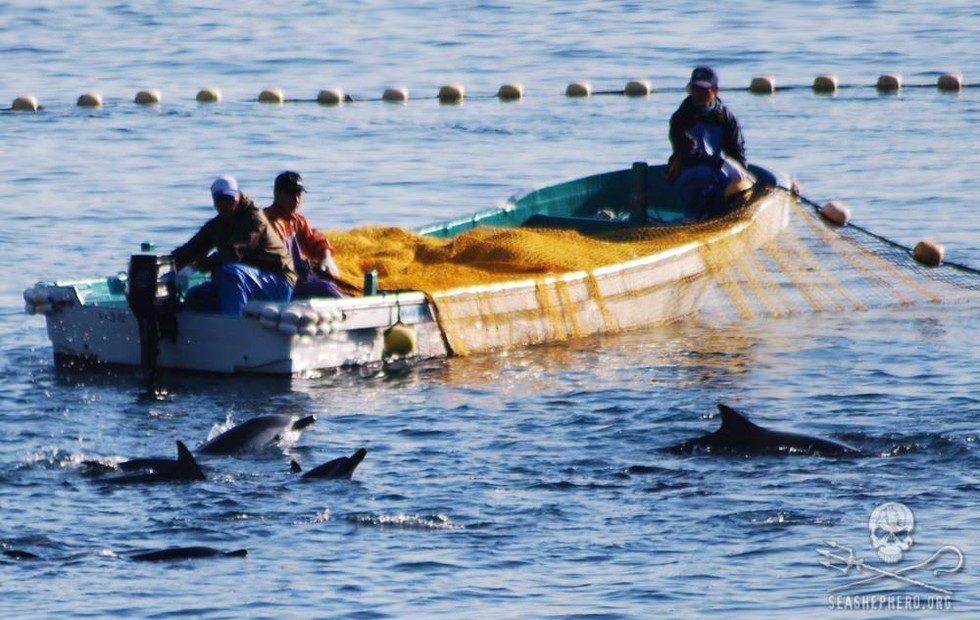
Meanwhile in Taiji, the drive hunt season continues. Just this week, a pod of some 50 striped dolphins was ushered into the cove and slaughtered for their meat. Since Sept. 1, 20 pods of dolphins, nearly 300 total, have been killed in the cove.

(Sea Shepherd Conservation Society)

A Lot Of Heart For Orcas

By Steven Huxter

In December 2013, Seattle rockers Nancy and Ann Wilson of the band Heart, cancelled their concert at Sea World as a result of watching “Blackfish.” After hearing from fans and considering the implications of a decision to cancel, Heart tweeted: “Heart has chosen to decline their forthcoming performance at SeaWorld on 2/9/14 due to the controversial documentary film ‘Black Fish’.”

A year later, and true to form, Heart continues to be a supporter of Orca welfare. This past November, Nancy and Ann donated an autographed guitar that was raffled as part of the “Lolita’s Gift Holiday Auction,” a fundraising effort to support the Orca Network and a newly released documentary, “Fragile Waters” from filmmakers Rick Wood and Shari Macy. The film highlights the plight of the endangered Southern Resident Killer Whales and their home waters, the Salish Sea.

The winner of the autographed guitar generously donated it back to the auction organizer so it could be included as part of the “Orca Network Reunion Raffle” which seeks to help fund the Orca Network and traveling expenses for Orca Network founder, Howard Garrett, when he joins the “Miracle March for Lolita” in Miami, Fl. on January 17, 2015. Lolita, who was captured from the Southern Resident Orca population in 1970, has been held captive at the Miami Seaquarium for over forty years.

When Ann and Nancy Wilson of Heart were told that their autographed guitar had been donated back so it could help raise more funds for the “Orca Network Reunion Raffle,” they were so touched by the generosity that they donated more items for the raffle, to be bundled with the guitar as the “Heart for Lolita” package.

Along with the guitar they added an autographed copy of their book, “Kicking and Dreaming,” an autographed photo of Ann and Nancy, and two passes to see Heart in concert. Heart has also posted a link to the online raffle on their Facebook page.

When asked how she came by her appreciation for orca’s, Nancy Wilson said, “I got to know a family of orcas first hand when I hosted a documentary about orca’s called Baby Wild. They are magic and beautiful.”

Ann and Nancy Wilson made a strong statement when they cancelled their concert at SeaWorld in December 2013. Their continued support of advocacy efforts is testament to their sincerity and heartfelt appreciation for orcas.

Raffle tickets for the “Heart for Lolita” package, and other items, can be found here.

Whale of a Fight Over Bringing Belugas to U.S.

http://www.11alive.com/story/news/2014/08/20/beluga-whale/14325783/

ATLANTA, Ga. — The Georgia Aquarium wants to bring 18 Beluga Whales to the US.

The Aquarium was denied their request to bring the whales here more than two years ago, but Wednesday, they will appeal that decision.

When they first asked to bring the mammals here, it started a firestorm of controversy from animal rights advocates.

The whales were collected at a research facility in Russia in 2006, 2010, and 2011.

There has been strong opposition to bringing the Belugas to the US from environmentalists who think the whales should stay put… But the aquarium argues it would do more good to have them here, where they say they can teach people to care about wildlife and serve as ambassadors.

This is a very long running fight between the two groups.

All the way back in June of 2012, the Aquarium submitted the application to bring the whales to the US.

A year later, in November, NOAA denied their application, which at the time, was unexpected.

The Georgia Aquarium filed their appeal, in October of 2013

The court will hold a hearing on Wednesday about documents the Georgia Aquarium wants uncovered.

According to the Aquarium, NOAA seemed likely to approve their request and then changed course.

The Aquarium is asking for all documents related to the decision not to allow the whales to come to the US.

There will likely not be a ruling Wednesday.

Vaquita Porpoise Faces Imminent Extinction—Can It Be Saved?

http://news.nationalgeographic.com/news/2014/08/140813-vaquita-gulf-california-mexico-totoaba-gillnetting-china-baiji/

by Virginia Morell

for National Geographic

Published August 13, 2014

The vaquita, a small porpoise found only in the Gulf of California, is rapidly going extinct, an international team of scientists reported earlier this month.

The researchers say that the marine mammals—whose name means “little cow” in Spanish—are accidentally drowning in the gill nets local fishers deploy for fish and shrimp. A mere 97 vaquitas remain.

Vaquitas are shy creatures, and rarely seen, except when they’re pulled to the surface—dead—in nets. They’ve been known to science only since 1958, when three skulls were found on a beach. At the time, it was thought that they numbered in the low thousands. Scientists and fishers alike say the animals, with their pretty facial markings (“they look like they’re wearing lipstick and mascara,” one scientist said) and sleek bodies, are endearing.

There’s danger now that the porpoises will become the second cetacean (the first was the baiji, or Chinese river dolphin) to succumb to human pressures, most likely disappearing forever by 2018.

“It’s a complete disappointment for everybody, because we’ve all been working hard to turn this around, and the [Mexican] government has addressed this from the highest level possible,” said Lorenzo Rojas-Bracho, a cetacean conservation specialist at Mexico’s Commission of Natural Protected Areas and a member of the team.

Indeed, the Mexican government established a presidential commission on vaquita conservation in 2012, when scientists estimated the porpoise’s population at 200.

Map of Gulf of California showing the range of the vaquita porpoise, along with the vaquita reserve, nearby biosphere reserve, and proposed gill-net exclusion zone.

MAGGIE SMITH, NG STAFF. SOURCES: International Committee for the Recovery of the Vaquita; IUCN; UNEP-WCMC

Failing Measures

To stem the vaquitas’ decline, in 2005 Mexico created a refuge for them, banned all commercial fishing in the refuge’s waters, beefed up enforcement, and invested more than $30 million (U.S.) to compensate fishers and encourage them to switch to other fishing methods.

It also established the international scientific team to monitor the porpoise’s population, reproductive rates, and habitat. Its members hail from such august conservation bodies as the International Union for Conservation of Nature, the International Whaling Commission, the U.S. Marine Mammal Commission, and Norway’s Institute of Marine Research.

All were optimistic then. “We thought we were going to see the vaquitas’ numbers increasing by 4 percent a year,” said Barbara Taylor, a marine biologist with the Southwest Fisheries Science Center in San Diego, California, and a member of the team. “Instead, they’ve had a catastrophic decline of 18.5 percent per year.”

Chinese Demand—But Not for Vaquitas

That decline, Rojas-Bracho said, is “all due to illegal fishing that is out of control.”

In the past three years, illegal gillnetting for the totoaba, a critically endangered fish that can grow to more than six feet long (1.8 meters) and 300 pounds (136 kilograms), has surged. Unfortunately, the porpoise and the similarly sized totoaba live in the same parts of the gulf.

The totoaba’s swim bladder, highly prized as a traditional health food and medicine in China, can fetch thousands of dollars. Few fishers can resist the temptation.

“It’s like trying to control traffic while someone’s throwing money from the Empire State Building,” said Rojas-Bracho, who learned of the extent of this illegal take from several fishers who are also on the presidential commission.

The team estimates that about 435 miles (700 kilometers) of legal nets are in the water every day during the fishing season, from mid-September to mid-June. “And that’s not counting the illegal nets for the totoaba,” Taylor says.

Last-Ditch Solution

Because of the vaquita’s timid nature (a sighting at 300 feet [90 meters] is considered close), scientists can’t make visual counts of the animals. They rely instead on an array of special acoustic devices, deployed every year before the fishing season begins (they too are easily tangled in the nets), to record the sounds of the animals as they forage in the murky waters they favor. From these sounds, the researchers are able to estimate the vaquitas’ numbers.

Because the animal’s population is so low, the team says there is only one solution: Ban all gillnetting in the gulf’s upper regions, including the waters surrounding the vaquitas’ refuge. The ban must be strictly applied, even to the legal shrimp and fin fish fishery, and enforced with more police patrols on sea and land.

“It’s a hard choice,” Taylor acknowledges. Such a ban will hurt all the fishers, including those who aren’t engaged in the illegal fishery. But, she said, if Mexico doesn’t do that, it “will lose the vaquita.”

Rojas-Bracho said that Mexico, China, and the United States governments also need to work together to control—if not end—the trade in totoaba swim bladders. The dried bladders are often smuggled across the U.S. border before ending up in the Chinese marketplace.

There is a modicum of hope. Even at only 97 animals (25 of them believed to be females of reproductive age), the species can still be saved, Taylor believes. “Most marine mammals, including other cetaceans, that have been taken down through hunting have come back, so it’s not too late. But if nothing is done, they can also go extinct rapidly, as happened with the baiji. They can be gone before you know it.”

The commission will meet again at the end of August to discuss what to do next to save the vaquita.

Virginia Morell is the author of four acclaimed books, including Animal Wise: The Thoughts and Emotions of Our Fellow Creatures.

The Canadian government fantasy about the seal hunt is just not that widely shared

Canadian Blog

by Barry Kent MacKay,
Senior Program Associate

Born Free USA’s Canadian Representative

Barry is an artist, both with words and with paint. He has been associated with our organization for nearly three decades and is our go-to guy for any wildlife question. He knows his animals — especially birds — and the issues that affect them. His blogs will give you just the tip of his wildlife-knowledge iceberg, so be sure to stay and delve deeper into his Canadian Project articles. If you like wildlife and reading, Barry’s your man. (And we’re happy to have him as part of our team, too!)

Advice to Gail Shea and the Canadian Government: Here’s How to Impress the EU

The Canadian government fantasy is just not that widely shared

Published 04/18/14

You may wonder why I, a long time opponent of Canada’s east coast commercial seal hunt, would offer advice to those who fight people like me: the Canadian government. No fear. Anything not fitting the current Canadian government’s ideology is ignored, and yet I live in hope. Call it Canadian pride, or what is left of it, but I hate how we’re increasingly considered to be so backward and regressive on issues pertaining to the environment and animal welfare by so much of the rest of the world—including the European Union (EU), whose ban on the import of products from the east coast commercial seal hunt is opposed by Member of the Canadian Parliament, Gail Shea.

Recently, she was quoted as blaming the “the animal rights movement” for China’s apparent reticence to import products, claiming that we had “put a lot of pressure” on the Chinese. Think how that sounds in Europe or China. The so-called “animal rights movement,” whatever she thinks that may be, is supported by volunteered donations (not taxes), and has its hands full with multitudes of humanitarian and environmental concerns in China—from imports of endangered species through dwindling habitat for its own endangered fauna; to horrific zoo, fur, and livestock farm conditions; to a lack of laws providing animal protection; to the live skinning of dogs, cats, or other meat animals in street markets; to shark fin soup; to killer pollution that has caused birds to drop from the sky and marine life to go extinct; to there being virtually no local NGO (non-governmental organization) of its own dedicated to animal protection. And, compared to the resources available to the Government of Canada, what “pressure” do you think humanitarians have? Trade sanctions? Travel restrictions? Call in the ambassador? Mobilize military assets?

So, my first piece of advice to Shea and her colleagues: get real if you want the Europeans to take Canada seriously when it fights to lift the ban on products from the east coast commercial hunt. And to be fair, China is moving forward on environmental and animal protection issues, yes—but no western NGO influences China’s government policy.

Shea is fully in her right to claim that no “baby” seals are killed, but she should understand that, for it to be a truthful statement, a seal has to suddenly stop being a baby at about three weeks of age. But, redefining words does not change their meaning for the rest of the world.

The federal government (dominated by a party most Canadians did not vote for) has continually disgraced itself on many fronts, including the recently-announced (and ironically named) Fair Elections Act, which, if passed, will reduce the number of votes cast by citizens. (But, most foreigners don’t know about that sort of domestic issue.) However, because the issue is of global significance, they do know that former Minister of Natural Resources, Joe Oliver, referred to “environmental and other radical groups” as threatening “to hijack our regulatory system to achieve their radical ideological agenda.” Oh, the irony, coming from a government that has systematically cut funding to research that demonstrates the risk of over-fishing or global climate change. I’ve been a Canadian longer than the Prime Minister and have never seen a more ideological government—and part of the ideology is to ignore facts or expert opinion. It’s no wonder that the Conference Board of Canada ranked our environmental record 15th out of 17 industrial countries, with, a year later, Simon Frazer University ranking us 24th out of 25 Organization for Economic Co-operation and Development nations on environmental performance.

It is hard to reconcile the Canadian decision to contemptuously close, without a trace of consultation with the scientists affected, more than a dozen science libraries run by the Department of Fisheries and Oceans (DFO) and Environment Canada, including the then-newly refurbished, century-old St. Andrews Biological Station in New Brunswick—literally throwing hundreds of thousands of documents, including unpublished material with irretrievable baseline data, into dumpsters!

Just recently, Shea has made moves to reduce protection of breeding habitat of various fish stocks, and to ignore utterly scientific advice in order to support west coast salmon farming that puts native stocks at serious risk. In fact, there is a long history of bad decisions by a succession of fisheries ministers for both parties that have formed governments, resulting in numerous losses of valued fish stocks (but nothing like the anti-environmental fanaticism we now see). With such contempt for science, is it any wonder that claims that the commercial seal hunt is supported by “science” are taken with more than a grain of salt in Europe? People can judge for themselves by viewing video online, to which the government has responded by tabling a bill that would prevent observers from getting close enough to sealers to film how they do it. That’s just so typical. Never have I seen such opacity, such secrecy, and such contempt for openness and accountability as is displayed by this government.

In addressing the World Trade Organization, Leona Aglukkaq, Minister of the Environment (who once asked us to celebrate the killing of a polar bear), was miffed that the EU imported seals from Greenland. That’s because it’s an aboriginal hunt… but so is the hunt for seals in northern Canada, and products from it are also not banned: a point Canada ignores, to the detriment of northern “subsistence” sealers’ interests. They have a monopoly. Subsistence, yes, but Europeans know that trade with them is a function of European colonization. The real irony is that the Canadian government has continually ignored warnings about climate change that so profoundly puts northern traditions at risk from melting permafrost and diminishing ice, including the sea ice so essential to seals and polar bears.

It is ironic, too, that—again ignoring any science that shows that gray seals are not proved to be a threat to commercial fisheries (and could help them in their role as apex predators)—Canada claims that they should be culled, and claims that no seal is wasted, when there is no market. Again, the Europeans are informed on such matters.

Canada loves to mention foie gras, bullfights, and fox hunting as examples of European traditions equal to the seal hunt in cruelty. But, to compassionate (and logical) Europeans, two wrongs don’t make a right, and the fact is that the EU is far ahead of Canada in trying to set standards for increasingly humane treatment of animals. As the recent trial of Maple Lodge, our largest chicken producer, shows, we have a very long way to go. Meanwhile, the humane movement also fights these “traditions,” success dependent on public support. The trajectory, in Europe and many other regions, is forward, toward ever more animal welfare. Not so, sadly, here in Canada.

10264634_10152337495904586_9174164310757903244_n

Sea Shepherd Founder to Bill Maher: ‘If Oceans Die, We Die’


http://ecowatch.com/2014/04/08/sea-shepherd-bill-maher/

| April 8, 2014

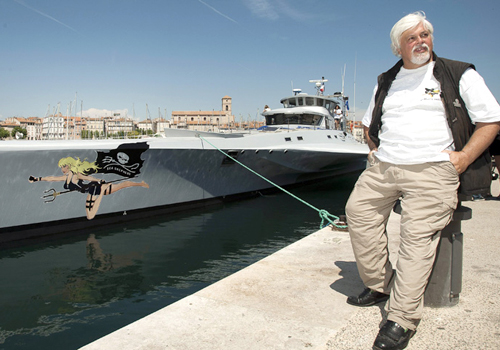
You can always expect to see Captain Paul Watson on the front lines of the battle to conserve and protect marine ecosystems for wildlife. He and his Sea Shepherd Conservation Society have been doing it for nearly 40 years.

A late-night, cable television got the chance to learn more about Watson’s mission during the most recent episode of Real Time with Bill Maher. He discussed some of his biggest enemies—Japanese whalers—and his joy regarding last week’s International Court of Justice ruling that Japan’s “research whaling” is illegal. It marked a big moment for Watson, who says he has been labeled an “eco-terrorist” for years.

“I’m not an eco-terrorist—I don’t work for BP,” he said to a round of applause from the studio audience.

Paul WATSON, Brigitte BARDOT

Back in February, chapters of Watson’s organization hosted “World Love for Dolphins Day” demonstrations in large cities, calling for an end to brutal dolphin hunts in Taiji, Japan’s killing cove.

Watson has also been jailed for his cause. He was arrested two years ago in Germany for extradition to Costa Rica for ship traffic violation as he exposed an illegal shark finning operation on Guatemalan waters run by a Costa Rican company.

——–

YOU ALSO MIGHT LIKE

International Court Rules Japan’s ‘Research’ Whaling Illegal in Landmark Case

250+ Bottlenose Dolphins Captured in Japan’s Taiji Cove Hunt

Sea World Responds to Blackfish Documentary, Sea Shepherd Sets the Record Straight

Japan mulls over Pacific research whaling

Japan is considering whether to conduct research whaling in1625686_10153991126600648_6519826837941566402_n the northwestern Pacific Ocean later this month as planned.

The International Court of Justice in The Hague ruled in March that Japan’s whaling program in the Antarctic cannot be recognized as serving research purposes in its current form.

Japan also carries out research whaling in the northwestern Pacific, including waters off the country’s coast.

This year’s activities are scheduled to start off the coast of Ishinomaki City, northeastern Japan, on April 22nd. There are plans to conduct it farther out into the northwestern Pacific next month.

The court’s decision does not directly cover Japan’s research whaling in those areas.

But the government thinks the court’s ruling could be applied to those waters depending on methods used, including the number caught.

The concern is prompting the government to assess its research procedures. It plans to decide as early as next week whether to go ahead with research whaling in the northwestern Pacific.

Some in the government claim that it should conduct the Pacific research whaling as planned. But others argue that Japan could be sued again if it continues the program without due consideration to the court’s ruling.

Apr. 10, 2014  http://www3.nhk.or.jp/nhkworld/english/news/20140411_03.html

Inuit use social media to post “sealfies,” standing beside freshly killed seals

http://www.cbc.ca/news/canada/north/humane-society-says-it-doesn-t-oppose-inuit-seal-hunt-1.2603306

Humane Society says it doesn’t oppose Inuit seal hunt

Donation to group by Ellen DeGeneres sparked #sealfie social media campaign

The Canadian Press Posted: Apr 08, 2014

Related Stories

Wildlife Photography © Jim Robertson

Wildlife Photography © Jim Robertson

A spokeswoman for the Canadian arm of the Humane Society International isclarifying the group’s position on the Inuit seal hunt, as a protest against TV star Ellen DeGeneres in the North gains support.

Rebecca Aldworth says recent reports on the protests are mixing up subsistence sealing in Canada’s North with the commercial hunt.

She says animal protection groups oppose commercial sealing in Atlantic Canada by non-aboriginal people.

Inuit in Nunavut have been engaged in a “sealfie” movement ever since DeGeneres took a celebrity selfie at the Oscars last month.

DeGeneres donated $1.5 million of the money raised by the star-studded picture to the Humane Society of the United States, an organization that fights seal hunting.

In response, Inuit are using social media to post pictures of themselves wearing sealskin clothes, standing beside freshly killed seals or looking forward to enjoying a seal meal.

“Commercial sealing advocates have long attempted to blur the lines between their globally condemned industry and the socially accepted Inuit subsistence hunt,” Aldworth said in a statement Tuesday.

“Unlike Inuit sealers, commercial sealers almost exclusively target baby seals who are less than three months old. Inuit hunters kill seals primarily for meat,” she said.

“Commercial sealers slaughter seal pups for their fur, dumping most of the carcasses at sea. Inuit sealers kill seals sporadically throughout the year, while commercial sealers often kill hundreds of thousands of seals in a matter of days or weeks.”

Inuit have long maintained that any opposition to the seal hunt, commercial or otherwise, harms Inuit by destroying the market for seal furs. That’s the reason Inuit launched a legal challenge against a European ban of seal products, even though that legislation included an exemption for seal products harvested by Inuit.

While it is true that most seals harvested in the commercial seal hunt are under three months old, all are independent animals. Hunting white coat baby seals has been outlawed in Canada since 1987.

To promote its own message, the Inuit land claims group Nunavut Tunngavik is supporting the sealfie movement and plans to operate a photo booth in its offices in Iqaluit this Thursday. It is also organizing a giant sealfie in Iqaluit on Friday afternoon.

The group says it wants to educate people about Nunavut’s sustainable and humane seal harvest.

During the Oscar broadcast on March 2, host, comedian and daytime TV star DeGeneres went into the audience and snapped a selfie that included luminaries such as Bradley Cooper, Meryl Streep and Kevin Spacey. Smartphone manufacturer Samsung, which made the phone DeGeneres used, promised to donate a dollar to charity for every time the photo was retweeted.

The selfie almost immediately crashed Twitter and became the most widely retweeted photo ever.

In statements on her website, DeGeneres, a vegan, calls the seal hunt “one of the most atrocious and inhumane acts against animals allowed by any government.”

Dolphin Speak: Did a Dolphin Really Say “Seaweed”?

dolphin_228398

http://www.psychologytoday.com/blog/animal-emotions/201404/dolphin-speak-did-dolphin-really-say-seaweed

”I don’t see a fundamental white line that distinguishes us from other animals.” Dr. Terrence Deacon
Dolphin tool use influences a population’s genetic structure and they may talk.
 
Dolphins are unquestionably highly charismatic animals. They have unique and sophisticated communication skills and also are known to use tools, including sponges to protect their sensitive beaks, when foraging for food.

During the past two weeks I came across two extremely interesting articles about these crafty cetaceans. The first, titled “Dolphin whistle instantly translated by computer” by Hal Hodson, considers the possibility that dolphins are able to whistle the same words we use to denote an object. The print version of the latter essay is called “Decoding dolphin.” The second, called “Cultural transmission of tool use combined with habitat specializations leads to fine-scale genetic structure in bottlenose dolphins” by Anna Kopps of the University of New South Wales and her colleagues, focuses on their use of protective sponges during foraging and its effect on the genetic structure of dolphin populations.

Say what? Did you really whistle seaweed?

Denise Herzing is well known for her and her team’s long-term field research on Atlantic spotted dolphins. Among many aspects of the amazing lives of dolphins, she has long been interested in dolphin communication and whether or not they and other animals use language to communicate with one another or can use language to communicate with us.

While it’s too early to know for sure, there is compelling evidence that some animals are language users (see, for example, a brief review of the research by Dr. Con Slobochikoff on prairie dogs). I found Hal Hodson’s essay called “Decoding dolphin” to be an extremely interesting, stimulating, and easy read. To wit, and I encourage you to take a few minutes to read it, Mr. Hodson begins: “IT was late August 2013 and Denise Herzing was swimming in the Caribbean. The dolphin pod she had been tracking for the past 25 years was playing around her boat. Suddenly, she heard one of them say, ‘Sargassum'”. And, what did Dr. Herzing exclaim? “‘I was like whoa! We have a match. I was stunned.'” Dr. Herzing “was wearing a prototype dolphin translator called Cetacean Hearing and Telemetry (CHAT) and it had just translated a live dolphin whistle for the first time.” So, “When the computer picked up the sargassum whistle, Herzing heard her own recorded voice saying the word into her ear.” I, too, would have been stunned and I can’t wait for more research in this fascinating area of study.

Perhaps we are not the only animals who use language. Dr. Terrence Deacon, a neuroscientist at the University of California, Berkeley, who also is an expert in animal communication, notes, “I don’t see a fundamental white line that distinguishes us from other animals.” Only time and research will tell if we’re alone in the language arena. For now it’s a good idea to keep the door wide open.

Cultural hitchhiking: Was there a “sponging Eve”?

An informative summary of the research on the genetics of tool use in dolphins living in Shark Bay in Western Australia can be found in an article called “Cultural hitchhiking: How social behavior can affect genetic makeup in dolphins.” It turns out that the culturally transmitted use of sponges—called vertical social transmission—can actually “shape the genetic makeup” of wild dolphins. Dolphins, who live deep in the bay, show mitochondrial DNA (mtDNA) types called Haplotype E or Haplotype F that are inherited solely from the mother, whereas non-sponging dolphins who live in shallower water mainly show Haplotype H. All of the 22 sponging dolphins who were observed turned out to be members of one matriline and were Haplotype E.

This novel and significant discovery demonstrates a strong correlation between haplotype and habitat. According to Dr. Kopps, “Our research shows that social learning should be considered as a possible factor that shapes the genetic structure of a wild animal population.” She also notes, “For humans we have known for a long time that culture is an important factor in shaping our genetics. Now we have shown for the first time that a socially transmitted behaviour like tool use can also lead to different genetic characteristics within a single animal population, depending on which habitat they live in.” This is one of the first demonstrations of what is called “cultural hitchhiking” in nonhuman animals.

What an exciting time it is to study the behavior of nonhuman animals. Stay tuned for more on their fascinating lives.

Marc Bekoff’s latest books are Jasper’s story: Saving moon bears (with Jill Robinson; see also), Ignoring nature no more: The case for compassionate conservation (see also)and Why dogs hump and bees get depressed (see also). Rewilding our hearts: Building pathways of compassion and coexistence will be published fall 2014.