Austrian poacher-turned-killer committed hundreds of crimes, at cost of millions

[Interesting that the title reads: “poacher-turned-killer.” Isn’t poaching also killing?]

http://www.foxnews.com/world/2013/12/19/police-austrian-poacher-turned-killer-committed-hundreds-crimes-at-cost/?intcmp=obnetwork

December 19, 2013

Associated Press
  • 95c9de829f2a612a460f6a7067004f99.jpg

    This picture provided by the Police Department of Lower Austria (Landespolizeidirektion Niederoesterreich) shows trophys police found at the poacher’s house, who killed four people and then himself. Police say nearly 100 other crimes that caused estimated damages and losses valued around 10 million euros (nearly US dollar 14 million). Police published their conclusions Thursday, Dec. 19, 2013, three months after Alois Huber, 55, killed three policemen and a paramedic after police tried to question him. He then barricaded himself on his farm before setting fire to his hideout and shooting himself in the head. (AP Photo/Landespolizeidirektion Niederoesterreich) (The Associated Press)

  • cf6720969f2a612a460f6a706700ddb7.jpg

    This picture provided by the Police Department of Lower Austria (Landespolizeidirektion Niederoesterreich) shows trophys police found at the poacher’s house, who killed four people and then himself. Police say nearly 100 other crimes that caused estimated damages and losses valued around 10 million euros (nearly US dollar 14 million). Police published their conclusions Thursday, Dec. 19, 2013, three months after Alois Huber, 55, killed three policemen and a paramedic after police tried to question him. He then barricaded himself on his farm before setting fire to his hideout and shooting himself in the head. (AP Photo/Landespolizeidirektion Niederoesterreich) (The Associated Press)

VIENNA –  Austrian police say the poacher who killed four people and then himself this year committed nearly 100 other crimes that caused estimated damages and losses valued around 10 million euros (nearly $14 million).

Police published their conclusions Thursday, three months after Alois Huber, 55, killed three policemen and a paramedic after police tried to question him. He then barricaded himself on his farm before setting fire to his hideout and shooting himself in the head.

The report says Huber committed 91 crimes between 1994 and the time he killed himself. They included burglaries, arson, car break-ins, license plate thefts and motorcycle thefts.

Police believe that most of the 600 deer and chamois trophies found on his property came from illegal kills, including 29 deer heads discovered in a freezer.

Guilty plea in major rhino horn smuggling case

Kevin Johnson, USA TODAY

December 19, 2013 A Chinese antique dealer, described as one of the most prolific wildlife traffickers in the world, pleaded guilty Thursday as the director of conspiracy to smuggle $4.5 million in rhinoceros horn and elephant ivory from the U.S. to China.

Zhifei Li, 29, faces a maximum punishment of 10 years in prison on each of 11 criminal counts when he is sentenced April 1.

New Jersey U.S. Attorney Paul Fishman, whose office prosecuted the case, said the trafficking of such things as rhino horn, which can fetch up to $17,500 per pound on the illegal market, has swelled to “unprecedented levels.”

“The brutality of animal poaching, wherever it occurs, feeds the demand of a multibillion-dollar illegal international market,” Fishman said.

More Kids With Guns and Evil Intent…

At least 9 elk shot in 5 minutes near Sula; young hunters cited

SULA – In a five-minute span on the day before Thanksgiving, the French Basin near Sula sounded like a war zone.

Some elk had wandered out onto an open hillside and a group of young hunters opened fire.

“Nine elk that we could account for were shot in about five minutes,” said Montana Fish, Wildlife and Parks warden Lou Royce. “There were a few wounded ones that we never recovered.”

Royce wrote citations to the parents of the five young hunters who broke the law in one way or another.

“There was a lot of unethical behavior that happened that day,” he said.

People were shooting into herds of elk running across the hillside. Some were shooting right off the roadside. Others were shooting elk on private property without permission.

“We ended up finding a few dead elk that no one claimed,” Royce said. “A few of the wounded elk were killed in the next few days by other youth hunters.”

That episode and several others that occurred during the last week of hunting season in the Sula Basin has state officials, landowners and local sportsmen searching for ways to ensure that it doesn’t happen again.

Tony Jones of the Ravalli County Fish and Wildlife Association said the situation in the Sula Basin is unique in the Bitterroot Valley.

The open hillsides found there are used as winter range by elk that migrate annually out of the Big Hole Valley after the snow starts to pile up. Several landowners offer access through the block management program. And there are enough roads that allow people to drive fairly close to elk in the late part of the season.

For the most part, the only hunters allowed to shoot an antlerless elk in the area are youth between the ages of 12 and 15.

“Elk hunting has become more restrictive in the valley,” Jones aid. “Hunters figured out the most liberal part of the season, which turns out to be youth hunting.”

“It wasn’t necessarily youth doing bad things,” he said. “It was the adults with the youth who were putting the youth in bad situations.”

When situations like that occur, Jones said sportsmen worry that some landowners will close off access to their properties.

“With access getting tougher and tougher, we don’t want to lose prime acres of block management because of the actions of a few bad apples,” he said.

***

Last week, sportsmen and local landowners sat down with FWP officials to talk about what happened and to start talks on what should be done in the future.

“If done right, the youth hunting opportunities are a great thing,” Royce said. “Some of the things we were seeing were not good situations at all.”

For instance, Royce said he pulled up to one block management entry point and found a number of vehicles parked there and a large group of hunters milling about.

“There were fewer than 10 adults and somewhere around 30 to 40 kids standing there in the parking area,” he said.

It appeared that all of the 12- to 15-year-old hunters were armed.

“That’s not a good situation,” he said. “It’s a safety issue. It’s a resource issue. And it’s a legal issue, too. We don’t want to create a situation where people feel like it’s OK to break the law.”

Becky Doyle is a local landowner who is worried about the safety aspect. She said there are buildings in the Sula Basin that have bullet holes in them due to unsafe practices by hunters.

“What we saw happening up here this year isn’t what we teach kids in their hunter safety classes,” she said. “We see parents who race up a road in hopes of heading elk off and then getting out and having their kids shoot from the road. It’s unethical.”

“Unfortunately, this kind of stuff has been going on for years in the Sula Basin,” she said. “Now, instead of it being adults, it’s kids.”

Travis Goodsell of Conner spent most of the last week of the season in the area. He saw a good deal of illegal and unethical behavior as well.

At one point, he watched a father direct his son to shoot at some elk that were about 100 yards away from the edge of the road. He fired five times and didn’t hit anything.

Earlier, he saw a herd of elk that couldn’t get over a fence being pursued by about 10 people. One youngster was yelling as loud as he could in an attempt to spook them back to where a group of 16 or so young hunters were waiting.

“Half of them didn’t have parents with them,” Goodsell said. “I was up there four or five days and I probably saw 20 people leave with elk that were shot right off the road.”

***

Royce said that’s not the intention of the youth hunt.

“When a kid goes through hunter safety, they are taught the difference between what’s right and wrong,” he said. “They are supposed to have a good mentor with them as they learn how to hunt.”

When he was young, Royce said, he hunted with his father, uncle and grandfather.

“I didn’t get out of their sight until I was 16 or 17,” he said. “It was a controlled situation. My dad, uncle and grandpa were right there to make sure I did it right.”

The youth hunt is supposed to be just that.

“It can be a great thing if people do it right,” he said. “I don’t think anyone likes to see wounded or dead elk out there that no one gets to harvest. I hope we can come up with some changes that will at least cut down on some of the unethical things we saw this year.

“I think we can do better,” Royce said.

FWP regional wildlife manager Mike Thompson said it’s important that everyone realizes that same situation in the East Fork has repeated itself over the years.

Since the antlerless opportunities were now limited to youth, “we’ve kind of set them up to fail,” Thompson said. “People from all walks of life have fallen into that same trap when they see lots of elk on an open hillside.”

Thompson plans to broaden the conversation in the search of a solution.

“We want to look for a way that youth can learn in a more safe environment,” he said. “When I say safe, I mean not out on the highway shooting into a herd of elk, but instead, one on one with them in mountains, like it’s supposed to be.”

[Like it’s supposed to be? So by that logic, mass murder is bad, but serial killing is okay?]

Wildlife Photography ©Jim Robertson, 2013. All Rights Reserved

Wildlife Photography ©Jim Robertson, 2013. All Rights Reserved

A HUGE Positive Step: China to Finally Criminalize Poaching

http://www.onegreenplanet.org/news/a-huge-positive-step-china-to-finally-criminalize-poaching/?utm_source=Green+Monster+Mailing+List&utm_campaign=fdb7346a41-GM_RSS_EMAIL_CAMPAIGN&utm_medium=email&utm_term=0_bbf62ddf34-fdb7346a41-102169273

Kristina Pepelko                       
December 5, 2013

Many never thought they’d see the day come, but it finally has – China, one of the world’s largest importers of ivory, has announced, that it, along with 29 other nations, will help protect the world’s elephants by criminalizing poaching.

Now, that’s something to celebrate.

For the past year, it seemed that poaching was reaching a whole new level, with poachers resorting to tactics like cyanide poisoning to hack off precious elephant tusks and a death toll skyrocketing to 22,000 dead elephants across Africa in 2012 – a number that a new report by the Convention on International Trade in Endangered Species (CITES) recently revealed.

The same report estimates that if poaching continues at around the same rate it is now for the next 10 years, 20 percent of Africa’s elephants will be wiped out, further devastating the ecosystem and an already vulnerable population.

These numbers are almost as hard to hear as this recording of an elephant slaughter and the heartbreaking fact that elephants are still affected by mass killings years later.

Plenty of tactics have been proposed to combat this crime and the grim future

 facing Africa’s wildlife including shooting poachers on the spot and hiring more park rangers. But what has sorely been missing from the conversation is a collective crack-down on the crime by the international community.

Thankfully, nations have finally been shaken into action. At a summit this week in Bostswana’s capital Gaborone, 30 nations, including China, Germany, Zambia, Nigeria, Zimbabwe, Botswana, Thailand, Vietnam, the Philippines, and the United States, signed an agreement to adopt 14 measures to protect wildlife crime victims.

According to Bloomberg, the steps “include classifying poaching as a serious crime, strengthening cross-border law-enforcement and reining in demand for ivory in Asia with information campaigns.”

“The conference resulted in concrete improvements for elephants in Africa,” German Environment Minister Peter Altmaier said via Bloomberg. “I hope that we can now break the dangerous

 trend toward more poaching.”

Ultimately, what this new agreement does is “render the trade of ivory … a serious crime, enforceable under international law, with stricter prison sentences,” reports International Business Times.

Now, isn’t that something? It’s always said that good things happen when you least expect it, and turns out, it’s true. Many thought poaching was getting beyond control, and that there was little hope left for major steps to be taken against it. But perhaps we threw down our hats too soon.

While time will tell how well this new agreement will be upheld, for now, let’s take the good news and celebrate properly (cake, anyone?).

Image source: Voices in the Wilderness / Flickr

ele-with-tusks-feature

3 Hamilton men lose hunting privileges for killing 25 deer

“As best as we could determine, they were shooting deer for the thrill of it.”

http://billingsgazette.com/news/state-and-regional/montana/hamilton-men-lose-hunting-privileges-for-killing-deer/article_50676767-b60a-58a9-a4a0-e30af3061de8.html

HAMILTON – Three Hamilton men have forfeited their hunting privileges after being

Photo Copyright Jim Robertson

Photo Copyright Jim Robertson

found guilty of killing deer for the thrill of it last year.

One defendant told investigators the men shot as many as 25 deer, but wardens were only able to locate nine, said Montana Fish, Wildlife and Parks warden Lou Royce.

“We really don’t have a clue exactly how many deer they shot,” Royce said. “One defendant said they shot between 20 and 25 deer with a .22. The deer could have run off and died in the woods or been hauled off by predators. There could still be deer out there with bullets in them.”

The case began a little more than a year ago after a landowner off the Westside Road near Hamilton called to report a poaching case.

Royce said the property owner and his son had heard a shot after dark near their home. A few minutes later, they saw headlights shine on their front yard to illuminate a deer. A moment later, a shot rang out and the deer dropped.

“The shot was made right toward the building,” Royce said.

The property owner’s son chased after the vehicle and was able to obtain a license number.

“That was our big break in the case,” Royce said.

Royce said a newspaper article in the Ravalli Republic about the poaching also led investigators to several carcasses.

“The news article helped,” he said. “People told us about a number of different deer after they had read it.”

Ravalli County Justice Jim Bailey handled all of the cases.

Gabe Rinehart, 19, pleaded guilty in August to 18 misdemeanor citations that included hunting without a license, hunting after dark, using a spotlight, as well as others.

Rinehart was fined $7,580 and ordered to pay $700 in restitution to FWP. He was sentenced to 1,980 days in jail, with all but two suspended.

Rinehart also lost hunting privileges for 20 years, but may apply with the court for reinstatement after five years.

Nicholas Cropp, 19, was found guilty of eight citations in a jury trial on Oct. 24.

Cropp was required to serve 15 days of his 1,100-day sentence in jail. He was ordered to pay $4,569 in fines, $639 in jury fees, and $800 in restitution. Cropp also forfeited a .270-caliber Savage bolt-action rifle.

Cropp lost his hunting privileges for 10 years.

Jedidiah Schmitt, 19, was sentenced on Nov. 7 for two citations for illegally killing one deer following a bench trial.

He was required to pay $1,370 in fines and $300 in restitution. Schmitt lost hunting privileges for six years. He was also sentenced to 360 days in jail, with all of it suspended.

“They later claimed that they were going to go back and get the meat, but they never did,” Royce said. “As best as we could determine, they were shooting deer for the thrill of it.”

Wyoming Game and Fish investigate killing of cow moose with calf by its side

http://www.foxnews.com/us/2013/11/26/wyoming-game-and-fish-investigate-killing-cow-moose-with-calf-by-its-side/

Published November 26, 2013/
Associated Press

LARAMIE, Wyo. – The Wyoming Game and Fish Department is looking for information about a cow moose that was poached on state land north of Buford.

Laramie Game Warden Kelly Todd says the cow moose was shot sometime around the weekend of Nov. 9-10.

The cow was shot through the back legs and eventually died in South Crow Creek. A bull moose calf was spotted hanging around the cow’s body.

It is illegal to shoot a cow moose with a calf at its side that hunting area.

Todd says a hunter may have mistaken the moose for an elk. He says hunters need to be aware of what they’re shooting at. [Always good advice!]

The game department is asking anyone with information about the crime to come forward.

Wildlife Photography ©Jim Robertson, 2013. All Rights Reserved

Wildlife Photography ©Jim Robertson, 2013. All Rights Reserved

New Article: Outdoorsman seeks action after pet malamute shot, killed by wolf hunter

Nov. 21, 2013

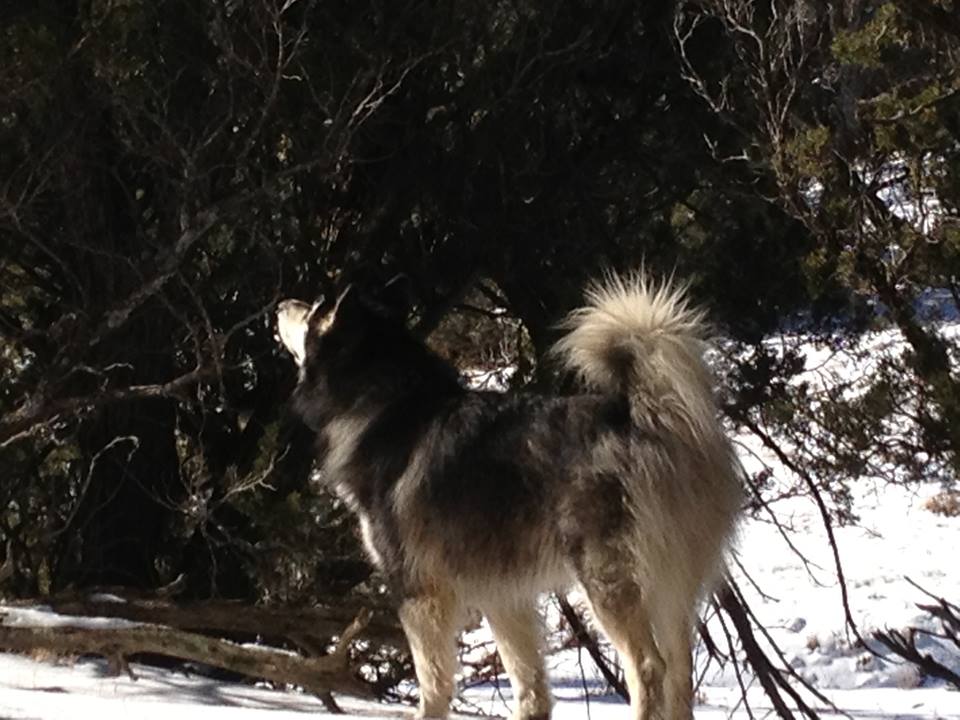
Layne Spence's pet malamute, Little Dave.

Layne Spence’s pet malamute, Little Dave.

Here’s the Great Falls Tribune article in its entirety:

Written by John S. Adams

Tribune Capital Bureau

http://www.greatfallstribune.com/apps/pbcs.dll/article?AID=/201311200500/NEWS01/311200023

HELENA –  Layne Spence went out into the woods west of Missoula on a Sunday afternoon to do what he loves to do best: recreate in Montana’s outdoors with his three beloved malamutes.

Spence, an avid outdoorsman, drove to the Lolo National Forest’s Lee Creek campground, an area the agency touts on its website for its “winter recreation opportunities such as cross-country skiing and snowmobiling.”

The area also is popular with hunters and trappers.

Spence parked his truck, turned on his dogs’ lighted collars, clipped into his cross-country skis and set off down the snow-covered forest road.

Within minutes of starting out on his trek with his dogs Rex, Frank and Little Dave, Spence said he heard a gunshot from up ahead. Spence said he looked up from road just as Little Dave’s hind leg was struck by a bullet. Spence said a man, dressed mostly in camouflage, was standing on the road approximately 30 yards ahead of him and was aiming a semiautomatic assault rifle in his direction.

Merriam-Webster defines an assault rifle as “any of various automatic or semiautomatic rifles with large capacity magazines designed for military use.”

“I started screaming at the top of my lungs, ‘No! No! Stop! Stop! You’re shooting my dog!,” Spence recalled, his voice still hoarse from yelling three days after the alleged incident.

Spence, a licensed emergency medical responder, said even though his dog was gravely wounded, he thought he had a chance to save him after the first shot. Even with a missing leg, Little Dave could live a full and happy life, Spence said later.

“I started running toward Little Dave, screaming the whole time and then I heard this ‘tat, tat, tat’ five or six more times,” Spence said. “Then Little Dave’s head just tilted over and he was dead.”

As Spence huddled over the body of his dead pet, the unidentified shooter approached him and told Spence he thought the dog was a wolf. According to Spence, the man asked if there was anything he could do. Spence he was distraught and screamed at the man to leave him alone.

“I was sitting there screaming, I was covered in blood, and I was trying to find my dog’s leg,” Spence recalled.

Spence said any responsible wolf hunter should have known his domestic dogs aren’t wolves. Spence said Little Dave bears a resemblance to the Ewok characters from the “Star Wars” films.

Local law enforcement authorities, state wildlife officials and U.S. Forest Service officials announced Tuesday that they spoke to the hunter involved in the incident.

According to a joint statement issued by the Missoula County Sheriff’s Office, the hunter broke no criminal or wildlife laws in the incident. Authorities said they are withholding the man’s name for his own safety.

“Based on the statements provided by both parties, it was determined that there was no malicious or purposeful intent to cause harm or injury to a domesticated animal on behalf of the hunter,” the statement read. “The Missoula County Attorney’s Office concurs with the Missoula County Sheriff’s Office that the facts of the incident do not fit the elements of any criminal statutes contained in Montana law …”

The Montana Department of Fish, Wildlife and Parks said the circumstances do not “constitute any egregious violation of Montana hunting regulations.”

“The incident was not enforceable by their agency because it involved a domesticated animal, rather than a game animal,” the statement read.

Debate ignites

Although authorities say no laws were broken, widespread news of the incident has outraged many outdoor enthusiasts and sparked debate over who is responsible for the safety of the nonhunting public and their pets on public lands during open hunting seasons.

Wolf hunting and trapping is legal in Montana, and so far 85 wolves have been killed during Montana’s 2013-2014 hunting and trapping season.

Hunters can hunt wolves with guns from Sept. 15 to March 15, and trapping runs from Dec. 15 to Feb. 28. Wolf hunters are only required to wear “hunter orange” during the five-week general rifle season. After Dec. 1, they can hunt until mid-March without wearing orange.

Matthew Koehler, executive director of the Missoula-based WildWest Institute, said as an environmentalist and a big-game hunter, he is deeply troubled by the reported actions of the hunter who allegedly shot Spence’s dog.

Koehler said state wildlife and law enforcement officials appear to be applying a different set of rules for wolf hunters than other big-game hunters.

“The first rule for any ethical hunter is to know your target,” Koehler said. “If FWP or law enforcement found out a hunter mistakenly shot a bull elk when the regulations only allowed the taking of antlerless elk, they would fine the hunter and perhaps even take away his license. It blows me away that in this case, authorities are apparently saying it’s OK for wolf hunters to shoot people’s pets on public lands and there are no consequences for those actions.”

Jerry Black is an anti-wolf hunting advocate who said Montana’s liberal wolf hunting laws put unreasonable onus on unarmed citizens to protect themselves and their pets from injury or death while recreating on public lands.

“What’s screwed up is this tragic incident shows that we as citizens out walking with our dogs, or out there hiking, fishing or skiing on public lands, it’s now our responsibility to not get shot,” Black said. “For six months out of the year, we’re under siege by wolf hunters who say it’s our responsibility to wear blaze orange.”

Changes coming?

Spence said he believes the man who shot Little Dave should lose his hunting privileges and have his guns taken away.

Spence said  the hunter violated hunting regulations, including shooting from a public roadway.

According to the 2013-2014 Montana wolf-hunting regulations, “it is illegal for anyone to hunt or attempt to hunt any wolf from, on or across any public highway or the shoulder, berm, barrow pit or right-of-way of any public highway …”

“I don’t want anything bad to happen to the guy. I just want an apology,” Spence said. “He has to be held accountable. I’m lucky to be alive. He was shooting right at me.”

Spence said he believes there needs to be stiff penalties on the books for hunters who endanger nonhunters or their pets through irresponsible actions. He said he hopes if anything good comes from the death of Little Dave, it will prevent future incidents like this from occurring.

“It could have happened to anyone. I could have had a child out there with me,” Spence said. “People need to be aware. I don’t want this to happen to anybody else.”

One state lawmaker is already talking about taking action in the 2015 Legislature.

Rep. Ellie Boldman Hill, D-Missoula, said on her Facebook page that she is considering proposing legislation making what happened on Sunday a crime. Hill is up for re-election in 2014.

Spence said he’s not opposed to hunting and has hunted in the past. However, Spence said he believes the use of a semiautomatic rifles should not be allowed for hunting.

Semiautomatic rifles are legal in Montana and no special permit is required to own them or hunt with them.

“Everybody has their Second Amendment right to bear arms, but irresponsibility and those kinds of weapons that allow you to fire off a bunch of rounds with a few quick squeezes of the trigger should be banned,” Spence said. “Assault weapons are not hunting rifles.”

Missoula Sherriff: No Harm, No Foul

Bureaucrats Pass the Buck

Here’s the latest news report from the great state of Montana:

MISSOULA — The Missoula County sheriff’s office has ended its investigation into the fatal shooting of a malamute on Lolo Pass by a hunter who apparently mistook it for a wolf.

Sheriff’s spokeswoman Paige Pavalone said Monday the agency passed the case over to the Department of Fish, Wildlife and Parks and the U.S. Forest Service, the Missoulian reported.

“There is no criminal activity here, and this is out of our jurisdiction,” Pavalone said. “We don’t have any witnesses and we’re not investigating the situation any further.”

Spokespersons for both FWP and the Forest Service had said Monday morning that they believed the case would be a criminal matter.

Photo by Oliver Starr

Photo by Oliver Starr

OSP Bags Hunter on Multiple Charges

Deer head discovered in felon’s pickup

Posted: Tuesday, November 12, 2013 9:49 am | Updated: 10:14 am, Tue Nov 12, 2013.

By Chelsea Gorrow
The Daily Astorian | 0 comments

A convicted felon who decided to take two 12-year-olds out shooting on McGregor Road was arrested Monday for 11 charges, after police discovered a fresh deer head in the back of his truck.

Oregon State Police made contact in South Clatsop County withelk-000-home17300 Alex Arias, 51, just after 9:30 a.m., after Arias shot an elk decoy several times near milepost 17.

Arias, from Cornelius, fired the weapon from inside of his vehicle, while a 19-year-old female, Dominique Arias, fired at it from the roadside. Two 12-year-olds were in the backseat of the vehicle.

Neither Alex or Dominique Arias had an elk hunting tag and troopers discovered the head of a four-point buck blacktail deer in the back of the truck, as well as fresh meat.

Most of the meat, however, had been left with the animal carcass, which troopers believe was shot by Dominique Arias and dressed out by Alex Arias.

Troopers discovered marijuana and an open container of alcohol in the truck. Alex Arias had allegedly been smoking the drug inside the vehicle with the kids inside.

Arias was arrested for wildlife offenses, including no big game tag, take or possession of a spike elk, aiding in a wildlife offense, waste of a game mammal, hunting from a motor vehicle, driving while suspended, an ex-convict in possession of a weapon, possession of marijuana, open container of alcohol and two counts of reckless endangering. He was booked into the Clatsop County Jail.

Dominique Arias was arrested for no big game tag, take or possession of a spike elk, take or possession of a buck deer and hunting in a prohibited area, a public road.


N. Minn. hunting guide hit with mountain of charges involving bear, deer kills

 by:  Paul Walsh                                                                                                                                                                                                                                                                                                                                                                                                                                                                                                                             PAUL                 Star Tribune

November 5, 2013

A north­ern Min­ne­so­ta bear hunt­ing guide has been charged with using vari­ous il­legal tac­tics in­volv­ing the kill­ing of bear and deer, ac­cord­ing to auth­ori­ties.

A north­ern Min­ne­so­ta bear hunt­ing guide has been charged with using vari­ous il­legal tac­tics in­volv­ing the kill­ing of bear and deer, ac­cord­ing to auth­ori­ties.

Keith R. Slick, 32, of Baudette, was charged Fri­day in Lake of the Woods District Court with a long list of offenses, a­mong them: two counts of pos­sess­ing an over lim­it of bear, three counts of un­law­ful pos­ses­sion of deer, two charges of un­law­ful­ly trans­port­ing a bear, fail­ure to reg­is­ter a se­cond bear, fail­ure to tag a se­cond bear, il­legal pos­ses­sion of a car-killed deer, untagged big game ani­mal (bear), no bear out­fit­ter/guides li­cense, un­law­ful trans­fer/lend or bor­row of li­cense, fail­ure to reg­is­ter bear bait sta­tions, hunt­ing with­in 100 yards of an un­regis­tered bear bait sta­tion, and plac­ing bait for bear with­out a li­cense.

There were oth­er vio­la­tions, ac­cord­ing to the state Department of Nat­u­ral Resources (DNR), but the stat­ute of limi­ta­tions had ex­pired on them.

Slick was not im­medi­ate­ly avail­able to re­spond to the charges.

Ac­cord­ing to the DNR:

Dur­ing the fall bear hunt­ing sea­son, state con­ser­va­tion of­fi­cer Robert Gorecki lo­cat­ed an ac­tive bear bait sta­tion be­long­ing to Slick. A search of his home un­cov­ered nu­mer­ous bear capes and skulls, as well as sets of deer ant­lers.

“There were no pos­ses­sion or reg­is­tra­tion tags found with any of the bears,” Gorecki said in a state­ment re­leased by the DNR. “The bears did not have any cuts in their ears that would in­di­cate that a site tag was at­tached at any time in the past,” Gorecki said.

A check of DNR re­cords in­di­cat­ed that Slick nev­er reg­is­tered an a­dult male deer or bear tak­en in the past 10 years, which is as far back as a­gen­cy re­cords go.

A cellphone seized in the in­ves­ti­ga­tion con­tained pic­tures of Slick with a dead bear. Nu­mer­ous text mes­sages were also found with Slick tell­ing peo­ple a­bout the bear he had shot. Oth­er text mes­sages from Slick stat­ed that he had shot seven bears in his life.

Only two of the six ant­ler sets re­cov­ered had site tags on them, but from in­di­vidu­als oth­er than Slick.

“Mr. Slick had multi­ple un­ex­plain­able deer racks,” Gorecki add­ed. “A third set of ant­lers were from an un­regis­tered road-killed deer, and he was un­sure where the re­main­ing sets of ant­lers came from.”

Slick faces near­ly $4,500 in fines and res­ti­tu­tion. A fire­arm and bow were also seized dur­ing the in­ves­ti­ga­tion. If con­victed, his hunt­ing privi­leges could be re­voked for three years.