Why Dogs Need More Control Over Their Lives

Jessica Pierce Ph.D.

All Dogs Go to Heaven

Agency, choice, and control are essential for psychological integrity.

Posted May 18, 2022 |  Reviewed by Gary Drevitch

KEY POINTS

  • The single most significant problem facing homed dogs is lack of adequate agency.
  • Having a sense of control over one’s environment is fundamental to psychological integrity.
  • There are countless creative ways to enhance a dog’s agency.

Jessica Pierce

Poppy thinking about which way to go

Source: Jessica Pierce

If I could identify the single most significant problem facing homed dogs right now it would be lack of adequate agency. Dogs have very little control over their sensory environment, their social interactions, and the basic elements of daily survival, all of which are orchestrated by human guardians. This lack of control—a near-total loss of agency—has significant fallout for their physical and especially their psychological well-being. Fortunately, there are countless easy ways to enhance our dogs’ agency—the only limit is our imagination.

Loss of agency

Agency is the ability to make choices for oneself, to exert control over one’s environment and, more important, to have the perception of being in control. Pet dogs experience a loss of agency in relation to the overall arc of their lives. They rarely get to choose their home, nor can they choose to leave if they are unhappy; they cannot choose their family or friends; nor do they have much choice about how to provision food, when are where to go to the bathroom, or when to mate, bear, and raise young. Loss of agency also occurs in various small but significant ways throughout the day—for example, the imposition of a collar and leash on free movement, unwanted and invasive touching by unfamiliar humans, and the suppression through training regimens of natural canine behaviors such as barking or seeking affection.

A sense of control is essential to well-being

Having a sense of control over one’s environment is fundamental to psychological integrity. This is as true for humans as it is for other animals, including dogs. As veterinarian Frank McMillan argues in “The Mental Health and Well-being Benefits of Personal Control in Animals,” a vast body of research on human and nonhuman animals has established that having a sense of control over one’s life circumstances, and especially over events or stimuli that are unpleasant, is a strong predictor of positive feelings and mental well-being. Particularly when faced with an aversive stimulus, the perception of being in control—of being able to move away from or reduce the intensity or duration of an aversive event—makes the experience more tolerable; feeling out of control increases the stress response to negative stimuli.

Exerting control over one’s environment also seems to be rewarding in and of itself. McMillan cites a series of experiments with captive rodents which found that the animals “exercise control virtually any chance they get” and appear to find it intrinsically rewarding to exert a high degree of control over their environment.[i]

article continues after advertisement

The process of making choices and exerting control promotes psychological well-being. But it may also be that actual choices animals make are important to them. They might make different choices for themselves than we make for them, choices more aligned with their preferences and needs than with our own. Aren’t there also some situations in which dogs might be able to make better choices than people? This certainly happens all the time on a small scale: You see a person walking a dog on a leash and the dog is sending clear signals that she would like to avoid a close interaction with a passing dog. The guardian ignores the dog’s choice, the dogs are pulled together by force, and they find themselves in an extremely uncomfortable situation that may lead to fear, anxiety, even injury.

Empowering Dogs

Empowering dogs is good for them in direct ways: Not only might they make different and better choices for themselves than we might make for them, the process of making and implementing choices improves their well-being by giving them control over their lives. Lack of control can be unpleasant, even psychologically harmful. A dog with greater agency is a happier dog. Moreover, through the process of choice-making, dogs have opportunities to learn and develop.

Empowering dogs is also good in indirect ways, because it helps shift the moral paradigm for humans. The act of respecting dogs’ interests in making choices is a way of acknowledging and respecting their intrinsic value. It also goes some small way toward redressing power asymmetries in human-animal relations.

Luckily, even within the structural constraints of current dog-keeping practices, we have many opportunities to enhance dog agency. The first step is to become more mindful of the ways in which choice and control are lost or constrained. The second step, of course, is to create or embrace opportunities for choice whenever they arise.

Making Space for Agency

Agency, control, choice—whatever term we decide to use—is very much on the mind of thoughtful dog guardians. When I talk to people who live with dogs and try their best to give their dog a good and happy life, I am constantly inspired by the myriad ways in which they try to make space for the dog to express opinions and preferences, collaborate in decision-making, and feel in control.

Here are a few specific ways we can make space for agency. All require that we listen actively to our dog and pay attention to body language, facial expression, and vocal communications.

  1. When out for a walk, let your dog choose the direction, pace, and length of the excursion. If your dog wants to stop and sniff here and there, let her.
  2. Protect your dog from unwanted social interactions with other dogs or humans. Dogs should be able to control when, how closely, and with whom they interact—especially in cases where interaction makes them afraid or uncomfortable. Being “friendly” is not a requirement for being a “good” dog.
  3. Make sure your dog gives consent for any petting or other physical touching, whether by you or by unfamiliar people. Unwanted touching may be experienced as a loss of control.
  4. Give your dog the choice to walk away from a training session. Training should be by invitation only and dogs should have the right to politely decline.
  5. Accept “no” as an answer from your dog (unless her safety is at risk).
  6. Be open to inquiries from your dog. Can I please have a taste of your lunch? Can I go outside? Can we play tug?
  7. When within the confines of your home, let your dog have access to as much space as possible. (Being locked in a crate dramatically reduces a dog’s sense of control over her environment.)

References

[i] Frank McMillan, “The Mental Health and Well-being Benefits of Personal Control in Animals,” in Mental Health and Well-being in Animals (2nd ed), edited by Frank D. McMillan. Wallingford, Oxfordshire: CABI, 2019, p. 67.

It’s Endangered Species Day!

Exposing the Big Game's avatarThe Extinction Chronicles

Friend,

View this email in your browser

https://mailchi.mp/c264c8d5bfe4/its-endangered-species-day?e=34cb4196ed

It’s Endangered Species Day. Designatedon the third Friday in May, it’s a day to celebrate the wins, mourn the losses, and most importantlycommit to preserving the plants and wildlife for present and future generations and for the health of the planet.

Established in 1964, according to theInternational Union for Conservation of Nature’s Red List of Threatened Species(INCN),more than 40,000 species are threatened with extinction.

“That is 28% of all assessed species.”

Scientists tell us we are in a 6th mass extinction and this time because of us.

In Montana, rare, threatened, and protected species continue to fall victim to traps and snares, intentionally and incidentally.

Yet, species do not get listed underthe Endangered Species Actor measures are insufficient in saving species at risk who are listed.

As featured above, these are a few of species occurring in Montana who…

View original post 892 more words

Mysterious Hominin Left its Mark With 3.66-Million-Year-Old Footprint

Exposing the Big Game's avatarThe Extinction Chronicles

Volcanic ash buried evidence shortly after several individuals walked through a part of eastern Africa.

By Joshua Rapp LearnMay 18, 2022 2:30 PM

https://www.discovermagazine.com/the-sciences/mysterious-hominin-left-its-mark-with-3-66-million-year-old-footprint?fbclid=IwAR1EubYnyWSNCIKJAJ7zQdebjISYZEs-tYm0xd7HPIzfVXWojLXxV-StDGc

Hominin footprint

(Credit: sabine_lj/Shutterstock)

Newsletter

Sign up for our email newsletter for the latest science newsSIGN UP

An unknown species of hominin that lived 3.66 million years ago left its only trace of a few dozen footprints in the mud that volcanic ash quickly buried. While these tracks have been known for nearly 50 years, new research reveals that the sets of footprints may belong to two distinct hominins that walked eastern Africa at the same time.

“That is the first, oldest unequivocal evidence for that — two hominins existing at the same place at the same time,” says Ellison McNutt, a biological anthropologist the Ohio University Heritage College of Osteopathic Medicine.

Original Findings

Researchers first discovered the tracks in the 1970s at the Laetoli site in…

View original post 903 more words

Temperature records broken across the US as UN warns of continued climate disruption

Exposing the Big Game's avatarThe Extinction Chronicles

Dinah Voyles Pulver, USA TODAY-5h agoFollow

View Profile

React125 Comments|93

Support journalism

Aheat wave gripping parts of the nation added an exclamation point to a series of announcements this week about the world’s warming climate.

A city water park in Grand Island, Nebraska, doesn’t open for another two weeks, but residents could have used it Thursday when the temperature reached 96, 21 degrees above normal for that date.

Why All Seniors Should Wear This Incredible Health Watch? (You Should Read

Ad

AdTopgadgetWorld

In Shreveport, Louisiana, on Thursday, the high of 94 tied a 148-year-old record. That was one of more than 110temperature records broken or tiedacross 21states this week. In Texas,Galveston sweltered, setting or tying records three out of four days.

Start the day smarter. Get all the news you need in your inbox each morning.

And it’s not just the U.S.

View original post 692 more words

Neil deGrasse Tyson explains why the zombie apocalypse is ‘more real than you think’

Exposing the Big Game's avatarThe Extinction Chronicles

Marty Rosenbaum-Yesterday 1:01 PMFollow

View Profile

React17 Comments|49

Here’s some great news to make you chipper for the weekend. The zombie apocalypse isn’t such a crazy idea!

©Provided by AudacyNeil deGrasse Tyson

LISTEN NOW:Neil deGrasse Tyson joins Audacy’s Klein & Ally

AstrophysicistNeil deGrasse Tysonjoined Audacy’sKlein & Allyon KROQ for a wide ranging conversation that began with a tweet that caused a bit of a stir. It began on Twitter when deGrasse Tyson said that lunar eclipses aren’t rare. When asked if he’d liked to walk back his comments or double down, he chose the latter.

“The thing lasts three hours,” he said. “You can start the eclipse, go in, have a midnight snack, come back out and it’s still going on. Anyone who is angry has never seen a solar eclipse. Those are spectacular! It’s by contrast, that’s all.”

“What I’ve…

View original post 437 more words

Too Much Time On Your Phone Might Be Making Your Dog Depressed

He might be sad about all your screen time.

By Ellen Schmidt

https://www.thedodo.com/dodowell/is-your-phone-making-your-dog-depressed

Published on 5/18/2022 at 4:30 PM

dog depressed when humans are on the phone

It’s fair to say that our relationships in life require mental presence and a willingness to connect in order to thrive. Well, the same goes for your relationship with your dog.

In a busy world of daily distractions (social media being a prime example), what happens when we spend too much time on our phones — do our pets notice? Is your phone making your dog depressed?

Dr. Iain Booth, a veterinary surgeon in the United Kingdom, made this assertion more than four years ago. We’ve decided to revisit the topic because during the pandemic, many people became pet parents while simultaneously spending more time on their phones.

We spoke with Colleen Safford, a dog trainer, behavior expert and owner of Far Fetched Acres, for more insight on our relationship with our pets and what dogs might be thinking when we’re on our phones.

Is your phone making your dog depressed?

While no two relationships are the same, each benefits from communication and attention. When it comes to the friendship between humans and dogs, we should try and understand their wants and needs so every pet can live their best life. While we rely on our dogs for love and companionship, they rely on us for, well, everything.

“While I hesitate to ever say that humans can fully understand exactly what is going on in the brain of man’s best friend, dogs by their very nature are deeply dependent on humans,” Safford told The Dodo. “We control every resource in their life, including food, exercise, affection, guidance and support. By their very nature, dogs are codependents in the world of domestic living! Simply put, we are their everything.”

While the larger issue of our dependence on phones is worth countless studies, a few things are clear: Too much screen time can lead to depression and anxiety in humans, among other issues. And it can isolate us from anyone in our presence — including our dogs.

“In relationship to dog depression, if an owner has thumbs too busy to provide petting, eyes too distracted to see that their dog is trying to play fetch, and a brain too busy to provide all those verbal ‘good boys,’ it is easy to understand why phone use can impact a dog’s overall health,” Safford said. “By not supplying our dogs with exercise, verbal attention or physical contact, we are ignoring their needs and increasing the chances of behavior issues and anxiety.”

As Booth said in his interview (in reference to ignoring your dog in favor of your phone), “You do that consistently for weeks, months and years on end, and you’re going to get some real behavioral issues.” So some dogs may even start misbehaving to get your attention.

While wholly dependent on the individual dog, this is something that every dog parent should be aware of, especially considering current events — as mentioned above, during the pandemic, dog adoptions went up as did smartphone usage.

Putting the phone down is step one

“Humans and dogs both release oxytocin from petting and affection, and release endorphins during exercises,” Safford said. “No petting or affection — no love hormone. No movement — no feel-good hormones. It’s as simple as that.”

Physical activity is necessary to maintain a bond with your dog. “Grab a ball and leash, and nurture and deepen that bond. Give your dog all those words of affirmation,” Safford said.

He definitely deserves it.

If Sea Ice Melts in the Arctic, Do Trees Burn in California?

Play Toggle MuteVolumeSeek

Current time00:00 /  Duration00:00

https://www.scientificamerican.com/podcast/episode/if-sea-ice-melts-in-the-arctic-do-trees-burn-in-california/

If Sea Ice Melts in the Arctic, Do Trees Burn in California?
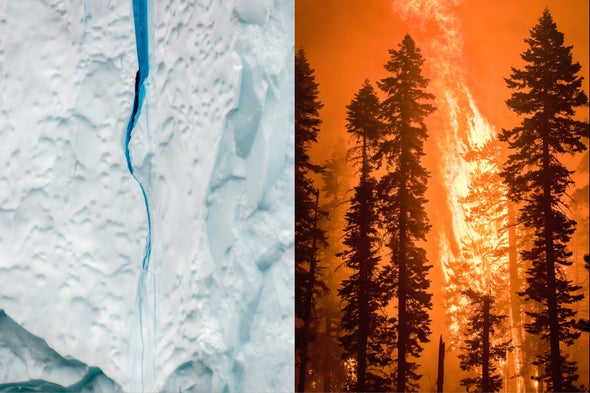
Crevice in melting icebergs in Jakobshavn Glacier in Ilulissat, Greenland (left). The Caldor Fire in California in 2021 (right). Credit: Paul Souders via Getty Images (left); Ty O’Neil/SOPA Images/LightRocket via Getty Images (right)

A new study links sea ice decline with increasing wildfire weather in the Western U.S.

Full Transcript

Emily Schwing: This is Scientific American’s 60 Second Science. I’m Emily Schwing.

Oil and water. Apples and oranges. Fire and Ice…none of these things really seem like they have much to do with one another…or do they? 

Hailong Wang: We found that more fire-favorable weather associated with declines in the Arctic sea ice during summer can increase autumn wildfires over the western United States.

Schwing: Hailong Wang is an Earth scientist at the Pacific Northwest National Laboratory in Washington state.  

Wang: So we analyzed a few decades of observations of how wildfire incidents, sea ice cover and weather conditions to identify a relationship between Arctic sea ice decline and the wildfire risks. We called it a teleconnection.

Schwing: Wang says this idea of a fire and ice “tele-connection?” … It’s not new. It’s a lot like the so-called “butterfly effect” – a term coined by meteorologist Edward Lorenz in the 1960’s to explain chaos theory. The idea can be summarized like this: if a butterfly flaps its wings in one location, that could displace enough air to cause a tornado or some other large scale atmospheric storm elsewhere. 

Wang: Certainly didn’t invent this concept, but it has been in the atmospheric sciences for a long time. So, because of the connections within the Earth system, especially in the atmosphere, one small change in one region could affect other regions through the atmospheric circulations.

Schwing: Connections between declining sea ice and wildfire weather have been made before. Wang says previous findings have relied heavily on statistical relationships. 

Wang: For example, they find that they found that maybe Arctic sea ice are declining in many years, and they also found the increase in extreme weather like wildfires in the western U.S. They can only identify the relationship, but there’s no mechanism to explain which which one is the cause? Which one is the effect?

Schwing: [possible VO: 

Those relationships found a link between a decrease in sea ice and an increase in wildfires in the WEstern US, but they could not explain the cause and effect. ]

So Wang and colleagues took those known statistical relationships a step further. The team applied them to a state of the art climate model with wildfire prediction capabilities. 

Wang: In that way, we were able to identify the response of the climate system, including the fire weather over the western U.S. and other responses to the Arctic sea ice.

Schwing: What they found is “a tale of two vortices.”

Wang: So when the summer sea ice is much reduced, ocean can absorb and store more heat from sunlight. Less sea ice cover over the Arctic will allow more heat to be also to be released from the ocean to the atmosphere in the following autumn and early winter. Otherwise, the sea ice can insulate the heat from the ocean to the air.

Schwing: So, more heat is released to the atmosphere as the sea ice declines.  

Wang: The anomalous heat in the Arctic can form rising air from the surface, and that can strengthen the low pressure system, which is one of the the spinning vortex. It’s  counter-clockwise.

Schwing: This forms a low pressure system and Wang says when it moves south, it pushes the polar jet stream off its normal course and forms a second vortex. 

Wang: So this shift also facilitate[s] the formation of a high pressure system over the western U.S. This high-pressure system is a clockwise spinning vortex. This drives dry and hot hot air to descend to the ground—from the upper air to the ground. Normally it comes with clear skies and no precipitation. So those are all favorable weather conditions for wildfire hazards.

Schwing: The findings are published in Nature Communications. And Wang says wildfire might not be the only result of declining sea ice. [Yufei Zou et al., Increasing large wildfires over the western United States linked to diminishing sea ice in the Arctic]

Wang: The arctic changes could also be connected to extreme cold weather.

Schwing: Like the infamous 2021 Texas ice and snow storm that knocked out power to millions and caused billions of dollars in damage. Wang says looking for more “teleconnections’ is where his research will go next. 

Wang: Moving forward, we would like to explore more connections of Arctic changes to weather, extreme weather, climate change over other regions of the entire globe.

Schwing: If wildfires and sea ice could be this climatically entwined, surely there are other climate surprises just waiting to be unraveled.

For 60 Second Science, I’m Emily Schwing.

[The above text is a transcript of this podcast.]

Elon Musk Names Humanity’s Biggest Threat

TheStreet Staff – Yesterday 5:40 PMFollow

View Profile

React2 Comments|190

Elon Musk navigates between running his businesses and trying to save the planet.

© TheStreetElon Musk Names Humanity’s Biggest Threat

At least, he tries to draw attention to global issues which he considers urgent to tackle.

For some time, the richest man in the world, with a net worth on paper estimated at $210 billion on May 18 by Bloomberg Billionaires Index, has been sounding the alarm about the decline of the population.

He started by worrying about the largest historical drop in inhabitants in Japan in 2021.

Then, instead of marveling at the beauty and history of Venice, Musk preferred to shine the spotlight on the fact that the Eternal City’s population has continued to decline for years.

For the mogul, this does not bode well for the future of Venice.

https://twitter.com/elonmusk/status/1523619407578427394

‘The Wealthier You Are The Fewer Kids You Have’

A few days after these first warning signals, Musk has just made an even more worrying announcement. The serial entrepreneur believes that it is urgent to deal with the decline in the birth rate which particularly affects rich countries and the West.

Cloud Computing Games – Results Updated Today

Ad

Adhttp://www.speedysearchresults.com/Cloud Computing Games

The Tesla CEO made that much clear in recent comments during a virtual appearance at the recent All-In Conference held in Miami on May 16.

The billionaire was asked about what could be done in terms of energy production to make electricity cheaper for everyone around the world. Basically, can the electricity needs of the world’s population be met at an affordable price?

“Because of just generally low birth rates almost worldwide, civilization is not headed to have a population that is an order of magnitude better than where we were kind of,” Musk responded. “We’re currently headed towards a population decline. And this is almost everywhere in well in the world.”

Musk, who pushed the auto industry to convert to electrification in order to lessen its impact on the environment, rejects preconceived and often widely held ideas that having a child is expensive or that making the choice not to have children is because we want to save the environment.

Related video: Musk still wants to get the deal done but at a lower price, says analyst (CNBC)

If it’s 5% seven percent, 10% that was no secret that that that that

Loaded: 75.97%PauseLQCaptionsFullscreen

Musk still wants to get the deal done but at a lower price, says analystUnmute

“It basically seems as though as soon as you have like, urbanization and education beyond a certain level and income beyond a certain level, birth rates plummet. And so as countries get wealthier, their birth rates plummet,” the tech tycoon said.

“It’s somewhat counterintuitive, because people will say, like, well, ‘it’s too expensive to have a baby’. No. The wealthier they are, the fewer kids you have; the more educated you are the fewer kids you have,” said the father or seven — Y, X, Griffin, Xavier, Kai, Saxon and Damian.

The Annual Growth Rate of World Population Is Going Down

He therefore argues that there are enough resources for all.

“So I’m not sure who [is going] to use all that energy unless there’s a significant change in the birth rate,” Musk, 50, said. “Or we have a very robot oriented economy. So that’s also possible if we’ve got a lot of four wheeled robots in cars, humanoid robots, then you could suddenly see that there’d be perhaps a need for an order of magnitude more energy.”

“But it’s not coming from the humans unless something major changes on the human birth rate level. But this, by the way, is, I think, the biggest single threat to civilization right now,” Musk added.

A recent study projects that the world’s population will peak at 9.7 billion in 2064, before decreasing to 8.8 billion in 2100. But, if we followed the curve of the growth rate of world population, say demographers, would begin to decline around 2060.

The annual growth rate of world population was 2.1% in the 1970s. Today, this rate is only around 1%. And it should go down to 0 between 2060 and 2070, demographers say.

In her provocative book “8 Billion and Counting”, political demographer Jennifer D. Sciubba says the twenty-first century is “a story about differential growth—marked by a stark divide between the world’s richest and poorest countries.”

She anticipates Europe’s population will shrink from about 521 million to about 482 million by mid-century.

‘We Can’t Have Civilization Just Dwindling’

In Asia, in addition to Japan, China also has the same birth rate problem.

Last January, the National Bureau of Statistics of China announced that 10.6 million children were born in 2021, down from with 12 million in 2020, despite the end of the one-child policy. This was the fifth year of decline in a row.

“Some people are thinking like having fewer kids is like better for the environment. It’s just total nonsense,” Musk said. “We’re going to be fine even if we doubled the size of the humans. I know a lot about environmental stuff. We can’t have civilization just dwindling to nothing.”

“A lot of people just think that having kids is somehow bad for the environment. I want to be clear it’s not. It’s essential for maintaining civilization. We don’t necessarily need to grow dramatically, but at least let’s not gradually dwindle away until civilization ends with us all in adult diapers and in a whimper.”

The world’s richest man concluded by saying that he’s heard many times people saying: “How can I bring a child into this terrible world?”

And his response: “Have you read history? Because let me tell you it was way worse back then.”This article was originally published by TheStreet.

Join the conversation2