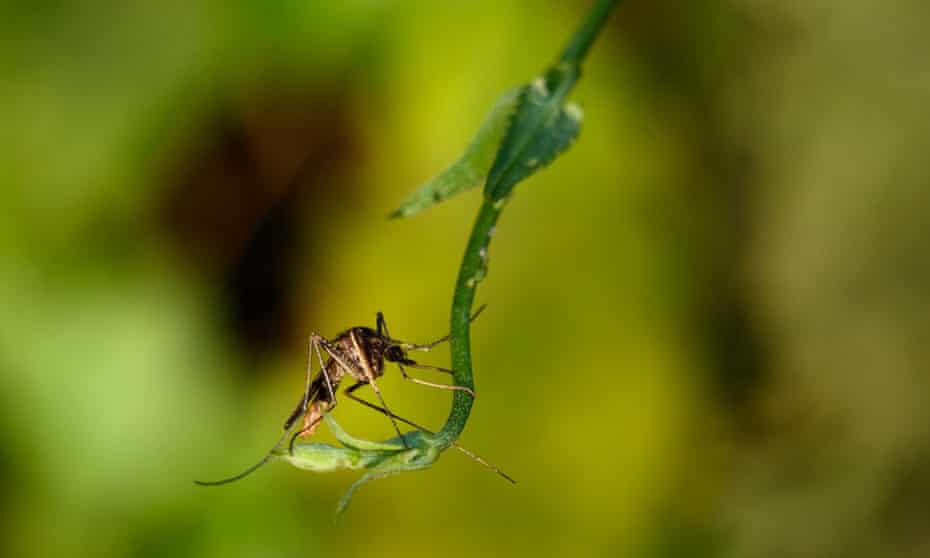
Changing the Earth’s climate artificially could have significant effects on the prevalence of disease carriers such as the Anopheles mosquito.Photograph: Soumyabrata Roy/NurPhoto/Rex/Shutterstock
Helena HortonEnvironment reporterWed 20 Apr 2022 05.00 EDT
Geoengineering to prevent the worst impacts of climate breakdown could expose up to a billion more people to malaria, scientists have found.
The report, published in Nature Communications, is the first assessment of how geoengineering the climate could affect the burden of infectious diseases.
Geoengineering includes removing carbon dioxide from the sky so the atmosphere will trap less heat, and solar radiation management (SRM) – reflecting more sunlight away from the planet so less heat is absorbed in the first place. The latter could be done in various ways, including spraying particles into the sky to reflect the sun…
The Sarmat intercontinental ballistic missile is launched during a test at Plesetsk cosmodrome in Arkhangelsk region, Russia, in this still image taken from a video released on April 20, 2022. Russian Defence Ministry/via REUTERS
Register now for FREE unlimited access to Reuters.com
Register
Summary
Sarmat launch comes at moment of extreme tension over Ukraine
Putin boasts it can evade missile defences
Test follows years of design and funding delays
LONDON, April 20 (Reuters) – Russia said on Wednesday it had conducted a first test launch of its Sarmat intercontinental ballistic missile, a new and long-awaited addition to its nuclear arsenal which President Vladimir Putin said would make Moscow’s enemies stop and think.
Putin was shown on television being told by the military that the missile had been launched from Plesetsk in the country’s northwest and hit targets in the Kamchatka peninsula in the…
Violent incidents towards dolphins are not uncommon in the Gulf of Mexico – at least 27 have washed up shot by guns or arrows or impaled since 2002. Photograph: Chris O’Meara/AP
Wildlife officials in Florida are investigating the mysterious death of a bottlenose dolphin that was recovered on a beach with an apparent stab wound to the head.
The mammal, which was found on Fort Myers beach in the south-west of the state on 24 March, is believed to have been killed deliberately, probably while it was being fed illegally by humans.
“Based on the shape, size and characteristics of the wound, it is suspected that the dolphin was impaled while in a begging position,” the National Oceanic and Atmospheric Administration (Noaa) said in a statement.
“Begging is not a natural behavior for dolphins and is frequently associated with illegal feeding.”
The dolphin was an adult lactating female, and was above water with its mouth open when it was attacked, NBC News reported. Its carcass was recovered by the Florida fish and wildlife commission, whose officers passed details on to Noaa.
“A necropsy, non-human autopsy, revealed the dolphin was impaled in the head with a spear-like object while alive,” the Noaa statement said.
“Further examination indicated the wound, above the right eye, was inflicted before the animal died. The animal appeared to have died from the trauma, which occurred at or near the time of death.”
The agency is seeking information about the incident and has an enforcement hotline where tips can be left anonymously.
Violent incidents toward dolphins in the Gulf of Mexico are not uncommon. The latest incident brings to at least 27 the number washed up to shore after being shot by guns or arrows, or impaled with sharp objects since 2002.
Harassing, harming, killing or feeding wild dolphins is prohibited under the Marine Mammal Protection Act, with fines of up to $100,000 and up to a year in jail for each violation.
Experts say illegal feeding of marine mammals is harmful to more than just the individual being fed.
“Those dolphins have learned to associate humans with food. Once they learn that, they also teach it to other dolphins and they teach it to their babies,” Laura Engelby, Noaa marine mammal branch chief, told WBBH News.
According to the Noaa statement, “Dolphins fed by people learn to associate people, boats, and fishing gear with food, which puts dolphins and people in harmful situations.”
Smoke from a wind-whipped wildfire rises above neighborhoods on the outskirts of Flagstaff, Arizona, on Tuesday.Photograph: Sean Golightly/AP
AssociatedPressWed 20 Apr 2022 08.47 EDT
Heavy winds kicked up a towering wall of flames outside a northernArizonatourist town late on Tuesday, ripping through two dozen structures and sending residents of more than 700 homes scrambling to flee.
Flames as high as 100ft raced through an area of scattered homes, dry grass and Ponderosa pine trees on the outskirts of Flagstaff as wind gusts of up to 50mph pushed the blaze over a major highway.
Coconino county officials said during an evening news conference that 766 homes and 1,000 animals had been evacuated. About 250 structures remained threatened in the area popular with hikers and off-road…
Nobody is denying that James Michael Rick went hunting.
The question of who or what he was hunting, however, is at the heart of a criminal trial that started on Tuesday afternoon.
Rick, who is from North Myrtle Beach, South Carolina, is charged with first-degree murder in the death of Delia “Joyce” Aldridge Rick, who he is alleged to have shot with a crossbow before dumping her car, with her body in it, in Lake Wylie.
In Rick’s trial on Tuesday, Assistant District Attorney Deborah Gulledge argued that on the evening of May 4, 2019, Rick thought that his girlfriend, Melinda Kay Robinson of Belmont, had stolen money that he planned to spend on drugs.
“And he got mad. He got really, really angry,” sending texts to someone else saying that he was looking for Robinson, Gulledge said.
Troy Ellis, 11, was killed May 1, 2020, when he was fatally shot by a former U.S. Marine during a turkey hunt for disabled veterans. (The Troy Ellis Foundation)
The father of an11-year-old boy killed during a turkey huntorganized for a disabled veteran nearly two years ago on Tuesday gave an emotional account of the final moments of his young son’s life.
Troy Ellis, then a fifth grader in Trussville, was killed May 1, 2020, on his father’s hunting land in eastern Jefferson County.
Warming temperatures are driving a hidden world of changes beneath the surface.By Mark Lara
/ April 17, 2022
Reading time: 7 minutes.
Across the Arctic, strange things are happening to the landscape.
Massive lakes, several square miles in size, have disappeared in the span of a few days. Hillsides slump. Ice-rich ground collapses, leaving the landscape wavy where it once was flat, and in some locations creating vast fields of large, sunken polygons.
It’s evidence that permafrost, the long-frozen soil below the surface, is thawing. That’s bad news for the communities built above it – and for the global climate.
As an ecologist, I study these dynamic landscape interactions and have been documenting the various ways permafrost-driven landscape change has accelerated over time. The hidden changes underway there hold warning for the future.
Gullies created by thawing soil drain a lake in the Arctic Coastal Plain of northern Alaska. Christian Andresen/Mark J. Lara/Creative Commons
What Is Permafrost?
Permafrost is perennially frozen soil that covers about a quarter of the land in the Northern Hemisphere, particularly in Canada, Russia and Alaska. Much of it is rich with the organic matter of long-dead plants and animals frozen in time.
These frozen soils maintain the structural integrity of many northern landscapes, providing stability to vegetated and unvegetated surfaces, similar to load-bearing support beams in buildings.
As temperatures rise and patterns of precipitation change, permafrost and other forms of ground ice become vulnerable to thaw and collapse. As these frozen soils warm, the ground destabilizes, unraveling the interwoven fabric that has delicately shaped these dynamic ecosystems over millennia. Wildfires, which have been increasing across the Arctic, have been increasing the risk.
Under the surface, something else is active – and it is amplifying global warming. When the ground thaws, microbes begin feasting on organic matter in soils that have been frozen for millennia.
These microbes release carbon dioxide and methane, potent greenhouse gases. As those gases escape into the atmosphere, they further warm the climate, creating a feedback loop: Warmer temperatures thaw more soil, releasing more organic material for microbes to feast on and produce more greenhouse gases.
The Evidence: Disappearing Lakes
Evidence of human-caused climate change is mounting across the permafrost extent.
The disappearance of large lakes, multiple square miles in size, is one of the most striking examples of recent patterns of northern landscape transitions.
The lakes are draining laterally as wider and deeper drainage channels develop, or vertically through taliks, where unfrozen soil under the lake gradually deepens until the permafrost is penetrated and the water drains away.
There is now overwhelming evidence indicating that surface water across permafrost regions is declining. Satellite observations and analysis indicate lake drainage may be linked with permafrost degradation. Colleagues and I have found it increases with warmer and longer summer seasons.
This insight came after some of the highest rates of catastrophic lake drainage – drainage that occurs over a few days due to permafrost degradation – on record were observed over the past five years in northwestern Alaska.
The disappearance of lakes across the permafrost extent is likely to affect the livelihoods of Indigenous communities as water quality and water availability important for waterfowl, fish and other wildlife shift.
Massive ice wedges dating to the late Pleistocene are visible in this thermokarst thaw in Noatak National Preserve. David Swanson/National Park Service
Slumping Hills And Polygon Fields
The thaw and collapse of buried glacial ice is also causing hillsides to slump at increasing rates across the Russian and North American Arctic, sending soil, plants and debris sliding downslope.
One new study in northern Siberia found that the disturbed land surfaces increased over 300% over the past two decades. Similar studies in northern and northwestern Canada found slumping there also accelerated with warmer and wetter summers.
In flat terrain, ice wedges are able to develop, creating unusual geometric patterns and changes across the land.
Over decades to centuries, melting snow seeps into cracks in the soil, building up wedges of ice. These wedges cause troughs in the ground above them, creating the edges of polygons. Polygonal features naturally form as a result of the freezing and thawing process in a way similar to that seen at the bottom of drying mud flats. As ice wedges melt, the ground above collapses.
Even in extremely cold high Arctic environments, the impacts of only a few uncommonly warm summers can dramatically change the surface of the landscape, transitioning previously flat terrain into undulating as the surface begins to sink into depressions with the melting of ice in the soil below. Overall rates of ice wedge thawing have increased in response to climate warming.
Across many Arctic regions, this thawing has also been hastened by wildfire. In a recent study, colleagues and I found that wildfires in Arctic permafrost regions increased the rate of thaw and vertical collapse of the frozen terrain for up to eight decades after fire. Because both climate warming and wildfire disturbance are projected to increase in the future, they may increase the rate of change in northern landscapes.
The impact of recent climate and environmental change have also been felt at lower latitudes in the lowland boreal forest. There, ice-rich permafrost plateaus – elevated permafrost islands heaved above adjacent wetlands – have rapidly degraded across Alaska, Canada and Scandinavia. They can look like cargo ships filled with sedges, shrubs, and trees sinking into wetlands.
Why Does It Matter?
Frigid temperatures and short growing seasons have long limited the decomposition of dead plants and organic matter in northern ecosystems. Because of this, nearly 50% of global soil organic carbon is stored in these frozen soils.
The abrupt transitions we’re seeing today – lakes becoming drained basins, shrub tundra turning into ponds, lowland boreal forests becoming wetlands – will not only hasten the decomposition of buried permafrost carbon, but also the decomposition of above-ground vegetation as it collapses into water-saturated environments.
Climate models suggest the impacts of such transitions could be dire. For example, a recent modeling study published in Nature Communications suggested permafrost degradation and associated landscape collapse could result in a 12-fold increase in carbon losses in a scenario of strong warming by the end of the century.
This is particularly important because permafrost is estimated to hold twice as much carbon as the atmosphere today. Permafrost depths vary widely, exceeding 3,000 feet in parts of Siberia and 2,000 feet in northern Alaska, and rapidly decrease moving south. Fairbanks, Alaska, averages around 300 feet (90 meters). Studies have suggested that much of the shallow permafrost, 10 feet (3 meters) deep or less, would likely thaw if the world remains on its current warming trajectory.
How big of a problem thawing permafrost is likely to become for the climate is an open question. We know it is releasing greenhouse gases now. But the causes and consequences of permafrost thaw and associated landscape transitions are active research frontiers.
One thing is certain: The thawing of previously frozen landscapes will continue to change the face of high-latitude ecosystems for years to come. For people living in these areas, slumping land and destabilizing soil will mean living with the risks and costs, including buckling roads and sinking buildings.
The world may seem just inches from the point of no return to combat climate change, but the United Nation’s latest report reassured us that there is still time left – under one condition: We take swift plant-based action. Coinciding with this call to action, Denmark just announced that it will invest $100 million into a brand new fund dedicated to promoting plant-based innovation, sales, and education across the country. The campaign will help curb the negative environmental consequences of Denmark’s large meat industry.
The Danish Agency for Agriculture launched this campaign, called The Plant Fund, to ensure the country helps uplift its growing plant-based market as environmental action becomes more urgent. The Danish government also invited the Danish Plantbased Business Association to sit on the board and advise how this investment should be allocated.
“The [plant-based] industry’s Achilles heel is that the market is too small. We will work to ensure that the fund’s funds are primarily used for market development,” Head of the Secretariat in the Danish Plantbased Business Association Frederik Madsen. “We are proud that the Danish Plantbased Business Association has now been recognized by the Minister of Food, in line with the other industry organizations that can get a seat on the board of the Plant Fund. Therefore, it is both a milestone and a great recognition that we are hugely honored when we established the industry association just three years ago.”
Denmark’s Growing Plant-Based Market
Denmark’s new campaign will help strengthen its steady plant-based market growth. Through this initiative, the Danish government aims to support its national brands including Dryk, Naturali, and Cavi-art as they enter international markets. Current estimates project that Denmark’s plant-based sales increased by $8 million from 2018 to 2020.
The country’s plant-based movement is occurring as more data shows just how detrimental Europe’s carbon footprint is to the global environment. One report found that animal products such as dairy account for 82 percent of the food industry’s carbon footprint in the EU, noting that cutting down meat and dairy consumption is the most effective method to minimize greenhouse gas emissions.
Plant-Based Incentives
Promoting plant-based food in Denmark has been met with some resistance. Danish cuisine is heavily defined by dishes that feature pork meat and dairy, but the Danish government is working to incentivize plant-based expansion at every level. Last November, the government launched another plant-based campaign, making $90 million USD available to farmers that produced primarily plant-based foods.
Denmark’s initial campaign also committed to establishing an annual fund of $11.7 million until 2030 that will be entirely dedicated to promoting the plant-based sector. For a small country, pig farming has experienced a substantial expansion in recent years. Now, the Danish government is looking to transition from animal products to plant-based food production.
Despite the growing pig farms, a recent report found that nearly half of Europeans have revealed that they are working to cut meat from their diets. The report found that 37 percent of people identified as vegan, vegetarian, or flexitarian; and 73 percent recorded lower levels of meat consumption this year than the year prior. With no time to waste, the Danish government intends to help raise these numbers by promoting businesses that are leading Denmark towards more sustainable food systems.
For more about plant-based planet initiatives, visit The Beet’s Environmental News.
Top 10 Sources of Plant-Based Protein According to a Nutritionist
1. Seitan
Getty Images/iStockphoto
1. Seitan
Protein: 21 grams in ⅓ cup (1 ounce) Seitan isn’t as popular as other proteins, but it should be! Made from wheat gluten, its texture resembles ground meat. It’s often used in pre-made veggie burgers or meatless nuggets. Seitan has a savory taste, like mushrooms or chicken, so it works well in dishes that call for an umami flavor. With a hearty texture, seitan can be the star of practically any vegan main dish. Add it to stir-fries, sandwiches, burritos, burgers, or stews. Like tofu, seitan will take on the flavor of any marinade or sauce.2. Tempeh
Unsplash
2. Tempeh
Protein: 16 grams in 3 ounces If you like a protein with a bit of bite, add tempeh to your list. Made from fermented soybeans, tempeh has a slightly nutty flavor and is pressed into a block. Most varieties include some sort of grains, such as barley or millet. Not only is tempeh a plant-based source of protein, but the fermentation process also creates good-for-your-gut probiotics. You can cut tempeh right off the block and use it as the base for a sandwich or pan-fry it with some sauce. Or, crumble, heat, and make it the star of your next taco night.3. Lentils
Monika Grabkowska on Unsplash
3. Lentils
Protein: 13 grams in ½ cup cooked Lentils come in multiple varieties–red, yellow, green, brown, black. Regardless of the type lentils are small but mighty nutritional powerhouses. They pack a good amount of protein as well as iron, folate, and fiber. When cooked, brown lentils retain their texture and can be the base for a grain bowl or make a hearty substitute for ground meat in meatballs, lasagna, tacos or Bolognese. Red lentils are a bit softer and make a nice add-in for a hearty soup, chili, or stew.4. Hemp Seeds
Getty Images
4. Hemp Seeds
Protein: 10 grams in 3 tablespoons Hemp seeds are a tender and nutty seed, derived from the hemp plant. They contain good amounts of omega-3s, iron, folate, magnesium, phosphorus, and manganese. They are also a solid source of both soluble and insoluble fiber, which helps to keep your digestive tract healthy and humming. Because they pack a double whammy of protein and healthy fats, hemp seeds can help satisfy hunger, preventing those embarrassing stomach growls as you slog your way to your lunch break. Add them to your morning smoothie or sprinkle them on top of yogurt, oatmeal, or even a salad.5. Tofu
Getty Images
5. Tofu
Protein: 9 grams in 3 ounces (⅕ of a block) Made from coagulated soybeans, tofu is the most popular plant-based protein. Soy is one of the only meatless “complete” proteins, meaning that it contains all of the essential amino acids that the body can’t make but needs for muscle and immune function. With 15% of your daily calcium needs, tofu is also a good replacement for dairy.6. Edamame
Valeria Boltneva from Pexels
6. Edamame
Protein: 9 grams of protein in ½ cup This sushi appetizer is a nutrient powerhouse, so eat it anytime. Edamame is really just another name for soybeans in their pods. Let’s list off some stats–a small ½-cup serving of edamame has 9 grams of protein, 15% of your daily vitamin C, 10% of your daily iron and 16% of your daily fiber. Keep a bag of edamame in your freezer to serve as a fun-to-eat side dish or opt for the shelled variety to toss into salads or a grain bowl.7. Quinoa
Getty Images/iStockphoto
7. Quinoa
Protein: 8 grams per cup (cooked) Quinoa is an ancient grain and since it’s gluten-free a great choice for anyone avoiding gluten. Add it to your burger recipe to create filling texture, or instead of meat in your taco or burrito. Quinoa is among the healthiest foods on the planet, delivering phytonutrients that have anti-inflammatory qualities, so keep it in your pantry for any meal that needs a filling grain. Just remember to soak it and rinse before cooking to get rid of any bitter taste.8. Black Beans
8. Black Beans
Protein: 7 grams in ½ cup (canned) Eating beans on the regular might as well be a prerequisite for a plant-based diet. Not only are canned black beans inexpensive, but they also contribute 10% of your daily iron and 25% of your daily fiber to your diet. For less than $1 a can, beans can be the star of tacos, quesadillas, salads, soups, burgers, or dips.9. Amaranth
Unsplash
9. Amaranth
Protein: 6 grams in ⅔ cup (cooked) Chances are you’ve never cooked amaranth. But you should, since this tiny, gluten- free grain is packed with almost 30% of your daily fiber and 20% of your daily iron. Cook it like a traditional grain to yield a soft, porridge-like texture. Many people add amaranth to other a hot breakfast cereal mixture, like oats and quinoa. It also pops like popcorn. Toss it in a pot with some oil and wait for it to pop up into a nutritious snack.10. Peas
Michaela Šiška on Unsplash
10. Peas
Protein: 5 grams in ⅔ cup If peas were one of your most hated veggies as a kid, it’s time to give them another chance. These green beans are a great low-calorie protein to keep in your freezer. Sure, they don’t always taste great when steamed or microwaved (who wants to eat mushy, overcooked peas?), but they do blend well into a yummy puree that can be slathered on toast. To amp up the flavor, add some lemon juice or mint to your mix before you blend.
The Ross 308 is one of the most successful products in consumer history, with many tens of billions sold around the world over the last decade.
With its own 15-page performance manual, low production costs and a bargain price for shoppers, it is marketed as the world’s most popular meat chicken.
Owned by the global breeding firm Aviagen, the Ross 308 has been bred to reach its kill weight in just 35 days, growing more than three times faster than the conventional breeds of the 1950s.
While families across the country gather this weekend, the Ross 308 will be an affordable option for the Easter Sunday roast. A whole chicken can be bought for as little as £2.46.
Animal welfare campaigners claim the cost of such low-priced meat is being paid for by the chickens, which grow so fast their hearts and bone structures can struggle to cope. They want retailers to stop selling the Ross 308 and the Cobb 500, the UK’s other main fast-growing breed, citing research showing these chickens had higher mortality, lameness and muscle disease than slower-growing breeds.
But the poultry industry warned this weekend that adopting slower-growing breeds could increase the price of a standard chicken by more than 30% at a time when consumers face a cost of living crisis. This puts meat chickens – known in the industry as broilers – at the centre of one of the biggest animal welfare battles since the 2012 ban on barren battery cages for hens.
There are now 325 retailers and firms in the UK and Europe, including Marks & Spencer, Waitrose, KFC and Premier Foods, that have signed up to the Better Chicken Commitment, the international initiative to phase out the use of fast-growing breeds, which campaigners call “Frankenchickens”.
The commitment requires companies to adopt slower-growing breeds by 2026, including some produced by Aviagen, with higher welfare outcomes and reduced stocking density.
All the major food supermarkets in France have signed up to the commitment. The Department for Environment, Food & Rural Affairs said in February that one of its welfare priorities was to implement the commitment.
However, most of the major supermarkets in the UK, including Tesco, Sainsbury’s and Asda, are yet to sign up to the pledge and there is concern among campaigners that the cost of living crisis may be used to stall the campaign.
The environment secretary, George Eustice, warned last month that the price of chicken could rise significantly because of higher energy costs and feed prices affected by war in Ukraine.
Campaigners say poultry has been produced too cheaply and farmers need to be paid more to ensure better conditions for the meat chickens.
On the modern food plate, the chicken can cost less than the chips. Photograph: reid3850/Getty Images/iStockphoto
On the modern food plate, the chicken can be cheaper than chips. A 1.4kg Willow Farm whole chicken in Tesco costs just £2.89 (£2.07 per kg), compared to a 1.6kg bag of McCain home chips costing £3.50 (£2.19 per kg).
Connor Jackson, chief executive of the animal welfare group Open Cages, which has conducted covert investigations into broiler farms, said: “It’s very sad that these animals’ lives have become worth so little. We call them Frankenchickens. The science is clear that fast-growing chickens like the Ross 308 are doomed by their genetics. These have been engineered to grow so incredibly fast, and their bodies just cannot handle it.”
Jackson said secret filming at broiler farms supplying big supermarkets has shown birds struggling to walk or collapsing under their own weight, or dying from heart failure, and dead birds were filmed lying among the flocks. Chicken producers say they are committed to animal welfare and the overwhelming majority of birds are clean and healthy.
The modern broiler industry expanded in the US and Britain after the second world war. Large-scale breeding firms used genetic selection to produce birds with faster growth rates, efficient conversion of feed to muscle growth and a higher yield of breast meat.
A 2019 study by Aarhus University in Denmark and Wageningen University in the Netherlands found a Ross 308 took 32 days to reach 1.8kg compared to a broiler developed from 1957 commercial meat chicken, which took more than 100 days to reach the same weight.
The fast-growing breeds are helping to provide a cheap and plentiful supply of meat, but in recent years research has highlighted animal welfare concerns. A report by the RSPCA in March 2020 found the fast-growing broilers had significantly higher mortality (including culls), a greater risk of being lame and were more affected by the breast muscle diseases wooden breast and white striping.
The report said: “Although current genetic selection programmes may be justified by some on the basis they result in an animal that provides a cheap, efficient source of meat and protein, there is no acceptable justification when such programmes have serious inherent flaws and are associated with poor health and welfare.”
Andrew Knight, a professor of animal welfare and ethics at the University of Winchester, said: “With these really rapid growth rates, it can be difficult for the heart and circulatory system to keep up with the expanding body mass. A proportion of these animals suffer from heart failure. It’s also difficult for the bones, ligaments and tendons to keep up with the rapidly increasing body mass, meaning that a proportion of these birds become severely lame.”
The animal welfare charity the Humane League UK unsuccessfully sought a judicial review against the government over the production of fast-growing chickens, which it considers is in breach of the 2007 welfare of farmed animals regulations, which state animals can only be farmed if they can be kept “without any detrimental effect on their health or welfare”. The charity said last week it intends to appeal.
Free range chickens on an organic farm. Photograph: mauritius images GmbH/Alamy
Richard Griffiths, chief executive at the British Poultry Council, said farmers needed healthy chicken, but considered fast-growing breeds like the Ross 308 could be reared with good animal welfare. He said there were concerns about the pace of growth, but improved farming technology and breeding were making a difference and the adoption by the industry of slower growing breeds and reduced stocking density would have a significant environmental impact, because this woud require more feed and more space. But it could also increase the price of fresh chicken by more than 30%.
“We are a dynamic industry and we respond to consumer demand, but there are several factors involved including a cost of living crisis.”
Rob Morton, 49, of Morton’s Family Farm in Norfolk, rears the slower-growing Hubbard JA787 chicken for the Christmas market and hopes to expand production year round. “It makes a better-tasting bird because they have time to mature.”
A British Retail Consortium spokesperson said supermarkets offered customers affordable choices at high standards, including those in the Better Chicken Commitment: “All major UK supermarkets take their responsibilities to animal welfare very seriously.”
A spokesperson for Aviagen, which has its headquarters in Alabama, in the US, said: “Our first priority is and has always been the welfare of our birds. Welfare characteristics are a major part of modern broiler breeding, and are among the absolutely top selection priorities for all of our breeds we supply.” The spokesperson said the company bred a range of birds to suit different requirements including the Better Chicken Commitment.
Dr Tracey Jones, director of food business at Compassion in World Farming, said last week it was possible to implement the Better Chicken Commitment despite rising food prices. “It is going to be difficult, but we need to be eating less meat. We could then perhaps afford to pay for better-quality chicken.”
The main picture on this article was changed on 17 April to more accurately reflect the headline.