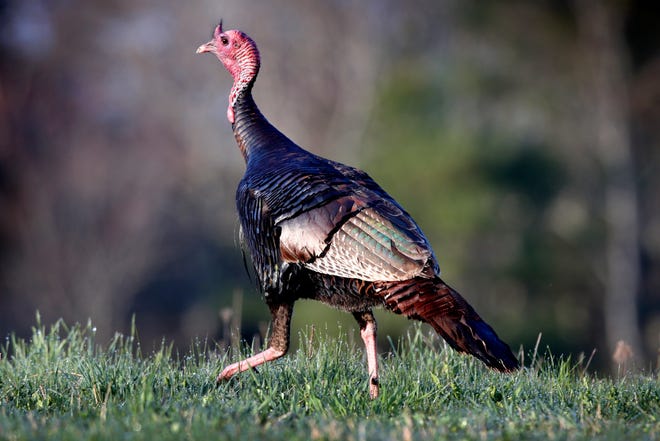
Ohio’s two-day youth spring wild turkey hunt arrived before sunrise Saturday and ends at sunset Sunday during yet another season of change.
Young hunters checked 1,473 bearded birds a year ago, a decline from 1,843 taken in 2020. A downward trend in the take continued through the full spring and fall seasons a year ago.
The wait won’t be long to find out whether ups or downs prevail during spring 2022.
In central Ohio and the rest of the state with the exception of five northeastern counties that lag by a week, the turkey season begins one-half hour before sunrise April 23 and runs daily through five weekends until closing at sunset May 22. Note the hunting day ends at noon through May 1.
Washington Fish and Wildlife commissioners approved big game hunting seasons with little debate Friday but rejected proposed rules that would have incrementally modernized some primitive weapon hunts.
They chose to put off a vote until today on a controversial proposal that would clarify when wolves can be killed for attacking livestock. The delay will allow more people to comment on the proposed rule.
Commissioners also enacted a ban on the importation of deer, elk, moose and caribou carcasses from outside the state. Washington hunters may bring in the antlers and deboned meat from animals killed in other states. The rule is designed to prevent chronic wasting disease from entering Washington. The disease was found in…
Children think farm animals deserve to be treated as well as human beings but lose this belief in adolescence, a groundbreaking study has found.
Researchers from the universities of Exeter and Oxford asked a group of British children aged nine to 11, young adults aged 18 to 21 and older men and women about their attitudes to different sorts of animals.
In general, the children said farm animals and human beings should be treated the same and found eating animals less morally acceptable than both sets of adults. The findings suggest that “speciesism” – a moral hierarchy that gives different value to different animals – is learned during adolescence, according to the study.
“Humans’ relationship with animals is full of ethical double standards,” said the lead author, Luke McGuire, a lecturer at the University of Exeter who specialises in social and moral development. “Some animals are beloved household companions, while others are kept in factory farms for economic benefit. Judgments seem to largely depend on the species of the animal in question: dogs are our friends, pigs are food.”
The report says an important aspect of the human mind is “moral acrobatics”: people can hold ethical values that contradict each other and employ moral double standards. But the origins of moral acrobatics relating to animals is poorly understood and the researchers say this new study provides some of the first evidence examining the differences in how children and adults think about animal treatment.
Among other tasks, participants in the study were presented with pictures including a farm animal and companion animals and asked to categorise them as “food”, “pet” or “object”. They were asked how animals were treated, and how they should be treated.
Children did not judge all animals to be equal. They concluded, in fact, that dogs ought to be treated better than pigs – but also that pigs ought not to be treated differently from humans.
The two sets of adult groups said pigs ought to be treated less well than dogs, while humans and dogs ought to be treated the same.
McGuire said the study suggests that while children think farm animals and humans ought to be treated equally well, by adulthood people believe that companion animals and humans ought to be treated better. He said children rated eating animals as significantly less permissible than young adults and adults did.
“Something seems to happen in adolescence, where that early love for animals becomes more complicated and we develop more speciesism,” said McGuire. “It’s important to note that even adults in our study thought eating meat was less morally acceptable than eating animal products like milk. So aversion to animals – including farm animals – being harmed does not disappear entirely.”
McGuire said that while adjusting attitudes was a natural part of growing up, the “moral intelligence of children” could be valuable.
He said: “If we want people to move towards more plant-based diets for environmental reasons, we have to disrupt the current system somewhere. For example, if children ate more plant-based food in schools, that might be more in line with their moral values, and might reduce the normalisation towards adult values that we identify in this study.”
WASHINGTON (Reuters) – Frigid and far-flung Neptune, our solar system’s outermost planet, is adding to its reputation as an enigmatic world, with astronomers puzzled by a surprising drop in its atmospheric temperatures during the past two decades.
Focusing upon Neptune’s stratosphere – the atmosphere’s relatively stable region above the turbulent weather layer – the researchers had expected to find rising temperatures in the part of the planet visible from Earth with the onset of its southern hemisphere summer, a season lasting four decades. Instead, they found temperatures declining significantly.
The study was based on more than 95 thermal-infrared images – every one ever taken – spanning 2003 to 2020 using ground-based telescopes in Hawaii and Chile, mostly the European Southern Observatory’s Very Large Telescope. It is the most comprehensive assessment to date of Neptune’s atmospheric temperatures.
“The atmosphere appears more complicated than we had naively assumed, which, unsurprisingly, seems to be a general lesson that nature teaches scientists again and again,” said Michael Roman, a postdoctoral researcher at the University of Leicester in England and lead author of the study published on Monday in the Planetary Science Journal.
Neptune’s stratosphere temperature fell as much as 14 degrees Fahrenheit (8 degrees Celsius) to minus 179 F (minus 117 C) over the 17 years studied. In contrast, temperatures in Neptune’s troposphere – the even-colder weather layer – showed no significant variability while reaching as low as minus 370 F (minus 223 C).
Neptune is among the least explored of the solar system’s eight planets, with its great distance making it difficult to study from Earth. NASA’s Voyager 2 is the only spacecraft to have made a close-up visit, flying past Neptune in 1989.
“I think Neptune is very intriguing to many of us because we still know so little about it,” Roman said.
Its temperature changes were unevenly distributed, with regional variations. The southern tropics cooled, then warmed, then cooled again. Mid-latitudes temperatures initially remained constant before falling gradually. South pole temperatures initially dropped only slightly before warming dramatically between 2018 and 2020.
“I suspect the overall temperature drop may most likely be due to changes in the atmospheric chemistry, which responds to changing seasonal sunlight and, in turn, alters how effectively the atmosphere cools,” Roman said.
Neptune’s average diameter is about 30,600 miles (49,250 km), making it four times wider than Earth. It orbits more than 30 times as far away from the sun as Earth at an average distance of about 2.8 billion miles (4.5 billion km), needing about 165 Earth years to complete a single orbit around the sun – a Neptunian year.
The dwarf planet Pluto most of the time orbits even further away but its oval-shaped orbit sometimes brings it closer to the sun than Neptune.
Neptune and neighboring Uranus are classified as ice giants, as opposed to the gas giants Jupiter and Saturn. Neptune, which like those other planets lacks a solid surface, possesses an extremely dynamic atmosphere mainly of hydrogen and helium, with a small amount of methane, atop a mantle mostly of slushy ammonia and water and a solid core. Neptune boasts the strongest winds of any planet.
Neptune may offer lessons about planets beyond our solar system, called exoplanets, said study co-author Glenn Orton, a planetary scientist at Caltech’s Jet Propulsion Laboratory.
“The close relationship that Neptune may share with a large segment of the population of exoplanets,” Orton said, “means that it may be ‘an exoplanet in our backyard’ – probably on the colder end of that spectrum, but still a model for the things we might expect to see in the meteorology of various exoplanets.”
Workers remove a destroyed Russian military tank from the road near Andriivka, a village close to Kyiv, Ukraine, on Monday.
Maxym Marusenko/NurPhoto/Getty Images
As Monday draws to a close in Kyiv and in Moscow, here are the key developments of the day:
Ukrainian President Volodymyr Zelenskyy warned that thousands of Russian troops are massingfor a new offensivein eastern Ukraine — an assessment backed by Western governments. A senior American defense official saysthe U.S. continues to see signsof Russian command-and-control elements, support battalions, infantry and helicopters moving into the Donbas region from just across the border in Russia.
Ukrainian officials sayat least1,200 civilians have been killed in the Kyiv area.Recovery efforts continue in the suburbs, cities and towns outside the capital. Bodies have been found in basements and manholes and being recovered…
Children differ dramatically from adults in their moral views on animals, new research shows.
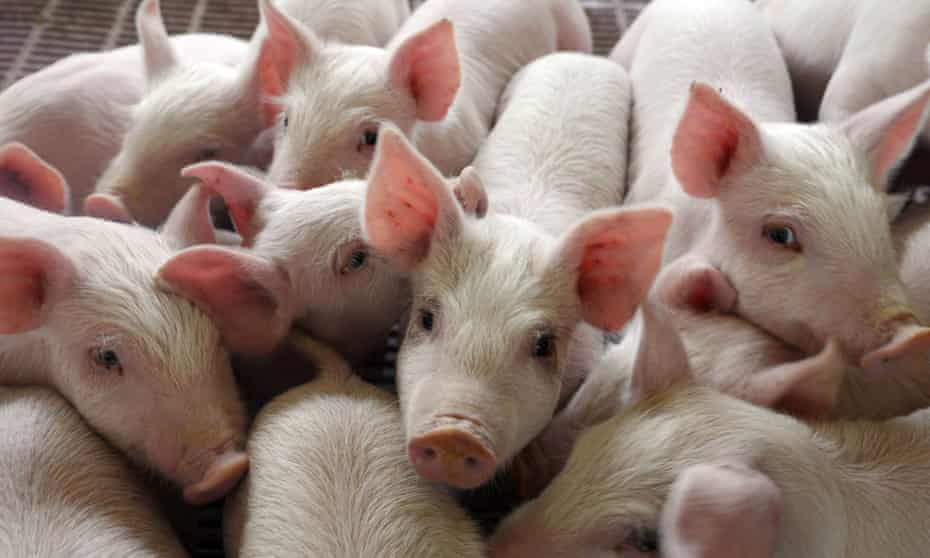
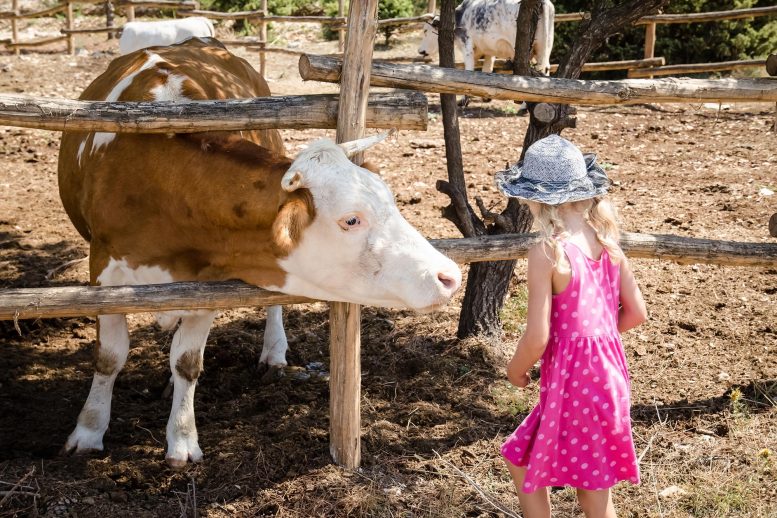
University of Exeter researchers asked children aged 9-11 about the moral status and treatment of farm animals (pigs), pets (dogs), and people.
Unlike adults, children say farm animals should be treated the same as people and pets, and think eating animals is less morally acceptable than adults do.
The findings suggest that “speciesism” – a moral hierarchy that gives different value to different animals – is learned during adolescence.
“Humans’ relationship with animals is full of ethical double standards,” said Dr. Luke McGuire, from the University of Exeter.
“Some animals are beloved household companions, while others are kept in factory farms for economic benefit.
“Judgments seem to largely depend on the species of the animal in question: dogs are our friends, pigs are food.”
The research team – including the University of Oxford – surveyed 479 people, all living in England, from three age groups: 9-11, 18-21, and 29-59.
The two adult groups had relatively similar views – suggesting attitudes to animals typically change between the ages of 11 and 18.
“Something seems to happen in adolescence, where that early love for animals becomes more complicated and we develop more speciesism,” said Dr. McGuire
“It’s important to note that even adults in our study thought eating meat was less morally acceptable than eating animal products like milk.
“So aversion to animals – including farm animals – being harmed does not disappear entirely.”
The study also found that, as people age, they are more likely to classify farm animals as “food” rather than “pets” – while children were equally likely to consider pigs to fall into either of these categories.
While adjusting attitudes is a natural part of growing up, Dr. McGuire said the “moral intelligence of children” is also valuable.
“If we want people to move towards more plant-based diets for environmental reasons, we have to disrupt the current system somewhere,” he said.
“For example, if children ate more plant-based food in schools, that might be more in line with their moral values, and might reduce the ‘normalization’ towards adult values that we identify in this study.”
The paper, published in the journal Social Psychological and Personality Science, is entitled: “The development of speciesism: Age-related differences in the moral view of animals.”
Reference: “The development of speciesism: Age-related differences in the moral view of animals” 11 April 2022, Social Psychological and Personality Science. DOI: 10.1177/19485506221086182
Ukraine’s President Volodymyr Zelensky said that tens of thousands of people had likely been killed in Mariupol.
The BBC has not verified the figure, but reports from the region and the refugees fleeing the city spoke of bodies lying in the streets and most buildings damaged or destroyed.
Mariupol lies between the pro-Russia breakaway regions of Donetsk and Luhansk in the east, and…
More than 5,000 new virus species have been identified in the world’s oceans, according to a new study.
The study researchers analyzed tens of thousands of water samples from around the globe, hunting for RNA viruses, or viruses that use RNA as their genetic material. The novel coronavirus, for instance, is a type of RNA virus. These viruses are understudied compared with DNA viruses, which use DNA as their genetic material, the authors said.
The diversity of the newfound viruses was so great that the researchers have proposed doubling the number of taxonomic groups needed to classify RNA viruses, from the existing five phyla to 10 phyla. (Phylum is a broad classification in biology just below “kingdom.”)
“There’s so much new diversity here – and an entire [new] phylum, the Taraviricota, were found all over the oceans, which suggests they’re ecologically important,” study lead author Matthew Sullivan, a professor of microbiology at The Ohio State University, said in a statement(opens in new tab).
RECOMMENDED VIDEOS FOR YOU…
The Berlin Wall Comes Down
On December 22, 1989, the Brandenburg Gate crossing in east Germany opened after being closed for 30 years. Credit: ITN
Studies of RNA viruses have usually focused on those that cause diseases, according to Sullivan. (Some well-known RNA viruses include influenza, Ebola and the coronavirus that causes COVID-19.) But these are just a “tiny slice” of RNA viruses on Earth, Sullivan said.
“We wanted to systematically study them on a very big scale and explore an environment no one had looked at deeply,” Sullivan said in the statement.
For the study, published Thursday (April 7) in the journal Science(opens in new tab), the researchers analyzed 35,000 water samples taken from 121 locations in all five of the world’s oceans. The researchers are part of the Tara Oceans Consortium, a global project to study the impact of climate change on the ocean.
They examined genetic sequences extracted from small aquatic organisms known as plankton, which are common hosts for RNA viruses, the researchers said. They homed in on sequences belonging to RNA viruses by looking for an ancient gene called RdRp, which is found in all RNA viruses but is absent from other viruses and cells. They identified over 44,000 sequences with this gene.
But the RdRp gene is billions of years old, and it has evolved many times. Because the gene’s evolution goes so far back, it was difficult for the researchers to determine the evolutionary relationship between the sequences. So the researchers used machine learning to help organize them.
Overall, they identified about 5,500 new RNA virus species that fell into the five existing phyla, as well as the five newly proposed phyla, which the researchers named Taraviricota, Pomiviricota, Paraxenoviricota, Wamoviricota and Arctiviricota.
Virus species in the Taraviricota phylum were particularly abundant in temperate and tropical waters, while viruses in the Arctiviricota phylum are abundant in the Arctic Ocean, the researchers wrote in The Conversation.(opens in new tab)
Understanding how the RdRp gene diverged over time could lead to a better understanding of how early life evolved on Earth, the authors said.
“RdRp is supposed to be one of the most ancient genes — it existed before there was a need for DNA,” study co-first author Ahmed Zayed, a research scientist in microbiology at Ohio State, said in the statement. “So we’re not just tracing the origins of viruses, but also tracing the origins of life.”
Maxar technologies took the satellite images which showed the heavy military build-up as it made its way through Velykyi Burluk in an eight mile procession
Satellite images show the convoy of Russian armoured military vehicles(
Waterfowl and the raptors that dine on them, like this bald eagle and snow goose, have both been killed by the new bird flu virus.
Jeff Goulden/Getty Images
Anewly arrived bird fluis sweeping through wild bird populations in the United States, and that may mean trouble for poultry farmers who have been doing their best to control this flu outbreak in their flocks.
Some 24 million poultry birds like chicken and turkeys have already been lost, either because they died from the virus or were killed to prevent its spread. But unlike a similar bird flu outbreak seven years ago, this one is unlikely to just burn itself out.
That’s because this particular flu virus seems capable of…