The young woman died on Saturday afternoon while she was walking with her companion in a town near Aurillac, mortally wounded by a gunshot during a wild boar beat.
The public prosecutor in Aurillac, Paolo Giambisi, told AFP that the author of the shot, a 17-year-old young woman, was placed in custody on Sunday morning on the charge of manslaughter.
Tested negative for narcotics and alcohol, she was hospitalized on Saturday in shock.
“A young woman died after being hit by a bullet during an afternoon hunt. Thoughts to his loved ones. We need more regulation of this activity, it is urgent!“, insisted on Saturday the environmental candidate for the presidential election, Yannick Jadot.
“Prohibition of hunting on weekends and school holidays, at least“, added Sandrine Rousseau, finalist of the environmental primary.How many more deaths before we decide to…
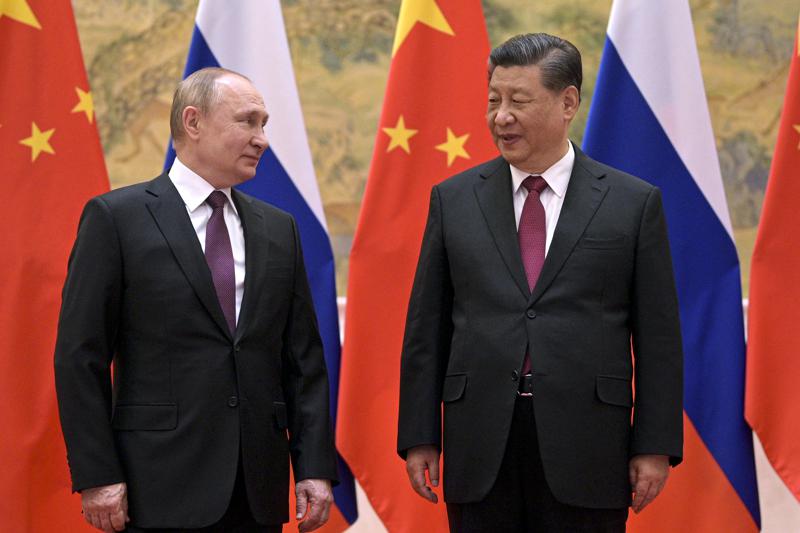
FILE – Chinese President Xi Jinping, right, and Russian President Vladimir Putin talk to each other during their meeting in Beijing, Friday, Feb. 4, 2022. Following this month’s meeting in Beijing between Russian leader Vladimir Putin and China’s Xi Jinping, speculation has risen over whether a new alliance could form between the two superpowers locked in competition with the U.S. (Alexei Druzhinin, Sputnik, Kremlin Pool Photo via AP, File)
BEIJING (AP) — Russia’s military buildup along its border with Ukraine is testing the possibility of a Moscow-Beijing axis lining up against the U.S. and its allies.
Russian leader Vladimir Putin’s meeting with Chinese counterpart Xi Jinping in Beijing this month fed speculation that a new alliance could form between the two great powers as they face off with the U.S. over a range of issues.
Russia and China have backed each other’s positions on opposing a NATO expansion in former Soviet republics and buttressing China’s claim to the self-governing island of Taiwan.
But the relationship remains lopsided. China’s confident rise as an economic and political force contrasts with Russia’s growing isolation and reversion to Cold War tactics of intimidation and bullying.
China also remains opposed to actions that could damage its territorial ambitions, from the South China Sea and Taiwan to the Indian border.
Here are some of the main factors driving, and blocking Russo-Chinese relations:
___
WHERE DOES CHINA STAND ON THE UKRAINE CRISIS?
China has not criticized Russia over its moves against Ukraine, and has joined in verbal attacks on Washington and its allies. Addressing the Munich Security Conference over the weekend, Chinese Foreign Minister Wang Yi lashed out against the U.S., accusing “a certain power” of “stirring-up antagonism.”
However, in response to a question from conference Chairman Wolfgang Ischinger, Wang said the “sovereignty, independence and territorial integrity of any country should be respected and safeguarded, because this is a basic norm of international relations.”
“Ukraine is no exception,” Wang added.
He also stated that major powers should act in defense of global peace and no country should “repeat the past mistake of forging rival alliances.”
That chimes with China’s longstanding opposition to military alliances and often invoked — but often breached in practice — policy of non-interference in other countries’ internal affairs.
The comments were also in keeping with Beijing’s quest to replace a global order underpinned by alliances it considers threatening to its own development. Those include NATO and newer groupings joining the U.S. with Japan, India, Australia and other states with which China has substantial foreign policy disputes.
___
WHAT DID THE XI-PUTIN SUMMIT ACHIEVE?
Xi and Putin met ahead of the opening ceremony of the recently concluded Winter Olympics in Beijing, after which they issued a lengthy joint communique seen as announcing a new and closer relationship.
The two sides said they “strongly support each other” in confronting what Xi called “regional security threats” and “international strategic stability,” without directly naming the U.S.
The meeting between the leaders marked their 38th contact in person and by phone, a number touted by Beijing as a sign of closeness between the countries that had been rivals for leadership in the Cold War’s socialist bloc.
The fall of the Soviet Union remains an obsession among Chinese Communist leaders, along with Putin, a former officer in the Soviet KGB who shares Xi’s authoritarian leanings and has aligned his foreign policies with those of Beijing while courting China’s market for Russian energy resources and military hardware.
In its own readout of the Xi-Putin meeting, however, China held back on making a full-throated endorsement of Russia’s strategy of attacking alleged Western threats to its security.
___
IS THERE A LINK BETWEEN UKRAINE AND TAIWAN?
China’s Communist Party leadership is believed to be watching the U.S. response to Russia’s actions closely for signs of how Washington would behave if Beijing were to move against Taiwan.
China has been dispatching military aircraft and holding threatening war games in hopes of undermining support in Taiwan for the self-governing island’s de facto independence.
Washington provides Taiwan with fighter jets, warships and other arms and is legally required to consider threats to the island as matters of “grave concern.” That doesn’t obligate the U.S. to intervene militarily on Taiwan’s behalf, but the possibility has not been ruled out, with allies such as Australia and Japan potentially joining in a conflict.
___
WHERE IS AMERICA LEFT IN THE DEBATE?
China is not putting its weight behind Russia’s foreign policy gambits, but the frostiness in relations with Washington shows no sign of thawing, said Shi Yinhong, a professor of international relations and director of the Center on American Studies at Beijing’s Renmin University of China.
“I believe that the Chinese government will continue to take care of China itself in the first place rather than take care of Russia,” Shi said. In the meantime, relations with Washington will remain fraught, particularly over the issue of Taiwan.
Beijing blames heightened tensions with the U.S. on what it calls a false depiction of China as a strategic rival.
This week marks the 50th anniversary of Richard Nixon’s visit to China that led to the establishment of formal diplomatic ties in 1979 and a new era of trade and economic relations. No joint celebrations have been announced.
Sharing a meal with a greedy tablemate makes for fraught relations, especially when there are claws and fangs involved.
For wolves and grizzly bears in Yellowstone National Park, competition over a dead elk dinner has some unexpected results. When a bear steals a meal from a wolf pack, the wolves kill less often.
“What we did was break down the wolf foraging sequence,” University of Montana researcher Matthew Metz told the Missoulian. “We studied their searching time and their handling time – the amount of time they spend eating and digesting their kills.”
A wolf in Yellowstone National Park follows a grizzly bear in early spring 2005. New research from the University of Montana shows that wolves reduce their kill rates in spring when grizzlies pressure them for their prey. DOUG SMITH / AP
And especially in spring, when Yellowstone’s elk herds are birthing thousands of wobbly calves throughout the Lamar Valley and every predator around cruises for fresh protein, grizzly bears lean on wolves in ways that change the wolves’ behavior. The reduction in wolf kills when grizzlies are around was also seen in a paired study of Scandinavian predators.
“Wolves put extra food on the landscape for bears,” said Norwegian Institute for Nature Research scientist Aimee Tallian, who collaborated with Metz through UM’s Yellowstone Wolf Project. “But bears are antagonistic for wolves. They take part of the supply of shared prey, and they usurp wolf kills. So wolves are kind of helping bears, but bears aren’t necessarily helping wolves a lot.”
The Greater Yellowstone Ecosystem surrounding Yellowstone National Park has the second-largest concentration of grizzlies in the Lower 48 states. Its estimated 1,000 grizzlies pack themselves between five and 13 per 100 square kilometers.
By comparison, Scandinavia has about 3,000 brown bears (the same species as U.S. grizzly bears). But they are dispersed at about three bears per 100 square kilometers across Norway and Sweden. And they feed on moose, which don’t herd like elk but do exist in similar numbers in the Scandinavian forests.
“They’re controversial there, too,” Tallian said of bear relations on the far side of the Atlantic Ocean.
Scandinavia also has a sizable wolf population, which inhabits regions with and without brown bears. That added complexity to the study, because the researchers could contrast wolf behavior with and without ursine competition.
“The fact we’re seeing patterns in multiple places suggests these patterns exist where wolves and bears persist together,” Tallian said. “Which is a lot of their habitat.”
Comparing American and Scandinavian meat-eaters has other complications. In Yellowstone, the wolves and grizzlies also have to compete with black bears, which don’t exist in Europe.
While grizzly competition tends to reduce wolf kill rates, it has an opposite effect on mountain lions. Metz said lions in bear country also get driven off their kills by grizzlies, and then have to kill more to stay nourished.
The relationship can change from place to place. Along Alaska salmon streams, for example, Kodiak brown bears tend to eat only the heads of spawning fish, leaving a bounty of body meat for following wolves.
Exactly why and how these inter-species kill rates balance out remains to be discovered. But Tallian and Metz agreed the opportunity to study several top predators at work on the same landscape was enlightening.
“Relatively little had been known about how bears affected the foraging dynamics of wolves,” Metz said. “Our work starts to fill in the gap by demonstrating that the dynamics do differ and provides another reminder of how changes in ecosystem complexity – in this case the presence of bears – affects the behavior of other species.”
“One cool way to think about this is the historical context,” Tallian added. “This is likely what these systems looked like for thousands of years, with this dynamic interplay of competitors on the landscape. There are very few places that feel that untouched these days, where ecosystems are allowed to play out on their own.”
A 17-year-old girl has been arrested in connection with the shooting.
Terrible tragedy that happened during the wild boar hunt. On Saturday, February 19, a 25-year-old woman was killed by a bullet. The victim was walking with his companion when he was shot by a wild boar while hunting in the territory of a town near Arylock.
The teacher, who is suspected of being responsible for the deadly shooting, is a 17-year-old man. The latter was arrested on Sunday, February 20.An investigation into the “arson” has opened. As a reminder, in France, a minor from the age of 15 practices hunting in the presence and responsibility of a guide.
The victim was walking with his companion in the woods, on a marked sidewalk, in La Bécarie.As reported by France Blue. According to Aurillock’s lawyer, the bullet struck “on the…
Conservation Officers Tyler Cole, left, and Matt Page are seen in this October 2021 photo with the heads of eight deer poached by Justin Ernst. Two days later, officers found a ninth deer. (Photo: WWMT via Michigan Department of Natural Resources)
VAN BUREN COUNTY, Mich. (WWMT) — A Michigan man received prison time, a large fine and a lifetime ban from hunting in Michigan after he poached nine trophy bucks.
Justin Ernst, of Decatur, pleaded guilty Monday to three counts of illegal taking/possessing of whitetail deer, one count of obtaining a hunting license when ineligible and one felony count for possession of a firearm, said the Michigan Department of Natural Resources.
The 33-year-old was sentenced to serve 18 months to five years in prison. In addition, he was ordered to pay a $25,000 fine and received a lifetime loss of hunting privileges.
“We’re satisfied that this criminal will be imprisoned for robbing ethical hunters, damaging crops and endangering others by recklessly driving through fields and shooting deer at night,” said David Shaw, assistant chief of the Michigan Department of Natural Resources Law Enforcement Division. “We hope this serious sentence serves its intended purpose and are grateful for the strong message rendered by the 36th Circuit Court.”
On Oct. 17, 2021, Michigan State Police were investigating a domestic violence complaint involving Ernst, officials said. Troopers contacted conservation officers after they saw several deer in a nearby barn that Ernst frequented. Conservation officers then seized eight illegal bucks from the barn, including five 10-pointers and three eight-pointers.
Two days later, officials said they received an anonymous tip stating Ernst had taken another deer. Conservation officers later confirmed Ernst had indeed poached his ninth trophy buck.
Ernst was previously convicted in 2018 for illegally taking or possessing whitetail deer, department officials said.
Police addressed the public Saturday regarding the ongoing trucker Freedom Convoy protests raging in Ottawa, Canada.
The press conference comes on the heels of mass arrests and aggravated clashes between law enforcement and the protesters, who have now grown in numbers to include not only Canadian truck drivers but also members of the public and even Americans who have traveled to join the cause.
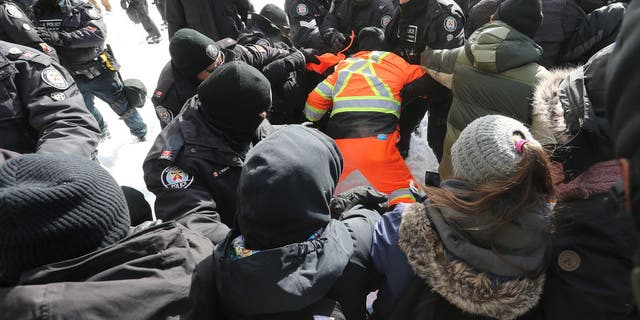
They faced a barrage of resistance, shoving and vitriol. We all saw that the protesters were aggressive with the officers and we needed to use horses at one point,” Police Chief Steven Bell said at the conference. “As a result, we responded this morning by adding helmets and batons to our equipment for the safety of our officers.
He continued, “Our officers continued to face resistance at one point, a flare was ignited by a protester. Officers used a chemical irritant also known as pepper spray, to disperse unlawful demonstrators who were resisting police orders. Sadly, we again saw young children being brought to the unlawful demonstration and to the front of our police.”
Ottawa Police move a line of protesters from the intersection at Sussex and Rideau Streets in Ottawa on Feb. 18, 2022. (Steve Russell/Toronto Star)
Canadian truckers have been protesting in Ottawa since late January calling for an end to COVID-19 mandates. On Monday, Prime Minister Justin Trudeau invoked the Emergencies Act for the first time in Canadian history.
Reporters questioned Bell on rumors and video that purported to show violent clashes between the horse-mounted officers and protesters.
“What I can indicate is there was two members of the protesters who did collide with the horses. They fell down,” Bell told the reporters. “They immediately got back up and started to again engage in their protest and demonstration activity. That is one of the circumstances where as we monitor it, we’re identifying this information as quickly as we can, providing accurate, real information about what is occurring on the ground.”
The police chief warned about “misinformation” coming out of Ottawa’s protest, and assured the public that they would be quick to turn around reliable info as it becomes available.
Asked about reports of violent beatings at the protests, specifically baton injuries to retreating protesters, the chief doubled down on the necessity of force in shutting down the demonstration efficiently.
“As indicated earlier, we will have the opportunity to review all of those files. There are complaint mechanisms for people to enter into if they feel that there is excessive use of force by members of our police service,” Bell said. He added, “This occupation is over. We have advised them that if they peacefully leave, they may go home. That still exists. We also indicated that we would escalate and forcibly remove people from the streets if they did not comply. Some of that is what you’re seeing. So I will stand here today again and say this demonstration is over. Go home. If you don’t go home, we will remove you from the streets.”
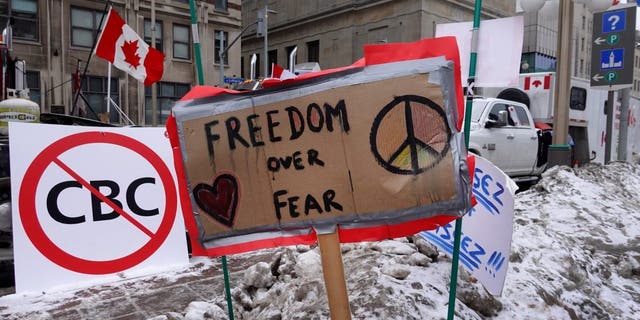
Signs of support are planted in a snow bank near the parliament building where trucks have formed a blockade of streets as a demonstration led by truck drivers protesting vaccine mandates continues on February 16, 2022 in Ottawa, Ontario, Canada Prime Minister Justin Trudeau has invoked the Emergencies Act for the first time in Canada’s history to try to put an end to the blockade which is now in it’s third week. (Photo by Scott Olson/Getty Images)
Ottawapolice on Friday announced the arrests of more than 100 protesters participating in demonstrations against COVID-19 vaccine and mask mandates in Canada that have been ongoing for weeks.
Authorities also removed 21 vehicles in Canada’s capital on Friday night as protesters refused to vacate certain areas surrounding Parliament Hill and appeared to clash with police in videos posted online.
“You must leave,” Ottawa police said in repeated messages posted to their Twitter page in an effort to disperse protesters. “You must cease further unlawful activity and immediately remove your vehicle and/or property from all unlawful protest sites. Anyone within the unlawful protest site may be arrested.”
Fox News’s Audrey Conklin, Jon Michael Raasch, and Adam Sabes contributed to this report.
WASHINGTON — The U.S. has picked up intelligence showing that Russian military officials were given an order to go ahead with an invasion of Ukraine, a U.S. official and another person with knowledge of the matter told NBC News.
The intelligence, which was developed very recently, informed President Joe Biden’s startling declaration on Friday that the U.S. believes President Vladimir Putin has already decided to invade, the individuals said.
The U.S. then witnessed Russian military units taking steps to carry out the order in preparation for an invasion, further bolstering the assessment that Putin could strike at any time, they added.
“As of this moment, I’m convinced he’s made the decision. We have reason to believe that,” Biden said at the White House Friday. Asked how the U.S. knew, the president said only: “We have a significant intelligence capability.”
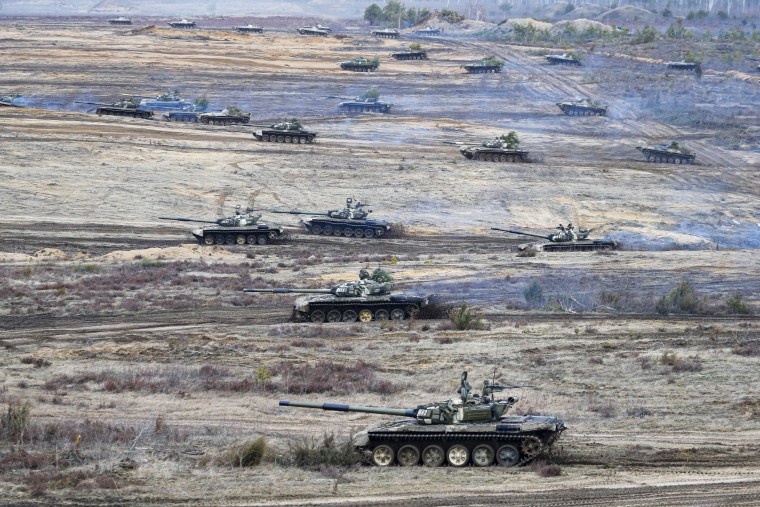
Tanks move during the Union Courage-2022 Russia-Belarus military drills at the Obuz-Lesnovsky training ground in Belarus on Feb. 19, 2022. Russia has deployed troops to its ally Belarus for sweeping joint military drills that run through Sunday, fueling Western concerns that Moscow could use the exercise to attack Ukraine from the north.Alexander Zemlianichenko Jr. / AP
Biden’s assertion had marked a shift after weeks of saying the U.S. believed Putin hadn’t made a final decision. On Saturday, Defense Secretary Lloyd Austin said he agreed with Biden that Putin had decided to invade and that Russia’s military was now in “the stance that you need to be in to attack.”
White House officials say that the threat level in eastern Ukraine and along the Russian border has not diminished over the weekend, despite diplomatic efforts by Vice President Kamala Harris and Secretary of State Antony Blinken at a major annual security conference in Munich. The White House said that Biden was briefed again on Saturday by his aides that “Russia could launch an attack against Ukraine at any time.”
On Sunday, Biden convened a rare weekend meeting of the National Security Council focused on Ukraine, the White House said. Austin and Blinken, both newly back from Europe, were spotted entering the West Wing shortly before noon. A White House official said Harris would participate in the meeting remotely from Air Force Two while she flies back from Germany.
Blinken, who on Thursday told the U.N. Security Council of an elaborate Russian plot to fabricate a pretext for war, told NBC’s “Meet the Press” that Putin’s actions since then are “following the script that I laid out.” He pointed to his earlier predictions that Russia would mount false flag operations in eastern Ukraine and use purported temporary military exercises to justify a military buildup near Ukraine’s border.
“Everything we said was likely to occur in the lead up to the actual invasion is happening,” Blinken said.
By Samantha Noble BBC NewsPublished5 days agoShare
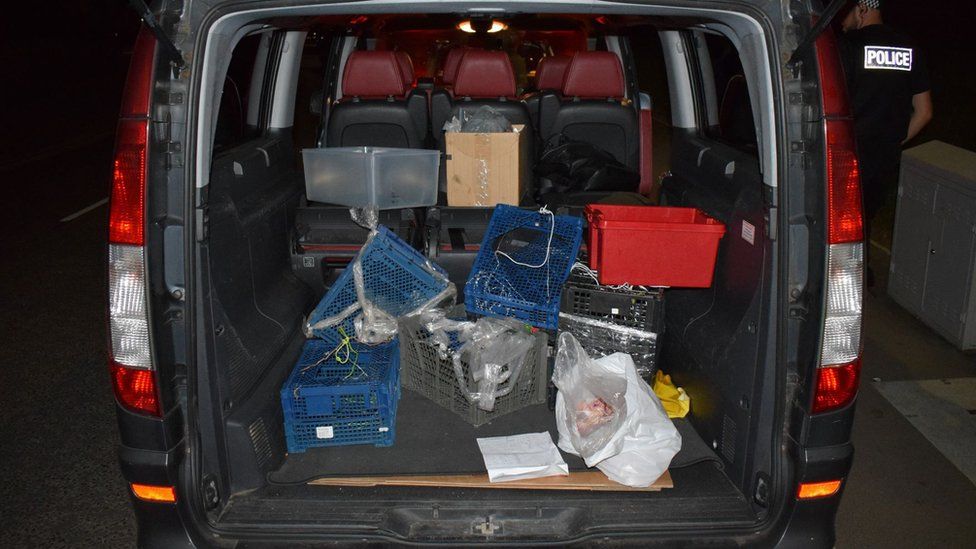
Image caption,Police found crates and wire used to make the crayfish traps in a van
Two men have been fined in court for illegally fishing for crayfish in Derby.
Xiao Chaun Zhang and Weiqui Lui were spotted by police near St Mary’s Bridge on the River Derwent at about midnight on 23 July 2019.
The pair were seen by officers throwing traps in the river, the Environment Agency said.
Zhang and Lui, both from Nottingham, were fined at Southern Derbyshire Magistrates’ Court on Monday.
The agency said some signal crayfish had been caught, and a chicken carcass – which was being used as bait – was also found.
The defendants had modified crates to make traps to catch signal crayfish, an agency spokesperson added.
‘Deterrent’
According to the public body, the trapping of crayfish for human consumption is banned as it can cause the spread of disease, known as crayfish plaque.
Trapping can cause the spread of plaque from invasive signal crayfish to native white claw crayfish, which is fatal to the latter.
Zhang, 41, of Prospect Road, was fined £400 and ordered to pay a £40 victim surcharge and £650 costs.
Lui, 39, of Alfreton Road, was fined £233 and ordered to pay a victim surcharge of £33 and costs of £650.
A spokesperson for the agency said: “We hope the high penalty will act as a deterrent to anyone who is thinking of fishing for crayfish.
“Money raised from fishing licence sales is used to protect and improve fish stocks and fisheries, benefitting anglers and, for those caught cheating the system, we will always prosecute.”