Police in Parisused tear gas Saturday against protesters inspired by theCanadian “Freedom Convoy”who were demonstrating against COVID-19 vaccine mandates on the Champs-Élysées avenue
French police set up checkpoints on roads into Paris, stopping more than 500 vehicles from heading to the protest, but dozens were able to get through. Tear gas was fired, and several protesters were detained as some demonstrators climbed on their vehicles in the middle of the road.
A man walks through tear gas on the Place Charles De Gaulle in Paris Feb. 12, 2022, as convoys of protesters, “Convoi de la Liberte,” arrived in the French capital.(Sameer Al-Doumy/AFP via Getty Images)
US poultry producers are tightening safety measures for their flocks as disease experts warn that wild birds are likely spreading a highly lethal form of avian flu across the country.
Indiana on Wednesday reported highly pathogenic bird flu on a commercial turkey farm, leading China, South Korea and Mexico to ban poultry imports from the state. The outbreak put the US industry on edge at a time that labor shortages are fueling food inflation.
MADISON, Wis. — The Wisconsin Department of Natural Resources says the state is no longer allowed to have a wolf-hunting season following a U.S. district court ruling Thursday that returned wolves to the Federal Endangered Species List.
The DNR says it is reviewing the ruling to determine how it affects those who bought licenses for the fall wolf hunt. The department also says the state’s wolf population “remains healthy and secure.”
As a result of the Feb. 10 ruling, the DNR says permits that previously allowed the lethal removal of wolves by landowners experiencing wolf conflicts are no longer valid. The DNR is also not allowed to use lethal control as part of its conflict management program. Training dogs to track and trail wolves also is not allowed.
The DNR says it will continue to help people who have conflicts with wolves through an interagency agreement with the USDA-Wildlife Services.
If you think wolves are attacking your livestock, pets or hunting dogs, or if wolves in your area are showing threatening or dangerous behavior, you should contact USDA-Wildlife Services immediately. You can call 1-800-433-0663 or 920-324-4514 for support in southern Wisconsin.
The answer lies in the psychology behind the way we perceive contradictory information: a manifestation of cognitive dissonance called the ‘meat paradox’
Feb 10, 2022 • 2 days ago • 6 minute read • 74 Comments
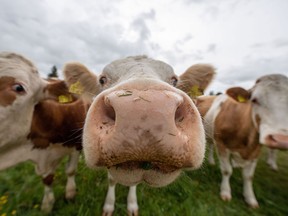
Many people experience the “meat paradox,” U.K. researchers say: caring for animals yet also consuming them as meat. PHOTO BY LINO MIRGELER /DPA/AFP via Getty Images
Reviews and recommendations are unbiased and products are independently selected. Postmedia may earn an affiliate commission from purchases made through links on this page.
Article content
Canadians prefer pepperoni on their pizza. And though one in four considered cutting it during COVID-19, beef is still a staple.
Toyota Super Bowl ad features Canadian Paralympians, no cars
about:blank
If you eat meat — as more than 90 per cent of Canadians do — chances are good, it comes from factory farms. Each year, 80 billion animals are slaughtered for meat globally, more than 90 per cent of which are estimated to live in intensive farming systems.
The alternative — meat bearing labels such as “free-range,” “grass-fed” and “certified humane” — is very much the minority. But those $7.99 rotisserie birds come at a cost to animal welfare and the environment.
According to Our World in Data, livestock production takes a significant environmental toll. Beef (meat and dairy), lamb and mutton emit the most greenhouse gas per kilogram than any other food. And when it comes to producing the beef that leads the pack in emissions, a study published in the journal Animal Welfare suggests that 13.6 per cent of bulls are inadequately stunned.
Many of the same people who regularly put meat on their plates are also likely to identify as animal lovers — sharing their homes with pets they adore, devouring cute animal videos on social media and supporting stricter food labelling around animal welfare.
A 2017 study published in the journal Society & Animals even suggests that people empathize more with dogs than they do other adults.
So, how do people reconcile their affection for animals with their desire to eat them in the form of meat?
The answer lies in the psychology behind the way we perceive contradictory information: a manifestation of cognitive dissonance (the discomfort of our beliefs clashing with new information) called the “meat paradox.”
In a first-of-its-kind literature review published in the Social Psychological Bulletin, U.K. researchers from the Societies Research Hub at Anglia Ruskin University (ARU) and Nottingham Trent University investigated the meat paradox and identified its two main psychological processes: triggers, such as reminding people of meat’s animal origin; and restorative strategies including disengagement from the issue.
Advertisement
STORY CONTINUES BELOW
Your next adventure is a flight away.
American Airlines mobile app, touchless kiosks, and travel planning tools make traveling easier than ever. Book now.
Ad By American Airlines
See More
Article content
“One of the big triggers of this meat paradox and of this cognitive dissonance, as we call it — this feeling of discomfort — is just hearing information about animals,” says ARU doctoral researcher Sarah Gradidge, lead author of the literature review.
“So simply just, for example, saying to somebody that their meat comes from an animal could be a trigger of this discomfort and can make them feel very uncomfortable and potentially very threatened.”
The researchers found that people use different strategies to deal with the meat paradox and alleviate their discomfort. Different people — intersecting with age, culture, dietary preferences, gender, occupation or religion — use different strategies, adds Gradidge, though figuring out why requires future research.
Simply just saying to somebody that their meat comes from an animal could be a trigger of this discomfort and can make them feel very uncomfortable and potentially very threatened.
Some tend to use indirect strategies, the most common of which is avoidance: mental (e.g., avoiding thinking about meat as animal flesh) or physical (e.g., steering clear of slaughterhouse footage).
“Obviously, if you’re eating meat, you might not want to think about where that meat has come from. So very simply, you might just be avoiding any thoughts that this meat has come from an animal,” says Gradidge.
Others tend to use more direct strategies to reduce dissonance by justifying their meat consumption. Most commonly: “denying positive traits to animals,” the 4Ns — defending meat eating as “natural,” “necessary,” “nice” and “normal” — and “denial of adverse consequences.”
“Instead of not thinking about it, they might actually be actively denying certain information. They may be denying that meat consumption causes harm to animals. They may be denying that animals even feel pain,” Gradidge explains.
“And that alleviates guilt because obviously, if animals can’t feel pain, then meat consumption isn’t going to hurt them. It essentially renders meat consumption completely harmless because it doesn’t cause any pain.”
Vegaphobia — stigma against vegans and vegetarians — can also be a strategy for dealing with the meat paradox, she adds. Sociologists Matthew Cole and Karen Morgan first identified the phenomenon in 2011 in their examination of the British media’s “derogatory” portrayal of vegans.
Most people want to act in a moral way, says Gradidge. If someone were to tell them that their meat eating is causing harm, for example, it could make them feel threatened and uncomfortable.
Instead of dealing with those emotions of discomfort, reflecting on and perhaps changing their own behaviour — such as reducing meat consumption — they may deflect the threat towards vegans and vegetarians. “I suppose, almost like shooting the messenger.”
Advertisement
STORY CONTINUES BELOW
Article content
In “It ain’t easy eating greens,” a 2015 study published in the journal Group Processes & Intergroup Relations, researchers Cara C. MacInnis and Gordon Hodson observed that only people with an addiction are viewed more negatively than vegans and vegetarians.
“Unlike other forms of bias (e.g., racism, sexism), negativity toward vegetarians and vegans is not widely considered a societal problem; rather, (it) is commonplace and largely accepted,” the Guardian reports of their conclusions.
Demonstrating this stigma — a phenomenon called do-gooder derogation — doesn’t just apply to vegans and vegetarians, Gradidge highlights, but people dealing with other moral issues as well (e.g., resentment of others’ generosity).
The way people communicate information about the consequences of meat eating matters, highlights Gradidge.
An August 2021 study published in the journal PLOS One suggests that blaming people — intentionally or not — for their role in unethical behaviour “leads to increased defensiveness and may be counterproductive.”
Alleviating them of any wrongdoing, however, may make them more receptive to information and potential change.
“It’s really, really important that when we’re talking about these issues, we’re doing it in a way that is absolving. So, we’re doing it in a way that’s not blaming meat eaters and saying, ‘It’s all your fault, you’re a bad person,’ etc.,” says Gradidge.
Advertisement
STORY CONTINUES BELOW
Article content
“We want to try to do it in a way that’s compassionate, and in a way that’s relatable to them. We really want to avoid these ‘us versus them’ politics. We don’t want to be presenting it as us, the animal welfare advocates, against them, the meat eaters. We really want to be thinking about how we can relate and try to bridge the gap.”
Effective communication requires finding the “sweet spot of cognitive dissonance,” she adds. Behavioural change requires some discomfort — if people don’t feel any, they’ll continue doing what they’ve always done.
If people feel too threatened, however, they tend to switch off and avoid the issue. A minority of people will even do the opposite in an urge to rebel (a psychological effect called reactance). If the message is to decrease meat consumption, they will increase it due to a perceived loss of freedom.
Raising awareness about animal welfare and environmental issues related to meat consumption is necessary, says Gradidge, but needs to be done in a way that will encourage people to reflect — not disengage.
“It raises some major issues when we’re talking about these issues, because we need to talk about them. But then we have to really navigate this cognitive dissonance and this potential discomfort as well,” she adds.
“It’s not about trying to force people to change their behaviour. It’s about trying to get people to reflect on their meat consumption themselves and to then make the decision themselves…. But obviously if we are presenting it in a way that’s threatening, then people aren’t going to reflect at all. They’re just going to ignore the information sadly.”
Close up image of a gray wolf in winter. Following a U.S. District courts ruling on Feb. 10 returning wolves in the lower 48 states to the Federal Endangered Species List, Wisconsin is not authorized to implement a wolf harvest season. Photo Credit: iStock.com – Lynn_Bystrom
MADISON, Wis.–The Wisconsin Department of Natural Resources (DNR) today announced that following a U.S. District court’s ruling on Feb. 10 returning wolves in the lower 48 states (except the northern Rocky Mountains region) to the Federal Endangered Species List, Wisconsin is not authorized to implement a wolf harvest season. The DNR is reviewing the ruling to determine how it impacts hunters and trappers who purchased licenses for the Fall 2021 wolf hunt.
Wisconsin’s wolf population remains healthy and secure in the state. The department will continue its robust wolf population monitoring program to ensure the population…
BREAKING NEWS: Trap Free Montana/Wolves of the Rockies vs Montana Fish Wildlife & Parks/Commission
On February 10, 2022, a preliminary injunction hearing occurred on behalf of Trap Free Montana and Wolves of the Rockies concerning Montana 2021 wolf regulations.
Trap Free Montana and Wolves of the Rockies filed a lawsuit in December and asked a judge to eliminate the use of infrared and other night hunting aids and to prevent the Department of Fish, Wildlife and Parks from allowing aerial spotting and hunting of wolves.
The complaint contends changes were made to the Montana 2021 wolf regulations without public comment. The request for a temporary restraining order was denied on January 28, 2021.
“Wolves of the Rockies and Trap Free Montana want to thank Rob Farris Olson of Morrison, Sherwood, Wilson & Deola law firm for a solid and defendable argument before Lewis and Clark County District Court Judge Michael McMahon,” said Marc Cooke, president of Wolves of the Rockies.
“Montana Fish Wildlife and Parks and Commission have a responsibility under the Public Trust doctrine to manage wildlife responsibly to ensure their sustainability for present and future generations of Montanans,” said Marc Cooke.
“Since Montana’s 2002 wolf management plan and the 2009 wolf delisting, wolves in Montana have been classified as a ‘species in need of management’. Rather than reclassify wolves as ‘game’ or ‘furbearers’, wolves are now being treated as ‘predators’. Altering the 2021 wolf regulations, the killing of wolves is further eased with the added use of night vision, thermal, and infrared imagery, and to the arsenal, the spotting and shooting of wolves from aircraft. This arbitrary species classification is somehow being used to try to justify the exclusion of the public in the due process of these additives,” said KC York, president and founder of Trap Free Montana/TFMPL.
Research shows from the states that allow night hunting, 3 prohibit artificial light and 10 prohibit night vision. It is basically unheard of to allow the night hunting of game animals. In 2019, Montana FWP came out formally in opposition to Rep. Bob Brown’s HB551, Allowing for wolf hunting at night on private lands. The bill failed to pass in the House 44:56.
During the February 10th, 2022 hearing, Attorney Farris-Olsen stated, “The department does not have the authority to change regulations.” He went on to say, per Montana statute, “The Commission shall establish the hunting, fishing, trapping rules of the department. The Department doesn’t get to just simply change regulations or adopt some implied interpretation of those regulations simply because it wants to. It needs to follow the process, and that process wasn’t followed here.”
Montana FWP received ~ 25,000 public comments and consistent with the 2021 legislative bills the far majority were in opposition to the aggressive measures proposed and killing more wolves.
“Transparency in the department is waning, too. It all diminishes public faith in Montana Fish Wildlife and Parks and the Commission. This is taking a tremendous toll, emotionally and financially, on all those who care about wolves. But we are here today, and we will be here tomorrow to right wrongs we feel conducted by the Montana Fish Wildlife and Parks and Commission,” said Marc Cooke.
“Montana’s wildlife management system is broken. The public has been ignored, denied public comment, kept in the dark, and violated in our constitutional right to participate. The wolves, however, are paying the ultimate price with their lives,” said KC York.
As wolves in Montana, Idaho, and Wyoming remain under intense fire, wolves elsewhere will now be spared. Other than our three states and portions of the other Northern Rocky Mountain states….on February 10, 2022,
In 44 of the 48 lower states the gray wolves are relisted!
Our Western states’ gray wolves were delisted over a decade ago. Carried by Montana Senator Jon Tester, the means by which it was done through Congress, the wolves cannot be relisted through the courts. However, given the 2021 aggressive wolf management plans, they are being reviewed for relisting by the US Fish and Wildlife Agency (USFWS).
Please continue to be the voice for wolves in the Northern Rocky mountain region. Urge the USFWS to relist the gray wolf. Submit your publiccomment. With what is happening in these states, there is plenty of ammo to provide in your comment to fight for the wolves and their rightful respectful place in the ecosystem. Always in public comment use your own words.
The USFWS are reviewing the comments now. They encouraged getting comments in by the end of January, but the comment period has NOT closed.
Interior Secretary Deb Haaland addressed the killing of wolves, finally! Although it is beautiful and eloquently stated, wolves in our states need far more than words, they need help! They will never be able “to flourish” or possibly survive under the current management regimes.
Continue to respectfully contact-her and urge protections for our wolves! Phone 1-202-208-3100
We want to extend our thanks to Rick Lamplugh for his help in our request for witnesses, i.e. Yellowstone business owners and especially those who did not get to give public comment on January 28, although registered to do so, like many of us. We appreciate all who came forward to help and to Jeff Reed for being one who was able to testify.
Over 30% of Yellowstone wolves are allegedly missing and the wolf hunting and trapping season does not close in the state until March 15. Region 3 which abuts Yellowstone National Park is reporting 80 wolves shot, trapped, or snared. The threshold for closing that region is a reported 82 wolves killed. The latest reported toll for the 2021 Montana wolf season, effective February 11, 2022:
Russia is in a position to “mount a major military action” says US National Security Adviser Jake Sullivan
Russia has the troops in place to invade Ukraine “at any time” and American citizens should leave within the next 48 hours, the US has warned.
An invasion could start with aerial bombing that would make departures difficult and endanger civilians, the White House said on Friday.
A host of other countries have also urged their nationals to leave Ukraine.
Russia has repeatedly denied any plans to invade Ukraine despite massing more than 100,000 troops near the border.
US National Security Adviser Jake Sullivan said Russian forces were now “in a position to be able to mount a major military action” and urged American citizens in Ukraine to “leave as soon as possible” in remarks seen as a clear escalation in the…
Ontario has declared a state of emergency in response to two weeks of protests against Covid restrictions.
The order came as demonstrations continue to shut down parts of Ottawa and the Ambassador Bridge, a vital US-Canada trade link.
Blocking crucial infrastructure would be made “illegal” under the order, said Premier Doug Ford.
Protesters could face up to a year in jail and C$100,000 ($79,000; £58,000) in fines.
Mr Ford said the order would apply to anyone impeding the movement of goods, people and services along international border crossings, airports, ports and major highways.
The Canadian province will also provide additional authority so that the personal and commercial licences of protesters who do not comply may be cancelled.
US officials believe Russian President Vladimir Putin has decided toinvade Ukraineand an attack could take place as soon as next week,as National Security Adviser Jake Sullivan told Americans still in the Eastern European nation to get out within “24 to 48 hours.”
PBS foreign affairs correspondent Nick Schifrin tweeted that US officials believe Putin has communicated an invasion orderto the Russian militaryand that Washington expects a “horrific, bloody” campaign.
According to the report, a Russian attack would be preceded by two days of aerial bombardment and electronic warfare, followed by a ground assault with the potential goal of overthrowing…
Chicken is pictured at a market on Granville Island is on Vancouver, Friday, Jan. 23, 2015. File photo by The Canadian Press/Jonathan HaywardListen to article
Canada’s food safety watchdog says the discovery ofavian influenzain a commercial poultry flock in Nova Scotia has resulted in international trade restrictions on some Canadian poultry products.
TheCanadian Food Inspection Agencysays the outbreak of high pathogenic H5N1 was reported last week to the World Organization for Animal Health.
The agency says in a news release on Wednesday that the detection has resulted in Canada’s animal health status being changed to say it is not free from avian influenza.
GET TOP STORIES IN YOUR INBOX.
Email*
South Korea and the Philippines have imposed restrictions on poultry products from all of Canada including live poultry, poultry meat and edible eggs.