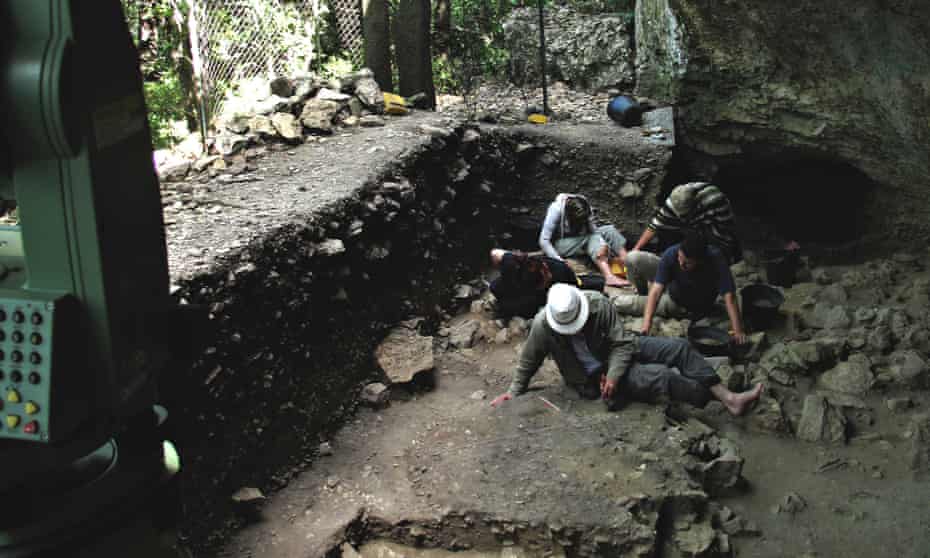
The fossil of a child’s tooth is the earliest known evidence of modern humans in western Europe. Researchers say the area also documents the first clear alternating occupation of a site by Neanderthals and early modern humans.Photograph: The Natural History Museum/PA
Staffandagencies
Wed 9 Feb 2022 16.09 EST
Homo sapiens ventured into Neanderthal territory inEuropemuch earlier than previously thought, according to a new archaeological study.
Up to now, archaeological discoveries had indicated that Neanderthals disappeared from the European continent about 40,000 years ago, shortly after the arrival of their “cousin” Homo sapiens, barely 5,000 years earlier and there was no evidence of an encounter between these two groups.
The new discovery, by a team of archaeologists and paleoanthropologists led by Ludovic Slimak of Toulouse University, pushes back the arrival of Homo…
A mountain lion photographed with a motion sensor camera in the Verdugo Mountains overlooking the city lights of Los Angeles. New money for wildlife crossings will help animals whose habitat has been cut by roadways.
Just outside of Los Angeles, in one of the most human-modified parts of the planet, a rare coastal ecosystem is being pinched against the Pacific Coast. The mountain range is home to one of thehighest concentrationsof threatened and endangered species in the country.
For the better part of the last century, the Santa Monica Mountains have been effectively cut off from the larger world, hemmed in by seawater and sprawl. Highway 101, carved across the range’s northern…
A man has been killed in the latest hunting accident reported in FrancePic:franz12 / ShutterstockByHannah Thompson
A 66-year-old man has died after being shot during a hunt. It is believed he was accidentally hit by a fellow hunter’s bullet which was intended for a fox.
The hunt, which involved around 20 people, took place on February 7 in the commune of Vallières-les-Grandes (Loir-et-Cher).
A 59-year-old man taking part in the hunt is suspected of having fired the fatal bullet but investigations are ongoing.
Feeding and handling wildlife could provide the coronavirus with an opportunity to jump species
Jaela Bernstien · CBC News · Posted: Feb 10, 2022 4:00 AM ET | Last Updated: 11 hours ago
White-tailed deer, like this one pictured at a park in Longueil, Que., can catch SARS-CoV-2 from humans and spread it to other deer. It’s not yet known whether deer can spread it back to humans. (Dave St-Amant/CBC)
If there’s one thing social media loves, it’s a Disney-like moment with a wild animal. There’s the much-loved video with the golden retriever who’s best friends with a deer, or the one where a woman hand-feeds deer on her porch. But those seemingly innocent interactions between humans and wildlife could be costly during a pandemic.
Humans are currently the main source of transmission for the virus that causes COVID-19, SARS-CoV-2. Globally, the virus has been found in 19 different species, mostly animals that are domestic or living in captivity.
What concerns scientists is the potential for another species to become a reservoir. If SARS-CoV-2 circulates widely enough in another species, there’s a risk that animal could become a potential source for new variants and transmission back to humans.
While so far there’s no evidence of that happening in the wild, the cycle of transmission seen on mink farms in Denmark, where mink infected by workers spread a new variant back to workers, is exactly the type of situation infectious disease experts want to avoid.
So far, the only known cases of SARS-CoV-2 in the wild were found in mink and deer. Most of the mink that have been infected were on fur farms, but a wild mink did test positive in Utah, in an area where there were outbreaks on local farms.
Until recently, most conversations about animals and COVID-19 had to do with its origins, said Scott Weese, an infectious disease veterinarian and a professor at the University of Guelph’s Ontario Veterinary College.
He’s one of many experts saying that kind of thinking to change to more of a holistic approach, one that considers how all species are interlinked.
“We had to really kind of drag people kicking and screaming to pay attention to animals,” Weese said.
“We don’t have people and everything else. We’re all in this big ecosystem.”
People should be aware of the risk of animal transmission, but not worried, he said. At this stage of the pandemic, the average person poses a greater risk to other animals than animals pose to people, and people are far more likely to be exposed to the virus from another person than an animal.
Guelph, Ont., infectious disease veterinarian Scott Weese advises people infected with COVID-19 to limit their contact with animals, the same way they would with humans. (Dave MacIntosh/CBC)
But the last thing we want to do is gain control of the virus in humans only to discover another species has become a reservoir, he said.
“The risk of variants emerging in the human population will get lower as we vaccinate everyone, if we vaccinate the world. So if we do that, the biggest pool of susceptible individuals and the biggest pool for circulating virus may be wildlife,” he said.
Need for long-term wildlife surveillance
At Toronto’s Sunnybrook Health Science Centre, infectious disease physician and virologist Dr. Samira Mubareka has been working with her team to analyze samples taken from white-tailed deer killed by hunters.
Together with the Canadian Food Inspection Agency’s National Centre for Foreign Animal Disease, they analyzed the entire genome sequence of the virus found in Quebec deer and identified the Delta variant.
Jonathon Kotwa, left, and Dr. Samira Mubareka, right, pictured in their lab at the Sunnybrook Health Sciences Centre in Toronto. They’re part of team of scientists across Canada analyzing samples taken from wildlife to monitor the spread of COVID-19. (Doug Nicholson/Sunnybrook Research Institute)
“Delta started surging over the course of 2021, especially in the fall. So most likely, that’s when those deer got infected, when it happened to also be circulating in humans,” Mubareka said.
So far the virus has been found in wild white-tailed deer in the northeastern United States, as well as in Quebec, Ontario and Saskatchewan. It’s not clear exactly how humans are transmitting the virus to deer, but it could be through contaminated drinking water, direct contact, food or farming.
Despite humans introducing the virus to deer, there’s no evidence of it spilling back into humans. Infected deer haven’t displayed symptoms, and the virus doesn’t appear to be significantly mutating as it spreads within their population.
But that could change.
It’s why Mubareka and her colleagues say it’s important to keep up surveillance long-term, to find out what happens next.
“What we don’t know is, what is [the virus] doing now?” Mubareka said.
“For example, if Omicron spilled over into deer, would there be a difference?”
Hunters advised to mask up
Since humans are still the main source of SARS-CoV-2, the best way to prevent animals from getting it is for humans to take precautions.
The Public Health Agency of Canada is advising to avoid close contact with pets and animals as much as possible if you have COVID-19. That includes feeding wildlife.
It’s not known exactly how people are transmitting the coronavirus to deer, but it could be through wastewater, direct contact, or food. (Dave St-Amant/CBC)
There are no reports of people catching COVID-19 from preparing or eating meat, but hunters should be cautious while handling carcasses. Public Health also recommends hunters wear a mask when exposed to any respiratory tissues and fluids, and to wear gloves and eye protection while handling and dressing a carcass.
‘The more we can stay away, the better’
Weese, who has been testing the pets of Canadians who have COVID-19, said that so far the virus doesn’t seem to have much of an effect on dogs, and domestic cats usually only show minor symptoms.
His advice is to, “treat your animals like you would anyone else. If you’re staying away from people, limit your contact with animals.”
“If your cat is your support mechanism, know the risk to the cat is fairly low, so you don’t lock the cat in the bathroom because you’ve got COVID. But the more we can stay away, the better,” he said.
There have also been reports that other pets, such as ferrets, are susceptible to the virus and show symptoms.
Zoos have also taken extra precautions to make sure their animals stay safe.
While American zoos have experienced outbreaks, no animals at Canadian accredited zoos have tested positive so far. That’s partly thank to the safety precautions in place.
Take the Toronto Zoo, for instance. It had been closed to the public since Jan. 5, but staff were still wearing protective gear when they were around gorillas and other susceptible animals, like big cats. Visitors, when they can return, are asked to wear masks.
A sign at the Toronto Zoo asks visitors to mask up for the safety of animals. About 10 per cent of the species at the Toronto Zoo are at high risk of being infected with with the virus, including big cats and gorillas. (Amy Naylor/Toronto Zoo)
Gabriela Mastromonaco, the director of conservation science at the Toronto Zoo, said the pandemic has really highlighted how humans are inextricably linked with the other species around us.
“They’re part of our lives every day whether we know it or not. It really is up to us to protect them or not because whatever happens to them is going to come back to us. It is a circle.”
She said people tend to forget all the ways our lives interact with other animals through agriculture, food, pets and companion animals, zoo animals and wildlife.
“COVID heightened our sense of relationships, whether it’s with each other or with the animal world.”
The Omicron variant of the coronavirus has found its way into white-tailed deer living in New York, new research released this week has found. The results are the latest to show that deer in the U.S. have become frequent carriers of SARS-CoV-2—a phenomenon that could have important implications for the future of the virus and our vulnerability to new variants.
Numerous studies have found that deer can readily contract the coronavirus. Last November, for instance, researchers from Penn State University and elsewhere reported that up to a third of free-living and captive deer in Iowa carried traces of the virus from late 2020 to early 2021. Some of these same researchers from Penn State and others, including those with the New York City Department of Parks & Recreation, have released their latest findings this week on the preprint website bioRxiv.
The team tested blood and nasal samples from wild deer living on Staten Island that were temporarily captured as part of a sterilization program to keep the population in check. The samples were collected between December 2021 and January 2022, and the scientists performed antibody and RNA tests on them.
Overall, 14.5% of 131 deer that had their blood taken tested positive for antibodies to the coronavirus, indicating a prior infection. About 10% of the 68 deer that had nasal swabs taken tested positive for an acute infection. And when the researchers sequenced the genetics of these positive samples, they found that some had caught the Omicron variant, the most transmissible version of the coronavirus to emerge yet.
The Omicron found in these deer bore a close genetic resemblance to Omicron strains found in human residents of the city, all but confirming that humans had somehow been the source of the deer infections. It’s unclear how this is happening, but direct contact via hand-feeding or through exposure to contaminated wastewater or trash are possibilities. Interestingly, at least one infected deer had both an active infection and very high antibody levels, possibly indicating that it had been reinfected.
This work, the researchers say in their paper, clearly shows that Omicron “can infect white-tailed deer and highlights an urgent need for comprehensive surveillance of susceptible animal species to identify ecological transmission networks and better assess the potential risks of spillback to humans.”
Deer, at least in the lab with older strains of the virus, don’t appear to experience much if any illness from their infections, unlike other animals such as minks. But the widespread transmission of the virus seen in these animals doesn’t bode well for several reasons. The virus could mutate to become a serious health problem for deer in the U.S., which would only add to the list of infectious diseases circulating in these animals. The virus could also mutate in unpredictable ways or recombine with other coronaviruses in deer that would allow it to become more immune-evading or virulent once it’s transmitted back to humans.
None of this is certain, of course, and there’s plenty of coronavirus already circulating and mutating in humans. But one reason why diseases like influenza are considered a pandemic threat is that flu viruses are constantly being spread back and forth between different species. Every once in a while, the genetic shuffling that this process produces can spit out a version of the flu that’s both highly contagious in humans and much more deadly than the typical seasonal flu. So if the same thing can happen with SARS-CoV-2, it’s a risk that we have to keep an eye on as much as possible, the researchers say.
Subscribe to our newsletter!
Give us your email address or the robot gets it.Enter your emailSign Me Up
“The circulation of the virus in deer provides opportunities for it to adapt and evolve,” study author Vivek Kapur, a veterinary microbiologist at Penn State University, told the New York Times. “And it’s likely to come back and haunt us in the future.”
It is not often that a hunter gets a chance to take an 8-point buck, so when a group of Alabama hunters got the rare opportunity, they were pretty excited.
But,according to a report,when they got the deer with the big rack back home and started cleaning it, they were startled.
Turns out, what they bagged was something far more rare than an 8-point buck. It was an 8-point doe. Kind of.
That’s right. The big deer had a full rack of antlers, but no visible male reproductive parts, according to reports. And, officials with Alabama’s Wildlife and Freshwater Fisheries Division’s Deer Program said they’ve never seen anything quite like what the group brought in.
“I’ve seen a few over the years that looked like does externally that…
A crocodile with a motorcycle tire stuck around its neck basks on a riverbank in Palu, Central Sulawesi in 2020. The wild crocodile that has the used tire stuck around its neck for six years has finally been freed by an Indonesian bird catcher in a tireless effort that wildlife conservation officials hailed as a milestone.
Mohammad Taufan/AP
PALU, Indonesia — A wild crocodile with a used motorcycle tire stuck around its neck for six years has finally been freed by an Indonesian bird catcher in a tireless effort that wildlife conservation officials hailed as a milestone Wednesday.
The 4.5-meter (14.8-foot) saltwater female crocodile has become an icon to the people in Palu, the capital city of Central Sulawesi. The beast was seen on the city’s river with the tire around its neck becoming increasingly tighter, running the risk of choking her.
Conservation officials were racing to rescue the crocodile since residents spotted the reptile in 2016, generating sympathy among residents and worldwide. In 2020, Australian crocodile wrangler Matthew Wright and American wildlife biologist Forrest Galante tried and failed to free the reptile.
In early January, 35-year-old bird catcher and trader Tili, who recently moved to the city, heard about the famous crocodile from his neighbors and determined to rescue the reptile after he saw her frequently sunbathing at a nearby estuary.
“I have experiences and skills in catching animals, not only birds, but farm animals that are released from the cage,” Tili, who goes by a single name, told The Associated Press. “I believe I can rescue the crocodile with my skills.”
He stringed ropes of various sizes into a trap tied to a tree near the river, and laid chickens, ducks and birds as bait. After three weeks of waiting and several failed attempts, the crocodile finally fell into the trap Monday night. With the help of two of his friends, Tili pulled the trapped crocodile ashore and sawed through the tire, which was 50 centimeters (1.6 feet) in diameter.
A video that circulated widely on the internet showed a crowd cheering nearby as Tili and his friends broke the crocodile free. Other residents then contacted firefighters and a wildlife conservation agency to help them release the animal back into the wild.
“For all of the efforts Tili has done for protected wildlife and being the kind of animal lover he is, that’s a great milestone,” said Haruna Hamma who heads Central Sulawesi province’s conservation agency.
He said it was unclear how a used motorcycle tire got stuck around the crocodile neck. Conservationists have said that it was likely deliberately placed by people in a failed attempt to trap it as a pet or skin it for sale, but crocodiles and other swimming reptiles often travel into garbage-studded waters with nothing to stop a tire from encircling them, Hamma said.
Government data recorded 279 crocodile attacks in Indonesia, the world’s largest archipelago nation with more than 17,000 islands, between 2007 and 2014. Of these, as many as 268 cases of attacks were carried out by saltwater crocodiles, of which 135 were fatal.
Despite the attacks, the saltwater crocodile is protected under Indonesian law.
Arkansas woman warns others after her dog was caught in trap on nature trail
00:0000:00
Author:Frederick Price (KTHV)
Published:5:30 PM CST February 7, 2022
Updated:9:01 AM CST February 8, 2022
MAYFLOWER, Ark — One Arkansas woman is reeling after an evening walk with her dog turned into a nightmare after Gypsy walked into a wildlife trap along a nature trail in Mayflower.
With warmer temperatures starting to roll in following the harsh winter storms, more people like Ann Marks are at the hiking and nature trails.
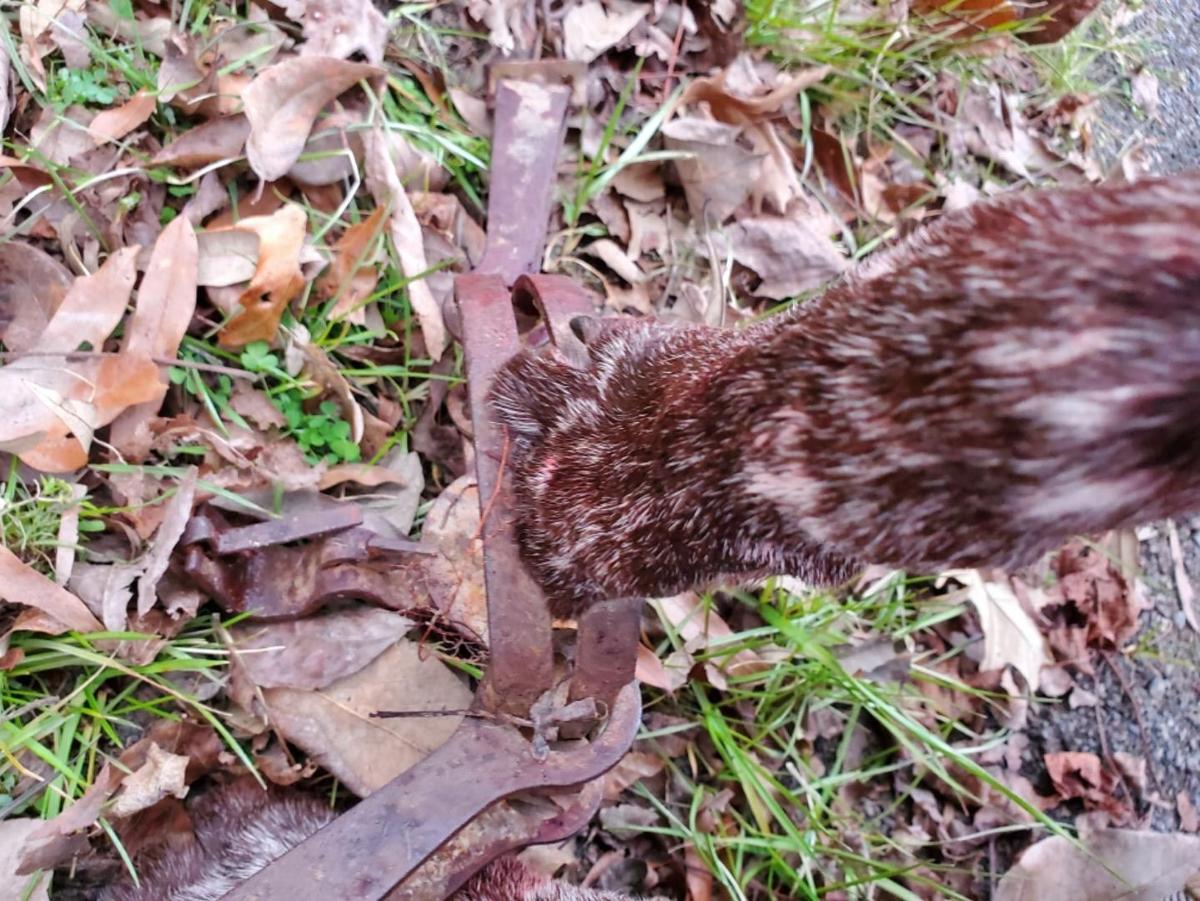
Gypsy, a 4-year-old German Shorthaired Pointer, got her right front paw caught in a trap near the back entrance to Bells Slough trail in Mayflower.
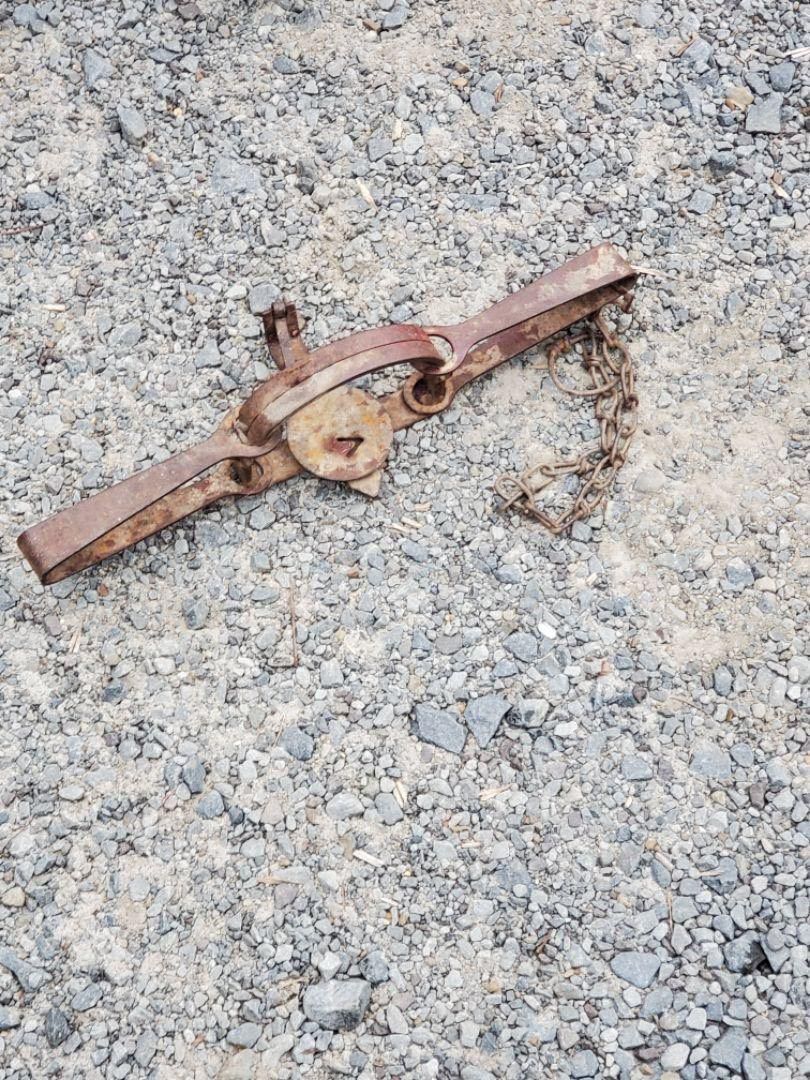
This is the unmarked trap that Gypsy got her right front paw caught in Jan. 27.
Gypsy, a 4-year-old German Shorthaired Pointer, is recovering after getting her right front paw caught in a trap near a popular walking trail in Mayflower.
A Faulkner County woman wanted to make people aware to watch out for traps after her dog – Gypsy, a 4-year-old German Shorthaired Pointer – got her right front paw caught in one last week near the back entrance to Bells Slough trail in Mayflower.
Ann Marks took Gypsy to the popular walking trail around 4:30 p.m. Jan. 27. As they…
Spanish hunters are under fire for reportedly slaughtering nearly 450 fenced-in game animals in what environmentalists have dubbed an “orgy of blood and death.”Courtesy of El Mundo
It was a slaughterfest of a-pork-alyptic proportions.
Spanish hunters are under fire for reportedly slaughtering nearly 450 fenced-in game animals in what environmentalists have dubbed an “orgy of blood and death.”
“It’s an absolute bloodbath, slaughter on a totally senseless scale,” Eduardo Goncalves, founder of the Campaign to Ban Trophy Hunting, toldthe Independentof the “shocking” massacre, which occurred in one day on a private estate in Villaviciosa de Córdoba, Andalucia.