Comet 2014 UN271 the largest ever observed

Exposing the Big Game's avatarThe Extinction Chronicles

by Bob Yirka , Phys.org

https://phys.org/news/2022-02-comet-un271-largest.html

Comet 2014 UN271 the largest ever observed
Fig. 1. Recentered 233 GHz total image of 2014 UN271 merging data from the two SB and the four spectral windows. The synthesized beam, shown in white, is 0.067”× 0.062”. The scale of the color bar is in mJy. Credit: https://arxiv.org/pdf/2201.13188.pdf

A team of researchers with the Paris observatory and Instituto de Astrofísica de Andalucía-CSIC, has confirmed that comet 2014 UN271 is the largest comet ever observed. They published a paper describing their findings on the arXiv preprint server, and it has been accepted for publication inAstronomy and Astrophysics Letters.

Comet 2014 UN271, also known as Bernardinelli-Bernstein, was first sighted in 2014; hence, the initial part of its name. Researchers determined at the time that it had originated in the Oort Cloud. It was observed during the search for solar system objects during the Dark Energy Survey. Back then, thecometwas…

View original post 252 more words

Winter ‘heat wave’ hits San Francisco Bay Area: How hot will it get?

Exposing the Big Game's avatarThe Extinction Chronicles

Photo of Amy Graff

Amy Graff,SFGATE

Feb. 8, 2022

https://www.sfgate.com/weather/article/Winter-heat-wave-hits-San-Francisco-Bay-Area-16841049.php

People enjoy their leisure time on a beach in Half Moon Bay in California, the United States, Feb. 28, 2021. 
People enjoy their leisure time on a beach in Half Moon Bay in California, the United States, Feb. 28, 2021.Xinhua News Agency/Xinhua News Agency/Getty Images

Call it California living — beachweatherin February.

Record-breaking temperatures are heating up Northern California this week with afternoon highs expected to be 10 to 20 degrees above normal, the National Weather Service said. Temperatures in the mid- to upper 70s will be widespread by mid-week and some locations including the beach in Santa Cruz are likely to break into the 80s.

“We have an extreme forecast index and this event is on the higher end of being a rare occurrence for us,” said Brooke Bingaman, a meteorologist with the weather service’s Monterey office.

https://imasdk.googleapis.com/js/core/bridge3.496.0_en.html#goog_415005744

The warmest day of the week will be Thursday when San Francisco is forecast to top out at 75 degrees and the…

View original post 298 more words

Scientists raise alarm over ‘dangerously fast’ growth in atmospheric methane

As global methane concentrations soar over 1,900 parts per billion, some researchers fear that global warming itself is behind the rapid rise.

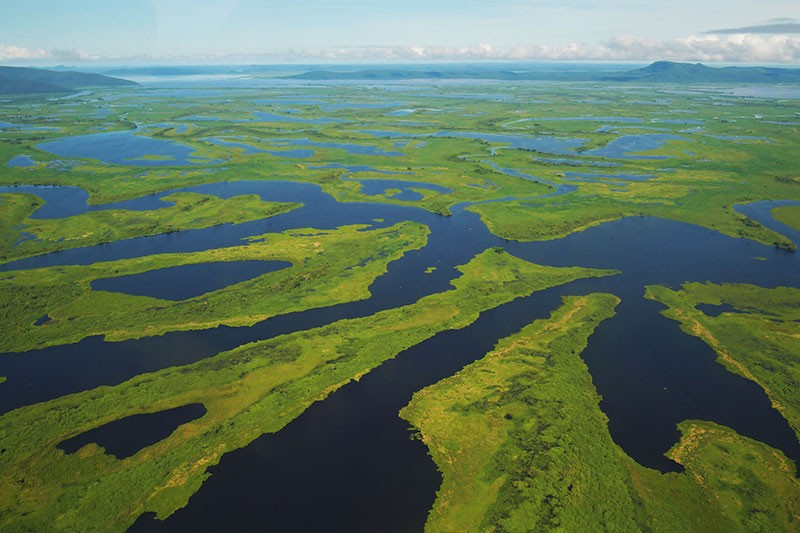
Aerial view of the Pantanal wetlands, in Mato Grosso state, Brazil.
Tropical wetlands, such as the Pantanal in Brazil, are a major source of methane emissions.Credit: Carl De Souza/AFP via Getty

Methane concentrations in the atmosphere raced past 1,900 parts per billion last year, nearly triple preindustrial levels, according to data released in January by the US National Oceanic and Atmospheric Administration (NOAA). Scientists says the grim milestone underscores the importance of a pledge made at last year’s COP26 climate summit to curb emissions of methane, a greenhouse gas at least 28 times as potent as CO2.

The growth of methane emissions slowed around the turn of the millennium, but began a rapid and mysterious uptick around 2007. The spike has caused many researchers to worry that global warming is creating a feedback mechanism that will cause ever more methane to be released, making it even harder to rein in rising temperatures.

“Methane levels are growing dangerously fast,” says Euan Nisbet, an Earth scientist at Royal Holloway, University of London, in Egham, UK. The emissions, which seem to have accelerated in the past few years, are a major threat to the world’s goal of limiting global warming to 1.5–2 °C over pre-industrial temperatures, he says.

A worrying trend: Line chart showing the rise in atmospheric methane levels since 1985.
Source: NOAA

Enigmatic patterns

For more than a decade, researchers have deployed aircraft, taken satellite measurements and run models in an effort to understand the drivers of the increase (see ‘A worrying trend’)1,2. Potential explanations range from the expanding exploitation of oil and natural gas and rising emissions from landfill to growing livestock herds and increasing activity by microbes in wetlands3.

“The causes of the methane trends have indeed proved rather enigmatic,” says Alex Turner, an atmospheric chemist at the University of Washington in Seattle. And despite a flurry of research, Turner says he is yet to see any conclusive answers emerge.

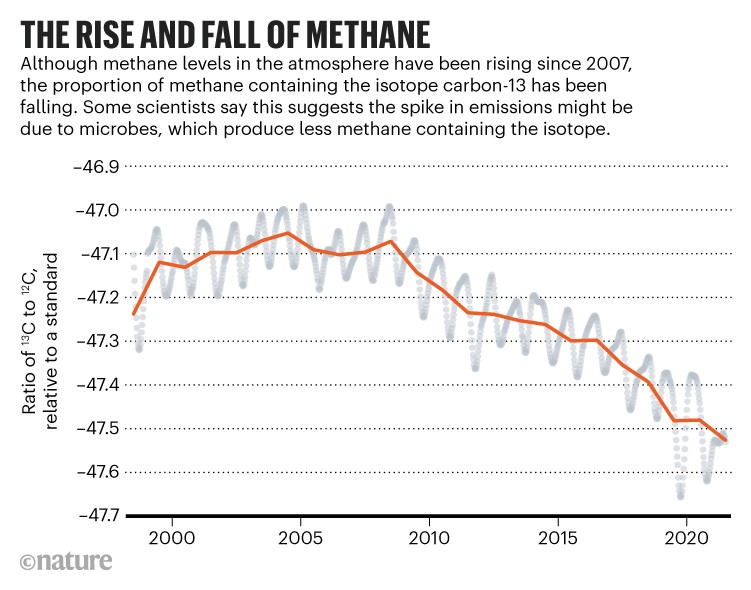
One clue is in the isotopic signature of methane molecules. The majority of carbon is carbon-12, but methane molecules sometimes also contain the heavier isotope carbon-13. Methane generated by microbes — after they consume carbon in the mud of a wetland or in the gut of a cow, for instance — contains less 13C than does methane generated by heat and pressure inside Earth, which is released during fossil-fuel extraction.

Scientists have sought to understand the source of the mystery methane by comparing this knowledge about the production of the gas with what is observed in the atmosphere.

By studying methane trapped decades or centuries ago in ice cores and accumulated snow, as well as gas in the atmosphere, they have been able to show that for two centuries after the start of the Industrial Revolution the proportion of methane containing 13C increased4. But since 2007, when methane levels began to rise more rapidly again, the proportion of methane containing 13C began to fall (see ‘The rise and fall of methane’). Some researchers believe that this suggests that much of the increase in the past 15 years might be due to microbial sources, rather than the extraction of fossil fuels.

The rise and fall of methane: Line chart showing the proportion of methane containing the isotope carbon-13.
Source: Sylvia Michel, University of Colorado Institute of Arctic and Alpine Research

Back to the source

“It’s a powerful signal,” says Xin Lan, an atmospheric scientist at NOAA’s Global Monitoring Laboratory in Boulder, Colorado, and it suggests that human activities alone are not responsible for the increase. Lan’s team has used the atmospheric 13C data to estimate that microbes are responsible for around 85% of the growth in emissions since 2007, with fossil-fuel extraction accounting for the remainder5.

The next — and most challenging — step is to try to pin down the relative contributions of microbes from various systems, such as natural wetlands or human-raised livestock and landfills. This may help determine whether warming itself is contributing to the increase, potentially via mechanisms such as increasing the productivity of tropical wetlands. To provide answers, Lan and her team are running atmospheric models to trace methane back to its source.

“Is warming feeding the warming? It’s an incredibly important question,” says Nisbet. “As yet, no answer, but it very much looks that way.”

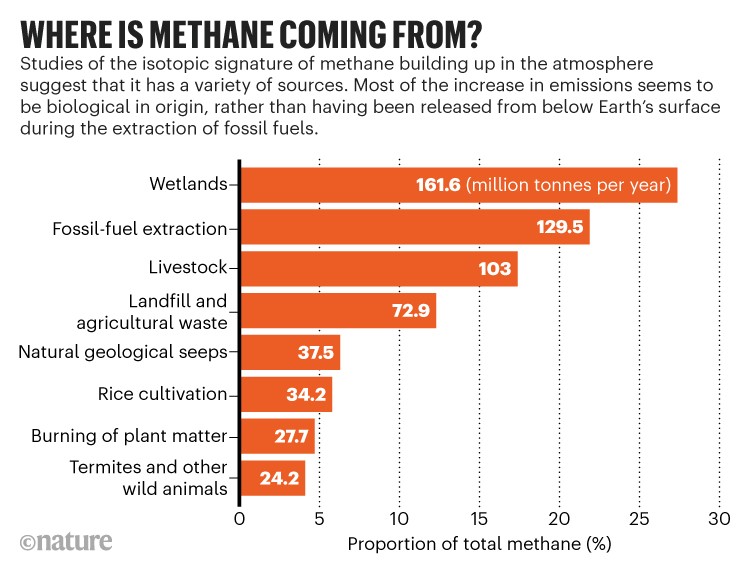
Regardless of how this mystery plays out, humans are not off the hook. Based on their latest analysis of the isotopic trends, Lan’s team estimates that anthropogenic sources such as livestock, agricultural waste, landfill and fossil-fuel extraction accounted for about 62% of total methane emissions since from 2007 to 2016 (see ‘Where is methane coming from?’).

Where is methane coming from?: Bar chart showing proportions of total methane produced by various sources.
SOURCE: Ref. 5.

Global Methane Pledge

This means there is plenty that can be done to reduce emissions. Despite NOAA’s worrying numbers for 2021, scientists already have the knowledge to help governments take action, says Riley Duren, who leads Carbon Mapper, a non-profit consortium in Pasadena, California, that uses satellites to pinpoint the source of methane emissions.

Last month, for instance, Carbon Mapper and the Environmental Defense Fund, an advocacy group in New York City, released data revealing that 30 oil and gas facilities in the southwestern United States have collectively emitted about 100,000 tonnes of methane for at least the past three years, equivalent to the annual warming impact of half a million cars. These facilities could easily halt those emissions by preventing methane from leaking out, the groups argue.

At COP26 in Glasgow, UK, more than 100 countries signed the Global Methane Pledge to cut emissions by 30% from 2020 levels by 2030, and Duren says the emphasis must now be on action, including in low- and middle-income countries across the global south. “Tackling methane is probably the best opportunity we have to buy some time”, he says, to solve the much bigger challenge of reducing the world’s CO2 emissions.

doi: https://doi.org/10.1038/d41586-022-00312-2

UPDATES & CORRECTIONS

  • Correction 08 February 2022: An earlier version of this story said that bacteria generate methane in wetlands and the guts of cows. Methane is emitted by microbes in these places.

References

  1. 1.Nisbet, E. et al. Phil. Trans. R. Soc. A. https://doi.org/10.1098/rsta.2021.0112

Phasing Out Animal Agriculture Could Stabilize Climate Change

Published: February 7, 2022

https://www.technologynetworks.com/applied-sciences/news/phasing-out-animal-agriculture-could-stabilize-climate-change-358277

| Original story from the University of California, Berkeley

Credit: Pixabay.

Read time:

 5 minutesGet PDF Version

A new study of the climate impacts of raising animals for food concludes that phasing out all animal agriculture has the potential to substantially alter the trajectory of global warming.

The work is a collaboration between Michael Eisen, professor of molecular and cell biology at the University of California, Berkeley, and Patrick Brown, professor emeritus of biochemistry at Stanford University and the CEO of Impossible Foods Inc., a company that sells plant-based meat substitutes.

Eisen, who consults for Impossible Foods, and Brown used a simple climate model to look at the combined impact of eliminating emissions linked to animal agriculture and of restoring native vegetation on the 30% of Earth’s land surface currently used to house and feed livestock.

They found that the resulting drop in methane and nitrous oxide levels, and the conversion of 800 gigatons (800 billion tons) of carbon dioxide to forest, grassland and soil biomass, would have the same beneficial impact on global warming as cutting annual global CO2 emissions by 68%.

“Our work shows that ending animal agriculture has the unique potential to significantly reduce atmospheric levels of all three major greenhouse gases, which, because we have dithered in responding to the climate crisis, is now necessary to avert climate catastrophe,” said Eisen, who is also a Howard Hughes Medical Institute (HHMI) investigator at UC Berkeley.

A major reason for the large long-term effect Eisen and Brown observe is that its benefits accrue rapidly. Brown argues that this demonstrates that eliminating animal agriculture should be as high a priority as eliminating fossil fuel use.

“Eliminating animal agriculture would have a quicker and greater impact over the next 20 to 50 years, the critical window for avoiding climate catastrophe, and thus should be at the top of the list of potential climate solutions,” Brown said.

“There is,” he added, “an enormous, previously unrecognized opportunity to sharply bend the trajectory of climate change within a couple of decades, with multiple additional environmental and public health benefits, and minimal economic disruption.”

The study was published Feb. 1 in the journal PLOS Climate.

Not an impossible task

Eisen and Brown have discussed the impacts of raising animals for food for years. Both men are vegans. Eisen stopped eating meat after convincing himself of the dire impact animal agriculture has on the world’s climate. Brown founded Impossible Foods in 2011 for similar reasons, began marketing the Impossible Burger in 2016, and recently launched plant-based chicken nuggets and ground pork products. 

“My awareness of the potential impact was a major motivation for launching Impossible Foods,” Brown said. “In fact, I’ve been saying for years that replacing livestock in the global food system would turn back the clock on climate change. But although I knew that this conclusion was directionally correct, the environment and policy community would accept it only if we did this rigorous modeling that Mike and I did.”

Most research on the impact of animal agriculture has focused on the impact today of methane emissions from animals and their manure, nitrous oxide from fertilizer used to grow animal feed, and from the carbon dioxide produced raising and transporting animals and meat. Two reports within the past year, however, addressed a different aspect of animal agriculture: the potential that grazing land has for regrowing vegetation and sequestering carbon from the atmosphere.

“Everybody knows that methane is a problem. Everybody knows that livestock contribute to global warming in some way,” Eisen said. “But animal ag contributes to global warming in two ways: It contributes via emissions and contributes because that land would otherwise be holding carbon. Most analyses only look at one of those things.”

Even though the animal industry today is responsible for about 16% of annual greenhouse gas emissions, by some estimates about one-third of all the carbon dioxide humans have added to the atmosphere since the dawn of animal husbandry is a result of land cleared for animal grazing and to grow feed or provide forage for animals used as food.

“What hadn’t been recognized is the much more impactful potential to unlock negative emissions by eliminating that industry,” Brown said.

The two scientists spent the pandemic years researching climate models and climate change literature to quantify the direct and indirect impact of eliminating animal agriculture worldwide. While cows and other bovids, like buffalo, represent about 80% of animal agriculture’s impact, they also considered the impact of pigs, chickens and other domesticated animals used for food, though not the world’s fisheries. 

While both researchers would just as soon eliminate animal agriculture today, they chose a more realistic scenario: a phaseout over 15 years.

“A 15-year phaseout is not unrealistic — a lot of things happen on that timeframe,” Eisen said. “We went from having no cellphones to cellphones being ubiquitous in less time than that. It’s not that we’re saying we’re going to get rid of animal ag in the next 15 years, though that’s sort of the mission for Impossible Foods, but that is something we could do.”

Their conclusions are that a 15-year phaseout would immediately eliminate about one-third of all methane emissions globally and two-thirds of all nitrous oxide emissions, allowing the atmosphere to achieve a new equilibrium at lower levels of both.

Better nutrition without animal products

While Eisen and Brown acknowledge that animal products are key to nutrition in most countries — they supply about 18% of the calories, 40% of the protein and 45% of the fat in the human food supply — they point out that worldwide, about 400 million people already live on entirely plant-based diets. Existing crops could replace the calories, protein and fat from animals with a vastly reduced land, water, greenhouse gas and biodiversity impact, requiring only minor adjustments to optimize nutrition.

Based on his experience with Impossible Foods, Brown said, “there’s compelling evidence that animal agriculture can be replaced without requiring meat lovers to compromise on nutrition or any of the sensory pleasures they love.”

Both scientists hope that their study will prod policymakers to consider the reduction or elimination of animal agriculture — barely mentioned in the most recent IPCC (Intergovernmental Panel on Climate Change) report — as an important option for reducing greenhouse gases. They look forward to a robust debate now that their data and analysis are online through the open access journal PLOS Climate.

“What we really did in the paper was try to formalize what it would mean to get rid of animal agriculture without making it too complicated,” Eisen said. “There’s a lot of uncertainty, there are a lot of unknowns, but I think probably the biggest uncertainty is whether people will look at this potential and act on it as a society.”

“I’m hoping that others, including entrepreneurs, scientists and global policymakers, will recognize that this is the most important opportunity humanity has to reverse the trajectory of climate change, and seize it,” Brown said.

The study was conducted with no outside funding. Eisen worked on the project as an HHMI investigator, alongside his research on gene regulation in fruit flies.

“I think this is a kind of Pearl Harbor moment for science. The climate of the planet is under a bigger threat now than it’s ever been in history, and to the extent that scientists can find ways to contribute, I think it’s really incumbent upon us to do so,” Eisen said.

Reference: Eisen MB, Brown PO. Rapid global phaseout of animal agriculture has the potential to stabilize greenhouse gas levels for 30 years and offset 68 percent of CO2 emissions this century. PLOS Climate. 2022;1(2):e0000010. doi:10.1371/journal.pclm.0000010


This article has been republished from the following materials. Note: material may have been edited for length and content. For further information, please contact the cited source.

Letter: Current Wolf Hunt is an Eradication

Let’s be honest why this eradication is taking place before we eliminate an important ancient wild animal from our landscape for the second timeBY MATT BOWSERFEBRUARY 5, 2022

I am a big game hunter. I’m not opposed to the ethical hunting of predators when it’s balanced with economic, social, and ecological factors. But the current wolf “hunt” in Montana is an eradication.

Montana’s wolf population is estimated between 900 and 1,100. Montana Fish, Wildlife and Parks is well on its way to achieving its kill quota of 450 this year – that’s almost half the total population. In addition to shooting and trapping: baiting, snaring (strangulation), night hunting (on private land), and electronic calling are legal means for taking a wolf.

If you’re like me and nearly vomit when thinking about this atrocity and try to find a scapegoat – look in the mirror. We’ve put the people in power who are making these decisions. Our governor – himself an illegal wolf hunter– and our state legislators passed the laws, then appointed unqualified cronies to top positions.

Politics aside, what a bizarre set of societal norms we adhere to when distinguishing acceptable treatment/management of animals? You can spend a year in jail for beating your dog. And the weekly police blotter reveals just how many folks dial 911 to report an underfed horse. Yet we send Yellowstone buffalo to slaughter because they cross an invisible line in search of food. Then we casually annihilate half the population of a species that dates back nearly a million years – whose domesticated descendants loyally sit next to us on the couch each evening.

It might help us to unravel the buried layers of “ye old pioneer spirit” wrapped within our current management policy: centuries old fears, inflated horror stories, and the control of nature. And begin to separate old superstitions from current reality. Let’s be honest why this eradication is taking place before we eliminate an important ancient wild animal from our landscape for the second time. 

Matt Bowser
Columbia Falls

Hunter shot dead in Catshill Forest

Exposing the Big Game's avatarCommittee to Abolish Sport Hunting Blog

YVONNE WEBB YESTERDAY

File photo
File photo

INVESTIGATIONS are continuing into the circumstances surrounding the shooting death of Ramcharan Bhimsingh.

Bhimsingh, 42, of Poonah Road, Whiteland, was reportedly in search of a lost dog at the Catshill Forest around 2 am on Sunday, when he was killed.

Relatives say Bhimsingh was a hunter.

A report said the police were called by one of the men who accompanied Bhimsingh into the forest. There were two others who were also part of the search for the dog.

The man told police, he and Ramcharan walked some miles into the forest, while the other two men stayed behind in their camp.

Just after midnight, they heard dogs barking and Bhimsingh walked towards the sound after which a loud explosion was heard like that of a gunshot. When he checked, the man saw Bhimsingh lying on the ground with what…

View original post 22 more words

COVID-19: An epidemic among deer

 STAFF REPORT  FEBRUARY 4, 2022 @ 11:47 PM 

Although a variety of animals have been infected with COVID-19, the infection in deer has turned into an epidemic.

COVID-19 is an epidemic among deer

In Iowa 80 out of 97 deer tested positive for COVID-19.https://googleads.g.doubleclick.net/pagead/ads?gdpr=0&us_privacy=1—&client=ca-pub-5391402735581468&output=html&h=187&slotname=7799918157&adk=1067748030&adf=3424203830&pi=t.ma~as.7799918157&w=748&fwrn=4&lmt=1644268869&rafmt=11&psa=0&format=748×187&url=https%3A%2F%2Fwww.fingerlakes1.com%2F2022%2F02%2F04%2Fcovid-19-an-epidemic-among-deer%2F&flash=0&wgl=1&adsid=ChAIgKODkAYQw_HSzK6Ns-dgEj0AxpwutgbTZiA5X89WzVXe7kmxeGuYWiESB1C79jdsamAyyBLnxupyfDj_TxkhhuY1SqDNnHqrqTckL0Yc&uach=WyJXaW5kb3dzIiwiMTAuMC4wIiwieDg2IiwiIiwiOTguMC40NzU4LjgyIixbXSxudWxsLG51bGwsIjY0IixbWyIgTm90IEE7QnJhbmQiLCI5OS4wLjAuMCJdLFsiQ2hyb21pdW0iLCI5OC4wLjQ3NTguODIiXSxbIkdvb2dsZSBDaHJvbWUiLCI5OC4wLjQ3NTguODIiXV1d&dt=1644268836691&bpp=35&bdt=19427&idt=1649&shv=r20220203&mjsv=m202202010101&ptt=9&saldr=aa&abxe=1&cookie=ID%3D9e71ea2a34620032-224127e970d00096%3AT%3D1643486298%3ART%3D1643486298%3AS%3DALNI_MagnQTOSG-4ZHsFDEP_oSB8-9nQJA&prev_fmts=728×90%2C0x0%2C1123x504&nras=2&correlator=4973200783853&frm=20&pv=1&ga_vid=1696174304.1643486255&ga_sid=1644268843&ga_hid=37408736&ga_fc=1&rplot=4&u_tz=-480&u_his=1&u_h=640&u_w=1139&u_ah=607&u_aw=1139&u_cd=24&u_sd=1.2&dmc=4&adx=24&ady=897&biw=1123&bih=504&scr_x=0&scr_y=0&eid=42531398%2C31064729%2C31060047%2C31062930&oid=2&psts=AGkb-H-srBHG44n_HnKALs9k-OBArutDw3ewxhktkbSOP9zaA23Tl-53E9dAfDbeih3ZDLTd09xCwrgkDMS0&pvsid=4037920857839337&pem=397&tmod=1280760686&uas=0&nvt=1&ref=https%3A%2F%2Fnews.google.com%2F&eae=0&fc=896&brdim=0%2C0%2C0%2C0%2C1139%2C0%2C0%2C0%2C1139%2C504&vis=1&rsz=%7C%7Cpoebr%7C&abl=CS&pfx=0&alvm=r20220201&fu=128&bc=31&jar=2022-02-07-21&ifi=2&uci=a!2&btvi=1&fsb=1&xpc=m2f0p7akBC&p=https%3A//www.fingerlakes1.com&dtd=32988

COVID-19 has a neurological impact

Are deer everywhere infected?

COVID-19 antibodies in deer have been reported in Ohio, Illinois, Michigan, New York, and Pennsylvania. There are millions of deer in the US and although it is unknown how many have been infected, the numbers are thought to be high. Find more information on it here.

The deer don’t really get symptoms from the COVID-19 infections, but that isn’t the experts main concern.

They fear that there is a possibility of another variant emerging from the deer whole have been infected. It is concerning because the potential variant could infect humans or other wildlife.

Because humans environmental contamination, like garbage or sewage.

COVID-19: Why some people get sick and others don’t

Does this impact humans?

Scientists agree that COVID-19 in humans is far more pressing than it is in animals.

There is a real fear of the potential variant to spread. Sarah Olson, an epidemiologist at the Wildlife Conservation Society, said “We can’t even control it in people. There’s hardly a chance we’re going to be able to control it in the wild.”

The COVID-19 remains hard to predict in humans, and proves to be even more of a challenge in animals.

Octopus, crabs and lobsters feel pain – this is how we found out

December 16, 2021 9.01am EST

Authors

  1. Alexandra SchnellResearch Fellow in Comparative Psychology, Darwin College, University of Cambridge
  2. Andrew CrumpPostdoctoral Research Officer, London School of Economics and Political Science
  3. Jonathan BirchAssociate Professor of Philosophy, London School of Economics and Political Science

Disclosure statement

Andrew Crump receives funding from the European Research Council (ERC) under the European Union’s Horizon 2020 research and innovation programme, Grant Number 851145. He is affiliated with the Animal Welfare Research Network, Association for the Study of Animal Behaviour, and Universities Federation for Animal Welfare.

Jonathan Birch receives funding from the European Research Council (ERC) under the European Union’s Horizon 2020 research and innovation programme, Grant Number 851145.

Alexandra Schnell does not work for, consult, own shares in or receive funding from any company or organization that would benefit from this article, and has disclosed no relevant affiliations beyond their academic appointment.

Partners

University of Cambridge provides funding as a member of The Conversation UK.

View all partners

CC BY NDWe believe in the free flow of information
Republish our articles for free, online or in print, under a Creative Commons license.

Republish this article

 Email

 Twitter61

 Facebook3.1k

 LinkedIn

 Print

Does a lobster feel pain when you pop it in a pot? The UK government asked us to find out.

We were commissioned to find out the likelihood of sentience – the capacity to have feelings, such as pain and pleasure – in two groups of invertebrate animals: the cephalopod molluscs (including octopuses, cuttlefishes and squids) and decapod crustaceans (including lobsters, crabs and prawns). We found strong and diverse evidence of sentience in both. And our recent report, which reviewed over 300 scientific studies, led to the UK government’s decision to legally recognise all of these animals as sentient beings.

You may wonder how we find out if an animal can feel pain. It’s tempting to think we only need to look at whether they try to avoid or escape being injured. However, after touching a hot stove, humans withdraw their hand before feeling the burn. Hand withdrawal is an unconscious reflex. Perhaps other animals only respond reflexively to injury, without experiencing pain.

For our investigation, we used eight scientific criteria for determining sentience.

Don’t let yourself be misled. Understand issues with help from experts

Get the newsletter

The first four addressed whether the animal’s nervous system could support sentience. We wanted to find out whether it can detect harmful stimuli and transmit those signals to the brain. And also whether the signals were processed in integrative brain regions – parts of the brain that bring together information from many sources. Finally, it was important to understand whether anaesthetic or painkillers changed the nervous system response.

Our four remaining criteria focused on the animal’s behaviour. Could they trade-off risks of injury against opportunities for a reward? Did individuals tend to the specific site of an injury, and could they learn to avoid stimuli associated with injury, for example? We also investigated whether they valued anaesthetics or painkillers when injured. This behaviour, which distinguishes rigid and reflex reactions to injury, such as withdrawing a burnt hand, from flexible responses, is taken to be evidence of pain.

Individually, none of our criteria proves that a creature is sentient. But the more criteria it meets, the more likely sentience becomes.

Signs of feeling

We found the strongest evidence for sentience in cephalopods. Octopuses were the stars. With around 170 million brain cells, they have higher brain-to-body ratios than most reptiles and fish. This allows octopuses to perform remarkable feats of learning and memory.

Octopuses also behave in ways that point strongly to experiences of pain. For example, in a recent study, they were given three chambers to explore. Injection with acetic acid in their initially preferred chamber led to octopuses avoiding that chamber from then on. Injured octopuses learned to prefer an alternative chamber, where local anaesthetic was available. This anaesthetic silenced nerve activity between the injury site and the brain. Similar findings in mammals are taken to indicate the subjective experience of pain.

Two crabs on a table with their claws taped up
Crabs capacity to feel pain has implications for animal welfare. RODNAE Productions/Pexels, CC BY

Decapods also displayed compelling signs of sentience. For instance, one high-profile study allowed crayfish to explore a cross-shaped tank. Two arms of the cross were illuminated, whereas the other two were shaded. In the wild, crayfish use dark shelters to hide from predators, so time spent in the shaded arms was taken to measure anxiety-like behaviour. Exposure to an electric field caused crayfish to avoid the light arms. Administering an anti-anxiety drug reversed the effect. These findings reveal that crayfish have mental states with similar brain mechanisms and behaviour to anxiety.

Despite striking evidence for sentience in some well-studied species, there are 750 cephalopod species and 15,000 decapod species – more than double the total number of mammal species. Most individual species have never been studied in detail.

But sentience has never been studied in most individual vertebrate species either. With vertebrates, it is usually accepted that we can make reasonable generalisations from laboratory species – such as rats and zebrafish – to other species.

Invertebrates should be treated in the same way as vertebrates. That means protecting under-studied animals if it is reasonable to generalise from strong evidence in a better-studied species. This principle led us to recommend extending protection to all cephalopod molluscs and all decapod crustaceans.

Implications for welfare

Recognising these animals as sentient is undoubtedly a step forward for UK animal welfare law, which currently applies almost exclusively to vertebrates. Some other countries, such as New Zealand, Norway and Sweden, have already given invertebrates legal protection. These cover issues such as the storage and slaughter of decapods in the food industry.

But in the UK, current industry practices will not be affected as the new bill does not apply to existing law. That means that procedures like boiling lobsters, asphyxiating octopuses and dismembering crabs will still continue.

We hope our report begins a wider conversation about how these animals can be treated humanely so we can minimise their pain and suffering. Many techniques, such as electrical stunning and rapid slaughter, are already informally considered best practice. Encouraging and enforcing best practice could protect producers against the erosion of standards, and reassure consumers that their expectations of high welfare standards are being met.

Fish and Wildlife Service to release nine endangered red wolves near Outer Banks

“We are committed, more than ever before … to identify ways to encourage and facilitate a coexistence between people and red wolves,” said the USFWS’s assistant regional director in the South Atlantic-Gulf and Mississippi Basin Regions.

By

Jenna Romaine | Feb. 4, 2022

https://thehill.com/changing-america/sustainability/environment/592837-fish-and-wildlife-service-to-release-nine?fbclid=IwAR0NvJJdfDsGyRnZi_Jl2iKFk9KGHVqicuo-1fFF6sNF55w74hGfdKOn_bM

In this June 13, 2017, file photo, the parents of this 7-week old red wolf pup keep an eye on their offspring at the Museum of Life and Science in Durham, N.C.(Associated Press photo/Gerry Broome, File)

Story at a glance

  • The U.S. Fish and Wildlife Service (USFWS) is preparing to release nine endangered red wolves to a conservation area west of the Outer Banks in North Carolina.
  • The red wolf, endemic to the United States and considered the most endangered wolf in the world, once called the entire Southeastern U.S. home before habitat destruction and overhunting nearly killed off the species.
  • The nine red wolves consist of a family and two additional breeding pairs that conservationists hope will help rebound the population of the species in the wild.

The U.S. Fish and Wildlife Service (USFWS) is preparing to release nine endangered red wolves to a conservation area west of the Outer Banks in North Carolina. 

The red wolf, endemic to the United States and considered the most endangered wolf in the world, once called the entire Southeastern U.S. home before habitat destruction and overhunting nearly killed off the species. Red wolves were listed as endangered in 1973 under the Endangered Species Act. 

Now, the USFWS is working to transfer and release nine of the wolves to a conservation area that includes the Alligator River and Pocosin Lakes National Wildlife Refuges. The nine red wolves consist of a family and two additional breeding pairs that conservationists hope will result in breeding to help rebound the population of the species in the wild. 


America is changing faster than ever! Add Changing America to your Facebook or Twitter feed to stay on top of the news.  


The USFWS recently held a virtual meeting with local residents, landowners, and stakeholders to address concerns and ensure a smooth transition in habiting species. The service has appointed a community liaison and set up a red wolf recovery hotline to aid with the transition. 

“We are committed, more than ever before, to working with our partners — the North Carolina Wildlife Resources Commission, landowners, and other stakeholders — to identify ways to encourage and facilitate a coexistence between people and red wolves,” Catherine Phillips, the USFWS’s assistant regional director in the South Atlantic-Gulf and Mississippi Basin Regions, said in a press release.  

“The recent meeting allowed us to hear from the local community and stakeholders, and to share with them what we are doing and plan to do going forward. We cannot recover the red wolf without them.”