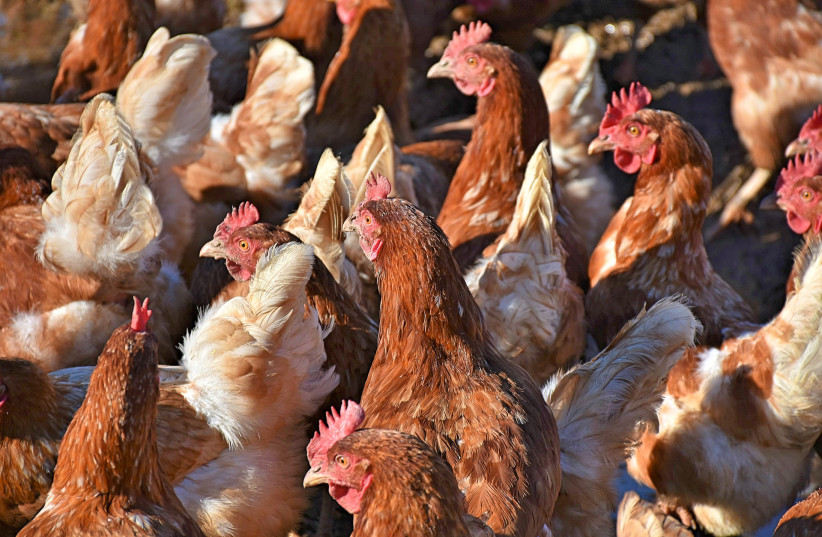
A flock of chickens (Illustrative).(photo credit: PIXABAY)Advertisementhttps://trinitymedia.ai/player/trinity-player.php?pageURL=https%3A%2F%2Fwww.jpost.com%2Fisrael-news%2Farticle-689748&unitId=2900003088&userId=43dabe08-2b1a-4c7c-bafe-85ac9a956566&isLegacyBrowser=false&version=20211223_a54468f8a9ce1bc491ca7dbac28b069f261fc6a4&useCFCDN=0&themeId=140A state of emergency has been announced in Israel by the Veterinary Service at the Ministry of Agriculture on Saturday evening after H5N1bird fluwas found in chicken coops near the town of Margaliot leading to the killing of 320,000 hens after 244,000 hens were killed in a separate outbreak on Sunday.Margaliot is a moshav in northern Israel. It is located near the border of Lebanon in the Upper Galilee area near Kiryat Shmona.The Veterinary Service said that it isolated the coops, immediately stopped the marketing of eggs both from the coops and the sorting station that received them, and began to examine nearby coops…
Travelers are seen at Hartsfield-Jackson Atlanta International Airport in Atlanta, Georgia, U.S. December 22, 2021. REUTERS/Elijah Nouvelage
WASHINGTON, Dec 25 (Reuters) – U.S. airlines canceled more than 900 flights on Saturday, the second straight day of massive cancellations as surging COVID-19 infections have sidelined some pilots and other crew members, upending plans for tens of thousands of holiday travelers over the Christmas weekend.
Authorities expect to have to clear 25 to 30 tons of crane carcasses after H5N1 virus spread from northern moshav, where farmers failed to report poultry deaths on time
The carcass of a crane, infected by avian flu, at the Hula Valley Nature Reserve in northern Israel, on December 23, 2021. (Shlomit Shavit, Israel Nature and Parks Authority)
One in five of the wild cranes living in or migrating through Israel have been infected with the fatal H5N1 bird flu virus, with authorities expecting to have to remove 25 to 30 tons of carcasses, the Israel Nature and Parks Authority (INPA) said Thursday.
The virus is believed to have spread from Moshav Margaliot on the Lebanese border, where 244,000 laying hens were housed in 60 coops, supplying six million eggs monthly, out of the 200 million eggs Israelis consume each month.
According to the Agriculture Ministry, the farmers there failed to report in real-time the rising numbers of poultry deaths, leading to the virus spreading rapidly.
Many of the chickens were dead by the time ministry inspectors arrived, and the rest were culled. In one coop, only 70 chickens were found alive out of 2,000.
The farm has been sealed off, as well as facilities receiving eggs from it.Get The Times of Israel’s Daily Editionby email and never miss our top storiesNewsletter email addressGET ITBy signing up, you agree to the terms
But on Thursday, the ministry reported that it was investigating someone from the moshav suspected of having tried to smuggle eggs out to sell them privately.
כשמדברים איתכם על שפעת העופות והמילה “השמדה” של מיליוני עופות עוברת לכם מעל הראש, כך זה במציאות, חנק בקצף שנמשך 9 דק’,…
A resident asked for special attention to his property Dec. 12 because he was receiving unwanted text messages. His request was granted, and advice was…
Bear managers across the state relayed plenty of grizzly bear stories during the Northern Continental Divide Grizzly Bear Ecosystem Subcommittee meeting earlier this month.
Region 2 bear specialist Jamie Jonkel spoke briefly about the fatality this summer of a bicyclist who was camping in Ovando and was killed by a grizzly bear that came into town.
Leah Davis Lokan, 65, of Chico, California, was killed when a bear attacked her in her tent.
The bear had awakened the woman and two others who were camping near the post office about 3 a.m. July 5, officials said. The bear then ran away.
The campers removed food from their tents, secured it and went back to sleep.
The approximately 400-pound (181 kilogram) bear was seen by a video camera at a business about a block away from the…
ROME, December 21, 2021—The Budget Committee of the Italian Senate today voted to approve a modified version of an amendment to the budget law which will see the country’s 10 remaining mink fur farms closed within six months and a permanent ban on fur farming throughout Italy.
HSI/Europe’s fur farm conversion proposal, which sought an end to fur farming due to animal cruelty and public health risks from zoonotic diseases, was endorsed by Italian Member of Parliament the Hon. Michela Vittoria Brambilla, who launched the political action to implement the conversion strategy with existing public funds, and Sen. Loredana De Petris who formally submitted the amendment.
Martina Pluda, director of Humane Society International in Italy, states: ”This is an historic victory for animal protection in Italy, and HSI/Europe is immensely proud that our fur farm conversion strategy has played a central role in dismantling this cruel and dangerous industry in our country. There are very clear economic, environmental, public health and of course animal welfare reasons to close and ban fur farms. Today’s vote recognizes that allowing the mass breeding of wild animals for frivolous fur fashion represents a risk to both animals and people that can’t be justified by the limited economic benefits it offers to a small minority of people involved in this cruel industry. With so many designers, retailers and consumers going fur-free, conversion of fur farms offers people a sustainable future that the fur trade simply cannot provide.”
The approved amendment includes:
An immediate ban on breeding of fur-bearing animals including mink, foxes, raccoon dogs and chinchillas, and the closure of all active fur farms in Italy by 30th June 2022;
Compensation for farmers, covered by a fund from the Ministry of Agriculture for a total of 3 million euros in 2022.
Hon. Michela Vittoria Brambilla, president of the Parliamentary Intergroup for Animal Rights and of the Italian League for the Defense of Animals and the Environment commented on the vote: ”In thirty years of animal rights battle this is the best victory. Finally, a parliamentary vote sanctions the end of unspeakable suffering inflicted on animals only in the name of profit and vanity. Italy is the twentieth European country to introduce a ban or severe restriction on fur farming: better late than never. Now we await the final approval of the budget law, but the political will has been clearly expressed. A dream comes true that animal protection associations have cultivated for decades in our country. I want to thank all the colleagues of the Intergroup, in particular Vice-President De Petris, who presented the amendment and reported it to the committee, the parliamentarians who shared this choice and the Italian office of Humane Society International which has promoted the economic study whose results formed the ‘basis’ for formulating the proposal. It is a great achievement, which finally all those who love and respect animals rejoice!”
The 4-year-old female ape, named Baran, had been relocated from Eram Zoo in Iran to the Sweetwaters Chimpanzee Sanctuary in central Kenya in August.
The sanctuary is in Ol Pejeta Conservancy, which covers 220 square miles in Laikipia County. According to a statement posted on Facebook by the organization, the new arrival had an unexpected encounter with some of the other chimpanzees, who reacted aggressively to her
After the death of her mother, Baran—whose name means “rain” in Persian—had to be moved to a cage alone to protect her from attacks by the other apes.
The transfer to the Kenyan sanctuary was the result of months of collaboration between Ol Pejeta Conservancy, Eram Zoo, the Kenya Wildlife Service, Iranian embassy officials and other animal welfare organizations.
Following the transfer, Baran was quarantined for 90 days, as required by the Kenya Wildlife Service. During this period she will have had access to round-the-clock veterinary care, because the rescued chimps who arrive at Sweetwater generally need to be nursed back to health.
“Baran had successfully completed her quarantine period since her arrival at the sanctuary and had been moved from quarantine to the main chimpanzee house where she was in the process of being integrated with the other chimpanzees,” Ol Pejeta Conservancy wrote. “She was at the primary stage of integration in a facility where she could see the other chimpanzees from a distance, but with no physical contact.”
During this stage, which the charity says is necessary to help the chimps familiarize themselves with one another until a bond is formed to enable the next stage of integration, Baran breached security and encountered the other chimps.
The conservancy statement continued: “Whilst the chimpanzees were in a separate room from Baran, there was a small section in the wall with grilles between them. It was between these grilles that a physical encounter occurred with some of the other chimpanzees.”
Ol Pejeta Conservancy said 22 chimpanzees had been successfully integrated into the Sweetwaters sanctuary in previous years.
It added: “We take this situation very seriously and shall ensure procedures and protocols are further strengthened.
“We are deeply saddened by the loss of Baran as she was poised to become a youthful member of the larger family of 34 chimpanzees living within the sanctuary.”
Chika, a shiba inu, dashes through a trail in winter. (Photo courtesy of Megan Ahleman)
At least a half dozen dogs and one person were accidentally caught in traps or snares in Alaska last winter, and at least one of those accidents killed a dog. That’s according to a report from the Alaska Wildlife Alliance, a nonprofit that advocates for more trapping restrictions.
The group saysits report, called “Map the Trap,” was the first of its kind and sought to fill a void of information in the state about how the public interacts with traps.
“There’s no centralized database for trap encounters, be it through ADF&G or state troopers or wildlife troopers,” said Alaska Wildlife Alliance director Nicole Schmitt, “Each…
People with IBD had greater levels of microplastics in their feces than healthy controls, but it’s not clear yet whether these pollutants are a true trigger.
A scientist collecting microplastic waste for research on the beach of Contis, southwestern France, on August 17, 2020.
Scientists this week have reported an interesting correlation between microplastics and inflammatory bowel disease (IBD). Those with diagnosed IBD, the researchers found, had noticeably greater levels of microplastics in their feces than healthy controls. The findings could suggest that these pollutants have a causative role in IBD, the researchers say, or indicate that people with IBD are more likely to collect microplastics in their gut.
Inflammatory bowel disease, not to be confused with irritable bowel syndrome (IBS), is a debilitating, chronic, and complexdigestive condition. It comes in two major forms, ulcerative colitis and Crohn’s disease…
The Pennsylvania Game Commission won’t file charges in connection with a fatal November hunting-related shooting in Warren County nor in a separate hunting accident earlier this month in Crawford County.
Investigations into the separateincidents have been completedwith no chargesfiled, Jason Amory told the Tribune. Amory is theinformation and education officer with the Pennsylvania Game Commission’s Northwest Regional Office in Franklin.
Gary Hunt, 64, of Corry, died after he was shot fatally in the abdomen byhis hunting companion’s .270-caliber rifleas the two men were crossing a creek around noon Nov. 20 in western Warren County. The two men were bear hunting onState Game Lands 197 in Columbus Township, west of Corry.Hunt’s companion slipped or tripped as the two crossed the stream with an unintentional discharge of the companion’s rifle.
“There was no way to tell whether the safety (on the rifle) was…