A major new windfarm project that will power millions of homes is likely to be approved on Friday, but conservationists fear for the safety of endangered birds in the area.
The Norfolk Boreas offshore windfarm is due to get the green light from the government, the Guardian can reveal.
The windfarm is said to be being backed by Boris Johnson who, government sources claim, is so keen on the project that he refers to himself as “Boreas Johnson” in meetings about it. The Department for Business, Energy and Industrial Strategy (BEIS) source claimed that Johnson was extra keen on the project because of his love of Greek mythology – Boreas was the ancient Greek god of the north wind. It is said the prime minister hopes this can be a flagship green energy project that could make Britain the “Saudi Arabia of wind power”.https://interactive.guim.co.uk/uploader/embed/2021/12/norfolkwindfarm-zip/giv-825QJ9lTK8xOKyf/
The windfarms planned for the Norfolk coast – Boreas and another project, Vanguard – are estimated to be able to power 10% of UK homes – around 3.9million UK homes. Wind power contributed 24.8% of UK electricity supplied in 2020, having surpassed coal in 2016 and nuclear in 2018. To meet a net zero pledge in 2030, more windfarms need to be built, as this is currently the UK’s most significant source of renewable energy.Advertisementhttps://126c518b6419ad175c2ca146e39de34c.safeframe.googlesyndication.com/safeframe/1-0-38/html/container.html
However, the north Norfolk coast is home to some of Britain’s most significant colonies of endangered sea birds including kittiwakes, gannets and lesser black-backed gulls. There are concerns from the Royal Society for the Protection of Birds that the blades could kill the birds. On top of this the project involves disrupting the area where the birds feed, and making it more difficult to travel from the ocean to their nests. If it takes the birds too long to fly back to their young, the chicks can starve to death.
An RSPB source said the site has difficulties because of the number of rare birds that feed, travel through and nest in the area. “Ultimately we need to get away from sites with unavoidable problems. Which is in the gift of the Crown Estate, as the seabed belongs to the Queen,” he said.
“We are very concerned about the cumulative impact of all these turbines in one space. The secretary of state has ‘accepted’ other windfarms will impact on seabirds in this area (some globally important colonies for kittiwakes and others) – and the mitigation methods being proposed are untried and untested, so it could well be over a decade before we know if they will be successful, by which time the damage will have been done to the colony.”
A source at BEIS confirmed the windfarm is expected to be approved.
The windfarm, which is to be built by the Swedish firm Vattenfall, has also faced complaints from people in Norfolk, who say the vast cabling required to construct the project would be disruptive to their homes. Some 85 parish councils have written to BEIS to express opposition to the plans.
The Vanguard project was recently blocked in the high court after a resident argued the joint impact of Vanguard and Boreas would be too disruptive to his home and that the secretary of state had not taken into account the effect of both. The application must now go back to the government for reassessment, according to the Planning Inspectorate.
Vattenfall said in a statement: “Offshore wind will be the backbone of our energy system as we tackle climate change. By 2050, it’s estimated that renewable energy will provide 80% of our electricity needs, and much of this will need to come from offshore windfarms.
“Norfolk Vanguard and Norfolk Boreas are part of the next generation of windfarms. By working with communities, the supply chain, skills and environmental experts, we have designed projects that can bring real lasting benefits – to Norfolk and the UK.
“These windfarms will bring £15m of funding for local communities, and will be in place for the 25-year life of the windfarms. This is the largest funding commitment to Norfolk by an offshore wind company to date.”
It argues that biodiversity is at the forefront of its plans: “Each windfarm has its own bespoke monitoring and habitat management plan, developed through the planning process with input from expert groups.
“This work constantly improves our understanding of the ways in which wildlife and habitats responds and adapts to wind farms, and helps to inform our research programmes.”
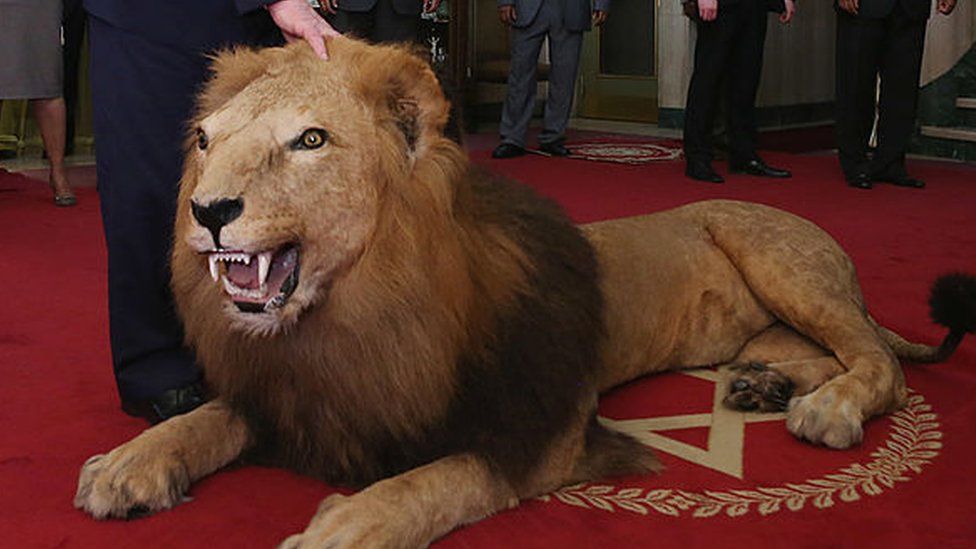
Image caption,Animal trophies are brought into the UK each year
Conservation groups and campaigners have called on the government to move faster with plans to ban the import of animal hunting trophies.
On Friday, the government published its long-awaited response to a public consultation on the issue and promised a ban.
But it stopped short of naming a date when legislation would be introduced.
Trophies made from hunted lions and elephants are brought into the UK each year.
“The longer it goes on, the more animals are being shot and brought back to Britain as trophies,” Campaign to Ban Trophy Hunting founder Eduardo Goncalves told BBC News.
Every year, hunters from the UK travel abroad, often to southern Africa, and pay thousands of pounds to legally shoot animals such as lions and elephants.
With the right paperwork, they can then bring trophies, such as stuffed heads or horns, back to the UK.
Announcing details of the new bill, Environment Secretary George Eustace said the legislation would go further than originally promised.
The import ban would include not just endangered and threatened species but also more than 1,000 others, such as zebra and reindeer.
Image caption,Animals such as elephants are hunted for trophies to be displayed in the UK
“This would be one of the toughest bans in the world, and goes beyond our manifesto commitment,” Mr Eustace said.
“We will be leading the way in protecting endangered animals and helping to strengthen and support long-term conservation.”
In 2020, despite the pandemic restricting travel, elephant tusks, hippo skulls, lion, baboon and giraffe were among the trophies legally brought back to the UK from southern Africa, the latest, incomplete data shows.
And between 2015 and 2019, there were 335 documented imports of trophies from animals covered by the Convention on International Trade in Endangered Species of Wild Fauna and Flora, the government report says.
A ban on the import of hunting trophies was included in the Conservative Party’s 2019 election manifesto and the Queen’s Speech that followed and has been mentioned by Prime Minister Boris Johnson several times in Parliament.
But asked in early December when the legislation would be brought to Parliament, Leader of the House of Commons Jacob Rees-Mogg replied: “In the fullness of time.”
On Friday, Labour MP John Spellar will table a private member’s bill that would ban the import of trophies – but it has little chance of success without government backing.
“The public will be rightly outraged by dither and delay,” Mr Spellar said.
“It’s time to put an end to this vile trade once and for all.
“The government should either allow my private member’s bill to progress or rapidly introduce its own legislation.”https://emp.bbc.com/emp/SMPj/2.44.10/iframe.htmlMedia caption,On frontline with Kenya’s anti-poaching force
But although 86% of the 44,000 responses to the public consultation called for tighter restrictions on the import of hunting trophies and a ban has cross-party support in the Commons, some conservationists say hunting provides funds that can be used to protect endangered animals and their habitats.
“This decision is a triumph of propaganda over science, and prejudice over evidence,” Christopher Graffius, from the British Association for Shooting and Conservation, told BBC News.
“What aid will the government give to replace income from hunting to seriously economically and environmentally challenged communities around the world?
“This ban will be bad for animals, people and the land they live on.”
Dec 9, 2021by James Smurthwaite Followhttps://www.facebook.com/plugins/like.php?width&layout=button_count&action=like&show_faces=false&share=true&height=21&href=https%3A%2F%2Fwww.pinkbike.com%2Fnews%2Fmountain-biker-in-spain-shot-after-being-mistaken-for-a-rabbit.html%3Futm_source%3Dfacebook.com%26amp%3Butm_medium%3Dreferral%26amp%3Butm_campaign%3Dfb-like https://platform.twitter.com/widgets/tweet_button.21f942bb866c2823339b839747a0c50c.en.html#dnt=false&id=twitter-widget-0&lang=en&original_referer=https%3A%2F%2Fwww.pinkbike.com%2Fnews%2Fmountain-biker-in-spain-shot-after-being-mistaken-for-a-rabbit.html&size=m&text=Mountain%20Biker%20in%20Spain%20Shot%20After%20Being%20Mistaken%20for%20a%20Rabbit%20-%20Pinkbike&time=1639179000071&type=share&url=https%3A%2F%2Fwww.pinkbike.com%2Fnews%2Fmountain-biker-in-spain-shot-after-being-mistaken-for-a-rabbit.html&via=pinkbike Add to FavoritesPhoto: Ernest Damian Diez, Facebook A mountain biker was shot with dozens of pellets after being mistaken for a rabbit by a hunter in Alicante, Spain, theolivepress reports
Miguel Toran had just passed a pair of hunters on his ride but was then mistakenly shot by a third a few metres later. Torna was in colourful kit and wearing a helmet while riding on the Monte Orgergia forest trail, which is popular with riders and walkers. The hunter discharged a cartridge that contained hundreds of pellets and left Toran with impacts on his buttocks, lower back and legs. Fortunately, no major organs were hit but paramedics later removed 20 pellets that had become embedded in Toran’s skin.
Local emergency services were called and although the cyclist was not taken to hospital, his wounds are being monitored by doctors to see if…
The Iowa DNR is asking hunters to review safety procedures after several weekend hunting accidents — including one that was fatal.
The DNR is still investigating the details of the shooting of 37-year-old Nathan Sharpnack of Winterset — who was hit and died while deer hunting in Marion County Saturday.
They have also received reports of an individual who was taken to the hospital after being shot in the stomach while deer hunting in southern Muscatine County. Another person was treated and released from the hospital in Waukon after a slug grazed his right hand and forearm during a deer drive in Allamakee County.
A pheasant hunter was hit with four pellets in the neck and face area while hunting in Calhoun County. He was treated and released. The DNR education coordinator says it’s time for everyone…
NORTHEAST PA – (WOLF) —Pennsylvania Game Commission announced yesterday that a Lackawanna County man was prosecuted for the illegal poaching of eight white-tailed deer over a three-month period in Pike, Lackawanna, and Susquehanna counties.
Anthony Santarelli, 50, of Jessup, pled guilty to five counts of unlawful taking or possession of game and 16 other similar charges.
Bill Williams of the PA Game Commission confirmed that they received information earlier this year that multiple deer were unlawfully killed in the community of Fawn Lake Forest in Pike County.
Officials say that video surveillance showed Santarelli’s truck in the same area as two deer that had been fatally wounded from a crossbow bolt.
Further investigation allowed officials to find a crossbow bolt on the deck of the homeowner; forensic evidence at the scene revealed that this bolt had…
BEIJING, Dec 9 (Reuters) – A woman in China’s Sichuan province died from the H5N6 strain of avian influenza last month, a regional health bureau said this week, in the latest human fatality from the lethal disease.
She had been exposed to dead poultry before the onset of illness, it added.
The number of people in China infected with H5N6 bird flu this year has jumped, raising concern among experts, who say a previously circulating strain appears to have changed and may be more infectious to people.read moreReport ad
Of 26 infections reported by various government departments this year, most have been…
In Kim Stanley Robinson’s novel The Ministry for the Future, climate disasters kill tens of millions of people – and that’s a scenario he portrays as relatively optimistic
‘Robinson’s books slow down the apocalyptic highlight reel, letting the story play in human time for years, decades, centuries. … We watch people keep dying, and coping, and struggling to shape a future – often gloriously.’ Photograph: Terese Loeb Kreuzer/Alamy
To really grasp the present, we need to imagine the future – then look back from it to better see the now. The angry climate kids do this naturally. The rest of us need to read good science fiction. A great place to start is Kim Stanley Robinson.
Robinson is one of the most brilliant writers of the genre. During Covid quarantine, I read 11 of his books, culminating in his instant classic The Ministry for the Future, which imagines several decades of climate politics starting this decade.
The first lesson of his books is obvious: climate is the story. Compared with the magnitude of the crisis, this year’s United Nations climate summit, Cop26, was a poorly planned pool party where half the guests were sweating in jeans, having forgotten their swimming suits. If you’re reading this, you probably know what climate science portends – and that nothing discussed in Glasgow was within rocket range of adequate. What Ministryand other Robinson books do is make us slow down the apocalyptic highlight reel, letting the story play in human time for years, decades, centuries. The screen doesn’t fade to black; instead we watch people keep dying, and coping, and struggling to shape a future – often gloriously.
I spoke to Robinson recently for an episode of the podcast The Dig. He told me that he wants leftists to set aside their differences, and put a “time stamp on [their] political view” that recognizes how urgent things are. Looking back from 2050 leaves little room for abstract idealism. Progressives need to form “a united front,” he told me. “It’s an all-hands-on-deck situation; species are going extinct and biomes are dying. The catastrophes are here and now, so we need to make political coalitions.”
The point of Robinson’s decades of sci-fi isn’t to simply counsel “vote blue no matter who.” He told me he remains a proud and longtime member of the Democratic Socialists of America (DSA). But he does want leftists – and everyone else – to take the climate emergency more seriously. He thinks every big decision, every technological option, every political opportunity, warrants climate-oriented scientific scrutiny. Global justice demands nothing less.
Robinson believes every big decision, every technological option, warrants climate-oriented scientific scrutiny
More broadly, Robinson seems to be urging all of us to treat every possible technological intervention – from expanding nuclear energy, to pumping meltwater out from under glaciers, to dumping iron filings in the ocean – from a strictly scientific perspective: reject dogma, evaluate the evidence, ignore the profit motive.
It’s an admirable view. And Robinson is no blinkered techno-optimist: some of the most compelling characters in his novels use science to reject swaths of technological development. He doesn’t necessarily want to pursue every form of geoengineering that we investigate, but he wants us to debate them.
As he put it to me: “science good, capitalism bad”. He sees the development of the scientific method as a phenomenon as universal to the human condition as art. In his ice age novel Shaman, one character invents a new kind of ankle brace while another invents a new kind of cave painting.
I’m attracted to this vision. But I’m not convinced that the science v capitalism binary is as clear in practice as Robinson asserts. We live in a world where capitalist states and giant companies largely control science. (Just consider the moral insanity and capitalist logic of global vaccine apartheid.) Some of the biggest backers of technology to capture carbon and store it underground are oil companies like Exxon. Yes, we need to consider technologies with an open mind. That includes a frank assessment of how the interests of the powerful will shape how technologies develop. Robinson could learn from the positions of activists of color, especially Indigenous and environmental justice groups, who fight against “false solutions” based on centuries of exploitation and sacrifice.
Robinson’s imagined future suggests a short-term solution that fits his dreams of a democratic, scientific politics: planning, of both the economy and planet. It’s a grandiose imperative, but the underlying insight is sound, and it’s borrowed from Robinson’s reading of ecological economics. That field’s premise is that the economy is embedded in nature – that its fundamental rules aren’t supply and demand, but the laws of physics, chemistry, biology. The upshot of Robinson’s science fiction is understanding that grand ecologies and human economies are always interdependent.
Robinson believes that once progressives internalize the insight that the economy is a social construct just like anything else, they can determine – based on the contemporary balance of political forces, ecological needs, and available tools – the most efficient methods for bringing carbon and capital into closer alignment. Success will snowball; we’ll democratically plan more and more of the eco-economy.
Seen from Mars, then, the problem of 21st-century climate economics is to sync public and private systems of capital with the ecological system of carbon. Robinson’s elegant solution, as rendered in Ministry, iscarbon quantitative easing. The idea is that central banks invent a new currency; to earn the carbon coins, institutions must show that they’re sucking excess carbon down from the sky. In his novel, this happens thanks to a series of meetings between United Nations technocrats and central bankers. But the technocrats only win the arguments because there’s enough rage, protest and organizing in the streets to force the bankers’ hand.
Robinson thus gets that climate politics are fundamentally the politics of investment – extremely big investments. As he put it to me, carbon quantitative easing isn’t the “silver bullet solution,” just one of several green investment mechanisms we need to experiment with.
In his political economy, Robinson tries to think like a bench scientist – an experimentalist, wary of unifying theories
Robinson shares the great anarchist dream. “Everybody on the planet has an equal amount of power, and comfort, and wealth,” he said. “It’s an obvious goal” but there’s no shortcut. Moving in that direction, he argues, requires radical pragmatism – preventing ecological collapse, while ratcheting up public control of investment. We just can’t know in advance what works best.
In his political economy, like his imagined settling of Mars, Robinson tries to think like a bench scientist – an experimentalist, wary of unifying theories, eager for many groups to try many things.
And there’s something liberating about Robinson’s commitment to the scientific method: reasonable people can shed their prejudices, consider all the options and act strategically. This blurring of science and politics is what draws me to his work, even when I (often) disagree with his conclusions. Like the great socialist film-maker Ken Loach, Robinson is a leftist who portrays debate as one of the greatest activities in organized social life. It’s in that sense that Robinson’s optimistic opposition between science and capitalism is most compelling: not beakers versus banks, but social action based on thoughtful discussion of social and ecological needs instead of the murderous supremacy of profit.
Of course, there are limits to people’s good sense. Robinson gets that too. The years ahead will be brutal. In Ministry, tens of millions of people die in disasters – and that’s in a scenario that Robinson portrays as relatively optimistic. And when things get that bad, people take up arms. In Ministry’s imagined future, the rise of weaponized drones allows shadowy environmentalists to attack and kill fossil capitalists. Many – including myself – have used the phrase “eco-terrorism” to describe that violence. Robinson pushed back when we talked. “What if you call that resistance to capitalism realism?” he asked. “What if you call that, well, ‘Freedom fighters’?”
There will be escalating violence, escalating state repression and increasing political instability. We must plan for that too
To be clear, Robinson insists that he doesn’t condone the violence depicted in his book; he simply can’t imagine a realistic account of 21st century climate politics in which it doesn’t occur. He has spoken approvingly of Andreas Malm’s book How to Blow Up a Pipeline, which urges sabotage against the fossil fuel industry. Malm writes that it’s shocking how little political violence there has been around climate change so far, given how brutally the harms will be felt in communities of color, especially in the global south, who bear no responsibility for the cataclysm, and where political violence has been historically effective in anticolonial struggles.
In Ministry, there’s a lot of violence, but mostly off-stage. We see enough to appreciate Robinson’s consistent vision of most people as basically thoughtful: the armed struggle is vicious, but its leaders are reasonable, strategic. And the implications are straightforward: there will be escalating violence, escalating state repression and increasing political instability. We must plan for that too.
And maybe that’s the tension that is Ministry’s greatest lesson for climate politics today. No document that could win consensus at a UN climate summit will be anywhere near enough to prevent catastrophic warming. We can only keep up with history, and clearly see what needs to be done, by tearing our minds out of the present and imagining more radical future vantage points. If millions of people around the world can do that, in an increasingly violent era of climate disasters, those people could generate enough good projects to add up to something like a rational plan – and buy us enough time to stabilize the climate, while wresting power from the 1%.
Robinson’s optimistic view is that human nature is fundamentally thoughtful, and that it will save us – that the social process of arguing and politicking, with minds as open as we can manage, is a project older than capitalism, and one that will eventually outlive it. It’s a perspective worth thinking about – so long as we’re also organizing.
Daniel Aldana Cohen is assistant professor of sociology at the University of California, Berkeley, where he directs the Socio-Spatial Climate Collaborative. He is the co-author of A Planet to Win: Why We Need a Green New Deal
The Congress of Deputies in Spain passed a new bill on animal sentience last Thursday, ruling that animals in the country should be afforded the protections of “sentient beings” by law. With it will come new sanctions on the seizure, mistreatment, and abandonment of domestic and wild animals, including the way in which custody of pets is decided post-divorce.
“It’s a step forward and it says that in separations and divorces, the arrangement that will be applied to the animals will take into account not only the interests of the humans, but also of the animal,” said animal rights advocate María González Lacabex from INTERcids.
The positive move for animal rights was met with widespread support, only being contested by Ángel López Maraver of the far-right political party Vox, former president of the Spanish Hunting Federation, who branded it “insanity, nonsense, stupidity. It humanizes animals and dehumanizes man.”
HOW IS ANIMAL SENTIENCE RECOGNIZED ELSEWHERE?
Animal sentience has been a hot topic in the UK this year. In May, 50 animal charities inspired the UK Government to formally recognize animals as sentient beings in domestic law.
Since its introduction, octopuses, squid, and lobsters have also joined the sentience crew, animals that had previously struggled to fall under this category owing to their lack of backbones and bizarre neural blueprints. The review will change commercial practices such as live boiling without stunning, extreme slaughter methods, transporting the animals in icy water, and the sale of live decapod crustaceans to untrained handlers.
WHAT IS SENTIENCE?
“Animal sentience refers to the ability of animals to feel and experience emotions such as joy, pleasure, pain and fear,” reads a 2013 review titled Searching for Animal Sentience: A Systematic Review of the Scientific Literature.
“It is animals’ capacity to feel both positive and negative states that drives the animal welfare movement and is the reason why animal protection laws exist.”
As humans, we have historically found it easier to apply the concept of sentience to closely related species such as primates. For some of Earth’s less familiar subjects, we’ve been more reserved. Lawmakers in the US are currently fighting the good fight on behalf of cephalopods including octopuses, who currently aren’t even classified as animals when it comes to federal research. This leaves them vulnerable to mistreatment that multiple studies and organizations have found them to be both capable of experiencing and vulnerable to.
BY MIKE STUNSON UPDATED DECEMBER 08, 2021 4:04 PM Play VideoDuration 1:52 Hunters: Know the rules of firearm safety Texas Parks and Wildlife hunter education specialist Heidi Rao reviews the four rules of firearm safety. BY TEXAS PARKS AND WILDLIFE DEPARTMENT A high school freshman was killed last weekend after he accidentally shot himself while hunting, Missouri officials told news outlets. Jordan Griffey, a 14-year-old student at Clark County R-1 High School in northeast Missouri, tripped while he was hunting on Dec. 3, causing his rifle to fire at him, WGEM reported. Jordan was shot in the shoulder and died of “massive blood loss,” the coroner said, according to KHQA. TOP VIDEOS Continue watching Video: Better yet, here’s how to compost yard, food waste for a better garden after the ad × The teenager was known “as a kind and loving person,” his obituary states. “He had a passion…
The body of Luki Akelkok III was found Saturday, ending a multi-day search for the 28-year-old Dillingham man who went missing after his boat sank near Whittier in bad weather, according to Alaska State Troopers.
Akelkok was on the boat with 28-year-old Anchorage man Stefan Weingarth. Weingarth was found dead Wednesday night. The two men had been returning to Whittier from a hunt on Esther Islandearlier that daywhen they encountered rough seas and high winds. Weingarth contacted another group of boaters to report that they were five minutes outside of Whittier and sinking, said troopers. Bad weather hampered the rescue.
On Saturday, Aklelkok’s family and the boat’s owner were in Whittier to retrieve the capsized skiff.