Hunting this fall could be largely shaped by the widespread drought hitting the stateBY TOM KUGLIN, INDEPENDENT RECORDAUGUST 9, 2021
HELENA — Hunting this fall could be largely shaped by the widespread drought hitting the state this summer, from potential access closures to impacts on wildlife fitness and location.
While some early hunts start in August, Montana’s hunting season really begins in earnest Sept. 4 with the start of the six-week archery season. On Oct. 23 general season kicks off for five weeks and ends the Sunday after Thanksgiving. And new for this year, traditional muzzleloader hunters will have their own nine-day season to chase elk and deer in December.
Most big game herds fared pretty well following a mild winter by Montana standards. Cold snaps remained relatively short-lived with little lower elevation snow. And hunter success hovered around average levels…
Therelease todayof the first part of the Intergovernmental Panel on Climate Change’s sixth assessment report makes for stark reading. It reaffirms that anthropogenic climate change is real, present and lasting: it is now unequivocal that human influence has warmed the atmosphere, ocean and land to an unprecedented degree, with effects almost certain to worsen through the coming decades.
The report also dispels any notion that the effects of the climate crisis are abstract or distant. Extreme events are being felt across the world, from wildfires in Australia, Sweden and north-west America to heatwaves in Siberia and Canada and the devastating…
BISMARCK, N.D. (AP) — Wildlife managers say predictions of a poor duck breeding season in North Dakota due to the drought have proven true, and hunters should expect challenging conditions this fall.
The number of duck broods, or families, observed during the state Game and Fish Department’s annual mid-July survey was the lowest in nearly three decades. This year’s fall duck flight is expected to be down 36% from last year, according to Mike Szymanski, the agency’s migratory game bird management supervisor.
“Hunters should take advantage of early migrants like blue-winged teal during the first two weeks of the season,” Szymanski said. “We won’t be able to depend on local duck production to the extent that we have in the past.”
The news was not unexpected,the Bismarck Tribunereported. More than half of North Dakota is in extreme or exceptional drought, the two worst categories, while all…
Written byCharlie SchillAugust 9, 2021In mid-July, the non-profit Earthjustice organization signaled its intent to file a lawsuit on behalf of 10 other environmental groups against the state of Idaho to block implementation of new laws encouraging the hunting of gray wolves.
BOISE – Environmentalists’ opposition to Idaho’s war on wolves is gaining momentum.
On behalf of 10 other wildlife advocacy groups, the non-profit Earthjustice organization recently filed a legal notice of its intent to sue the state of Idaho over its new wolf-hunting laws.
Those statutes, which went into effect July 1, call for the killing of up to 90 percent of the state’s gray wolf population through year-round hunting, trapping and snaring.
But environmentalists argue that Idaho’s unlimited wolf-hunting methods will result in incidental trapping and snaring of federally protected lynxes and bears, violating the Endangered Species Act.
Many consider Dixie the biggest fire in state history because 2020’s massive1,032,648-acre August Complexwas a “complex fire,” made up of lightning-sparked blazes.
Hunter McKee pets Rosy after helping evacuate the horse to the edge of Lake Almanor as the Dixie Fire approaches Chester, Calif, on Tuesday, Aug. 3, 2021. Officials issued evacuation orders for the town earlier in the day as dry and windy conditions led to increased fire activity.(AP Photo/Noah…
Amassive Atlantic Ocean current system, which affectsclimate, sea levels and weather systems around the world,may be about to be fatally disrupted.
Anew reportin the journal Nature Climate Change describes howa series ofAtlantic Oceancurrents have reached “an almost complete loss of stability over the last century” as the planet continues to warm. The report, authored by Dr. Niklas Boers, specifically analyzes data on ocean temperature and salinity to demonstrate that their circulation has weakened over the past few decades. If current trends continue unabated, they may slow to a dangerous level or even shut down entirely.
The series of currentsin question is known asthe Atlantic Meridional Overturning Circulation, or AMOC…
Deadly weather events such as those in Germany and China are increasing as intense rains become more common
Flash floods, such as those that struck Germany in July, are occurring more frequently world-wide.THOMAS FREY/ZUMA PRESSByMax RustAug. 10, 2021 11:34 am ETListen to articleLength2 minutes
Monday’s report from the Intergovernmental Panel on Climate Change indicated that among other consequences of global warming, heavy rains fueled by warmer airwill increase the number of deadly floodsacross the planet, a trend that many researchers say is already under way.
The recentflooding disasters in Germany,Chinaand Afghanistan share a characteristic that is on the rise: flash flooding. It isn’t clear whether such individual eventscan be blamed on climate change, even though generally higher temperatures can cause more moisture to gather in the atmosphere. And other factors like the age of infrastructure and river management can contribute to…
“Climate emergency is intensifying, we are on the front lines,” Mohamed Nasheed, the president of the Maldives, said.YOUR VIDEO BEGINS IN:00:15TAP TO UNMUTE
Island nations across the world are warning that they face catastrophic consequences of rising sea levels and possible extinction, after a landmarkU.N. report warnedof the effects of a warming world.
An alliance of 39 coastal and low-lying nations said theIntergovernmental Panel on Climate Change reportwas a “major alert for the world” and called on more powerful countries to do all they can to keep global warming to no more than 1.5 degrees Celsius to “save lives and livelihoods.”
“We have to turn this around,” Diann Black-Layne, the lead negotiator for the Alliance of Small Island States, said ina statementMonday after the IPCC report was released.
The latest UN report is clear: Climate change is here, it’s a crisis, and it’s caused by fossil fuels.By Robinson Meyer
NurPhoto / Getty
AUGUST 9, 2021SHARE
A new United Nations–led report from hundreds of climate scientists around the world makes it clear: The human-driven climate crisis is now well under way. Earth is likely hotter now than it has been at any moment since the beginning of the last Ice Age, 125,000 years ago, and the world has warmed 1.1 degrees Celsius, or nearly 2 degrees Fahrenheit, since the Industrial Revolution began—an “unprecedented” and “rapid” change with no parallel in the Common Era. What’s more, the recent spate of horrific heat waves, fire-fueling droughts, and flood-inducing storms that have imperiled the inhabited world are not only typical of global warming, but directly caused by it.
A NEW GUIDE TO LIVING THROUGH CLIMATE CHANGE
The Weekly Planet brings you big ideas and vital information to help you flourish on a changing planet.Email Address (required)Sign Up
THANKS FOR SIGNING UP!
Climate change has arrived, in other words, and it will keep getting worse until humanity reduces its greenhouse-gas pollution to zero, which can be accomplished only by dethroning oil, coal, and gas as the central energy sources powering the global economy.
But the speed of that transition matters—and preventing every last ton of carbon pollution, and averting every additional tenth of a degree of warming, will not only lessen the harm over the next few decades, but resound for centuries and even millennia to come.
These are the conclusions of the newest assessment report of the Intergovernmental Panel on Climate Change, a UN-sponsored body that has periodically released a synthesis of current climate science since its founding in 1988. The group’s reports tend to punctuate the otherwise slow immiseration of climate change; its previous synthesis report, released in 2013, helped inform international climate policy, including the writing of the Paris Agreement.
This is its sixth report and its most definitive. The group’s findings must be agreed to by 195 countries; this famously makes it more conservative than some scientists believe is prudent. But compared with previous reports, there is little restraint here. In its strongest statement of culpability ever, the IPCC declared that humanity is “unequivocally” responsible for climate change. “In past reports, we’ve had to make that statement more hesitantly. Now it’s a statement of fact,” Gregory Flato, a vice chair of the group that authored the report and a senior research scientist within the Canadian government, told me.
Some of the worst impacts of climate change can still be avoided. “There are still emissions pathways that would lead us to limiting warming to 1.5 degrees, but they require deep, rapid cuts in greenhouse-gas emissions,” Flato said. “That leaves a glimmer of optimism that we could limit warming to levels like that.” But it would require much more expedient action from the United States than is contemplated in, say, the bipartisan infrastructure bill that Congress is currently considering.
The report is 3,949 pages long and synthesizes the past eight years of advances in climate science; altogether, it cites some 14,000 studies. It would be folly to try to summarize all that work here. But the bottom line is that climate science, and the cataclysm of climate change, has lurched into the present tense. Where scientists once warned of disasters in the distant future, now they strive to understand what has already happened—and what is too late to save. Here are four takeaways:
1. Climate change is now a fact of modern life—and it will only get worse.
Climate change has been happening now nearly since before it first became a public issue. When James Hansen, the head of climate science at NASA, first warned Congress about climate change in 1988, he framed it in what might be called the tentative present tense, saying that the agency could now say “with a high degree of confidence” that global warming was under way.
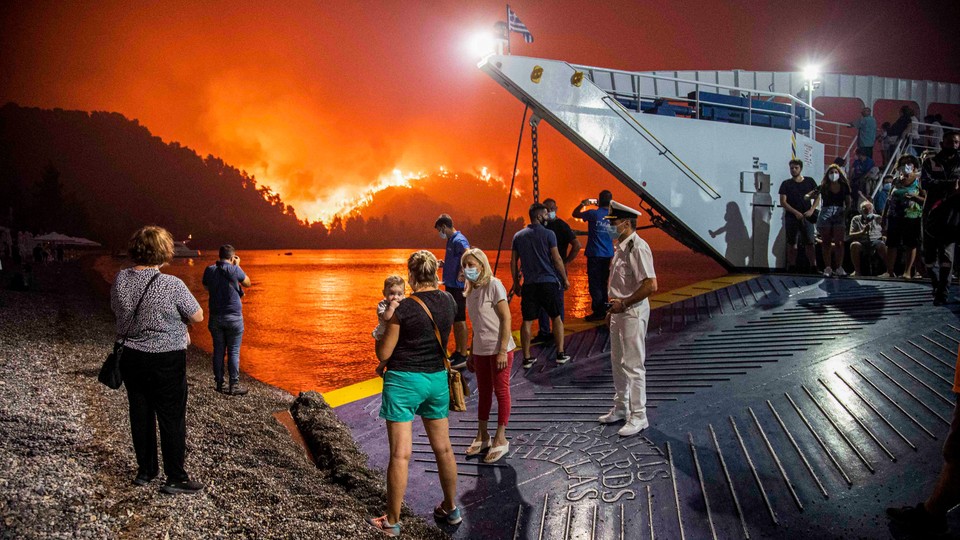
And it was. As the new report notes: “Each of the last four decades has been successively warmer than any decade that preceded it since 1850.” Yet in the past few years, global warming has moved from a statistical property to an ambient condition of modern life. A mega-drought seems to grip the American West without end. A series of wildfires have passed, like a baton, from one part of the world to another, going from California to the Amazon to Australia to Greece to California again. And then there was the morning, a few weeks ago, when Americans on the East Coast and in the Midwest woke up, thousands of miles away from any wildfire, and smelled smoke in the air.
“We’re reaching a point where the impacts of climate change are becoming too hard to ignore for many people,” Zeke Hausfather, a climate scientist and a co-author of one of the report’s chapters, told me.
For the first time, the report establishes that those extreme events are happening because of climate change. Scientists’ ability to attribute individual events to the warming atmosphere is the “biggest advance” the field has seen in the past decade, Ben Cook, a climate-science professor at Columbia University, told me.
“Every inhabited region across the globe” has seen a well-documented increase in heat waves, heavy rain, or drought, the report says. Human activity is also behind the demise of glaciers since 1990, the hemorrhaging of the Greenland ice sheet, and the decline of snow cover in the Northern Hemisphere since 1950, the report says. No part of the world has been left untouched by humanity’s prodigious carbon pollution.
2. Sea-level rise will be worse than once thought—and could occur quickly and catastrophically.
In the past decade, climate scientists have arrived at more pessimistic views about sea-level rise, and those views are reflected in this report. Most researchers now believe that the oceans will rise roughly half a foot more than once projected. In a relatively optimistic “intermediate” emissions scenario, for instance, the IPCC once projected that oceans would rise about one and a half feet by 2100. The new report finds that just under two feet is more likely, and two and a half feet is not out of the question.
The authors could not eliminate from their models the small chance that some of the largest glaciers in West Antarctica could catastrophically collapse this century. In that scenario, humanity could see more than six and a half feet of sea-level rise by 2100 and perhaps as much as 16 feet of sea-level rise by 2150.
3. Sea-level rise is also essentially irreversible.
If humanity successfully learns how to remove carbon from the atmosphere, some of the impacts of climate change, such as ocean acidification and the rise in land temperatures, may be reversible.
But some will not. Sea-level rise is chief among them. “Once you have melting under way, it’s very hard to rein it in, even if you go full-scale into reversal of global warming,” Kim Cobb, a climate scientist at Georgia Tech and a co-author of the report, told me. The slow increase in sea levels could continue for millennia.
“When I say those words, it almost chokes me up. It scares the crap out of me, frankly,” Cobb said. “This is a horrific long-term consequence to the decisions we’ll be making this decade on our watch.”
4. The climate is now changing on political time.
If climate change is happening now, then its time scales—which once seemed distant—are suddenly ticking by at the speed of the political or business calendars. An earlier draft of this report cautioned that the world could see more than 1.5 degrees Celsius of warming by the early 2030s. Although that language was removed because researchers could not guarantee that a fluke event, such as a once-in-a-century volcanic eruption, would not briefly cool the planet and delay the inevitable for a few years, the broad point remains. The IPCC now warns that the world is likely to exceed 1.5 degrees Celsius of warming by 2040 even if humanity cuts carbon pollution as rapidly as is plausible. In fact, the agency estimates that enough greenhouse gas is already in the atmosphere today to raise the planet’s temperature by 1.5 degrees Celsius—only the cooling effects of smog and other forms of conventional air pollution are keeping temperatures depressed.
But humanity may still avoid warming the planet by 1.5 degrees Celsius by 2100. On all pathways, the world’s temperature will increase more than 1.5 degrees Celsius by the middle of the century; the only question is whether it then begins to cool down or keeps going up. Current policies suggest that the planet is set for 3 degrees Celsius, or more than 5 degrees Fahrenheit, of warming by the end of the century.
“We’re already seeing extreme rainfall, heat waves, and droughts that are all implicitly or explicitly tied to climate change—and this is just a 1-degree world,” Cook said. “I would not want to live in a 4-degree world. And a 3-degree world … would be quite challenging.”
Earth’s climate is getting so hot that temperatures in about a decade will probably blow past a level of warming that world leaders have sought to prevent, according to a report released Monday that the United Nations calls a “code red for humanity.”
“It’s just guaranteed that it’s going to get worse,” said report co-author Linda Mearns, a senior climate scientist at the U.S. National Center for Atmospheric Research. “I don’t see any area that is safe … Nowhere to run, nowhere to hide.”
But scientists also eased back a bit on the likelihood of the absolute worst climate catastrophes.
The authoritative Intergovernmental Panel on Climate Change (IPCC) report, which calls climate change clearly human-caused and “unequivocal,” makes more precise and warmer forecasts for the 21st century than it did last time it was issued in 2013.
Each of five scenarios for the future, based on how much carbon emissions are cut, passes the more stringent of two thresholds set in the 2015 Paris climate agreement. World leaders agreed then to try to limit warming to 1.5 degrees Celsius (2.7 degrees Fahrenheit) since the late 19th century because problems mount quickly after that. The limit is only a few tenths of a degree hotter than now because the world has already warmed nearly 1.1 degrees Celsius (2 degrees Fahrenheit) in the past century and a half.
Under each scenario, the report said, the world will cross the 1.5 degrees Celsius warming mark in the 2030s, earlier than some past predictions. Warming has ramped up in recent years, data shows.
In three scenarios, the world will also likely exceed 2 degrees Celsius (3.6 degrees Fahrenheit) over pre-industrial times — the other, less stringent Paris goal — with far worse heat waves, droughts and flood-inducing downpours “unless deep reductions in carbon dioxide and other greenhouse gas emissions occur in the coming decades,” the report said.
“This report tells us that recent changes in the climate are widespread, rapid and intensifying, unprecedented in thousands of years,” said IPCC Vice Chair Ko Barrett, senior climate adviser for the U.S. National Oceanic and Atmospheric Administration. “The changes we experience will increase with further warming.”
The 3,000-plus-page report from 234 scientists said warming is already accelerating sea level rise, shrinking ice and worsening extremes such as heat waves, droughts, floods and storms. Tropical cyclones are getting stronger and wetter, while Arctic sea ice is dwindling in the summer and permafrost is thawing. All of these trends will get worse, the report said.
For example, the kind of heat wave that used to happen only once every 50 years now happens once a decade, and if the world warms another degree Celsius (1.8 degrees Fahrenheit), it will happen twice every seven years, the report said.
As the planet warms, places will get hit more not just by extreme weather but by multiple climate disasters that occur simultaneously, the report said. That’s like what’s now happening in the Western U.S., where heat waves, drought and wildfires compound the damage, Mearns said.
Some harm from climate change — dwindling ice sheets, rising sea levels and changes in the oceans as they lose oxygen and become more acidic — are “irreversible for centuries to millennia,” the report said.
The world is “locked in” to 15 to 30 centimeters (6 to 12 inches) of sea level rise by mid-century, said report co-author Bob Kopp of Rutgers University.
Nearly all of the warming that has happened on Earth can be blamed on emissions of heat-trapping gases such as carbon dioxide and methane. At most, natural forces like the sun or simple randomness can explain one- or two-tenths of a degree of warming, the report said.
The report described five different future scenarios based on how much the world reduces carbon emissions. They are: a future with incredibly large and quick pollution cuts; another with intense pollution cuts but not quite as massive; a scenario with moderate emissions; a fourth scenario where current plans to make small pollution reductions continue; and a fifth possible future involving continued increases in carbon pollution.
In five previous reports, the world was on that final hottest path, often nicknamed “business as usual.” But this time, the world is somewhere between the moderate emissions path and the small pollution reductions scenario because of progress to curb climate change, said report co-author Claudia Tebaldi, a scientist at the U.S. Pacific Northwest National Lab.
In a way, the world can stay at the 1.5-degree threshold with extreme and quick emission cuts, but even then, warming would hit 1.5 degrees in a decade, rise a tad and then come back down, said co-author Maisia Rojas Corrada, director of the Center for Climate and Resilience Research in Chile.
While calling the report “a code red for humanity,” United Nations Secretary-General Antonio Guterres kept a sliver of hope that world leaders could still somehow prevent 1.5 degrees of warming, which he said is “perilously close.”
“Anything we can do to limit, to slow down, is going to pay off,” Tebaldi said. “And if we cannot get to 1.5, it’s probably going to be painful, but it’s better not to give up.”
In the report’s worst-case scenario, the world could be around 3.3 degrees Celsius (5.9 degrees Fahrenheit) hotter than now by the end of the century. But that scenario looks increasingly unlikely, said report co-author and climate scientist Zeke Hausfather, climate change director of the Breakthrough Institute. Both extremes are looking less likely, he said.
“We are a lot less likely to get lucky and end up with less warming than we thought. We won’t be able to meet Paris Agreement goals without rapid near-term reductions in our emissions,” Hausfather said. “At the same time, the odds of ending up in a much worse place than we expected if we do reduce our emissions are notably lower.”
The report said ultra-catastrophic disasters, commonly called “tipping points,” like ice sheet collapses and the abrupt slowdown of ocean currents are “low likelihood” but cannot be ruled out. The much talked-about shutdown of Atlantic ocean currents, which would trigger massive weather shifts, is something that’s unlikely to happen in this century, Kopp said.
The report “provides a strong sense of urgency to do even more,” said Jane Lubchenco, the White House deputy science adviser.
In a new move, scientists emphasized how cutting airborne levels of methane, a powerful but short-lived gas that has soared to record levels, could help curb short-term warming.
More than 100 countries have made informal pledges to achieve “net zero” human-caused carbon dioxide emissions sometime around mid-century, which will be a key part of climate negotiations this fall in Scotland. The report said those commitments are essential.
“It is still possible to forestall many of the most dire impacts,” Barrett said.


 In mid-July, the non-profit Earthjustice organization signaled its intent to file a lawsuit on behalf of 10 other environmental groups against the state of Idaho to block implementation of new laws encouraging the hunting of gray wolves.

 Rising sea levels(freie-kreation/Getty Images)