Bruce A. ScrutonNew Jersey Herald1:161:16https://imasdk.googleapis.com/js/core/bridge3.472.0_en.html#goog_1632181709
There will be no bear hunt in New Jersey in 2021.
Department of Environmental Protection Commissioner Shawn M.LaTourette has not signed off on the updated Comprehensive Black Bear Management Plan and without such a plan, the Fish and Game Council cannot set a hunting season.
In mid-afternoon Wednesday, the Division of Fish and Game, part of DEP, postedon its website that on June 21, 2021, New Jersey’s Comprehensive Black Bear Management Policy (CBBMP) expired, “and as such, there is no black bear hunt in 2021.”
The message read that in accordance with the Supreme Court ruling on Sept.27, 2007, no black bear hunt may occur without a “properly-promulgated CBBMP proposed by the New Jersey Fish and Game Council and approved by the Commissioner of the New Jersey Department of Environmental Protection.”https://774cd21ddf1ea8e50a944cc6a5c65345.safeframe.googlesyndication.com/safeframe/1-0-38/html/container.html
Not only has he not signed off on the updated plan…
According to a study published July 14 in Nature, the Brazilian Amazon is emitting more carbon than it captures.
This study is the first to use direct atmospheric measurements, across a wide geographic region, collected over nearly a decade that account for background concentrations of atmospheric gases.
Eastern Amazonia is emitting more carbon than western Amazonia, and southern Amazonia is a net carbon source; Southeastern Amazonia, in particular, switched from being a carbon sink to a carbon source during the study period. The reason: a disruption in the balance of growth and decay and emissions from fires.
These results have important implications for policy initiatives such as REDD+ that rely on forests to offset carbon emissions: Because different regions of the Amazon differ in their ability to absorb carbon, schemes that use one value for the carbon-capturing ability of the whole Amazon need to be reexamined, scientists say.
The Amazon has long done its part to balance the global carbon budget, but new evidence suggests the climate scales are tipping in the world’s largest rainforest. Now, according to a study published July 14 in Nature, the Amazon is emitting more carbon than it captures.
“The Amazon is a carbon source. No doubt,” Luciana Gatti, a researcher at Brazil’s National Institute for Space Research (INPE) and lead author of the study, told Mongabay. “By now we can say that the budget for the Amazon is 0.3 billion tons of carbon per year [released] into the atmosphere. It’s a horrible message.”
Southeastern Amazonia, in particular, switched from being a carbon sink to a carbon source during the study period. Emissions were high in 2010 because of a dry El Niño year, Gatti says, and she expected to see emissions return to normal afterward. But this never happened. The reason: emissions from fires.
Fires burning in the Amazon on Aug. 17, 2020, next to the borders of the Kaxarari Indigenous Territory, in Labrea, Amazonas state. Felled forests are intentionally lit in the Amazon to clear land for cattle ranching. Credit: Christian Braga/Greenpeace
In the Amazon, forests are often cut during the wet season and burned during the dry season to make way for agribusiness, particularly cattle pasture. According to the study, fire emissions in the southeastern Amazon are three times larger than the net biome exchange (NBE), a measure of the forest’s carbon uptake plus all emissions from decomposition and human sources such as burning fossil fuels.
Without emissions from fires, Gatti says, the Amazon would be a carbon sink. “In other words, the Amazon is a source because of biomass burning.”
Using a small aircraft, Gatti and colleges measured carbon dioxide, carbon monoxide, and other gases above four locations across the Brazilian Amazon. Between 2010 and 2018, they collected air samples seasonally from near the treetops up to 4,500 meters (14,800 feet) above sea level, creating nearly 600 vertical profiles of CO2 levels.
Their conclusion: Eastern Amazonia is emitting more carbon than western Amazonia, and southern Amazonia is a net carbon source.
Other studies have noted a decline in the carbon uptake of forests based on on-the-ground measurements. But this study is the first to use direct atmospheric measurements, across a wide geographic region, collected over nearly a decade, while accounting for background concentrations of atmospheric gases.
“Gatti et al were able to establish seasonal and regional differences in carbon balance and attribute them to drought, fire, deforestation, and forest degradation,” Scott Denning, a professor of atmospheric science at Colorado State University who was not involved in the study (but wrote about it for Nature News & Views), told Mongabay in an email.
Deforestation rates have been higher under Brazil’s current president, Jair Bolsonaro, than any past president and they show no sign of halting. In 2020, Brazil lost 158 hectares (390 acres) of forest per hour—an area half the size of New York City’s Central Park—according to a report by MapBiomas, a network of NGOs, universities, and tech firms that include Google.
In May of this year, forest clearing in the Brazilian Amazon increased 67 percent over May 2020, according to INPE’s satellite-based deforestation tracking system, DETER. This puts deforestation in 2021 on pace with last year’s rate.
“If you’re thinking a tipping point [for] the Amazon [is when] it becomes a carbon source, this region is at a tipping point,” Gatti said. “My question is if we stop now with fires and deforestation and start the very important repair process for forests, could we reverse the picture? I don’t know.”
Aerial view of deforestation in the Brazilian Amazon taken from a small aircraft used to measure carbon emissions. Credit: Luciana Gatti
Decades of deforestation and fires in the Amazon coupled with the global climate crisis have caused the dry season to get longer and made mega droughts more common, contributing to a feedback loop that degrades forests. These degraded conditions mean trees are dying at a faster rate. As more plants and trees die, the Amazon’s ability to absorb carbon from the atmosphere is declining.
“The Amazon is like a bubble … if the trees are intact, it keeps moisture under the canopy in the forest,” Ernesto Alvarado, a professor of wildland fire sciences at the University of Washington, told Mongabay last year. Deforestation, roads, and fires can puncture this moisture bubble. “You open the canopy, right? It’s like a bunch of holes in the bubble, and now the moisture is better escaping and the forest becomes drier.”Play00:00-05:50MuteSettingsEnter fullscreenhttps://www.youtube-nocookie.com/embed/m07iKzx1QHs?autoplay=0&controls=0&disablekb=1&playsinline=0&cc_load_policy=0&cc_lang_pref=auto&widget_referrer=https%3A%2F%2Fsentientmedia.org%2Fbrazils-amazon-now-emits-more-carbon-than-it-captures%2F&noCookie=true&rel=0&showinfo=0&iv_load_policy=3&modestbranding=1&enablejsapi=1&origin=https%3A%2F%2Fsentientmedia.org&widgetid=1Play
The results of the Nature study have important implications for policy initiatives such as REDD+ that rely on forests to offset carbon emissions. The Amazon is not homogenous; different regions have different types of soil, humidity, and tree species. And as this study shows, they also differ in their capacity to absorb or emit carbon.
For example, the eastern Amazon, mainly in the states of Pará and Mato Grosso, is 30 percent deforested and emits 10 times more carbon than other regions. So schemes that use one value for the carbon-capturing ability of the whole Amazon, Gatti says, need to be reexamined.
“Forests might not be able to sequester enough carbon to provide a net benefit for climate mitigation,” Ruth DeFries, a professor of sustainable development at Columbia University who was not involved in the study, told Mongabay in a 2020 interview. “[This] suggests that efforts to reduce emissions of greenhouse gases depend on alternatives to fossil fuel burning—the largest and well-quantified source of anthropogenic greenhouse gases.”
“Worldwide, plants have been growing faster than they’re dying for decades, providing a priceless emissions reduction,” Denning said. “Now we’re seeing the limits of that process. It means society will have to work harder to eliminate fossil fuels from the world economy since we won’t be able to rely on tropical forests to clean up after ourselves.”Read More
A steep downturn in human population and quality of life could be coming in the 2040s, the report finds.
(Image credit: Getty)
Human society is on track for a collapse in the next two decades if there isn’t a serious shift in global priorities, according to a new reassessment of a 1970s report,Vice reported
In that report — published in the bestselling book “The Limits to Growth” (1972) — a team of MIT scientists argued that industrial civilization was bound to collapse if corporations and governments continued to pursue continuous economic growth, no matter the costs. The researchers forecasted 12 possible scenarios for the future, most of which predicted a point where natural resources would become so scarce that further economic growth would become impossible, and personal welfare would plummet.
The report’s most infamous scenario — the Business as…
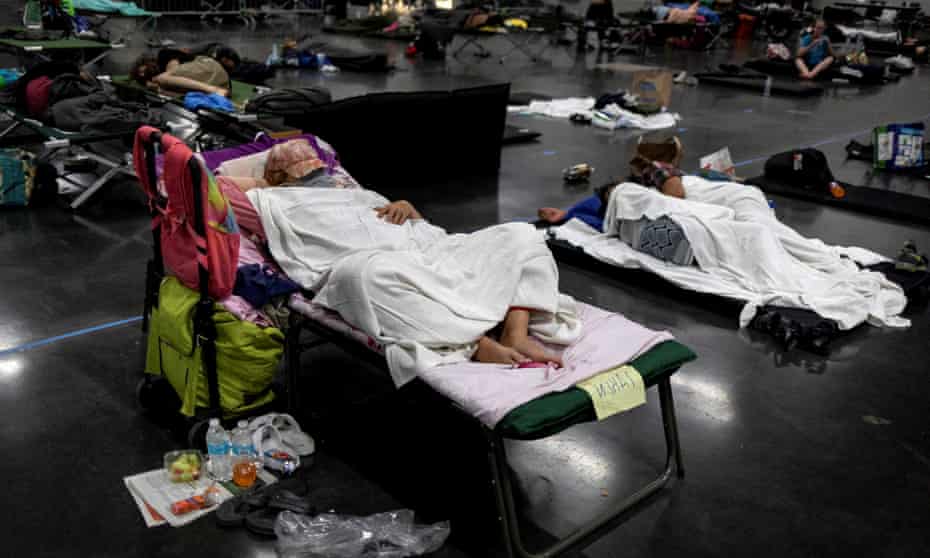
The recent heatwave that broiled the US Pacific north-west not only obliterated temperature records in cities such as Seattle and Portland – it also put a torch to a comforting bromide that the region would be a mild, safe haven from the ravages of the climate crisis.
Unprecedented temperatures baked the region three weeks ago, part of a procession of heatwaves that have hit the parched US west, from Montana to southern California, over the past month. A“heat dome” that settled over the areasaw Seattle reach 108F (42.2C), smashing the previous record by 3F (1.7C), while Portland, Oregon, soared…
“The intention is to create an environment where girls feel a little more confident speaking up, less self conscious about some of the questions they have,” says Service Coordinator for the Fish and Game office in Pocatello.
They started classes Monday for girls and ladies.
It’s a setting Atwood says is a bit more easy going than the mixed classes.
“Typically in a mixed class, boys end up dominating our conversations,” says Atwood.
But Wednesday’s focus has been about what to do when you’re out in the field.
Some participants have hunting backgrounds and still wanted to learn more.
“When I was first coming here I was like ‘Oh this is going to be easy. I know all this stuff, I go hunting a lot,” saidShyann Schilhabel, a course participant, “But no I actually learned a lot more than…
Brian WhipkeyPennsylvania Outdoor ColumnistView Comments0:031:12https://imasdk.googleapis.com/js/core/bridge3.472.0_en.html#goog_1963821682
If you enjoy the bonding experience of seeing a young dog mature into a hunting sport, you may want to consider getting a coon dog.
Efforts are underway to introduce more people to the sport of having dogs trail raccoons at night into a tree. It’sa sport that has local, regional, state and national competitions. The raccoons are trailed up a tree, but not killed in the competitions.
Greg “Sparky” McClellanof Stoystownhas been hunting with Bluetick coon dogs for 50 years. “I’ve been working off the same blood line for 22 years,” he said about having dogs with the right qualities and temperament.
Washington (CNN)President Joe Bidenparticipated Wednesdayin the second CNN town hall of his presidency, taking questions from anchor Don Lemon and local residents in Cincinnati.As he did at hisFebruary town hall, Biden made a number of false or misleading claims. We haven’t been able to look into every single thing he said Wednesday night, but here is a rundown on some of his remarks.
Covid-19 vaccines
Calling on Americans to get vaccinated against Covid-19, Biden said, “If you’re vaccinated, you’re not going to be hospitalized, you’re not going to be in the ICU unit and you’re not going to die.” In another exchange moments later, Biden said that even if vaccinated people do “catch the virus,” they are “not likely to get sick.”
But then, during a third exchange, Biden said that since the vaccines “cover”the highly transmissible…
An eleven-year-old boy’s death highlights a new risk for the world’s second-most populous nation battling the coronavirus pandemic.
An Indian poultry worker carries dead chicken to dispose of at a farm near Hyderabad city [File: Mahesh Kumar A/AP Photo]
22 Jul 2021
India is investigating its first documented human death from bird flu after an 11-year-old boy succumbed to the disease earlier this month, says the health ministry.
Health workers treating the patient and the boy’s family have been kept in isolation, and authorities have launched contact tracing, the statement said.
In Haryana, the boy’s home state in India’s north, the Animal Husbandry Department has not found any suspected case of bird flu but has stepped up surveillance, it said.
Genome sequencing and virus isolation is in process and an epidemiological investigation has been initiated, the health ministry said.
The boy lived in Gurgaon, on the outskirts of capital New Delhi, and was also suffering from leukaemia and pneumonia, a report by the AFP news agency said on Thursday.
The death from the bird flu virus of the H5N1 strain highlights a potential new risk for the world’s second-most populous nation battling the coronavirus pandemic, which has infected more than 31 million people and killed over 400,000.https://imasdk.googleapis.com/js/core/bridge3.472.0_en.html#goog_1293241178Play Video
India has seen more than half a dozen bird flu outbreaks in poultry in the past 20 years, all of which were brought under control, with no human cases reported in the country previously.
Avian influenza occurs mainly in birds and poultry. In 2008, millions of poultry were culled in India.
But cases of transmission between humans are extremely rare.ADVERTISING
H5N1 first broke out in 1997, then spread between 2003 and 2011, while H7N9 was first detected in 2013.
Two strains of bird flu, H5N1 and H7N9, first found in 2013, led to human contamination in Asia through infected birds.
H7N9 has infected 1,668 people and killed 616 since 2013, according to the United Nations’ Food and Agriculture Organization.
In the Indian case, the ministry said, the virus belonged to the H5Nx subtype, considered worrying as they have proven to evolve into highly dangerous strains.
Last month, China revealed its first human case of bird flu and in February, Russia detected the disease among workers at a poultry factory.
Customs officers examine the suspected rhino horns detected from a shipment delivered from South Africa to Da Nang City, Vietnam, on July 17, 2021. Photo: Son Nguyen / Tuoi Tre
Customs officers at the Da Nang port in central Vietnam have discovered a shipment of over 100 kilograms of suspected rhino horns and more than three metric tons of alleged wildlife bones imported from South Africa with a fraudulent customs declaration.
The discovery was made when customs inspectors, in conjunction with other relevant units, examined a suspicious shipping container of goods shipped to the port of Da Nang City on Saturday.
The inspectors found 138kg of suspected rhino horn and about 3.1 metric tons of animal bones probably from rare and precious wildlife species, which were all packed in cartons placed in the container.
The shipment owner had falsely declared the imported goods…


 Victor Moriyama / Greenpeace