Sharks Use Earth’s Magnetic Fields to Guide Them Like a Map – “It Really Is Mind Blowing”

TOPICS:Cell PressMarine BiologySharks

By CELL PRESS MAY 7, 2021

Bonnethead Shark Hunting at Night

Sea turtles are known for relying on magnetic signatures to find their way across thousands of miles to the very beaches where they hatched. Now, researchers reporting in the journal Current Biology on May 6, 2021, have some of the first solid evidence that sharks also rely on magnetic fields for their long-distance forays across the sea.

“It had been unresolved how sharks managed to successfully navigate during migration to targeted locations,” said Save Our Seas Foundation project leader Bryan Keller, also of Florida State University Coastal and Marine Laboratory. “This research supports the theory that they use the earth’s magnetic field to help them find their way; it’s nature’s GPS.”

Researchers had known that some species of sharks travel over long distances to reach very specific locations year after year. They also knew that sharks are sensitive to electromagnetic fields. As a result, scientists had long speculated that sharks were using magnetic fields to navigate. But the challenge was finding a way to test this in sharks.

“To be honest, I am surprised it worked,” Keller said. “The reason this question has been withstanding for 50 years is because sharks are difficult to study.”

This image shows an overhead shot of bonnetheads in the holding tank. Credit: Bryan Keller

Keller realized the needed studies would be easier to do in smaller sharks. They also needed a species known for returning each year to specific locations. He and his colleagues settled on bonnetheads (Sphyrna tiburo).

“The bonnethead returns to the same estuaries each year,” Keller said. “This demonstrates that the sharks knows where ‘home’ is and can navigate back to it from a distant location.”

The question then was whether bonnetheads managed those return trips by relying on a magnetic map. To find out, the researchers used magnetic displacement experiments to test 20 juvenile, wild-caught bonnetheads. In their studies, they exposed sharks to magnetic conditions representing locations hundreds of kilometers away from where the sharks were actually caught. Such studies allow for straightforward predictions about how the sharks should subsequently orient themselves if they were indeed relying on magnetic cues.

https://www.youtube.com/embed/FI8p3ZR914A?feature=oembed
This video is footage from an experimental trial, where the bonnethead’s swimming behavior is affected by the magnetic field it is experiencing. Credit: Bryan Keller

If sharks derive positional information from the geomagnetic field, the researchers predicted northward orientation in the southern magnetic field and southward orientation in the northern magnetic field, as the sharks attempted to compensate for their perceived displacement. They predicted no orientation preference when sharks were exposed to the magnetic field that matched their capture site. And, it turned out, the sharks acted as they’d predicted when exposed to fields within their natural range.

The researchers suggest that this ability to navigate based on magnetic fields may also contribute to the population structure of sharks. The findings in bonnetheads also likely help to explain impressive feats by other shark species. For instance, one great white shark was documented to migrate between South Africa and Australia, returning to the same exact location the following year.

This figure shows how the experiment assessed the ability of bonnethead sharks to use the Earth’s magnetic field to navigate. Credit: Keller et al./Current Biology

“How cool is it that a shark can swim 20,000 kilometers round trip in a three-dimensional ocean and get back to the same site?” Keller asked. “It really is mind blowing. In a world where people use GPS to navigate almost everywhere, this ability is truly remarkable.”

In future studies, Keller says he’d like to explore the effects of magnetic fields from anthropogenic sources such as submarine cables on sharks. They’d also like to study whether and how sharks rely of magnetic cues not just during long-distance migration but also during their everyday behavior.

Reference: “Map-like use of Earth’s magnetic field in sharks” by Bryan A. Keller, Nathan F. Putman, R. Dean Grubbs, David S. Portnoy and Timothy P. Murphy, 6 May 2021, Current Biology.
DOI: 10.1016/j.cub.2021.03.103

This work was supported by the Save Our Seas Foundation and the Florida State University Coastal and Marine Laboratory.

Largest expansion of hunting and fishing opportunities proposed by the U.S. Fish and Wildlife Service

Exposing the Big Game's avatarCommittee to Abolish Sport Hunting Blog

https://www.foxnews.com/great-outdoors/largest-expansion-hunting-fishing-opportunities-proposed-by-the-u-s-fish-and-wildlife-service

23 hours ago

The proposal will expand various hunting and fishing areas

ByMichael Hollan| Fox News

closehttps://static.foxnews.com/static/orion/html/video/iframe/vod.html?v=20210505155811#uid=fnc-embed-1

Fox News Flash top headlines for May 5

This is literally big news forhuntingand fishing.

TheU.S. Fish and Wildlife Servicerecently announced a proposal that would be the largest expansion of opportunities for access to hunting and fishing. The move is part of the Department of Interior’s efforts to increase the amount of recreational access on public lands.

The U.S. Fish and Wildlife Service recently announced a proposal that would be the largest expansion of opportunities for access to hunting and fishing.

The U.S. Fish and Wildlife Service recently announced a proposal that would be the largest expansion of opportunities for access to hunting and fishing.(iStock)

According to apress releasefrom the US FWS, these new opportunities would include turkey hunting and sport fishing in Florida at the Florida Panther National Wildlife Refuge. The proposal also aims to open migratory game bird hunting…

View original post 185 more words

The world needs to dramatically cut methane emissions to avoid worst of climate change, UN says

Exposing the Big Game's avatarThe Extinction Chronicles

The world needs to dramatically cut methane emissions to avoid worst of climate change, UN says (msn.com)

Emma Newburger2 hrs ago


RELATED QUOTES

|


Why Australia-China War Talk is Rising Between the Two NationsBill and Melinda Gates are among America’s largest private landowners —…

  • A landmark United Nations report has declared that drastically cutting emissions of methane, a key component of natural gas, is necessary to avoid the worst impacts of global climate change.
  • The world could slash human-caused methane emissions by up to 45% this decade, according to the Global Methane Assessment.
  • The report represents a shift in the worldwide conversation on how to best address the climate crisis, which has focused on setting longer-term carbon dioxide reduction targets.

a sunset over a fire: Flames from a flaring pit near a well in the Bakken Oil Field. The primary component of natural gas is methane, which is odorless when it comes directly out of the gas well. In addition to methane, natural gas typically contains other hydrocarbons such as ethane, propane, butane, and pentanes.© Provided by CNBCFlames from a flaring pit near a well in the Bakken Oil Field. The primary component of natural gas is methane, which is odorless…

View original post 702 more words

A gas vehicle ban would leave us stuck in the slow lane

Exposing the Big Game's avatarThe Extinction Chronicles

A gas vehicle ban would leave us stuck in the slow lane (msn.com)

Emilie Dye2 hrs ago


Why Australia-China War Talk is Rising Between the Two NationsBill and Melinda Gates are among America’s largest private landowners —…

A Senate Democrat recently began pushing the Environmental Protection Agency toban the sale of new, gas-powered vehicles by 2035as a part of new, strict anti-pollution standards. Washington state has put the pedal to the floor and is speeding toward aban by 2030.a view of a city street filled with lots of traffic© Provided by Washington Examiner

While electric vehicles are the future, outright banning the sale of gas-powered cars will only impede progress. Blanket bans slow innovation, disrupt markets, and hurt at-risk groups.https://products.gobankingrates.com/r/e842bf20ca03e0c72baf5dc63cea5f2a

Right now, only well-off people are able to go the extra mile for the environment and purchase electric vehicles. Those who lost their jobs during the pandemic may care for the environment just as…

View original post 496 more words

Dr. Fauci explains why COVID-19 vaccines work much better than natural immunity to protect you from the coronavirus

Exposing the Big Game's avatarThe Extinction Chronicles

Dr. Fauci explains why COVID-19 vaccines work much better than natural immunity to protect you from the coronavirus (msn.com)

hbrueck@businessinsider.com (Hilary Brueck)21 hrs ago


Bill and Melinda Gates are among America’s largest private landowners —…Why Australia-China War Talk is Rising Between the Two Nationsa person wearing a costume: Dr. Anthony Fauci, director of the National Institute of Allergy and Infectious Diseases, gives a thumbs up after receiving his first dose of a COVID-19 vaccine at the National Institutes of Health on December 22, 2020 in Bethesda, Maryland. Patrick Semansky-Pool/Getty Images© Patrick Semansky-Pool/Getty ImagesDr. Anthony Fauci, director of the National Institute of Allergy and Infectious Diseases, gives a thumbs up after receiving his first dose of a COVID-19 vaccine at the National Institutes of Health on December 22, 2020 in Bethesda, Maryland. Patrick Semansky-Pool/Getty Images

  • Dr. Anthony Fauci discussed new data suggesting that COVID-19 vaccines “can do better than nature.”
  • People who’ve had prior infections saw their immune response to COVID-19 drastically improve after receiving mRNA vaccines.
  • The finds are a beacon of hope, as new variants (which may reinfect people) circulate the globe.
  • See more stories on Insider’s business page.

Dr. Anthony Fauci…

View original post 507 more words

Austin, Texas, Police Say ‘No Criminal Offense’ in Filmed Beating of Elderly Dog!

ShareTweet

Distressing footage reportedly captured recently at a residence in Austin, Texas, appears to show an evidently elderly and disabled dog being viciously attacked by a woman. In three videos captured on two days, the abuser can be seen violently yanking the leash; lifting the dog by her tail repeatedly while shouting, “Stay up!”; striking her with full-force downward slaps; and punching the animal as she yelps in obvious distress—all in apparent “retaliation” for this poor old dog simply being unable to hold herself up in the backyard.

WARNING: GRAPHIC FOOTAGEhttps://www.youtube.com/embed/bZbDKM2WNYQ?wmode=transparent&rel=0

PETA and our complainant have alerted Austin and Travis County authorities to this situation—providing the sickening visual evidence and the suspect’s address and imploring them to rescue the victim before more abuse transpires.

Unfortunately, authorities have apparently decided that no crime was committed—although Texas’s anti-cruelty statute reads, “A person commits an offense if the person intentionally, knowingly, or recklessly … tortures an animal,” and defines “torture” as “any act that causes unjustifiable pain or suffering.”

Most importantly—where is the dog? Despite vague assurances that she isn’t in danger, officials aren’t saying whether she was removed from the home.

Please politely urge the following officials to provide assurances that the victimized dog has been removed from her abuser:

Austin Police Department
police3@austintexas.gov

Travis County District Attorney’s Office
TCDAPublic@traviscountytx.gov

The Honorable Steve Adler
Mayor of Austin
steve.adler@austintexas.gov

Please also ask members of the Austin City Council to secure for their constituents an update about this dog’s status.

After you’ve e-mailed officials, please comment on their Facebook pages as well—then forward this alert far and wide!

AUSTIN POLICE DEPARTMENT

TRAVIS COUNTY DISTRICT ATTORNEY’S OFFICE

Nepal reports 19 positive Covid tests at Dhaulagiri base camp

Exposing the Big Game's avatarThe Extinction Chronicles

https://www.theguardian.com/global-development/2021/may/05/nepal-report-19-positive-covid-test-dhaulagiri-base-camp

Decision to allow expeditions to go ahead dealt blow after outbreak on world’s seventh highest mountain

Dhaulagiri as seen from Ghorepani, Nepal
At 8,167 metres, Dhaulagiri is one of the world’s highest peaks and popular with international climbers.Photograph: Sam Oakes/Alamy

Global development is supported by

Bill and Melinda Gates Foundation

About this contentRajneeshBhandariinKathmanduWed 5 May 2021 09.37 EDT

33

Nepal’s decision to allow people to continue to climb its Himalayan peaks asa vicious Covid-19 wave sweeps the countrywas dealt a further blow after 19 more climbers tested positive for the virus.

Last monthit was reported that the pandemic had reached Everest base campand though officials later denied it, climbers have reported a wave of infections that were being covered up.

Now it has emerged that 19 people – foreign climbers and sherpas – have tested positive at the base camp of Dhaulagiri, the world’s seventh highest…

View original post 359 more words

Impossible Foods clears legal battle over the ingredient that makes its meat ‘bleed’

https://www.theverge.com/2021/5/3/22418036/impossible-foods-legal-battle-key-ingredient-heme-fda

The contested ingredient is supposed to make Impossible Burgers “taste like meat.”By Justine Calma@justcalma  May 3, 2021, 6:32pm EDT

Share this story

Impossible Burger
Close-up shot of the Impossible Foods Company’s product Impossible Burger in Walnut Creek, California, January 11, 2021.

A San Francisco federal appeals court upheld a decision by the Food and Drug Administration to allow Impossible Foods to use “heme,” the additive the company says makes its products “taste like meat.”

Had Impossible Foods lost this legal battle, it could have dealt a heavy blow to the company. Genetically engineered heme is what sets its products apart from other competitors like Beyond Meat that don’t use the ingredient.HEME IS WHAT SETS ITS PRODUCTS APART FROM OTHER COMPETITORS

The FDA used a weaker legal standard than it should have to approve the use of heme, the nonprofit Center for Food Safety argued in a lawsuit it filed last year. It said the FDA made its decision based on safety standards for food additives rather than on standards for color additives, which stipulate that there needs to be “convincing evidence” that the color additive causes no harm. Heme is a red ingredient that makes Impossible Foods’ products appear to “bleed.”

The appeals court ruling said that the FDA had “substantial evidence” to deem heme in Impossible Foods safe to eat, Bloomberg reported today. It also allowed the FDA to rely on research commissioned by Impossible Foods in its decision-making.

Impossible Foods shared its own data with a food safety panel of experts from several universities for review and then conducted rat feeding studies to address questions from the FDA. “We have no questions at this time regarding Impossible Foods’ conclusion that soy leghemoglobin preparation is [generally recognized as safe] under its intended conditions of use to optimize flavor in ground beef analogue products intended to be cooked,” the FDA concluded in 2018.

The Center for Food Safety, on the other hand, said there needs to be more analysis. “FDA should have required additional independent testing to make sure that this new substance does not cause allergic reactions or other health problems in people,” Jaydee Hanson, policy director for the Center for Food Safety, said in a statement last year.

A Giant Organic Farm Faces Criticism That It’s Harming The Environment

https://www.npr.org/2021/05/03/989984124/a-giant-organic-farm-faces-criticism-that-its-harming-the-environment

  • Facebook
  • Twitter
  • Flipboard
  • Email

May 3, 20214:04 PM ETHeard on All Things Considered

DAN CHARLESTwitterLISTEN· 4:124-Minute ListenAdd toPLAYLIST

Wind-blown soil fills a ditch between a road and the fields of Gunsmoke Farms, a large organic farm northwest of Pierre, S.D., in early March.Stringer

Hardly a week goes by, it seems, without a big food company making promises to deliver products from green, sustainable farms. Turning those promises into reality, though, can be complicated.

Take Gunsmoke Farms, a vast property that covers 53 square miles just northwest of Pierre, S.D. The food company General Mills, maker of Cheerios, announced in 2018 that it would convert the farm to organic production. The company planned to turn it into an educational hub to teach other farmers “how to implement organic and regenerative agriculture practices.”

Now, some of Gunsmoke Farms’ neighbors say that the farm is doing more environmental harm than good.

Among the critics is Dwayne Beck, a soil scientist who manages South Dakota State University’s Dakota Lakes Research Station, 40 miles east of Gunsmoke Farms. Beck was skeptical about the project from the beginning. “It scared me, because normally organic [farming] entails lots of tillage, and those soils are very fragile,” he said.

Farmers often till the soil — breaking it up with tools such as chisel plows or disks — to uproot weeds and get land ready for planting. But tillage also tears soil loose from the plant roots that help hold it together and also breaks down parts of the soil that are most rich in carbon and nutrients.Article continues after sponsor messagehttps://4df503c1e72eef0faa09f6db82733d6a.safeframe.googlesyndication.com/safeframe/1-0-38/html/container.html

This is especially true of soils where Gunsmoke Farms is located, Beck said. The area developed from an ancient ocean floor, and the soil is full of clay. “Once you disturb it, nothing holds that soil together. It just turns into powder,” he said, vulnerable to rain or wind that can carry it away.

This used to happen regularly in western South Dakota. Beck recalls dust storms so thick, cars crashed because drivers couldn’t see vehicles just in front of them.

South Dakota was one of the places that saw severe soil erosion from wind during the Dust Bowl of the 1930s.Universal History Archive/Universal Images Group via Getty Images

Those dust storms happen less often now because over the past two decades, many farmers in the region abandoned regular tillage. They now use planting equipment that slices into undisturbed soil and places seed in the ground.

To control weeds, these farmers use herbicides. But chemical weed control isn’t an option for an organic business such as Gunsmoke Farms.

During the farm’s three-year transition to organic status, its managers grew primarily alfalfa, which doesn’t require annual planting. In 2020, though, they planted their first crops of wheat and peas, which involved tilling the enormous fields.

Months later, Beck said his fears were realized. He collected photographs of the damage: small drifts of wind-blown soil in a roadside ditch, and a country road that disappears into a brown cloud of blowing dust. “The soil that blew out of there, it will never be the same as it was before it blew,” he said. It won’t have the stability and structure of healthy soil, held in place by the roots of plants.

Beck and others who live near Gunsmoke Farms said that nonorganic farmers also struggled to control soil erosion in 2020 because of drought and high winds. But the problems at Gunsmoke, they said, were worse. A planting of winter wheat, which was supposed to protect the soil on those fields, failed to grow well.

When the Gunsmoke project was just getting off the ground, in 2018, an expert from the U.S. Department of Agriculture’s Natural Resources Conservation Service drew up a soil conservation plan for the farm. That plan called for wide strips of native grasses across the farm to help prevent soil from blowing, and for the steepest slopes to stay covered, most years, with crops such as alfalfa that don’t require annual planting.

Gary Zimmer, an expert on organic farming who collaborated with General Mills in launching the Gunsmoke project, said that he drew up a plan that incorporated many of these measures. But he said much of his plan was never implemented.

“It’s in a deep hole,” Zimmer said, referring to the farm. “I don’t know how you get it back out organically. It’s hard to farm organically if you do it really well, and have your intensive management. But 30,000 acres, poorly managed, is a really good sign for failure.”

General Mills doesn’t own Gunsmoke Farms or control it directly. It signed a “strategic sourcing agreement” with an investment firm called TPG Sixth Street Partners, an affiliate of the firm TPG, which acquired the land in order to supply General Mills with organic wheat, peas and other crops. Sixth Street later became an independent operation, and it currently owns Gunsmoke. The investors have hired a series of managers to run the farm.

General Mills said in a statement to NPR that turning Gunsmoke Farms into a thriving ecosystem “is a journey” and promised continued efforts to minimize erosion and improve soil health there.

Sixth Street Partners said in its statement that the farm is “early in the process of regenerating land” and that its mission — organic farming — also provides additional environmental benefits, such as lower use of pesticides and synthetic fertilizer.

Ruth Beck, who’s married to Dwayne Beck, spent many years as an extension agronomist with South Dakota State University, advising farmers in the area around Gunsmoke Farms. She said it’s simply difficult to grow crops organically, on a large scale, in this semi-arid part of the country. “You know, we’ve got to figure out ways to do that, if that’s what people want,” she said. “But we aren’t there yet.”

At Gunsmoke, she said, environmental marketing got ahead of what farmers can actually do

Global heating pace risks ‘unstoppable’ sea level rise as Antarctic ice sheet melts

https://www.theguardian.com/environment/2021/may/05/antarctica-ice-sheet-melting-global-heating-sea-level-rise-study

World faces ‘abrupt jump’ in pace of ice loss around 2060 unless emissions reduced to meet Paris agreement goals, study warns

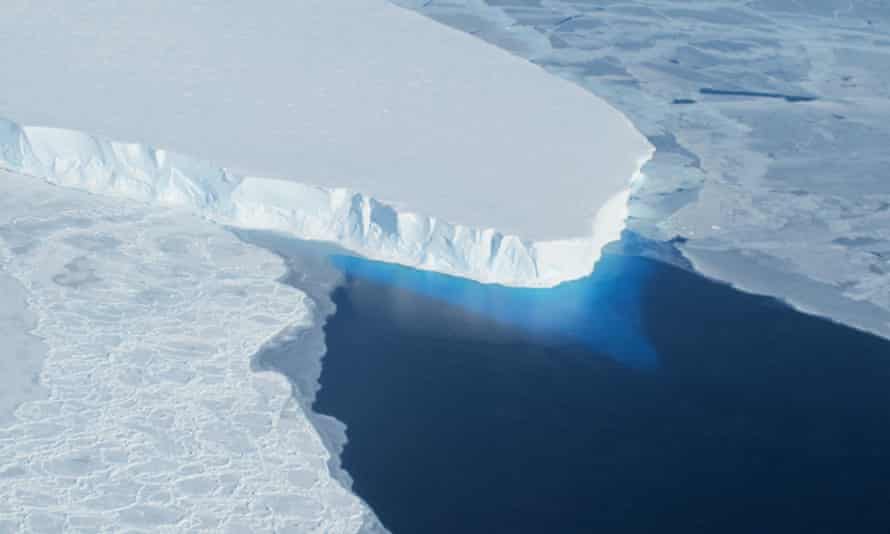
An undated photo courtesy of Nasa showing the Thwaites glacier in western Antarctica. This tipping point for Antarctica could be triggered by a global temperature rise of 3C above the preindustrial era.
An undated photo courtesy of Nasa showing the Thwaites glacier in western Antarctica. This tipping point for Antarctica could be triggered by a global temperature rise of 3C above the preindustrial era. Photograph: AFP/Getty Images

Oliver Milman@olliemilmanWed 5 May 2021 11.00 EDT

99

The current pace of global heating risks unleashing “rapid and unstoppable” sea level rise from the melting of Antarctica’s vast ice sheet, a new research paper has warned.

Unless planet-heating emissions are swiftly reduced to meet the goals of the Paris climate agreement, the world faces a situation where there is an “abrupt jump” in the pace of Antarctic ice loss around 2060, the study states, fueling sea level rise and placing coastal cities in greater peril.

“If the world warms up at a rate dictated by current policies we will see the Antarctic system start to get away from us around 2060,” said Robert DeConto, an expert in polar climate change at the University of Massachusetts and lead author of the study. “Once you put enough heat into the climate system, you are going to lose those ice shelves, and once that is set in motion you can’t reverse it.”AdvertisementTrump criticizes Facebook ruling and says social media companies ‘must pay a political price’ – liveJudge orders release of memo on Trump obstruction decisionExplosives and weaponry found at US far-right protests, documents revealRome court to rule on two Americans accused of fatally stabbing police officerSteven Soderbergh: Oscars ending changed in case Chadwick Boseman wonTrump criticizes Facebook ruling and says socialmedia companies ‘must pay a political price’ – livehttps://imasdk.googleapis.com/js/core/bridge3.453.0_en.html#goog_50591582https://imasdk.googleapis.com/js/core/bridge3.453.0_en.html#goog_856866834https://imasdk.googleapis.com/js/core/bridge3.453.0_en.html#goog_1219580895javascript:false00:16/00:30SKIP ADTrump criticizes Facebook ruling and says social media companies ‘must pay a political price’ – live

DeConto added: “The oceans would have to cool back down before the ice sheet could heal, which would take a very long time. On a societal timescale it would essentially be a permanent change.”

This tipping point for Antarctica could be triggered by a global temperature rise of 3C (5.4F) above the preindustrial era, which many researchers say is feasible by 2100 under governments’ current policies. The new research, published in Nature, finds that ice loss from Antarctica would be “irreversible on multi-century timescales” should this happen, helping raise the world’s oceans by 17cm to 21cm (6.69in to 8.27in) by the end of the century.

If the world was able to meet commitments made in the Paris deal, however, the research found Antarctica would contribute 6cm to 11cm of sea level rise by the end of the century, on a par with the current rate of ice loss. Under the Paris agreement, governments have vowed to limit dangerous global heating below 2C hotter than preindustrial times, with efforts to keep the increase to 1.5C.

“It’s really the next few decades that will determine the sea level rise from Antarctica,” De Conto said. “These ice shelves won’t be able to just grow back.”

Scientists have increasingly issued warnings over the fate of the huge amount of ice stored in Antarctica which, if it all melted, would raise global sea levels by 57 metres, completely submerging the world’s coasts.

While this won’t happen in any sort of foreseeable timescale, even a small increase in ice loss would be felt in global sea levels. Of particular concern is the western section of the Antarctic ice sheet, with scientists currently exploring the rate of decline experienced by the Thwaites glacier, also known as the doomsday glacier. In a worst-case scenario, the loss of the glacier, which is about the size of Britain and 1km deep, would raise sea levels by 65cm.

Antarctica is being winnowed away by a warming atmosphere as well as the heating oceans, with warming seawater entering crevasses and gnawing away at “pinning points” that hold enormous bodies of ice to submerged bedrock. A rapid acceleration of melting could cause a cascading effect where huge amounts of ice and water flow uninterrupted into the Southern Ocean.

Once in motion, the impacts from such dramatic ice loss would unfurl over centuries. “In the century after 2100 it’s potentially catastrophic,” said DeConto. “If we did nothing at all to reduce emissions we could get 5 metres of sea level rise just from Antarctica by 2200, at which point you’d have to remap the world from space. It would be unimaginable.”

DeConto’s paper uses a mode that incorporates temperature increase and ice loss, as well as the dynamic processes at play in Antarctica that present challenges in predicting exactly what will happen as the world continues to heat up.

Another study published in Nature on Wednesday, by scientists at King’s College in London, finds the sea level will rise by 0.5cm every year by 2100 if the global temperature rise hits 3C. DeConto said the other paper is an “impressive piece of work” but differed from his paper, which factored in compounding impacts from the loss of ice shelves.

“Neither of these papers are the last word, this is ongoing work,” he said. “Basically we are going to have to cope with continued sea level rise. The real question is whether it will be at a manageable or unmanageable rate for us.”

Orrin Pilkey, a sea level rise expert at Duke University who was not involved in the research, said the paper is an “important attempt to relate the Paris agreement to reality”.

He added: “I would consider this a thoughtful and even frightening but credible contribution which should provide a very strong basis to get on with implementation of the Paris agreement.”

Andrea Dutton, an expert in sea level rise at University of Wisconsin–Madison, who was a co-author, said the paper “addresses an important and pressing question” of what the Paris climate targets will mean for future sea level rise.

“We are already struggling with the amount of sea level rise that has occurred over the past century,” said Dutton, who added that a major acceleration in Antarctic melting will “bring about coastal retreat and migration on a scale that we have never before witnessed”.

“We will not be able to just adapt because it is impossible to just engineer our way out of this,” she said. “The conclusion is a stark reminder of the urgency in making deep and sustained cuts in our greenhouse gas emissions.”