MOUNTLAKE TERRACE, Wash. — A disturbing rash of suspected animal cruelty cases in Mountlake Terrace.
Police believe one person has shot and killed at least a dozen crows in the city. Authorities said they are very close to recommending charges.
That’s a big relief to the community, because the worry is for the bird’s safety and more.
“I’m scared this guy is going to miss some day and hurt somebody,” said Eileen Wood-Lim outside her Mountlake Terrace home today.
Since February, Mountlake Terrace Police said at least 12 crows have been shot and killed in the city limits – all in the middle of the day.
Two home security videos shared by police and captured by worried residents show the same red truck multiple residents have reported seeing in the areas of multiple shootings. Police identified that same truck and its driver as their suspect.
He said they believe there could be as many as 20 cases of crow shootings in Mountlake Terrace alone. Twelve are active and there are dozens of other unconfirmed reports on social media in the surrounding areas, from Brier to unincorporated Snohomish said Commander Lowe.
“I’m just horrified,” said Wood-Lim, standing in her driveway. She was home Monday during her lunch break from work.
One of those crows fell to its death March 4 in her driveway. She was home working, heard two shots, a thump and then the loud shriek from a cluster of crows.
“I love crows and to have somebody shooting them and have it happen right in my driveway made me upset,” Wood-Lim said.
Her worry is exactly why Mountlake Terrace Police have worked nonstop to track the crow killer
“If you take someone who will be so brazen do out in broad daylight and shoot out in public that’s pretty scary cause those bullets have to go somewhere,” Lowe said.
Lowe said the same red truck seen outside Eileen’s house on her doorbell camera is the same truck captured in multiple videos by others residents and turned over to police as evidence.
You can’t make out the driver in Eileen’s video but you can see what looks like a long gun. Police think it might be a high caliber pellet gun or even a 22. caliber rifle, but that’s still under investigation.
“It’s not out of the realm of possibilities that if someone is doing that with a crow, and then they’re upset with a pet dog, or pet cat or a child,” Lowe said.
Through an anonymous tip, police tracked down the truck’s owner.
Police said the Mountlake Terrace man agreed to let them see his truck to rule him out as a suspect, but kept rescheduling.
Eventually, Lowe said they found the truck at a nearby dealership and that the man sold it and didn’t tell them. Inside police found possible evidence.
We asked police since they made contact with the man who they consider a suspect, what’s happened with the shootings.
“It’s stopped,” Lowe said. “It’s the main thing we wanted to stop the shootings.”
Police said they are confident the truck’s owner is behind all the crowing killings and they will recommend charges be filed very soon.
Possible charges, may include shooting a firearm in the city and animal cruelty-related charges but police are still determining charges and are working with the state Fish and wildlife agency.
“Our task must be to free ourselves from this prison by widening our circle of compassion to embrace all living creatures and the whole of nature in its beauty.”
Albert Einstein
One doesn’t have to be a genius like Einstein to figure out that the ultimate moral goal of our species should be to move forward in regards to our kind treatment of others. Yet, when it comes to our behavior toward animals—especially wildlife—the human species seems to be backsliding a bit these days. Examples of it are many, while advancements are few and far between.
To counter this disparity, perhaps it’s time we stop using the term “human rights” in reference to things that should be considered basic rights for all species. Surely, the human race doesn’t need anything else singling it out to stroke its over-inflated, collective ego. Differentiating between human and non-human rights just encourages…
On May 1st, dozens of conservationists and animal rights activists staged a rally in Times Square to help members of the public connect the dots between eating animals and pandemics. Their message was simple: “Eating Animals Causes Pandemics.” The New York City rally was one of approximately 60 that took place in 20 countries around the world in support of International Pandemic Outreach Day.https://www.youtube.com/embed/M_AfsUPXW1k?feature=oembed
The Eating Animals Causes Pandemics campaign is a collaboration among animal rights, environmental, conservation and religious organizations. It emerged as a result of the outbreak of COVID-19, which is believed to have jumped to humans in a live animal market in China. Like many of the pandemics that preceded it, including the catastrophic Spanish Flu of 1918, COVID-19 is a zoonotic disease — one that is transmitted to humans from a non-human animal.
On International Pandemic Outreach Day, advocates in New York City spoke to hundreds of pedestrians whose attention they captured with their hazmat suits and posters. Most were not aware that outbreaks of avian flu, swine flu and a human version of mad cow disease are caused by our consumption of chickens, pigs and cows.
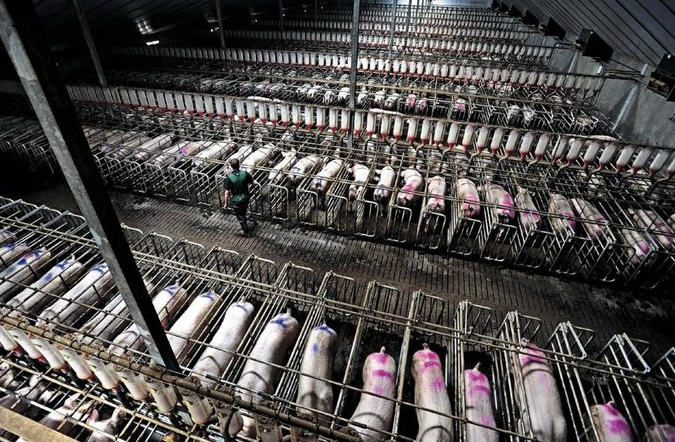
Factory farms are a breeding ground for infectious diseases, which could easily spread among the animals and, if zoonotic, to humans
The COVID-19 pandemic shined a global spotlight on the infectious disease risks associated with live animal markets, but zoonotic diseases can – and do – emerge in factory farms, slaughterhouses and any other setting where animals are intensively confined and/or slaughtered for human consumption. Dr. Michael Gregor, the author of Bird Flu: A Virus of Our Own Hatching (2016) has said, “If you actually want to create pandemics, then build factory farms.”
Conservationists and animal rights activists staged a rally in Times Square to raise awareness about the connection between eating animals and pandemics
This week, Idaho governor Brad Little is expected to sign into law a bill that calls for the extermination of 90 percent of the state’s 1,500-strong wolf population. Proponents say wolves are ruining the livelihoods of ranchers and hunters. Opponents say the wolves are necessary to a healthy ecosystem.
“They’re destroying ranchers,” said Republican senator Mark Harris, one of the bill’s sponsors, during a debate in the Idaho statehouse. “They’re destroying wildlife. This is a needed bill.”
“The politicians behind this bill lack science, ethics, and fact,” Amaroq Weiss, senior West Coast wolf advocate for the Center for Biological Diversity, told Outside.
After being eradicated earlier in the 20th century, wolves were reintroduced to Idaho in 1995. Initially protected by the federal government under the Endangered Species Act, the state legislature worked to establish political control over management of the species. The Idaho Wolf Conservation and Management Plan was passed in 2002, creating a blueprint for the state’s Fish and Game department to take over management of the species upon delisting from the ESA, which took place across the northern Rocky Mountains in 2011.
That original plan, written by the legislature, not Fish and Game, called for a minimum population level of 15 packs. Given that wolf packs in this part of the world average about ten members, that roughs out to a population of about 150 wolves. That number was determined by the legislature to be the population size that would allow the species to remain sustainable in the state—without creating conflict with ranchers and hunters. Wildlife biologists, in contrast, argue that wolves must return to the entire portion of their historic range that’s currently able to support the species before their population can be considered sustainable.
This new bill, SB 1211, calls for Idaho’s wolf population to be reduced from its current estimated size of 1,556 back to that politically determined level of 150 wolves. To achieve that, it devotes $590,000 to hire contractors to exterminate the animals and removes any limits on the number of wolves hunters may harvest, while freeing them to use any method currently legal in the state, including trapping, the use of night vision equipment, shooting from vehicles, and baiting.
The Idaho Fish and Game Commission opposes the legislation, arguing the bill would remove decisions about how to manage wildlife from the department’s professionals and place that decision making in the hands of politicians. Idaho’s approach is also in conflict with that of the U.S. Fish and Wildlife Service.
Here are the reasons the bill’s proponents argue such extraordinary action is necessary—and how they compare to science.
The Claim: Wolves Kill Livestock
“A cow taken by a wolf is similar to a thief stealing an item from a production line in a factory,” Cameron Mulrony, executive vice president of the Idaho Cattle Association, told The Guardian.
And in the debate at the statehouse, Idaho’s Senator Harris called wolf livestock depredation a “disaster.”
The Reality:The Number of Kills by Wolves Is Exceptionally Small
In 2018 there were 113 confirmed wolf kills of cows and sheep. In 2019 that number was 156, and in 2020 it was 84. That gives us a three-year average of 113 wolf kills per year in the state. There are currently 2.73 million head of cows and sheep in Idaho. That means confirmed wolf-caused losses amount to 0.00428 percent of the state’s livestock.
According to a study published in 2003 and widely cited by the agriculture industry, variables like terrain can sometimes make it hard to find dead livestock, so the true number of wolf-related losses may be up to eight times greater than the official tally. Assuming that worst-case scenario applies universally, wolf kills may account for as much as 0.02 percent of the state’s livestock.
Idaho loses about 40,000 cattle each year to non-predator causes like disease, birthing complications, and inclement weather.
U.S. Fish and Wildlife provides the state of Idaho with funding to compensate ranchers for confirmed cases of livestock lost to wolf depredation. Currently that amount covers 50 percent of the rancher’s total cost.
The Claim: Killing Wolves Reduces Depredation
“We need proper management to keep Idaho ranchers in business,” wrote Cameron Mulroney, vice president of the Idaho Cattle Association, in an opinion piece published by the Idaho Statesman. He goes on to call for taxpayer-funded wolf culling and increased wolf hunting opportunities for members of the public.
The Reality: Healthy Packs Prefer Natural Prey
“Multiple state-sponsored studies have concluded that large-scale wolf removal through public hunting or significant lethal control does not substantially reduce livestock losses to wolves in areas of recurring conflict,” Zoë Hanley, a representative of Defenders of Wildlife, wrote in a letter to Idaho lawmakers.
Many biologists believe that, because wolves function in packs, destabilizing and weakening those packs by killing members of them forces the wolfs to seek easier prey. “The odds of livestock depredations increased four percent for sheep and five to six percent for cattle with increased wolf control,” said a study that tracked livestock depredations across Idaho, Montana, and Wyoming between 1987 and 2012.
The study does confirm that culling wolves to the point of removing them from an ecosystem can be demonstrated to reduce depredation.
The Claim: Wolves Decrease Hunting Opportunities
Wolves are “destroying wildlife,” said Senator Harris in the debate. Hunters complain that they must compete with wolves for their natural prey, elk and deer, and that wolves push those animals out of traditional hunting areas, while reducing their outright numbers.
“The old place where you took your Dad or your dad takes your son, you can’t go there anymore because the elk are gone,” wrote Benn Brocksome, executive director of the Idaho Sportsman’s Alliance, in an opinion piece. “There’s one or two deer where there used to be hundreds, they’ve really pushed the elk and deer populations around, and really diminished the populations in different areas.”
The Reality: Wolves Create Healthy Ecosystems
Despite all those pesky wolves, elk populations in Idaho are actually at or above management objectives. The outright number of elk in the state currently stands at 120,000, just 5,000 fewer than the all-time high of 125,000. That’s also 8,000 more elk than were counted in 1995, the year wolves were reintroduced to Idaho.
As of 2019, the population of bulls (male elk) was above management objectives in 41 of Idaho’s 78 elk-hunting zones. According to Idaho Fish and Game, 2019 saw the 14th-highest elk harvest of all time in the state. In fact, the biggest problem elk populations in Idaho face is a lack of hunters prepared to hunt tough terrain. “One of the challenges we face in managing elk populations is getting enough hunters to hunt hard for and harvest antlerless elk in areas where we are working to bring elk herds back to the population objectives in the statewide elk plan,” Rick Ward, the department’s deer and elk program coordinator, said in a statement.
Mule deer aren’t fairing quite as well. “The three-year stretch of winters spanning from 2016 to 2019 was tough on many of Idaho’s mule deer herds, largely due to poor-to-average fawn survival,” according to Idaho Fish and Game. Still, 24,809 mule deer were harvested during the 2020 hunting season, with 28 percent of hunters finding success.Below average, but far from the lowest.
It doesn’t appear that wolves decreased populations of ungulates, and the predators may even play an important role in protecting them: chronic wasting disease (CWD) is a contagious neurological disease that degrades brain tissue in deer and elk over time, leading to emaciation and eventually death. CWD has not yet reached Idaho, but it has been found just over the border in southwest Montana and in Wyoming. There is currently no known cure and no effective tool for preventing its spread.
At least that’s what researchers thought until they began a research project into CWD’s spread in Yellowstone National Park. There, preliminary results suggested that wolves may be effective at slowing its spread by killing infected animals. Wolves cannot be infected by the disease.
“Wolves wouldn’t be a magic cure everywhere,” Ellen Brandell, the Penn State University researcher leading the project, told The New York Times. “But in places where it was just starting and you have an active predator guild, they could keep it at bay and it might never get a foothold.”
Gary J. Wolfe, a wildlife biologist and the former president and CEO of hunting advocacy group the Rocky Mountain Elk Foundation, agrees. “While I don’t think any of us large carnivore proponents are saying that wolf predation will prevent CWD, or totally eliminate it from infected herds, it is ecologically irresponsible to not consider the very real possibility that wolves can slow the spread of CWD and reduce its prevalence in infected herds,” he said in a statement released by the Sierra Club. “We should consider wolves to be ‘CWD border guards,’ adjust wolf hunting seasons accordingly, and let wolves do their job of helping to cull infirm animals from the herds.”
SB 1211 isn’t going to save livestock and won’t help hunters, but ultimately it may pose one major problem for anti-wolf Idahoans: if it causes the state’s wolf population to fall below ten packs, the bill could eventually lead to the state losing the ability to manage wolves within its borders. The 2002 Wolf Conservation and Management Plan, written by Idaho’s own legislature, calls for wolf management to revert to U.S. Fish and Wildlife control if the state’s population falls below ten packs.
“In the unlikely event the population falls below ten packs … wolf management will revert to the same provisions that were in effect to recover the wolf population prior to delisting,” according to Idaho’s management plan. That’s the Endangered Species Act.
Poland is currently contending with 262 outbreaks of bird flu, the country’s highest recorded number of infections. Reporting from Notes from Poland explains that over six million birds have been culled to stem the spread of the disease. Though poultry farmers can claim compensation for their losses, the hit to the country’s poultry industry, which produces 20% of the EU’s poultry meat, has been immense.
Animal health authorities believe that the outbreaks are due to the high concentration of poultry farms in certain locations. Poland’s chief veterinarian is calling on the government to update regulations to ensure greater biosecurity measures and that there is sufficient space between poultry farms.
“This is the first time we are facing such a great crisis,” Andrzej Danielak, from the Polish Association of Poultry Breeders and Producers said. “Until now, 65 outbreaks was the largest [annual] number, and here we have already exceeded 200.”
Prices for eggs and poultry meat in Poland have already increased 65% since November, and many economists expect the price hikes to continue. However, there could be some relief as the weather becomes warmer.
A new study in the journal Nature Climate Change analyzed the Brazilian Amazon’s carbon emission.
The Brazilian Amazon released 16.6 billion tonnes of carbon dioxide from 2010 through 2019.
The study also found that deforestation increased almost fourfold in 2019 from the previous two years.
A new report on Thursday found that over the last decade theBrazilian Amazon released approximately 20 percent more carbon dioxide than it absorbed.
According to the journalNature Climate Change, the Brazilian Amazon released 16.6 billion tonnes of carbon dioxide and only absorbed 13.9 billion tonnes from 2010 through 2019.
America is changing faster than ever! Add Changing America to yourFacebookorTwitterfeed to stay on top of the news.
(CNN)America’s emerging limbo between a full-blown pandemic and a return to normal is throwing up new public health dilemmas that spark instant political fires — like afresh round of grandstanding over mask wearing.Top White House adviser Anita Dunn SundaydefendedPresident Joe Biden over his continueduse of a mask outdoors– even though the practice appears to conflict with new and relaxed administration guidelines for fully vaccinated citizens.In comments that didn’t necessarily clarify the situation, Dunn told CNN’s Jake Tapper on “State of the Union” that “extra precautions” were being taken for the President and that mask wearing was “a matter of habit.”
Republicans, seeking to dentstrong public approval ratingsfor Biden’s handling of the pandemic, have already accused him of whipping up stigma against people who refuse to wear masks…
Tyson debuts its first vegan burger, as the industry tries to make up for slow start inbooming plant-based meat market.ByMichael Hirtzer,Deena Shanker, andFabiana BatistaMay 3, 2021, 5:50 AM PDTUpdated on
There’s no other way to put it: Tyson Foods Inc.’sfirst attempt at an alt-meat burger was aflop.
Two years ago, the biggest U.S. meat company marketed a mix of real beef and pea protein to consumers with a “flexible diet.” But the half-vegan, half-not patty proved a tough sell. Tyson eventually discontinued it, saying only that it “constantly evaluates products.”
Now it’s back and trying again. On Monday, the maker of Jimmy Dean sausages unveiled a lineup of 100% vegan meat products…
The funeral was a suitably solemn affair. The small casket was placed on a table covered in a black drape, a maudlin yet defiant speech quoted a Dylan Thomas poem, a moment’s silence was held.
Inside the casket, however, was not a body, but a vial of meltwater from Clark glacier in Oregon, once an imposing body of ice but now a shrivelled remnant.
The funeral, a stunt held by worried glacier researchers on the steps of the state capitol in Salem, illustrated how the climate crisis is rapidly gnawing away at the majestic icepacks that used to throng the mountains of the northwestern US, potentially posing a threat to the region’s water supplies.
“There is just this immense sadness because we all knew it was going to be bad, but didn’t think it would be this bad,” said Anders Carlson, president of the Oregon Glacier Institute, who read the eulogy for Clark glacier at the “funeral” in October.
Clark glacier is, or was, found if you took a moderately strenuous hike amid the Cascade mountains, a range that stretches from British Columbia in Canada down to the northern reaches of California.
Once spanning about 46 football pitches in size, the Clark glacier is now about three football pitches in area, or what Carlson calls a “stagnant scrap of ice”.
Mount Rainier Photograph: Elaine Thompson/AP
“It’s like a rotting carcass of its former self,” said Carlson. Glaciers move via gravity under their own vast weight, but once they have lost a certain amount of volume, they become dormant patches of ice. Other nearby glaciers found on the three sisters, a chain of volcanic peaks, and Mount Hood have similarly “died” in this way.Advertisementhttps://2d5c5e053b62f319ca53502bafa5e824.safeframe.googlesyndication.com/safeframe/1-0-38/html/container.html
“You go back through old photographs and glaciers have disappeared just in the last 20 years – it’s really dramatic,” said Carlson, who has calculated that at least a third of the state’s glaciers named by the US government in the 1950s are now gone.
Among their other benefits, the meltwater from glaciers each spring feeds streams and rivers that supply a water source for apple and pear orchards, vineyards and even some drinking water for towns situated in the shadows of the mountains.
Researchers have estimated that river volumes in the late summer could drop by 80% by the end of the century due to decreases in glacier and snow melt. These huge losses raise tough questions over how to replace the water.
“These glaciers are not just nice to look at – they are our water towers, where we store our water,” said Carlson.
“Places like Hood River and Eugene are drinking and growing crops with water from glaciers. If you like Oregon wine, the chances are it was grown with glacier water. If you lose that, it’s not going to be a pretty picture. You either try to get groundwater or build new dams, which is not popular with anyone.”
The decline of glaciers is part of a broader trend that has seen vast bodies of ice wither away from the Himalayas to Switzerland as global temperatures climb. The glaciers of America’s Pacific north-west aren’t as well known as those overseas, but they play an important role in the local environment and are suffering stunning losses.
Since the mock funeral, researchers have found that the Cascades are particularly vulnerable to the melting of glaciers, which can cause maladies ranging from increased wildfire risk to the loss of species such as steelhead trout that rely on the frigid cold of glacier-fed streams. In the longer term, the glaciers of the American west face almost complete obliteration.
“The glaciers in the western US continue to shrink and will largely disappear by the end of the century,” said Andrew Fountain, a geologist at Portland State University who has submitted new research that found the glaciers of the Olympic Mountains, in the state of Washington, will probably vanish by 2070.
“You might get icy remnants on the peaks of tall mountains like Mount Rainier or Mount Baker, but they will be pretty small. Rising temperatures are doing this, without a doubt.”
Beyond drastically cutting planet-warming emissions, there is little that can be done to salvage the glaciers, a sobering reality for those who have long hiked and climbed the peaks of the US north-west.
“It’s really hard to stop the decline,” said Carlson. “People don’t realise we are a glacierised country – we rely upon them, like the Swiss and Norwegians do. They are important and we need them.”

 https://imasdk.googleapis.com/js/core/bridge3.453.0_en.html#goog_1072611284Volume 90% Police believe one person has shot and killed at least a dozen crows in the city. (KOMO)