Sure, we were eavesdropping, but it’s all in the name of science. Besides, we now have some galactic gossip we’re dying to share – this was not your typical solar eruption.
As far as neighbors go, you could do worse than Proxima Centauri. At a mere 4 light-years (just over 30 trillion kilometers) over the back fence, it’s close enough to keep an eye on without being prone to blowing up ina life-destroying cataclysm.
That doesn’t mean it’s quiet. Likemost hot-temperedred dwarf stars, Proxima Centauri vents its…
Proponents of the bill say the added day will have a positive impact on the state’s economy.
While critics say Sunday is a day landowners can get outside without concerns about hunters.
“Many local businesses such as restaurants, gas stations, convenience stores, hunting supply establishments just to name a few would become more prosperous as a result,” said Rep. David McCrea, (D) – Fort Fairfield.
Green Bay, Wis. – In honor of the 12 cows who were killed when a truck reportedly carrying them to a JBS slaughterhouse overturned at the roundabout of N. Packerland Drive and Highway 29 on Monday, PETA plans to place a billboard near the crash site proclaiming, “See the Individual. Go Vegan.” Some of the 12 died instantly, while others had to be shot dead on the scene after being severely injured.
“Twelve gentle cows died in terror and agony as a result of this crash, and the traumatized survivors were likely hauled off for their throats to be slit and their bodies carved up for food,” says PETA Executive Vice President Tracy Reiman. “PETA’s ad encourages anyone disturbed by the thought of animals suffering on the side of the road or under the slaughterhouse knife to go vegan.”
Cows in the meat industry are often confined to cramped, filthy feedlots without protection from the elements. At the slaughterhouse, workers shoot them in the head with a captive-bolt gun, hang them up by one leg, and cut their throat—often while they’re still conscious.
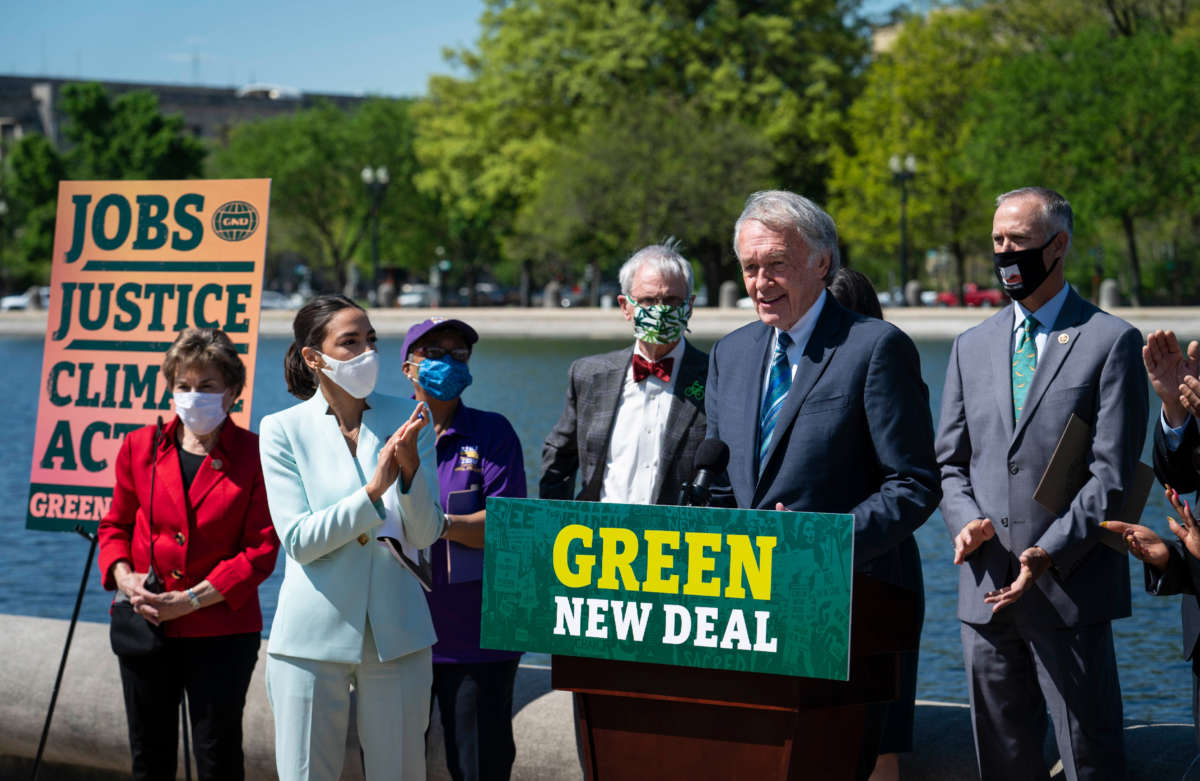
Sen. Ed Markey speaks during a news conference held to reintroduce the Green New Deal at the West Front of the U.S. Capitol on April 20, 2021, in Washington, D.C.
This story is part of Covering Climate Now, a global journalism collaboration strengthening coverage of the climate story.
Earth Day has been celebrated since 1970, an era which marks the beginning of the modern environmental movement, with concerns built primarily around air and water pollution. Of course, the state of the environment has shifted dramatically since then, and while environmental policy has changed a lot in the United States over the past 50 years, biodiversity is in great danger and the climate crisis threatens to make the planet uninhabitable.
On the 51st anniversary of Earth Day, world-renowned scholar and public intellectual Noam Chomsky, institute professor emeritus at Massachusetts Institute of Technology, laureate professor of linguistics and also the Agnese Nelms Haury chair in the Agnese Nelms Haury Program in Environment and Social Justice at the University of Arizona; and leading progressive economist Robert Pollin, distinguished professor of economics and co-director of the Political Economy Research Institute at the University of Massachusetts at Amherst, share their thoughts on the state of planet Earth in this exclusive interview for Truthout.
C.J. Polychroniou: The theme of Earth Day 2021, which first took place in 1970 with the emergence of environmental consciousness in the U.S. during the late 1960s, is “Restore Our Earth.” Noam, how would you assess the rate of progress to save the environment since the first Earth Day?
Stay in the loop
Never miss the news and analysis you care about.
Email
Noam Chomsky: There is some progress, but by no means enough, almost anywhere. Evidence unfortunately abounds. The drift toward disaster proceeds on its inexorable course, more rapidly than rise in general awareness of the severity of the crisis.
To pick an example of the drift toward disaster almost at random from the scientific literature, a study that appeared a few days ago reports that, “Marine life is fleeing the equator to cooler waters — this could trigger a mass extinction event,” an eventuality with potentially horrendous consequences.
It’s all too easy to document the lack of awareness. One striking illustration, too little noticed, is the dog that didn’t bark. There is no end to the denunciations of Trump’s misdeeds, but virtual silence about the worst crime in human history: his dedicated race to the abyss of environmental catastrophe, with his party in tow.
They couldn’t refrain from administering a last blow just before being driven from office (barely, and perhaps not for long). The final act in August 2020 was to roll back the last of the far-too-limited Obama-era regulations to have escaped the wrecking ball, “effectively freeing oil and gas companies from the need to detect and repair methane leaks — even as new research shows that far more of the potent greenhouse gas is seeping into the atmosphere than previously known … a gift to many beleaguered oil and gas companies.” It is imperative to serve the prime constituency, great wealth and corporate power, damn the consequences.
Indications are that with the rise of oil prices, fracking is reviving, adhering to Trump’s deregulation so as to improve profit margins, while again placing a foot on the accelerator to drive humanity over the cliff. An instructive contribution to impending crisis, minor in context.
Even though we know what must and can be done, the gap between willingness to undertake the task and severity of the crisis ahead is large, and there is not much time to remedy this deep malady of contemporary intellectual and moral culture.
Like the other urgent problems we face today, heating the planet knows no boundaries. The phrase “internationalism or extinction” is not hyperbole. There have been international initiatives, notably the 2015 Paris agreement and its successors. The announced goals have not been met. They are also insufficient and toothless. The goal in Paris was to reach a treaty. That was impossible for the usual reason: the Republican Party. It would never agree to a treaty, even if it had not become a party of rigid deniers.
Accordingly, there was only a voluntary agreement. So it has remained. Worse still, in pursuit of his goal of wrecking everything in reach, the hallmark of his administration, Trump withdrew from the agreement. Without U.S. participation, in fact leadership, nothing is going to happen. President Joe Biden has rejoined. What that means will depend on popular efforts.
I said “had not become” for a reason. The Republican Party was not always dedicated rigidly to destruction of organized human life on Earth; apologies for telling the truth, and not mincing words. In 2008, John McCain ran for president on a ticket that included some concern for destruction of the environment, and congressional Republicans were considering similar ideas. The huge Koch brothers energy consortium had been laboring for years to prevent any such heresy, and moved quickly to cut it off at the past. Under the leadership of the late David Koch, they launched a juggernaut to keep the party on course. It quickly succumbed, and since then has tolerated only rare deviation.
The capitulation, of course, has a major effect on legislative options, but also on the voting base, amplified by the media echo-chamber to which most limit themselves. “Climate change” — the euphemism for destruction of organized human life on Earth — ranks low in concern among Republicans, frighteningly low in fact. In the most recent Pew poll, just days ago, respondents were asked to rank 15 major problems. Among Republicans, climate change was ranked last, alongside of sexism, far below the front-runners, the federal deficit and illegal immigration. Fourteen percent of Republicans think that the most severe threat in human history is a major problem (though concerns seem to be somewhat higher among younger ones, an encouraging sign). This must change.
Turning elsewhere, the picture varies but is not very bright anywhere. China is a mixed story. Though far below the U.S., Australia and Canada in per capita emissions — the relevant figure — it nevertheless is poisoning the planet at much too high a level and is still building coal plants. China is far ahead of the rest of the world in renewable energy, both in scale and quality, and has pledged to reach net-zero emissions by 2060 — difficult to imagine at the present pace, but China has had a good record in reaching announced goals. In Canada, the parties have just released their current plans: some commitment but nowhere near enough. That’s aside from the terrible record of Canadian mining companies throughout the world. Europe is a mixed story.
The Global South cannot deal with the crisis on its own. To provide substantial assistance is an obligation for the rich, not simply out of concern for their own survival but also a moral obligation, considering an ugly history that we need not review.
Can the wealthy and privileged rise to that moral level? Can they even rise to the level of concern for self-preservation if it means some minor sacrifice now? The fate of human society — and much of the rest of life on Earth — depends on the answer to that question. An answer that will come soon, or not at all.
Bob, in hosting the Earth Day 2021 summit, Biden hopes to persuade the largest emitters to step up their pledges to combat the climate crisis. However, the truth of the matter is that most countries are not hitting the Paris climate targets and the decline in emissions in 2020 was mostly driven by the COVID-19 lockdowns and the ensuing economic recession. So, how do we move from rhetoric to accelerated action, and, in your own view, what are the priority actions that the Biden administration should focus on in order to initiate a clean energy revolution?
Robert Pollin: In terms of moving from rhetoric to accelerated action, it will be useful to be clear about what was accomplished with the 2015 Paris climate agreement. Noam described the Paris agreement and its successors as “insufficient and toothless.” Just how insufficient and toothless becomes evident in considering the energy consumption and CO2 emissions projections generated by the International Energy Agency (IEA), whose global energy and emissions model is the most detailed and widely cited work of its kind. In the most recent 2020 edition of its World Energy Outlook, the IEA estimates that, if all signatory countries to the Paris agreement fulfilled all of their “Nationally Determined Contributions” set out at Paris, global CO2 emissions will not fall at all as of 2040.
It’s true that, according to the IEA’s model, emissions level will not increase any further from now until 2040. But this should be cold comfort, given that, according to the Intergovernmental Panel on Climate Change (IPCC), CO2 emissions need to fall by 45 percent as of 2030 and hit net-zero emissions by 2050 in order for there to be at least a decent chance of stabilizing the global average temperature at 1.5 degrees Celsius above pre-industrial levels. In other words, soaring rhetoric and photo opportunities aside, the Paris agreement accomplishes next to nothing if we are serious about hitting the IPCC emissions reduction targets.
The “American Jobs Plan” that the Biden administration introduced at the end of March does give serious attention to many of the main areas in which immediate dramatic action needs to occur. It sets out a range of measures to move the U.S. economy onto a climate stabilization path, including large-scale investments in energy efficiency measures, such as retrofitting buildings and expanding public transportation, along with investments to dramatically expand the supply of clean energy sources to supplant our current fossil fuel-dominant energy system. Burning oil, coal and natural gas to produce energy is now responsible for about 70 percent of all CO2 emissions globally.
The Biden proposal also emphasizes the opportunity to create good job opportunities and expand union organizing through these investments in energy efficiency and clean energy. It also recognizes the need for just transition for workers and communities that are now dependent on the fossil fuel industry. These are important positive steps. They resulted because of years of dedicated and effective organizing by many labor and environmental groups, such as the Green New Deal Network and the Labor Network for Sustainability.
I also have serious concerns about the Biden proposal. The first is that the scale of spending is too small. This is despite the constant barrage of press stories claiming that the spending levels are astronomical. During the presidential campaign, Biden’s “Build Back Better” proposal was budgeted at $2 trillion over four years, i.e., $500 billion per year. His current proposal is at $2.3 trillion over eight years, i.e., somewhat less than $300 billion per year. So, on a year-by-year basis, Biden’s current proposal is already 40 percent less than what he had proposed as a candidate.
This overall program also includes lots of investment areas other than those dealing with the climate crisis, such as traditional infrastructure spending on roads, bridges and water systems; expanding broadband access; and supporting the care economy, including child and elder care. Many of these other measures are highly worthy. But we need to recognize that they will not contribute to driving down emissions. I would say a generous assessment of the Biden plan is that 30 percent of the spending will contribute to driving down emissions. We now are at a total annual budget of perhaps $100 billion. That is equal to 0.5 percent of current U.S. GDP.
It is conceivable that this level of federal spending could be in the range of barely adequate. But that would be only if state and local governments, and even more so, private investors — including small-scale cooperatives and community-owned enterprises — commit major resources to clean energy investments. By my own estimates, the U.S. will need to spend in the range of $600 billion per year in total through 2050 to create a zero-emissions economy. That will be equal to nearly 3 percent of U.S. GDP per year.
But the private sector will not come up with the additional $400-$500 billion per year unless they are forced to do so. That will entail, for example, stringent regulations requiring the phase out of fossil fuels as energy sources. As one case in point, utilities could be required to reduce their consumption of coal, natural gas and oil by, say, 5 percent per year. Their CEOs would then be [held responsible] if they fail to meet that requirement.
At the same time, the Federal Reserve can easily leverage federal spending programs by establishing Green Bond purchasing programs at scale, such as in the range of $300 billion per year to finance clean energy investments by both state and local governments as well as private investors. Right now, a significant number of Green Bond programs do already exist at state and local government levels, including through Green Banks. These are all worthy, but are operating at too small a scale relative to the need.
Beyond all this, those of us living in high-income countries need to commit to paying for most of the clean energy transformations in low-income countries. This needs to be recognized as a minimal ethical requirement, since high-income countries are almost entirely responsible for having created the climate crisis in the first place. In addition, even if we don’t care about such ethical matters, it is simply a fact that, unless the low-income countries also undergo clean energy transformations, there will be no way to achieve a zero-emissions global economy, and therefore no solution to the climate crisis, in the U.S., Europe or anyplace else. The Biden proposal to date includes nothing about supporting climate programs in developing economies. This must change.
Noam, when surveying reactions to whatever environmental gains have been made over the past 50 years, one observes a rather unsurprising pattern, which is, namely, that the right assigns virtually all credit to businessmen and to capitalism, while the left to environmental activists, and contends that the only hope for a greener tomorrow mandates the rejection of capitalist logic. Is capitalism saving or killing the planet?
Chomsky: It’s close to a truism that, “capitalist logic will kill the planet.” That’s one of the many reasons why business has always rejected the suicidal doctrines that are piously preached. Rather, the business world demands that a powerful state, under its control, intervene constantly to protect private power from the ravages of an unconstrained market and to sustain the system of public subsidy, private profit that has been a cornerstone of the economy from the early days of industrial state capitalism….
The only way to answer the question posed is to look at examples. Let’s pick a central one: a Green New Deal. In one or another form, such a program is essential for survival. A few years ago the idea was ignored or ridiculed. Now it is at least on the legislative agenda. How did the transition occur? Overwhelmingly, thanks to wide-ranging activism taking many forms, culminating in the occupation of congressional offices by activists of Sunrise Movement. They received support from representatives swept into office on the Sanders wave of popular activism, notably Rep. Alexandria Ocasio-Cortez, joined by senior Sen. Ed Markey, who had long been concerned with environmental issues.
There’s a long way to go from legislative agenda to implementation, but we can be confident that steady and dedicated activism will be a prime factor in carrying the project forward; to be concrete, in pressing Biden’s program, itself a product of sustained activism, toward the kinds of policies that are necessary to reach such goals as net-zero emissions by mid-century. The example breaks no new ground. It is, in fact, the norm.
The protestations of the right are, however, not without merit. Given the right structure of benefits and threats, private capital, driven by profit and market share, can be enlisted in pursuing the goal of species survival. That covers contingencies ranging from incentives to invest in solar power to imposing what the private sector calls “reputational risks,” the polite term for the fear that the peasants are coming with the pitchforks.
There is an impact. We see it in the current rage for ESG investment (environmental and social factors in corporate government) — all, of course, in service of the bottom line. We also see it in the solemn pledges of corporate executives and business groups to reverse their self-serving course of recent years and to become responsible citizens dedicated to the common good — to become what used to be called “soulful corporations” in an earlier phase of this recurrent performance — which may, on occasion, have an element of sincerity, though always subject to institutional constraints.
Such impacts of popular activism should not be dismissed — while always regarded with due caution. They may induce the search for private gain to veer in a constructive direction — though far too slowly, and only in limited ways. Like it or not, there is no alternative now to large-scale governmental projects. The reference to the New Deal is not out of place.
Whatever the source, the outcome should be welcomed. It’s of no slight importance when “More than 300 corporate leaders are asking the Biden administration to nearly double the emission reduction targets set by the Obama administration,” including big boys like Google, McDonalds, Walmart.
The choice is not popular activism or managerial decisions, but both. However, a little reflection on time scales, and on the urgency of the crisis, suffices to show that the critical problems must be addressed within the general framework of existing state capitalist institutions. These can and should be radically changed. At the very least, serious moves should be made to escape the grip of predatory financial capital and the rentier economy that impedes the right mixture of growth/de-growth: growth in what is needed, like renewable energy, efficient mass transportation, education, health, research and development, and much more; de-growth where imperative, as in fossil fuel production. But overall, substantial social change, however important for decent survival, is a long-term project.
Bob, certain studies seem to indicate that the climate crisis won’t be stopped even if we reduced greenhouse gas emissions to zero. I am compelled therefore to ask you this: Is the climate crisis a race we can actually win?
Pollin: I am not a climate scientist, so I am not qualified to answer the question at the first, most critical level of climate science itself. But I can at least comment on some related points.
First, we do know what the IPCC has said about what is needed to have a reasonable chance at climate stabilization — that is, first of all, to cut global CO2 emissions by 45 percent as of 2030 and to reach net-zero emissions by 2050 in order to stabilize the global average temperature at 1.5 degrees Celsius above pre-industrial levels. How are we doing in terms of meeting those goals? The only fair assessment is that, to date, the record is dismal.
I would add here one additional set of observations beyond what we have already described. That is, climate scientists have known about the phenomenon of global warming since the late 19th century. But, as a steady pattern, the average global temperature only began rising above the pre-industrial level in the late 1970s. By the mid-1990s, the average temperature was 0.5 degrees Celsius above the pre-industrial level. As of 2020, we are nearly at 1 degree above the pre-industrial level. If we follow the pattern of the past 20 years, we will therefore breach the 1.5 degrees threshold by roughly 2040.
What happens if we do breach the 1.5 degrees threshold? I claim no expertise on this, and I think it is fair to say that nobody knows for certain. But we do at least know that the patterns we are already seeing at our current level of warming will only intensify. Thus, the World Meteorological Organizations’ provisional 2020 report, “State of the Global Climate” finds that,
“Heavy rain and extensive flooding occurred over large parts of Africa and Asia in 2020. Heavy rain and flooding affected much of the Sahel, the Greater Horn of Africa, the India subcontinent and neighboring areas, China, Korea and Japan, and parts of southeast Asia at various times of the year. Severe drought affected many parts of interior South America in 2020, with the worst-affected areas being northern Argentina, Paraguay and western border areas of Brazil…. Climate and weather events have triggered significant population movements and have severely affected vulnerable people on the move, including in the Pacific region and Central America.”
We also know that poor people and poor countries have already borne the greatest costs of the climate crisis, and that this pattern will continue as global average temperatures increase. As the economist James Boyce has written, poor people “are less able to invest in air conditioners, sea walls and other adaptations. They live closer to the edge … and the places that climate models show will be hit hardest by global warming — including drought-prone regions of sub-Saharan Africa and typhoon-vulnerable South and South East Asia — are home to some of the world’s poorest people.”
It therefore seems clear that we are obligated to act now on the premise that the climate crisis is a race that we can still win, even if we don’t know for certain whether that is true. But in addition, it is important to also recognize that advancing a global Green New Deal is fundamentally a no-lose proposition, as long as it includes generous transition support for fossil fuel-dependent workers and communities. This is because, first, the global clean energy transformation will be a major source of job creation in all regions of the world as well as creating a viable path to building a zero-emissions global economy. It will also significantly improve public health by reducing air pollution, lower energy costs across the board, and create opportunities to deliver electricity to rural areas of low-income countries for the first time.
All of these impacts will also help break the grip that neoliberalism has maintained over the global economy over the past 40 years. If we do end up building a viable clean energy system through a global Green New Deal, we will therefore also succeed in advancing democracy and egalitarianism.
This interview has been lightly edited for length and clarity.
S. 1211 would allow trophy hunters and trappers to kill an unlimited number of wolves by shooting mothers and pups in their dens, poisoning the animals, and shooting them from helicopters or airplanes, among other extremely cruel methods.Photo by Jean Landry/iStock.com
A bill that would allow trophy hunters, trappers and private contractors hired at taxpayer expense to kill up to 90% of the state’s wolves is flying through the Idaho legislature, and we need to stop it in its tracks.
The bill, introduced Tuesday, has already passed the state Senate and the House Resources and Conservation Committee. It could receive a vote on the floor of the House as early as Monday.
This is a terrible and wrongheaded measure that shows neither compassion nor any understanding of science. S. 1211 would allow trophy hunters and trappers to kill…
This story is part of Covering Climate Now, a global journalism collaboration strengthening coverage of the climate story.
It’s a bleak sort of Earth Day today. All the major newspapers are carrying headlines about President Biden’s global eco-summit, about his pledge to cut greenhouse emissions in half by 2030, but so far as I have seen, none use the words “Earth Day” to mark the moment. This environmental holiday was created in 1970. I was created in 1971. We’re both 50-ish now, and feeling the mileage.
There has never been an Earth Day like this. As a kid, I remember huge gatherings on Boston Common to plead for politicians and industry leaders to find their conscience and realize there is no profit in a dead world. All too often, these pleas were met by the likes of James G. Watt, Ronald Reagan’s notoriously anti-environmental Interior Secretary, who never met a mine he didn’t love or a tree he didn’t hate.
As a member of Generation X, it has been my special fate to bear witness to the long and ever more visible arc of environmental dissolution that has led us to this moment. From acid rain to the ozone layer, my youth was suffused with a daily drumbeat of looming ecological doom. “What do you say, for instance, about a generation that has been taught that rain is poison?” asked Hunter S. Thompson in 1988. I read that when it came out, realized he was talking about me, and had to agree: There really was nothing to say.
Don’t miss a beat
Get the latest news and thought-provoking analysis from Truthout.
Email
That arc brought us here, and boy howdy, here really sucks. More than a year into a lethal pandemic that is nothing more or less than a global environmental calamity itself, some 3 million people have died worldwide. Somewhere around 315,000 people in India were diagnosed with COVID-19 just yesterday, a record likely to be broken either today or tomorrow. In the U.S., the death toll lurks close to 600,000 souls, with millions more infected. There were almost 65,000 new cases diagnosed here on Wednesday.
How, then, do we look on Earth Day in this grim context? For me, COVID is a microcosm of the larger issues that have made defending the environment such a frustrating and often futile endeavor. As with the environment, the people in power knew the dangers represented by COVID, but chose not to act in order to protect and defend capitalism. A segment of the population believed the lies being peddled by those in power, and now stand as an immotile barrier to progress. The roof is on fire, but they would rather burn than be convinced that the flames are real. The money is just too good.
As with the environment, it did not have to be this way. We had ample means to stifle the COVID crisis, but failed or actively chose not to time and again. Even today, with new infections exploding, governors are dropping their states’ mask mandates, because conservative peer pressure deems it time to do so. It’s as if we made a bizarre sort of suicide pact with people who don’t know what death is, even as they march resolutely into its maw.
Still, at long last, efforts are being taken to undo the catastrophe of the prior presidential administration, which spent its four critical years obliterating environmental protections while opening national parks to the strip miners and the pipeline layers. In its final year, the Trump administration almost completely ignored COVID, and now, most of the horses have left the barn.Rouse yourself in defense of this precious thing, for it is not all gone, not yet, and that which can be saved must be saved by us.
Because of that, because of the failure to thwart circumstances that give rise to viral variants, many of the things we are required to do today are permanent fixtures. COVID may always be with us in some form, much the way radioactive fallout from nuclear tests is now part of our DNA. That’s all of us, every single one.
The same can be said for the state of the environment: The damage that has been done is only now beginning to reveal itself in deadly storm seasons, endless droughts and terrifying infernos. Any actions we take will be on the level of mitigation only; the damage is baked in and inexorably coming no matter what we do.
The environment and COVID: They knew, they failed to act, and now the damage not only appears to be permanent, but we live under the ever-present threat of severe outbreaks capable of harming or killing untold numbers.
While it can be argued that we are within sight of bringing COVID under some semblance of control, the same is not true of the ongoing and worsening phenomenon of climate disruption. The climate crisis is, truly, only just beginning.
Several years ago, Truthout’s invaluable environmental reporter Dahr Jamail embarked upon a journey to the various environmental graveyards of the world. He sought out the places where climate disruption is not just happening, but where it has been visibly happening for a long time.
Jamail put his hand into the melted tears of a dying glacier and touched the corpse of the Great Barrier Reef. He smelled smoke in the rainforest, heard the ticking of methane bombs beneath the melting tundra, and watched the ocean as it slowly devoured a fishing village that had stood safely by the shore for generations.
“Writing this book is my attempt to bear witness to what we have done to the Earth. I want to make my own amends to the Earth in the precious time we have left, however long that might be. I go into my work wholeheartedly, knowing it is unlikely to turn anything around. And when the tide does not turn, my heart breaks, over and over again as the reports of each succeeding loss continue to come in. The grief for the planet does not get easier. Returning to this again and again is, I think, the greatest service I can offer in these times. I am committed in my bones to being with the Earth, no matter what, to the end.
Please take this Earth Day and do likewise. Be with the green and the blue, the astonishment of life we have been gifted to witness and be part of, for we are inseparable from that which created us on this small space-borne rock. Rouse yourself in defense of this precious thing, for it is not all gone, not yet, and that which can be saved must be saved by us.
The world came together to join the Montreal Protocol, and today the damage to the ozone layer is visibly diminished. The world came together to act on acid rain, and it was eradicated so thoroughly that some climate denialists argue it never existed. It did, and now it is all but gone, because of us. It can be done, because it has been done.
Knowing this, it’s time to reject greenwashing and false promises from the powerful when they are proffered. After 51 Earth Days, only a revolution of the mind, body and spirit can save what we have left.
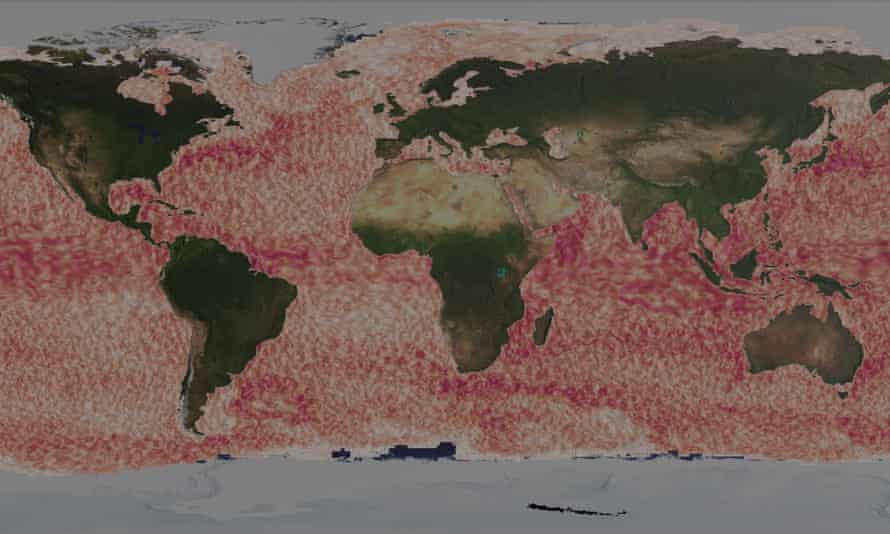
Researchers fear increasing energy in these eddies could affect ability of Southern Ocean to absorb C02
Giant eddies ranging from 10km to 100km across are intensifying in the South Ocean, one of the world’s biggest natural carbon stores. Researchers are concerned this could have grave effects for the world.Photograph: EKE
Swirling and meandering ocean currents that help shape the world’s climate have gone through a “global-scale reorganisation” over the past three decades, according to new research.
The amount of energy in these ocean currents, which can be from 10km to 100km across and are known as eddies, has increased, having as yet unknown affects on the ocean’s ability to lock-away carbon dioxide and heat from fossil fuel burning.
One expert said the changes described in the research could affect the ability of the Southern Ocean, one of the…
And the damage isn’t likely to have stopped there. Prunicki, director of air pollution and health research at Stanford University’sSean N. Parker Center for Allergy and Asthma Research, is studying the blood samples to understand what wildfire…










 © Provided by NBC News