BySydney HawkinsPublished:Apr. 24, 2021 at 3:53 PM PDT|Updated:18 hours ago
WAUSAU, Wis. (WSAW) – Dozens of people came together Saturday to support a Marathon’s man road to recovery.
Brent Nieslowski was diagnosed with quadriplegic paralysis last fall after a deer hunting incident.
“I’m a big deer hunter,” Brent explained. “it’s always been my passion. But unfortunately, on November 2nd, I fell out of my tree. My tree-stand broke and over 100 days later, here I am.”
After months of physical therapy, Brent has gained some mobility, but he says he will not stop until he’s able to walk again.ADVERTISEMENThttps://6e5ee0c6518cc85307ffa6c52e7d0c89.safeframe.googlesyndication.com/safeframe/1-0-38/html/container.html
“Through my faith in God and all the prayers,” Brent expressed, “I’m able to make a decent recovery and I’m going to continue to get stronger, and hopefully make a full recovery and walk again.”
Brent is planning to participate in more, intense aquatic physical therapy in…
A buck head-butted the owner of a Minnesota fur company last week before trashing the warehouse full of deer hides.
A six-point buck head-butted the owner of a rural Minnesota fur company last week before trashing the shop’s warehouse, currently full of deer hides being tanned for hunters.
The owner of Johnson Fur in rural Wilmar, Minnesota, claims the buck was looking for a mate when he smelled the deer hides and became confused.
J0hnson walked away with only minor bruises from the deer’s headbutt, but the deer dashed through the room, jumping over tables and destroying the office’s paperwork. Even a refrigerator was jumped upon by the buck.
The confused deer eventually ran back out the door and into the wild after the Johnsons’ Jack Russell terrier began nipping at his heels.
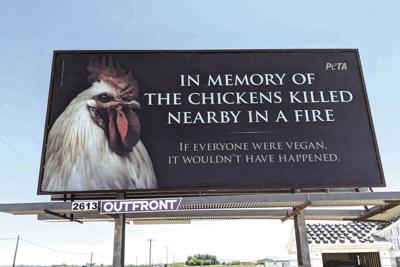
PETA erected a billboard near the main office of Hickman’s Family Farms “in memory” of the more than 165,000 birds who were killed in March in a fire at a facility owned by the company.
The billboard, at MC 85 between South 223rd and South 221st avenues, urges anyone upset by the animals’ suffering to take personal responsibility by no longer buying eggs and by going vegan.
“We’re encouraging people who were feeling sympathetic to those birds to take a look at their own actions that are also making those birds suffer on a daily basis,” said Amber Canavan, PETA senior campaigner spokesperson.
Canavan said PETA watches out for incidents in the news involving animals on farms.
“That goes for fires and transport trucks,” Canavan explained. “Transport trucks have fairly high incidents of crashes on the way to slaughterhouses, from facility to facility.
“There are least 100 a year. Many are not even reported or make it into the news. Those animals are crammed onto transport trucks, shoulder to shoulder, in there for days without food, water or rest.”
She said the public rarely thinks about animals locked behind closed doors, “out of sight, out of mind.”
“We want to make sure that they don’t just say, ‘Oh, that’s sad and go on about their day.’ We have the power to help them in many cases by not buying meat, dairy and eggs in the first place.”
PETA’s statement said hens used for egg production are confined to cramped barns, where each bird has no more than a square foot of space. Few farms install smoke detectors or fire-suppression systems.
PETA notes that going vegan spares animals immense suffering and helps prevent future epidemics and pandemics. SARS, swine flu, bird flu and COVID-19 all stemmed from confining and killing animals for food.
Montana Gov. Greg Gianforte signed a bill Friday allowing the use of private funds to reimburse wolf hunters or trappers for their expenses — reminiscent of bounties that widely exterminated the species in the last century.
Hunting and livestock groups, and their Republican allies in the legislature, contend not enough of the 1,200 wolves in Montana are being killed by hunters to limit their impact on big game outfitters or cattle and sheep producers.
The reimbursement program is similar to one in Idaho, where a private group pays its members up to $1,000 for costs incurred while scouting, hunting or trapping wolves.
Opponents argued there are tourists who come to Montana to see wolves and if too many are killed, they will return to protection under the Endangered Species Act.
Last week, Gianforte signed bills to allow the snaring of wolves, in addition to trapping; and another one to extend the wolf hunting season.
Lawmakers have also forwarded to the governor a bill to allow individuals to kill an unlimited number of wolves, hunt at night with artificial lights and night vision scopes and use bait to lure wolves into traps.
In Idaho, a bill that would allow the state to hire private contractors to reduce the wolf population from about 1,500 to 150 is quickly moving through the legislature. It allows the use of night-vision equipment to kill wolves as well as hunting from snowmobiles and all-terrain vehicles, among other changes.
Backers cite cattle and sheep deaths that cost ranchers hundreds of thousands of dollars, while opponents say the legislation threatens a 2002 wolf management plan involving the federal government.
SALT LAKE CITY — The letter is hitting mailboxes across Utah.
“This notice is to inform you that according to records maintained by the Office of Recovery Services (ORS), you currently have child support arrears over $2,500.00,” it reads, then warns that under a new Utah law “you may not apply for, obtain, or attempt to obtain a license, permit, or tag for hunting or fishing…”
ESCANABA — A plan to amend the city’s code of ordinances to prohibit hunting in Escanaba was met with questions by the city council, who worried the language of the ordinance could inadvertently allow hunting around Ludington Park.
During Thursday’s regular city council meeting, Escanaba Parks and Recreation Director Kim Peterson presented the ordinance, which would expand the city’s current ordinance prohibiting the discharge of firearms and other hunting weapons, such as crossbows and airguns, to prohibit all hunting, baiting, and blinds within the city limits.
The changes were spurred by an ongoing issue of hunting blinds being put on land within the Westside Recreation Area. Currently, individuals can only be ticketed if they are seen discharging a firearm, but the number of blinds appearing over recent years has the city concerned for public safety.
SHAREShare Article via FacebookShare Article via TwitterShare Article via LinkedInShare Article via EmailKEY POINTS
India is in the grip of a rampaging second wave of the pandemic, hitting a rate of one COVID-19 death in just under every four minutes in Delhi as the capital’s underfunded health system buckles.
The government has deployed military planes and trains to get oxygen from the far corners of the country to Delhi.
Television showed an oxygen truck arriving at Delhi’s Batra hospital after it issued an SOS saying it had 90 minutes of oxygen left for its 260 patients.
Medical staff in PPE attending to a person in the temporary Covid-19 care centre attached to LNJP Hospital, at Shehnai Banquet Hall, on April 23, 2021 in New Delhi, India.Raj K Raj | Hindustan Times | Getty Images
India’s coronavirus infections rose by 346,786 overnight, the…
Montana Gov.Greg Gianforte(R) on Friday signed a bill nullifying federal gun bans.
“Today, I proudly signed Rep. Hinkle’s law prohibiting federal overreach into our Second Amendment-protected rights, including any federal ban on firearms,” Gianforte tweeted.
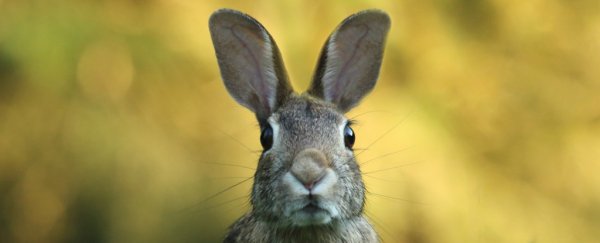
If you’ve ever wondered why rabbits and hares never evolved to be the size of horses, scientists have now got the answer.
It might sound like a flippant question, but it gets to an important part of evolutionary science: What is it that causes some animal taxonomies to have such a wide variation in size, while with others it’s very small?
For example, lagomorphs – which include rabbits and hares – don’t vary much in size, whereas the closely related rodents can go all the way from the tiny pygmy mouse to the chunky capybaras with hundreds of times as much mass.
“The largest living wild lagomorphs weigh only about 5 kg (11 lbs) on average, a tenth of the largest living rodent, the capybara,” says vertebrate paleontologist Susumu Tomiya from Kyoto University in Japan.
“But some breeds of domestic rabbits and other extinct species can weigh up to 8 kg. We were surprised by this and so began to investigate what sort of external forces keep wild lagomorphs across the world from evolving larger body sizes.”
The researchers analyzed lagomorph sizes past and present, looking at the fossil record and evolutionary history of the mammals, before turning their attention to other ecological factors. It turns out that the presence of ungulates, or hoofed animals, can be linked to lagomorph size.
Following up on the lead, the team looked at energy use across different sizes of lagomorphs and ungulates. They found that once lagomorphs reach around 6 kilograms (about 14 lbs) in mass, they’re at a competitive disadvantage to ungulates.
A return to the fossil record for North America backed up the idea that the smallest contemporaneous ungulate in an area was a big factor in determining the largest lagomorph – anything larger had a lower chance of survival with the bigger, more energy-efficient competitors around.
“We see this pattern today across numerous eco-regions, suggesting that there is an evolutionary ceiling placed on lagomorphs by their ungulate competitors,” says Tomiya.
The researchers point out that there are other factors that come into play once lagomorphs become too big to operate at optimum capacity: competition from other animals from the same clade and increased danger from predators.
However, it’s the ungulate comparison that seems to have had the most effect in this case. The research feeds into two contrasting ideas about how species evolve: the ‘red queen’ hypothesis, which ascribes most importance to species competition, and the ‘court jester’ hypothesis, which says abiotic forces like climate changes have the most impact.
According to the research, it seems that the red queen model is the one that’s most significant here, against the backdrop of abiotic forces that aren’t anything to do with animal competition.
“An ongoing debate in evolutionary biology concerns whether biological or environmental processes are more important in shaping biological diversity,” says Tomiya.
“For some time, the court jester model – ascribing diversity to abiotic forces such as the climate – has been dominant, due to the difficulty of studying biological interactions in the fossil record.”
These results serve as a reminder that we can’t ignore the effects of ignore species competition, however, as it seems to be the main reason we don’t have horse-sized rabbits and hares.