How California snared two elite hunters posting ‘once a lifetime’ kills on social media

https://www.sacbee.com/news/investigations/the-public-eye/article250441186.html

BY RYAN SABALOWAPRIL 07, 2021 04:55 AM, UPDATED 4 HOURS 52 MINUTES AGO

Joe Frater and Chris Stone were on their way to social media stardom in the elite world of trophy deer hunting.

The two law enforcement officers — Frater is a corrections officer at a local prison; Stone is an investigator for the Amador County district attorney — regularly showed off their trophies from just a few years of hunting with bows and arrows in the Sierra foothills of Northern California.

They posed with impressive, mature bucks that they somehow managed to pull from a place known mostly for its scrawny deer with tiny racks. The men appeared on hunting websites, podcasts and YouTube videos, and they had sponsorships with companies that sell hunting equipment.TOP ARTICLESEl Dorado promoted to orange reopening tier while statewide coronavirus numbers stay low

Along the way, California wildlife officers were beginning to grow skeptical of the steady feed of social media posts featuring Frater and Stone. Most of their kills looked like the bruisers that celebrity hunters brag about on hunting shows — that is, extraordinary.

What unfolded next over five months in 2019 could be an episode of “CSI,” as wardens undertook a complex operation with covert stakeouts, DNA evidence, aerial surveillance and vehicle tracking devices — tactics that the men’s attorneys say went too far in upholding California’s stringent and complex hunting rules.

Get unlimited digital access

Subscribe now for only $1CLAIM OFFERhttps://d9a47f024a3d4e0b131a2bac81881a0c.safeframe.googlesyndication.com/safeframe/1-0-38/html/container.html

From the beginning, investigators thought the two archery hunters may have been cheating. They suspected Frater and Stone had lured in the deer using bait, a practice that’s considered unsporting. It’s also illegal in California.

“The caliber/type of deer is very rare for a legal CA hunter to harvest, especially with only using archery equipment,” Game Warden David Moskat wrote in a 2019 search warrant. “I have known many archery and rifle hunters who would be satisfied to harvest even one of this caliber of buck in a lifetime of legal hunting in California.”

In California — and elsewhere around the country — breaking the hunting rules can be a criminal offense. Violators can face misdemeanor charges for breaking even the most technical rules in a thick rule book dedicated to hunting and wildlife protection.

In 2010, one of the biggest names in the hunting world, rock musician Ted Nugent, showed himself hunting over bait as he killed a small “spike” buck on an episode of his “Spirit of the Wild” hunting program on the Outdoor Channel.

Nugent — who often hunts in Texas, where using bait is legal — pleaded no contest to two misdemeanors: illegally baiting a deer, and failing to have a hunting permit signed by a government official after a kill.

The Public Eye

Get The Bee’s big stories and major investigations into government wrongdoing, school spending, political corruption and more on Thursdays.SIGN UP

This site is protected by reCAPTCHA and the Google Privacy Policy and Terms of Service apply.https://d9a47f024a3d4e0b131a2bac81881a0c.safeframe.googlesyndication.com/safeframe/1-0-38/html/container.html

To figure out the methods used by Frater and Stone, a team of officers went on their own hunt, using the same tactics as any elite law enforcement agency would.

They used a surveillance plane to trail the men from overhead. They set out motion-activated cameras. They put tracking devices on their pickups. They took samples from the guts left behind from kills and swabbed the bed of Frater’s pickup for deer blood and hair for DNA evidence. They combed through their text messages and tallied who they called and the minutes they were on the phone.

After weeks of stakeouts both day and night, they raided the two men’s homes, going room to room, rifling through drawers, freezers and closets, seizing deer-head trophies, archery equipment, cell phones, frozen venison, computers, trail camera memory cards and taxidermy and butcher receipts.

At Frater’s home, they seized salt licks, mineral blocks and bags of feed, the sorts of bait used to lure in deer.

When the investigation was complete, the wardens said they found enough evidence the men were hunting deer using bait. Among several other violations: failure to report harvested deer as required by law, intentionally misrepresenting the location of their kills, and trespassing.https://d9a47f024a3d4e0b131a2bac81881a0c.safeframe.googlesyndication.com/safeframe/1-0-38/html/container.html

Because of a recently enacted state law designed to punish poachers specifically targeting trophy-class deer, Stone and Frater faced special sentencing enhancements that included up to a year in jail and up to $40,000 in fines.

In the end, the California Attorney General’s Office allowed the men to sign plea bargains that included no jail time and fines nowhere near the maximum the law allows. (The state agency prosecuted the case in Amador County Superior Court, given that Stone worked for the local district attorney.)

Stone’s and Frater’s attorneys argue the Attorney General’s Office knew the state’s case was overblown, which is why the trophy enhancement was never filed. They argue that the two men didn’t deliberately intend to violate the state’s strict prohibition on hunting deer using bait.

As for the other allegations, John Holbus, Stone’s Sacramento attorney, said they were for technical and “so meritless that the Attorney General’s office declined to even file them.”

Frater’s Sacramento attorney, Candice Fields, said the amount of time and resources spent on the case were wasted on her client “who has been licensed since around age 13, (and) has a spotless record.”https://d9a47f024a3d4e0b131a2bac81881a0c.safeframe.googlesyndication.com/safeframe/1-0-38/html/container.html

“My client and I are both disappointed that significant and precious law enforcement resources were expended on what the California Attorney General’s Office obviously deemed was an overblown investigation based upon the limited code violations which were ultimately charged,” she said in an email.

“If violent crime investigations receive less funding than did this investigation, the public really should be left wondering about the prioritization of how their tax dollars are spent.”

READ NEXT
STATE-WORKER

Here’s our best subscription deal, California state workers. Thank you for what you do

APRIL 08, 2020 5:00 AM


Holbus said that when he met with Fields and the attorney general’s prosecutor to go over the case, the seasoned criminal law attorneys were stunned at the number of DNA tests the wardens had ordered done.

“There were more DNA tests done than all three of us had seen in our careers put together,” Holbus said.https://d9a47f024a3d4e0b131a2bac81881a0c.safeframe.googlesyndication.com/safeframe/1-0-38/html/container.html

But some say that given what the wardens uncovered during their investigation, the punishment wasn’t severe enough — the latest example of what they say is a troubling trend.

“Judges, courts never take wildlife cases as seriously as drug offenses or violent crimes — they just don’t,” said former federal wildlife officer Michael Sutton, past president of the California Fish and Game Commission, the agency sets state hunting laws.

“There’s a big need to educate both prosecutors and judges about the serious nature of these offenses.”

The Attorney General’s Office said in an emailed statement that prosecutors were “unable to discuss charging analysis.”

SOCIAL MEDIA POSTS BECOME EVIDENCE

https://d9a47f024a3d4e0b131a2bac81881a0c.safeframe.googlesyndication.com/safeframe/1-0-38/html/container.html

Frater and Stone may have been the victims of their own desire, like millions of other people, to boast about their accomplishments and build their brand on social media. That’s exactly where the case began in August 2019, according to a pair of Department of Fish and Wildlife search warrants unsealed at The Sacramento Bee’s request in Amador County.

Moskat, the game warden, wrote in his affidavit that he was suspicious of Frater and Stone based on what he saw on their Instagram and Facebook accounts.

Stone had posted a picture from that year’s hunting season of him holding the antlers of a buck he’d shot with his bow. The deer didn’t have an orange piece of paper tied around its antlers, a state-issued “deer tag.” The state issues those permits to deer hunters, allowing them to kill one deer per tag. California hunters are allowed up to two deer tags each season.

A 2013 YouTube hunting video featuring Stone also showed him posing with three giant bucks that didn’t have tags on their antlers, Moskat wrote.https://d9a47f024a3d4e0b131a2bac81881a0c.safeframe.googlesyndication.com/safeframe/1-0-38/html/container.html

The law says hunters are required to “immediately” write on the form the date, time and exact location where the deer was killed, and tie it to the animal’s antlers. The purpose of the rule is to help prevent hunters from bagging too many deer or shooting them in areas where they’re not allowed to hunt.

Many hunters snap a photo with their kill just before they tag it, even though it’s technically a crime under the state’s strict rules.

Stone’s attorney, Holbus, said that’s what his client did when he posed for the cameras. He tagged the bucks moments later before they were moved from the site, Holbus said.

But for Moskat, it was a sign that Stone and his hunting partner were willing to bend or break the state’s hunting rules. He used it as his first example in his affidavit to convince the judge that he had probable cause to conduct his search.

Moskat wrote that he started digging into the online system that hunters use to report their kills after a successful hunt.https://d9a47f024a3d4e0b131a2bac81881a0c.safeframe.googlesyndication.com/safeframe/1-0-38/html/container.html

Frater and Stone had an impressive track record. Between 2012 and 2019, the men had reported killing around two dozen deer, most of them trophy-class bucks with large antlers and multiple tines and points.

But Moskat wrote that Stone didn’t report to the state at least three of the deer he killed and posed with in social media pictures and on the YouTube video. Moskat also pulled the deer tags the men had filed with the state. Moskat noted the men didn’t write down exactly where they’d killed the buck on the tags, instead merely noting a general landmark like a road or a ridgetop, according to the affidavit.

Holbus, Stone’s attorney, said this is another example of the highly technical violations the men were accused of committing, akin to how almost all drivers drive at least a little bit over the speed limit.

“If the rules were strictly enforced by the text of the law only, then every single hunter could be arrested on every single successful hunt,” Holbus said.

Capt. Patrick Foy, a spokesman for the wardens at the Department of Fish and Wildlife, however, said when it comes to this case, those technical distinctions mattered. In the game wardens’ minds, he said, it showed the two didn’t want to formally alert law enforcement to exactly where they killed a buck while trespassing or if they shot it over a pile of apples.https://d9a47f024a3d4e0b131a2bac81881a0c.safeframe.googlesyndication.com/safeframe/1-0-38/html/container.html

Around the time Moskat was digging into Frater’s and Stone’s hunting records, Moskat found evidence of baiting by looking at Frater’s small parcel from a neighbor’s place. Moskat wrote that he spotted “several heavily used deer trails,” “salt/mineral blocks” used to attract deer, birdfeeders, bales of feed and partially buried buckets placed near motion-activated trail cameras.

It’s not clear in the search warrants whether Frater was hunting on his property, but regardless of if he was, intentionally feeding large wildlife in California is a crime. It became another piece of evidence Moskat used to convince the judge he had probable cause to conduct searches that eventually led to the wildlife officers getting permission to track the hunters’ vehicles, read through their text messages, phone call logs, search their homes and seize their property.

WHAT THE WARDENS UNCOVERED

In September 2019, the wardens received the court’s approval to put tracking devices on Frater’s and Stone’s pickups, which they monitored for several weeks during the middle of the state’s deer hunting season.

At one area that Frater frequented, Moskat wrote that he found a pile of around 100 apples next to a trail camera.

At another site Frater visited, one of Moskat’s fellow wardens allegedly found a tree stand that hunters use to shoot deer from above. A pile of apples and a salt or mineral block was placed nearby, Moskat wrote.

The wardens set out motion-activated surveillance cameras at the site, which later showed Frater carrying a bow and wearing a climbing harness, a sign that he was hunting, according to the affidavits. Meanwhile, a plane overhead was tracking Frater’s movements. The pilot spotted him one day practicing with his bow before driving to go hunt at a baited site, Moskat wrote.

Stone also was being surveilled. A camera on the road outside his home took photos of him coming and going. His vehicle, which has a customized license plate that translates to “Turkey Slayer” was spotted at a site where Moskat wrote he found bait pellets in front of one of Stone’s trail cameras, and a spray-painted bottle filled with “sweet smelling liquid similar to molasses” hanging from a tree.

This, Moskat alleged, was another form of attractant to lure in deer. Later, the wardens also later found plum skins and pits that they say were evidence the fruit had been intentionally placed in one of Stone’s hunting areas to lure in deer.

Moskat put out a camera at one site, which later showed Stone walking past it with a rifle slung over his shoulder.https://d9a47f024a3d4e0b131a2bac81881a0c.safeframe.googlesyndication.com/safeframe/1-0-38/html/container.html

Holbus, Stone’s attorney, said that was the only violation for which Stone ended up being charged. He said Stone hadn’t actually been hunting that day, but he had merely been going to check the memory cards on his game cameras.

“While checking on one of them, he walked through a field that was baited two months previously,” Holbus told The Bee in an email. “Mr. Stone did not think the bait, from two months earlier, was still in the field.”

Holbus said his client, who prefers to archery hunt, didn’t have any intention to shoot a deer that day and even walked up on a nice buck he didn’t shoot with his rifle.

But there was evidence that bucks had died on Stone’s baited properties, according to the affidavits. Wardens said during their stakeouts they watched as Stone hunted with friends other than Frater. Over the course of their investigation, they found four gut piles from where the hunters cleaned their kills, Moskat wrote. The warden took samples from the guts to be used as DNA evidence in the case.

In his affidavit, Moskat wrote that he believed the untagged buck Stone had posed with on social media earlier that season was likely shot over bait.https://d9a47f024a3d4e0b131a2bac81881a0c.safeframe.googlesyndication.com/safeframe/1-0-38/html/container.html

He also wrote he believed that Frater’s kills that year — two bucks and a black bear — had been targeted over bait as well.

It was enough for the judge to authorize searching the men’s trucks, homes and properties in December 2019. The Attorney General’s Office filed formal charges against the men in August in Amador County.

That same month, Stone, 41, pleaded no contest to one count of hunting over bait. He was fined $780 and placed on three-years probation along with a suspension of his hunting privileges during the probationary period.

Frater, the 38-year-old prison guard, pleaded no contest in January to two counts of hunting deer over bait. He was fined $5,000, placed on one year of informal probation and agreed to forfeit his hunting privileges for a year.

“He has accepted responsibility, paid a fine to one of CDFW’s wildlife conservation funds, and surrendered one of his bows which he understands will be used to raise additional conservation funds,” Fields, Frater’s attorney, told The Bee. “He is happy to support a cause so close to his heart.”https://d9a47f024a3d4e0b131a2bac81881a0c.safeframe.googlesyndication.com/safeframe/1-0-38/html/container.html

Frater remains employed at Mule Creek State Prison where he’s worked for the past seven years. A California Department of Corrections and Rehabilitation spokeswoman declined to comment on whether he’d been disciplined, citing personnel confidentiality rules.

It’s also not clear whether Stone was disciplined as a result of the case by his bosses at the Amador County District Attorney’s Office.

District Attorney Todd Reibe declined to comment, citing the same personnel rules.

Fields said that since baiting is what’s known as a “strict liability” regulation, it means wardens don’t have to prove that a hunter intended to violate the law.

“In other words, if there are apples on the ground from a nearby tree, a hunter who otherwise legally hunts a deer within 400 yards of those apples (that’s four football fields) violates the regulation,” she said in an email. “That’s what happened here.”https://d9a47f024a3d4e0b131a2bac81881a0c.safeframe.googlesyndication.com/safeframe/1-0-38/html/container.html

Capt. Foy, the game warden spokesman, said the evidence the wardens uncovered clearly showed the men repeatedly killing big bucks over bait and then boasting of their successes, “claiming they’re legitimate and then posting them on multiple social media platforms.”

That was no accident or simple misunderstanding, Foy said.

“Not when it happens,” he said, “over and over again.”

RELATED STORIES FROM SACRAMENTO BEE

ENVIRONMENT

Nothing Wild: California’s relationship with the animal kingdom is broken. Can it be fixed?

‘Ecocide’ movement pushes for a new international crime: Environmental destruction

Exposing the Big Game's avatarThe Extinction Chronicles

https://www.nbcnews.com/news/world/ecocide-movement-pushes-new-international-crime-environmental-destruction-n1263142

A growing number of world leaders advocate making ecocide a crime before the International Criminal Court, to serve as a “moral line” for the planet.

Image: Photo illustration of Deepwater Horizon, Amazon fires, city pollution, ocean oil spill and refinery exhaust.

As rainforests burn and ice sheets melt, criminalizing ecocide could serve as a deterrent for companies and governments that harm the environment, advocates say.Chelsea Stahl / NBC News; Getty ImagesApril 7, 2021, 2:00 AM PDTByNicholas Kusnetz, Inside Climate News,Katie Surma, Inside Climate NewsandYuliya Talmazan

This article was published in partnership withInside Climate News, a nonprofit, independent news outlet that covers climate, energy and the environment. It is part of “The Fifth Crime,” a series on ecocide.

In 1948, after Nazi Germany exterminated millions of Jews and other minorities during World War II, the United Nations adopted a convention establishing a new crime so heinous it demanded collective action. Genocide, the nations declared, was “condemned by the civilized world” and justified intervention in…

View original post 3,057 more words

‘Bad’ Bison Bills In Montana Set Back Conservation of America’s Official National Mammal

https://mountainjournal.org/montana-bills-for-bison-represent-major-blow-to-conservation?fbclid=IwAR2YWcEy36hEA4k3qJK4U3icb4TFN6gpXk-YiU7xyQYnRMaL66_2ifi3kkA

MARCH 29, 2021

WILDLIFE BIOLOGIST, AUTHOR AND CONSERVATIONIST JIM BAILEY SIZES UP WHAT HE CALLS “THE FULL CATASTROPHE” REGARDING MONTANA LEGISLATURE’S BACKWARD ATTITUDE TOWARD BISON. WILL THE CONTROVERSIAL GOVERNOR

by Jim BaileySUPPORT USGET NEWSLETTERBailey writes: “Currently, there are no public-trust wild bison, year-round, in Montana. Two bills in the Montana legislature would prevent any restoration of the species, as wildlife, in the state. While touting ‘protect public lands’ as a smokescreen, Montana lawmakers are betraying their public trust responsibilities to manage a resource for all people. They are bulldozing a whole history of bison conservation efforts into the refuse pile of the ‘once best place.'”
Opinion guest essay by Jim Bailey
Bison are the official land mammal of the United States. They are on the flag of the US Interior Department, they appear on the insignia of the National Park Service, they were featured on one side of the buffalo nickel and, in Montana, the skull of a bison, as portrayed by famous Western artist Charles M. Russell, was showcased on the Montana collectible 25-cent piece.
Bison were once the most abundant large land mammal in the world. Their great numbers, their basis for a renowned Native American horse culture on the Great Plains, and their demise are legendary parts of American and Montana histories. But, two bills moving through the Montana legislature and headed for the desk of Governor Greg Gianforte would undo years of attempts to securely recover this iconic species, widely loved by the American people, as a wildlife species.
The vast majority of plains bison are being domesticated in private herds for commercial purposes. Many tribes have bison herds, managed to fulfill important needs of Native Americans. American conservation herds in parks and refuges are mostly small, on small ranges, and most are managed with domesticating interventions, much like livestock. But, there are no public-trust, wild bison year-round in Montana. (Yellowstone bison are only seasonal visitors to Montana from most of the park encompassed by Wyoming.)
As wildlife, bison are a natural resource jointly and cooperatively managed by state and federal legislatures and administrations having trust obligations to benefit all the people, including future generations.
A long history of federal and state legislation, policy and planning, has been established to guide and constrain bison management – to benefit and protect the people. These actions, listed below, have included decisions under federal and state laws developed under agencies representing over a million Montanans and over 300 million American citizens who own Montana wildlife.
House Bill 302 would permit any county commission in Montana to veto any publicly analyzed and examined proposal for local bison restoration, even on federal land. House Bill 318, in narrowly redefining “wild bison” in Montana law, would disqualify all possible plains bison for use in restoring any population of public-trust, wild bison in the state.
Both of those bills 302 and 318 would ignore, duplicate, violate or render meaningless the following Montana history regarding bison restoration:Mandates in Article IX of the state Constitution to care for natural resources and objects of historic, cultural and recreational value; and to preserve the opportunity to harvest wild game.
Legislative guidelines in MCA 87-1-216, developed in response to the constitutional mandate, providing requirements for restoring public, wild bison in Montana.
The Montana Environmental Policy Act, MCA 75-1-103, for making difficult decisions. Abundant public effort under MEPA could simply be vetoed and wasted, with little county analysis or explanation.
Twelve years, (so far) of effort and expense by Montana Fish, Wildlife & Parks to develop a statewide plan for restoring at least one herd of public, wild bison in the state.
Three polls demonstrating that 70 percent of Montana voters support bison restoration on the Charles M. Russell Refuge.
For restoration of public-trust—getting wild bison established on the Charles M. Russell National Wildlife Refuge—house bills 302 and 318 would ignore, preclude or render meaningless the following federal mandates, plans and policies (again, set in bold for emphasis)The mission statement of the U. S. Fish & Wildlife Service.
The mission statement of the Fish and Wildlife Service’s cherished National Wildlife Refuge System.
The Refuge System Improvement Act of 1997.
The U. S. Department of Interior’s recent Bison Conservation Initiative.
The National Environmental Policy Act, for use in decision-making.
The ability of the Russell Refuge to achieve its overall goal of restoring natural ecosystems on the Refuge, as stated in the Refuge Plan.
House Bill 302 would duplicate existing requirements for notifying rural counties and citizens of the details in any plan for restoring wild, public bison in Montana.
Any proposal for bison restoration must be developed under either or both the Montana and National Environmental Polcts and under MCA 87-1-216. These laws provide all citizens with detailed project analyses and abundant opportunities to comment. Rural counties are not being discriminated against in this public outreach.“Domestication is the most serious threat to the future of bison as a wild species,” Bailey writes. “The vast majority of North American plains bison exist in privately-owned commercial herds where they are being domesticated by replacing natural selection with human-determined selection, augmented by genetic effects of small population sizes.”For example, the current MEPA process to develop a state plan for restoring at least one herd of public, wild bison has been ongoing for 12 years, with abundant public outreach and input, including public hearings around the state. A preliminary review  by Adams and Dood, 2011) and the current, interim “programmatic” plan and impact statement include abundant information on diverse issues related to bison restoration. This information, developed by professional biologists and others, has been widely available.
Likewise, under the NEPA process, the Charles M. Russell National Wildlife Refuge Conservation Plan was developed with public outreach and input. Public hearings were held in 6 Montana towns and cities.
House Bill 302 would allow a local government, representing perhaps only 1000-5000 Montanans, to preclude the needs and privileges of the majority of citizens of the state and the nation, as these needs and desires are provided for under existing statutes.
In contrast to the small numbers of citizens in many rural counties, Montana Fish, Wildlife & Parks received over 21,000 public comments in response to the 2015 Draft Environmental Impact Statement for bison conservation and management. Also, the U. S. Fish and Wildlife Service received over 23,000 public comments during scoping and over 21,000 Public comments on the draft conservation plan for the CMR Refuge.
Again, three polls of citizens have shown that about 70 percent of Montana voters support restoration of public-trust, wild bison on the CMR Refuge.
House Bill 302 would duplicate existing legal requirements for protecting private property, while restricting private and public property rights for many citizens. 
Private landowners cannot be discriminated against with restoration of wild bison.  Existing law (MCA 87-1-216) does not permit Fish, Wildlife & Parks to allow wild bison on any property where the landowner does not accept them. Further, this law requires Fish, Wildlife & Parks to compensate for any damage caused by wandering bison. Among many other requirements, it minimizes possible transfer of disease from wild bison to livestock and requires a pre-restoration public hearing in any affected county.
In contrast, HB 302 could prevent any landowner who would accept wild bison from enjoying that option, limiting private property rights. Moreover, HB 302 could prevent the majority of Americans and of Montanans from restoring a native species, with its important ecological functions, on their public property.
House Bill 302 would be an imprudent precedent in negating the role of the Fish, Wildlife & Parks Commission to determine policy for conserving and managing state wildlife.
House Bill 318 would disqualify all possible plains bison for any transplant to restore public, wild bison in Montana. 
Aside from redefining “wild bison”, HB318 amends MCA 15-24-921 to clearly exempt tribal bison from the per capita livestock fee. Redefining wild bison is not necessary for this purpose.
Under HB 318, a wild bison: has not been reduced to captivity; has never been owned by a person; has never been taxed as livestock; nor is the offspring of a bison once taxed as livestock. These proposed redefinitions of “wild bison” have no basis in biology. There is no reason why the past ownership of a bison, or its parents, should disqualify and animal from initiating a new, wild herd.
In particular, HB 318 at least implies that a wild bison is one that has never been in captivity. Since the vast majority of plains bison, including conservation herds in public ownership, are fenced-in, mostly small herds on small ranges, and the very few unfenced herds would have to be captured for months or years of quarantine or inspection and for transportation, HB 318 would disqualify all possible plains bison for use in restoring a public wild herd in Montana. No bison, anywhere, would clearly qualify to be used in restoring bison as wildlife in Montana.
House bills 302 and 318 would expedite gradual disorganization and domestication of the wild bison genome.The International Union for Conservation of Nature and Natural Resources has concluded that large herds of bison subject to the full range of natural limiting factors must be of pre-eminent importance to the long-term conservation, global security and continued evolution of bison as wildlife. The Alternative is gradual domestication of the species (Gates et al. 2010).
As large, highly mobile grazing mammals, restoration of bison as wildlife has been difficult. In the USA, most conservation herds of bison are small, genetically inadequate, limited to small ranges, and managed much like livestock. Gradual deterioration of the wild bison genome is underway in a domesticating process including loss of genetic diversity.
It is a national goal of the US Department of Interior’s Bison Conservation Initiative to forestall this deterioration of wild bison. This will require restoring at least one large herd on a large, diverse landscape. Realistically, this will require a large area of all or mostly public land where conflicts with private interests, especially livestock production, can be minimized. For plains bison, the best option, anywhere, for such restoration of wild bison exists on the Charles M. Russell National Wildlife Refuge in Montana. The CMR Refuge is the largest federal refuge within the historic range of plains bison.
Seven rural counties include some of the CMR Refuge. HB 302 would allow one county commission, representing a few thousand citizens, to prevent achievement of global and national goals for conserving bison as a wild species.Observes Bailey, “The Charles M. Russell National Wildlife Refuge in east-central Montana is the largest refuge within the historic range of plains bison. But the refuge has no bison and lacks the diverse ecological effects of this keystone species. Despite mandates in federal law and policy, the Refuge Management Plan cedes the right to restore, or not restore, wild bison to the state of Montana.”House bills 302 and 318 would prevent diversification and enhancement of rural economies with opportunities from bison-based hunting and tourism.
Thirty-three contiguous counties in eastern and north-central Montana have been losing population for many decades. Most lack a critical population necessary to support a comprehensive county government, adequate health care, emergency services, quality education, communication facilities and other infrastructure. Poverty levels are the highest in the state. Livestock production has remained the primary economic foundation for these counties, and this industry has opposed any projects that might compete with cattle production.
Under the requirements of MCA 87-1-216, a large herd of public-trust, wild bison could be restored with minimal or no negative impacts on the livestock industry, especially if bison are reestablished on the CMR National Wildlife Refuge.
Bison restoration has potential to augment and diversify local economies by enhancing tourism and with monies spent during months-long hunting seasons for lodging, meals, supplies and outfitting services (Sage, 2017). Either HB 302 or HB 318 would prevent bison restoration in these counties, perpetuating an economic strategy that has failed for decades.
House bills 302 and 318 would justify and encourage independent federal action to restore wild bison on the CMR Refuge.The Fish and Wildlife Service and its refuge system are mandated to collaborate and cooperate with the states in the management of wildlife on federal lands. However, the states’ trust responsibilities for wildlife are subordinate to the federal government’s statutory and trust obligations over federal lands and their integral resources (Nie et al. 2017). Federal agencies have often abdicated this responsibility and authority to the states. HB 302 could be an ultimate expression of Montana’s obstinacy and lack of cooperation for restoring bison, a keystone species, on the CMR Refuge. 
This may lead the Fish and Wildlife Service to fulfill its legal mandates by exercising its ultimate authority and proceeding with bison restoration without state approval.

Bison conservation and the future of bison as wildlife are not merely a local or state issue. The state of Montana, especially the Charles M. Russell National Wildlife Refuge, have a unique and important role to play in preserving a future for public-trust, wild bison. Under HBs 302 and 318, Montana will fail to fulfill an irreplaceable opportunity to conserve a wild resource that is a unique component of global biodiversity.

In conclusion, any proposal for a Montana bison restoration project must be developed by professionals and abundantly vetted under MEPA and MCA 87-1-216. HB 302 adds nothing to this comprehensive process. However, a county veto of a professionally developed and vetted bison restoration plan could be based upon a narrow sample of public goals, by commissioners having no staff to evaluate complex biological issues. 
Either house bills 302 or HB 318 would almost certainly prevent any restoration of public-trust wild bison in Montana, preempting economic opportunities in many rural counties, ignoring the desires and statutory privileges of most citizens of the state and nation, and disregarding a host of state and federal legal mandates and policies. 
Bison conservation and the future of bison as wildlife are not merely a local or state issue. The state of Montana, especially the Charles M. Russell National Wildlife Refuge, have a unique and important role to play in preserving a future for public-trust, wild bison. Under HBs 302 and 318, Montana will fail to fulfill an irreplaceable opportunity to conserve a wild resource that is a unique component of global biodiversity.
In 1910, William Hornaday of the Smithsonian Institution proposed a preserve for wild bison on the south side of the Missouri River in Montana. In Congress, he was thwarted by the Montana Woolgrowers Association. Now, 111 years later, we still have no herd of public, wild bison in the state. Citizens of Montana and the nation must be heard. If Montana’s obstinacy toward bison restoration offends you, contact Governor Greg Gianforte at mt.gov, phone 406-444-3111, or write him at PO Box 200801, Helena, MT 59620-0801. 
Silence is complicity.
EDITOR’S NOTE: For more information, visit the Montana Wild Bison Restoration Coalition and the Buffalo Field Campaign.  Mountain Journal welcomes a rebuttal to Bailey’s essay provided it is based upon science and established fact.

HSUS’s Chimpanzee Debacle

APRIL 6, 2021 BY DONNY MOSS — LEAVE A COMMENThttps://www.facebook.com/plugins/share_button.php?href=https%3A%2F%2Ftheirturn.net%2F2021%2F04%2F06%2Fhumane-society-fails-project-chimps%2F&layout=button&size=small&appId=560935960731324&width=67&height=21https://platform.twitter.com/widgets/tweet_button.e16c6ecf9d86005b77fc7c17beced5d8.en.html#dnt=false&id=twitter-widget-0&lang=en&original_referer=https%3A%2F%2Ftheirturn.net%2F2021%2F04%2F06%2Fhumane-society-fails-project-chimps%2F&size=m&text=HSUS%27s%20Chimpanzee%20Debacle%20-%20Their%20Turn&time=1617824164287&type=share&url=https%3A%2F%2Ftheirturn.net%2F2021%2F04%2F06%2Fhumane-society-fails-project-chimps%2FShare on TumblrSave

The News

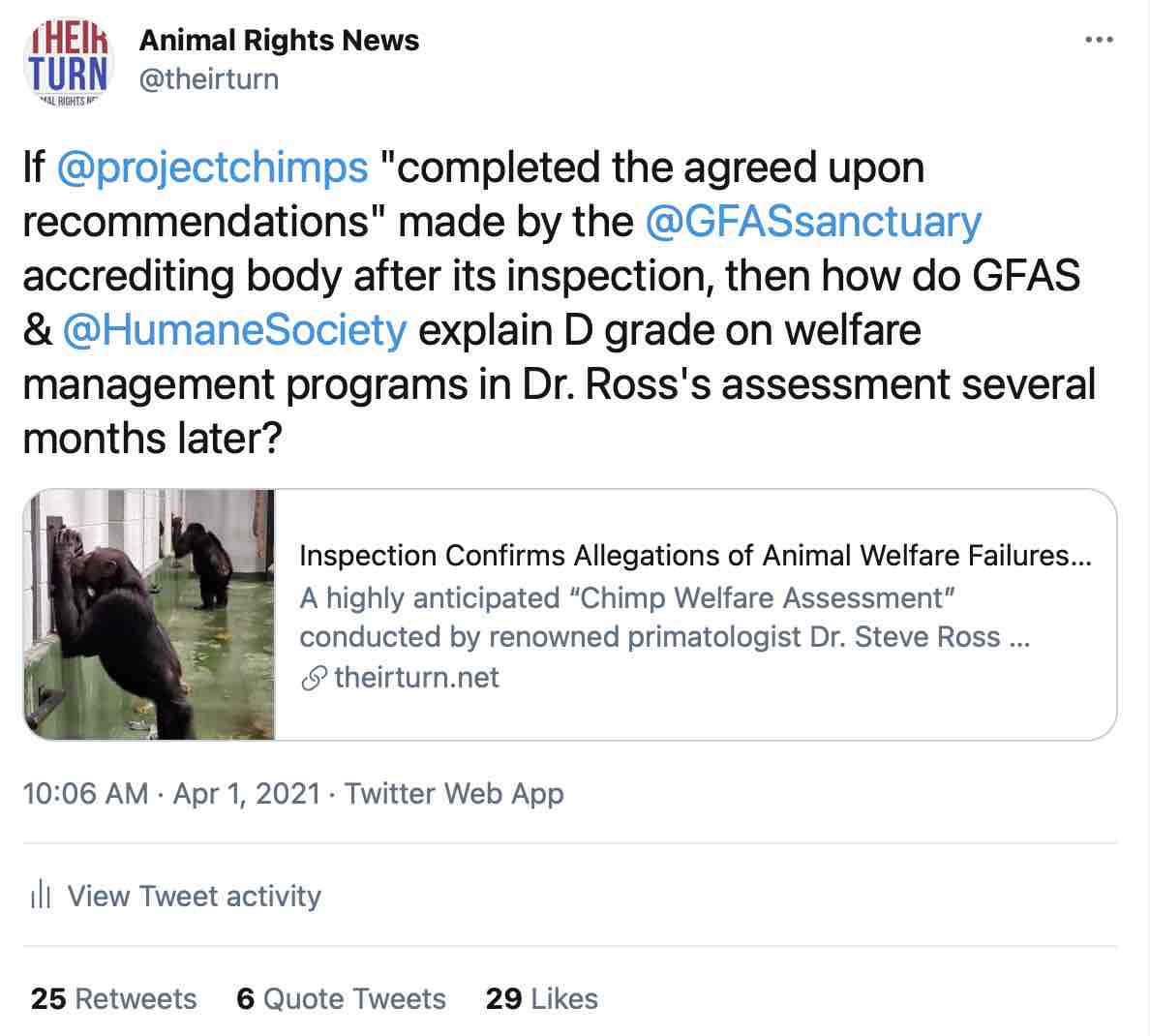
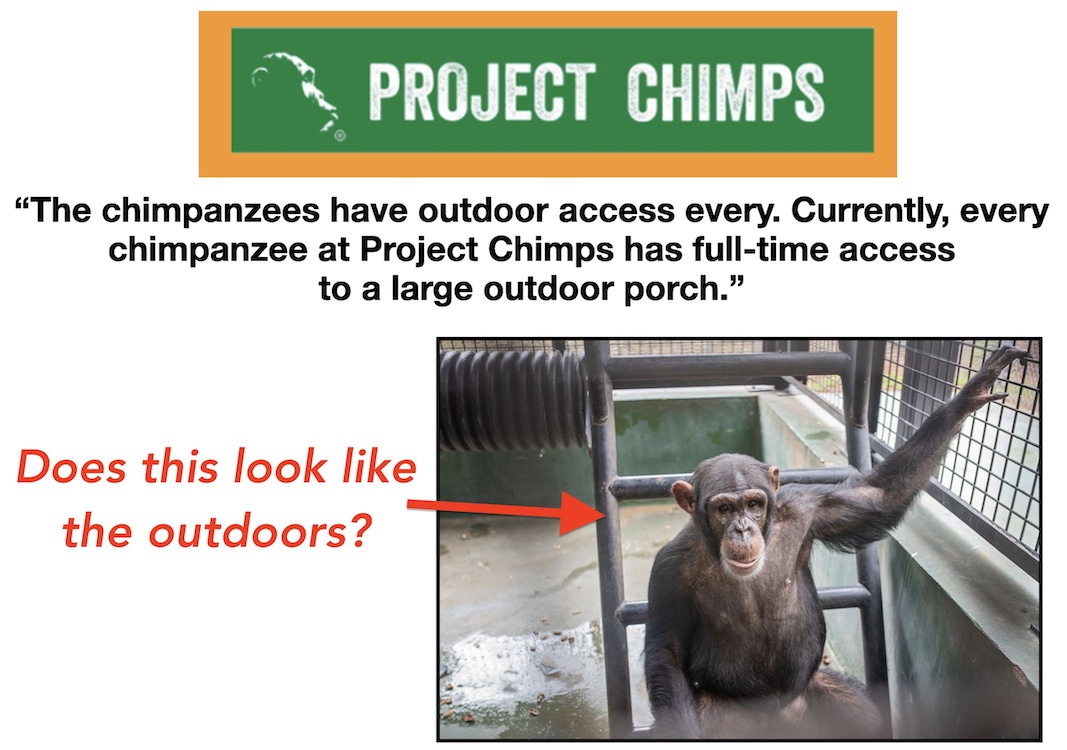
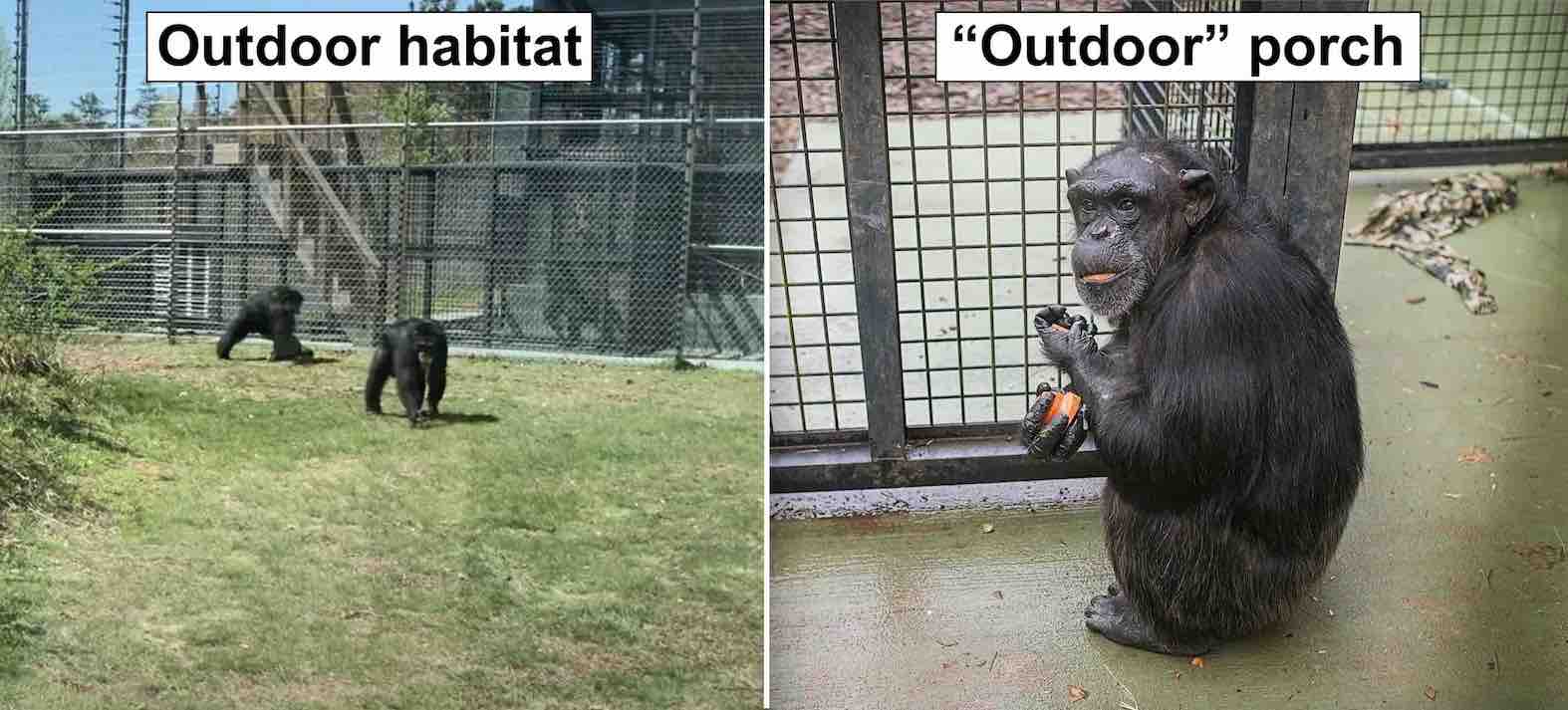
In June 2020, I posted an article entitled “Why I’m Blowing the Whistle on HSUS” in order to raise awareness of the plight of chimpanzees at two sanctuaries run by the Humane Society of the United States (HSUS) – Project Chimps in Georgia and Second Chance Chimpanzee Refuge in Liberia. Both are plagued by substandard facilities, deficient veterinary care and unqualified management. At Project Chimps, the residents are held in concrete rooms for all but about 10 hours a week because HSUS has not created enough enclosed yards on its “236-acre wooded habitat” to be able to provide the 77 chimps with daily access to the outdoors. Instead of acknowledging and fixing these serious, systemic problems, HSUS has used its PR machine to minimize them or deny that they exist. It has also used its lawyers to silence and intimidate those who speak out.

Precious, a chimpanzee at Project Chimps

In May 2020, HSUS inadvertently shined a national spotlight on Project Chimps by suing two women who came forward with credible and extensive evidence of animal neglect. Appalled that HSUS would sue whistleblowers (an intimidation tactic typically associated with big animal ag), animal advocates around the country, including several with expertise in captive primate care, stepped in to support the whistleblowers and amplify their calls for reform at Project Chimps.

Project Chimps, an HSUS sanctuary, sued former employees Crystal Alba and Linsday Vanderhoogt after they came forward publicly with evidence of animal cruelty

Despite not having visited Project Chimps, I believed the whistleblowers – not only because of the evidence they provided, but also because I saw the same problems during my two visits to HSUS’s chimp “sanctuary” in Liberia. There, HSUS is overseeing the care of over 60 ex-lab chimpanzees who the New York Blood Center (NYBC) moved to islands on a river when they no longer needed the chimps for experiments. Despite having received a $6 million check from NYBC in 2017 and hundreds of thousands of dollars in large and small donations from the public since 2015, HSUS has not built any desperately needed infrastructure on the islands.

National Geographic published an in-depth story that corroborated their allegations.

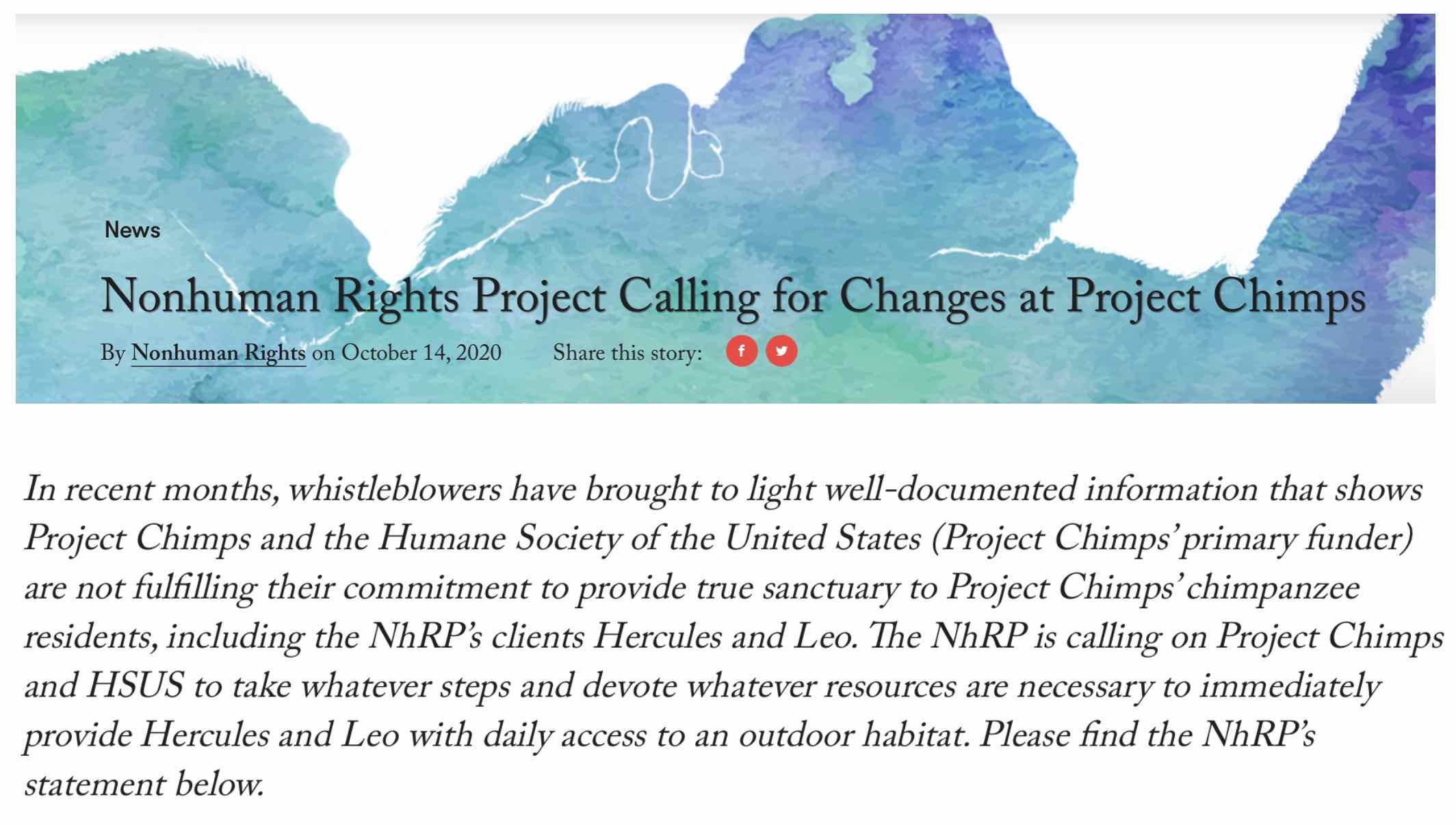
In October 2020, The Nonhuman Rights Project (NhRP), an organization of animal rights lawyers who represent captive chimpanzees and elephants, took the unusual step of issuing a public statement calling on HSUS to improve animal welfare at Project Chimps. NhRP was particularly distressed by the fact that Hercules and Leo, chimpanzees who they freed from a laboratory, did not have daily access to the outdoor habitat. HSUS dismissed their concerns, arguing that the concrete porches where they spend their days are outdoors.

HSUS claims that the 77 residents of Project Chimps have daily access to the outdoors, but advocates believe this is misleading because the “porches” are enclosed concrete rooms

The Nonhuman Rights Project issued a public statement demanding that Project Chimps provide its clients, Hercules and Leo, with daily access to the outdoors

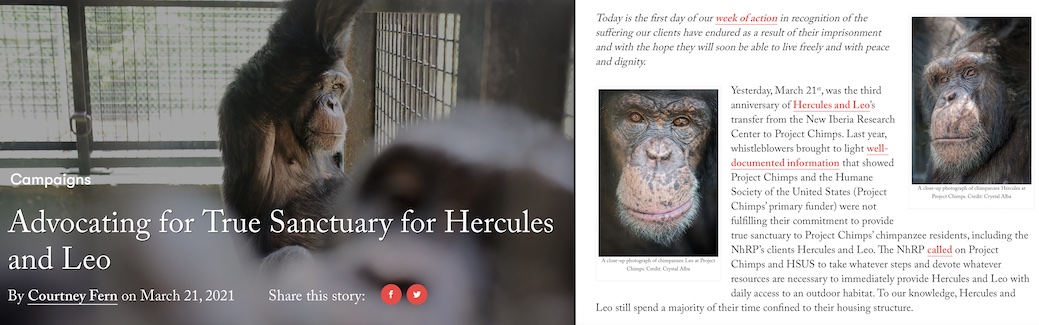
On March 21st, NhRP marked the three year anniversary of Hercules’ and Leo’s arrival at Project Chimps by issuing another public statement, this time asking its global network of supporters to call on HSUS CEO Kitty Block to provide Hercules and Leo with daily access to the outdoors. NhRP and PETA, which also issued a statement, must have agonized about publicly criticizing another animal advocacy group, but, by repeatedly dismissing the concerns they raised in private, HSUS left them with no choice.

The Nonhuman Rights Project is asking its supporters to call on HSUS CEO Kitty Block to give the chimpanzees the choice to spend their days in the forested habitat

Primate community stakeholders (sanctuary directors, primatologists and veterinarians) are aware of the systemic failures at Project Chimps, but they have not spoken out publicly. That can be attributed to a desire to avoid infighting or, more likely, to a fear of retaliation. HSUS is well known in the animal advocacy community for using its resources to intimidate and silence its critics. It used its lawyers at Seyfarth Shaw LLP, a global law firm with 12 offices in the U.S., to represent Project Chimps in its lawsuit against the whistleblowers. (HSUS ultimately dropped the suit, but not before the whistleblowers spent $30,000 on legal fees, a very large sum for young people earning a modest sanctuary salary.)

Fear of retaliation also helps to explain why former Project Chimps employees, who bonded with the chimpanzees, have been silent for the last year. Their fear of violating their termination agreements, however, could be outweighed by their desire to help the chimps.

The Nonhuman Rights Project is calling on The Humane Society of the United States (HSUS) to provide its clients, Hercules and Leo, with daily access to an outdoor yard.

A conflict of interest could also explain why stakeholders in the primate sanctuary community have been silent. Many receive monetary and/or non-monetary support from HSUS that they cannot afford to turn down.

Since writing my first article about the plight of the chimps in HSUS’s care, advocates have asked me why HSUS, an organization whose mission is to protect animals, is failing the animals in their own care. I can only surmise, based on my experience at its chimpanzee sanctuary in Liberia, that HSUS doesn’t want to spend the money to transform Project Chimps into a real sanctuary. This frugality is inexcusable not only because of HSUS’s considerable wealth, but also because the organization has raised millions of dollars off of the plight of captive chimps.

The 77 chimpanzees at Project Chimps have access to an outdoor habitat for approximately 10 hours per week. They spend the remainder of their days in concrete porches that HSUS and Project Chimps describe as “outdoors”

Over the past several months, outside inspections that revealed serious deficiencies have left HSUS with no choice but to publicly acknowledge problems at Project Chimps in Georgia, but the organization has downplays the problems as minor. If HSUS were to acknowledge the seriousness of the problems, then it would be forced to make the necessary investments and to acknowledge that the whistleblowers who they sued were right all along.

Continued public pressure will ultimately compel HSUS to fix the systemic failures at Project Chimps, but shouldn’t HSUS have wanted to live up to its promise to provide a “great home for retired chimpanzees” in the first place?

Progress For Science, a Los Angeles-based animal rights group,  protests at the Santa Monica home The Humane Society of the United States board member Steven White over the mistreatment of animals at its Project Chimps sanctuary

Kanawha County woman recovering from hunting accident

Exposing the Big Game's avatarCommittee to Abolish Sport Hunting Blog

FacebookTwitterEmailSMSByMetroNews StaffApril 7, 2021 – 1:29 pm

CHARLESTON, W.Va.— A Kanawha County woman is recovering from a gunshot wound to the leg in what investigators describe as a hunting accident in Kanawha County.

The 30-year old victim from Clendenin was shot in the thigh around 9:30 p.m. Tuesday night. Reports indicate the woman was coyote hunting in a remote part of the county and leaned a 30-30 Winchester rifle against the side of her four-wheeler.

State Police indicated the rifle was cocked and apparently tipped over, discharged, and struck her in the leg. She was flown via HealthNet to the Charleston Area Medical Center and is undergoing treatment today.

The West Virginia Division of Natural Resources Police have also been called in to investigate the incident.

View original post

New York lowers bear and deer hunting age to 12 in state budget

Exposing the Big Game's avatarCommittee to Abolish Sport Hunting Blog

https://www.foxnews.com/great-outdoors/new-york-lowers-big-game-bear-deer-hunting-age-12

21 hours ago

Junior hunters between the ages of 12 and 13 will be able to participate in big game hunting

ByCortney Moore| Fox News

https://static.foxnews.com/static/orion/html/video/iframe/vod.html?v=20210405182002#uid=fnc-embed-1

Fox News Flash top headlines for April 6

Fox News Flash top headlines are here. Check out what’s clicking on Foxnews.com.

New Yorkstate’s finalized budget for the fiscal year of 2022 says junior big gamehuntingwill be expanded to pre-teens as young as 12-years-old.

In a sub-section titled “Expand Hunting and Crossbow Licensing,” the state’sExecutive Budget Briefing Bookclaims: “The Budget includes expanding the existing crossbow season and increasing the pool of possible big game hunters to 12- and 13-year olds to encourage and expand outdoor recreation.”

9-YEAR-OLD MISSOURI HUNTER SHOOTS HUGE BUCK

The expansion of big game hunting in New York will reportedly generate revenue for the state from licensing fees.

View original post 383 more words

New Research by Born Free USA Calls for End to Trapping as Crushing Cruelty is Uncovered

Exposing the Big Game's avatarCommittee to Abolish Sport Hunting Blog

https://finance.yahoo.com/news/research-born-free-usa-calls-110000078.html

Tue, April 6, 2021, 4:00 AM·4 min read

WASHINGTON,April 6, 2021/PRNewswire/ — Leading animal welfare nonprofitBorn FreeUSAhas today launched a comprehensivereport on animal trappinginthe United States, amending and updating work carried out in 2017 and providing each state with a score out of 100 based on its action to protect animals from cruel trapping. Only two states scored above 50/100, and almost half of the states scored just 25/100 or under. The findings present a sobering insight into this practice, which causes suffering and death to millions of animals each year. In addition to inadequate regulation, Born Free found traps, including those that are illegal to use in all 50 states, to be widely available for sale without restriction on online e-commerce platforms such as Amazon. The organization is calling for a ban on such sales, and a complete regulatory overhaul of trapping nationwide —…

View original post 551 more words

Seaspiracy Response: Here’s What NGOs & Other Organizations Are Saying About The Documentary, Plus Our Take

ALT PROTEINANIMAL RIGHTSBIODIVERSITYBy Sonalie Figueiras Published on Apr 6, 2021 Last updated Apr 6, 2021

9 Mins Read

Seaspiracy premiered on Netflix less than two weeks ago. Just four days after it was released, it had already made it to the Top 10 lists on Netflix in more than 32 countries, including the U.K. and the U.S. Netflix does not release viewing numbers often (or in most cases, at all) but we can take this as a strong indication that the film is getting a lot of viewing traction. The documentary is also getting its fair share of blowback. A barrage of criticism from NGOs, marine biologists, scientists, fisherpeople, fishing industry heads and social media commentators suggest that the film is too (Redditors are having a field day). Below, we dive into the backlash, starting with the responses from the various organizations depicted in the film.

Marine Stewardship Council (MSC)

Overally, MSC’s statement is rather mild, given how they are portrayed in the film (or not portrayed)- remember that they did not answer calls or requests for interviews and . The gist of their response is that sustainable fishing is very much what they believe the world needs.

“While we disagree with much of what the Seaspiracy documentary-makers say, one thing we do agree with is that there is a crisis of overfishing in our oceans. However, millions around the world rely on seafood for their protein needs. With the global population set to reach 10 billion by 2050, the need to harness our natural resources more responsibly is more urgent than ever. Sustainable fishing has a vital role to play in securing those resources.”

Plastic Pollution Coalition

Their statement is on the shorter end and mostly involves disputing the film’s representation of their funding and highlighting that both Greenpeace and Sea Shepherd Conservation Society are members of their Coalition.

“Plastic Pollution Coalition is not funded by Earth Island Institute or working with other projects of Earth Island Institute to support the commercial fishing industry. Plastic Pollution Coalition has a small but mighty staff supporting a growing global alliance of more than 1,200 organizations, businesses, and thought leaders in 75 countries working toward a world free of plastic pollution and its toxic impacts on humans, animals, waterways, oceans, and the environment.”

April 6 2020 Update: the above statement was taken on March 28th. The response page has since been updated with a more complete list of Q&As about the film above the original response, included one about their relationship to Earth Island Institute:

“We are not funded by Earth Island Institute; rather, we pay Earth Island Institute to run our human resources and payroll for our small and mighty staff of 9 people. Our work is in no way dictated by Earth Island Institute.”

Oceana

Oceana’s statement, fairly concise as well, mostly focuses on their policy victories and disputes the movie’s conclusion- they believe coastal communities need to consume fish for survival.

“We believe people have the right to choose what they eat, and we applaud those who make personal choices to improve the health of our planet. However, choosing to abstain from consuming seafood is not a realistic choice for the hundreds of millions of people around the world who depend on coastal fisheries – many of whom are also facing poverty, hunger, and malnutrition. Oceana campaigns to save the oceans for both the people who depend on them and to protect the marine animals (and other forms of life) who live in them.”

Will McCallum of Greenpeace

This article is not presented as a response to Seaspiracy, in fact the movie is not referenced at all. Still, given the arguments presented and the publication date (Mar 23 2021), it’s reasonable to infer that it’s meant to engage with the discussion. McCallum, who is Head of Oceans at Greenpeace, elaborates on the problem of overfishing that he has seen first hand, while underlining that populations in the Global South that rely on fishing for their livelihood must be supported.

“During my time as an oceans campaigner at Greenpeace, I’ve sat in a tiny boat in the middle of the Indian Ocean, watching a fishing boat pull in miles of drift nets.  The nets were full of tuna, but there were also dead spinner dolphins, manta rays, thresher sharks and more – a grim demonstration of devastation at sea. I’ve been right up close with some of the biggest fishing vessels in the world, watching as they haul out incomprehensible numbers of fish.”

“For years, Greenpeace has been telling our supporters that eating less fish and eating a more plant-based diet is key for ocean health. But campaigning for a blanket ban on fishing would undermine the rights of people worldwide who depend on the oceans for their food and livelihoods and who are in desperate need of allies prepared to speak up on their behalf.”

Earth Island Institute (Dolphin Safe)

Earth Island Institute, which manages the Dolphin Safe label that was harpooned in the film, issued a statement on behalf of their International Marine Mammal Project, which in their own words “worked assiduously for the protection of marine mammals for more than 40 years” backing their Dolphin work.

“David Phillips, director of the International Marine Mammal Project stated, ‘The dolphin-safe tuna program is responsible for the largest decline in dolphin deaths by tuna fishing vessels in history. Dolphin-kill levels have been reduced by more than 95 percent, preventing the indiscriminate slaughter of more than 100,000 dolphins every year.’

Phillips added, ‘While covering critical topics, Seaspiracy unfortunately does a disservice to a number of organizations that are doing critical work to protect oceans and marine life. It’s no surprise that the New York Times panned the film for entrapping interviewees with leading questions and getting lost in a sea of murky conspiratorial thinking.’ “

Global Aquaculture Alliance (GAA)

The Global Aquaculture Alliance, which later this year will become the Global Seafood Alliance given its work around wild fisheries as well as farmed setups, was not directly named in the film, though it has responded to Seaspiracy by inviting Tabrizi and Kip Anderson, the movie’s executive producer to join them in a roundtable debate, a gesture worth applauding.

“In light of the documentary “Seaspiracy,” released on Netflix on March 24, GAA invites director Ali Tabrizi and executive producer Kip Anderson to join the nonprofit organization’s responsible-seafood journey by participating in its upcoming discussion on social accountability as part of its series of GOAL 2021 virtual events.”

GAA says “is committed to continually raising the bar on social accountability through the adoption of standards and certification demonstrating best practices in aquaculture and fisheries as well as through its pre-competitive education and advocacy work.”

What should you believe?

Now you’ve got a handle on the other side of the story. Here’s the gist of most of the arguments and statements: the film raises important issues about illegal overfishing, but it’s wrong to insist that there is no such thing as sustainable fishing and many low income communities rely on fishing for subsistence. Further, the more angry commenters and debaters add that it’s elitist to ask people to convert to veganism, and that the film is one-sided in its arguments.

Our take on the above:

  • If you don’t like the film, that’s your right. However, do make sure you have actually watched it before you critique it.
  • Do your own homework- you don’t have to believe Tabrizi and the Seaspiracy producers, but don’t blindly believe the NGOs and other interested parties either. Everyone has an agenda (and most of the most ardent critiquers make their money from, your guessed it, fishing). Tabrizi’s agenda may be to promote veganism. He is not hiding this.
  • Almost every single headline mentioned in the film has been reported on before. You can check out this Green Queen article from 2019: 10 Reasons Why You Should Reconsider Eating Fish & Seafood– it’s nothing new.
  • The film is one-sided, this is a fact. For the better part of the last few decades, we have been fed the other one-sided side, aka the fishing industry’s story.
  • Veganism is an all encompassing lifestyle choice based first and foremost on compassion for all beings. This includes fish and marine wildlife. End of story.
  • As a consumer, you likely have very little oversight into whether the fish you are eating is 1) mercury & heavy metal free, 2) was fished without marine bycatch, 3) is actually the species you believe it to be, 4) was fished legally and without any slave/indentured labor and 5) was partially responsible for any fishing gear debris left in the ocean. If you feel you can be sure on all these points, then by all means, go ahead and consume fish. If not, reduce as much as you can.
  • It’s taken many years and relentless work by experts and activists (including films such as Cowspiracy), but finally people are starting to reduce their meat consumption. The problem? They are turning to fish instead. If this film helps stem this tide, it’s a net positive.
  • As for aquaculture, here’s a recent report about salmon farming and the US$47 billion in losses the sector has incurred since 2013– remember, the global fishing industry is subsidized to the the tune of US$38 billion per year.
  • The argument that the film is looking to punish low-income coastal fishermen communities is a stretch- quite on the contrary, the Somali pirates segment does the opposite, illustrating how industrial overfishing led poor fishermen to lives of crime. This seems like an easy way for those with industrial fishing agendas to discredit it and on the whole, rings hollow.

Famous last words: Captain Paul Watson

Captain Paul Watson founder of Sea Shepherd Conservation Society and a human who has spent 60 years of his life at sea may deserve the last word here:

“Predictably, the successful release of Seaspiracy on Netflix is receiving some criticism from the usual subjects. That was expected, but it really is not all that important. Many documentaries that I have been involved with over the years have been met with similar negativity and vitriol. […] Seaspiracy as a film is what it is, a message transmitted by a medium to provoke discussion and to expose and illustrate a global problem and as such it is both powerful and influential and most importantly thanks to Netflix it is reaching millions and trending phenomenally. […] Filmmaking is storytelling. It’s meant to be emotive. It’s designed to captivate viewers and to entice discussion and controversy. If people are talking about it that means it’s a success. If people are criticizing it, that means it is having an impact. If some people are condemning it, that means that some people are threatened by it. Personally, I don’t care if there are scientists and industry people who dislike the film. I don’t need bio institutes and P.R. firms to lecture me on something I have seen and witnessed with my own eyes over the last 60 years. There is no such thing as a sustainable fishery. That is my considered observation based on 60 years of experience. Phytoplankton populations in the sea have been reduced by 40% since 1950 and that is probably the most important validated scientific fact to be concerned about. (Source: Scientific American). Life in the Ocean is being diminished and that diminishment is escalating. I’m not surprised that there are many who wish to deny this just as there have been many quick to deny climate change. Change comes about through stories and in today’s world, the most powerful communication medium is film. […] If they [the critics] want to make a film with what they consider to be “real” science they should do it. […] This film despite the naysayers and the critics is a critically acclaimed success and that is a fact. It is a weapon of revelation and it is influencing millions and it needs to be built upon and not dismissed or belittled, especially by people who profess to care about marine ecology. The Ocean does not have time for the justifiers, the appeasers and the complainers. Right now, the Ocean needs activists more than scientists.

Read Captain Watson’s full statement on his Facebook page.


Lead image courtesy of Seaspiracy.

Commercial Fishing is an Abomination

By Captain Paul Watson

There is no such thing as a sustainable commercial fishing industry. Over 2 trillion fish are taken from the sea every year and that figure does not include the 120 billion killed on fish farms. This kill is far larger than the estimated 65 billion animals slaughtered each year for meat and fur. The critics of Seaspiracy are trying to say that fishing can be sustainable and necessary by pointing to artisanal and indigenous communities suggesting that the film is racist. That is a ridiculous accusation. The film is directed at the reality of industrialized commercial fishing. The fishermen in their tiny boats in the waters off Africa or India are not the problem. In fact they are the victims of the problem as industrialized highly technological ships plunder their seas for profit. Traditional artisanal fishing communities in the Southwest coastal province of Kerala have long suffered from the mechanized vessels funded by Norway.

Commercial Norwegian fishing off India forced hundreds of thousands of Indians into poverty with the result that today Norway, the 2nd largest exporter of fish in the world (And the world’s No. 1 killer of whales) is a major exporter of fish to India. By destroying artisanal fishing, Norway reduced competition in India and increased their export sales to India.

Norway is also the world’s largest producer of farm raised salmon. Pirate fishing is also a major problem and many of these illegal operations are funded by companies in Spain and China and untraceable trans-shipping of fish at sea makes it difficult to track fish catches. Who are the pirates of Somalia? Why is piracy becoming a problem now in the West African Gulf of Guinea? The answer is desperate artisanal fishermen forced into piracy by the depredations of the highly efficient illegal operations by Europe and Asian commercial fisheries.

When consumers order fish on the menu or buy it from the market they are supporting the destruction worldwide of marine eco-systems. They are supporting the impoverishment of artisanal and indigenous communities. They are supporting slavery and the murder at sea of observers and rebellious slaves. When consumers eat meat or wear fur they are also supporting the destruction of marine eco-systems and slavery because some 40% of fish caught are rendered into fishmeal to feed chickens, pigs, domestic salmon and farm raised fur-bearing animals. Additionally 2.4 million tons of wild fish caught each year is used directly for cat food.

This is more fish for cats than consumed by all four species of seals ((Harp seals (Phoca groenlandica), Hooded seals (Cystophora cristata), Grey seals (Halichoerus grypus) and Harbour seals(Phoca vitulina) in the waters of the Northwestern Atlantic Ocean. Chickens and pigs eat more fish than all the world’s puffins and albatross. This translates into a world out of balance and the antithesis of the word sustainable.In recent years the use of the words “sustainable” or “sustainability” has increased as species and eco-systems are depleted. It is the green-washing or blue-washing term of choice by the commercial fishing industry.

In 2021, no self respecting environmental NGO should be justifying, rationalizing and enabling commercial fishing operations. If they do so they are in willful denial of the reality of the threats to survival of life in the sea and on land.Since 1950, the seas have lost 40% of phytoplankton populations (Source: Scientific American). from pollution and diminishment of the nutrient base provided by marine life. Phytoplankton provides up to 70% of the oxygen in the air that sustains all life.

The Ocean is the life support system of this planet. Yes it provides food (Far too much for us and far too less for other species) but more importantly it provides oxygen and regulates climate and temperature. This life support system is maintained by a crew of living beings and we the human passengers feasting merrily and ignorantly oblivious at the table are murdering and consuming the crew that sustains this life support system.

NYS budget update: Minimum age for hunting deer with firearm, crossbow drops from 14 to 12

Exposing the Big Game's avatarCommittee to Abolish Sport Hunting Blog

https://www.newyorkupstate.com/outdoors/2021/04/nys-budget-minimum-age-for-hunting-deer-bear-with-firearm-crossbow-drops-from-14-to-12.html

Updated Apr 06, 4:30 PM;Posted Apr 05, 4:33 PM

2020 Columbus Day Weekend Youth Firearms Hunt
Alex Taylor, 15, shot this spike buck on Saturday during the Youth Hunt Weekend, while hunting with her father, Eric, in Whitehall in Washington County. She shot it with 243 rifle.

Facebook ShareTwitter Share4,424sharesByDavid Figura | dfigura@nyup.com

Editor’s note: This story originally noted the legislation would include hunting for both deer and bear. In it’s current form, the change would only apply just to deer hunting.)

The final version of New York State budget for the coming year, which could be approved this week, includes a provision lowering the minimum age for hunting deer with a firearm or crossbow from age 14 to 12.

The legislation entails a two-year pilot program that takes effect June 1 and expires Dec. 31, 2023. The change will impact most of the state, excluding Long Island, New York City and Westchester County.https://4d2df21a0d84c1089aed956da047dbbc.safeframe.googlesyndication.com/safeframe/1-0-38/html/container.html

Another…

View original post 612 more words