Fewer Yellowstone National Park bison migrated out of the park this winter meaning hunters had fewer chances for success and the park staff decided not to trap any for slaughter.
RYAN BERRY, Billings Gazette
The remnants of a bison hunt outside Yellowstone National Park near Gardiner lie in the sun after being picked clean by birds and at least one grizzly Wednesday, March 31.
RYAN BERRY, Billings Gazette
A Yellowstone ranger and an employee from the Department of Livestock watch from a cliff overlooking a herd of elk near the Yellowstone National Park boundary as tribal hunts near Gardiner continued.
RYAN BERRY. Billings Gazette
A post marks the northern boundary of Yellowstone National Park near Beattie Gulch, signifying one edge of the area where bison hunters can take down their prey.
NEWARK – The following people were sentenced for misdemeanor offenses in Licking County Municipal Court. The Advocate publishes sentences where court costs and fees exceed $500 and sentences with jail time of any kind.
Lucas E. Glandon, 36, of Dayton, hunting license violations, failure to check deer, illegal possession of deer, $875.
Nathaniel A. Butterworth, 35, of Tipp City, deer and turkey permit, hunting license violations, and wild animal violations, $520.
Christopher Mobley, 33, of Columbus, domestic violence, $528 and 180 days in jail with 178 suspended and credit for two, and a year of probation.
On a planet wracked by rising seas, expanding deserts, withering biodiversity, and hotter temperatures, that’s a fraught question to answer. Food production accounts for roughly a quarter of the world’s greenhouse-gas emissions, and scientists have found that limiting global warming will be impossible without significant changes to how the world eats. At the same time, climate change is threatening the world’s food supply, with land and water being exploited at an “unprecedented” pace.
A new guide to living through climate change
The Weekly Planet brings you big ideas and vital information to help you flourish on a changing planet.Join the Newsletter
Reforming the food system to save the planet is going to require new corporate practices, and new laws and regulations at the national and international levels. But individual consumer behaviors matter as well—more than you might think. Your diet is likely one of your biggest sources of climate emissions. But what should you do? Eat locally? Get your food from small-scale farmers? Choose organics and fair trade? Avoid processed foods? Eat seasonally?
The choices are many; the stakes are high. But experts on land use, climate change, and sustainable agriculture told me that two habits tower above all others in terms of environmental impact. To help save the planet, quit wasting food and eat less meat.
The conservation nonprofit Rare analyzed a sweeping set of climate-change mitigation strategies in 2019. It found that getting households to recycle, switch to LED lighting and hybrid vehicles, and add rooftop solar systems would save less than half the carbon emissions combined than would reducing food waste and adopting a plant-based diet.
Let’s begin with the role of food waste. Americans waste a lot of food. Nearly one-third of it, in fact. More than 130 billion pounds a year, worth roughly $160 billion. We throw away enough food to close our own “meal gap” eight times over. Food is the single biggest component of our country’s landfills, and the average American sends more than 200 pounds of food there every year. More than 1,250 calories per person a day, or more than 140 trillion calories a year, get tossed in the garbage.
Households, not restaurants or schools or corporate cafeterias, are the dominant wasters. The problem is worse in the United States than in most other countries, and it has worsened over time. When you toss a spoiled chicken breast or moldy tomato into the trash, you’re wasting a greenhouse-gas-intensive product. You’re also sending it to a landfill, where it will emit methane.
Addressing food waste would be low-hanging fruit: The country could save money, emit less carbon into the atmosphere, alleviate the burden on landfills, reduce the number of animals subjected to life on a factory farm, and address its hunger crisis just by eating all the food it makes. Households consuming more of what they buy, and thus buying less, would have a major effect on the whole food system. Food suppliers would produce less to meet the country’s more efficient demand. Supermarkets would stock less food. Fewer trucks would need to run from plant to store. Fewer refrigerators would be needed in stores and industrial facilities to keep groceries cold. Fewer cows would fill up feedlots. Fewer acres of corn and soy would be grown to feed them.
How to do it? For one, get wise about expiration labels and quit throwing out perfectly good food. Research shows that nearly all Americans misinterpret date labels and toss their groceries out prematurely, for fear of food poisoning, and understandably so. Retailers and production companies use 50 different use by–type labels, and none is federally regulated, except for those on infant formula. sell by stamps tend to be for inventory management, and have nothing to do with food safety; best if used by and use by stamps tend to be about freshness and food quality, not whether you are about to enjoy a serving of mycotoxins. As a general point, most food is safe to eat as long as there is no evident spoilage, such as visible mold or an off smell. “Use your senses,” says Yvette Cabrera of the Natural Resources Defense Council, the conservation nonprofit, noting that those senses were refined through millennia of natural selection in no small part to help us figure out whether food is safe to eat.
Experts also point to a series of simple, old-fashioned techniques households can use to ensure that they eat more of the food they buy. They amount to thinking like your Depression-era forebears, pretty much. Figure out appropriate portion sizes; eat your leftovers; store food in appropriate containers and at the right temperature; prepare and freeze perishables instead of letting them linger and go bad; and shop in your refrigerator and cabinet before you hit the store.
And when you’re at the store, there is one dietary change to consider that beats all others in terms of its climate impact. It is not eating locally or seasonally. It is not eating organic or fair-trade. It is not eating unprocessed foods or avoiding big-box and fast-food retailers. It is eating less meat. Roughly three-quarters of the world’s farmland is used to pasture livestock or raise crops to feed that livestock. That contributes to deforestation, destroys the planet’s natural carbon sinks, erodes the planet’s biodiversity, and uses up fresh water.
The main, mooing offender is beef. Cattle are responsible for roughly two-thirds of the livestock sector’s greenhouse-gas emissions, while beef and dairy products are responsible for about one-tenth of global emissions overall. Gram for gram, beef produces roughly eight times more greenhouse-gas emissions than farmed fish or poultry, 12 times more than eggs, 25 times more than tofu, and even more compared with pulses, nuts, root vegetables, bananas, potatoes, bread, or maize.
Beef is so bad for two reasons, Michael Clark, a scholar of food systems and health at the University of Oxford, explained to me. The first is that it takes a lot of inputs to produce beef as an output: about 20 kilograms of corn and soy protein to produce one kilogram of beef, he said. The second is that cows produce methane as they digest their food. “Other types of animals don’t do that,” he said. “And methane is a more potent greenhouse gas than carbon dioxide.”
Trading your rib eyes and cheesesteaks for lentils and tofu is one of the best things you can do as a consumer for the environment; if all Americans did, the country would be roughly halfway to hitting its Paris Agreement targets. Still, the all-or-nothing way the choice is often presented is a mistake. There is enormous acreage between the Atkins diet, or even the meat-heavy diet of the average American, and full-on veganism, which remains a niche lifestyle choice that few follow for long. Better all Americans cut meat consumption by 40 percent than 3 percent of Americans cut it out completely. Experts encourage taking small, meaningful steps to reduce your meat consumption, and trying to find some joy in doing it. Participate in Meatless Monday; try learning to cook dishes from a plant-heavy cuisine you like; offer a vegetarian option at work events; opt for dishes where meat plays a supporting, rather than leading, role.https://d858d25b90763dc6b2a9f8f70ad934b6.safeframe.googlesyndication.com/safeframe/1-0-38/html/container.html
After wasting less food and eating less meat, all other changes a person might make are marginal, experts said, among them eating locally, organically, and seasonally. Moreover, the climate impact of those food choices is in many cases contradictory. “I work in food, and it’s confusing for me,” Cabrera, of the NRDC, told me. “Is this lettuce better than this lettuce? Consumers are faced with so many choices, and it is really hard to know.”
Humanely raised, local meat, for instance, can produce more emissions than meat coming from a concentrated industrial operation, Clark told me. Cows in concentrated animal-feeding operations are generally slaughtered at 12 to 18 months of age, while cows raised exclusively on pastures typically live twice as long. “The cow that lives for longer is going to emit more methane over the course of its lifespan,” he said, though he added that there were still compelling reasons to opt for the local beef.
Similarly, growing a given amount of organic produce usually requires more emissions and acres of land than growing the same amount using conventional farming methods. One study conducted in Sweden, for instance, showed that organic peas and wheat have a bigger climate impact than their conventionally farmed cousins.
That said, when it comes to the emissions related to shipping food around the world, experts argue that—surprisingly—local is not always better. There’s a certain uncanny decadence to eating Peruvian avocados and Chinese grapes in the dead of winter, or opening a bottle of French Beaujolais or a package of Scottish smoked salmon at will. But transporting food around the world tends to make up only a small share of a given product’s total greenhouse-gas emissions. What you are eating and how it was farmed is far more important than how it got to you, and imported food typically has a low carbon impact.
For all that, experts said there are good reasons to opt for organic, locally produced, seasonal food, even if it might not be as efficient to produce, or might not have the lowest greenhouse-gas emissions. Many smaller-scale operations outside Big Ag produce food without pesticides, without monoculture, with manure instead of chemical fertilizers, and with respect for biodiversity and soil health. Those are all important facets of environmental preservation too.
Complicating things, what’s good for the environment isn’t always what’s good for animal welfare. When it comes to eating animals, “unfortunately, the cruelty scale is the flip of the emissions scale,” Leah Garcés, the president of Mercy for Animals, a nonprofit that advocates for better conditions for animals raised in industrial environments, told me. A family can easily eat a chicken in a single night, but might struggle to eat a whole cow over the course of a year. Moreover, transportation and processing is much rougher on birds, which have delicate bodies. (Each year, more than 1 million chickens die en route to slaughter, and half a million are not actually dead when they hit the scalding tank.) For these reasons, a chicken breast represents much more suffering than a steak, even though the steak is worse for the planet. But the fact remains: The fewer animals you eat, the fewer die, and the better off the planet is.https://d858d25b90763dc6b2a9f8f70ad934b6.safeframe.googlesyndication.com/safeframe/1-0-38/html/container.html
Diets that are good for the planet tend to be good for people too. Research by Clark and his colleagues has shown that foods associated with good health generally have low environmental impacts, “indicating that the same dietary transitions that would lower incidences of noncommunicable diseases would also help meet environmental sustainability targets.”
Our diets are cooking the planet, and changing them, even in small ways, might help avert catastrophe. A burger for lunch, a bag of wilted greens in the trash—these may not be as obviously destructive to the environment as a private jet or a gas-guzzling car. But they are choices we make daily, and they matter.
Based on data collected at theMauna Loa laboratoryin Hawaii, the peak comes after relatively low readings throughout March and early April, aside from a single uptick recorded between March 19 to 21.
Notably, however, when observing annual trends, this record-breaking volume represents a return to pre-pandemic levels.
Carbon dioxide emissions have gradually increased since hitting…
RIO DE JANEIRO, April 6 (Reuters) – Brazil’s brutal surge in COVID-19 deaths will soon surpass the worst of a record January wave in the United States, climbing well beyond an average 3,000 fatalities per day, scientists predict, as contagious new variants overwhelm hospitals.
Brazil’s overall death toll trails only the U.S. outbreak, with nearly 333,000 killed, according to Health Ministry data, compared with more than 555,000 dead in the United States.
But with Brazil’s healthcare system at the breaking…
Infectious disease expert Michael Osterholm on Monday warned of the inevitability of another wave of coronavirus infections in the United States.
“While vaccination is important, it is obviously a critical part of our long-term game plan, we’re not going to have enough vaccine, at the way we’re going, into the arms of enough Americans over the course of the next six to 10 weeks, with this surge, that we’re going to stop it,” Osterholm, the director of the Center for Infectious Disease Research and Policy at the University of Minnesota, told CNN’s Erin Burnett.
“It’s just simply not going to happen,” he added.
Osterholm noted that some states, even where vaccination uptake has been high, are now experiencing rising daily new infections.
As GOP-led states lift pandemic restrictions, new infections nationwide have plateaued at around 65,000. It’s a stubborn detail that has troubled public health experts.
Dr. Anthony Fauci, the director of the National Institute of Allergy and Infectious Diseases and top medical adviser of President Joe Biden, cautioned last week that now is “just not the time to pull back and declare premature victory.”https://action.publicgood.com/embed.html?partner_id=buzzfeed-huffpost&utm_source=buzzfeed-huffpost&title=Infectious%20Disease%20Expert%20Explains%20Why%20Next%20COVID-19%20Wave%20In%20U.S.%20Is%20Inevitable&url=https%3A%2F%2Fwww.huffpost.com%2Fentry%2Fmichael-osterholm-inevitable-new-wave-coronavirus_n_606c1818c5b6c00165c52ac1&utm_content=https%3A%2F%2Fwww.huffpost.com%2Fentry%2Fmichael-osterholm-inevitable-new-wave-coronavirus_n_606c1818c5b6c00165c52ac1&widget_type=card&action=Default&is_flex=true&match_type=ml&campaign_id=ea0fef93-4deb-4581-9ad2-0fae5b670347&parent_org=buzzfeed&target_id=ea0fef93-4deb-4581-9ad2-0fae5b670347&content_id=15908882&cid_match_type=post-filter%20guid%20name%20match&tag=public%20health%20~%20pfizer%20ml%20match&is_filter=true&url_id=29244908&target_name=Explore%20Breakthroughs&is_sponsored=true&sponsor_name=Pfizer%20Inc.
Osterholm on Sunday warned the forthcoming wave will more likely affect children, due to the prevalence of the more contagious B.1.1.7. variant.
“Unlike the previous strains of the virus, we didn’t see children under eighth grade get infected often, or they were not frequently very ill,” Osterholm said on NBC’s “Meet the Press.” “Kids are playing a huge role in the transmission of this,” he added on Fox News.
According to research published yesterday in Nature Climate Change, by the end of this century, lightning will be about twice as likely in the Arctic if greenhouse gas emissions continue as usual.
“We’ve been trying to find out in the Arctic region, where there’s little fire in the region previously, how that will change in the future,” says Yang Chen, who researches climate and wildfire at UC Irvine, and was the lead researcher on the study. “And the only ignition source is lightning strikes.”
Lightning requires two ingredients: warm air that rises quickly from the ground, and moisture. “When you get warm air … it kind of bubbles up through the atmosphere,” says Peter Bieniek, a climatologist at the University of Alaska who was not involved in the research. “It actually condenses, just like you would condense humid air on a cool window.” When that water freezes into ice, it can create lightning.
Those turbulent, wet conditions are becoming more common across the United States. A 2014 study in the journal Science predicted that by the end of the century, the country would experience 50 percent more lightning. What’s surprising, Chen says, is the magnitude of the changes in the Arctic: “It’s really big. It’s much bigger than in other regions of the world.”
The Nature research is actually the second recent study to find this result in the Arctic: a team of researchers in Alaska predicted last year that lightning strikes would double in the state over the next century. Alison York, a fire ecologist at the University of Alaska Fairbanks who co-authored that study, says that the findings in this most recent research are consistent with other work. “The physics of climate change would say, yes, we would have increased lightning, just from increased air temperatures.”
Those changes have implications not only for the Arctic landscape, but for the entire planet.
Right now, fire isn’t a major component of the tundra. “If you think of a tundra ecosystem, you think of these little tiny plants: little tiny blueberries, dwarf mosses, birch, lots of mosses,” says York. That’s because only a few inches to a foot of ground thaw out every summer, and larger plants can’t survive in the shallow conditions. That also means that fires normally don’t spread widely. “The fires are kind of like peat burning, along the surface,” says Chen, or into the carbon stored in the ground itself.
[Related: Beavers might be making the Arctic melt even faster]
The “dirt” on a tundra is mostly layers of older, dead plants, says Troy, “forming this blanket of moss, and litter” called duff.
More lightning would mean more fire, and that could tip the environment into something entirely different. Spring melts could reach deeper into the ground, and trees could take root in the bare soil. That process is likely to speed warming, and maybe spur even more lightning.
At stake is the permafrost, the rock-hard layer of soil that hasn’t thawed in tens of thousands of years, and which locks in a sleeping giant of methane, half-decayed plants, and carbon-rich dirt. In some places, that material has piled up thousands of feet deep. When it escapes—through burning, rotting, or simply burping out into the air—it contributes to greenhouse gas emissions, speeding up climate change.
With the insulating mosses and grasses burned away, it’s likely that the permafrost will melt even faster. “That blanket keeps the permafrost cold. And as the fire burns into that blanket of duff, the underlying ground is exposed and warmed,” says Troy.
If the fire goes deep enough, there’s more ground to grow in, allowing trees and shrubs to move in, which in turn speeds up the warming process. Because trees are darker than the surrounding snow, they absorb heat rather than reflecting it. “You can actually deliver energy directly from the sun to the soil surface, so you can actually accelerate permafrost thaw,” says James Randerson, an author on the recent paper who studies climate change’s impact on Arctic ecosystems at UC Irvine.
Forests also have their own effects on fire and lightning; there’s some evidence that, because they create warm, wet conditions, they can actually promote lightning storms overhead. And when a fire is sparked in the boreal forest, it tends to jump from tree to tree, resulting in much larger blazes. Lightning will probably become more common in forests too, but won’t create the same kinds of landscape changes.
“We have not seen documentation of treeline migration on a large scale, but that might just be a process that takes a long time to observe,” Troy says. And, she notes, some of the trends can be seen in localized areas already, as in the site of a giant 2007 tundra fire that’s now growing back as willows and other brush.
The transition might take decades, Randerson agrees. “There’s a time delay between when climate conditions are suitable, and the migration rates of these trees’ lifetimes. It takes them a while to catch up.”
Several days before Seaspiracy was released on Netflix, a response made by the National Fisheries Institute was leaked. Before audiences had gotten a chance to see the documentary, the fishing industry was already dismissing it as “vegan propaganda.” Unfortunately, it is unlikely that their opinion of the film emerged from any genuine Delphic foresight. Indeed, “propaganda” seems quite a puzzling label to stick on a movie that unravels its story in such a deliberate and reasoned manner.
The facts in the documentary are nothing short of remarkable. A marine biologist explains that the Deepwater Horizon Disaster, which spilled thousands of gallons of oil into the sea and saw countless images of seabirds coated in black, dying on slimy beaches, killed fewer animals than commercial fishing in the Gulf of Mexico kills in a single day. Indeed, the disaster actually allowed fish stocks in the Gulf to bounce back because it interfered with normal fishing operations. Other numbers in the film are so big they really can’t be comprehended, like the fact that humanity kills five million fish every second.
Lex Rigby, the head of investigations at Viva!, explained the apathy most people feel towards fish. “Whenever we talk about fish, we talk about harvesting them like crops,” she said. “We talk about their slaughter number in tonnage rather than individuals.” Perhaps this is one place Seaspiracy is a touch lackluster; it doesn’t dwell for long on the evidence that each fish is an individual with a distinct psychology, no matter how remote their experience is from ours, which can feel pain.
However, the movie does illustrate the troubling ways in which commercial fishing has been sidelined as an issue, even by the environmentally-conscious. Plastic is the favored bogeyman when it comes to ocean pollution, and it certainly is a serious problem. Yet popular talking points, like the murderous flotillas of plastic straws, are more or less total canards. Plastic straws make up 0.03 percent of ocean plastics, and all plastics combined kill roughly 1,000 sea turtles a year. Fishing, on the other hand, kills 250,000 sea turtles a year. Similarly, the origin of the plastic is often imagined to be apathetic consumers who purchase thirty plastic bags every trip they make to Walmart, and yet 46 percent of the Great Pacific Garbage Patch is made up of fishing nets. These nets drift through the open ocean for miles, tangling and strangling thousands of animals as they go, and are far deadlier than plastic bags.
It is not an accident that fishing has been neglected in discussions about ocean conservation either. The issue has been obscured by specious labeling and a culture of omertà amongst governments and regulators. The Earth Island Institute relies on captains’ self-reporting when they hand out their dolphin-free labels, which is an obviously poor standard of evidence. Rigby described the way self-reporting is abused by fishing vessels, drawing from her time with Sea Shepherd off the coast of West Africa, “We counted one hundred and seventeen sharks in one net. They only reported four.”
The Marine Stewardship Council, whose ubiquitous blue tick assures millions of consumers that they are purchasing vetted and sustainable seafood, seem to have included the word ‘stewardship’ in their title as some sort of bad joke. The more blue ticks they hand out, the more money they make, and one of their founding members was the food (including seafood) giant Unilever. Additionally, the world’s sustainable fisheries are proved to be anything but, seeing as 90 percent of them continue to allow commercial fishing.
Those invested with the powers of stewardship neglect them. Citizens are left in the dark with misleading labels and glib talk about sustainable fishing for a comfort blanket, while the oceans are scraped and pillaged. Aquaculture, like salmon farming, is not a sustainable alternative to wild fishing, although it is promised to be. Salmon are fed wild fish, with 1.2 kilograms of wild fish producing 1 kilogram of salmon. The farms are teeming with lice which feed on the salmon while their accumulated waste creates zero-oxygen dead-zones.
Like all great explorations of ecology, Seaspiracy highlights the dramatic intersection between animal wellbeing, environmental health, and human prosperity. European and North American fishing fleets scouring the coasts of Africa drive local fishermen to bushmeat hunting, which causes pandemics like Ebola, or piracy, as happened in Somalia. Rigby described these local fishermen as “really the only sustainable fishing there is, just one man and his net pulling up enough to feed his family.” It is these sustainable communities which industrialized seafood has ruined; and they aren’t the only ones. Indeed, mangroves are cleared at the peril of locals, who are made vulnerable to tsunamis and typhoons, and the shrimp farms that replace them are often exploited by slave labor.
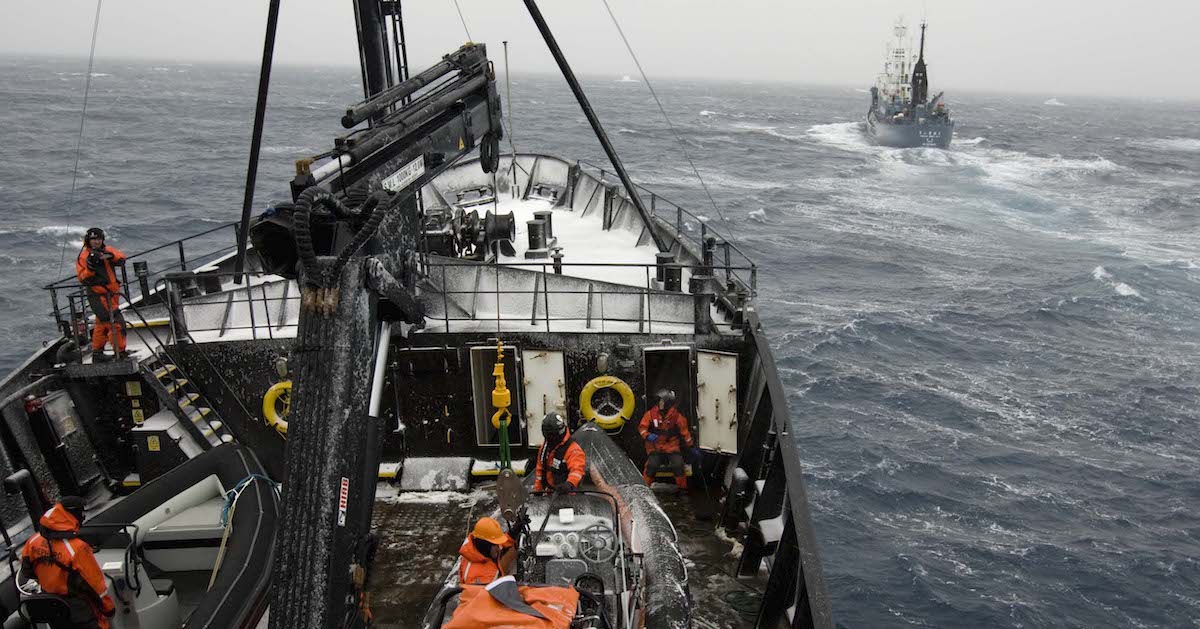
The documentary finishes with a famous event on the relatively obscure Faroe Island archipelago. Communities there participate in whale hunts, called Grindadráp, where locals round up pilot whales on boats before harpooning them en masse in the shallows. It is a gory and relentless scene, and the sea sloshes in Biblical reds under grim and misty cliffs. Here, the movie sticks the landing. Sustainable fishing has been discredited and the severity of human pillaging of the oceans has been put beyond doubt. Yet, even if these things could be managed, the film begs us to question if it would be worth it. It questions if fish and chips are really worth killing for, if dead whales soaking in a Norse lagoon is an acceptable sight in a world where kinder, greener and healthier alternatives exist. Such disturbing spectacles are by no means unique to the Faroes; one articulate whaler in the documentary points out that suffering is universal in global meat and fish production. Rigby described disturbing scenes from her own experience, from endangered whale sharks scooped up in nets in Africa, to lice-ridden salmon suffering on Scottish farms.
In 90 minutes, the film provides helpful graphics, illustrations, anecdotes, filmed evidence, mountains of data, and the opinion of scientists and ethicists to make its point. It doesn’t shrink from violence, nor does it fetishize it. The arguments are concise and plainly presented. Yet all this can be waved away by the magic wand of the fishing industry and fellow travelers as “vegan propaganda,” and well before the movie is even released. Remind me again who the propagandists are?Read More
The analysis,published last month in Climatic Change, looks at the PR moves behind some of the world’s largest producers of meat and dairy, comparing them to their emissions. Most shockingly, the analysis finds that all 10 of the top agriculture companies in the U.S. have contributed to efforts to downplay how agribusiness is linked to climate change.
“We’re trying to show how important thinking about the corporate actor is in this problem,” said Jennifer Jacquet, an associate professor of environmental studies at New York University and a coauthor of the paper. “These companies are not just influencing the geophysical processes…
DEFEATED PART X OF GOVERNOR’S BUDGET BILL S2508 EMERGES MODIFIED IN PART ZZ OF S2505C/A03005C !
While this isn’t the outcome we wanted to see, it is far better than it would have been without your protest.
First, thank you ALL for speaking out against Cuomo’s inclusion of a lower hunting age for “big game” and the expanded use of crossbows to kill deer and bears. Your calls and email put hunting on the radar of the legislature – including the leadership — andwe encourage you to continue your calls to keep out last-minute insertions of language that would be harmful to wildlife. You can see contact information here:http://lohvny.org/NYActionAlert.html
Part ZZ in S2505C/A03005C WILL STILL LOWER THE HUNTING AGE FOR DEER AND BEARS, ALONG WITH ALLOWING 12 AND 13 YEAR OLDS TO USE CROSSBOWS!BUT WITH MAJOR DIFFERENCES!
Part ZZ counters the Governor’s Part Xin the following…






 © Provided by Popular Science Lightning strikes could double in the Arctic this century, setting the tundra on fire
 © Provided by Popular Science
 Adam Lau / Sea Shepherd Conservation Society


