Wyoming hunter sparks outrage for allegedly wounding wolf, parading it in bar before killing it
2

…of a tortilla.


Livestock bosses celebrate outcome at online summit, while critics condemn failure to tackle meat and dairy consumption
Rachel Sherrington
Mon 8 Apr 2024 05.00 EDTShare
Lobbyists for the world’s biggest meat companies have lauded a better than expected outcome at Cop28, which they say left them “excited” and “enthusiastic” for their industry’s prospects.
US livestock bosses reflected on the conference’s implication for their sector on a virtual panel, fresh from “sharing US agriculture’s story” at the climate summit in December.
Campaigners and climate scientists had hoped the summit, which was billed as a “Food Cop” because of its focus on farming, would result in governments agreeing to ambitious action to transform food systems in line with the goals of the Paris climate agreement.
But while more than 130 governments vowed to tackle agriculture’s carbon footprint, a slew of announcements and initiatives failed to set binding targets, or to broach the question of reducing herds of ruminant livestock such as cattle and sheep, which are agriculture’s largest driver of emissions.
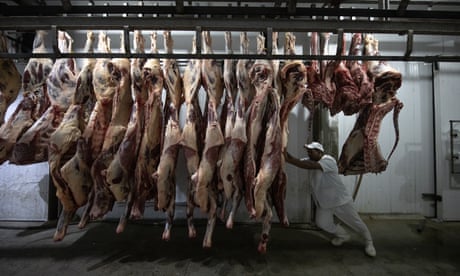
In the online discussion, which was hosted by the trade publication Feedstuffs, meat lobbyist groups made it clear they felt Cop28 resulted in a positive outcome.
The three representatives all said there had been widespread recognition at the Dubai summit that agriculture was a “solution” to the climate crisis, despite livestock accounting for more than 30% of anthropogenic methane emissions.
Outcomes at the summit were characterised as “far more positive … than we anticipated” by Constance Cullman, the president of the Animal Feed Industry Association (AFIA), a US lobby group whose members include some of the world’s biggest meat and animal feed producers.
She added that this was the first time she had “felt that optimistic” after a “large international gathering like this one”.
Cullman also praised the UN Food and Agriculture Organisation (FAO)’s “Global Roadmap” to tackle the climate crisis and end hunger, which she described as “music to our ears”, saying she particularly welcomed the report’s emphasis on “production and efficiency” over “looking at reduced consumption of animal protein”.
Academics described the FAO report’s failure to recommend cuts to meat-eating as “bewildering” in a March submission to the journal Nature Food.
According to a March paper, which surveyed more than 200 environmental and agricultural scientists, meat and dairy production must be drastically reduced – and fast – to align with the Paris agreement.
The report concludes that global emissions from livestock production need to decline by 50% during the next six years, with “high-producing and consuming nations” taking the lead.
The FAO said in a statement that its roadmap took a “balanced” approach to animal agriculture, saying that its report had “acknowledged the importance of livestock for poor people in traditional agrifood systems” and referred to the need for dietary shifts.
“We believe that some comments on the change in diets and the role of animal products in them are either misinformed because people have not properly read the roadmap report, or deliberately disingenuous for the sake of feeding vested interests narratives,” it said.
Another industry panellist, Eric Mittenthal, had attended Cop28 on behalf of lobby group the Meat Institute (formerly the North American Meat Institute, or Nami). He emphasised the importance of sharing the message that animal agriculture was necessary for nutrition and sustainability.
The Meat Institute represents hundreds of corporations in the meat supply chain, including the meat sector’s three largest companies, JBS, Cargill and Tyson Foods, which together have emissions equal to a major oil company on the scale of BP or Shell.
Sophie Nodzenski, a senior campaign strategist on food and agriculture at Greenpeace International, said it was “unsurprising” that industrial meat producers felt positively about Cop28’s outcomes “given that their interests essentially took the central stage there”.
The number of lobbyists for big meat and dairy companies tripled at Cop28, as revealed by DeSmog and the Guardian, amid rising scrutiny of the food sector’s climate impact, while smallholders and family farmers at the summit said they felt “drowned out”.
“Cop28 has rightly put the spotlight on the link between food production and the climate crisis, but the sheer number of Big Ag lobbyists present gave them an outsized influence,” Nodzenski said.
Documents seen by DeSmog and the Guardian show that the meat industry was poised to “tell its story and tell it well” before and during the Dubai conference, which it described as a “notoriously challenging environment”.
Cop28 had promised to increase action on food systems transformation, but campaigners and experts said its declarations and reports fell far short of what was needed.

On the second day of the summit, the leaders’ declaration on sustainable food systems, which was signed by more than 130 countries, committed to food systems transformation.
But while it was praised for moving food up the global climate agenda, the International Panel of Experts on Food Systems co-chair Lim Li Ching criticised the declaration for its “vague language” and noted the lack of any reference to “reducing overconsumption of industrially produced meat”.
The long-awaited FAO roadmap followed. While it proposed a 25% reduction in livestock methane emissions by 2030 to put the agriculture sector on track to reach global climate goals, it again failed to explicitly recommend a cut to meat and dairy consumption.
A reduction in “excess meat eating” – which is prevalent in high-income countries such as the US and UK – is a key recommendation of major scientific bodies, and has appeared in reports from the UN’s Intergovernmental Panel on Climate Change and the recommendations of the EAT-Lancet commission.
The third Cop28 agreement that failed to tackle food system emissions was the “Global Stocktake”, in which agriculture was mentioned only in the context of adaptation to climate impacts, not mitigation, despite food systems making up around a third of greenhouse gas emissions overall.
Jamie Burr, a representative of the US Pork Board who spoke on Feedstuff’s panel, said he was “excited to see” the roadmap recognise efficiency as the best pathway to emissions reduction, going on to describe US agriculture as the “most efficient in the world”.
Industrial meat companies emphasise emissions intensity and efficiency over absolute cuts to emissions, or dietary shifts that would lead to a drop in production.
This is especially true in the US, where livestock methane emissions as reported to the UN Framework Convention on Climate Change have increased by about 5% since 2010 according to the Institute for Agriculture and Trade Policy, and have increased about 20% since 1990.
Cullman also welcomed the FAO’s proposals – including its plug for the role new technologies could play in bringing down methane emissions.
Numerous assessments have found that there is a role for efficiency and innovation to cut livestock emissions, although many technologies are unproven at scale. But to be effective, they should also be accompanied by a shift away from meat in diets, and, researchers caution, should not be used to delay demand-side policy.
Scrutiny of the FAO’s relationship with industry has grown in recent years. Last autumn, former officials said their work on livestock emissions had been censored because of pressure from industry and diplomats from large producer countries. Experts have called on the FAO for greater transparency, querying the lack of authors on the roadmap.
The FAO said: “The Global Roadmap has been developed with reference to and based on existing scientific and peer-reviewed publications. In no stage of the development of the roadmap were livestock industries consulted, or any inputs received from them.”
AFIA, Nami and the US Pork Board did not respond to a request for comment.
The meat lobbyists, whose industry enjoyed many routes to influence at the summit, also celebrated the cut-through of their message that industrial animal agriculture has an important role to play in addressing global hunger.
Cullman said that she was pleased to see there had been a “strong recognition” at Cop28 that animal products “had a real role in meeting the nutritional needs of folks around the globe”.
Burr added that Cops provided an opportunity for US agriculture groups to demonstrate how they “feed the world”, while Mittenthal said the Meat Institute had showcased how agriculture can be a “solution” for “healthy people and a healthy planet”.
A spokesperson for the Global Alliance for the Future of Food said the argument that industrial agriculture is “critical to address hunger” is one of the greatest “myths” shared by the industry.
As well as helping to drive global heating, which is undermining food security worldwide, the meat industry is also the leading driver of deforestation and ecosystem loss, while the overconsumption of animal products has been linked to a greater likelihood of developing illnesses such as heart disease.
BY
KITTY BLOCK AND SARA AMUNDSON
SHARE https://www.humanesociety.org/blog/lawsuit-filed-protect-northern-rocky-mountains-wolves
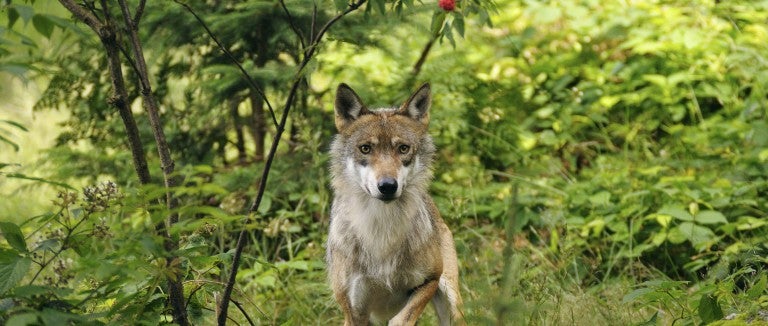
Alamy Stock Photo
Today, with our allies, we sued the U.S. Fish and Wildlife Service over its decision to not reinstate federal protections for wolves in the Northern Rocky Mountains. In 2022, most wolves in the U.S. regained their federal protections under the Endangered Species Act when a federal judge ruled in their favor in response to a lawsuit we filed with other groups—most wolves, but not all. Wolves in the Northern Rocky Mountains, including in Idaho, Montana and Wyoming, lost federal protections years ago, and the 2022 court decision did not impact their status.
Since losing federal protections, wolves in the Northern Rocky Mountains have suffered relentless persecution from trophy hunters, trappers and predator control agents. Conditions for wolves in Idaho and Montana became even worse in 2021 when those states enacted policies aimed at decimating their populations through wolf killings. As public policy, this is nothing less than disastrous. Recent scientific research concludes that the level of genetic variability in U.S. wolves, including in the Northern Rocky Mountains, is already insufficient to prevent long-term extinction risk. Drastic population declines associated with their persecution will exacerbate that harm. Plus, small and fragile wolf populations in other parts of the Western United States—such as California and Colorado—depend on the migration of wolves from the Northern Rocky Mountains. When wolves migrate, they can establish packs in new habitats and also connect different wolf populations, which enhances genetic health. In contrast, killing wolves can limit this range of movement and fragment wolf populations.
In the face of such reckless conduct by these states, we and our allies submitted a legal petition to the U.S. Fish and Wildlife Service in May 2021 requesting that federal protections be restored to wolves in the Northern Rocky Mountains. The agency determined our request may be warranted in September 2021, when it launched a review of their status. Yet, in February 2024, the agency ultimately denied our petition—despite finding that wolf killing under state laws could reduce the region’s wolf population from an estimated 2,534 wolves down to as few as 667 wolves.
Consider the facts. New Montana laws allow wolves to be killed using bait and strangulation snares, permit a single person to kill 20 wolves each year, and lengthen the state’s wolf-trapping season.
In about 85% of Wyoming, including along the entire Colorado border, wolves can be killed without a license in nearly any manner and at any time. Wyoming hunters have killed several wolves just miles from the border with Colorado, a state to which wolves are finally returning through dispersal and release.
In Idaho, recent changes allow the state to hire private contractors to kill wolves, allow hunters to purchase an unlimited number of wolf-killing tags, and permit hunters to kill wolves by chasing them down with hounds and all-terrain vehicles.
And right now, with respect to that state, we’re doing something about the carnage. Last month, we and our allies succeeded in obtaining an injunction halting wolf trapping in parts of Idaho. The court agreed that indiscriminate traps and snares set for wolves under Idaho’s liberal new laws will unavoidably injure or kill federally protected grizzly bears. But protecting wolves needs to be an end in itself, not a contingent consequence of protecting other animals. While this is an important victory, wolves in Idaho and across the northern Rockies are still imperiled by reckless state management practices. Federal protections are necessary to ensure their survival.
Nearly 30 years after the first wolves were brought back to Yellowstone National Park and the Northern Rockies, and after millions of tax dollars spent on this important restoration, they are once again on the precipice of disaster.
The evidence for relisting Northern Rocky Mountain wolves under the Endangered Species Act is overwhelming, and we will not stand by while the federal government allows Northern Rockies states to continue their hostile assault on wolves. We’re taking our fight to court on behalf of wolves in that region and the millions of Americans who care about them and want to see them protected.
Sara Amundson is president of the Humane Society Legislative Fund.
Top 15 Most Expensive Cars in the World
WATCH NOW: Join NASA for the total solar eclipse live

NewsweekFollow
935.9K Followers
Story by Pandora Dewan
• 4h • 2 min read

Nanuqsaurus, standing in the background, and pachyrhinosaurus, skull in the foreground, were among the dinosaur species included in a new study led by scientists at the University of Alaska Fairbanks and the University of Reading that calls into question Bergmann’s rule.© James Havens/University of Alaska Fairbanks
Dinosaurs have thrown into question everything we thought we knew about the evolution of body size.
In biology, Bergmann’s Rule is a 150-year-old principle that correlates an animal’s body size to their external environment. It was first described by German biologist Carl Bergmann in 1847 who noticed that animals in cold climates are expected to have a larger body size compared to their close relatives in warmer climates. For example, polar bears typically weigh more than three times your average American black bear.
Loaded: 100.00%Play

Current Time 0:50
/
Duration 0:56Quality SettingsCaptionsFullscreen

New US Dinosaur That Lived Just Before Mass Extinction RevealedUnmute
0
However, new research from the University of Alaska Fairbanks and the University of Reading in the U.K. has called this rule into question.
“Our study shows that the evolution of diverse body sizes in dinosaurs and mammals cannot be reduced to simply being a function of latitude or temperature,” Lauren Wilson, a UAF graduate student and a lead author of the study, said in a statement.
Savings AccountThree banks in Omak Are Offering Crazy High Returns on Savings Accounts.
In the study, published in the journal Nature Communications, Wilson and colleagues trawled through the fossil records to determine whether the correlation between body size and climate was still applicable for prehistoric animals.
“We found that Bergmann’s rule is only applicable to a subset of homeothermic animals (those that maintain stable body temperatures), and only when you consider temperature, ignoring all other climatic variables,” Wilson said. “This suggests that Bergmann’s ‘rule’ is really the exception rather than the rule.”
The dataset included the northernmost dinosaurs known to science, those found in Alaska’s Prince Creek Formation. And yet, despite the freezing temperatures and snowfall these beasts had to endure, the researchers found no notable increase in body size compared to their more temperate relatives.
These findings are a good example of why the fossil record should be used to test current-day scientific rules and hypothesis, the researchers said. “The fossil record provides a window into completely different ecosystems and climate conditions, allowing us to assess the applicability of these ecological rules in a whole new way,” Jacob Gardner, a postdoctoral researcher at the University of Reading and the other lead author of the paper, said in a statement.
www.expedia.com/Wine_Country_CA/HotelsTop Hotels in Wine Country – You Can Save Time and Money
Patrick Druckenmiller, director of the University of Alaska Museum of the North and another of the study’s co-authors, added: “You can’t understand modern ecosystems if you ignore their evolutionary roots. You have to look to the past to understand how things became what they are today.”
Published: April 8, 2024 5:07am EDT
C Raina MacIntyre receives funding from NHMRC (L3 Investigator grant and Centre for Research Excellence) and MRFF (Aerosol transmission of SARS-CoV-2 experimentally and in an intensive care setting) currently. She currently receives funding from Sanofi for research on influenza and pertussis. She is the director of EPIWATCH®️, which is a UNSW, Kirby Institute initiative.
Ashley Quigley receives funding from the Balvi Filantropic Fund.
Haley Stone receives funding from The Balvi Filantropic Fund. Haley Stone would like to acknowledge the support through a University International Postgraduate Award from the University of New South Wales.
Rebecca Dawson receives funding from the Balvi Filantropic Fund.
Matthew Scotch does not work for, consult, own shares in or receive funding from any company or organization that would benefit from this article, and has disclosed no relevant affiliations beyond their academic appointment.
UNSW Sydney provides funding as a member of The Conversation AU.
Arizona State University provides funding as a member of The Conversation US.
 We believe in the free flow of information
Republish this article
The United States’ Centers for Disease Control and Prevention (CDC) has issued a health alert after the first case of H5N1 avian influenza, or bird flu, seemingly spread from a cow to a human.
A farm worker in Texas contracted the virus amid an outbreak in dairy cattle. This is the second human case in the US; a poultry worker tested positive in Colorado in 2022.
The virus strain identified in the Texan farm worker is not readily transmissible between humans and therefore not a pandemic threat. But it’s a significant development nonetheless.
There are two types of avian influenza: highly pathogenic or low pathogenic, based on the level of disease the strain causes in birds. H5N1 is a highly pathogenic avian influenza.
Get our newsletter
H5N1 first emerged in 1997 in Hong Kong and then China in 2003, spreading through wild bird migration and poultry trading. It has caused periodic epidemics in poultry farms, with occasional human cases.
Influenza A viruses such as H5N1 are further divided into variants, called clades. The unique variant causing the current epidemic is H5N1 clade 2.3.4.4b, which emerged in late 2020 and is now widespread globally, especially in the Americas.
In the past, outbreaks could be controlled by culling of infected birds, and H5N1 would die down for a while. But this has become increasingly difficult due to escalating outbreaks since 2021.
Waterfowl (ducks, swans and geese) are the main global spreaders of avian flu, as they migrate across the world via specific routes that bypass Australia. The main hub for waterfowl to migrate around the world is Quinghai lake in China.
But there’s been an increasing number of infected non-waterfowl birds, such as true thrushes and raptors, which use different flyways. Worryingly, the infection has spread to Antarctica too, which means Australia is now at risk from different bird species which fly here.
H5N1 has escalated in an unprecedented fashion since 2021, and an increasing number of mammals including sea lions, goats, red foxes, coyotes, even domestic dogs and cats have become infected around the world.
Wild animals like red foxes which live in peri-urban areas are a possible new route of spread to farms, domestic pets and humans.
Dairy cows and goats have now become infected with H5N1 in at least 17 farms across seven US states.
Globally, there have been 14 cases of H5N1 clade 2.3.4.4b virus in humans, and 889 H5N1 human cases overall since 2003.
Previous human cases have presented with a severe respiratory illness, but H5N1 2.3.4.4b is causing illness affecting other organs too, like the brain, eyes and liver.
For example, more recent cases have developed neurological complications including seizures, organ failure and stroke. It’s been estimated that around half of people infected with H5N1 will die.
The case in the Texan farm worker appears to be mild. This person presented with conjunctivitis, which is unusual.
Contact with sick poultry is a key risk factor for human infection. Likewise, the farm worker in Texas was likely in close contact with the infected cattle.
The CDC advises pasteurised milk and well cooked eggs are safe. However, handling of infected meat or eggs in the process of cooking, or drinking unpasteurised milk, may pose a risk.
Although there’s no H5N1 in Australian poultry or cattle, hygienic food practices are always a good idea, as raw milk or poorly cooked meat, eggs or poultry can be contaminated with microbes such as salmonella and E Coli.
Scientists have feared avian influenza may cause a pandemic since about 2005. Avian flu viruses don’t easily spread in humans. But if an avian virus mutates to spread in humans, it can cause a pandemic.
One concern is if birds were to infect an animal like a pig, this acts as a genetic mixing vessel. In areas where humans and livestock exist in close proximity, for example farms, markets or even in homes with backyard poultry, the probability of bird and human flu strains mixing and mutating to cause a new pandemic strain is higher.
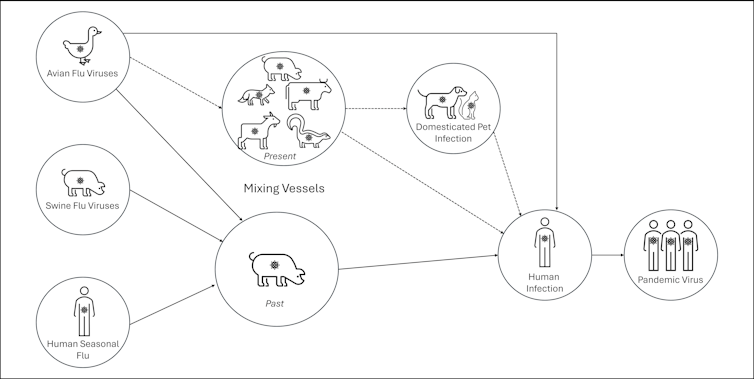
The cows infected in Texas were tested because farmers noticed they were producing less milk. If beef cattle are similarly affected, it may not be as easily identified, and the economic loss to farmers may be a disincentive to test or report infections.
For now there is no spread of H5N1 between humans, so there’s no immediate risk of a pandemic.
However, we now have unprecedented and persistent infection with H5N1 clade 2.3.4.4b in farms, wild animals and a wider range of wild birds than ever before, creating more chances for H5N1 to mutate and cause a pandemic.
Unlike the previous epidemiology of avian flu, where hot spots were in Asia, the new hot spots (and likely sites of emergence of a pandemic) are in the Americas, Europe or in Africa.
Pandemics grow exponentially, so early warnings for animal and human outbreaks are crucial. We can monitor infections using surveillance tools such as our EPIWATCH platform.
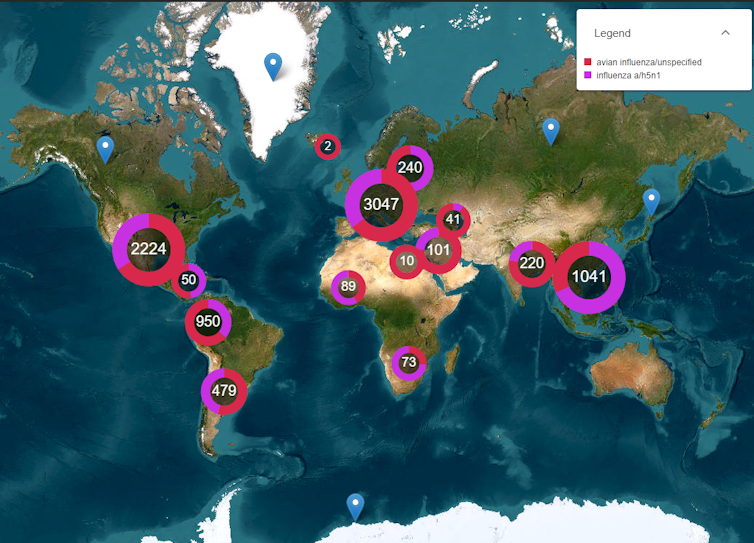
The earlier epidemics can be detected, the better the chance of stamping them out and rapidly developing vaccines.
Although there is a vaccine for birds, it has been largely avoided until recently because it’s only partially effective and can mask outbreaks. But it’s no longer feasible to control an outbreak by culling infected birds, so some countries like France began vaccinating poultry in 2023.
Read more: Migrating birds could bring lethal avian flu to Australia’s vulnerable birds
For humans, seasonal flu vaccines may provide a small amount of cross-protection, but for the best protection, vaccines need to be matched exactly to the pandemic strain, and this takes time. The 2009 flu pandemic started in May in Australia, but the vaccines were available in September, after the pandemic peak.
To reduce the risk of a pandemic, we must identify how H5N1 is spreading to so many mammalian species, what new wild bird pathways pose a risk, and monitor for early signs of outbreaks and illness in animals, birds and humans. Economic compensation for farmers is also crucial to ensure we detect all outbreaks and avoid compromising the food supply.

