Could bird flu cause a human pandemic?

Here’s what’s worrying experts right now about H5N1’s spread among dairy cows — and what isn’t.

By Keren Landman, MD  Apr 30, 2024, 12:10pm EDT

https://www.vox.com/even-better/24145304/bird-flu-h5n1-avian-influenza-pandemic

Share this story

A dairy farm workers attaches milking machines to cows housed in metal enclosures.
A dairy farm worker prepares cows for milking in Ontario, Canada, in July 2022.

Keren Landman, MD is a senior reporter covering public health, emerging infectious diseases, the health workforce, and health justice at Vox. Keren is trained as a physician, researcher, and epidemiologist and has served as a disease detective at the US Centers for Disease Control and Prevention.

Last year, when an H5N1 avian flu virus — commonly known as bird flu — was spilling over from bird populations into a variety of wild mammals, Seema Lakdawala, a virologist and influenza A transmission specialist at Emory University, was “not overly concerned” about human risk. We don’t have “much of an interface with seals or with foxes, for that matter, or polar bears,” she says.

But when it comes to cows, that interface is vast. People on dairy farms regularly interact with cows and their milk; when the animals and their milk are infected with a virus that can cause disease in humans, and that mutates constantly, each of those interactions functions as an opportunity for the virus to workshop its adaptability. Now, says Lakdawala, “I am more concerned than I have been, and it’s not for the general public — it is for dairy workers.”

The H5N1 outbreak among cows on 34 dairy farms in nine states has so far led to only one very mild human infection. However, the virus was likely spreading among cows for months before it was detected. Lakdawala’s greatest concern is that this highly changeable virus has now arrived at an important point of human-animal convergence, and that we are not prepared.

For a virus to cause a human pandemic, it has to have three important characteristics, say flu experts. It has to cause human disease; it has to be something our immune systems haven’t encountered before; and it must spread easily among humans, especially through the air. The latest events do not yet demonstrate that H5N1 has new capacities in any of these categories. However, they hint that the virus has the machinery to evolve those capacities — and that it could do so before we know it.

In dairy cows, H5N1 has found an excellent laboratory for evolving traits dangerous to humans

Although Lakdawala was concerned when mink, seals, and other mammals were infected with H5N1 last year and the year before, cows are different. An outbreak among “mammals with a large interface with humans” is a red flag to her.

It’s a numbers game. Although all viruses mutate routinely, flu viruses are particularly good at shapeshifting and can even swap entire chunks of genetic material with other flu viruses if an animal is co-infected with more than one of them. These mutations happen randomly, and most don’t make the viruses more dangerous to humans — but it’s entirely realistic to imagine that some occasionally do. If that occasionally human-threatening mutation happens to a flu virus that has infected, say, a wild fox, it doesn’t pose a particularly high risk of causing a pandemic among humans. After all, few wild foxes have contact with humans. If it happens in a cow, however, there are far more opportunities for the virus to effectively workshop its new features.

People who work on dairy farms are constantly interacting with cows and their milk — they check udders, hook and unhook milking machines, and perform other tasks to care for the animals. That puts them in lots of contact with any virus infecting the cows. If the virus were one that didn’t infect and kill people or that doesn’t mutate and adapt as easily as the flu does, perhaps it wouldn’t be as concerning — but H5N1 does infect people at close proximity to animals, and at least half of the more than 900 people who’ve been infected with the virus since it came on the scene in 1996 have died.

“There is a high viral load in milk of these infected cows, and so it is a concern to me in terms of spillover [from] cows into workers,” says Lakdawala. “And the more often the virus has an attempt to spill over, the more likely it is to adapt.”

We already know the virus is adapting in mammals, she says. “The more spillover events, the more attempts that the virus has to find a successful variant that can take off or infect the human — and then one infected individual, three infected individuals, go home” to their families, where they could potentially spread the virus further.

It’s not a pandemic right now, she says, but now is the time to act to reduce the opportunities for spillover events.

For the first time, we have proof of H5N1 spreading among a mammalian species

When a virus leaps from one species into another, that’s not usually enough to cause a large outbreak. You could look at H5N1’s history: Although the virus has leapt from animals into people hundreds of times, it has very rarely spread among people. When infections effectively stop spreading once they cross species lines, the non-transmitting species is called a “dead-end host.”

Birds readily transmit H5N1 to other birds, but until recently, scientists have thought mammals getting infected with H5N1 were dead-end hosts. In the past couple of years, they’ve had some sneaking suspicion that minks and other mammals getting infected with the virus were spreading it among themselves — but they never had definitive proof. That is, they couldn’t rule out the possibility that all the animals had gotten infected by eating bits of the same sick bird, or through another so-called “common source” exposure.

It’s much harder to contain a pathogen’s spread within a species if members of that species can transmit it to each other. What the dairy cow outbreak shows for the first time is that mammals can indeed now infect each other with H5N1 — and can do it efficiently.

“Genetic data and epidemiologic data are all quite strongly suggesting that these viruses are getting transmitted in some way between these cows,” says Louise Moncla, a veterinary pathobiologist at the University of Pennsylvania School of Veterinary Medicine whose team has analyzed genetic data from infected cows that the US government recently made available.

This virus’s mode of transmission isn’t apparent yet — and it matters

It’s not yet clear how the virus is being spread through and between dairy cow herds. High viral loads in cows’ udders and in their unpasteurized milk make it possible that contact with contaminated milking machines is doing most of the transmission. However, it’s also possible the virus is spreading through the fecal-oral route or through contaminated air; the latter would be particularly concerning because it’s so much harder to prevent. (Moncla notes that while the classic genetic fingerprint for a bird flu’s ability to spread through air between mammals is absent from this strain of H5N1, that doesn’t mean we’ve ruled out respiratory spread.)

Regardless of exactly how H5N1 is spreading among cows, the significance that they’re transmitting the virus to each other is clear to flu experts: If the virus has adapted to spread among one mammalian species, it raises the specter that it can also adapt to spread among humans.

There is a precedent for flu viruses to spread from livestock to humans, leading to a pandemic: The H1N1 flu outbreak began when a flu virus spread from pigs to humans. It caused far less death than expected through a stroke of luck — because the virus had similarities to strains that circulated in the first few decades of the 20th century, many older adults still had some flu immunity left over from childhood infections.

If H5N1 develops the ability to spread among humans, it would be a novel infection to most immune systems, giving us much less protection from old flu infections. There are “no signs of that [ability] so far in the cattle sequences,” says Andrew Pekosz, a virologist who studies respiratory virus biology at Johns Hopkins University’s Bloomberg School of Public Health. “That’s a good thing.”

Still, because we don’t know much about how influenza A viruses like H5N1 behave in cows, we don’t yet know what cautionary measures will do the most to slow their spread. In 2011, scientists learned that the influenza D virus causes respiratory illness in cattle. However, not all flu viruses are created equal: “I did not ever anticipate seeing an influenza A in cattle,” says Lakdawala.

While influenza D infections don’t appear to cause much disease in humans, influenza A viruses very much do: All of the past global flu pandemics have been caused by influenza A viruses.

Because this is such an unusual event, says Moncla, “we know very little about how flu replicates and transmits in cows.” That makes it hard to quickly design and implement precautions to prevent the virus from spreading to the people who handle them.

“What would calm me down is if we started implementing interventions that would mitigate the presence of the virus and its transmission amongst cattle, and spilling over into humans,” says Lakdawala. “Say, okay: Every dairy farm worker is gonna wear a face shield,” she said.

It would help to know whether cows that are infected but asymptomatic have infectious virus in their milk, and whether they can transmit virus to each other, says Pekosz. Ongoing studies by academics and federal agencies should help answer those questions.

Here’s why you shouldn’t panic

At the moment, there are more “coulds” than “ares” with H5N1: Although the virus is showing that it could adapt further to spread among humans, so far it hasn’t; and while it’s reasonable to conduct studies to ensure pasteurization works against this particular strain of H5N1, there’s no reason to think it won’t.

It’s also worth noting that according to the USDA spokesperson, the virus has so far not caused severe disease or death in the cows it has infected — they’ve all recovered with supportive care. In that way, this outbreak is very different from the ones we’ve seen in some other mammals.

Furthermore, testing at the Centers for Disease Control and Prevention has already demonstrated that existing antiviral medications are effective at preventing human infections with this strain of H5N1 and that two existing candidate vaccines could be used to rapidly scale up mass production of human vaccines against this virus if needed.

So for now, the general public shouldn’t be overly concerned about the virus, says Pekosz. “Scientists are … working extra overtime for this. But the general public should still feel safe.”

Stephen Colbert: ‘If you like puppies, you’re not going to like Kristi Noem’

Late-night hosts discuss the South Dakota governor and possible Trump VP pick revealing she killed her family dog

Guardian staffTue 30 Apr 2024 11.25 EDTShare

https://www.theguardian.com/culture/2024/apr/30/stephen-colbert-kristi-noem-dog

Late-night hosts talk about Kristi Noem’s puppy-killing admission and Donald Trump’s day off from court.

Stephen Colbert

“If you like puppies, you’re not going to like Kristi Noem,” said Stephen Colbert on Monday evening, referring to the governor of South Dakota and a possible running mate for Donald Trump. In her new book, first obtained by the Guardian, Noem admitted to killing her dog. “Now, I know that sounds terrible, but it’s much worse,” said Colbert. “Because this wasn’t some rabid, 90lb hell hound on a meth bender.” It was a 14-month-old wirehaired pointer named Cricket.

“It is worth pointing out: no one made Noem confess to puppy-snuffing,” the Late Show host said. “She volunteered this information,” even saying: “I guess if I were a better politician I wouldn’t tell the story here.”

https://61408c460e1bb60b4001cb6e503491e5.safeframe.googlesyndication.com/safeframe/1-0-40/html/container.html

“So, why? Why did Cricket need to kick it?” Colbert wondered. According to Noem, the puppy was “untrainable”. “Well yeah! She was 14 months old!” Colbert exclaimed.

man on stage in a suit

Noem wrote – “again, in a story no one asked her to tell us”, Colbert noted – that she took Cricket on a pheasant hunt that the puppy ruined, going “out of her mind with excitement, chasing all those birds and having the time of her life”.

“But who among us hasn’t seen a dog running through the fields, not a care in the world, and thought ‘you deserve to die,’” Colbert deadpanned.

Cricket then “made the fatal mistake of continuing to be a normal puppy on the way home”, Colbert noted. Noem wrote that on the way home, Cricket attacked her neighbor’s chickens. “Governor Noem, if you don’t like untrainable animals that wolf down chicken, I have bad news about your party’s nominee,” Colbert quipped.

With the chickens, Cricket was “the picture of pure joy”, prompting Noem to write: “I hated that dog.”

“This book is starting to sound less like a political memoir and more like the scrawled manifesto of a guy whose neighbors said, ‘He just kinda kept to himself, you know?’” Colbert said.

https://61408c460e1bb60b4001cb6e503491e5.safeframe.googlesyndication.com/safeframe/1-0-40/html/container.html

Noem said she led Cricket to a gravel pit and shot her, as well as a goat, for smelling bad. “Oh my God, what kind of reverse John Wick farm is she running out there?” Colbert exclaimed.

Seth Meyers

“It’s one thing to kill a dog named Cricket, it’s another to brag about it in a book,” said Seth Meyers on Late Night.

“She thought telling that story would make her look cool,” Meyers mused. “What’s going on? Does she think cats can vote? And even if they could, those lazy sons of bitches aren’t going to wait in line at a high school for three hours.

“It’s horrible enough to kill a dog, but even crazier to brag about it,” he continued. “That’s a level of psycho I didn’t even know existed. Even Buffalo Bill [from The Silence of the Lambs] had the self-awareness to keep his abhorrent behavior indoors. He didn’t walk around town saying, ‘Hey, check out my new outfit. It’s a skin suit!’”

Noem defended her actions on X, formerly Twitter, writing: “tough decisions like this happen all the time on a farm” and that she just had to “put down 3 horses a few weeks ago”.

“Way to change the narrative,” Meyers mocked. “‘Yeah, I killed a dog. But in my defense: also, three horses. Sleep with your eyes open, donkey!’”

Meyers also noted another weird Noem moment this year, when she appeared in an ad for a cosmetic dentistry company from Texas. “These stories tell us a lot about Kristi Noem, but they also say a lot about Donald Trump,” he said. “She wants to be his VP, and thought both of those things were positives. That when her name came up, Trump would say ‘nice teeth, kills dogs, a lot to like!’”

Jimmy Kimmel

https://61408c460e1bb60b4001cb6e503491e5.safeframe.googlesyndication.com/safeframe/1-0-40/html/container.html

The Trump hush-money trial in New York took Monday off, “giving our former president a well-deserved chance to nap and fart at home”, joked Jimmy Kimmel.

According to Trump’s friend John Catsimatidis, Trump has been miserable in court. “There is no more horrible thing than just having to sit there and be quiet,” he said.

“Well if that’s the case, he’s going to love prison,” said Kimmel.

On Friday, Trump publicly wished Melania a happy birthday to the cameras outside the courthouse. “You know you could also call her on the phone,” Kimmel deadpanned. “How oblivious do you have to be to wish your wife a happy birthday outside the courtroom where you’re on trial for paying off a porn star?”

Trump was in Miami over the weekend, where he met with his former presidential rival Ron DeSantis. The Florida governor reportedly promised to help raise money for Trump’s campaign. “Poor Ron DeSantis. What a pathetic little worm,” said Kimmel. “They say he did it because he wants to run for president again in 2028, which seems like a great idea,” Kimmel deadpanned. “What he doesn’t realize is that Trump is also going to be running for president in 2028.”

First case of walrus dying from bird flu recorded in Arctic

https://www.theguardian.com/world/2024/apr/30/first-walrus-bird-flu-death-arctic-islands

Virus has already killed other mammals including sea lions and seals, while also taking toll on farm animals

Guardian staff and agenciesTue 30 Apr 2024 01.01 EDTShare

The first case of a walrus dying from bird flu has been detected on one of Norway’s Arctic islands, a researcher has said.

The walrus was found last year on Hopen island in the Svalbard archipelago, Christian Lydersen, of the Norwegian Polar Institute, told AFP.

Tests carried out by a German laboratory revealed the presence of bird flu, Lydersen said. The sample was too small to determine whether it was the H5N1 or the H5N8 strain.

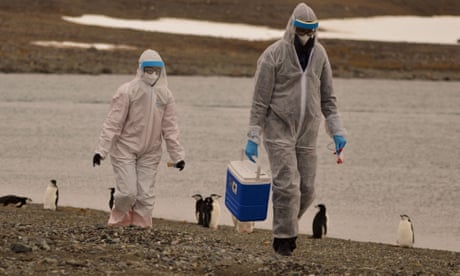
Two researchers wearing white protective suits, one carrying a blue box, walk across stony ground with penguins and water in the background

“It is the first time that bird flu has been recorded in a walrus,” Lydersen said.

About six dead walrus were found last year in the Svalbard islands, about 1,000km (620 miles) from the north pole and halfway between mainland Norway and the north pole.

Lydersen said it was “not improbable” that some of them had the bird flu.

Frank Wong, a molecular microbiologist at the CSIRO Australian Animal Health Laboratory, said transmission to walrus was of significant concern to marine mammals. Animals such as sea lions and fur seals had previously died from the disease, he said.

He said bird flu was still a “bird adapted virus” which is transmitted by birds like ducks and geese. The sporadic infection and spread of bird flu in mammals was likely due to mammals ingesting infected dead birds and living in colonies in close contact with other animals.

Walrus, which can grow to a weight of two tonnes, eat mainly fish and shellfish, but sometimes also consume marine birds.

Lydersen said it was important to monitor developments as walrus tend to group together in summer months when the ice flow melts.

There could also be a risk from a polar bear eating an infected walrus corpse.

Bird flu has taken a growing toll on farm animals since 2020.

It has already killed one polar bear in Alaska, according to US authorities. Thousands of marine mammals have died from bird flu viruses in South America, according to Antarctic researchers.

Agence France-Presse contributed to this report

Kristi Noem Killed Her Dog—and Committed ‘Political Suicide’

CRICKETS FOR KRISTI

https://www.thedailybeast.com/kristi-noem-killed-her-dogand-committed-political-suicide

Noem was seen as a possible VP pick for Trump, but even MAGA world is revolted over her shocking admission she shot and killed a family dog.

Reese Gorman

Politics Reporter

Jake Lahut

Politics Reporter

Updated Apr. 30, 2024 3:06AM EDT / Published Apr. 29, 2024 8:01PM EDT 

A photo illustration of Kristi Noem with a howling dog and a Trump/Noem button with a gun shot through it behind her

https://buy.tinypass.com/checkout/template/cacheableShow?aid=SrmTGdXwNo&templateId=OTG4JH0BZ81K&templateVariantId=OTVW7M104FBOB&gaClientId=1625731213.1714490947&offerId=fakeOfferId&experienceId=EXER0V1EECF4&iframeId=offer_510b08ce416817a3859d-0&displayMode=inline&pianoIdUrl=https%3A%2F%2Fid.tinypass.com%2Fid%2F&widget=template&url=https%3A%2F%2Fwww.thedailybeast.com

South Dakota Gov. Kristi Noem’s gruesome recounting of how she killed her dog may have also killed something else: her hopes to be Donald Trump’s running mate.

In Trump’s orbit, Noem’s decision to disclose in her forthcoming memoir that she once shot and killed a family dog is being seen as pure political self-immolation—part of a series of “lapses in judgment” and a sign of “desperation that President Trump especially doesn’t like,” according to a over a half-dozen GOP sources who spoke to The Daily Beast on condition of anonymity to detail confidential conversations.

“Everyone around Trump is talking about this,” said a MAGA operative.

“Haven’t seen a more public suicide than Jim Jones at Jonestown,” another Trumpworld source told The Daily Beast.

For years, Noem has been seen as a rising star in Republican politics, thanks to her combative, unabashedly MAGA image. She routinely appears in news reports as one of Trump’s top contenders for his vice-presidential slot in 2024.

At this point, though, even Republicans may agree that by deeply offending a bipartisan constituency—pet lovers—Noem isn’t just politically incorrect but politically incompetent.

In a startling revelation from her new memoir No Going Back, set to be published next month, Noem details the shocking end of her 14-month-old wirehair pointer, Cricket.

Noem recounts she killed the dog, who lived on the family’s farm in South Dakota, because of its “aggressive personality” and lack of hunting skills. She also writes that Cricket escaped her truck and attacked a group of chickens, “grabb[ing] one chicken at a time, crunching it to death with one bite, then dropping it to attack another.” This was the final straw.

“I hated that dog,” Noem writes, adding that Cricket was simply “untrainable,” “worthless as a hunting dog,” and “dangerous to anyone she came in contact with.” It was then, she says, she realized “I had to put her down.”

But Noem did the dirty work herself, leading Cricket to a gravel pit and then shooting the dog.

Trump and Noem
Donald Trump listens as Gov. Kristi Noem speaks at a rally in Ohio in March 2024.

This graphic and shocking excerpt has been poorly received by many, including those in Trumpworld, and it may have sunk whatever hopes she had to be Trump’s running mate.

The Trumpworld source added that Noem had “a very slight shot before” of being Trump’s running mate but that it is “less than zero now.”

“A vice president is chosen to solve problems and add real value. A proven gaffe machine does neither,” a source close to the Trump campaign told The Daily Beast.

Not only that, but a MAGA operative said Noem’s chances at a Cabinet position could also be toast. Her involvement with the Trump campaign at all could be limited going forward, too.

Operatives around Trump “are fixated on the ads that would run if she were anywhere involved with President Trump’s campaign, regarding the dog,” the Trump operative said. “I mean, this stuff is devastating. There’s nothing more popular in politics than dogs, and she killed one—and she continues to talk about it… That’s what’s baffling and shows out-of-control judgment.”

The Trump campaign did not respond to a request for comment. A spokesperson for Noem also did not respond to a request for comment.

Indeed, amid all the blowback, Noem has refused to apologize. She wrote in subsequent posts on X that she “understands” why people might be upset but that “tough decisions like this happen all the time on a farm.”

The governor also tried to spin the execution as an example of how she doesn’t “shy away from tough challenges.”

“Whether running the ranch or in politics, I have never passed on my responsibilities to anyone else to handle,” Noem said on X. “Even if it’s hard and painful. I followed the law and was being a responsible parent, dog owner, and neighbor.”

The widespread and swift backlash to Noem’s bizarre and off-putting story within Trumpworld is an exception to the general rule that Trump’s most trusted allies typically are protected when a bad news cycle comes for them after a self-inflicted wound.

Take Rep. Matt Gaetz (R-FL) and his Trumpian ability to survive serious scandal. Or look at how the likes of Rep. Lauren Boebert (R-CO) and Rep. Marjorie Taylor Greene (R-GA) have been able to avoid—at least in the friendly confines of Trumpworld—being forever tied down to episodes they’d like to forget, from the infamous ‘Beetlejuice’ escapades for Boebert to Greene’s remarks about “Jewish space lasers.”

Yet Noem might be in a league of her own.

Matthew Bartlett, a GOP strategist and director of public affairs at the Department of State under Trump, said Noem may have carved out a new category for herself in the lexicon of political blunders.

“For Kristi Noem, it’s hard to even call this an unforced error,” Bartlett said, “because she deliberately told this story from something she thought would be a position of strength.”

A Trump-aligned strategist called Noem’s decision “one of the worst PR handlings I’ve ever seen.”

“In America we love beer, baseball, and dogs. It’s bipartisan,” the strategist said. “And to think that Donald Trump would think you’re tough ’cause you killed a dog? It’s the weirdest fucking thing I’ve ever seen.”

The canine blow-up has also raised questions about who is advising Noem, or whether she listens to any sound political advice at all.

“They just don’t know how to handle this,” another veteran GOP strategist said of Noem’s team. “Confirming it yourself, and doing so in a book—this wasn’t a slip of the tongue—it shows kind of a string of bad judgment along the way.”

“What she put in the book is the most positive version of this story she could possibly have,” the strategist added. “Think of it that way.”

Noem’s main champion in Trumpworld has long been Corey Lewandowski, Trump’s former campaign manager in 2016. Several Republicans who spoke with The Daily Beast said Noem’s account of shooting the puppy may well blow back on Lewandowski, who insisted in a Monday talk radio interview in New Hampshire that Noem was “still in the top three” contenders for Trump’s VP pick.

Lewandowski did not return a request for comment.

What’s made matters worse for Noem is that she has aggressively maneuvered to put herself in the VP conversation—magnifying the scrutiny on her missteps not just by Trump’s top lieutenants but by others who are angling for the No. 2 spot, too.

“She’s sort of put herself in the VP-or-bust bucket,” the MAGA operative said, “and that’s a really bad place to be.”

Bartlett said Noem may have fallen into a trap in her “misguided attempt” to project “some sort of Midwesternly strength.”

“Connecting with rural America to show strength and hard decisions could have been a true asset,” Bartlett said, “but shooting a puppy never is.”

Consuming Bird Flu Contaminated Cow Milk Discouraged

Fact checked by Robert Carlson, MD

https://www.precisionvaccinations.com/consuming-bird-flu-contaminated-cow-milk-discouraged-2024-04-28

+ 1

Published

April 28, 2024

Fact checked

April 29, 2024

Unhealthy zoonotic pathogens can be transmitted through unpasteurized milk

Bird flu vaccine

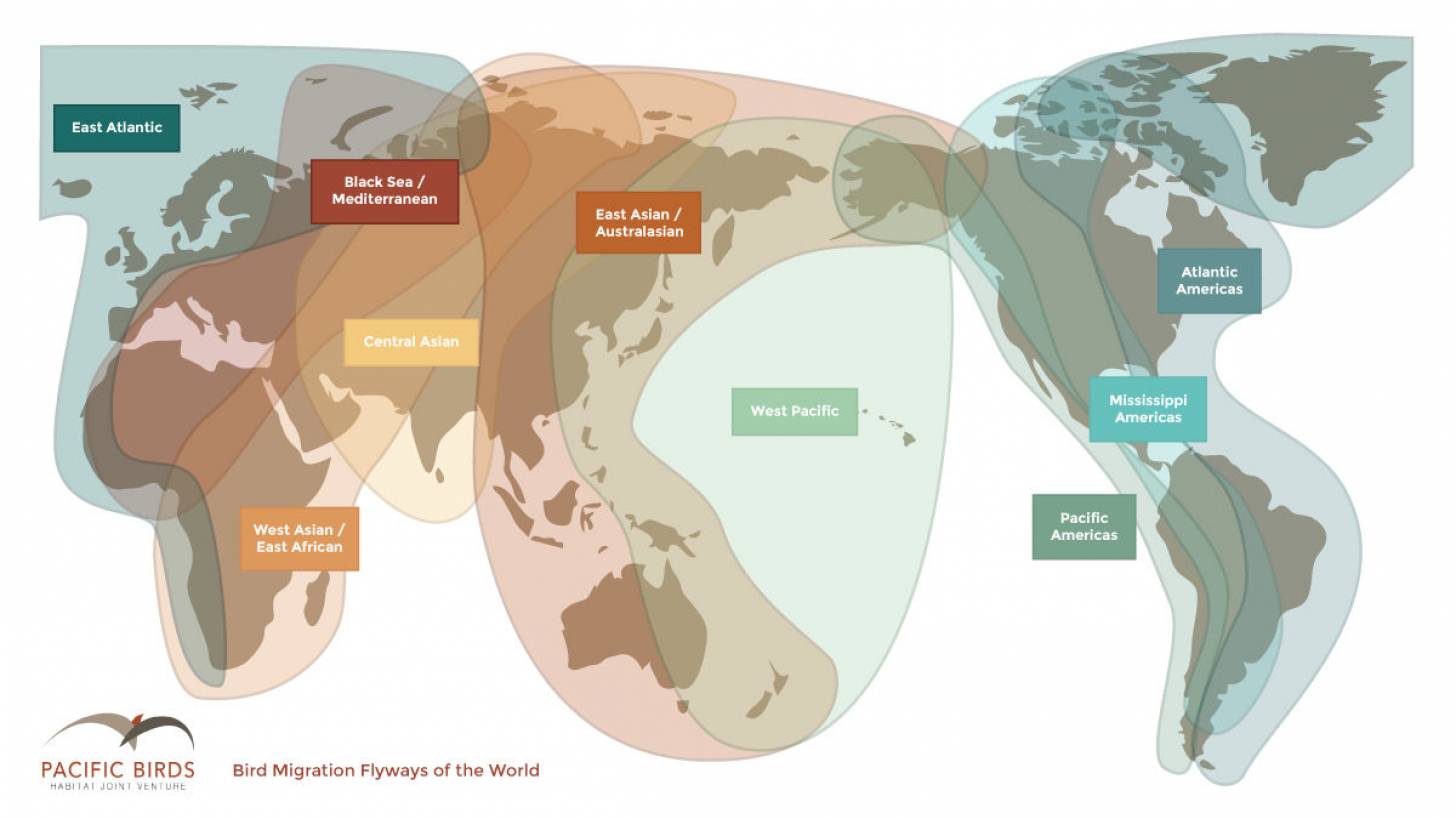
Migratory bird flyways – U.S. Fish & Wildlife Service 2024

GENEVA (Precision Vaccinations News)

Over the past few years, significant media attention has been paid to detecting avian influenza (bird flu). While the overall human health risk is being evaluated, the World Health Organization (WHO) recently shared clarifying data points.

During 2020, highly pathogenic avian influenza (HPAI) A(H5N1) clade 2.3.4.4b viruses arose from previously circulating influenza A(H5Nx) viruses. They spread predominantly via migratory birds to many parts of Africa, Asia, and Europe.

In late 2021, these bird flu viruses crossed to North America and, in late 2022, to South America.

According to the WHO statement on April 26, 2024, the epizootic has led to unprecedented deaths in wild birds, domestic poultry, and various mammals such as bears.

The WHO has confirmed that relatively few human infections have been reported despite the high number of A(H5N1) clade 2.3.4.4b detections.

Since the beginning of 2021, 28 A(H5N1) detections in humans have been reported to the WHO.

Of the 28 human cases, all were sporadic infections in people exposed to A(H5N1) viruses through direct or indirect contact with infected birds, infected mammals, or contaminated environments, such as live poultry markets or other premises with infected animals.

Specifically, no human-to-human transmission has been reported in these cases.

However, active investigations are continuing to determine whether there is any.

Most A(H5N1) human cases reported in Europe and North America were asymptomatic or mild, with fatigue reported for the cases detected in the U.S. 

On April 1, 2024, the Texas Department of State Health Services reported the first confirmed human case of A(H5N1) virus in Texas. This person successfully recovered.

Based on available information, the WHO currently assesses the overall public health risk posed by A(H5N1) to be low. For those exposed to infected birds or animals or contaminated environments, the risk of infection is considered low to moderate.

Furthermore, investigations are ongoing to understand the risk to humans from consuming milk contaminated with the A(H5N1) virus. According to the WHO, dangerous zoonotic pathogens can be transmitted through unpasteurized milk.

As investigations continue in the U.S. and elsewhere, more information regarding ‘contaminated cow milk’ will be available in the coming days and weeks.

Historically, the U.S. CDC has advised against consuming un-cooked birds and mammals infected with avian influenza viruses.

The good news is that the U.S. FDA has already approved one bird flu vaccine (Audenz™).

As of April 28, 2024, the government has invested hundreds of millions in additional avian influenza vaccine candidate production. In late 2023, about 32 million bird flu vaccines were available in the U.S. National Strategic Stockpile.

This saltwater lagoon is legally a person. Here’s why that could help it survive

By Nell Lewis, CNN

 4 minute read 

Published 4:32 AM EDT, Mon April 29, 2024

https://www.cnn.com/2024/04/29/travel/goldman-environmental-prize-mar-menor-spain-climate-c2e-spc-intl/index.html

6 comments

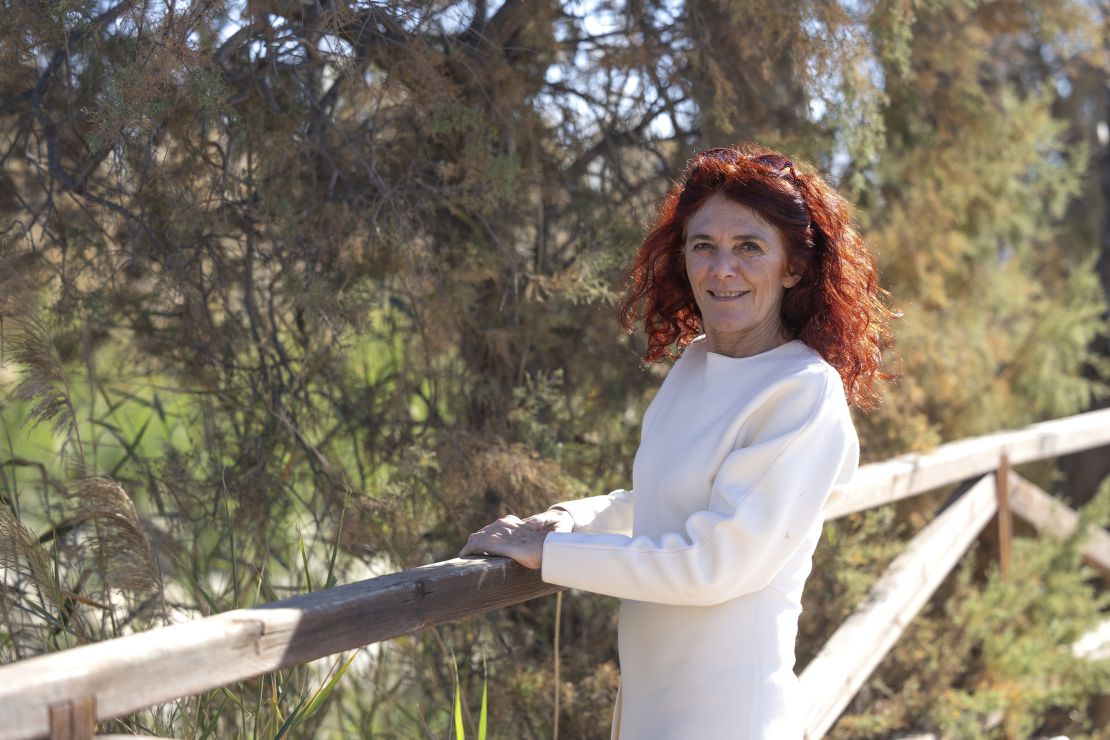
Teresa Vicente, a professor of philosophy of law at the local University of Murcia, was appalled by the state of the lagoon, and in 2020 she launched a campaign to grant Mar Menor rights of nature, meaning that it would have a right to exist and be defended from further damage.
In 2022, Spain’s senate approved the bill and Mar Menor became the first ecosystem in Europe to be given the same legal rights as a person.
Mar Menor, Europe’s largest saltwater lagoon, is located in the region of Murcia, southeast Spain.

Mar Menor, Europe’s largest saltwater lagoon, is located in the region of Murcia, southeast Spain.Jorge Guerrero/AFP/Getty Images

It has long been popular with tourists, attracted by its sunny beaches and clear waters. But recently, the lagoon has suffered from environmental collapse.
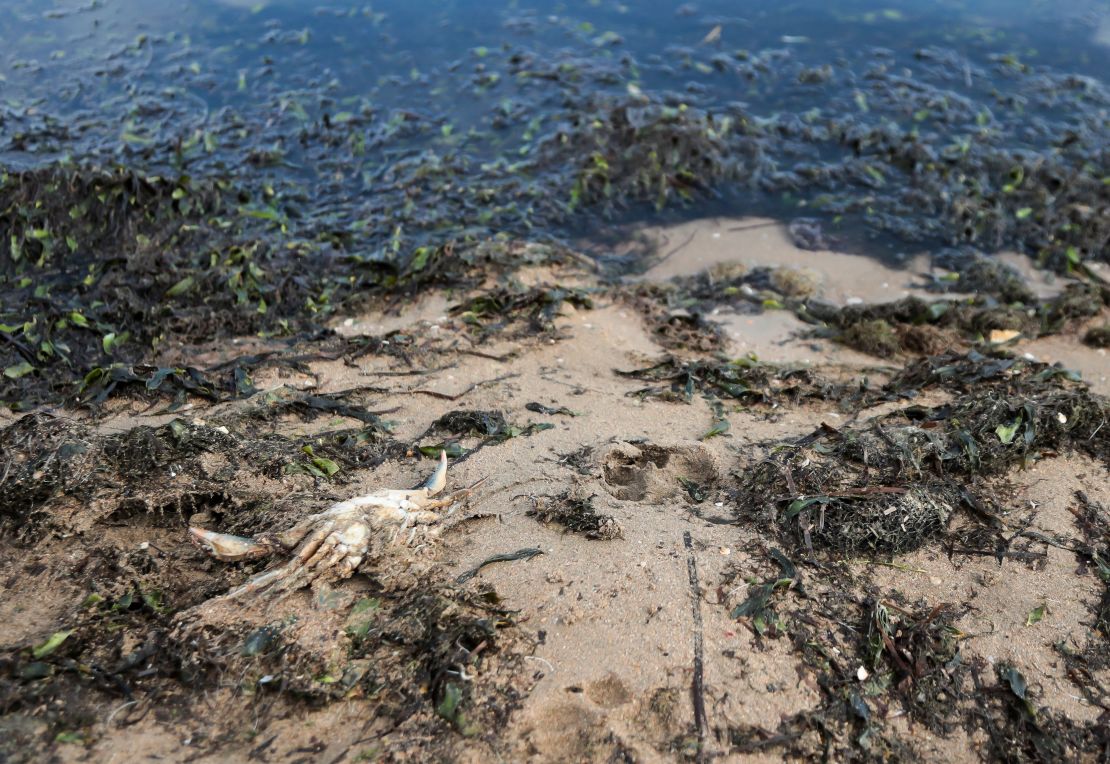
The lagoon’s waters have become choked with algal blooms, causing three mass fish and crustacean die-offs since 2016. In 2021 (when this photo was taken), five tons of dead sea creatures washed ashore at Mar Menor.
The environmental damage has been linked to the intensive agriculture in the surrounding region. Run-offs from nitrate-filled fertilizers entered the lagoon, causing extreme eutrophication – the accumulation of algae that depletes the water of oxygen.

In the 1970s, a development boom around Mar Menor led to hotels and high-rise apartments being built right at the water’s edge. But since the waters have turned murky and dead fish have washed up, both house prices and tourism revenue have dipped.
Teresa Vicente, a professor of philosophy of law at the local University of Murcia, was appalled by the state of the lagoon, and in 2020 she launched a campaign to grant Mar Menor rights of nature, meaning that it would have a right to exist and be defended from further damage.
In 2022, Spain’s senate approved the bill and Mar Menor became the first ecosystem in Europe to be given the same legal rights as a person.
Mar Menor, Europe’s largest saltwater lagoon, is located in the region of Murcia, southeast Spain.
It has long been popular with tourists, attracted by its sunny beaches and clear waters. But recently, the lagoon has suffered from environmental collapse.
Europe’s largest saltwater lagoon has faced environmental collapse. Now it’s a legal person

1 of 8PrevNext

Editor’s Note: Call to Earth is a CNN editorial series committed to reporting on the environmental challenges facing our planet, together with the solutions. Rolex’s Perpetual Planet initiative has partnered with CNN to drive awareness and education around key sustainability issues and to inspire positive action.CNN — 

Mar Menor, Europe’s biggest saltwater lagoon, sits on the coast of southeastern Spain. A strip of sand separates the 52-square-mile area from the Mediterranean, creating warm shallow waters and enticing beaches popular with tourists.

But in recent years these crystalline waters have turned murky with algal blooms, mounds of dead fish have washed up on its shores, and the once fresh and salty scent has been replaced by a foul stench of decay.

Ad Feedback

House prices in the area have fallen, tourist revenue dropped and local people were left furious. But one of them had a new idea to protect the lagoon: what if it was given the same legal rights as a person? What if it had a right to exist and protection against the damage being done to it?

Teresa Vicente, a professor of philosophy of law at the local University of Murcia, first asked these questions in 2019. Three years later, following an intense campaign, Mar Menor became the first ecosystem in Europe to be designated legal personhood rights.

Today, Vicente was awarded the prestigious Goldman Environmental Prize – an annual award given to six grassroots environmental leaders, each working in a different continent. Her legal strategy, which empowers citizens to act on behalf of nature, was commended for setting “an important precedent for democratizing environmental protection and expanding the role of civil society in support of environmental campaigns.”

A strip of sand, known as La Manga, separates the lagoon from the Mediterranean Sea. Today, the strip is dense with buildings.

A strip of sand, known as La Manga, separates the lagoon from the Mediterranean Sea. Today, the strip is dense with buildings. Jose Guerrero/AFP/Getty Images

Ecological disaster

Vicente, 61, was born and raised in the region of Murcia and her memories of the lagoon go all the way back to her childhood. She remembers playing there in shorts and t-shirts, parties on the beach during her teenage years, and the transparent water. “For me, the lagoon was everything,” she tells CNN.

But a few decades ago, things started changing. There was a development boom (today, the sandbank separating the lagoon from the ocean is filled with high-rise apartment buildings), an increase in plastic pollution, and a huge rise in intensive agriculture. In 1979, a new canal opened bringing irrigation to the region and helping to transform it into a farming powerhouse. Today, Murcia accounts for 20% of Spain’s fruit and vegetable exports, exporting more than 2.5 million tons a year, from lettuce and broccoli to lemons and artichokes.

Teresa Vicente, 61, has been awarded the Goldman Environmental Prize for her successful campaign to grant Mar Menor legal personhood rights.

Teresa Vicente, 61, has been awarded the Goldman Environmental Prize for her successful campaign to grant Mar Menor legal personhood rights. Goldman Environmental Prize

Combined with waters warmed by climate change, this became a recipe for ecological disaster. Run-offs from nitrate-filled fertilizers entered the lagoon, causing extreme eutrophication – the accumulation of algae that depletes the water of oxygen. Since 2016, there have been three mass fish and crustacean die-offs, mussel populations have collapsed, and 85% of the lagoon’s seagrass died.

RELATED ARTICLEHow this beautiful Spanish tourist city became the green capital of Europe

It was after the 2019 die-off, when an estimated three tons of dead fish washed up onto the shores, that Vicente was compelled into action. She had been on a three-month fellowship at the University of Reading’s Centre of Justice and Climate in the UK at the time, but her students in Murcia called her up and told her what was happening. “I immediately went back, because I wanted to start implementing the theory into law,” she says.

Right to exist

Granting “rights of nature” is a concept that has long been debated but has only gained momentum in recent years. In the last decade, ecosystems such as the Atrato River in Colombia and New Zealand’s Whanganui River have been granted legal personhood.

In 2021, a thick algal bloom resulted in five tons of sea creatures washing up on beaches around the lagoon, including this crab.

In 2021, a thick algal bloom resulted in five tons of sea creatures washing up on beaches around the lagoon, including this crab. Jose Miguel Fernandez/AFP/Getty Images

It was these examples that inspired Vicente to do the same for Mar Menor. She notes that, on paper, the lagoon was already protected by several international conventions: such as being classified as a Ramsar Wetland of International Importance and a Special Protection Area for Wild Birds. But none seemed to be protecting the lagoon from the severe pollution. “We knew that we needed to do something more than all these protections, something that goes beyond that,” she says.

She started to raise awareness of the campaign, writing an article for a local paper, and despite initial opposition she managed to win support from the riverbank communities who were enraged by the pollution on their doorstep. By 2021, Vicente had collected more than 600,000 signatures, more than she needed to propose the bill. Public demonstrations, meetings with government representatives and media interviews followed, until in September 2022, Spain’s senate passed it into law.

RELATED ARTICLEThese furry-clawed crabs are causing havoc in Europe’s rivers. Scientists believe they have a solution

Less than two years after the legislation, Mar Menor has not miraculously recovered. The process will take time, but now the lagoon has the right to conservation, protection and remediation of environmental damage. Vicente explains that three new legislative bodies, composed of government representatives, scientists, and local citizens, have been appointed to oversee enforcement, and while the lagoon may not be able to speak for itself, any citizen is now able to file a lawsuit on behalf of Mar Menor.

Vicente is confident that the new model for justice will help to “cut the poison” that is entering the lagoon, referring to the nitrates from intensive agriculture, and defend it from further harm. Then she hopes that nature-based solutions can start to restore the area.

“Right now, Mar Menor is in intensive care,” she says. “Maybe it won’t go back to the same as it was when I was younger, but at least it will have a life of dignity.”

An El Niño-less summer is coming. Here’s what that could mean for the US

By Mary Gilbert, CNN Meteorologist

 4 minute read 

https://www.cnn.com/2024/04/29/weather/la-nina-summer-forecast-us-el-nino-climate/index.html

Updated 8:25 AM EDT, Mon April 29, 2024

Video Ad Feedback

What exactly is El Niño?

01:56 – Source: CNNCNN — 

It may be spring, but it’s not too soon to look ahead to summer weather, especially when El Niño – a player in last year’s especially brutal summer – is rapidly weakening and will all but vanish by the time the season kicks into gear.

El Niño’s disappearing act doesn’t mean relief from the heat. Not when the world is heating up due to human-driven climate change. In fact, forecasters think it could mean the opposite.

What this summer’s weather could look like

El Niño is a natural climate pattern marked by warmer than average ocean temperatures in the equatorial Pacific. When the water gets cooler than average, it’s a La Niña. Either phase can have an effect on weather around the globe.

By June, forecasters expect those ocean temperatures to hover close to normal, marking a so-called neutral phase, before La Niña builds in early summer, according to NOAA’s Climate Prediction Center.

But the strength of El Niño or La Niña’s influence on US weather isn’t uniform and varies greatly based on the strength of the phenomena and the season itself.

This handout photograph taken and released by the Center for Volcanology and Geological Hazard Mitigation on April 17, 2024 shows Mount Ruang spewing hot lava and smoke as seen
from Sitaro, North Sulawesi. A volcano erupted several times in Indonesia's outermost region overnight on April 17, forcing hundreds of people to be evacuated after it spewed lava and a
column of smoke more than a mile into the sky. Center for Volcanology and Geological Hazard Mitigation/AFP via Getty Images

RELATED ARTICLEA powerful volcano is erupting. Here’s what that could mean for weather and climate

The influence of El Niño or La Niña on US weather isn’t as clear-cut in the summer as it is in the winter, especially during a transition between the two phases, said Michelle L’Heureux, a climate scientist with the Climate Prediction Center.

Temperature differences between the tropics and North America are more extreme in the winter, L’Heureux explained. This allows the jet stream to become quite strong and influential, reliably sending storms into certain parts of the US.

In the summer, the difference in temperature between the two regions isn’t as significant and the obvious influence on US weather wanes.

But we can look back at what happened during similar summers to get a glimpse of what could come this summer.

In short: It’s not cool.

The summer of 2016 was one of the hottest on record for the Lower 48. La Niña conditions were in place by midsummer and followed a very strong El Niño winter.

Summer 2020 followed a similar script: La Niña conditions formed midsummer after a weak El Niño winter but still produced one of the hottest summers on record and the most active hurricane season on record.

Then there’s the fact that these climate phenomena are playing out in a warming world, raising the ceiling on the extreme heat potential.

“This obviously isn’t our grandmother’s transition out of El Niño – we’re in a much warmer world so the impacts will be different,” L’Heureux, said. “We’re seeing the consequences of climate change.”

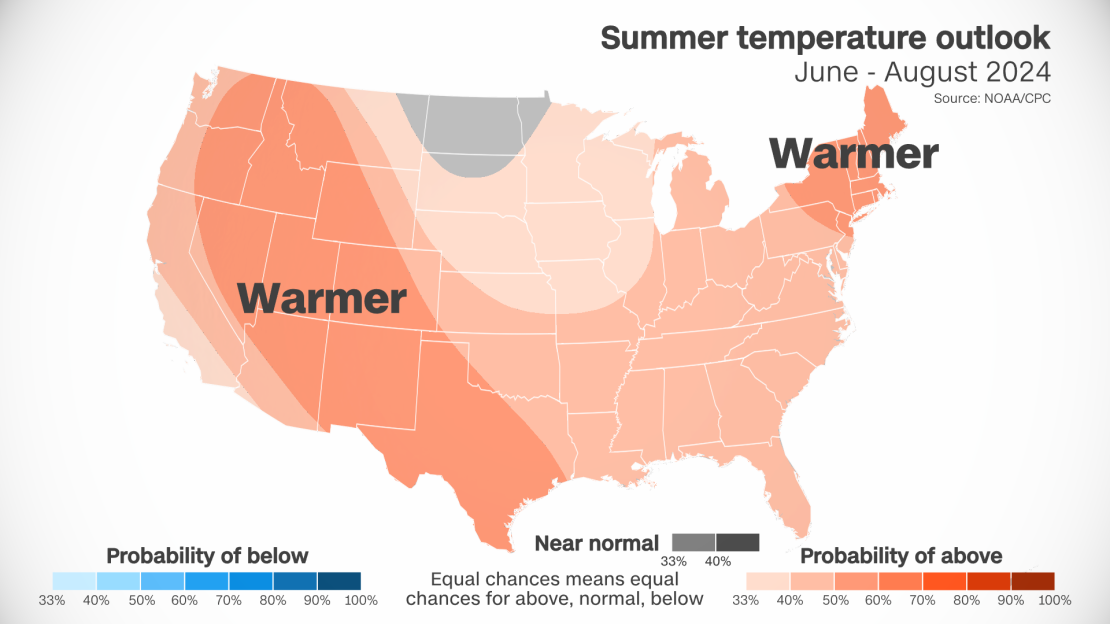
Current summer temperature outlooks for the US are certainly bringing the heat.

CNN digital season outlook temp white summer 042324.png

CNN Weather

Above-average temperatures are forecast over nearly every square mile of the Lower 48. Only portions of the Dakotas, Minnesota and Montana have an equal chance of encountering near normal, above- or below-normal temperatures.

A huge portion of the West is likely to have warmer conditions than normal. This forecast tracks with decades of climate trends, according to L’Heureux.

Summers have warmed more in the West than in any other region of the US since the early 1990s, according to data from NOAA. Phoenix is a prime example. The city’s average July temperature last year was an unheard-of 102.7 degrees, making it the hottest month on record for any US city. It was also the deadliest year on record for heat in Maricopa County, where Phoenix is located.

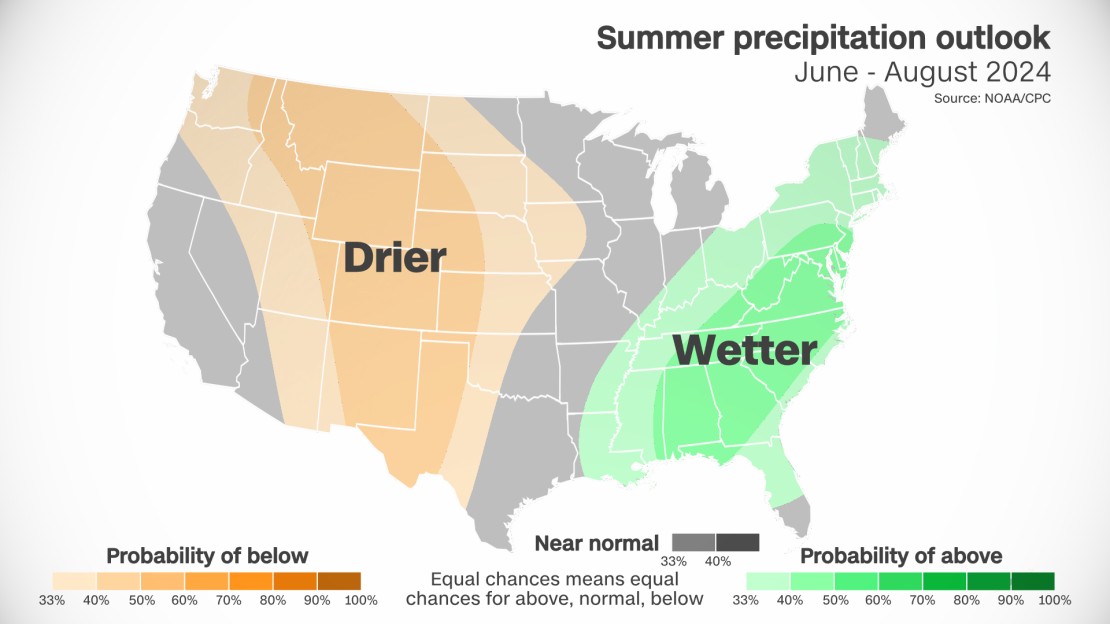
Forecasts also show a worrying precipitation trend for parts of the West.

CNN digital season precip outlook white summer 042324.png

CNN Weather

Large sections of the West and the central US are likely to be drier than normal. This dryness, combined with above-normal heat, which only amplifies the dryness, could be a recipe for new or worsening drought.

Wetter than normal conditions are in the forecast from the Gulf Coast to the Northeast. Stormy weather could be a consistent companion for much of the East – but whether it comes from typical rain and thunderstorms or tropical activity won’t be known for months.

A brutal summer also predicted in the water

Heat isn’t the only threat to look out for.

The strengthening La Niña conditions, coupled with ocean temperatures which have been at record highs for over a year, could supercharge the Atlantic hurricane season.

A warming world generates more fuel for more tropical activity and stronger storms. La Niña tends to produce favorable atmospheric conditions to allow storms to form and hold together in the Atlantic.

Early this month, forecasters at Colorado State University released their most active initial forecast ever.

“We anticipate a well above-average probability for major hurricanes making landfall along the continental United States coastline and in the Caribbean,” the group said in a news release.