The path of an asteroid will soon be coming nearly as close to Earth as our Moon’s orbit. Though some consider a collision with an asteroid more likely andmore dangerousthan we think, scientists are certain this one will pass us by. Even when objects come much closer to us than this one, they tend to burn up in our atmosphere in anawesome blaze.
AsNewsweekreports, the asteroid is considered an NEO (Near Earth Object) and will pass our planet on Wednesday with extraordinary closeness, about 1.1 lunar distances. That means that when it comes closest to us, it will be 1.1 times as far away as the Moon’s orbit. For more accurate numbers, but perhaps slightly less relatable perspective, the Moon…
WASHINGTON (AP and KWCH) – Kansas’ delegation in the U.S. Senate applauded the Senate’s passage of legislation that nullifies the listing of the lesser prairie chicken as a threatened species. The Sunflower State’s representation in Washington has pushed back on the bird’s listing under the Endangered Species Act, citing a negative economic impact on the state.
Sen. Roger Marshall, R-Kan., sponsored a measure repealing federal protections for the rare prairie bird that’s found in parts of the Midwest and Southwest, including one of the country’s most prolific oil and gas fields. Rep. Tracy Man, R-Kan. led companion legislation in the U.S. House of Representatives.
The lesser prairie chicken’s range covers a portion of the oil-rich Permian Basin along the New Mexico-Texas state line and extends into parts of Colorado, Oklahoma and Kansas. The habitat of the bird, a type of grouse, has diminished across about 90% of its historical range, officials said.
The crow-size, terrestrial birds are known for spring courtship rituals that include flamboyant dances by the males as they make a cacophony of clucking, cackling and booming sounds. They were once thought to number in the millions, but now hover around 30,000, according to the U.S. Fish and Wildlife Service.
Environmentalists have long sought stronger federal protections for the bird, which they consider severely at risk due to oil and gas development, livestock grazing and farming, along with roads and power lines.
Marshall and other Republicans say greater protections aren’t needed and that the government instead should rely on voluntary conservation efforts already in place.
“Farmers, ranchers, and others in Kansas and the region have been instrumental in the recovery of the species to this point, while the climate activists demanding (federal protections under the Endangered Species Act) have no understanding of the threat it poses to Kansas’s economy, especially the energy and ag industries,’’ Marshall said in a statement.
Lew Carpenter, director of conservation partnerships with the National Wildlife Federation, said voluntary efforts are not enough.
“We hope partisan politics will not put a halt to federal efforts to recover one of our region’s iconic birds. And recovery means recovery of the habitat, too,’’ said Carpenter, who also serves as vice president of the North American Grouse Partnership, a Colorado-based conservation group.
In favor of the Senate’s latest action, Sen. Jerry Moran, R-Kan., joined Marshall in issuing a statement explaining his support.
“[Thursday], the Senate acted to protect farmers, ranchers and producers from the unnecessary consequences of listing the lesser prairie chicken,” Sen. Moran said. “Listing the bird as a threatened or endangered species is not the answer – plain and simple, we need more rainfall, not more regulation. I am confident there are ways to conserve the species without hindering economic development in rural communities, and I will continue to push for a voluntary solution. I appreciate the Senate acting quickly to pass this resolution and Sen. Marshall’s efforts to bring this legislation to the floor.”
FILE – A bald eagle flies over a partially frozen Des Moines River, Dec. 21, 2022, in Des Moines, Iowa. Federal and Arkansas state wildlife authorities are asking for the public’s help in catching whoever might be responsible for the deaths of four bald eagles in Arkansas’ Marion County in early 2023. (AP Photo/Charlie Neibergall, File) (ASSOCIATED PRESS)
PYATT, Ark. (AP) — Federal and state wildlife authorities are asking for the public’s help in catching whoever might be responsible for the deaths of four bald eagles in Arkansas’ Marion County earlier this year.
The U.S. Fish and Wildlife Service last month put up a $5,000 reward for tips that lead to the arrest and conviction of those who killed the federally protected birds discovered Feb. 13 near Pyatt, the Arkansas Democrat-Gazette reported.
A joint investigation by the Arkansas Game and Fish Commission and the U.S. Fish and Wildlife Service determined that the birds were shot between mid-January and mid-February. In addition to the eagles, authorities found red-tailed hawks, a domestic dog and white-tailed deer in the vicinity that had also been shot and killed.
“There’s, I think, evidence that somebody probably shot (the birds) from the road, but I don’t even know that they’re 100% certain of that,” said Rob Finley, the Arkansas Game and Fish commissioner for the area where the eagles were killed. “I know that they did set up a little bit of an operation to see if … the people ever came back, but never did.”
Finley said that is when the U.S. Fish and Wildlife Service took the lead on the investigation.
Bald eagles are federally protected and if killed, violators could face up to a $250,000 fine and up to two years in federal prison if convicted. While protected, bald eagles are no longer considered endangered. They were removed from the endangered list in 2007.
“The bald eagles do migrate in and out of the state quite a bit now,” Arkansas Game and Fish Commission spokesperson Randy Zellers said. “We do have nesting bald eagles in the state. But we (also) see an influx of bald eagles every winter, primarily with the waterfowl migration. When the waterfowl come south, a lot of eagles will follow them down (to prey on).”
Anyone with information about the bald eagles killed in Marion County should contact the U.S. Fish and Wildlife Service at (501) 513-4470 or the Arkansas Game & Fish Commission at (833) 356-0824.
FILE – A man cools himself at a fountain in Seville, Spain, April 27, 2023. Record-breaking April temperatures in Spain, Portugal and northern Africa were made 100 times more likely by human-caused climate change, a new flash study found. (AP Photo/Santi Donaire, File)
MADRID (AP) — Record-breaking April temperatures in Spain, Portugal and northern Africa were made 100 times more likely byhuman-caused climate change, a new flash study found, and would have been almost impossible in the past.
A group of international scientists did a rapid computer and statistical analysis of a late-April heat wave that stretched across the Iberian peninsula into Algeria and Morocco. The four countries experienced temperatures as high as 36.9 degrees Celsius (98.4 degrees Fahrenheit) to 41 degrees Celsius (105.8…
PERQUIMANS COUNTY, N.C. (WAVY) – A 15-year-old has died following a hunting accident Friday morning in Perquimans County.
According to the NC Wildlife Resources Commission Lieutenant John Beardsley, the call for the accident came in around 8:30 a.m. off Hickory Cross Road. Officials say two teens, a 17-year-old and a 15-year-old, were turkey hunting in the area.
SUBSCRIBE NOW
Daily News
SIGN UP NOW
The 17-year-old was standing up the look at turkeys across the field when he heard his hunting partner’s gun go off next to him. He then turned to see that the 15-year-old teen has been shot.
Officials say an investigation revealed that the 15-year-old was attempting to stand up when his gun went off, which resulted in the victim dying.
Perquimans County Schools Superintendent Dr. Tanya Turner…
The U.S. State of Montana’s legislature has recently proposed a litany of extreme anti-wildlife bills despite widespread and diverse opposition.
Grizzly bears are protected under the federal Endangered Species Act, but Montana lawmakers and Gov. Greg Gianforte are pushing measures that would issue grizzly bear kill permits to ranchers using public lands, for example.
The state has also opened up unlimited wolf hunting along Yellowstone National Park’s border, despite the fact that those wolves spend 96% of their time in the park.
This post is a commentary. The views expressed are those of the author, not necessarily of Mongabay.
Whether you live in Big Sky country, have enjoyed its natural wonders as a tourist, or marveled at the iconic imagery of Yellowstone National Park’s bears and wolves from afar – what’s happening…
The business operator of a slaughterhouse on the outskirts of Chester and six men who worked there have been sentenced for animal welfare offences including, in some cases, causing avoidable pain, distress or suffering to animals.
G and GB Hewitt Ltd operates a slaughterhouse at The Abattoir, Huxley, where cattle and sheep are slaughtered.
In addition to the company itself, the defendants, all slaughtermen, are:
Mark Lee Hewitt, 34 from Huxley
Stephen Mayren, 66, of Poulton-le-Fylde in Lancashire
Joseph Anthony Arden, 66, from Nantwich.
Matthew David Arden, 32 from Whitchurch.
Gerald Mark Hewitt, 59, from Tarporley.
Paul May, 49, from Whitchurch.
The Food Standards Agency (FSA) monitors and enforces animal welfare at approved slaughterhouses in England and Wales by ensuring they are compliant with all specific requirements in hygiene and animal welfare legislation.
Legislation is in place to protect the welfare of animals at the time…
While it has been established that marine heat waves are warming our oceans and causing great disruptions to marine ecosystems, new research has broadened our understanding of these occurrences.
The study, led by researchers from the National Oceanic and Atmospheric Administration (NOAA), shows that marine heat waves do, in fact, happen at the seafloor.
While marine heat waves have been studied at the surface level for more than a decade, this is the first time we’ve had the ability to explore how they affect deeper waters. The NOAA-led team was able to do so using observations and computer models to create the first broad evaluation of deep sea heat waves in waters surrounding North America.
The research team, which also included scientists from the Cooperative Institute for Research in Environmental Sciences and the National Center for Atmospheric Research, found that on the continental shelves of North America, deep sea heat waves tend to last longer than those that occur on the surface. Surface level and bottom marine heat waves can occur simultaneously in the same place, especially in shallower areas. Bottom marine heat waves, however, can happen without displaying warming at the surface, which means their impacts could come without warning.
Related video: ‘Oceans becoming ticking time bombs’ (WION)
These heat waves have drastic and devastating effects on the health of our ocean ecosystems, as they can disrupt the behaviors and productivity of ocean inhabitants of all sizes. This is why studying heat waves is so important.
Marine heat waves have experienced an estimated 50% increase in frequency in the past decade, according to the study, largely due to the fact that our oceans have absorbed about 90% of our planet’s excess heat stemming from global warming.
“We know that early recognition of marine heat waves is needed for proactive management of the coastal ocean,” said Michael Jacox, one of the study’s co-authors and a research oceanographer at NOAA’s Southwest Fisheries Science Center and the Physical Sciences Laboratory. “Now it’s clear that we need to pay closer attention to the ocean bottom, where some of the most valuable species live and can experience heat waves quite different from those on the surface.”
Updated: 10:58 PM EDT May 3, 2023Infinite Scroll EnabledPlay Video
GET LOCAL BREAKING NEWS ALERTS
The latest breaking updates, delivered straight to your email inbox.Your Email AddressSUBMITPrivacy Notice
PROVINCETOWN, Mass. —
The International Fund for Animal Welfare says nine dolphins were stranded over a two-day period on Cape Cod and that two of them had to be relocated after they ended up swimming close to shore.
According to the IFAW, its marine mammal rescue team responded to Wellfleet Harbor on Monday after the nine Atlantic white-sided dolphins were reported swimming in shallow waters during the early afternoon.
One of the nine dolphins swam off into deep water, but the remaining eight were stranded and needed to be rescued. The eight dolphins received a health assessment and treatment after they were rescued and released to deeper waters.
On Tuesday, the IFAW said one of the eight stranded dolphins that was released on Monday was stranded early in the morning in Provincetown. The rescue team responded, but the dolphin had refloated. The team then used kayaks to herd the dolphin into an area where they could assess and treat it before it was released to safer waters.
While the IFAW rescue team was helping the stranded dolphin in Provincetown, another one of the dolphins that was stranded in Wellfleet on Monday was seen swimming between the boat slips in Barnstable Harbor on Tuesday. Members of the team used kayaks to herd that dolphin to an area where it could be extracted so that it could be assessed and treated.
At the same team, a second rescue team was responding to reports of a dolphin that was seen swimming close to shore near the Wellfleet Pier at midday Tuesday. The IFAW said that the dolphin is likely the one that did not end up getting stranded in Wellfleet on Monday. The team used kayaks to herd the dolphin close to shore, which allowed staff to extract the animal for assessment and treatment.
The two dolphins that were rescued in Barnstable and Wellfleet on Tuesday were brought together and rode in the IFAW’s custom-built mobile dolphin rescue vehicle to Herring Cove Beach in Provincetown, where they were released early Tuesday evening.
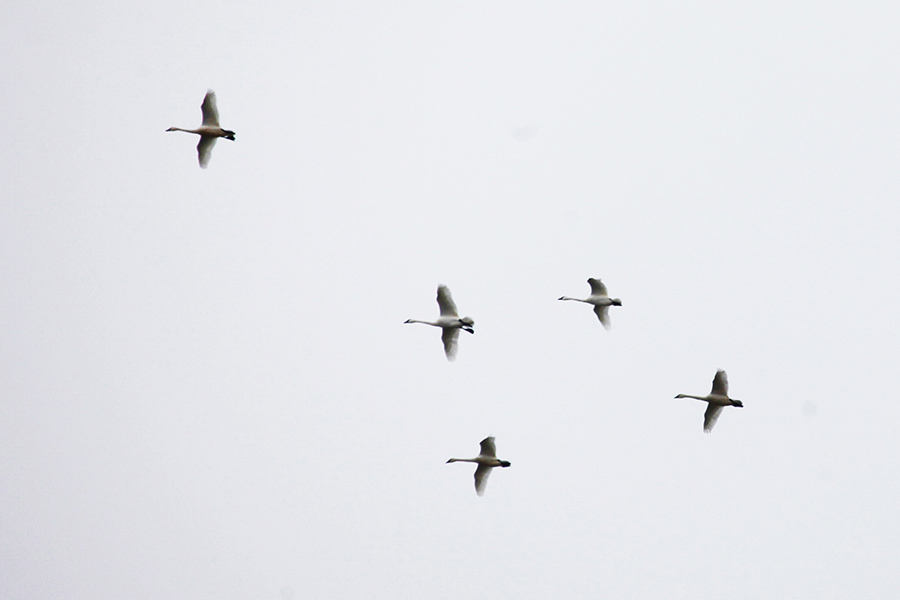
SALT LAKE CITY — The Utah Division of Wildlife Resources is recommending a few changes to upland game hunting and waterfowl hunting — including making it illegal to harvest trumpeter swans — as well as changes to a few other items. The DWR is seeking the public’s feedback on the proposals online and at the upcoming public meetings.
In 2019, swan regulations changed to expand the hunting boundaries in Box Elder County and to increase the total number of swan permits offered in Utah. Since that change, the DWR has hadto close the swan hunting season early for the last four years, due to the federal quota of trumpeter swans being met.
Utah is one of only nine states in the U.S. that allows hunting for swans. Due to the low population size of trumpeter swans in the Greater Yellowstone area, the U.S…


 WION