A northeast Missouri turkey hunter suffered burns on his arm Thursday while trying to retrieve a gun from a burning house he was using as a hunting cabin. (Echo Menges/Edina Sentinel)
KNOX COUNTY, Mo. —A turkey hunter in northeast Missouri was burned during a Thursday afternoon fire at a small old house he was using as a hunting cabin.
The blaze on Stonewall Avenue between Edina and Knox City was reported at 12:53 p.m.
Knox City Firefighter Andrew Weiler told KTVO that the flames were through the roof when crews arrived on the scene. The structure is a total loss.
Knox City Fire Chief Todd Goodwin said the cause could possibly be electrical, but they aren’t sure because the damage is too extensive.
A BRADFORD district woman left her neighbour’s dead cat dangling from a tree after it was caught in a snare on her land.
June Kershaw, 77, of Harbour Lodge Farm, Haworth, was convicted at court of causing unnecessary suffering to two cats who died in snares on her land.
The cats, Marley and Frankie, belonged to her neighbour.
At Bradford and Keighley Magistrates’ Court, Mrs Kershaw admitted she did not like her neighbour who had an injunction against her in 2017.
Mrs Kershaw told the court the three snares, which she checked every day, had been in the same positions every spring for the last 14/15 years and had only ever caught rabbits attempting to steal growing vegetables from her garden.
The first cat, Marley, a tabby and white Bengal/Savannah type, was found by Mrs Kershaw on April 26.
Cruelty is alive and well in Stafford Township’s Mill Creek Park. Squirrels are being trapped and relocated, which according to studies, is a death sentence.
Relocated squirrels do not know their source of food, water and shelter. Also, resident squirrels are territorial. Mother squirrels are being forced to leave behind babies. Trapping is even permitted when squirrels must endure torrential downpours and hail, like we experienced the other night, while trapped.
If squirrels can not live in the park this truly has become a sad world.
JELEBU: A hunting trip for two friends here turned tragic when one was killed in a shooting incident.
Jelebu police chief Deputy Supt Mazlan Udin said police have remanded a 52-year-old man after he claimed to have accidentally shot his 61-year-old friend in the incident on April 24.
“The suspect claimed they went hunting at Muka Sauk in Kuala Klawang and were armed with home-made weapons.
“The suspect, thinking that he saw a deer, fired a shot which then hit the victim in the head,” he said, adding that the victim was killed on the spot.
DSP Mazlan said the man turned himself in at the Titi station around 8.30pm the same day.
Police also seized the weapon, some live ammunition and empty shells from the suspect.
The case is being investigated under Section 302 of the Penal Code…
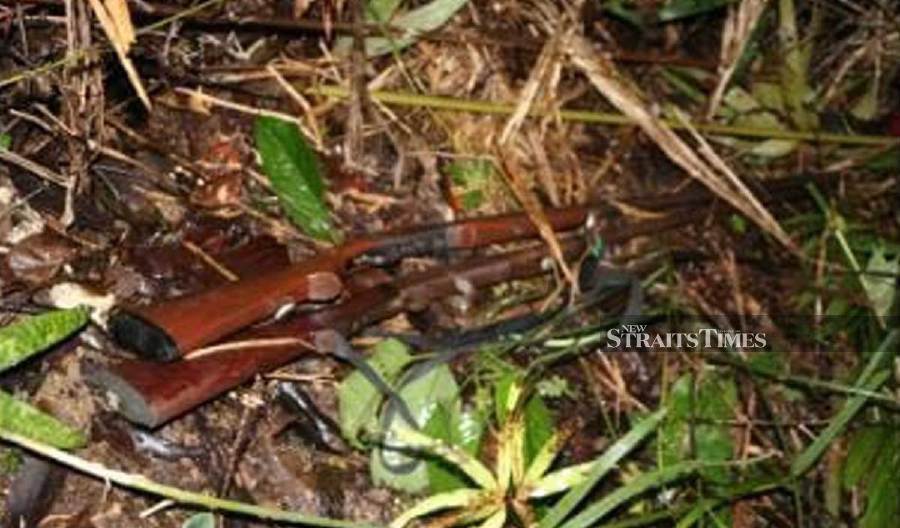
The two homemade shotguns seized by police. -Pic courtesy of police.
BAU: A man died from 43 shotgun pellet wounds in an accidental shooting by his brothers while they were hunting in the forest near Sungai Boyuh, Jugan village here, last night.
Bau District Police Chief, Deputy Superintendent Poge Nyaon said the police received a phone call from the Bau hospital informing them that a 49-year-old man had died after being shot while out hunting at 11.45pm.
“A total of 43 pellet wounds were found with most hitting the front of the victim’s body and a few on the victim’s hands and thighs.
“A police team from the Criminal Investigation Division, Bau District Police Headquarters, arrested two individuals aged 40 and 50, who are the victim’s brothers at 5pm yesterday,” he said today.
The eruption of the underwater Tonga volcano produced a mega-tsunami, scientists have found(Image credit: NASA)
The Tonga underwater volcanic eruption rivaled the strength of the largest U.S. nuclear bomb and produced a “mega-tsunami” nearly the height of a 30-story skyscraper,a recent study finds(opens in new tab).
On Jan. 15, 2022, the Hunga Tonga-Hunga Ha’apai submarine volcano — a large, cone-shaped mountain located near the islands of the Kingdom of Tonga in the South Pacific — erupted with a violent explosion. The eruption generated thehighest-ever recorded volcanic plume, which reached 35 miles (57 kilometers) tall. The…
SPOKANE, Wash. — A Spokane gun range and Olympic athlete filed a lawsuit against Washington Attorney General Bob Ferguson and State Patrol Chief John Batiste on Tuesday over a recently passed law to ban the sale and import of “assault weapons.”
Sharp Shooting Indoor Range & Gun Shop and Amanda Banta, a former member of the USA Shooting Team who competed in the 2012 Olympic Games, among others, are suing Washington Attorney General Bob Ferguson and Washington State Patrol Chief John Batiste over a newly passed law to ban the sale and import of assault weapons.
Sharp Shooting Indoor Range & Gun Shop, Olympian Amanda Banta and others argued in the lawsuit that the weapons included in the ban are “in common use,” and based on current case law cannot be banned.
According to the plaintiffs, the law “takes the radical step of banning nearly every modern semiautomatic rifle—the single most popular type of rifle in the country, possessed by Americans in the tens of millions.”
The plaintiffs sued Ferguson and Batiste to prevent their respective agencies from enforcing the law.
Proponents of the legislation, including First Spouse Trudi Inslee, argued throughout the session that it will help keep children safe by making it harder for would-be school shooters from obtaining their weapons of choice.
A RAND Corporation review of research found such a ban may decrease mass shooting deaths, but more research is needed.
The lawsuit filed Tuesday draws distinctions between fully-automatic weapons and semi-automatics, arguing bans against the former are reasonable, while the latter “have been in safe and effective use by civilians in this country—including in Washington—for more than a century.”
Only about 135 grizzly bears remained when the species was granted Endangered Species Act protections in 1975. iStock.com
174SHARES
Today, the U.S. House of Representatives’ Committee on Natural Resources voted in favor of six bills and resolutions that threaten to remove protections from grizzly bears and gray wolves and weaken the Endangered Species Act. This “grab bag” of danger includes:
The Trust the Science Act, H.R. 764, would remove Endangered Species Act protection for gray wolves in the lower 48 states.
The Grizzly Bear State Management Act, H.R. 1245, would remove Endangered Species Act protection for grizzly bears in the Greater Yellowstone Ecosystem population.
The Comprehensive Grizzly Bear Management Act, H.R. 1419, would remove Endangered Species Act protection for grizzly bears in the Northern Continental Divide Ecosystem population.
House Joint Resolution 29 would nullify a U.S. Fish and Wildlife Service decision last year to protect the lesser prairie-chicken under the Endangered Species Act.
House Joint Resolution 46 would nullify last year’s joint decision by the U.S. Fish and Wildlife Service and the U.S. National Marine Fisheries Service to expand the habitat that the Endangered Species Act can protect for the benefit of species facing extinction.
House Joint Resolution 49 would nullify last year’s tentative decision by U.S. Fish and Wildlife Service to protect the northern long-eared bat under the Endangered Species Act.
House Joint Resolutions 29, 46, and 49 would significantly harm the Endangered Species Act by using the Congressional Review Act to overturn recent protections for imperiled animals. Using the Congressional Review Act in this way sets a dangerous precedent by essentially voiding previous rules issued by the U.S. Fish and Wildlife Service and U.S. National Marine Fisheries Service and by prohibiting the agencies from issuing any similar rule without a future act from Congress.
This kind of public policy doesn’t simply weaken our democratic processes; it puts these vulnerable species under terrible pressure. We’ve already seen the harm that comes when Congress removes a population from the Endangered Species Act’s list of threatened and endangered species: Since Congress directed the U.S. Fish and Wildlife Service to delist wolves in Montana and Idaho in 2011, thousands of wolves—including pups—have been slaughtered, and those states continue to pursue new and crueler ways to kill wolves. If H.R. 764 is passed, other states may move to adopt the same trophy hunting, trapping and population reduction schemes plaguing the wolves of the Northern Rockies.
Gray wolves face a new threat from the Trust the Science Act, which would remove Endangered Species Act protection for wolves in the lower 48 states. Alamy Stock Photo
Grizzly bears face peril once again if H.R. 1245 and H.R. 1419 go through. In the early 1800s this iconic species ranged from northern Mexico to Alaska and in the lower 48 states numbered as many as 50,000 individuals. But by the 1930s, grizzly bears had been nearly wiped out. Only about 135 bears remained when the species was granted Endangered Species Act protections in 1975. With these protections, grizzly bear numbers have slowly begun to recover, and they now live in small, isolated subpopulations. However, there are still fewer than 2,000 individuals in the lower 48 states, so it’s critical that grizzly bears retain their protections if they are to survive. Should those protections disappear, it’s likely that some states will rush to allow trophy hunting that targets them.
Not only would House Resolutions 764, 1245 and 1419 open the door to trophy hunting of imperiled species, but they would also bar these measures from judicial review, effectively removing the rights of citizens to challenge them in court, an essential feature of the checks-and-balances structure of our system of government.
We expect the House of Representatives to vote on these measures in the coming months, so there’s time to take action to protect wolves, grizzlies and the Endangered Species Act, one of the few laws that remains immensely popular with the American public. The Endangered Species Act has saved approximately 99% of its listed species from extinction, and it is thanks to this landmark law that iconic species such as the bald eagle, whose numbers had plummeted by the 1970s, still grace our national landscape.
ORLANDO, Fla. – A young black bear recently spotted in College Park was struck and killed by a car Thursday morning on Fairbanks Avenue, according to the Florida Fish and Wildlife Conservation Commission.
FWC bear biologists had been following the juvenile bear since Monday, the agency said in a statement. Orlando police warned at the time that “although the bear is cute, please do not approach,” with pictures of the bear emerging on social media showing it residing in a tree near Yale Street and Formosa Avenue.
Trending VideosUnmute
Duration 0:32
/
Current Time 0:04Advanced SettingsFullscreenPauseUp Next
College Park bear struck, killed by car, Florida wildlife officials say
NOW PLAYING
1 dead, 6 hurt in crash after Orlando teen runs red light in stolen car
Brightline unveils new train station at Orlando International Airport
Brightline unveils new train station at Orlando International Airport
Brightline reveals new train station at Orlando airport
Orlando’s jobless rate holds at 2.6% amid statewide growth
The bear was still in College Park the next day, police said, as the FWC advised all non-residents of the area to stay away while it worked to retrieve the animal.
College Park bear struck, killed by car, Florida wildlife officials say (Copyright 2023 by WKMG ClickOrlando – All rights reserved.)
According to FWC, what happened Thursday marks the first time that a “dispersing” bear has been run over by a car in Orlando. The term “dispersing” references when juvenile bears begin to leave their mother’s home range, the statement reads.
In this situation, attempts were made to try and trap the bear for relocation but the bear continued to be on the move. Each situation may be different, but generally it is best practice for bears to be given plenty of space so that they will move away on their own.Communications, Division of Habitat and Species Conservation | Florida Fish and Wildlife Conservation Commission
More and more black bear sightings are reported in the Orlando area each year, FWC said.
People who feel threatened by a bear, observe a sick, injured, dead or orphaned bear or observe someone intentionally feeding bears or harming them are directed to contact FWC’s Wildlife Alert Hotline at 888-404-FWCC (3922).
NORFOLK, VA (AP) – The U.S. government is launching a new program to combat the scourge of abandoned crab and lobster traps, which can dilute harvests and kill other fish in coastal waters from Maine to Alaska.
The National Oceanic and Atmospheric Administration has chosen William & Mary’s Virginia Institute of Marine Science to anchor the program.
The university announced Friday that NOAA is providing an $8 million grant to the institute to implement the project.
Abandoned fishing gear is a worldwide problem that’s been referred to as anything from “ ghost nets ” to the “land mines of the sea.” The lost equipment is often dislodged by storms or passing boats, but it still will attract and kill marine life.
Industry experts and scientists estimate commercial fishermen lose about 10% of their traps per year to bad weather, strong currents and vessels that sever tie lines.
A 2001 study suggested that ghost fishing kills 4 million to 10 million blue crabs each year in Louisiana alone.
The NOAA’s new program will fund efforts to remove derelict traps used to harvest blue, Dungeness and stone crabs as well as the American and spiny species of lobsters.
The program will collect nationwide data on where the lost traps are found and the types of marine life that is impacted.
The information will be used to help inform efforts throughout U.S. coastal waters, said Kirk Havens, who directs the Center for Coastal Resources Management at the Virginia Institute of Marine Science.
“Just removing 10% of the traps from a hotspot area, you can increase a harvest significantly,” he said.
Removal also helps preserve marine life. In the Chesapeake Bay alone, some 40 species have been caught in derelict blue crab traps, from rock fish and flounder to diving ducks, Havens said.
NOAA’s new effort is the Nationwide Fishing TRAP Program, with TRAP standing for Trap Removal, Assessment & Prevention. Havens said the institute will launch a national competition to fund removal endeavors across the U.S.
Coastal states have been battling the problem for decades.
For example, experts estimated in 2014 that more than 12,000 crab pots were being lost in Washington state’s Puget Sound every year, costing an estimated $700,000 in lost harvest revenue — as well as damaging the sea floor environment.
The Virginia Institute of Marine Science has worked with the state of Virginia and local watermen to remove tens of thousands of derelict crab pots. A 2016 study by the institute found that a 6-year removal program generated more than $20 million in harvest value.
Derelict equipment is also a concern in Texas, where volunteers have removed more than 40,000 abandoned traps in the last 20 years.
Last year, federal funding was approved in Connecticut to begin removing some of the hundreds of thousands of derelict lobster traps left on the floor of the Long Island Sound.
“The problem with lost gear is enormous,” Pascal van Erp, a Dutch diver who founded the charity Ghost Diving, told The Associated Press in 2016.
“It is found in all seas, oceans and inland waters at all depths, along the beach and under the sand,” he said.