When most people hear the word “tsunami,” they may imagine a massive wave, but that’s actually a misconception that researchers in Washington state are trying to correct. Since the state’s coastline is at risk of being hit with a devastating tsunami following an earthquake of magnitude 7.5, the state is trying to educate the public about what it actually would be like.
The Washington State Department of Natural Resources released awave simulation studyin July and shared a bit of startling news: a tsunami in Puget Sound could engulf Seattle’s shoreline, leaving it under more than 20 feet of water within minutes.
Several videos released along with the study illustrate how an earthquake-triggered tsunami would most likely cause water to inundate the coastal areas around Seattle. From land, a tsunami functions and looks…
People cross the Diyala River, a tributary of the Tigris, where decreasing water levels this year have raised alarm among residents near Baghdad, Iraq, on June 29.Hadi Mizban/AP
Editor’s Note:A version of this story first appeared in CNN’s Meanwhile in the Middle East newsletter, a three-times-a-week look inside the region’s biggest stories.Sign up here.Abu Dhabi, UAECNN—
London got so warm this summer that newspapers splashed with headlines saying temperatures in the city had exceeded those of scorching hot Dubai.
One after another, European countries such as Spain and Portugal registered record highs this year.
The northern hemisphere did indeed witness record temperatures, with wildfires engulfing parts of Europe and drought threatening food supplies. And, often, European cities witnessed hotter conditions than those in the Persian Gulf.
In mid-July, a 600kg (94 stone) walrus, affectionately nicknamed Freya, appeared near Norway’s capital city in the Oslo Fjord.
Not one to remain low-key, she soon became a local celebrity, as videos of her awkwardly and slowly scrambling onto boats went viral.
However, less than a month after her first appearance, Freya was killed by government authorities, having been deemed a danger to the public.
This has not gone down well – some went as far as to accuse Norway of “murdering” the mammal, while an online fundraising campaign for a bronze statue has raised almost $24,000 (£20,000) in a matter of days.
Indeed, the outrage – which fanned out far beyond Norway’s borders – has been such that even the country’s prime minister has been forced to comment, saying putting Freya down was “the right decision”.
But still people are asking: could Freya have been saved?
Freya’s journey to Oslo most likely started in the Arctic, but over the last year she appeared to have undertaken a European tour, with sightings in UK, Dutch, Danish and Swedish waters.
Everywhere the walrus went she attracted attention – but in Norway this started to worry officials.
Photographs showed large crowds gathered on the edge of the water, standing within touching distance. Meanwhile, reports emerged in local media of Freya chasing a woman into the water, while one kayaker described a “scary encounter” with the animal when she came too close to his vessel.
Image caption,The fisheries ministry released a picture of people gathered very close to the walrus
“Walruses are unpredictable in their behaviour,” says Erik Born, a senior scientist at the Greenland Institute of Natural Resources, “and are perfectly well able to catch a seal between their front flippers and stab them to death.”
As the walrus got closer to people – or the people got closer to her – there was an obvious danger. “Having a half-tonne heavy walrus – with sharp tusks – swimming among people is pretty risky,” Dr Born says.
What’s more, walruses have been known to attack scuba divers and small boats – although these cases are few and far between.
But then, says Mads Frost Bertelsen, the Zoological Director at Copenhagen Zoo, that is not surprising. Walruses tend to live in remote areas, which means they don’t often come into contact with humans. This means statistics on incidents are low – but, he points out, they are capable of inflicting “serious damage”.
So would Prof Bertelsen have come to the same decision as the fisheries ministry? He says he would.
The blame, however, does not sit with Freya, according to Dr Jeff W Higdon, a consulting Arctic marine mammal biologist from Canada with experience of walruses.
“Human behaviour significantly increased risk in this case,” he says – questioning why common sense did not prevail among the sightseers.
“Everyone who crowded that animal put themselves and their children at risk and contributed to the unfortunate outcome.”
But not everyone agrees that the risk inevitably should have led to Freya’s death.
Image caption,Freya climbs on board a boat in July
“The risk was potential rather than demonstrated,” argues Fern Wickson, a professor at the Arctic University of Norway.
Indeed, she says the level of risk posed by Freya was no greater than those “we regularly tolerate in our society and daily lives”.
“That the government chose to take Freya’s life rather than try to manage this potential risk through implementing more effective measures to manage the behaviour of people was surprising and disappointing,” Prof Wickson says.
Alternative methods
Norway’s Fisheries Directorate did discuss a possible solution to the issue other than euthanasia with experts before acting, including members of the Institute of Marine Research (IMR).
Attempting to immobilise the animal with drugs so she couldn’t swim away and drown would have come with its own risk, warns biologist Dr Higdon.
“Immobilising, capturing and moving wild animals can lead to physiological stress – and in extreme cases cause death,” he says.
The directorate agreed and had further concerns – pointing to the walrus’s large size, limited access to blood vessels and “severe respiratory and circularity problems” when anaesthetised.
But that wasn’t the only option put on the table – the IMR also considered putting a net under a boat with the aim of catching Freya.
“This would also entail a relatively high risk, as the walrus could easily become entangled in the net and panic and drown,” the institute explained in a statement.
The “gentlest” decision would have involved building an open-top cage which would be placed in the water with the top slightly sticking out. Freya could then have possibly been placed inside, and taken somewhere safer.
“If it had been successful, there would be little chance of the animal getting stuck under water or damaging the device,” explained the IMR.
However, the IMR revealed that it did not recommend a solution, and the Directorate of Fisheries made the final decision on Freya’s fate.
Their conclusion was that due to the high risk of harming or killing her and the “significant use of resources” and costs required to move her, it was not feasible to relocate Freya. Their statement said that growing crowds and ignored warnings led to more situations where Freya or nearby people could be injured.
“Both the behaviour of the walrus and people have changed recently. We therefore decided that euthanasia was the right measure,” the directorate told the BBC.
As Rod Downie, chief adviser for the WWF on Polar Regions, put it: “Freya posed a danger to the public – and the public posed a danger to Freya.”
But Freya’s journey isn’t quite over.
The IMR has announced that the Norwegian Veterinary Institute will perform a post-mortem examination on her which they say could provide valuable information about the animal.
Walruses are listed as vulnerable by the International Union for Conservation of Nature Red List of Threatened Species. However, several experts pointed out that Freya’s death will have little impact on walrus numbers.
“The Atlantic walrus population is not at risk and the loss of this animal, while unfortunate, isn’t a conservation concern,” says Dr Higdon.
Meanwhile, Prof Bertelsen was keen to emphasise that there were more pressing issues. “The bigger picture,” he says, “is global warming and pollution of the sea.”
The Sun has been waiting to kill us for a long time. In our high-tech era, it has a whole new tool it can use to strike us.
When conditions are right, coronal mass ejections (CMEs),magnetic loops drenched in hot plasma, can be fired toward Earth. This has happened before, and we refer to them now as Carrington Events.
If a Carrington Event happened today, most experts agree it would fry our power, GPS, and communication systems, leaving us cold, in the dark, and alone.
Kyiv and Moscow continued to accuse each other on Friday of shellingEurope’s largest nuclear power plant, stoking international fears of a catastrophe on the continent as Russian President Vladimir Putin said independent inspectors should visit the Zaporizhzhia plant “as soon as possible.”
“The Russian side confirmed its readiness to provide the (International Atomic Energy) Agency inspectors with the necessary assistance,” the Kremlin said in a statement after a call between Putin and French President Emmanuel Macron – their first call in nearly three months, the AFP news agency reported.
“The two presidents will speak about this subject again in the next few days following discussions between the technical teams and before the deployment of the mission,” a French readout of the call said.
Earlier, Nikolai Patrushev, the secretary of Russia’s Security Council, accused the United States of encouragingUkrainianattacks on the Zaporizhzhia nuclear power plant…
Zion’s dwindling cougar population traces its roots to the late 1920s, when the park’s management made efforts to increase visitation. Photo by Washington Department of Fish and
Growing crowds at Utah’s Zion National Park have led to the displacement of cougars, the area’s top predator, resulting in a devastating series of changes to the region’s biodiversity, environmental scientists report.
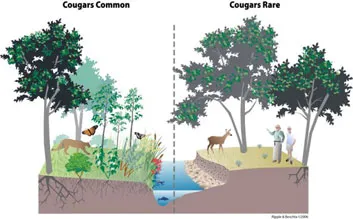
Compared with a nearby habitat in which cougars still thrive, Zion has fewer cottonwood trees, butterflies, amphibians and wetland plants, and much more deer, according to a paper that appears in the December Biological Conservation.
Report an ad
about:blank
“The effects have been quite strong and rippled through this ecosystem,” says Robert L. Beschta of Oregon State University, who coauthored the study.
Zion’s dwindling cougar population traces its roots to the late 1920s, when park management made efforts to increase visitation. By 1934, tourism had risen considerably, attracting some 70,000 visitors a year—about eight times what it had been only a decade earlier. Today the park receives about three million annual visitors.
To measure the impact of the shrinking cougar population, Beschta and William J. Ripple, also of Oregon State, collected census data on Zion’s deer populations dating back to the 1930s. They also studied tree rings to estimate the age and abundance of cottonwoods, a favorite food of young deer, and surveyed nearby river banks to gauge the number of butterflies, frogs, lizards and certain plants.
The researchers compared their figures with similar populations from an area next to Zion called North Creek, which has a stable cougar population. They found more deer, fewer young cottonwood trees and less riverbank life in Zion—a difference they attribute to the absence of cougars in the park.
An absence of cougars has had a major impact on Zion’s biodiversity. William J. Ripple
“These major predators are a key component of maintaining biodiversity,” Beschta says. “Most people look [around Zion] today and think it’s natural, but it’s not.”
The evidence from Zion suggests a system of trophic cascading, in which a reduced population of top predators has a trickle-down affect on the plants and animals below them in the food chain.
In Zion’s case, tourists caused the shy cougar, also called the mountain lion, to flee the area. Deer, which are the cougar’s main prey, increased in abundance, leading to a spike in the consumption of young cottonwood trees. These changes contributed to the erosion of riverbanks and a decline in wetland species.
Though trophic cascades have been well-documented in marine life, environmental scientists have debated their presence on land, says biologist Robert T. Paine of the University of Washington, who was not part of the study. Some cascade doubters believe that competition for food regulates deer populations in the absence of a top predator.
“This is a terrific contribution to a growing body of evidence that [cascades] occur in major terrestrial systems,” says Paine, who coined the term “trophic cascade” in 1980. Recent studies of shrinking numbers of wolves in Yellowstone National Park have shown similar effects on plant-life.
Restoring at least part of the cougar population could, over time, rebalance Zion’s ecosystem. One way to boost the number of predators might be to limit vehicle access to the park, speculates Ripple. When the park implemented a bus system that reduced car traffic in 2000, he says, cougar sightings increased.
NR Daily is delivered right to you every afternoon. No charge.SUBSCRIBE
Our climate Metternich does not seem to be proving as effective as he might have hoped. A couple of weeks ago, angered by Nancy Pelosi’s visit to Taiwan, the Chinese regime made it clear that it was not too interested in cooperating with the U.S. on climate issues. In reality, that won’t make much difference; Chinese energy policy has long been driven by other considerations (its investment in renewables owes more to Beijing’s pursuit of self-sufficiency — and export opportunities — than concerns about the climate), but it will make it even more difficult for Kerry to claim that the “world is with us” on our current climate-policy trajectory.
India’s government is studying a slower retirement of aging coal-fired power plants as it also adds newer sites, a move that would keep fossil fuel capacity higher for years and potentially stall efforts to hit climate goals.
Officials are considering a proposal to shutter less than 5 gigawatts of existing capacity by the end of the decade as the nation grapples with surging electricity demand and a global energy shortage, according to people familiar with the matter. That compares with plans drawn up in 2020 that proposed shuttering about 25 gigawatts by the same date…
The world’s third-largest emitter doesn’t envisage hitting net-zero until 2070, and is aiming only for half of its electricity generation capacity to use clean fuels by 2030, giving the nation scope to continue relying on coal for decades more. Together with China, India frustrated efforts to set a date to phase out the use of unabated coal power at last year’s Glasgow climate talks.
Never mind; there’s always the U.K., still wondering how to move forward with the war against meat.
The only way to have sustainable land use in [Britain], and avoid ecological breakdown, is to vastly reduce consumption of meat and dairy, according to the UK government’s food tsar.
Henry Dimbleby told the Guardian that although asking the public to eat less meat — supported by a mix of incentives and penalties — would be politically toxic, it was the only way to meet the country’s climate and biodiversity targets.
“It’s an incredibly inefficient use of land to grow crops, feed them to a ruminant or pig or chicken which then over its lifecycle converts them into a very small amount of protein for us to eat,” he said.
Currently, 85% of agricultural land in England is used for pasture for grazing animals such as cows or to grow food which is then fed to livestock. Dimbleby, the Leon restaurant chain co-founder and a respected voice in Conservative circles, believes a 30% meat reduction over 10 years is required for land to be used sustainably in England. Others go much further: Greenpeace, for example, say we must reduce our meat intake by 70%.
“If we fail on this,” Dimbleby said, “we will fail to meet our biodiversity or climate goals in this country. We also have a huge opportunity to show thought leadership worldwide, and show them that this can be done, that we can farm sustainably and still feed people.”
“Thought leadership worldwide”: Delusional, of course, but, as a phrase that combines both megalomania and McKinseyspeak, it’s not unimpressive.
TheWSDAreleased a newonline surveillance self-reporting tool that allows a veterinarian to make phone contact to discuss biosecurity, without having to make in-person contact.
A bird of prey found in Peel last week died from avian influenza, tests have confirmed.
The peregrine falcon is the seventh bird confirmed to have died from the highly contagious H5N1 strain on the Island since July.
In that time, nearly 200 dead seabirds have been collected by the Department of Environment, Food and Agriculture (DEFA) on Manx beaches.
It has not been possible to test all the birds, but it is strongly believed that the H5N1 strain confirmed in recent outbreaks in seabird colonies in Scotland, is to blame for the deaths.
As the virus is not affecting kept or farmed birds, no restriction zones or other measures have been introduced and the risk to people is considered very…
The use of all centerfire and rimfire rifles and handguns for the purposes of hunting is prohibited at Evansburg (Montgomery County), Marsh Creek (Chester County) and Nockamixon (Bucks County) state parks, as well as White Clay Creek Preserve in Chester County.
The DCNR reports hunters can still use shotguns, muzzleloaders and bows and arrows during established hunting seasons, except for the portion of White Clay Creek Preserve in London Britain Township where only the use of muzzleloaders and archery gear is permitted.