Exposing the Big Game

Forget Hunters' Feeble Rationalizations and Trust Your Gut Feelings: Making Sport of Killing Is Not Healthy Human Behavior

Exposing the Big Game

n Russia, a battle to free nearly 100 captured whales

I[AFP] Maria ANTONOVA ,AFP•February 22, 2019

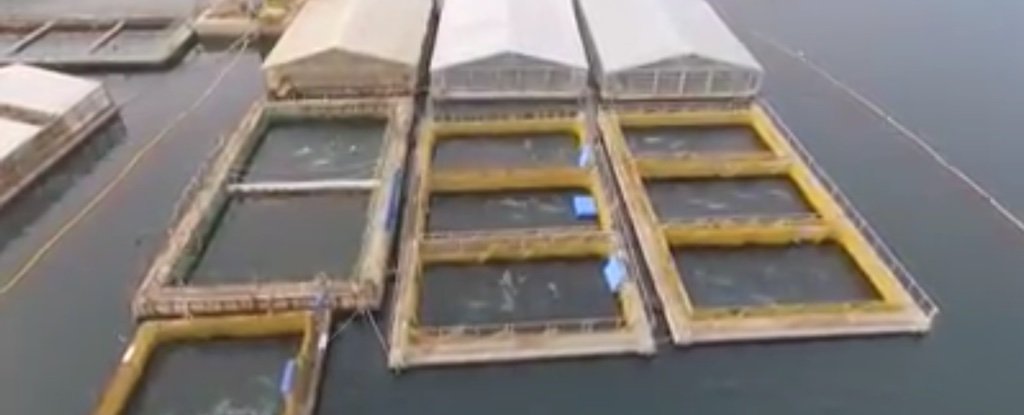
Captured marine mammals seen from above in enclosures at a holding facility in Srednyaya Bay in the Far Eastern town of Nakhodka (AFP Photo/Sergei PETROV)
Nearly 100 killer and beluga whales were captured last summer for sale to oceanariums, especially the Chinese market (AFP Photo/Sergei PETROV)
Greenpeace activists and supporters rally in Moscow, demanding the release of the orcas and beluga whales back into the wild (AFP Photo/Alexander NEMENOV)

1 / 4
Captured marine mammals seen from above in enclosures at a holding facility in Srednyaya Bay in the Far Eastern town of Nakhodka Captured marine mammals seen from above in enclosures at a holding facility in Srednyaya Bay in the Far Eastern town of Nakhodka (AFP Photo/Sergei PETROV)

Dozens of orcas and beluga whales captured for sale to oceanariums have brought Russia’s murky trade into the spotlight, but efforts to free them have been blocked by government infighting.

Russia is the only country where orcas, or killer whales, and belugas can be caught in the ocean for the purpose of “education”. The legal loophole has been used to export them to satisfy demand in China’s growing network of ocean theme parks.

Photos of a total of 11 orcas and 87 belugas crammed into small enclosures at a secure facility in the Far Eastern town of Nakhodka sparked a global outcry, and the Kremlin on Friday stepped in, saying the fate of “suffering” animals must be resolved.

“There have never been that many animals caught in one season and kept in one facility before anywhere in the world,” said Dmitry Lisitsyn, head of the Sakhalin Environmental Watch group, who has emerged as a point person in the campaign to release the whales captured last summer back into the wild.

Russian investigators launched two probes into poaching and animal cruelty, while Russia’s environmental watchdog said it has refused to issue permits to export the whales.

But the investigations and any potential court case could drag on for months.

The Russian government is split between the environment ministry that says the animals must be released, and the fisheries agency that defends their capture as part of a legitimate industry.

President Vladimir Putin has ordered his ministers to “decide on the fate of the whales” by March 1, a decree said Friday.

“The animals are suffering” and may die, said Kremlin spokesman Dmitry Peskov, adding that they “are being kept in conditions that are inadequate for such young animals of these species.”

– 200 orcas left –

The captured killer whales belong to the rarer seal-eating population of the species, which does not interbreed or interact with fish-eating orcas.

The environment ministry has tried to list the seal-eating type as endangered, ministry representative Olga Krever said.

“This population has only 200 adult animals” in Russian waters, she said.

But the agriculture ministry, which controls the fisheries agency and oversees non-protected sea species, views orcas as competitors for Russia’s fish stocks and doesn’t believe they are under threat, Krever said, calling the dispute a “big problem.”

Marine mammal researchers say there are good chances of a successful release, but the fisheries agency told AFP that it “carries high risks of their mass death”.

“Neither orcas nor belugas are endangered,” and are simply a resource that can be used according to existing legislation, agency representative Sergei Golovinov said.

– ‘Stars of the shows’ –

Both the United States and Canada stopped catching wild orcas in the 1970s due to negative publicity, so China relies on Russian exports.

There are 74 operational ocean theme parks in mainland China featuring whales and dolphins, according to the China Cetacean Alliance, which monitors the industry. More are under construction.

“Orcas are like the cherry on the cake” for new Chinese venues, said Greenpeace Russia campaigner Oganes Targulyan at a recent protest against whale capture.

“They are the stars of the shows.”

All 17 killer whales that Russia has exported since 2013 — which officials value at up to $6 million each — have gone to China, according to CITES wildlife trade figures.

Though the animals in Nakhodka are unlikely to get green-lighted for export, their fate is unclear.

The urgency of the situation is clear however: one killer whale went missing from the Nakhodka facility this week, Sakhalin Watch said Thursday, suspecting it may be dead.

In the West, there is widespread opposition to keeping the highly intelligent marine mammals in parks like the US chain Sea World, but in Russia public opinion is not so certain.

Companies that caught the animals are not giving up. At the weekend, they launched a new Instagram account, praising the Nakhodka facility and defending the oceanarium industry.

– ‘Lobbyist muscle’ –

On Saturday, dozens of pro-industry supporters disrupted a rally to free the whales. They showed up with signs reading “Each orca is 10 jobs” for the crews hired to catch them, and only left when police arrived on the scene.

“We see that the capturing companies are putting up a fight,” Lisitsyn said. “They are using their lobbyist muscle.”

Researchers meanwhile are already starting to organise to prepare for a potential release of the animals.

“There has never been so many animals released in the past,” said Dmitry Glazov, a beluga whale researcher at the Severtsov Institute of Ecology and Evolution in Moscow.

He said a project of that scale would certainly require international expertise and funding. The whales, which have been fed dead fish, would need to go through an adaptation period to make sure they can rely on their natural food sources.

“For science, releasing this many animals would be invaluable,” he said.
“But there needs to be a decision first.”

https://www.yahoo.com/news/russia-battle-free-nearly-100-captured-whales-033412177.html
Illegal ‘Whale Jail’ Has Been Spotted in Russia, Lifting The Lid on a Massive Animal Exploitation Industry

main article image

PETER DOCKRILL
13 NOV 2018

Over 100 captured whales are being held in small, crowded enclosures in a so-called ‘whale jail’ off the coast of Russia, where they await suspected sale to Chinese theme parks, according to local media reports.

The discovery of the marine containment facility near the city of Nakhodka in Russia’s south-east is being investigated by Russian prosecutors, who are examining whether the detainment is for illegal commercial purposes – in which case the captured animals would be worth a fortune on the black market.

According to Russian news site VL.ru – which obtained a number of photos of the holding pens in Srednyaya Bay – the whale jail is monitored by armed men who walk around the perimeters of the facility, while the animals are held in underwater cages formed by nets.

026 whale jail russia 1(Masha Netrebenko/Facebook)

Independent Russian newspaper Novaya Gazeta reports the giant haul of captured animals – said to be 11 orca whales and 90 beluga whales – represents a record catch for the four companies responsible: LLC Oceanarium DV, LLC Afalina, LLC Bely Kit and LLC Sochi Dolphinarium.

The report claims the virtually unregulated activity of these four companies controls the market for capturing and exporting marine animals, with some of the whales having been kept in crowded confinement since July.

Under international law, whales can be captured for certain scientific, educational, and cultural purposes, but commercial export – in this case, allegedly for sales to Chinese aquariums and entertainment parks – is strictly outlawed.

According to The Telegraph, an individual orca whale can fetch US$6 million on the Chinese black market, and there’s ample demand for the specimens. While China already has some 60 marine parks, a dozen more are reportedly under construction.

“Catching them at this tempo, we risk losing our entire orca population,” Greenpeace Russia research coordinator Oganes Targulyan told The Telegraph.

“The capture quota now is 13 animals a year, but no one is taking into account that at least one orca is killed for every one that is caught.”

While the current allegations remain an open investigation, the new details have emerged in the wake of a previous whale trafficking scandal reported to involve the illegal export of 15 orcas from Russia to China between 2013 and 2017.

While prosecutors investigate, there are also concerns for the way the animals are being kept and transported. Video on YouTube shows whales being moved between tanks, while drone footage shot from overhead just how cramped these poor whales’ captive conditions are.

“Under the guise of enlightenment and culture, dirty business is conducted on rare orcas,” a Greenpeace representative told RIA News (translated).

“They were caught in 2018, allegedly for educational and cultural purposes, but in fact it is about commerce with fabulous profits.”

https://www.sciencealert.com/whale-jail-spied-in-russia-lifts-lid-on-massive-animal-exploitation-industry?fbclid=IwAR0cxiQ5Wp7g4dbCTr_xxhJejZoTWfgkyZyNdHL68mTwwJ9dmOLo4WREo9E

An Unrelenting Hum Is Silencing Whales in Japan

main article image
(Velvetfish/iStock)

Humans have got a lot to answer for when it comes to interfering with nature. And we can add noisy cargo ships to the rather shameful list of ways we’re affecting the lives of the animals we share the planet with.

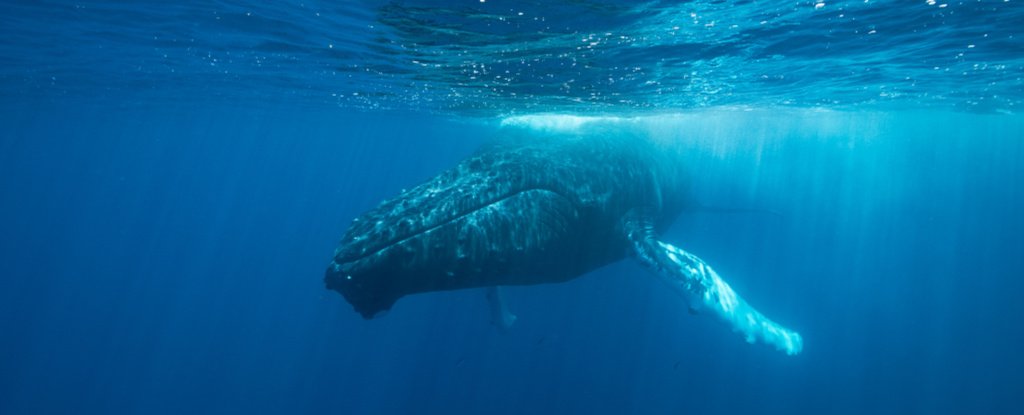
A new study reveals low-frequency hums from this maritime traffic are causing whales to stop their own singing calls, sometimes for up to 30 minutes after ships have passed by.

While the whales weren’t found to be adjusting their calls in any other way, that period of silence is troubling.

The researchers also noted that fewer male humpbacks were singing in the shipping lane areas compared with the surrounding parts of the ocean.

“Humpback whales seemed to stop singing temporarily rather than modifying sound characteristics of their song under the noise, generated by a passenger-cargo liner,” say the researchers.

“Ceasing vocalisation and moving away could be cost-effective adaptations to the fast-moving noise source.”

The research was carried out around the Ogasawara Islands in Japan, and involved 26 male singers in total (females and calves don’t sing) – between one and three calling whales a day.

One passenger-cargo ship passes through the region each day, and because the area is relatively free of traffic, it’s ideal for studying the impact this has in isolation.

Either the male whales reduce the number of singing calls they make, or they shut up completely while the ship goes past, according to the underwater acoustic measurements carried out by the researchers.

We’re still not sure whether or not long-term exposure to the sounds of ships has a negative impact on these whales, but this is a good starting point for future research, says the team.

There seems to be a 500 metre (1,640 feet) buffer around the shipping lane that whales are reluctant to make noise in, the researchers report, though the effects of the passing vessel were noted to have an impact on whales up to 1,200 metres (3,935 feet) away.

The study was carried out across the traditional mating season during 2017, February to July – the calls are used to attract mates, and as a result it’s possible that passing ships are interfering with the social structure of the humpbacks.

“It’s one more bit of evidence confirming that the noise humans make has a negative impact on all sorts of aspects of the life of marine mammals,” Spencer Fire from the Florida Institute of Technology, who wasn’t involved in the study, told CNN.

As the team notes, ambient underwater noise caused by humans continues to rise, with cargo and passenger traffic the main offenders.

Scientists are particularly concerned about how this affects cetaceans (whales, dolphins and porpoises) as they use sound to navigate, to communicate, and to find food.

Also this week, conservationists attending a conference held by the International Maritime Organisation in the UK have called for slower shipping routes to cut greenhouse gas emissions as well as underwater noise pollution.

While this study was carried out in a remote part of the ocean, the consequences on whale calling in a more crowded region could be more severe. Maybe it’s about time we started treading – or sailing – more lightly.

“Responses may differ where ship traffic is heavy, because avoiding an approaching ship may be difficult when many sound sources exist,” note the researchers.

The research has been published in PLOS One.

Beluga whales adopt lost narwhal in St. Lawrence River

The narwhal, a species which normally lives in the Arctic, has been spotted for 3 years in a row

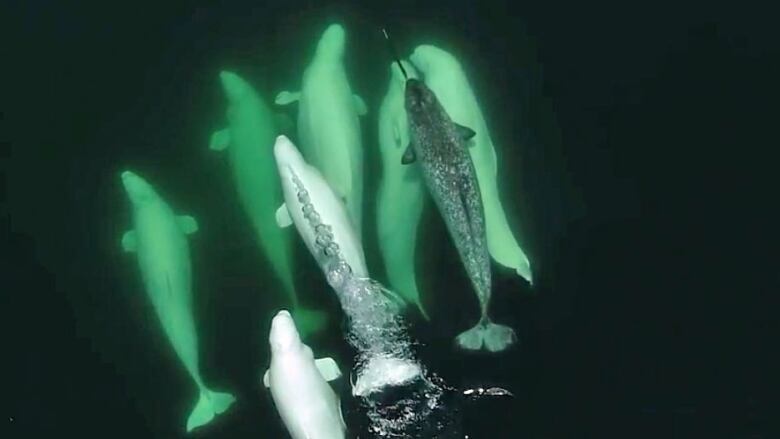
Drone footage captured by the Group for Education and Research on Marine Mammals (GREMM) shows a narwhal with a group of belugas in the St. Lawrence River in July 2018. (GREMM)

91 comments

An unusual visitor has been hanging out in the St. Lawrence River for the past three years: A narwhal, more than 1,000 kilometres south of its usual range.

But the lone narwhal is not alone — it appears he has been adopted by a band of belugas.

The narwhal — thought to be a juvenile male because of its half-metre-long tusk — was filmed in July playing among a pod of young belugas, thought to be mostly or all males.

The video was taken by the Group for Research and Education on Marine Mammals (GREMM), a non-profit group dedicated to whale research, conservation and education based in Tadoussac, Que.

“It behaves like it was one of the boys,” said Robert Michaud, the group’s president and scientific director.

In the drone footage captured by GREMM researchers and posted on their website Whales Online, a pod of nine or 10 belugas swim closely together near the surface, rolling and rubbing against each other.

“They are in constant contact with each other,” Michaud said. “It’s a like a big social ball of young juveniles that are playing some social, sexual games.”

The interactions between the narwhal and the belugas appear to be identical to those among just the belugas, suggesting the narwhal has been fully accepted as part of the group.

Narwhals live in the icy waters of the Arctic, including those surrounding parts of Canada, Norway, Greenland and Russia. They typically don’t range any farther south than northern Quebec’s Ungava Bay, located south of the southern tip of Baffin Island.

One was previously spotted in the St. Lawrence estuary by the Department of Fisheries and Oceans in 2003, according to GREMM.

But sightings are rare enough that there was a bit of a buzz when the researchers aboard GREMM’s boat, Le Bleuvet, spotted one on July 29, 2016, among a pod of 60 to 80 belugas.

Blowing bubbles with belugas

The researchers reported that it behaved like the belugas, even blowing bubbles from time to time, and drawing no special attention, except from one curious juvenile beluga.

The same narwhal — identified from photographs of its unique markings — was spotted again the following year, in 2017, and three times this year, likely with the same population of belugas, some of whom are identified and named by GREMM.

The group tracks and studies the whales from June to October, but loses track of them in the winter, when ice prevents GREMM from getting out in the research boat.

The narwhal itself hasn’t been named, Michaud said, as the group doesn’t tend to name “vagrants” — “because we don’t know when they will leave.”

So how did the narwhal end up in the St. Lawrence in the first place?

The narwhal was first spotted among the belugas of the St. Lawrence in 2016. (GREMM)

Michaud said it’s not unusual for young whales to wander into strange habitats. Young belugas, for example, have wandered as far as New Jersey and Nova Scotia.

Some, unable to find their own kind, end up trying to make friends with boats and humans, and get fatally injured by propellers.

“That little narwhal that made a similar trip was very lucky,” Michaud said. “Because he found almost normal buddies.”

Stick to their own kind

Kristin Laidre, a University of Washington researcher who has studied narwhals and other Arctic marine mammals for nearly two decades, said she’s surprised that a narwhal has been spotted so far south — and interacting so closely with belugas.

These beluga whales were spotted off Ingonish, N.S., earlier this year. Young whales are known to wander.(Submitted by Levon Drover)

While beluga and narwhal habitats overlap in many parts of the Arctic, they’re not observed interacting very often, and tend to be in different places at different times, especially in the summer.

“Narwhals and belugas, though closely related, are pretty different,” she said.

Narwhals are good divers that hunt deepwater fish and more comfortable in areas that are covered in dense ice in the winter. Belugas prefer coastal, shallower waters with less ice, and prefer fish like salmon and capelin that swim close to the surface.

But there are some similarities: they’re both very social species, although few details are known about their social structures. And little is known about how similar their communication may be; both make a variety of clicks and chirps.

There is some evidence that interaction takes place between belugas and narwhals from time to time.

A study published in 1993 described the skull of what was believed to be a narwhal-beluga hybrid, with teeth somewhat similar to both, although that was never confirmed with DNA testing.

The narwhal was spotted three times by GREMM researchers this year. (GREMM)

The study was co-authored by Randall Reeves, a Canadian scientist and consultant with Okapi Wildlife Associates in Hudson, Que., who has been studying whales for 40 years.

He, too, said belugas and narwhals tend to “stick to their own kind” when they encounter one another in the north.

But Martin Nweeia, a researcher at Harvard University who has been studying narwhals for nearly two decades, said given how social both species are, he thinks they’d be similarly capable of caring and compassion. (Although he agreed not much is known about their social structures.)

Nweeia, who has worked with Inuit in the Canadian Arctic and Greenland to gather traditional knowledge about narwhals and belugas, says there’s an Inuit legend that puts a narwhal among belugas. In it, a woman hunting belugas falls into the water and her hair twists into a narwhal horn.

Nweeia’s research team has also “observed the opposite,” he said, spotting belugas swimming among narwhals in Arctic Bay, Nunavut.

“I don’t think it should surprise people,” he said. “I think it shows … the compassion and the openness of other species to welcome another member that may not look or act the same. And maybe that’s a good lesson for everyone.”

JAPAN SLAUGHTERED OVER 120 PREGNANT WHALES IN ANNUAL ANTARCTICA SUMMER HUNT

http://www.newsweek.com/japan-kills-120-pregnant-whales-antarctica-946431

a prominent animal rights group has expressed outrage at Japan’s
controversial whaling program after it emerged that more than 120 pregnant
whales were slaughtered last year during the country’s annual hunt in the
Antarctic Ocean.

Latest figures show that 333 minke Antarctic whales were killed last
summer, 181 of which were females and 122 of which were pregnant.

The annual summer hunt, which lasted 143 days, killed 61 immature males and
53 immature females or 114 in total, according to meeting papers from the
International Whaling Commission’s scientific committee.

Humane Society International senior program manager Alexia Wellbelove
criticized the “cruelty of Japan’s whale hunt.”

A Minke whale is trussed to the side of the Japanese whale hunter Kyo Maru
in this image from 1995 as the boat heads for the factory ship Nisshin Maru
in the Antarctic whale sanctuary. Japan is under fire after it emerged that
it had killed over 120 pregnant whales in the summer of 2017.REUTERS

“It is further demonstration, if needed, of the truly gruesome and
unnecessary nature of whaling operations, especially when non-lethal
surveys have been shown to be sufficient for scientific needs,” she told the
*Sydney Morning Herald*
<https://www.smh.com.au/politics/federal/japan-slaughters-more-than-120-pregnant-whales-for-research-20180529-p4zi68.html>
.

Japan says the hunting is for scientific research which it describes as
“biological sampling” that allows examination of the Antarctic marine
ecosystem. Whale is allowed to be sold in Japanese food markets.

Keep Up With This Story And More By Subscribing Now
<https://subscription.newsweek.com/subscribe?utm_source=NWwebsite&utm_campaign=subscribe&utm_medium=in-article-daily#12months>

Harpoons loaded with a grenade are used to target one or two whales in a
school and the carcass is then taken to the Japanese research vessel
Nisshin Maru where the contents of the animal’s stomachs, body parts and
skull are examined.

In November, video showed the brutality of a Japanese whale hunt in an
Australian whale sanctuary, which was only released after five years, after
the Australian government feared that it would harm ties between Canberra
and Tokyo.

The Japanese Embassy has not yet commented and Tokyo insists its program is
carried out “in accordance with the International Convention for Regulation
of Whaling.”

Japan says it will hunt about 4000 whales over the next decade.

The International Court of Justice ruled in 2014 that Japan’s JARPA II
Antarctic whaling program was illegal but Japan no longer recognizes the
court as an arbiter of disputes over whales, the *Maritime Executive *
<https://www.maritime-executive.com/article/japan-killed-122-pregnant-whales#gs.9NymSMM>
reported.

Australia’s shadow minister for the environment Tony Burke called on his
country’s government to stop the annual hunt.

“There is nothing scientific about harpooning a pregnant whale, chopping it
up and putting it on a plate. Japan’s position on this is absurd and the
Australian government must not be silent,” he said.

Researchers work to free whale with jaw wrapped in fishing line for years

Researchers in Massachusetts are hopeful they’ll finally be able to free an endangered North Atlantic right whale who has had a fishing line wrapped around her jaw for several years.

The adult female named “Kleenex” was first spotted in the Cape Cod Bay in 1977, but has had a fishing lined wrapped around her jaw for at least three years, according to the Cape Cod Times.

Researchers and scientists attempted to remove some of the line on Thursday by using a method to weaken and deteriorate the rope, since there was no trailing line and the whale couldn’t be slowed to remove it.

Southern right whales, known in Spanish as ballena franca austral, swim in the waters of the Atlantic Sea, offshore Golfo Nuevo,  Argentina's Patagonian village of Puerto Piramides, September 19, 2014. The whales regularly come to breed and calve in this marine reserve from June to December.        REUTERS/Maxi Jonas (ARGENTINA  - Tags:  ANIMALS ENVIRONMENT) - GM1EA9K0GDZ01

Southern right whales, known in Spanish as ballena franca austral, swim in the waters of the Atlantic Sea, offshore Golfo Nuevo, Argentina’s Patagonian village of Puerto Piramides, September 19, 2014.  (REUTERS/Maxi Jonas)

“For more than a half century, Kleenex has defied the odds of survival and been a pillar of the right whale’s modest recovery,” New England Aquarium spokesman Tony LaCasse said in a statement. “Let’s hope that she sheds the entangling gear.”

‘BEGINNING OF THE END?’ NO NEW BABIES FOR ENDANGERED WHALES

The whale is a great-grandmother to six calves, which is 5 percent of the North Atlantic right whale population. Right whales recorded no new births in this year’s calving season, making preserving reproductive females extremely important to researchers.

As of now, the species has dwindled to no more than 450 animals, further strengthening conservation efforts. A total of 17 right whales washed up dead in the U.S. and Canada last year, far outpacing five births.

SPERM WHALE SWALLOWS 64 POUNDS OF TRASH, DIES OF ‘GASTRIC SHOCK’

With no rebound in births this past winter, the overall population could shrink further in 2018. One right whale was found dead off the coast of Virginia in January.

Kleenex hasn’t been seen since the disentanglement attempt, but that is typical of whale rescue efforts, Cathrine Macort, a spokeswoman for the Center for Coastal Studies in Provincetown, told the Associated Press. Macort said rescuers will keep looking for the whale so they can remove the gear.

The Associated Press contributed to this report.

A sperm whale that washed up on a beach in Spain had 64 pounds of plastic and waste in its stomach

How can I save the ocean from plastic? 01:36

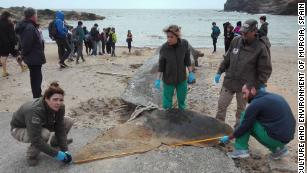
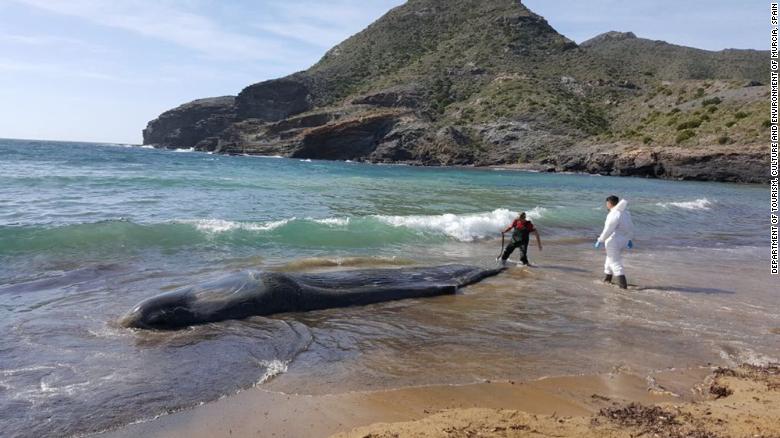
(CNN)When a young sperm whale washed up on a beach in southern Spain, scientists wanted to know what killed it. They now know: waste — 64 pounds of it. Most of it plastic, but also ropes, pieces of net and other debris lodged in its stomach.

The discovery has prompted authorities in Murcia, Spain, to launch a campaign to clean up its beaches.
“The presence of plastic in the ocean and oceans is one of the greatest threats to the conservation of wildlife throughout the world, as many animals are trapped in the trash or ingest large quantities of plastics that end up causing their death,” Murcia’s general director of environment, Consuelo Rosauro said in a statement.

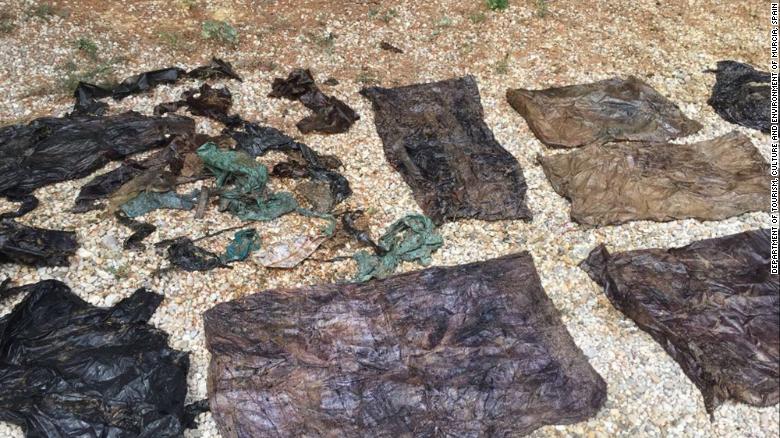
El Valle Wildlife Center found 64 lbs of plastic waste on a young sperm whale.

A sperm whale’s diet is usually comprised of giant squid. But the 33-foot long mammal that washed up on the beach of Cabo de Palos on February 27 was unusually thin.
The necropsy results, released last week, listed just some of the items scientists found stuck in its stomach and intestines: plastic bags, pieces of net, a plastic water container.
Officials said the whale died of an abdominal infection, called peritonitis: It just couldn’t digest the waste it had swallowed, causing its digestive system to rupture.

The six-ton mammal was found on February 27 on the beach of Cabo de Palos.

This, say officials, is a concern not only because sperm whales are endangered, but also because it’s another grim reminder of just how much plastic waste is being dumped into the ocean.
Around 150 million tons of plastic are already floating in our oceans — with an additional eight million tons entering the water each year, according to the World Economic Forum.
A report, released last month, found 70% of marine litter is non-degradable plastic. And that figure is expected to triple within a decade.
Plastic has been found to choke marine wildlife, and has also entered the ocean food chain — exposing marine life to toxic chemicals that can end up in the food on our plates.
Murcia’s new campaign will include 11 events to clean the beaches. Jaime Escribano, spokesman for Murcia’s environmental department, said the region will use both regional funds and assistance from the EU for the campaign.

Human disturbance hits narwhals where it hurts — the heart

 https://www.washingtonpost.com/news/speaking-of-science/wp/2017/12/07/human-disturbance-hits-narwhals-where-it-hurts-the-heart/?utm_term=.9650fdf68f38
 December 7 at 2:00 PM

Narwhals in Greenland. (Mads Peter Heide-Jørgensen)

Imagine you are a narwhal. You are cruising through chilly Arctic water when you sense a threat. Most animals, when alarmed, either lash out at their attacker or flee. You, narwhal — the unicorn of the sea — aren’t most animals.

You won’t fight. Yes, you have a long tusk growing out of your face. Your tusk, a canine tooth that stretches into a spiral five feet or longer, isn’t much of a weapon. Narwhal tusks are sensory organs filled with nerves, not dull spears for jabbing at predators or fending off rivals. If an orca swam nearby, you’d slink into deeper water or twist beneath ice floes where the larger whales cannot follow.

This threat is unusual. It’s noisy and unfamiliar. Instead of the usual flight response, your body reacts oddly.

You dive, flipping your flippers as fast as they can go. Meanwhile, your heart rate plummets. It’s as if your heart wants you to freeze in place, similar to the way young rabbits and deer play possum. (Biologists, borrowing from Greek, call this acting-dead defense “thanatosis.”) Yet the rest of you wants to escape. This conflict cannot be good for your cardiovascular health.

The researcher who discovered this reaction almost ignored it. Biologist Terrie Williams of the University of California at Santa Cruz, who studies the physiology of large mammals, spent two summers collecting heart-rate and flipper-activity data from wild narwhals in Greenland.

Researchers are studying narwhals to understand how the whales react to human disturbance.

The whales were stranded or caught in nets. Before cutting the whales loose, scientists outfitted the animals with a monitoring device. Immediately the narwhal bodies showed this conflicting response.

“My first inclination was to throw out the first couple of hours,” Williams said. “The animals were doing something weird. It was clear it wasn’t a normal dive response.” Only later did she realize the weirdness was in the whales’ reaction to humans.

Williams had developed the device, a combination EKG monitor, accelerometer and depth meter, to study marine mammals; she first tested it on retired dolphins that had been trained to work with the Navy. The machine was adapted for narwhals, made more rugged for colder and deeper water. Collaborating with Greenland’s Institute for Natural Resources, Williams and her colleagues stuck the monitor to wild whales with suction cups.

A few days later, the monitor fell off and floated to the surface, where Williams and her teammates located it via VHF and satellite signals. They repeated the process for a total of nine whales.

This was the first time anyone had measured heartbeats in narwhals, Williams said. As the scientists report in a paper published Thursday in Science, the whales’ heart rates plummeted from a resting rate of 60 to about three or four beats per minute.

Meanwhile, despite their sluggish hearts, the narwhals moved their flippers as fast as they could go. Williams likened the conflicting signals to narwhal hearts to the taxing experience of human triathletes: “Stress plus cold water in the face plus exercise.” (Triathletes are twice as likely to die during a race as marathoners, at a rate of about 1.5 deaths per 100,000 triathlon participants.)

Williams said it was unclear, at this stage, whether this depressed blood flow plus increased exercise was dangerous to narwhals. She hypothesized that the response probably restricts oxygen to the whales’ brains; this might, for instance, explain the disorientation rescuers observe when they try to return beached whales to the sea. The animals are also in danger of overheating, Williams said, if the slow circulatory systems fail to redistribute heat equally around their bodies.

The paper “provides a new angle on the vulnerability of narwhals to anthropogenic disturbance, which is linked to the sweeping environmental changes we are observing across the Arctic,” said Kristin Laidre, an ecologist at University of Washington who studies whales and bears in Greenland.

Earth is home to about 123,000 adult narwhals, according to the International Union for Conservation of Nature. Historical threats include killer whales and subsistence hunting by Arctic communities.

Human intrusion and depleted sea ice are looming. “With climate change, we are on a trajectory for a very different Arctic in the coming decades,” said Laidre, who was not involved with the Science paper. “This will mean a new reality for narwhals. A better understanding of human impacts is essential for conservation of this species given what the future looks like.”

Until recently, sea ice blocked the Arctic from heavy boat traffic and offshore oil and gas development. That’s changing.

Narwhals do not move quickly, but they evolved to escape dangers that came from a single source. In a more crowded ocean, polluted by ship noise, “you have novel kinds of threats out there that may not be a point source,” Williams said. “Maybe in time evolution will catch up, but it’s not there now.”

Read more:

Long-forgotten secrets of whale sex revealed

Endangered whales are dying off in Alaska, and scientists are racing to discover why

Oh Despicable Me!


Commentary by Captain Paul Watson

For all of the people who hate me, criticize me, loathe me, troll me, threaten me and generally carry on like I really give a damn, all I can say is thanks for taking your time to say so. It is much appreciated.

Sometimes you’re amusing, but most of the time you’re simply boring. But it’s no bother, because I have this simple delete button and a cyber dungeon to conveniently drop your ass into the internet version of the phantom zone, where for all intents and purposes you simply no longer exist on my particular plane of existence.

However I must confess that I do love the fact that so many people get all hot and bothered and spend time talking, complaining, ranting, sharing and even going to the trouble of setting up websites and Facebook pages simply to attack me. How awesome and flattering is that!

People I don’t know and have never met, hate me and I think that’s pretty damn impressive.

I considerate it a disappointing day when I don’t receive at least one hate message. It’s good to know that they know that I’m still here, pissing them off.

A person without enemies is a person who does not do much. Give me a person without enemies and I can guarantee few people really know or care who they are.

All great people have enemies. Mahatma Gandhi, Nelson Mandela, Martin Luther King Jr., Dianne Fossey, John Kennedy, Malala Yousafzai, Russell Means, and so many others including even Jesus Christ. I can only aspire to have the number of enemies they have had. In fact the more enemies one has, the more one achieves. Everyone needs a legion of enemies to inspire them to greater and better deeds and to validate their achievements.

I am not in the business of pleasing everyone. In fact I’m not in the business of pleasing anyone. I’m in the business of defending biodiversity from the irresponsible actions of my own species and that guarantees me volumes of enemies.
I pick up enemies like a dog picks up fleas except that I can shake them off easier than the dog.

If I can please my wife, my daughter, my son, my family, supporters, and my friends, I’m happy. Everyone else is irrelevant.

Even allies become enemies at the slightest disagreement. The infighting within movements is hilarious, like when the People’s Front for the Liberation of Judea attacked the Judaean People’s Liberation Front in Life of Brian.

We really can be a silly assortment species of primates.

I often wonder if a person who sends me a vile or threatening message imagines the said message as being hurtful or damaging to me. Do they really think that I shed a tear with each word? Do they really think I care what they think? I suppose it’s a good thing if they feel a sense of satisfaction with the illusionary belief that they are threatening me. If they deprive some sort of pleasure from it, all I can say, is go for it and enjoy yourself.

Now although I don’t care what people say about me or to me, I am posting this really to help people who are sensitive to attacks from perfect strangers in the internet. It is easy for me to ignore bullying because I simply don’t give a damn but there are people, especially younger people who are indeed hurt by comments from strangers and sometimes such bullying has disturbing and sometimes tragic consequences.

So I would like to advise such people to treat offensive and threatening comments as nothing more than a momentary fart in a windstorm. You may get a whiff but the stench is gone in seconds. People only have power over other people when people allow other people to have power over them.

So my advice to anyone plagued by trolls, haters and critics is simple. Ignore them, block them and delete them. They and their opinions simply do not matter.

Words are not bullets. Words are harmless.

Hell even being called names can be flattering. Years ago I was at the home of a famous Hollywood personality when the phone rang. I picked it up and a familiar voice said “is Maurice there?”

I said no but would you like to leave a message. The voice answered, “yes tell him Orson called.”

“Orson who”” I replied.

“Orson Welles, you idiot.”

Was I offended? Hell no. Orson Welles called me an idiot because I did not recognize his voice. How awesome was that?

No automatic alt text available.

What I learned the day a dying whale spared my life

It was 1975, Greenpeace’s first campaign, and the bodies of six Soviet-slaughtered whales were lying lifeless in the swell. I thought to myself, is humanity really this insane?
Greenpeace first anti whaling campaign : Phyllis Cormack ship and Paul Watson on Killed Whale
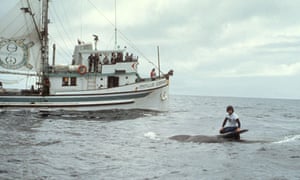
 Paul Watson on top of a slaughtered whale calf in the foreground, with the Greenpeace ship Phyllis Cormack behind, on 26 June 1975. Photograph: Rex Weyler/Greenpeace

The greatest gift that I have ever received is also my great and enduring curse.

It was June 1975 and I was a crew member on the first Greenpeace campaign to protect the whales. It was off the coast of northern California, 60 miles offshore. Before us, spread across the waters like some invading foreign armada, was the Soviet whaling fleet.

The ships were grey, black, and freckled with rust. From out of the side of the largest vessel, the huge factory ship Dalni Vostok, a steady stream of thick steaming blood poured into the sea.

We felt pretty small on board the 85ft Phyllis Cormack, the halibut seiner we had chartered out of British Columbia, skippered by big no-nonsense Captain John C Cormack.

We were a crew of 13 and I was the first officer.

This was before the 200 territorial limit had been imposed and when the Russians freely fished and whaled up to 13 miles off the shore. The Americans did not like it, but legally there was nothing they could do. Thus it fell to a small band of idealistic young Canadians to challenge the whale killers off the Californian coast.

We had been searching for them since April starting in the north off the Queen Charlotte Islands. It was like trying to find a needle in a haystack and we had no idea of where to even begin looking.

However in early June we received a tip-off from a source I can never reveal in Washington DC that if we wanted to find the Russian whalers, we needed to go south. As we proceeded south, the source supplied us with the movements of the Soviet fleet.

And there we were, 60 miles off the town of Eureka, approaching a massive factory ship and three fast, killer boats, each mounted with harpoons painted the colour of robin’s eggs.

We caught them hunting, arriving on the scene just as a harpoon tore into the backside of a young sperm whale. The whalers left it there floating with a radio buoy attached as they took off in pursuit of another victim.

We launched a Zodiac inflatable and I stood in the bow, the bowline wrapped tightly around my wrist for support as we approached the body bobbing up and down in the swells.

I stepped off the Zodiac and on to the carcass of the whale. It was still very warm and blood oozed and bubbled from a gaping raw wound in its side. A long yellow polypropylene rope protruded from the ugly wound. It had been cut and the nylon strands danced about on the surface of the water, whipping rivulets of blood into a salmon pink tinted foam.

The Phyllis Cormack came alongside for our photographer Rex Weyler to take a picture of the whale, using my body as a gauge to measure the animal. It was small, around 22 feet. A young whale.

My bare hand on the whale felt the warmth of its body and the blood on my skin was hot. The whale was lying on its left side and the right eye was open, staring sightlessly skyward. The lower jaw opened and closed with each swell and I could see the lower two rows of pointed teeth.

Suddenly there was a shout from the Phyllis Cormack. The harpoon vessel was returning and they had a fire hose blasting a stream of high-pressure water from the bow.

I jumped into the Zodiac as the Soviets quickly lashed the dead whale to the side of their ship and made way back to the factory ship. We followed and filmed them as they transferred the whale over to the slipway, where it was hauled by cables and winches up on to the flensing deck, where men with long sharp knives waited to flay the body.

More blood gushed from the scuppers into the sea.

And we felt so helpless, so small, and so useless.

After the harpoon vessels transferred their whales, they spread out to resume the killing. We followed one of the harpooners in three Zodiacs as the Phyllis Cormack slowly followed.

It was not long before the Russians found another pod, and once again the chase was on. But this time we were chasing the whalers as they pursued the whales.

Our strategy was simple. We would place our bodies between the whales and the harpoon. We were Gandhi-influenced non-violent advocates, and this was the only tactic we could think of to protect the whales without injuring the whalers.

We had practiced what we would do for over a year and I turned to Bob Hunter, our expedition leader, who was in the boat with me, and said, “Well Bob, this is it. Let’s do it.”

I gunned the outboard motor, and our inflatable boat roared ahead of the harpoon vessel, with the other two inflatables on either side. Within minutes we were racing ahead of the whaler and behind a pod of eight magnificent sperm whales.

They were racing for their lives, unable to take in enough air for a deep dive. They were spouting rapidly and we could see rainbows sparkling from the mist they expelled into the air. We were so close we could smell their breath, and our objective was to block the path of the harpoon.

Would the Soviets risk killing a human being to slay a whale? The answer to that question was a mystery to us.

But we were tempting them to give us an answer one way or another. As our three inflatable boats raced before the bow, I looked back to see an ape of a man stooping behind the massive harpoon cannon, trying to get one of the whales in his sight. He was not succeeding, and was clearly frustrated.

Suddenly a larger man came storming forward along the catwalk and began yelling into the ear of the Soviet harpooner. The harpooner nodded and crouched down behind his gun as the man who we later identified as the captain stood up and looked down at us with a smile. He brought his finger slowly across his throat, and that was when we realised that Gandhi was not going to work for us that day.

I saw the pod of whales rise up on a swell in front of us just as the harpoon vessel rode up on a swell behind us. As our inflatables descended into the deep trough between the two large swells, a horrendous explosion boomed over the whales.

The explosive-tipped harpoon whizzed through the air above as the attached cable slashed down upon the water close by, cleaving the surface like a heavy sword.

In front of us a female sperm whale screamed in pain as she rolled on her side, with a fountain of hot steaming blood pouring from her. Beside her, the largest whale in the pod rose up from the surface of the sea and dove. As his mighty tail slapped the water with a bang, he disappeared. The other six whales carried on fleeing as the huge male turned to defend them.

For a moment we thought he would attack us. We had all seen the old prints and woodcuts of enraged sperm whales cutting Yankee whaling boats in half with their sabre-like teeth, spilling wounded whalers into the sea.

We had little time to think as the ocean exploded behind us, and this great whale hurled himself from the water trying to reach the man behind the harpoon.

They were ready for him and had quickly reloaded the harpoon gun with a unattached harpoon. As the whale rose up and out of the water, the harpooner lowered the gun, pulling the trigger at point black range. With a thundering explosion the harpoon tore into the whale’s head.

He screamed. It was an excruciating cry of pain, shock, and confusion. He fell back into the sea, rolling in agony on the surface in a sea stained scarlet with his blood.

The two dying whales struggled to hold on to life between the harpoon boat and the six of us in three boats, sitting motionless on the swells.

I could not take my eyes off the dying whale closest to us. His tail flayed the sea and pink foam frothed all around him.

Then suddenly the whale was looking directly at me. I saw his huge eye and I could see that he saw me. At that moment he dove once again and I saw pink bloody bubbles coming to the surface, moving closer to our boat. Within seconds the whale’s head shot above the surface of the sea and began to tower above, rising higher, but as if in slow motion, and angled so that we could see that his intent was to come crashing down upon us.

And as his head rose ever higher I saw that eye once again, so close that I could see my own reflection in that deep dark orb. Suddenly I was struck with the realisation that this whale understood what we were doing.

His lower jaw hung down almost touching the side of our inflatable boat, so close that I could have reached across and encircled one of the six-inch teeth with my fingers.

His muscles tensed and he stopped rising, and began to slowly slide at an angle back into the sea. I kept eye contact with him until his eye sank beneath the surface of the sea and disappeared.

And so he died.

He could have killed us, but he had not, and the look in that eye has haunted me ever since.

I felt understanding and I knew he knew that we were there to save him, not to kill him. I felt ashamed that we had failed. I felt powerless and angry, frustrated and awed all at once. I felt indebted to him for sparing my life.

But I also saw something else in that eye, and that was pity.

Not for himself nor for his kind, but for us.

An uncomfortable pallor of shame fell over me as I sensed what the whale perceived. It was indeed pity, but pity for us, that we could take life so ruthlessly, so thoughtlessly, and so mercilessly; and for what?

We sat there in our little inflatable boats in the midst of the Soviet whaling fleet with the bodies of a half dozen sperm whales lying lifeless in the swell. I watched the sun begin to set in the west and I remembered that the Russians were killing whales primarily for the valuable spermaceti oil.

Spermaceti oil is valued for its high resistance to heat, and thus it is used in machinery where there is excessive heat. One of the demands for this oil by the Soviets was for use in the production on intercontinental ballistic missiles.

Here they were slaughtering these magnificent, intelligent, socially complex, wondrous sentient beings for the purpose of making a weapon designed for the mass extermination of human beings.

And I thought to myself, are we really this insane?

It is that thought, that unanswered question, that has haunted me every day since.

It is from what I saw in the eye of that whale that has led me to devote my entire adult life to the defence of the whales and the other creatures of the sea, because I know that if we cannot save the whales, the turtles, the sharks, the tuna, and the complex marine biodiversity, that the oceans will not survive. If the life in our oceans is diminished, humanity is diminished and if the oceans die, humanity will die; for we cannot survive on this planet with a dead ocean.

 Captain Paul Watson is a co-founder of the Greenpeace Foundation and the founder in 1977 of the Sea Shepherd Conservation Society. He is currently on board the Sea Shepherd ship Steve Irwin intervening against the killing of whales in the Southern Ocean Whale Sanctuary by the Japanese whaling fleet