Exposing the Big Game

Forget Hunters' Feeble Rationalizations and Trust Your Gut Feelings: Making Sport of Killing Is Not Healthy Human Behavior

Exposing the Big Game

Iceland sets target of 191 kills as country resumes whaling

https://www.theguardian.com/environment/2018/apr/18/iceland-sets-target-of-191-kills-as-country-resumes-whaling

Authorities grant whalers a quota to hunt the endangered fin whale this summer after a two-year pause

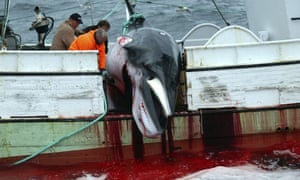
Whaling company Hvalur has a quota of 191 kills as Iceland announced it would resume hunting the endangered fin whale this summer.
 Whaling company Hvalur has a quota of 191 kills as Iceland announced it would resume hunting the endangered fin whale this summer. Photograph: Adam Butler/AP

Icelandic fishermen will resume their hunt for the endangered fin whale this year after a two-year pause and have set a target of 191 kills for the season.

An apparent loosening of Japanese regulations on Icelandic exports had made the resumption of the hunting commercially viable again, the country’s only fin whaling company, Hvalur, announced.

The firm also has plans to collaborate with researchers from the University of Iceland to develop medicinal products made of whale blubber and bones, aimed at combating iron deficiency.

Sigursteinn Masson, at the Icelandic branch of the International Fund for Animal Welfare (Ifaw), said: “I’m very disappointed. This decision is not based on real market needs and is not in line with public opinion polls on whaling, which doesn’t belong in modern times.”

Iceland and Norway are the only countries in the world to authorise whaling in defiance of the 1986 International Whaling Commission’s moratorium.

Iceland resumed whaling in 2006 on economic grounds and has defied threats of US sanctions to continue to do so. The US did not invite Iceland, one of the largest fishing nations in the north Atlantic, to the Our Ocean conference in 2014.

Japan hunts whales, but claims it does so for scientific research purposes, although a large share of the whale meat ends up being consumed.

Iceland’s whaling season opens on 10 June and the authorities have granted its whalers a quota of 161 fin whales in 2018, compared to 150 in 2017. In addition, Hvalur’s two ships are entitled to hunt 20% of its unused quota from last year, which means it will be allowed to hunt an 30 additional whales.

During its last hunt in 2015, Hvalur killed a record 155 fin whales, which are the planet’s second largest mammal after the blue whale.

The latest records from the Icelandic institute suggest there are about 40,000 in the north Atlantic ocean, up from 25,000 in 2006.

Iceland has only one other whaling company, IP-Utgerd Ltd, which specialises in hunting minke whales. The meat from the whales is served in Icelandic restaurants, but largely to cater to intrigued tourists.

A poll commissioned in October 2017 by the Ifaw suggested that 35.4% of Icelanders supported the fin whale hunt, compared to 42% in 2016.

The two-year suspension of hunting followed the claims from the Japanese authorities that the Icelandic company had not met Japanese health standards.

The company’s attempts to ship 1,700 tonnes of whale meat to Japan via Angola in 2015 had also been hampered by the reluctance of some foreign ports to allow transit of the meat.

Kristjàn Loftsson told the Associated Press that the company was working with Japanese officials on developing methods to fulfil Japanese standards for fresh meat imports.

THE POLITICALLY CORRECT MURDER OF WHALES


Commentary by Captain Paul Watson

One thousand whales will die because of a vote amongst a group of arrogant humans today in Florianopolis, Brazil

The vote was on so called indigenous whaling. In other words a slaughter quota for the Inuit, the Yupik, possibly the Makah, some Greenlanders and a few bogus aboriginal groups in the Caribbean.

Bogus?

Well the Aboriginal people of the Caribbean were the Caribs and they were wiped out by the Spanish colonizers. Thus, the people wanting to kill Humpbacks and pilot whales in Bequi, St. Vincent and the Grenadines and St. Lucia have no indigenous “rights” to slaughter whales at all.

Not that anyone has a right to murder a highly intelligent, self-aware, socially complex sentient being like a whale.

The position of the Sea Shepherd Conservation Society is that no one should have the “right” to kill whales anywhere for any reason.

Killing whales is plain and simply – murder!

The Japanese, Icelanders, Norwegians and Danes and Faroese are mass murderers and the killing of whales by indigenous cultures is also an act of murder.

I make no apologies for this position. We have been called racist for opposing the murder of whales but we are not motivated by racism. We don’t care what the color or the culture is of the hand that fires the harpoon. There is no justification for the mass murder of whales.

Racism is allowing one group to have special rights to commit murder based on culture and race.

We oppose whaling by the Japanese but also by the white Europeans of Iceland, Denmark and Norway.

Our passion and our loyalty is to the nation of whales and we will not betray them for any cultural justification.

I would like to salute the 7 nations that had the courage to vote against indigenous whaling.

Argentina
Colombia
Costa Rica
Dominican Republic
Ecuador
Panama
Uruguay

58 nations voted to slaughter whales in a proposal led by the United States.

Brazil, Chile, Gabon, Mexico and Peru abstained.

Australia has little respect for Aboriginals but voted to allow the Inuit on a distant continent to kill whales.

Japan has denied the indigenous Ainu people the right to whale and hunt but they have no problem backing indigenous peoples in the USA, Canada and Greenland to kill whales.

Perhaps the United States believes they can absolve the guilt of genocide by allowing the slaughter of whales so that the whales must die for their colonial sins.

It all reeks of self-serving hypocrisy.

Denmark will now try to convince the world that the slaughter in the Faroes is indigenous.

Will the Makah once again try to kill whales just to prove then have the right to do so? They have no subsistence necessity and nothing in their culture justifies killing a whale with a .50 caliber recoilless rifle.

How many more Humpbacks must die in Greenland to provide fad foodie meals for bored tourists?

How many 100 to 200 year-old Bowheads must die in the Arctic by people using explosive harpoons, motor boats, and sonar?

Sea Shepherd’s position on Aboriginal whaling may be controversial but it is consistent. We have always opposed the murder of whales and we always will, by anyone, for any reason, anywhere.


Japan Aims to Overthrow 32-Year-Old Global Whaling Ban

Tuesday, 11 September 2018

LORRAINE CHOW OF ECOWATCH FOR BUZZFLASH AT TRUTHOUT

whales Takver / Flickr

Article reprinted with permission from EcoWatch

http://buzzflash.com/commentary/japan-aims-to-overthrow-32-year-old-global-whaling-ban

Japan is proposing a slew of rule changes at the International Whaling Commission (IWC) meeting in Florianópolis, Brazil this week that conservationists worry would ultimately lift a 1986 moratorium on commercial whaling.

Japan, which launched a “scientific whaling” program in 1987 as a loophole to the moratorium, has killed more than 15,600 whales in the Antarctic since the ban (including juvenile and pregnant minke whales), according to a report released last month by the Environmental Investigation Agency (EIA) and the Animal Welfare Institute(AWI).

Other commercial whalers include Norway, which has killed more than 14,000 minke whales, and Iceland, which has killed nearly 1,800 whales in defiance of the moratorium, according to the report.

Previous reports have revealed that the Japanese government has an ultimate goal to resume commercial whaling, even though most of its citizens no longer eat whales. Whaling proponents say that hunting the mammals is part of their culture.

Hideki Moronuki, Japan’s senior fisheries negotiator and commissioner for the IWC, told the BBC that the country is pushing for the “the sustainable use of whales.”

Among its proposals, Japan wants to set up a “Sustainable Whaling Committee” which would create catch-quotas for nations wishing to allow their citizens to hunt healthy whale populations for commercial purposes, according to AFP.

Japan, which says minke and other whale stocks have recovered, will propose setting new catch quotas for species whose stocks are recognized as healthy by the IWC scientific committee.

Japan is also seeking to lower the proportion of votes required to set rule changes to a simple majority of the 89-member IWC, rather than three-quarters.

IWC meeting host Brazil is trying to rally other anti-whaling nations, such ads the European Union, Australia and New Zealand, to sign the “Florianópolis Declaration” that states commercial whaling is a no longer economically necessary and would allow the recovery of all whale populations to pre-industrial whaling levels, according to AFP.

Conservation groups have highlighted significant welfare concerns regarding “inhumane” time to death (TTD) rates after the whales are caught.

Whalers typically use an exploding harpoon to try to kill the animal “instantly”—defined by the IWC as within 10 seconds of being shot.

However, the report from EIA and AWI found that the hunted whales have suffered up to 25 minutes before dying:

  • Iceland’s TTD data in 2014 claimed that 42 died “instantly” while eight whales had to be shot a second time and their median TTD was eight minutes.
  • Norway recently collected TTD data for 271 minke whales. The median TTD for the 49 whales not registered as instantaneous deaths was six minutes. One whale had to be shot twice, taking 20-25 minutes to die.
  • Japan’s minke whales taken in the offshore North Pacific hunt take an average of two minutes to die, while those in the coastal hunt take over five minutes. Antarctic minkes take an average of 1.8 minutes to die.

Whaling opponents are urging the IWC to reaffirm its international moratorium on commercial whaling.

“If Japan gets its way, it would be a massive victory for those rogue whalers who have time and again defied the international ban on commercial whaling and an absolute disaster for the world’s whales,” said Clare Perry, EIA’s Ocean Campaigns leader in a statement received by EcoWatch.

“Many whale species have not yet recovered from massive overhunting in the past, and they are also facing a wide array of mounting existential threats ranging from climate change to marine pollution by chemicals, plastics and noise,” Perry added.

Kate O’Connell, marine wildlife consultant for the Animal Welfare Institute had similar sentiments.

“We’re only just beginning to grasp the vital role whales play in maintaining the health of the world’s oceans,” O’Connell said. “Weakening the ban now would be a fatal mistake, and would open the doors to increased commercial whaling around the world. This cruel and unnecessary industry is a relic of the past that has no place in modern society.”

“All other contracting governments to the IWC must step up to vigorously defend the moratorium from this new assault by Japan and its allies,” O’Connell concluded.

EcoWatch@EcoWatch

Japan Kills More Than 120 Pregnant Whales http://ow.ly/4NJS30keIMi  @SeaShepherd @Oceanwire @savingoceans

Japan Kills More Than 120 Pregnant Whales

More than 120 pregnant female minke whales were killed this year in the Antarctic Ocean as part of Japan’s “scientific whaling” program.

ecowatch.com

BBC shelves Human Planet over whale-hunting breach

https://www.theguardian.com/tv-and-radio/2018/apr/26/bbc-shelves-human-planet-after-doubts-cast-on-whale-hunting-scene

Broadcaster withdraws series from distribution amid doubts over harpooning scene

Human Planet
 A scene in Human Planet showing tribal people living in treehouses was faked, the BBC said earlier this month. Photograph: BBC

The BBC has withdrawn its TV series Human Planet from distribution after finding a second editorial breach in a matter of weeks.

Earlier this month the corporation said a scene in one episode showing tribal people living in treehouses had been faked by the programme’s makers. Now, it has said a scene showing a hunter apparently harpooning a whale is not an accurate portrayal of the man’s role.

“The BBC has been alerted to a further editorial breach in the Human Planet series from 2011,” it said in a statement. “In episode one, Oceans, a Lamaleran whale hunter named Benjamin Blikololong is shown supposedly harpooning a whale.

“On review, the BBC does not consider that the portrayal of his role is accurate, although the sequence does reflect how they hunt whales. The BBC has decided to withdraw Human Planet from distribution for a full editorial review.”

It is not the first time the series has been hit by claims of fakery. In 2015 it emerged that a semi-domesticated wolf had been used because the crew had been unable to find a wild wolf on location.

The BBC statement said: “Since this programme was broadcast in 2011, we have strengthened our training for the BBC’s Natural History Unit in editorial guidelines, standards and values.”

Why a ‘pirate’ who has tried to stop whalers near Antarctica is stopping

 https://www.washingtonpost.com/news/worldviews/wp/2017/08/29/why-a-pirate-whos-tried-to-stop-whalers-near-antarctica-is-stopping/?utm_term=.53fc1d4b44f1
 August 29 at 3:29 PM

Crew members aboard the Sea Shepherd vessel the Bob Barker react as the Japanese whaling vessel Yushin Maru 3 crosses close to its bow during a six-hour-long ordeal at close quarters in the Antarctic in 2014. (Simon Ager/Sea Shepherd Australia/Reuters)

Every year, Japanese boats with the word “RESEARCH” stenciled on the side head to the Southern Ocean to hunt for hundreds of whales. And every year since 2005, Paul Watson has used pirate-like tactics to try to stop them.

The ships of Watson’s Sea Shepherd Conservation Society nestle up to the back of the large Japanese factory boats that winch whale carcasses up a ramp for processing. Staying so close, Watson says, is a risky but nonviolent way of preventing the vessels from hauling in whales.

“We thought the best way to do this was to intervene directly,” Watson told The Washington Post. He and other international critics say the whales aren’t killed for research at all. “We block their ability to load dead whales and if we do that, they can’t hunt.”

But now, Sea Shepherd is stopping.

The organization said the Japanese have used military-grade satellite tracking to evade Watson’s whale-hunt-ending ships, which simply can’t get close enough.

In the past two years, Watson said, his organization’s ships have only caught glimpses of the Japanese whaling vessels.

“Every time we approached them, they would be just over the horizon,” he told The Post. “They knew where we were at every moment. We’re literally wasting our time and our money.”

It amounts to about $4 million per expedition, nearly a third of the nonprofit’s total yearly budget. And that wasted money could be better used to protect other marine animals around the world, Watson said, instead of endlessly chasing Japanese whalers.

The nonprofit group has been operating in the oceans near Antarctica since 2005, when it took the Farley Mowat, a “battered and slow vessel” out to thwart whalers, according to a news release.

Over the years, they added five other vessels, including one named after “Crocodile Hunter” Steve Irwin, and they claimed more and more successes.

At the same time, they’ve been engaged in other efforts to prevent poaching and illegal fishing across the globe. The battles aren’t just at close quarters in the high seas but are also in international courts of law.

Watson said one judge deemed him a pirate because of his tactics. Over the past 40 years, Sea Shepherd has engaged in embargoes and sunk several ships in the 1970s and 1980s. That was decades ago, Watson said, but he conceded that even blocking the whaling vessels involves dangerous maneuvering at close quarters.

Watson was one of the founding members of Greenpeace in 1969, but was expelled seven years later for what the organization deemed violent actions. He said he took a club away from a man who was attacking baby seals.

A Post story in 1979 dubbed him the “angry shepherd of the seas.”

“People sometimes say I have a suicide complex,” Watson told The Post’s Henry Mitchell for that story, which detailed his attempt to get between whalers’ harpoons and their intended target. “Well, in fact I enjoy being alive, more than most people. But people can’t believe a man will risk death to save whales. That’s what they can’t understand. So they think I’m crazy or that I attach no value to my life.”

Watson conceded there’s an air of oceanic vigilantism to what he does, but he told The Post that in his four decades of protecting sea animals, no one has been killed or injured. And he believes some of the people he’s trying to combat are violating international laws. The rest, he said, are just outright poaching. He described Sea Shepherd as an “interventionist anti-poaching organization.”

“Our opposition are criminals,” he said Tuesday. “These people are operating against the law. We shouldn’t be out there doing this. The governments of the world should be doing this. We would gladly step aside if they would do what they’re supposed to be doing.”

The legalized whaling is particularly vexing, Watson said, because the Japanese say they are killing the animals in the name of research.

As The Post’s Rachel Feltman wrote in 2015: “Most of the whales won’t end up in laboratories, but on dinner plates. Japanese officials claim that the specimens will be used to study the health and migration patterns of minke whales, but some argue that these research vessels have never been anything but a way around commercial whaling bans imposed in 1986.”

Even then, Wired wrote in 2015, only a small percentage of Japanese eat whale meat. The magazine cited a 2006 poll conducted by the Nippon Research Center that found that 95 percent of Japanese people very rarely or never eat whale meat. And the amount of uneaten frozen whale meat stockpiled in Japan has doubled to 4,600 tons between 2002 and 2012.

And the Japanese government spends about $50 million a year to heavily subsidize whaling, according to National Geographic. The staunchest advocates say it is a centuries-old tradition — and that no outside nation or international treaty should be able to tell the sovereign nation what it can hunt.

 
2015: Japan resumes ‘scientific’ whale hunts
Japan restarted its “scientific whaling” program on Dec. 1, 2015 after a year-long hiatus, amid international condemnation for the practice. (Reuters)

“And just as the whale has become symbolic for environmental groups like Greenpeace, it has, in response, become symbolic for the Japanese, too,” Wired wrote.

Kazuhiko Kobayashi, an agronomy professor, told the magazine that the “strong condemnation of whaling by the foreigners is taken as harassing the traditional values.”

While Watson’s role in the conflict has been paused, he emphasized that his group isn’t abandoning whales in the south seas. They’re simply trying to be practical as they figure out a better way to do it.

They still claimed a victory of sorts, having saved whales for a dozen years, and shined a light on whalers’ practices.

“The Japanese whalers have been exposed, humiliated and most importantly have been denied thousands of lives that we have spared from their deadly harpoons,” a statement from Sea Shepherd said. “Thousands of whales are now swimming and reproducing, that would now be dead if not for our intervene.”

Read more:

Scientists have identified the 50-foot creature that washed up on an Indonesian beach

From death row to adoption: Saving animals by car, van, bus and even plane

He was on his way to meet the mayor. Then he spotted a skunk with its head in a Coke can.

With 800 offspring, ‘very sexually active’ tortoise saves species from extinction

Wolf That Bit Thurston County Boy Relocated to Sanctuary

    • By Amelia Dickson / The Olympian
    • Jun 20, 2017


 A female wolf that bit off part of a 3-year-old Thurston County boy’s arm in April has been relocated to an out-of-state wildlife sanctuary, along with her pups and her Alaskan malamute mate.

The puppies were born in Thurston County Animal Services’ custody after the adult animals were seized following the attack, said Animal Services Director Ric Torgerson.

“Typically, in a lot of these situations, they end up euthanized,” Torgerson said. “It’s hard to find homes for them. They were lucky in this case.”

Torgerson said tests confirm that the female is 100 percent wolf, and the male is a malamute. That makes the puppies a wolf-dog hybrid.

“In this state, wolf hybrids are considered to be dogs, but they behave differently than dogs in many situations,” Torgerson said.

It’s not legal in Washington to privately own or breed wolves.

But the animals’ former owner, Rick Miracle, said the female, named Cheyenne, isn’t a full-blooded wolf. He calls her a “high-content wolf-dog,” and said that her wolf content is so high that the dog portion wouldn’t register on a test. He said that Cheyenne isn’t mean, she’s just extremely food-motivated.

“She’s not aggressive in a mean way,” Miracle said. “She just liked food.”

He believes that the boy was trying to feed Cheyenne a piece of pizza when he was attacked.

The malamute is named Ed, he said.

A Thurston County Sheriff’s Office report says deputies responded to Miracle’s home, located on the 7000 block of Meridian Road Southeast, at about 3:15 p.m. April 3. Multiple people had called 911 and reported that an animal had bitten off part of a child’s arm.

The boy was flown to Harborview Medical Center and survived his injuries. Information about the boy is limited because he is a minor. However, the Sheriff’s Office report requested that Child Protective Services be contacted regarding the incident.

“Entering the property, I could see that there was a large wooden cage with metal wiring just outside of the main entrance of the property, inside the fenced area,” wrote Deputy Evan Cofer in his report. “Inside the cage were two wolf/malamute breed dogs. At the entrance to the cage was a large amount of blood where one of the two animals has bitten (the child’s) lower right arm off. There was a blood trail from the cage leading into the house.”

Miracle told deputies he had been renting a room to the boy and his mother, a 31-year-old Thurston County woman. The woman reported that she was in her bedroom at the time of the attack, and she thought one of the other tenants was watching the child. The other tenant had been in her own bedroom, according to the report.

No adults witnessed the attack.

Miracle told deputies that he warned both the child and his mother to stay away from the cage, according to court documents.

Ed and Cheyenne, who was pregnant at the time of the attack, spent all of their time in a large enclosure on Miracle’s property. Their former owner said it wasn’t because they posed a risk to humans.

“It’s not that I think my dogs are dangerous,” Miracle said. “It’s that they’re animals. An animal is unpredictable no matter what.”

However, Miracle said he has a German shepherd that is allowed to roam his property.

Ed and Cheyenne aren’t the first of Miracle’s animals to end up at a sanctuary. Angel, Zoe and Lakota reside at Wolf Haven International, located near Tenino. State law allows wolves to reside at sanctuaries like Wolf Haven.

Wolf Haven’s website describes Lakota as a “male gray wolf who was privately owned in Washington state. After he escaped from his backyard enclosure and ran through a nearby town, Lakota was nearly euthanized.”

A blog post penned by Wolf Haven’s Communications Director Kim Young and Sanctuary Director Wendy Spencer explained that both Angel and Zoe were rescued from “deplorable conditions” earlier this year.

The post alleges that Angel was purchased by a local wolf-dog breeder, and that he decided to “get rid of her” after she went six years without producing offspring. Zoe was the runt of an unrelated half-wolf litter and was housed with her mother. The two animals fought for dominance, the post says.

Miracle said the animals were his, and he always took good care of them. He said he gave Angel, Zoe and Lakota to Wolf Haven “because they really wanted them.”

But why breed wolf-dogs? Miracle said he had one as a boy, and it was a wonderful animal. When he moved from Georgia to Washington state several years ago, breeding wolf-dogs seemed like the right fit.

“When I think of the Northwest, I think of living free and John Denver,” Miracle said. “My intention was never to be the guy who stuck out like a sore thumb and got all this attention.”

Approximately 40-50 Pilot Whales Slaughtered in the Danish Faroe Islands

#BREAKING:
After a chase lasting almost four hours approximately 40-50 pilot whales have been slaughtered on the killing beach at Bøur.
On May 8th 2017 Sea Shepherd Nederland officially submitted a request to the European Commission (EC) to start infringement proceedings against Denmark for facilitating the slaughter of pilot whales and other cetaceans in the Faroe Islands, with the formal support of 27

See More

Image may contain: one or more people, outdoor and nature
Image may contain: one or more people, outdoor and water
Image may contain: ocean, sky, mountain, twilight, outdoor, nature and water
Image may contain: one or more people and outdoor
Sea Shepherd Faroe Islands Campaign added 4 new photos.

#BreakingNews

The pilot whales have been driven up onto the beach, after an exhausting chase that lasted almost 4 stressful hours.

The pod has been estimated to be around 40 individuals who are now forced to endure a painful death in the blood of their relatives.

We will update more tomorrow. Please remember to share these posts, and sign our petition to hold Denmark accountable for slaughter of the pilot whales here: http://bit.ly/2rdZEM0

#OpBloodyFjords #OpGrindini #OpGrindStop #Grind #visitfaroeislands

Photos by Jn.fo

Animal rights advocates condemn Norway‘s whale hunt

http://www.koreaherald.com/view.php?ud=20170405000855

2017-04-05

Korean animal rights activists called on Norway to stop its whale hunt in a rally in Seoul timed with the start of its annual whaling season.

Members of the coalition comprising the Coexistence of Animal Rights on Earth, the Korean Animal Welfare Association and the Hotpink Dolphins staged the protest in front of the Norwegian Embassy in Seoul.

A minke whale after it has been caught (Yonhap)

The rally came after the North European country’s six-month whaling season began on Saturday with a quota raised from 880 last year to 999.

They challenged Norway’s assertion that the minke whale is not an endangered species with an estimated 100,000 living off the Norwegian coast where the hunt is due to take place, adding “the number of the animal includes that of minke whales returning to the North Atlantic and the Arctic Ocean in spring.”

“That many minke whales do not inhabit waters off Norway all the time,” they said. “Ninety percent of those whales slaughtered by Norway every year are female and most of them are pregnant.”

They also said the “No Way, Norway” petition calling for the end of Norway’s whale slaughter has garnered more than 2.6 million signatories.

During Wednesday’s rally, the coalition revealed data from the International Whaling Commission that says about 140,000 minke whales have been hunted in the North Atlantic since the 1940s, 120,000 of which were killed by Norway. (Yonhap)

Japan Meets Whaling Quota

 http://www.maritime-executive.com/article/japan-meets-whaling-quota

whalersImages courtesy of Sea Shepherd.

By MarEx 2017-03-31 19:06:14

The Japanese whaling fleet has returned from Antarctic waters having achieved their goal of hunting 333 minke whales.

“Since a majority of both the males and females taken were mature, this indicates that the species is reproducing healthily,” said the nation’s fisheries department in a statement.

Japan intends to take nearly 4,000 whales over the next 12 years as part of its research program and has repeatedly said it aims to resume commercial whaling, reports Reuters.

Environmental organization Sea Shepherd has issued the following statement regarding its attempts to prevent the Japanese fleet from fulfilling the quota:

“Despite our efforts to once again disrupt the slaughter of whales in the Southern Ocean, the Japanese whaling fleeting has reached their self-allocated quota of killing 333 minke whales.

“Today Sea Shepherd mourns the loss of these whales. We have called an emergency meeting of the Global Board of Directors in Amsterdam this weekend to review our whale defense strategy in the Southern Ocean, and will release a more detailed statement on Monday morning

“We were aware of the challenges from the outset of the campaign – the doubling of the whaling area and the reduced quota that would be easier to reach – but we did our best despite the odds because it was the right thing to do. And – as usual – we did it alone. It is a reminder that the needless slaughter of marine life will continue unless governments stop making hollow statements of disapproval and start taking action to hold Japan accountable.”

Former Australia Greens leader Bob Brown said Japanese whaling fleet’s gloating at its killing of 333 defenseless minke whales, 30 percent of which had not even reached maturity, shames humanity.

“The Bob Brown Foundation totally backs Sea Shepherd’s ongoing defense of the whales against these international criminals who bloody the Antarctic waters with their cruel grenade-tipped harpoons. Australia’s Turnbull government, by doing nothing despite the Federal Court injunction against the Japanese whale-killers, is complicit in the crime.”

The Sea Shepherd captains and crews, from eight countries, who tracked the Japanese criminals and showed an appalled world evidence of this year’s slaughter, are the heroes and upholders of human dignity in a world which would otherwise be oblivious of the Japanese outrage, said Brown. “Sea Shepherd’s huge public backing in Australia will continue to grow and the whaling, already reduced by two-thirds due to Sea Shepherd’s campaign, will be ended altogether in coming years.”

Japan’s “scientific research” program used to justify the killing of whales was rejected by the International Court of Justice in a 2014 decision.

The court ruled by 12 votes to four against Japan, and ordered it to revoke scientific permits issued under the program. At the time, the Japanese government told United Nations Secretary-General Ban Ki-Moon that the court’s jurisdiction “does not apply to … any dispute arising out of, concerning, or relating to research on, or conservation, management or exploitation of, living resources of the sea.”

In 2015, the Australian Federal Court fined the Japanese whalers A$1 million for hunting within an Australian whale sanctuary, however the fine remains unpaid.

The opinions expressed herein are the author’s and not necessarily those of The Maritime Executive.

Anonymous collective hackers bring down Iceland sites in whaling protest

Image

Activist hackers from the Anonymous collective have claimed responsibility for bringing down five government websites in Iceland in a protest against whale-hunting by the North Atlantic nation.

The sites, which included the prime minister’s official website and that of the environment and interior ministries, went offline on Friday and remained down until about midday on Saturday.

In an anti-whaling video posted on social media, activists called for people to hack websites linked to Iceland to protest persistent commercial hunting despite an international moratorium.

On a new Twitter account devoted to the campaign, screenshots showing the sites down were published late on Friday by activists who said they belonged to the loose Anonymous collective. The government made no comment about the outage.

Iceland is a member of the International Whaling Commission (IWC), an inter-governmental body which imposed a ban on all commercial whaling from 1986. The moratorium remains in place, but both Iceland and Norway continue to hunt whales.

Iceland has come under fire for whaling for decades, including in the 1970s and 1980s when activists from Greenpeace and the Sea Shepherd Conservation Society tried to disrupt annual hunts using boats or by sabotaging hunting stations.

Isolated in the North Atlantic with only Greenland as its close neighbor, Iceland has relied on fishing and whaling as a key part of its economy. Icelanders argue whales reduce the stocks of the fish they hunt for.

Since its devastating financial meltdown in 2008 and a sharp currency devaluation, however, tourism has boomed and whale tours are increasingly popular.

(Reporting by Ragnhildur Sigurðardóttir in Reykjavik and Sabina Zawadzki in Copenhagen; Editing by Helen Popper)

Read the article on News Republic

Read the original article