Exposing the Big Game

Forget Hunters' Feeble Rationalizations and Trust Your Gut Feelings: Making Sport of Killing Is Not Healthy Human Behavior

Exposing the Big Game

Action Alert: Yupik, Polar Bear in Mexico – emails needed to USFWS & Mexican Governor & Mexican Green Party (Secretary of Environment)

Zoocheck

2 hrs · Toronto · 

Morelia Zoo and Governor Sabotaging Yupik’s Future

It is with heavy hearts that we share the sad news that last night Friday 23nd of February, just days before a massive multi-year effort was about to be finalized, the Parque Zoologico Benito Juarez (Morelia Zoo) and the Governor of Michoacán, Silvano Aureoles, abruptly breached the legal agreement with Zoocheck and the Yorkshire Wildlife Park to relocate Yupik, the Morelia Zoo’s solitary polar bear, to the United Kingdom.

Yupik has been at the Morelia Zoo for more than 25 years, confined in a grossly inadequate, outdated enclosure and locked away in a tiny off-exhibit area for the majority of each day. For years, Yupik has also been suffering from deteriorating health and serious dental issues.

When Zoocheck’s world renowned team of bear veterinarians and specialist Mexican veterinarians conducted a full medical examination of Yupik in 2017, they discovered that she had been left for years with painful broken teeth and exposed nerves, a result of abnormal stereotyped bar biting behavior. Her muscle mass was poor due to lack of exercise and she had lost her natural layer of blubber due to her unnatural diet and the extreme heat she has been forced to live in.

Zoocheck’s expert team conducted surgery to address Yupik’s dental issues, finally freeing her from the immense suffering and pain her broken teeth had caused. If not for Zoocheck’s intervention, she would still be suffering today as the zoo had no intention of correcting the problem. However, her other medical issues will persist if Yupik is left in Mexico.

The Morelia Zoo’s veterinarians had also misdiagnosed Yupik with a heart condition that she did not have, which the zoo used to bolster their claim that it would be dangerous to move her. This false diagnosis was dismissed by the veterinary cardiologist that Zoocheck provided who examined Yupik’s heart with specialized cardiology equipment, finding no evidence of any heart disease.

Yupik has been suffering for many years and her only hope for a substantially improved life was relocation to a more appropriate and professional facility elsewhere. The Morelia Zoo and Governor are now squandering an opportunity to improve Yupik’s life, for no apparent reason. Yupik is the only Arctic animal in the Morelia Zoo and she will not be replaced once she dies. The legal agreement included a statement wherein the zoo committed to focusing on native species animals.

Operating in good faith, the Yorkshire Wildlife Park spent $400,000 thousand dollars (aprox. over 7 million pesos) preparing for Yupik’s arrival, her new habitat was set to be completed next week. Yorkshire is an accredited member of the British and Irish Association of Zoos and Aquariums (BIAZA) and the European Association of Zoos and Aquaria (EAZA). Their award-winning facility with its expanded space, natural grassy terrain and a natural deep lake, and the opportunity for Yupik to interact with other polar bears, would have made her life immeasurably better. Yorkshire is a collaborator in the polar bear research non-profit Polar Bears International and the Species Survival Comission from IUCN (International Union for Conservation of Nature), with whom Yorkshire has developed critical research initiatives to conserve polar bears and study their adaptation to threats from climate change.

The research project that was submitted to SEMARNAT (Mexico’s Environment Ministry) in order to comply with the Mexican wildlife regulations was authored by researchers from the University of Lincoln and the University of Edinburgh, authors of hundreds of peer-reviewed articles, book chapters and conference lectures. The research project as well as the assesment of the adaptation and acclimatisation of Yupik into her new home and more appropriate climate at Yorkshire Wildlife Park would have provided much needed data that could have been used to increase knowledge about the behavior and conservation of polar bears and their adaptation to climate change. This research was supported and encouraged by the AZA (Association of Zoos and Aquariums) Polar Bear SSP, the BIAZA, researchers at the Institute for Animal Welfare and Dr. Ian Sterling, one of the world’s most renowned polar bear researchers with 40 years of experience studying polar bears. Dr. Stirling said:

“I can say it is clear, from the delineation of the objectives of the overall project, that moving this bear from Mexico to the UK will provide the potential for some significant research on several aspects of polar bear ecology to be undertaken. The studies identified have the potential to contribute positively to the conservation of polar bears in the longer term. It is equally clear that there will be no scientific or conservation benefits to be gained by retaining this bear in Mexico, in conditions which may often be detrimental to her health.”

In 25 years, the Morelia Zoo has not conducted any scientific studies or produced any scientific publications that will benefit the conservation of polar bears, nor has any other Zoo in Mexico that has housed polar bears (now deceased) ever wanted to do a research project. And now, given this great opportunity for an international collaboration with reknowned scientists, the Morelia Zoo decided to dismiss it.

Zoocheck spent in excess of $50,000 and a great deal of time during the past year to facilitate Yupik’s move to her new home where she could enjoy whatever time she had left. Arranging medical assessments, sending a polar bear crate to Morelia, facilitating her training for transport, making flight and other travel arrangements, applying for permits, and all of the other aspects inherent in a complex move of this kind were handled by Zoocheck. Yupik’s relocation was literally just days away, until the Morelia Zoo and the Governor backed out of the agreement last night and sabotaged Yupik’s future.

Mexican celebrity, Eugenio Derbez stepped up to help Yupik by urging Mexican authorities to approve and expedite her export when it seemed things were moving too slowly. For doing that, he has been attacked viciously by members of the Mexican zoo community. Mr. Derbez is a hero for speaking out on behalf of Yupik and for trying to give her a better life.

Yupik was sent to the Morelia Zoo in 1992 on permanent loan under a Letter of Authorization from the United States. The authorization was contingent on the Morelia Zoo meeting certain conditions, including providing care that meets or exceeds US standards for polar bears. The Morelia Zoo has not satisfied these standards, so now we are calling on the United States to exercise their authority to recall Yupik so she can be transferred to the Yorkshire Wildlife Park. She should not be left to suffer the remainder of her life in the substandard conditions of Morelia Zoo. Yupik’s last hope is for her home country to take action to give her the quality of live she deserves, so she can receive professional care, improved conditions and a better life.

Yupik is the most famous animal at the Morelia Zoo but it is important to remember that many other animals also endure poor conditions. We sincerely hope the people of Mexico will stand up for Yupik and the other animals at the zoo and demand that their conditions be dramatically improved or that they be sent elsewhere. We will continue to do everything possible to support that goal.

Zoocheck is grateful to the Yorkshire Wildlife Park for opening up their hearts, their facility and for committing the funds necessary to give Yupik a better life. They are an example that other zoos should follow.

Thank you to Eugenio Derbez for his thoughtfulness, generosity and willingness to get involved. He is a true Mexican hero for animals and his efforts should be applauded, not attacked.

Our sincere thanks also go to the various veterinary professionals, trainers and other experts who volunteered their services. They have improved Yupik’s life, alleviated some of her pain and gave her hope.

And of course, Zoocheck would like to thank the thousands of concerned activists and citizens of Mexico, Canada and elsewhere around the world who also spoke out on behalf of Yupik. If she could understand, we have no doubt she would be grateful.

We urge everyone to contact US Fish and Wildlife, the legal “owner” of the bear asking them to take immediate action to repatriate Yupik so she can go to Yorkshire. Contact US Fish and Wildlife at https://www.fws.gov/duspit/contactus.htm

Also please email the Governor of Michoacan and urge him to allow Yupik’s transfer to the Yorkshire Wildlife Park: silvanoaureoles@michoacan.gob.mx

Portland bans the display of wild and exotic animals

http://www.pressherald.com/2017/09/18/portland-bans-the-display-of-wild-and-exotic-animals/

The City Council votes unanimously to reject the use of big cats, elephants and a wide range of other animals in circus acts.

Soon, the display of wild and exotic animals will no longer be allowed in Maine’s largest city.

The Portland City Council voted unanimously Monday to ban the use of big cats, elephants and a wide range of other circus animals because of “cruel” training and handling practices.

Portland joined over 100 municipalities nationwide to pass a ban on the display of wild and exotic animals, but is the first in Maine to do so, according to animal rights groups.

City Councilor Brian Batson first introduced the ordinance back in June. It was referred to the council’s Health and Human Services Committee, where it received a unanimous recommendation to the full council.

“We can all recognize the fact these practices are outdated,” Batson said. “They are not only cruel – they are inhumane.”

Nobody testified against the proposed ban, but more than a dozen supporters urged the council to adopt it, in hopes the state would follow suit.

“Tonight you have the opportunity to create history that Portland can be proud of,” said Melissa Gates of Animal Rights Maine, a group founded in Portland in 2009.

The ordinance will apply to a wide variety of animals. Prohibited animals include lions, tigers, zebras, giraffes, monkeys, elephants and kangaroos, as well as crocodiles, seals, walruses and sharks, among others.

The resolution explaining the ordinance cites the treatment and “draconian training that can be cruel and inhuman” toward the animals. It also describes how some exotic animals have escaped from their cages and “roamed in cities, threatening the safety of the residents and presenting a dangerous challenge to the police officers who must respond.”

It notes that two companies – Carson & Barnes Circus and Vincent Von Duke’s big cat act – that have been fined over their handling of animals have also been to Portland.

Violations of the city ordinance can result in a $500 fine.

The ordinance was supported by Animal Rights Maine, The Humane Society of the United States, and the Maine Animal Coalition.

Nearly two dozen people attended a rally prior to the meeting, including one person dressed as a tiger and another as an elephant.

According to the groups, four states and more than 125 municipalities have passed restrictions governing the use of wild animals in circuses and traveling shows.

Rep. Kim Monaghan, D-Cape Elizabeth, proposed a bill in the Legislature that would have banned the use of elephants in traveling animal acts in Maine, but it failed in May.

Monaghan presented a letter to the council from legislators who were disappointed that the state bill did not pass.

“We are pleased to see the city of Portland taking the lead on this issue,” she said.

Val Giguere, a member of the board of directors of the Maine Animal Coalition, applauded the council’s action. “We are hopeful that the passing of this ordinance in the City of Portland is the beginning of a trend towards ending the cruelty and exploitation of animals for entertainment in traveling acts throughout Maine,” she said in a statement.

Last spring, animal rights advocates staged protests outside the Cross Insurance Arena during the 64th annual Kora Shrine Circus, which uses elephants, lions and tigers in public performances. The Kora Shrine Circus defended the practice of using wild animals, arguing that their animals are not mistreated.

In May, Ringling Bros. and Barnum & Bailey Circus held its final performance, blaming the closure on declining attendance caused by its being forced to eliminate elephant acts.

Hurricane Irma: Zoos, Wildlife Centers Hunker Down as Historic Storm Reaches Florida

As Hurricane Irma’s powerful winds began hitting the Florida Keys on Saturday, many animals — including howler monkeys, dingoes and turtles — were safely tucked away in their shelters or elsewhere.

Zoos and conservation centers in South Florida moved their animals to safety earlier in the week as forecasts for the Sunshine State grew increasingly dire.

At the Palm Beach Zoo & Conservation Society in West Palm Beach, workers began moving smaller animals into facilities that doubled as hurricane shelters on Wednesday morning, said its communications director, Naki Carter.

“We are prepared for the worst and hopeful for the best,” Carter said. “We are preparing for a Category 5 to make direct impact with our zoo.”

ut what about the flamingos? 3:05

The zoo’s tiger, jaguar, bear and Komodo dragon populations would be staying put, she said, because their habitats already double as hurricane shelters.

“They will be locked inside of those shelters before the storm comes,” she said, adding that the zoo’s six-person storm team would monitor Irma from the Animal Care Center, the facility’s largest hurricane shelter.

“That is our command center,” she said, adding, “also our surgery and triage center.”

The zoo has more than 150 animals, 30 percent of which had been relocated by Thursday evening, Carter said. Among them were birds and smaller mammals.

Carter said the zoo had about 10 days of food for most animals, with about a month’s worth for larger animals. The zoo had also made arrangements to get additional food after the storm passes, she said.

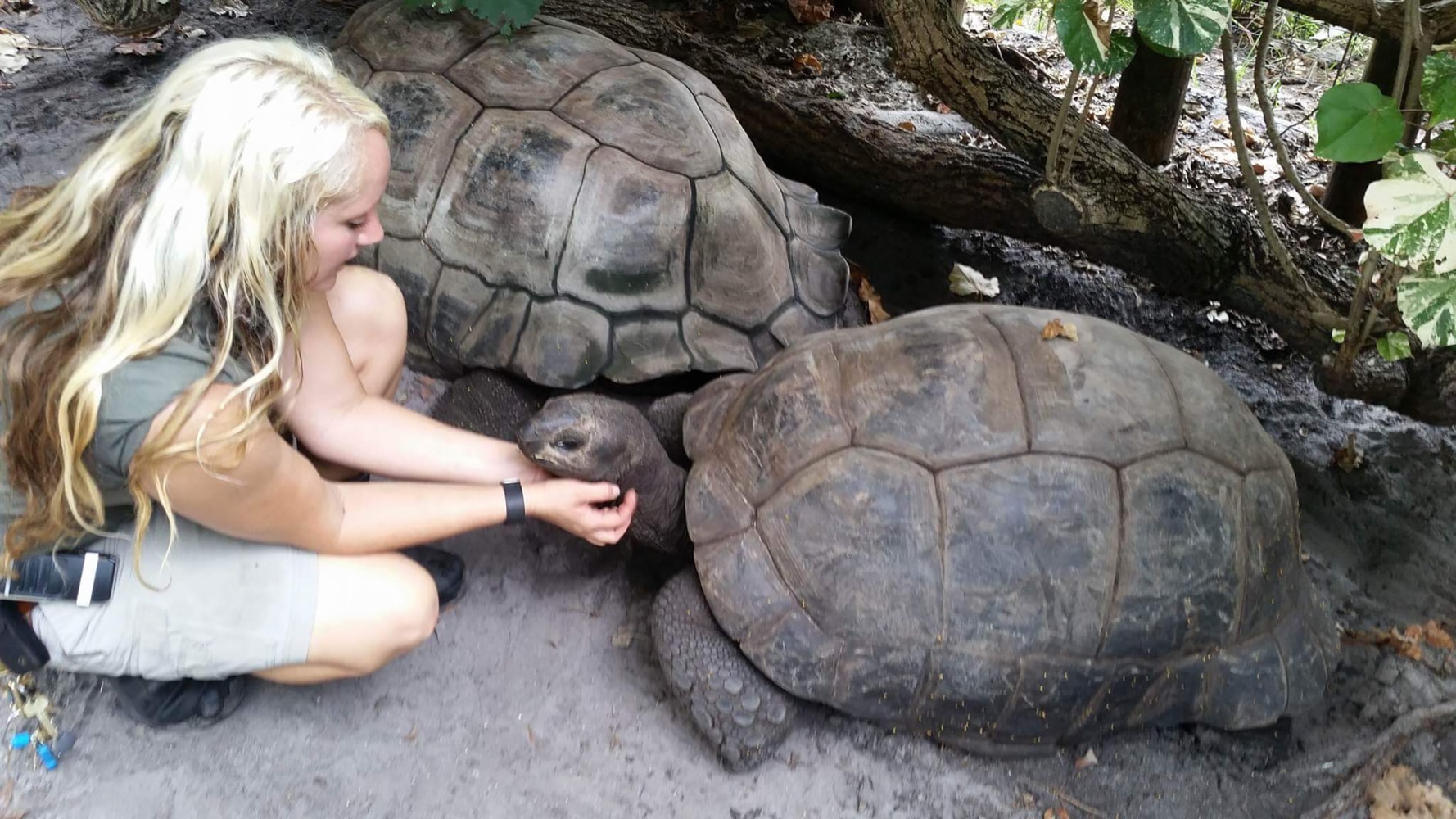
Image: Palm Beach Zoo
Aldabra tortoises at the Palm Beach Zoo. Palm Beach Zoo

Workers boarded up windows and put hurricane-proof shutters and glass in place throughout the 23-acre facility as well.

In a statement Wednesday, the Miami Zoo said it would not evacuate animals “since hurricanes can change direction at the last minute, and you run the risk of evacuating to a more dangerous location.”

“The stress of moving the animals can be more dangerous than riding out the storm,” the zoo said on its Facebook page.

Animals considered more dangerous will be kept in secure houses made of concrete, the statement said, adding that such animals survived the devastating Hurricane Andrew 25 years ago unharmed.

News of the hurricane conjured images of wildlife riding our previous storms from public facilities instead of their enclosures, like the iconic image of more than 50 flamingos taking shelter from Hurricane Georges in a men’s bathroom in 1998.

At the Rare Species Conservatory Foundation, a nonprofit in Loxahatchee, founder and president Dr. Paul Reillo said Thursday night that he and other staff members would ride out the storm with hundreds of rare and endangered animals.

Play

 Hurricane Irma: How will Florida’s zoo animals survive the storm? 3:10

“We’re with them every step of the way,” he said. “You can’t crate them and walk away — our prime directive is to save lives here.”

The foundation was prepared to bring smaller animals indoors before Irma hits, while larger animals may have to ride out the storm outdoors, Reillo said.

“We have large African antelope here, and unfortunately they cannot be caught up and put in small spaces,” he said. “They’re out in their environment, and hopefully they’ll hunker down and be fine.”

Reillo said many zoos and centers don’t have the space or expertise to evacuate animals that need special care, especially endangered species.

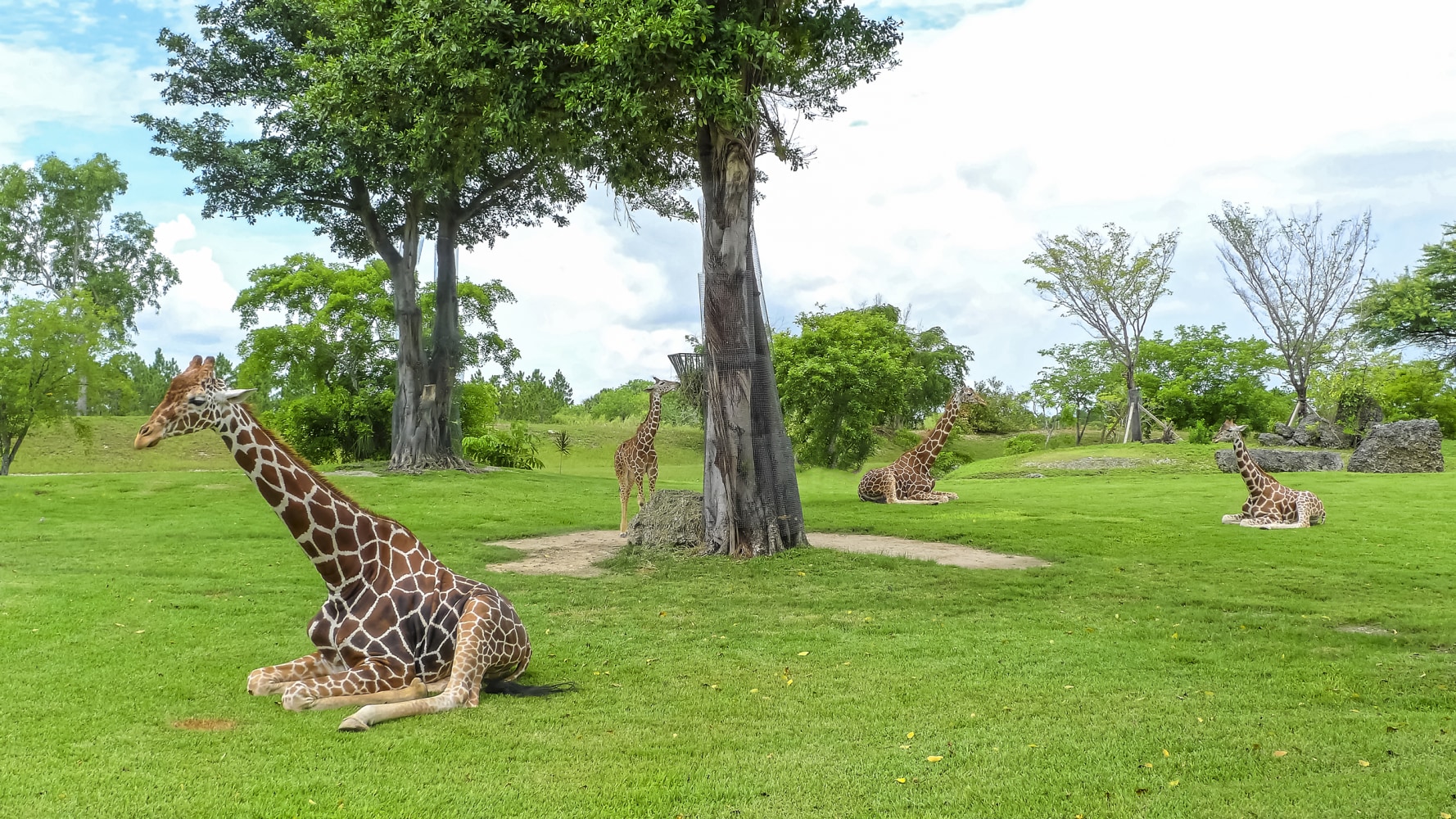
Image: Giraffes at Zoo Miami
Undated photo of giraffes at the Metro Zoo in Miami. Luis Castaneda Inc. / Getty Images

“Facilities are not provisioned to do that on normal day, much less in an emergency,” he said. “We’re kind of stuck with riding these things out.”

Reillo also said many wildlife facilities were forced into a waiting game of seeing where and how severe the hurricane would be.

“A mile or two can make a huge difference for a wildlife facility,” he said of a storm’s landfall. “It’s not just the stress on the animals of catching them up, but then realizing you have to have enclosures to release them into after the storm passes.”

Facilities in the area will also work together to help one another after the storm, he said.

“It’s our life’s work. It’s not about the people — this is bigger than us,” he said. “It’s about believing that wildlife deserves a chance for the future. We should do all we can to prevent extinction.”

CORRECTION (Sept. 8, 2017, 10:15): An earlier version of this article misstated the year 50 flamingos were pictured taking shelter in a men’s bathroom during Hurricane Georges. It was 1998, not 1988.

These haunting animal photos aim to make you reconsider a visit to the zoo

 July 18
Jo-Anne McArthur, a Canadian photographer and animal rights activist, does not deny that her new book could be called “one-sided.” That is sort of the point.

The images in “Captive” were taken at zoos across five continents, but they don’t include depictions of handlers bottle-feeding baby hippos, giving pandas ultrasounds or even cleaning cages. They’re taken from the perspective of the public, and, McArthur said, aim to show the animals as “individuals,” as opposed to representatives of their species. The photos are unusual and at times arresting, featuring solitary animals juxtaposed against gawking crowds, suburbia and the barriers that keep them enclosed.

The book comes off as quite anti-zoo, but McArthur says she hopes it will count as a contribution to an escalating public conversation about animals in captivity — one that has been highlighted by uproar over Sea World orcas and the killing of Harambe the gorilla, but that is also churning quietly among zoo managers.

What follows is a selection of photos from McArthur’s book, paired with her captions, and a Q and A about the book. All images were taken in 2016, when McArthur was on assignment in Europe for the Born Free Foundation, a wildlife advocacy organization.

This interview has been edited for length and clarity. 

What was your experience with zoos before this project?
I have an early childhood memory of a zoo in Hawaii. An orangutan was defecating in its hand, smearing it on a tree and eating it. All the tourists were laughing and screaming about it and taking photos. Our family also took photographs. I’d only visited one or two other zoos as a child. People often refer to the “love” I have for animals. That’s correct, but only partly so. I’ve also always had a concern for animals. I’ve often felt sad for them. Seeing them on display seemed so awkward to me. Staring, being stared at. I know I’m not alone in this sentiment.

It’s clear you’re not a fan of zoos now. Was there a turning point?
I don’t remember a turning point. I just remember always being on the side of the animals when it came to seeing them, living with them, and the rest. I remember always feeling that it wasn’t fair to the individuals that they were kept in zoos, that there were dogs locked up in back yards, birds kept in cages.

Did you go behind the scenes at the zoos you photographed or stay on the visitors’ side?
I’ve been behind the scenes, and I have a lot of zoo friends, and over the years I have heard their private complaints and worries. In the early 2000s, when I was still doing work as a photographer’s assistant, a fashion photographer knew I loved animals, and so invited me to do a three-day shoot with him. The zoo was making money renting out the animals. The animal that afternoon was a bald eagle. Behind the scenes were rows and rows of large, caged birds. The eagle was tethered by the ankle and made to sit under the hot lights of the shoot on a white backdrop, perched on a cow skull, next to a leather boot, which was the item being advertised. The bird was panting and kept trying to fly away. The bird would fly the length of the tether and then get yanked back and upside down, hanging by the tether, then righted by the handler, then put back on the cow skull to be photographed. My zoo friends quietly express their woes to me about things the visitors don’t know or see, like new animal introductions that go wrong and end in death; animals caught in wiring and fencing, found dead in the morning; families separated again and again for breeding programs.

How do you think that affected the portrayal of zoos in your book?
The book will get some criticism for being one-sided. But it’s important to remember that zoos are one-sided, and we need to see more of the darker corners so that we can continue to discuss the problems with captivity. The images in “Captive” will help to further enliven the discussion about the individuals caught in these systems. The zoo conversation often loops back to conservation efforts and species preservation, at the expense of the individuals. From the outside, we see zoo marketing. From the inside, as visitors, the zoo also shapes how we see, and fail to see, the animals — from the groomed pathways, the music, to all the supplementary entertainment. I want us to remember that we might pass through a zoo in two or three hours and return home to our families, friends, and a life of relative autonomy. Zoo animals, however, remain there long after we’ve gone. I try to show what that might be like for them.

You’re pretty dismissive of zoos’ wildlife conservation efforts. Why? Isn’t there a range of commitment to these programs?
What I’m trying to do is get the conversation away from the conservation crutch. “But, conservation!” is the go-to response to anyone challenging the many ethical issues confronting zoos today. Zoos have done a great job marketing conservation efforts when in fact most of their money is spent on other projects. Captive animals are bored, lonely, separated from their families and friends? But, conservation. Marius, the giraffe killed and publicly dissected by a Danish zoo, was “culled” because he was genetic surplus? But, conservation. Yes, please tell me about all the successful conservation happening. Show me the successful reintroduction of gorillas into the wild. The giraffes, too. Tell me about elephant conservation. Zoos use the conservation angle to this day to justify the catching of wild animals, including African elephants as recently as 2016, and bringing them to American zoos.

You single out the Detroit Zoo as worthy of praise. What makes it so different? It still holds captive animals.
It does, yes, and they are the first to say that they have a long way to go before they reach their goals. I encourage people to look at the zoo reform happening there. For example, they moved their elephants to a sanctuary in a warmer climate because they felt that keeping them in Detroit was ethically untenable. Most zoos won’t make a move like that because of the perceived lost revenue. Detroit Zoo, however, used it as an opportunity to talk about the ethics of captivity and to show that they wanted to be leaders in zoo reform. Their polar bears are rescued and have enough space to hide from the public. There’s a huge focus on humane education programs. They have a 4-D theater, where visitors can see animals in their natural habitat. This year they hosted a global symposium on zoo and aquarium animal welfare.

Zoos know they are in the spotlight, and not in a good way. Many zoos are interested in meaningful reform, where others are looking at how they can spin things to look like they are. Zoos are neither immutable nor inevitable and, in their current form, most are archaic. Zoos need to evolve to suit the more compassionate ethics of our time.

What do you want people to take away from your book?
“Captive” is my contribution to the ongoing mainstream discussion about the ethics of captivity. We lack critical thinking when it comes to facing other species. We face them without seeing them — interactions depicted frequently throughout the book. I’d like the people who see this book to become part of the growing numbers who are taking zoos to task. I’d like the book’s audience to reconsider visiting zoos, and put their support behind efforts that help animals, such as wildlife centers, sanctuaries and in-situ conservation projects. We can also learn so much more seeing animals filmed in high definition in their natural habitats than by looking at an isolated animal behind a grubby sheet of Plexiglas.

Read more:

What Harambe’s death means for a critically endangered species of gorilla

Detroit Zoo director: Zoos will ‘look and act radically different in 20 years’

A rhino at a French zoo was killed for his horn. Could that happen here?

To save rhinos, half of this African country’s elephants are being airlifted to U.S. zoos

Saskatoon zoo opening research facility to study orphaned grizzly bears

Bears Mistaya and Koda will help shed light on those in the wild

By Alex Soloducha, CBC News Posted: Apr 25, 2017 4:12 PM CT

The Saskatoon Forestry Farm Park and Zoo is beginning a new partnership with the Foothills Research Institute to start a grizzly bear research program in the city.

The five-year agreement between the two organizations will allow Foothills scientists to use Saskatoon zoo facilities to take part in conservation research on a variety of animals of different species currently housed there, starting with two orphaned grizzly bears.

The Saskatoon Zoo acquired two young grizzly bears in 2006. Mistaya and Koda were both orphaned in Alberta, paired at the Calgary Zoo and later transferred to their permanent home in Saskatoon.

Manager of the Saskatoon zoo, Tim Sinclair-Smith, said the organization is working to make research and conservation a priority.

“We shouldn’t have them here at all if we’re just going to display them,” he said.

Foothills researchers have been working on long-term conservation of grizzly bears in Alberta since 1999.

Their primary objective is to understand how the health of individual grizzly bears is influenced by human activities and changing environmental conditions. The second goal is to examine how that health affects the growth, stability and resilience of grizzly bear populations.

This year, during the bears’ hibernation, management at the zoo was working on making a connection with Foothills.

The City of Saskatoon will pool in-kind resources to create a Wildlife Health Centre, consisting of a laboratory for Foothills researchers. No changes will be done to the structure of the facilities, which are being outfitted with necessary lab equipment.

“For them to build a facility … you’re talking millions and millions of dollars,” Sinclair-Smith said. “This was a great opportunity for them to be able to utilize the data they can gather from these guys and use them for a baseline for all the research that they’re doing with the bears in the wild.”

The Foothills scientists will test samples of hair, feathers and scales picked up through non-invasive sample gathering.

Their research findings will often be communicated directly with zoo visitors.

With files from Charles Hamilton

 
http://www.cbc.ca/news/canada/saskatchewan/saskatoon-zoo-opens-new-med-facility-1.4085359

3 tiger cubs destined for zoo in Syria rescued in Lebanon

http://www.news-sentinel.com/article/20170403/AP/304039948&profile=1002

Monday, April 03, 2017 09:07 am
BEIRUT – Three Siberian tiger cubs destined for a zoo in war-torn Syria were rescued by a Lebanese animal rights group after being trapped in an unmarked, maggot-infested crate in Beirut’s airport for almost a week.

The tigers, which were being transported from Ukraine, arrived at the Beirut airport on March 7, inside a ventilated 0.3-cubic-meter (10.6-cubic feet) crate, where they could not stand or move and were forced to urinate and defecate on each other, according to Animals Lebanon.

The animal rights group, which had been alerted to the shipment ultimately bound for Samer al-Husainawi Zoo in Damascus before it landed in Beirut, petitioned a Lebanese judge to release the tigers into their care the following week, Executive Director Jason Mier said.

The judge responded by issuing an order demanding the tigers be released, citing concerns for their health and welfare, the group said.

“Once we finally got them out of the box, the box had dozens and dozens of maggots crawling around in it. There were maggots all over the back thighs of the animals and around their anus,” Mier said. The tigers also suffered from dehydration, according to the group.

The tigers were sent from the zoo in Mykolaev, Ukraine. Volodymyr Topchiy, that zoo’s director, said the deal to send them abroad was entirely legal.

“They passed customs clearance, we have customs declarations,” he said, adding that the tiger cubs were exchanged for some wildcats.

Topchiy believes problems with paperwork and bureaucracy stopped their transfer to Syria. “On the transportation boxes there were no ‘up’ or down’ signs,” he said.

He said the three tiger cubs were in one box, not separate, and the zoo dealer was stopped because of these reasons. “Authorities wanted to confiscate (the cubs),” he said.

Mier said the crate arrived with no markings and no documents, and did not meet IATA regulations nor those of CITES, the Convention on International Trade in Endangered Species, despite the fact that the four-month-old Siberian tigers fall under that category.

This is not the first deal that the Mykolaev zoo has made with its Syrian counterpart, and Topchiy said he is considering sending more tiger cubs there.

Lebanon enacted an animal protection and welfare law in 2015, granting animals legal rights and allowing for the regulation and monitoring of all the industries and establishments that use or sell animals to ensure that the animals are not placed in abusive environments.

The country is also a signatory to a number of international conventions regarding animal welfare, such as CITES, the main legislation against wildlife trafficking.

In August 2015, the death of a privately owned lion cub as a result of severe malnourishment prompted the Agriculture Ministry to clamp down on the sale and ownership of big cats.

In July, the ministry issued a decree to stop the trafficking of big cats and forcing zoos to register formally.

Wasted Lives and Roadside Zoos

http://www.bornfreeusa.org/weblog_canada.php?p=5669&more=1

08/11/16

by Barry Kent MacKay

Recently, I revisited Jungle Cat World Wildlife Park: a roadside zoo just outside the small town of Orono, Ontario. I had not checked it out in a couple of decades. It opened in 1983.

It’s neither the best nor the worst of its kind. When I sent photos I had taken to Rob Laidlaw of Zoocheck, he replied, “When I look at the images, it just strikes me how absurd and wasted the lives of the animals are living in those cages in Orono; a purposeless and hopeless existence.”

That perfectly expressed my own views. Scattered about the grounds are a series of cages and enclosures in which the usual assembly of animals commonly seen in zoos are imprisoned, without a jungle in sight. There is also a pet cemetery, a motel-like bed and breakfast accommodation, a tiny cafeteria, and a souvenir shop.

The zoo offers a “Safari Zoo Camp experience” each summer. It grandly promises to “protect and conserve the natural world by offering the public engaging wildlife education programs and experiences with animals to help foster the necessary awareness, knowledge, skills and confidence to live in an environmentally friendly way.”

Photo: Barry Kent MacKay

I climbed the “wolf tower” to peer down into an enclosure where some wolves remained, mostly hidden in the weeds. One was pacing in the classical stereotypic manner of confined zoo animals. By pre-focusing my camera at the spot where he was briefly visible, I got a few mediocre snapshots. This is definitely not how wolves act in the wild.

The sign for the European kestrel misidentified him as a female and contained a mishmash of information on that species and the markedly different American kestrel—while doing nothing to protect either species.

Until she read the sign on the cage, I overheard a lady say that the mountain lion, puma, and cougar were all the same species. I guess that’s education.

Photo: Barry Kent MacKay

My concern is that these places make people think that what they see in such facilities is somehow “normal” for the animals they imprison. The parrot on the t-bar, the lemurs jumping on a hanging spare tire and begging for grapes, that owl up in the corner of her cage, or the pacing tiger… This is what they’ll know of each species.

This is not what animals are like, so isolated from the realities they evolved to inhabit. And yet, in or near towns and cities across the continent, I fear that too many people see these facilities as normal components of our own society: the animals serving to amuse us, where we “ooh” over white lions, or gasp at how big a boa constrictor can grow, or laugh at the antics of a squirrel monkey.

Rob calls the last century and a half that the modern zoo has existed the “sanitization and acceptance” period, wherein wild animals in cages are increasingly seen to be perfectly normal… while the spaces they naturally inhabit continue to decline. Sadly, I think he’s right.

Keep wildlife in the wild,
Barry

https://www.thedodo.com/rebel-wolf-killed-zoo-1180189057.html

The only thing more upsetting than Harambe the gorilla’s death was the reality of his life

http://www.independent.co.uk/voices/the-only-thing-more-upsetting-than-harambe-the-gorillas-death-was-the-reality-of-his-life-a7057981.html

Surely we can begin to agree that animals which share 98 per cent of our DNA should not be kept as entertainment for us to gawk at in a zoo

Yet again, captivity has taken an animal’s life. The latest victim: a 17-year-old gorilla named Harambe, who was gunned down after a young boy managed to crawl through a fence before falling into his enclosure at the Cincinnati Zoo.

The incident (which could have been prevented by surrounding the enclosure with a secondary barrier) has generated a great deal of debate online, some extreme – one tweet said, “[I]f you have to shoot – aim for the least endangered one,” while an Express columnist took the view that “zoo staff did what you might think all people would want: they put the human life first”. But arguing over whose life is more valuable misses the point. What we should be asking is why intelligent, self-aware animals are still being displayed as living exhibits for humans to gawk at.

Harambe and other animals serving life sentences in zoos are leading lives of quiet desperation. They are denied the most basic freedoms, including being able to choose where to roam, when and what to eat, and whom to socialise with. It’s no wonder that these magnificent animals frequently exhibit signs of extreme depression and related psychological conditions, such as pacing, rocking and eating their own vomit, which is unheard of in their wild counterparts, as they struggle with the confines of their captivity. They’re also prone to cardiac disease: in 2011, the Smithsonian Institution revealed that 30 of its gorillas were on heart medication.

Fullscreen
 

Cincinnati zoo gorilla shot dead as boy falls into enclosure

Zoos try to justify their existence in the name of “conservation”, but warehousing animals in these facilities does nothing to help protect endangered animals in the wild. In fact, some say doing so actually harms wild populations because it diverts much-needed funds away from the protection of animals in their natural habitats.

After all, capturing (yes, some zoos still snatch animals out of their natural habitats), transporting and maintaining non-human animals for the professed purpose of “conserving” them is enormously expensive. It costs about 50 times as much to keep one African elephant in a zoo as it would to safeguard sufficient natural habitat to sustain that elephant and countless others.

When, in 2007, the Zoological Society of London spent £5.3m on a new gorilla enclosure, Ian Redmond, the chief consultant to the UN Great Apes Survival Partnership, said: “£5m for three gorillas [seems a huge amount] when national parks are seeing [three gorillas] killed every day for want of some Land Rovers, trained men and anti-poaching patrols. It must be very frustrating for the warden of a national park to see”. Clearly, the same amount of money a zoo spends on buying expensive animals could benefit so many more of the same animals living in the wild. Our need for entertainment is expensive, unnecessary and without discernible benefit, then, to the animals involved.

While zoos spend millions on keeping animals in captivity, wild animals continue to experience habitat destruction and poaching. Virtually none of the captive-bred species that do face extinction in the wild – including gorillas, elephants, polar bears, gorillas, tigers, chimpanzees and pandas – will ever be released back into their natural environments to bolster dwindling populations. The truth is that most zoos have no contact of any kind with reintroduction programmes.

Perhaps the only thing more tragic than Harambe’s death was his life. While the debate about whether Cincinnati Zoo should have killed him or not rages on, surely we can all agree that animals deserve better than a life sentence in a zoo.