Several projects are aiming to bring back mammoths and other species that have vanished from the planet. Whether that’s technically possible is beside the point.
A famous de-extinction project led by the geneticist George Church of Harvard University aims to bring back woolly mammoths — not exactly as they once were but as mammoth-elephant hybrids.Kristina Armitage/Quanta Magazine
For scientists studying de-extinction — the ambitious effort to resurrect extinct species —a paper that appearedinCurrent Biologyin March was a sobering reality check.Thomas Gilbert, a genomics researcher and professor at the University of Copenhagen, led a team of researchers who tested the feasibility of de-extinction by sequencing the genome of the Christmas Island rat, a species that went extinct in the late 19th or early…
SPOKANE, Wash. — The second positive case of avian influenza in Washington was found in a non-commercial backyard flock in Spokane County.
The Washington State Department of Agriculture and the U.S. Department of Agriculture’s Animal Plant Health Inspection Service confirmed the positive test on Saturday. The affected flock is a mix of about 75 geese, chickens, ducks and guinea fowl.
A private veterinarian submitted a dead goose that exhibited unusual behavior prior to death, including walking abnormally, shaking its head, not moving, and exhibiting a lack of fear of humans.
This marks the second confirmed case of the bird flu in Washington state, with the first being on Thursday in Pacific County.
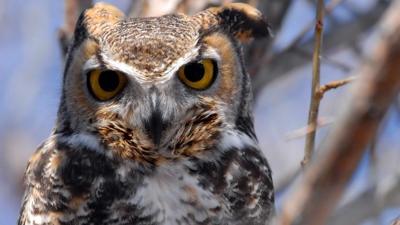
STANLEY – The Idaho Department of Fish and Game says a great-horned owl in Custer County has tested positive for Highly Pathogenic Avian Influenza, and people are asked to report any dead or sick wild birds on Fish and Game’s Wildlife Health webpage.
The recent detection follows a trend seen in other parts of the country where sporadic deaths of migrating waterfowl and other birds provided the first indication that HPAI is present in an area.
Avian influenza infections are caused by a virus that can infect poultry and are carried by wild birds. While all types of avian influenza are contagious to other birds, some can cause high rates of death and illness in poultry, including commercial farms and backyard flocks. These types are classified as highly pathogenic, or HPAI.
The positive owl in Custer County is the first confirmed wildlife detection in 2022 of HPAI in Idaho, but there were also detections in 2015 and 2017. Fish and Game will continue to conduct surveillance for Avian Influenza in wild bird species.
The virus poses a low risk to humans, however some people may have job-related or recreational exposures to birds that put them at higher risk of infection according to the Centers of Disease Control and Prevention. To learn more go to https://www.cdc.gov/flu/avianflu/index.htm
Humans can also spread the disease to new areas or flocks, so anyone who handles birds is encouraged to follow biosecurity measures to help prevent further spread.
Bird rehabilitators, zoos and other places that house birds should use extreme caution when accepting new birds, and bring their birds indoors, or maintain separation from wild birds in a covered area to reduce risk.
The best form of flock protection is maintaining strong biosecurity standards. Biosecurity includes limiting the number of people who interact with your birds, washing hands before and after handling the birds, and having dedicated clothing and tools for each flock. More information can be found through Idaho State Department of Agriculture and the United States Department of Agriculture.
With fair season approaching, ISDA has developed guidance for organizers of poultry exhibitions and exhibitors. These materials can be found on the ISDA website.
Dumped at sea, lost on land or left to rot in shops and fridges, the global catch of fish is being wasted like never before – hurting not only the oceans but the nutrition of billions of people. Can it be reversed?
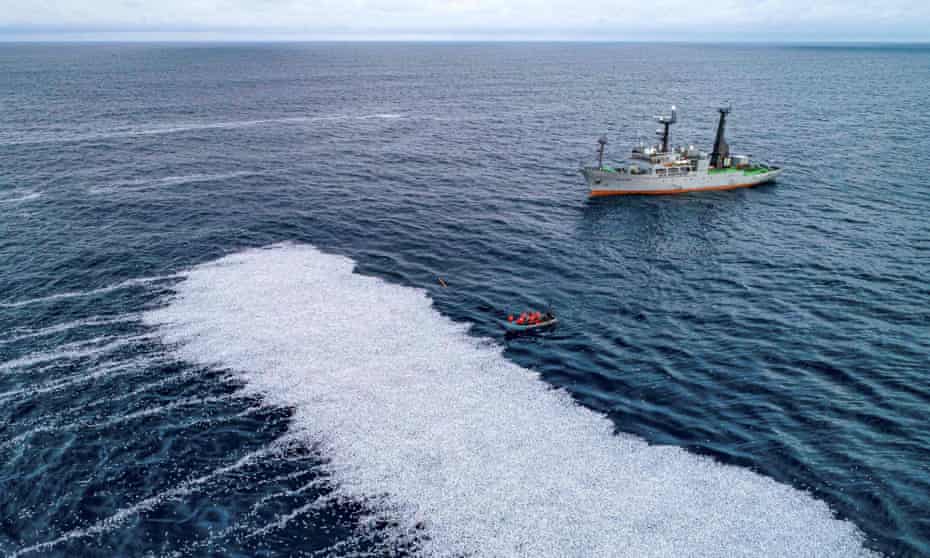
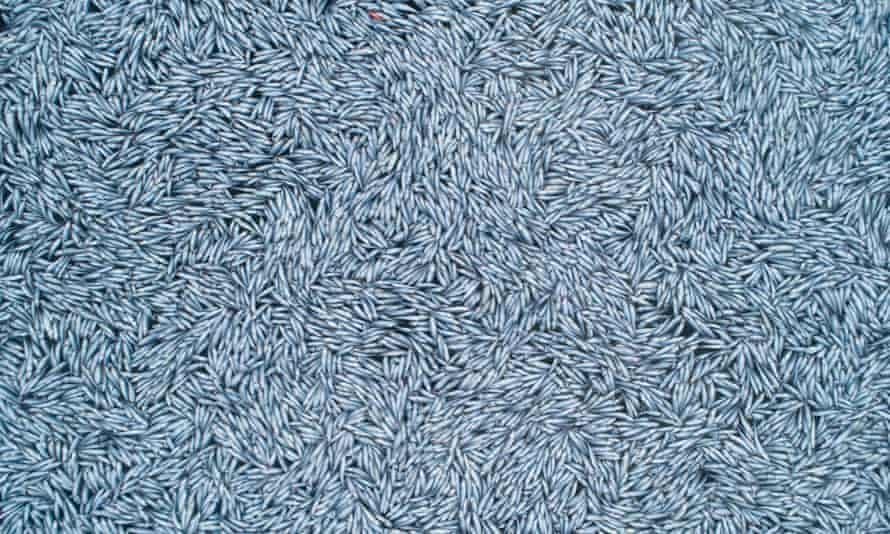
In February 2022, a Dutch-owned fishing trawler released a silvery stream of 100,000 dead fish, which carpeted several thousand square metres of ocean off the coast of France. The vessel’s owners blamed the discharge on a faulty net. Environmental groups alleged that the fish were intentionally dumped.
Whatever the truth, that spectacle of squandered sea life was the tip of the iceberg: figures from WWF show that in 2019, at least 230,000 tonnes of fish were dumped in EU waters. Most of the waste – 92% – is related to bottom-trawling, a fishing method that scrapes the seafloor, indiscriminately scooping up everything in its path.
Some of the 100,000 dead fish that were thrown into the sea off the coast of La Rochelle, France, by a factory ship in February. Photograph: AFP/Getty Images
But this figure is a small fraction of an even larger global issue. The UN Food and Agriculture Organization (FAO) estimates that 35% of all fish, crustaceans and molluscs harvested from oceans, lakes and fish farms are wasted or lost before they ever reach a plate.
Fish are highly perishable and fragile, which makes them more vulnerable to waste, a problem that is compounded by haemorrhaging fish at every step of the supply chain. Fish waste is especially shocking, says Pete Pearson, senior director for food waste at WWF, because they “are wild animals, so we are harvesting wildlife”.
That begins, experts say, with understanding exactly what is driving waste between harvest and plate. The task is made difficult by fisheries’ notoriously opaque supply chains, and incomplete datasets that are also inconsistent, although the evidence is clear that most fish waste starts at the point of extraction.
Just under half of all fish consumed by people is wild-caught at sea. “There’s such abundance that we’ve grown to be OK with certain loss rates,” Pearson says, although noting that 34% of global marine stocks are now overfished. Bycatch (unintentionally caught, unwanted fish) is a growing problem, too: roughly 10% of wild-caught fish are discarded worldwide each year, representing 8.6m tonnes of animals. The main culprits are imprecise fishing gear and policies that allow fishers to discard non-target species.
There’s an economic driver, too. “I think there is a strong connection between subsidies and waste in the water,” says Rashid Sumaila, professor of ocean and fisheries economics at the University of British Columbia.
Although subsidies were historically devised to support small-scale fishers, today 80% of $35.4bn (£26.4bn) in annual fishing subsidies goes to a handful of industrial fleets, Sumaila’s research shows. These include gargantuan bottom trawlers that are uniquely equipped to travel out to the high seas and overfish, leading to discards on an industrial scale.
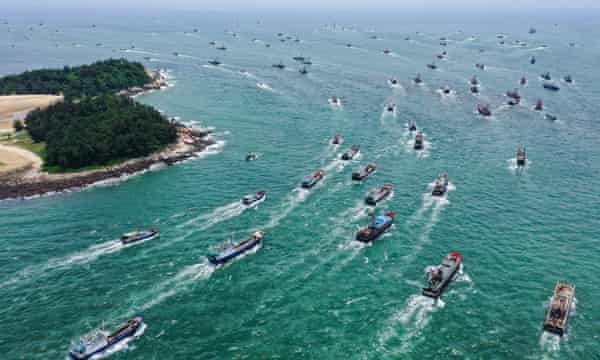
Fishing boats setting sail in Yangjiang, Guangdong province of China. Photograph: VCG/Getty Images
The impact of illegal and unreported fishing is also important, says Sumaila, as it is likely contributing tonnes more bycatch to global fish waste.
Food for 3 billion people
Fish waste is about more than just the physical loss of fish: for the 3 billion people whose diets depend on fish, it is a lost nutritional opportunity.
“The narrative is that we have to produce more to feed the growing masses, but the greatest pathway to [increasing] supply is reducing loss and waste,” says Shakuntala Thilsted, global lead for nutrition and public health at World Fish and winner of the 2021 World Food Prize.
Many see controlled aquaculture systems (or “fish farms”) – which generate more than half our fish supply – as a solution to the waste of wild fishing. But Dave Love, senior scientist at the Johns Hopkins Center for a Livable Future, says that various factors, such as disease, are driving considerable losses on farms, too. “Mortality in fish ponds is actually a significant source of lost potential food,” Love says.
Fish waste continues after harvest – though how it unfolds differs depending on location. The FAO estimates that 27% of all fish globally is lost or wasted after landing, but in low-income countries the fish is more likely to be unintentionally lost than wasted, says Peñarubia.
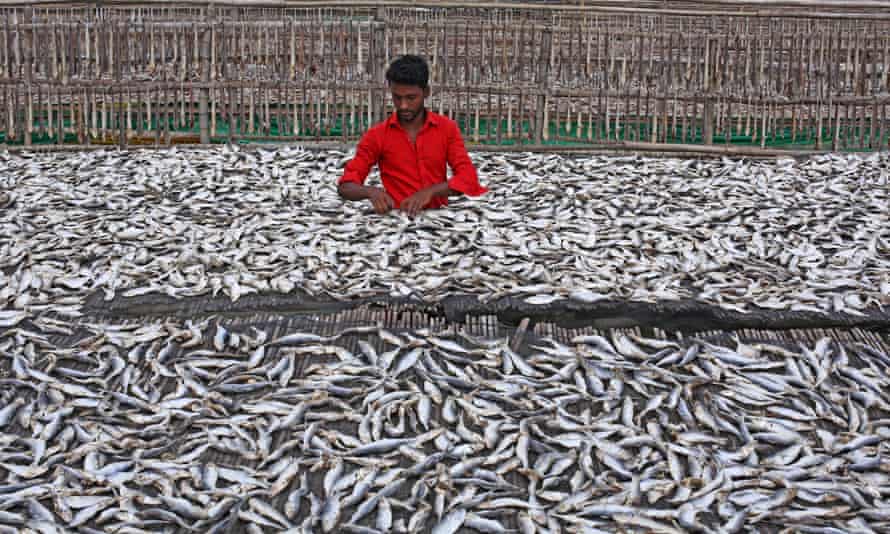
A fish-drying plant in Bangladesh. Much fresh fish waste is caused by poor handling and a lack of storage and cooling facilities on vessels. Photograph: Xinhua/Rex/Shutterstock
One study showed that in Ghana, Burkina Faso and Togo, 65% of lost fish on land was attributable to poor handling, lack of storage and cooling facilities on fishing vessels and along the lengthy supply chain.
Fish disappear after distribution, too, but here the culprits are retailers and consumers, almost exclusively in middle-and high-income countries. In North America, Oceania and Europe, fish waste at consumption far outstrips that of any other region in the world.
Pearson thinks retailers in the US partly contribute to the problem by prioritising large, fresh fish to sell at a premium, which quickly spoil. “This is the real tragedy, because it’s moved all the way through the supply chain, and then we’re comfortable with a 10% to 30% loss rate in the grocery store,” he says.
When retailers prioritise fresh fish, “the ripple effect is that consumers are more likely to waste that in their homes,” says Love, who published research showing that retailers were responsible for about 16% of wasted seafood in the US, while up to 63% comes down to consumers putting uneaten fish in the bin.
Go frozen?
Solutions do exist to reduce fish spoilage along the supply chain. Increasing access to cold-chain technologies in low-income countries, along with methods such as solar-powered drying tents, could extend the shelf life of fish. Fishers and processors also need training on better fish handling and storage to limit loss, Peñarubia says.
At the consumer end, Pearson and Love argue that we should encourage more people to opt for frozen fish, which could reduce demand for fresh fish in grocery stores, and limit the amount that is lost in retail and people’s homes.
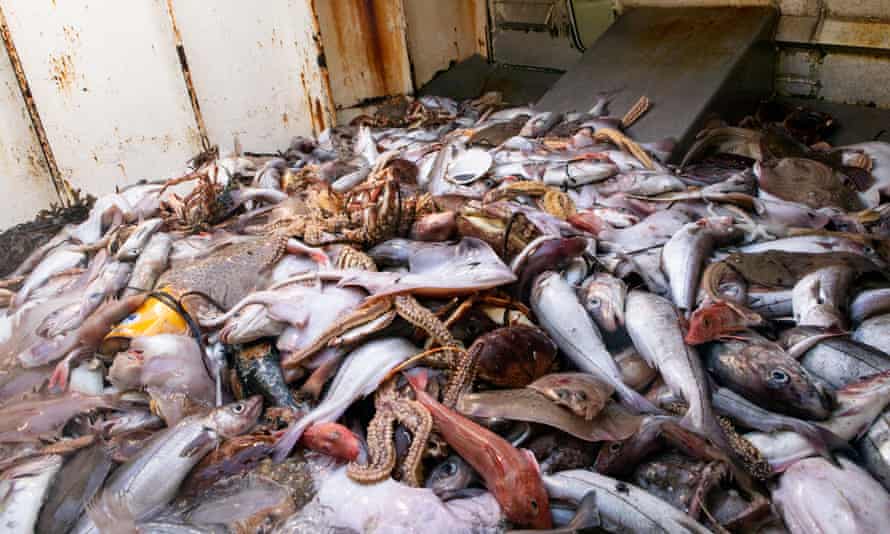
The fishing trawler Crystal Sea, which operates out of Newlyn, Cornwall. The catch includes all types of sea life. Photograph: Antonio Olmos/The Observer
Thilsted suggests diversifying our appetites beyond the ubiquitous fish fillet to smaller fish and bivalves, which can be consumed whole to reduce waste. “If our notion of ‘fish’ is a fillet on a pan, then we are already far down the path of loss and waste, because we have reduced the edible part to such a small portion of the whole.”
Existing fish byproducts can be captured and turned into new ones. Fish heads, fins, and bones from the fishing industry are already a source of fertiliser and feed; now innovators are finding uses for everything from fish skin for burn treatments, and crustacean waste to make biodegradable packaging.
“The idea of full utilisation is something that needs to be pervasive across all food supply chains” says Pearson, who cautions, however, that we shouldn’t overstate these solutions. Unless fish byproducts replace a share of fish demand, they are simply making use of waste – not reducing it at source.
Ultimately, prevention is the best solution, starting at sea, where this problem begins, Pearson says. Fishers need to be equipped with more selective gear for fishing, and aided by policies that discourage discards. Sumaila underscores the need for “good subsidies” that can be channelled towards fisheries that help replenish wild stocks: “We need to spend taxpayers’ money in ways that reinforce positive feedback from people to nature, and nature to people,” he says.
For generations we’ve believed “the ocean is huge, and we can just take whatever we want,” says Pearson. “Now we’re coming to see the limits of that. And when you have limits, it requires you to become more efficient.”
The past two pandemic summers saw a spikein COVID-19 cases, hospitalizations and death, but this season may be different.
Though health experts expect cases to rise, they said thewave won’t be as devastating as the previous two summers or the surge of the omicron variant of the coronavirus.
Unlike the previous summers, most of the U.S. population has some immunity against the coronavirus from vaccines, boosters and previous infections. People have access to antivirals that can prevent hospitalizations in the unvaccinated.
However, immunity wanes and new variants could evade what protection remains.
“I know we all want to be done with COVID, but I don’t think it’s done with us,” said Dr. Jessica Justman, associate professor of medicine in epidemiology and senior technical director of ICAP at Columbia University’s Mailman School of Public Health.
APRIL 26, 2021 / 10:51 AM/ CBS NEWShttps://www.cbsnews.com/embed/video/?v=d93428d16c825884443a51a351923569#xVZZb9w2EP4rgh4L0yJ1a4GicJoeQdMgjZMChRUsKHK0y4Y6Kko%2BGvi%2Fd0bS7jpOiz4kTWEsTJFz8ZvhN%2FPel9PY9Vbe%2BZtxmODMvzYaOn%2Fz3jcjNM7fXL33x7se%2FI1%2F3Wn%2FzDcal0UVq1jymPGwilmcJZzJQtcs02kCcZjyOspQtulvX0H9jDRunm93b4bp%2BT7e3sD0c3Px7PLX77e%2FXDbmtx%2F%2BeJFblHZ22qGksqaRIzA1GGccG8CBHNQeBsdqXLGd7Spp2Wj63rQ71nemHR2TdgCp7xjKAdoazWgp5m8XY95ibOP9MCt7q7K3KHvKdo60NLxDHVzUk7X%2FZOLVKSCPAvJ2f2tzDchbA1Ky7VqjpH39Wc2OpgE3yqb3NyIVhcgK%2FHHO8S7TIEfTtf4m4tHp87mswKJ7nmx4hAbs8t3ihTG3jdyBo%2BQ7ytl%2BHHu3KYMyUJVr4caF57gw6G806lx1TRnsp6oMTBkMZRDyUJQBj3EVlUECPK5DwVmotGSxLGKWF1XGIh3XVVSpNMqTMhj3U1O10tgySGN%2BG6UcF3kVhlpJwWte5QVGX1dpqDMtoziMZLJEw%2BrJ4XXYp1cLOwbB0qKIC8HWUM5%2F73eI0P6LQyHCnN9mIWKBCCR1nqVC8bSIZZoVIoqKNI8TrWnvy2Jxf%2Bb3A1wbuHkz2A9Acb01Cs5lY3fnpisD2SMQ1yH%2BiE3K4N9efxmshsvAP1LQA%2Fv90Olz5J%2F55HxNwQL7%2BoGuEPi9dY%2FRF3lecJ6leVQkBVYXXisvtrNgI90Iw3kTTfnBa%2FjF3dbdgElDt7InEOdHWga3rOlh9%2BbVc5SYHoF9c3PzYSwryJ%2Be%2Fhl94541fUch%2BptaWoc9ATuEUXNPoLcQpzxOkzBnWZJrJgSErNAiZJyLvIZccl7xB3ReOawqjKfphhb90osyMFBk2HOu6Nyjc%2B9w%2FharTA7Qjq%2FJ6wvZzGz55NJ7TVI%2Ff2zlyd0idPWx1FssWeiN6zSeC4wJpCNK9AUFCLsG3SwHU48V6NzxytLaC6Vw54nt1LsjQbo3DobLqXIIcgX6KO76rnXdcJDbw%2B3FU6jlZCmz%2FAz%2F%2FHn3yWk3Ks7i5CwpiMUHqd5RvAgxZtSpDsmd1iGxN094nmIHiRccXqx5p6aS4tZX5BI%2FWrd143ZHaFFpLDuy30q674syuDjKKHJ%2FrYQ47rjxke17BK6Zbl8OXQ%2FDePcTYK78MM5AyySNRKZFEhM%2FhFEko9S%2Fx6Q1MMq5deBtRtjd0Rr39p1eihtaPZtd6wJLcpwG0ExRZwIaLdY5A%2F0jmpSZUx%2FHJXIKLo7VfrvHh6c6a0EtT%2BaohrT5yHYZfGPc1na7Heitab%2FmRGUPQTfuu1ZWlhK6TEFyQF63cDFh%2FAMNMFc%2BNqVI8jxhCjLB4hAUK0KIGSgRF5pHWuUhFe8HqofK%2FB3q2quoYDVYax7IzdORSEAUKo%2BY4MBZnCrJKogyhiySykwowUOqk1Xl5VQ9xWtRRpBzGI5hYeqJeJOIDc9OYodJY%2BWFx5NEI3GKkNeAYUHrIQkgVejDfHHmwS1l3nkOR8OTyUOG2hGB3q67VInHRCxg8VTylKcVgzBJGBZKwmQtKhZCFtJFa13XBMJJ74DUIVq1ly0W81uayq6xuayuNbh3SEczTz2Fa8LAJ8LYHQSo9rc0u9ILx%2F8%2FGiKyK98pA62aDdL25eIVFQ4Hy%2F5qBbmAXrRBeG6g8lcKnHOV4YvMIsS9CkWBV4uBVbUsWJ2JIq%2FDokqS5KCwstfJBV7O4FuLj4hedtOgYOFJb3231SBb%2FdLKkXrD7HOl%2By1FuD1BQJ%2Bri1WCHIO0ZmqorLF%2F1cY%2BOCYFFIGWgKPuRg%2FhOJo%2B7uofNZql4x37zJyhj%2FpJI%2F%2FEWWSQpsXwcThlsh2Rp%2FG2DNPIdpOtGXIEyGZuNw1oI192GBmmY0XfYgmuWf1fYiLHK67%2FjYOZw%2F71ap%2Bzr9%2Ff%2FwU%3D
Through decades of research, and now lived experience, it has become clear that the impacts ofclimate changewill have drastic and far-reaching consequences on our planet. And while some of those consequences are predictable — like moreextreme weather,sea-level riseandloss of biodiversity— the pace at which these unfold and their eventual severity hinge on what happens with key linchpins in the climate system, called tipping points.
A tipping point is a threshold or point of no return in the climate system that once passed can no longer be reversed. Passing a tipping point does not necessarily mean immediate, drastic consequences, but it does mean those consequences become unavoidable, and over time the impacts may be dramatic.
In February 2021, a black wolf wandered across the border of Yellowstone National Park in Montana. Called 1155, he wore a radio collar that park biologists fit him with three years before. When he left the safety of the park, 1155 was what biologists call a “dispersed male,” leaving his pack to travel alone in search of a mate. As a descendant of wolves reintroduced in 1995 to Yellowstone and Idaho’s Frank Church-River of No Return wilderness, he was playing out a role in a success story three decades in the making: to ultimately restore wolves to their former range from which they’d been exterminated.
The year before, scientific findings emerged from Yellowstone on the impact of wolves’ return to the landscape. In their long absence, coyotes had run rampant and the elk population exploded, overgrazing the willow and aspen. Without those trees, songbirds declined, beavers no longer built dams, and streams began to erode. In turn, water temperatures were too high for cold-water fish. Upon wolves’ reintroduction, in what’s called a trophic cascade, the elk populations began falling immediately. Within about 10 years, willows rebounded. In 20, aspen began flourishing. Riverbanks stabilized. Songbirds returned, as did beavers, eagles, foxes, and badgers. Wolf populations in Montana and Idaho began to grow and slowly disperse to other parts of the Rockies and beyond. Media and conservationists heralded it as the greatest rewilding event in history.
It’s unclear when, exactly, 1155 walked onto Robert E. Smith’s private ranch 10 miles north of the park. Director of the conservative Sinclair Broadcasting Group (the biggest owner of television stations in the country), Smith is a major donor to Republicans in the state, including giving thousands to newly elected Montana Gov. Greg Gianforte’s campaigns. Smith’s ranch is managed by Matt Lumley, vice president of the Montana Trapper’s Association, who was aiding Gianforte in his long quest to kill a wolf. The pair had set a trapline on Smith’s property, and 1155 walked right into it, triggering metal jaws to close on his foot and keep the wolf trapped.
It’s also unclear how long 1155 lay caught before Gianforte, presiding over the frenetic session of a citizen Legislature that meets for a mere four months every two years (in Helena, a four-hour drive from Smith’s ranch) arrived to kill him. According to Montana law, trappers are required to check their traps at least every 48 hours to avoid leaving animals to suffer unnecessarily — a requirement the governor would have been familiar with, had he taken the required certification course all hunters are legally bound to take before killing a wolf. Later, Gianforte would say that he was already in the area, although one Montana reporter speculated how serendipitous it was that after weeks of waiting, the governor happened to be nearby when a wolf wandered into his trap; that perhaps Lumley had discovered 1155 and called Gianforte to let him know this was his chance — although law also states that trapped animals must be killed or released immediately upon finding them. Timeline aside, Gianforte shot 1155 — likely in the head to preserve the pelt for mounting — even though 1155 was radio-collared, and almost certainly knowing researchers have typically invested thousands of dollars in the animal for the purpose of scientific research
In Montana, violation of hunting rules can incur a fine of up to $500 and a stripping of hunting privileges. But the state’s Fish, Wildlife and Parks (FWP) agency — overseen by the governor — handed Gianforte only a written warning for trapping 1155 without certification. The governor mostly stayed mum on the incident, until reporters ambushed him at a press conference, where Gianforte called the lack of certification a “slight misstep” and called the kill “a tremendous honor.”
“That he got off with just a warning was a slap in the face to all ethical sportsmen,” says Tim Roberts, who’s on the board of the Montana Wildlife Federation, a conservation organization in the “radical middle” that advocates for managing wolves with a sense of responsibility and fair chase. “Governor Gianforte already had it in his mind that he was going to annihilate wolves in Montana.”
(“States are responsible for the welfare of the gray-wolf population,” a representative for Gianforte tells Rolling Stone. “Montana is fulfilling its responsibility by ensuring a healthy, sustainable population of wolves well beyond recovery targets set by the U.S. Fish and Wildlife Service, and will continue to manage wildlife wisely and judiciously.”)
The episode opened the floodgates in a state where many people have elevated a long-standing hatred of wolves to dogma. For the first time since wolves were deemed recovered enough for the federal government to hand their management back to Montana in 2009, the all-red state Legislature wasn’t reined in by a Democratic governor committed to managing wolves as wildlife, not vermin. Gianforte, a Trumpist Republican, is a wealthy creationist, best-known for body slamming a reporter on the eve of his 2017 election to Montana’s sole congressional seat. He took office toting a questionable environmental record, having sued his own state in 2009 to block longtime public access to the East Gallatin River from his Bozeman mansion. And he’d just shot a collared Yellowstone wolf to show he would do what he pleased on the hunting issue, research and rules be damned.
GOP lawmakers took full opportunity to strike a heavy blow in the West’s century-old wolf wars. By the end of the session, Gianforte had signed new laws that would extend the wolf-hunting season by several weeks; allow night hunting on private land with artificial lights, thermal-imaging tech, and night-vision scopes; neck snaring and the use of bait to hunt and trap; and increase the kill limit to 20 wolves per hunter.
And the kicker: Montana joined Idaho (which recently allocated $1 million for efforts that lawmakers there say could wipe out 1,300 of its estimated 1,500 wolves) in allowing monetary compensation to hunters for each wolf killed — what many call a bounty. Now, in the two states where American taxpayers spent $30 million to reintroduce wolves, anti-wolf organizations are legally paying hunters to kill them. The assault threatens the West-wide recovery the U.S. began 30 years ago — all because wolves are a socially charged political football used to appease a certain electorate, with the actual science on their contribution to the natural world often left on the sidelines.
“There’s nothing normal about this,” says Jamie Rappaport Clark. Now executive director of Defenders of Wildlife, Clark led the reintroduction of wolves to the area back in the 1990s as species director for U.S. Fish and Wildlife Services. “The numbers can’t sustain 20 wolves decimated per individual. It defies all logic. There is no other creature in this country that’s treated like wolves. It’s just reckless killing across the board.”
Wolves once roamed the western part of the continent from the Arctic to Mexico, but they were hunted to eradication from the 1870s onward. More than any other predator, wolves were seen as a symbol of the untamed wild in the West, and the antithesis of civilization: a danger to humans, a menace to ranchers, and competition for big-game hunters. That narrative persists, although wolves very rarely attack people and kill only 0.04 percent of available livestock.
Although USFWS underwent the requisite public-comment period in the early Nineties, people here still characterize the reintroduction as if the federal government “brought wolves and dumped them in Yellowstone Park basically overnight,” says Roberts. Many people versed on the issue believe social tolerance for wolves would be higher if the animals had continued their own, slower, dispersal down from Canada that was already in progress, instead of the agency dropping them in the middle of sagebrush-rebellion country, where private-property rights reign supreme and a significant portion of people don’t trust the federal government.
“There was never an educational effort to say ‘This is why wolves could be good,’ ” says Roberts. “And as wolves expanded, you’ve got conservative ranchers and sportsmen who felt like they had no say in their management, and the hatred just grew.”
Roberts, a longtime traditional bowhunter who lives in Fort Benton, describes himself as an independent with conservative leanings. He sees the expanded wolf hunt as “political bullshit” that panders to the rich landowners and outfitters profiting off elk hunts who backed Gianforte’s run for governor. It’s also a tit-for-tat system based mostly on revenge. “ ‘You crammed it down our throat back then, so we’ll cram it down yours now,’ ” he says. “If you make predators and agencies the boogeymen … well, hatred’s easier to practice than education and calm.”
If leveraging fear-based perspective for political gain sounds familiar, it should. “It’s a lot of what Trump does in drumming up the base,” says Dan Vermillion, a fly-fishing outfitter in Livingston who sat on the Fish and Wildlife Commission for 12 years, from the time wolves were delisted and Montana first allowed a hunt through 2018. He saw a lot of rancor dissipate over those years, as hunters felt they were part of the management strategy and the state set up programs to reimburse ranchers for lost livestock.
But this is where wedge issues can come in handy politically. Once a proudly purple state, Montana swung red for many of the same reasons as the rest of the country: in part due to the perception in rural America that the Democratic Party is disconnected from low- and middle-income and non-urban people, and — in a state where more than three in five people identify as hunters — out of growing fear that liberals will infringe on Second Amendment rights.
“Hunters, for years, get all spun up on Second Amendment issues, and they give the Republican Party a fair bit of latitude on wildlife issues, because they feel more strongly about the Second Amendment,” Vermillion says. “The governor and Legislature are listening to a small but vocal minority when they make these decisions on wolves, and there are a lot of other Republicans who aren’t going to stand up on it because it doesn’t really matter to them.”
Outside of the core wolf populations in the Northern Rockies (Michigan, Wisconsin, and Minnesota all have sizable numbers; Washington has an estimated 132 wolves, Oregon 173, California fewer than 20), wolves were still protected under the Endangered Species Act until the Trump administration delisted them in 2020. A federal judge reinstated their protections on Feb. 10. But that ruling doesn’t apply to Montana or Idaho, raising the question: What would it take to trigger relisting here? Wiping out 1,300 of Idaho’s wolves? Losing more than 20 percent of Yellowstone’s population?
Dan Helterline.
Courtesy of Dan Helterline
The man known as the god of wolf trapping sits across from me in a cafe in Plains, a rural town of less than 1,200 people set on the banks of the Clark Fork River. Dan Helterline, 55 years old, with a bushy beard going to slate and kind eyes behind wire-rimmed glasses, grew up here, like the three generations of his family before him. He taught himself to trap muskrat and fox in the surrounding Lolo National Forest, becoming a hunting and trapping guide for half the year and smoke jumping (a firefighter who parachutes into wildfires) for the Forest Service in the summers. He retired from smoke jumping seven years ago, after breaking his hip on a landing, and turned to wolf trapping full time, both on his own and taking people on guided trapping adventures. His god status in the small trapping community comes from the fact that he laid the foundations for the practice in Montana from the first legal hunt after delisting, and he maxes out his limit every year — or did, back when the limit was five wolves per person. This season, even the god has caught only four wolves.
“No one is going to get 20 wolves,” he says. “I bet no one even gets 10. Yes, they’ve passed all these mechanisms to give people more tools, but they’re not going to tenfold-increase the take of wolves.”
Montana’s forest floors aren’t running red with canid blood because wolves are so hard to hunt, Helterline explains. Wolves are smart, secretive, and travel long distances over large territories. Setting traps for them requires an immense amount of knowledge of their movements and behavior, which in turn requires significant time in the woods studying tracks and signs.
“People think that trapping is so unethical, so unfair. But a trap pan is five square inches, and a wolf has a territory of hundreds of square miles. So you tell me how it’s unethical trying to get an animal that might come through your area once a month to step into a five-inch pan. The thing about ethics, there’s a wide spectrum of them. They’re not black-and-white, everyone has their own — like opinions, or religion. That’s why it’s hard to enforce laws on ethics.”
Like many hunters and trappers, Helterline sees the harvest as a form of wildlife management. In fact, because trappers spend so much time on the ground, they’re often the ones informing biologists on numbers of species in certain regions and advocating for the complicated regulations on management and conservation. Helterline talks about how in the years between reintroduction and delisting he saw game zeroed out here as the wolf population boomed. Now that the hunt keeps wolf numbers down, he sees more moose in the Lolo than he’s seen in 10 years. “Without management, the population control is starvation, or disease. And people think that’s humane. Have you ever seen a dog die of mange? It’s ugly.”
Helterline doesn’t hate wolves, he says before we part — far from it. He thinks they’re incredible animals that are here to stay, and remembers with awe the time he saw a pack of 12 in the Selway wilderness (outside of his traps, he’s only ever seen one other wolf in the wild in all his time in the mountains). But there are people who do hate them, he says — there are extremes on both sides.
It takes a lot of effort, funding, and time to collar a wolf, wildlife biologist Sarah Sells tells me. We’re sitting in the Missoula office of the Montana Cooperative Wildlife Research Unit. Sells lives and conducts research in nearby Flathead. Her Ph.D. work helped develop the modeling that FWP uses to estimate the state’s wolf population, and she tells me about one memorable field stint.
Her team had traveled 21 miles into the Bob Marshall, a wilderness area southeast of Glacier. Horses were packed in the heavy gear of foot traps (pressure-based traps meant to capture an animal without injury, much like what Helterline uses — Sells has put her own hand in one to test that there’s no pain when it springs), collars, and other equipment. The wolves knew they were there, she says, but immense care was taken to seek out areas far from the cabin the team stayed in and conceal traps. Sells set one in a clearing. The next morning, a female wolf lay caught in it. The team collared her to track her movements and released her. Over the next two days, the team caught no other wolves. On the last night, the pack came to the cabin and howled, and on the last morning, the team went out to collect the traps to find each flipped over unsprung.
“It was like a wolf telling us to get out,” she says. “And we could see the movements of the one we’d just collared — she followed us 10 miles down the trail, as if escorting us out of there. It was really special.”
It takes time to get data from a collar that researchers can actually use, Sells explains. But a year after Sells collared her, the wolf from the Bob Marshall was killed. “It’s just unfortunate when you don’t get enough data, in particular for this purpose of modeling numbers. I mean, that was a couple of weeks of effort from several people.”
The loss of collared wolves from hunting and other mortality events is one of the reasons the state moved away from that kind of research. Diane Boyd, a Kalispell-based biologist who has been studying wolves in Montana for more than 40 years and recently retired as one of FWP’s Wolf and Carnivore Specialists, says a significant portion of wolves collared in her last year at FWP were also killed that same year. “It’s no longer about science. It’s all about politics,” Boyd says.
She points out that using the fairy-tale success story of Yellowstone’s ecosystem recovery to apply to statewide management is problematic, because trophic cascades aren’t such tidy stories; they’re huge and complicated. And the park is an isolated ecosystem — people aren’t living with wolves. “I’m not against controlling some number of wolves to keep the population happy,” Boyd says. “But what’s going on? It’s just a slaughter.”
Most Montanans I’ve spoken to agree. But in this kind of political atmosphere, it will take courage from leadership to change wolves’ fate — or a change in leadership altogether in voting Gianforte out of office. “He doesn’t understand — nor appreciate — the true intrinsic value of what Montana has had, and what it could have in the future, under the right leadership,” says Roberts.
Montana’s history runs far deeper as a purple state than a crimson one, and thanks to citizens standing up to wealthy magnates and corrupt politicians bent on exploiting the land in the past, it enjoys gold-standard public lands and stream access, and a rare constitutional right to a clean and healthful environment. Montanans could still surprise the country on this issue as well.
“Our wildlife shouldn’t be a political debate,” says Defenders of Wildlife’s Clark. “It’s not Republican or Democrat. It’s what we do as Americans. It’s what we do as citizens for our next generation.”
Editor’s note: Due to an editing error, a quote from Diane Boyd was misattributed to Sarah Sells. The piece has been updated.
Throughout our planet’s history, Earth has fluctuated between a hothouse and an icehouse.
Today, our home is supposed to be in a period of global cooling, but human emissions of greenhouse gasses are reversing that natural trend at a rapid and unprecedented rate.
One of the last times Earth went from an icehouse to a hothouse this quickly and dramatically, about 304 million years ago, our planet experienced major upheaval.
During the Kasimovian–Gzhelian boundary (KGB), atmospheric carbon levels doubled in roughly 300,000 years, from around 350 parts per million to 700 ppm. Now, new research suggests about 23 percent of the seafloor during this time were deprived of oxygen.
The findings are based on a fresh analysis of trace elements in a slab of ancient black shale in South China. The isotopes of carbon and uranium within this rock suggest that on top of global warming, rising sea levels, and melting glaciers, we also need to worry about ocean anoxia.
Anoxia is defined as a lack of oxygen. It can occur with climate change because when ice caps melt and add fresh water to the ocean surface, it obstructs atmospheric oxygen from dissolving and circulating in the sea.
Under extreme anoxic conditions, life in the ocean struggles to survive. Even areas with low oxygen, called hypoxia, are known as ‘dead zones’.
The new results are supported by previous research on ancient bedrock in South China, which found major losses to biodiversity in the sea during the KGB boundary.
When modeling these ancient climate changes, the authors of the current study realized the importance of timing.
“If you raised CO2 by the same amount in a greenhouse world, there isn’t much effect, but icehouses seem to be much more sensitive to change and marine anoxia,” explains sedimentary geochemist Isabel Montañez from the University of California, Davis.
In other words, if human emissions had rapidly increased during a natural period of global warming, instead of global cooling, ocean anoxia wouldn’t be nearly as big a threat.
Perhaps the reason has to do with the fact that greenhouse gasses in a hothouse world are already high, so emissions don’t have as strong a melting effect on ice sheets and permafrost.
But during a period of global cooling, there are more ice sheets and glaciers trapping fresh water, ready to infiltrate the surface of the ocean and obstruct oxygen dissolving.
Researchers suspect the massive release of carbon that caused climate change between 290 and 340 million years ago was probably stimulated by volcanic eruptions.
Extensive wildfires would then have added even more carbon to the atmosphere, as would permafrost melt.
These are just ideas, though. Researchers were unable to trace the exact cause of carbon emissions during the KGB, but their results show a clear spike in greenhouse gas emissions, followed by extensive sea level rise and anoxia.
“Massive carbon release with abrupt warming has occurred repeatedly during greenhouse states, and these events have driven episodes of ocean deoxygenation and extinction,” the authors write.
“Records from these paleo events, coupled with biogeochemical modeling, provide clear evidence that with continued warming, the modern oceans will experience substantial deoxygenation.”
Smoke from the Calf Canyon/Hermits Peak Fire drifts over Las Vegas, N.M., on Saturday.
Robert Browman/The Albuquerque Journal via AP
LAS VEGAS, N.M. — After a few days of calm that allowed some families who had fled wildfires raging in northeast New Mexico to return to their homes, dangerous winds picked up again Sunday, threatening to spread spot fires and complicate work for firefighters.
More than 1,500 firefighters were on the fire lines at the biggest blaze east and northeast of Santa Fe, which grew another 8 square miles (20 square kilometers) overnight to an area more than twice as large as the city of Philadelphia.
A red-flag warning was in effect Sunday, kicking off what fire officials predicted would be another “historic, multi-day wind event that could result in extreme fire behavior.”
About the author:Bill Spindleserved as South Asia bureau chief forThe Wall Street Journaland is a Council on Foreign Relations International Affairs Fellow in India. He writes about climate change and related issues atThe Energy Adventure(r).
CHANDIGARH, India—Soon after I arrived in the eastern megacity of Kolkata in February, temperatures began climbing. They always do when India’s short winter turns into an early spring. But then they kept rising.
After the hottest March in 122 years of record keeping, the scorching temperaturescontinuedthrough April, with the nationwide high averaging more than 95 degrees Fahrenheit. During my recent stop in New Delhi, the mercury topped 110 degrees for two consecutive days, overwhelming…