My first job was slitting the throats of chickens at a slaughterhouse. It changed me forever

Susana Chavez

March 22, 2022Updated: March 22, 2022 10:28 a.m.
https://www.sfchronicle.com/opinion/openforum/article/My-first-job-was-slitting-the-throats-of-chickens-17017934.php

Comments

We kill 9.5 billion animals in the United States every year, and behind the death of each one of those animals is someone forced to become numb.
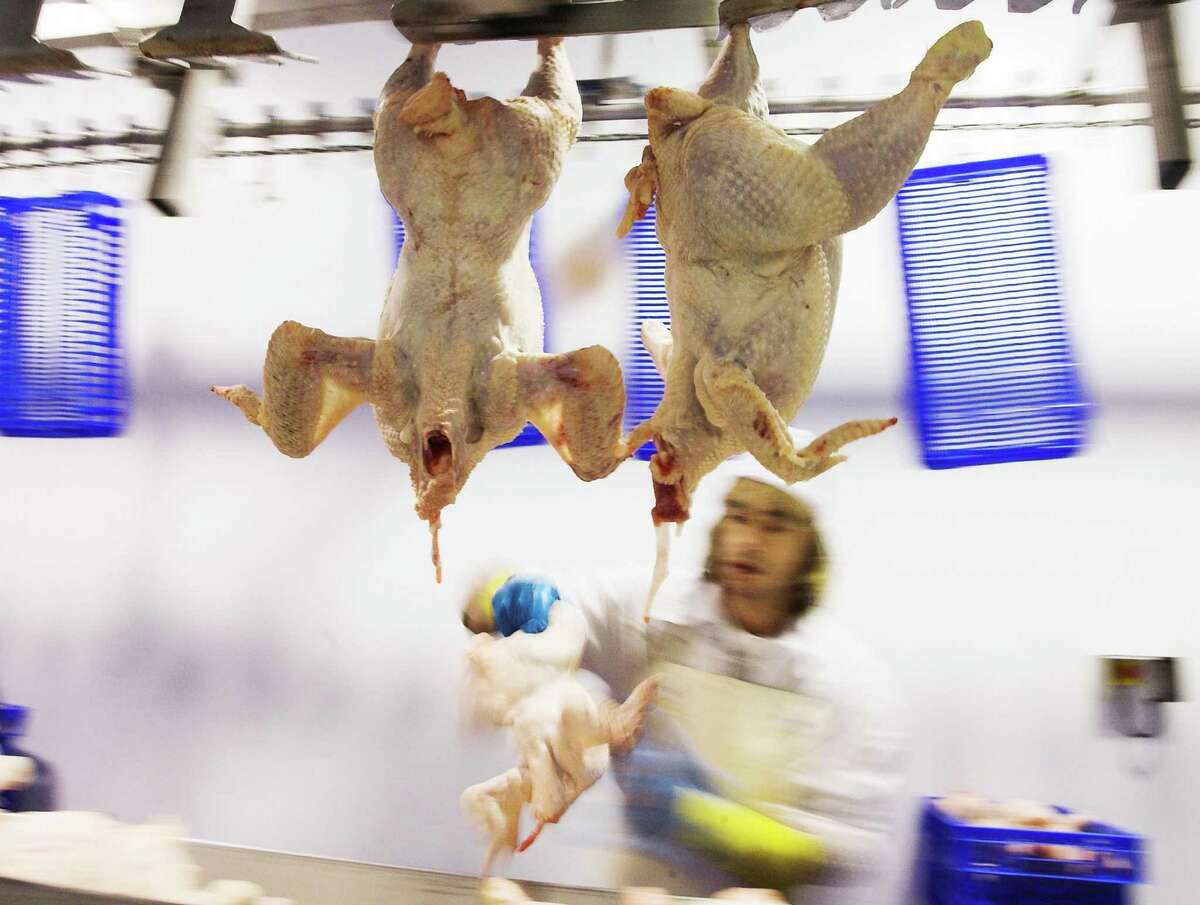
We kill 9.5 billion animals in the United States every year, and behind the death of each one of those animals is someone forced to become numb.Felix Ordonez Ausin/Reuters 2005

Growing up in Mexico City, my first job as a teenager was slitting the throats of chickens at a slaughterhouse. I started off as a “peeler.” I would pluck the feathers from their bodies as they came to me on the line. About 2% of the time, they would still be alive, still moving. Later, I moved on to a new role: cutting throats, which I did 700 to 800 times during my shift from 3 a.m. to 7:30 a.m. before heading to school at 8:30 a.m.

I was mostly numb to the killing. I didn’t recognize that each of those animals was an individual with a rich emotional life of their own. Occasionally, however, I would recognize their desperate eyes as they would look at me. But in order to do my job, to get through the day, I couldn’t care. It wasn’t until decades later, when I saw a video online of a chicken being killed that I came to grips with the disturbing reality of mass killing.

Many of us are concerned with the needless suffering of animals in industrialized animal agriculture, but the human cost of mass slaughter is just as troubling. I have two children and two grandchildren now, and I wouldn’t want any of them working in a slaughterhouse. But if not my children, then whose children will be asked to do this work?

SALE! Get an Entire 12 Weeks of Unlimited Digital Access for 99¢

ACT NOW

In addition to being the most dangerous profession in the United States, a 2016 study showed that slaughterhouse workers face higher rates of psychological distress compared to the general population. It is unnatural and inhumane for someone to kill for hours every day. The lasting trauma experienced by slaughterhouse workers is similar to that faced by combat veterans and disaster survivors and leads to high rates of drug and alcohol abuse, and domestic violence.

I experienced this firsthand: My boss and co-workers resorted to drugs and alcohol consumption after their shifts. My boss’s wife hid her black eyes behind dark sunglasses. We all directed our attention away from her plight: The abuse she was facing at the hands of someone who was supposed to care for her — the same way we had to ignore the animals we were charged with killing.

If compassion were a muscle, this work we did left it weak and atrophied.

We kill 9.5 billion animals in the United States every year, and behind the death of each one of those animals is someone forced to become numb to perform this inherently violent task. The rest of us avert our eyes. We say we care so much about where our food comes from while being shielded from the dark reality of its production.

Will we continue to increase our consumption of animals and rely on a system that requires people to kill for hours on end to feed our planet?

I certainly hope not. And we don’t have to accept the status quo.

A new bill, AB2764, introduced by Assembly Members Adrin Nazarian, D-Los Angeles, and Alex Lee, D-San Jose, would halt the construction and expansion of factory farms and slaughterhouses in California.

No doubt, future generations will look back in horror at our treatment of humans and animals. We need to create a kinder food system, one where we protect the vulnerable and foster compassion. This is the world we should all want for my grandchildren.

Susana Chavez was born in Mexico City and moved to California as a teenager. She is an elected member of the Core leadership team of Direct Action Everywhere (DxE), a global grassroots network with the goal of achieving revolutionary social and political change for animals in one generation.

Finland Joining NATO Means ‘Destruction of Their Country’: Russian Lawmaker

Exposing the Big Game's avatarThe Extinction Chronicles

Brendan Cole-5h agoFollow

View Profile

React|670

ARussian lawmaker has warned that Moscow would retaliate if Finland joins NATO as Russian aggression in Ukraine spurs the Nordic country towards membership of the alliance.

Vladimir Dzhabarov from Russia’s upper house, the Federation Council, said that any move by Helsinki to join NATO would be a “strategic mistake.”

Experts Opinion: This New $49 Smart Watch Is must For Seniors

Ad

AdTopgadgetWorld

He said that Finland had developed close ties with Russia but NATO membership would mean “it would become a target.”

“I think it [would be] a terrible tragedy for the entire Finnish people,” said Dzhabarov.

However, he said that it was unlikely that “the Finns themselves will sign a card for the destruction of their country,” in comments reported on Wednesday by Russian state-owned domestic news agency RIA Novosti.

The Finnish foreign ministry toldNewsweekin…

View original post 421 more words

End the Killing of Black Bears in California 

Exposing the Big Game's avatarCommittee to Abolish Sport Hunting Blog

from Project Coyote
End the Killing of Black Bears in California Voice your support for bears to the California Fish & Game Commission before Thursday, April 21

The California grizzly was hunted to extinction nearly a century ago. Now, the state is failing to protect California black bears from hunting, despite bear killing being unethical and relying on dubious claims about the health of the population.

The California Department of Fish & Wildlife has reported population declines of up to 67%, but continues to approve the hunting of black bears. They are considering increasing hunting opportunities even though black bears are already facing extreme hardship from wildfires, drought, and vehicle accidents.

Our partners at the Humane Society of the United States petitioned the California Fish and Game Commission (CFGC) (petition 2021/2022-027) to enact a moratorium on bear hunting, citing concerns over the health and viability of the state’s…

View original post 922 more words

Noam Chomsky: We’re nearing “the most dangerous point in human history”

Exposing the Big Game's avatarThe Extinction Chronicles

OpinionbyMatthew Rozsa-Yesterday 2:53 PMFollow

View Profile

React207 Comments|369

Support journalism

©Provided by SalonNoam Chomsky

Noam ChomskyBrill/ullstein bild/Getty Images

Renowned linguist, philosopher and Salon contributorNoam Chomskyissued a dire warning on Wednesday that humanity is at a crucial point in its history — largely due to the twin threats ofclimate changeandnuclear war.

Experts Opinion: This New $49 Smart Watch Is must For Seniors

Ad

AdTopgadgetWorld

“Because of Trump’s fanaticism, the worshipful base of the Republican Party barely regards climate change as a serious problem. That’s a death warrant to the species,” Chomsky said in an interview withThe New Statesman. The American scholar, who is currently a professor at the Massachusetts Institute of Technology and the University of Arizona, also warned of Russian President Vladimir Putin’s “monstrous” war in Ukraine. Chomsky explained that Putin has set off a…

View original post 509 more words

Army report finds horses that carry the coffins of America’s heroes live in ‘unsatisfactory’ conditions, after 2 die

Exposing the Big Game's avatarThe Extinction Chronicles

By Drew F. Lawrence and Katie Bo Lillis, CNN-4h agoFollow

View Profile

React59 Comments|372

The military horses that carry America’s heroes to their final resting place in Arlington National Cemetery are living in unsanitary and potentially life-threatening conditions, according to a US Army report reviewed exclusively by CNN, consuming poor-quality feed, suffering from parasites and standing in their own excrement in tiny mud lots scattered with gravel and construction waste.

©Elizabeth Fraser/Digital/Arlington National CemeteryIn this November 5, 2021, file photo, the 3rd US Infantry Regiment Caisson Platoon and an Armed Forces Body Bearer Team honor the late retired Gen. Colin Powell during a special military funeral at Arlington National Cemetery, in Arlington, Virginia.

Experts Opinion: This New $49 Smart Watch Is must For Seniors

Ad

AdTopgadgetWorld

Two military working horses died unexpectedly within 96 hours of each other in February –  one of whom perished…

View original post 2,312 more words

Hypersonic-Missile Delay Puts U.S. Further Behind Russia and China

Exposing the Big Game's avatarThe Extinction Chronicles

Tony Capaccio-Yesterday 1:22 PMFollow

View Profile

React|211

(Bloomberg) — The first U.S. hypersonic weapon will be delayed for as long as a year under a new schedule, even as lawmakers protest that the Pentagon is lagging behind in a new technology that Russia has already used in Ukraine and China has demonstrated in a space launch.

©BloombergThe Pentagon building in Arlington, Virginia, U.S., on Friday, April 9, 2021.

Most Read from Bloomberg

The goal to declare an “early operational capability” for the Lockheed Martin Corp. missile by Sept. 30 has been moved back to sometime in the next…

View original post 826 more words

Elon Musk Warns His Followers Of A Population Collapse: Should You Be Worried?

Aaron Bry – Yesterday 7:08 AMFollow

View Profile

React221 Comments|449

Earlier this year, Tesla Inc (NASDAQ: TSLA) CEO Elon Musk took to Twitter to warn his followers: “We should be much more worried about population collapse.”

© Provided by BenzingaElon Musk Warns His Followers Of A Population Collapse: Should You Be Worried?

Musk added that if there weren’t enough people for Earth, then there definitely won’t be enough people for Mars.

So, is population collapse something we should be seriously worried about? 

Musk referenced United Nations numbers that estimated nearly 10 billion people on the planet by 2050. Musk called these numbers nonsense. Birth rates have declined in a lot of developed countries, including the U.S. But birth rates are cyclical and declined in large part during the COVID-19 pandemic.

Musk also chimed in recently about the COVID-19 baby “bust” and of lack of children as issues.

Related Link: Elon Musk Tweets On Pandemic Baby Bust: Why A Lack Of Kids Is The Real Problem

There Are Some Concerns: Shanna Swan is an environmental and reproductive epidemiologist and professor at the Icahn School of Medicine at Mount Sinai in New York. Swan’s book “Count Down” hit the shelves in February 2021.

Related video: Elon Musk, Twitter’s “Most Influential” Person (QuickTake)

Play

Current Time 0:08

/

Duration 7:44

Loaded: 10.34%LQCaptionsFullscreenUnmute

0

Elon Musk, Twitter’s “Most Influential” Person

In “Count Down,” Swan outlined the various ways chemicals and endocrine disruptors have lowered sperm counts throughout the last century, threatening humanity’s chance of survival. These chemicals are found in common aerosols and plastics. By some measures, sperm counts in the West have dropped as much as 50%, Swan said.

Here Are 20+ Mother’s Day Presents She Will Actually Love And Use For 2022.

Ad

AdGadgets Laboratory

So this all sounds very concerning, right?

“Doomed is kind of an emotional word. It’s not a scientific word, right?” Swan said in an interview with GQ. “But let me tell you what I think. I think that sperm counts are really low in many places in the world, and people should be very concerned. Yes, I take it seriously. Am I panicking? No.”

So Why Isn’t She Panicking? Swan explained that while there are products and habits which have decimated the population’s sperm count, the reverse was also true. Swan suggested there are things we can do to alleviate, and even reverse, the harmful effects of chemicals. 

Swan wrote about one man who was a regular sperm donor. One day he was told his sperm count didn’t pass the threshold for him to be a donor.

“He was one of their prime donors, and then suddenly he didn’t make the cut, and they said, ‘What’s up?’ And he said, ‘Well, let’s see: I changed jobs; it’s more stressful. I have a new girlfriend, she smokes,’ and so on. And so he went back and he cleaned up his act, and then after a couple of months, his sperm count returned,” Swan explained. 

Now, this is very anecdotal and not the same as reversing a sociological effect that impacts millions of people. With that said, there is plenty of evidence that cutting out smoking, improving diet and increasing exercise are all real ways that one can increase sperm count. 

Should you be worried about population collapse? Yes, but not panicked. There is little to no evidence indicating we are facing an imminent collapse of the population. But we should be more mindful of some of the negative effects associated with the products we use every day. 

Photo; Courtesy Of Unsplash

China warns U.S. against House Speaker Pelosi visiting Taiwan

By Martin Quin Pollard – 7h agoFollow

View Profile

React232 Comments|504

By Martin Quin Pollard

© Reuters/Carlos Garcia RawlinsNews conference of China’s foreign ministry spokesperson Zhao Lijian in Beijing

BEIJING (Reuters) -China warned on Thursday it would take strong measures if U.S. House of Representatives Speaker Nancy Pelosi visited Taiwan and said such a visit would severely impact Chinese-U.S. relations, following media reports she would go next week.

China considers democratically ruled Taiwan its own territory and the subject is a constant source of friction between Beijing and Washington, especially given strong U.S. military and political support for the island.

The possible visit has not been confirmed by Pelosi’s office or Taiwan’s government, but some Japanese and Taiwanese media reported it would take place after she visits Japan this weekend.

Chinese Foreign Ministry spokesperson Zhao Lijian told reporters that Beijing firmly opposed all forms of official interactions between the United States and Taiwan, and Washington should cancel the trip.

“If the United States insists on having its own way, China will take strong measures in response to defend national sovereignty and territorial integrity. All possible consequences that arise from this will completely be borne by the U.S. side,” he added, without giving details.

Related video: U.S. Trade Representative Katherine Tai Full Interview (Bloomberg)

interesting ideas and those are certainly not talking points orPause

Loaded: 61.45%LOCaptionsFullscreenUnmute

U.S. Trade Representative Katherine Tai Full Interview

In Taipei, Taiwan Foreign Ministry spokesperson Joanne Ou would only say that inviting U.S. officials and dignitaries had always been “an important part” of the ministry’s work, and that it would announce any official visits at an appropriate time.

Experts Opinion: This New $49 Smart Watch Is must For Seniors

Ad

AdTopgadgetWorld

Sunday marks the 43rd anniversary of the United States signing into law the Taiwan Relations Act, which guides ties in the absence of formal diplomatic relations and enshrines a U.S. commitment to provide Taiwan with the means to defend itself.

The last time a House speaker visited Taiwan was in 1997, when Newt Gingrich met then-President Lee Teng-hui.

Pelosi, a long time critic of China, particularly on human rights issues, held a virtual meeting with Taiwan Vice President William Lai in January as he wrapped up a visit to the United States and Honduras.

Pelosi is one of the ruling Democratic Party’s most high-profile politicians, and second in the U.S. presidential line of succession after the vice president.

Taiwan has been heartened by continued U.S. support offered by the Biden administration, which has repeatedly talked of its “rock-solid” commitment to the island.

That has strained already poor Sino-U.S. relations.

In March, a delegation of former senior U.S. defence and security officials sent by President Joe Biden visited Taiwan, a strong show of support coming soon after Russia invaded Ukraine.

(Reporting by Martin Pollard; Writing and additional reporting by Ben Blanchard in Taipei;Editing by Raissa Kasolowsky and Nick Macfie)

Trapping ban now in effect on public lands in New Mexico

Exposing the Big Game's avatarCommittee to Abolish Sport Hunting Blog

KRWG | ByAP

PublishedApril 4, 2022 at 6:45 AM MDT

coyote.jpg

ALBUQUERQUE, N.M. (AP) — It is now illegal to use wildlife traps, snares and poison on public lands across New Mexico under a ban that took effect Friday. New Mexico joined a handful of Western states that have limited trapping on public lands. The New Mexico measure, dubbed “Roxy’s Law,” was approved in 2021 following several failed attempts by animal advocates over the years to rein in a practice they have described as archaic and indiscriminate. Ranchers and wildlife conservation officers have argued that trapping is an important tool for managing wildlife and protecting livestock in rural parts of the state.

Regional

View original post

What we know about the deadliest U.S. bird flu outbreak in 7 years

April 6, 20225:00 AM ET

BILL CHAPPELLTwitter

The price of eggs has risen sharply since the start of a bird flu outbreak that has resulted in millions of birds being culled.

Justin Sullivan/Getty Images

A highly pathogenic bird flu virus is tearing its way through U.S. farms and chicken yards, spreading to at least 24 states less than two months after the first outbreak was reported in a commercial flock.

Nearly 23 million birds have died. It’s the worst U.S. outbreak of the avian flu since 2015, when more than 50 million birds died. The outbreak is driving up consumer prices for eggs and chicken meat that, like many costs, had already been rising due to inflation.

Here’s what you need to know about the outbreak.

22,851,072 birds have been wiped out

Some birds have died from the disease itself, but the vast majority are being culled to try to stop the deadly and highly infectious virus from spreading. That includes millions of chickens and turkeys in barns and backyards that had been raised to provide eggs or meat.

YOUR MONEY

Food prices are going up — and at levels Americans haven’t seen in decades

One of the worst-hit states is Iowa, where more than 5 million birds died at an egg-laying facility in Osceola on March 31, according to the U.S. Department of Agriculture. Overall, more than 13 million birds have been culled in the state.

As of around noon ET on Tuesday, 72 commercial flocks and 46 backyard flocks were reported to be infected around the country.

The bird flu poses only a low risk to humans, the CDC says

It’s rare for a human to become infected with the avian virus. No human infections of the highly pathogenic avian influenza (HPAI), which includes the H5N1 bird flu virus, have ever been reported in the U.S., according to the Centers for Disease Control and Prevention.

Sponsor Message

https://6f6ec9ca7471bacb026d03c4c242f66e.safeframe.googlesyndication.com/safeframe/1-0-38/html/container.html

The virus does not pose a special risk in the nation’s food supply, either; the CDC states that like any poultry or eggs, proper handling and heating food to an internal temperature of 165˚F kills any bacteria and viruses present — including any HPAI viruses.

There have been only four human infections of low pathogenic avian influenza (LPAI) viruses ever in the U.S., the CDC says, noting that those cases resulted in only mild or moderate illness.

The virus was first reported in wild birds

The first U.S. warning of the new outbreak came on Jan. 13, when the USDA announced a strain of the highly pathogenic avian influenza virus had been found in wild birds for the first time since 2016. Many of those first cases were in South Carolina and North Carolina, in birds killed by hunters.

The cases then spread north as wild birds migrated and spread the virus to farms. On Feb. 9, an outbreak was confirmed at a commercial turkey flock in Dubois County, Ind.

BUSINESS

Avian flu is infecting U.S. poultry flocks. It could affect the price of chicken, too

Ben Slinger, whose family raises turkeys for a meat processor, recently told Iowa Public Radio that he’s taking precautions to protect his flocks from infection, after they had to cull tens of thousands of birds in 2015. In addition to using disinfectant, workers wear separate pairs of boots for each barn.

“We know what the aftermath of that is like, and it is pretty disheartening,” Slinger said.

Known cases now range from Maine to Texas, where the virus was found in a commercial pheasant flock in Erath County on Sunday.

Land is prepared for the disposal of nearly 3 million chickens after avian influenza was recently discovered at a commercial egg operation near Palmyra, Wis.

Scott Olson/Getty Images

Grocery prices for chicken are rising

For the current week, the average U.S. price of chicken breasts rose to $3.93 per pound at major supermarkets — sharply higher than last week’s $3.14 price. A year ago, the price was $2.48, the Agriculture Department says.

Egg prices have also gone up compared to 2021, and breast tenders cost a full dollar more now than they did a year ago, according to the USDA.

“Prices for white parts are on the rise” with a few exceptions, the department said. “The cost for dark meat items are also increasing; bulk pack drumsticks, thighs, and leg quarters take up most of the spotlight.”

The last outbreak lasted about 6 months

The bird flu outbreak that peaked in the late spring of 2015 was “the largest poultry health disaster in U.S. history,” the USDA says.

Many of those infections were reported in Iowa and neighboring states near “the intersection of the Central and Mississippi flyways used by wild birds during seasonal migration,” the agency said. That’s the same region that’s now being hit hard by the virus.

In the 2015 outbreak, fomites — objects that can transfer disease — were seen as a key source of viral transmission. Such items include the boots and clothing of poultry industry employees and vehicles used to spread feed. Officials also pointed to the dense concentration of some production facilities as a source of case clusters.

The 2015 outbreak tapered sharply and ended in June of that year — but 3 million birds still died in that final month. Because of the lingering effect on the supply chain, it wasn’t until several more months later that some poultry prices peaked and then normalized, according to the USDA.