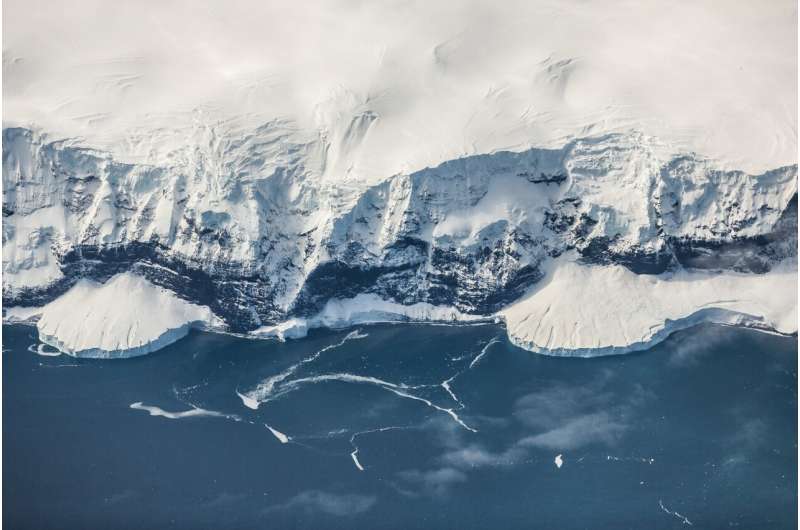
A new study provides the first evidence that rising greenhouse gases have a long-term warming effect on the Amundsen Sea in West Antarctica. Scientists from British Antarctic Survey (BAS) say that while others have proposed this link, no one has been able to demonstrate it.
Ice loss from the West Antarctic Ice Sheet in the Amundsen Sea is one of the fastest growing and most concerning contributions to global sea level rise. If the West Antarctic Ice Sheet were to melt, global sea levels could rise by up to three meters. The patterns of ice loss suggest that the ocean may have been warming in the Amundsen Sea over the past one hundred years, but scientific observations of the region only began in 1994.
In the study—published in the journalGeophysical Research Letters—oceanographers used advanced computer modeling to simulate the response…
The April 1 snow survey revealed just how critically low our snowpack is compared to normal, and how it’s contributing to a historic drought in California and the entire U.S. West region.
About 44 million people across the western United States are experiencing drought, according to Climate Central. The Sierra snowpack is at its lowest point in 70 years, and that translates to the worst megadrought in 1,200 years.
Due to climate change, snow melt is occurring on average 21 days earlier than in previous years. And because of the dry conditions, much of that snowmelt soaks into the ground before it gets a chance to run off and fill the reservoirs.
But there are ways to help preserve water sources in the future. Investment in wastewater treatment facilities and water storage, for example.
As the U.S. Supreme Court weighs the fate of Roe v. Wade, advocates on both sides of the fight are already positioning themselves for the next battle, over medication abortions or so-called abortion pills.
Why it matters: The pills for a medication abortion, mifepristone and misoprostol, are FDA-approved for use in the first 10 weeks of pregnancy. The FDA lifted long-standing restrictions in December and paved the way for doctors to prescribe them online and mail them to patients.
Republican states, meanwhile, are moving to increasingly limit access to the pills, setting up a new round of legal battles over who’ll have the final say over the distribution of the drugs.
What they’re saying: “That’s where the entire conflict is going to turn,” Mary Ziegler, a law professor at Florida State University specializing in reproductive health, tells Axios.
Since those drugs can only be used before 10 weeks of pregnancy, the right to surgical abortions will continue to loom large, Ziegler says.
Yes, but: “The kind of low visibility and flexibility of medication abortion is going to be really, really consequential” if the high court strikes down or guts Roe, she adds.
State of play: The abortion terrain has already shifted even before justices decided to review Mississippi’s 15-week abortion ban, which poses a direct challenge to Roe.
Medication abortion accounted for 54% of all U.S. abortions in 2020, up from 39% in 2017, according to the Guttmacher Institute.
The legal precedent: One of the cases that may be key in future arguments over limiting access to the pills involves a lawsuit over a painkiller. In 2014, Massachusetts instituted an emergency ban on the opioid Zohydro, saying the drug was dangerous and addictive.
But a federal judge struck down the ban, saying a state couldn’t take a drug off the market that the FDA had deemed safe, Rachel Rebouché, interim dean of Temple University’s law school, tells Axios.
Experts might argue that means states don’t have the authority to ban FDA-approved drugs, including abortion drugs. Some might even go so far as to argue that the FDA’s policies would preempt any attempt by states to ban abortion, Rebouché said.
“That’s a stretch,” she says. “I think a lot of people think that’s a difficult argument to make because states for so long have been able to regulate the practice of medicine and a law that says you can’t perform an abortion seems like regulating the practice of medicine.”
What’s next: Red states will likely pursue a strategy where they ban abortion and the use of drugs for abortion, but not the drugs themselves, according to experts who spoke with Axios.
“How a state crafts its law could impact how a court reviews it,” Greer Donley, an assistant law professor at the University Pittsburgh Law School, tells Axios.
Between the lines: This could all be a moot point since there are practical barriers to banning medication abortion.
“The reasons you see state banning medication abortion is because anti-abortion legislators recognized all too clearly that it is going to be really hard to track down pills you can take in your home and receive by mail,” Rebouché says.
That is already is causing skirmishes between states.
For instance, Missouri is also seeking to find ways to penalize out-of-state providers for providing any assistance in obtaining an abortion, Rebouché says.
“You’ll see not only this tension between state law and federal law … but you’ll see really intense interstate conflict,” Rebouché says.
What to watch: While previous abortion laws targeted those that help women seeking abortions, such as providers, it’s possible the approach may change in a world with self-managed abortions.
“Once providers are out of the equation or are outside the state’s jurisdiction, the only way to truly enforce these laws is to go after the pregnant people themselves,” Donley says.
“That’s historically something the anti-abortion movement has not wanted to do,” she adds. “But I’m curious if that’s going to change.”
To study emotions in animals, scientists need to look beneath feelings to the brain states that produce certain behaviors.
Fran Laurendeau/RooM RF/Getty Images
We humans often say that a growling dog is “angry” or a purring cat is “happy.”
But those terms are of little use to scientists like David Anderson, a biology professor at Caltech who studies the brain circuits involved in emotional behaviors. “We have to do more than just project our own emotions onto other animals,” he says, “because animals are not little people in furry costumes.”
And animals can’t tell us how they feel. Yet Anderson believes a connection exists between animal and human emotions.
“Emotions are brain functions that evolved over time by natural selection,” he says. “They didn’t just appear on the planet with the advent of Homo sapiens.”
That idea is central to Anderson’s latest book, The Nature of the Beast: How Emotions Guide Us. It’s also central to a growing scientific effort to find new treatments for disorders like PTSD by manipulating emotion-related brain circuits in animals.
In his book, Anderson describes research from his lab that suggests the brain circuits underlying human emotions have a lot in common with circuits found in mice and even fruit flies.
To study emotions in animals, Anderson says scientists first need to set aside their own perceptions of what people typically think of as emotions, such as anger, fear, sadness or joy.
In other words, they need to look beyond human feelings.
“The feeling part is just the tip of the iceberg, above the sea of our consciousness,” Anderson says. “The part below is what we share in common with animals.”
What lies beneath feelings, he says, are brain states that produce certain behaviors. And that’s the part of emotion that scientists can study. For example, Anderson’s lab has investigated fruit flies that become much more active when they see a moving shadow like the one cast by a flying predator.
“We see that the more times we deliver the shadow, the more jumpy the flies become, until they’re literally hopping around like popcorn,” he says.
And the flies keep hopping long after the shadow is gone.
Anderson would behave much the same way if he were on a hike and saw a rattlesnake.
“I’d jump in the air,” he says. “But even for minutes after the snake had slithered away into the bushes, my heart would be pounding, my mouth would be dry and I’d probably jump every time I saw a snakelike object in front of me — even if it was a stick.”
That sort of behavior is typical of a persistent brain state called defensive arousal. It’s present in both fruit flies and people, which is why Anderson believes studying fear in an insect or a mouse can reveal a lot about human emotions.
“We can try to figure out how the brain is generating that state and what makes it last so long and what makes the animal finally calm down,” Anderson says.
In mice, the answer appears to be specialized brain cells that become hyperactive when a mouse detects a threat and that return gradually to normal after the threat has passed. Anderson suspects people have a similar group of cells that generate the feeling we know as fear.
Aggression across species
Another human feeling that probably has its roots in animal emotion is anger.
There’s no way to know if animals have angry feelings, says Dayu Lin, a neuroscientist at New York University. But the sort of aggressive behavior associated with human anger can be found in fish, reptiles, birds and mammals.
So Lin has been studying the brain areas involved in aggression. And she has found one that appears to be critical.
“It’s a tiny, tiny region deep in the brain, and we all have it,” she says.
In people, this region is near the bottom of the hypothalamus, just above the pituitary gland. And studies show that in mice and other animals, this clump of brain cells is part of a core aggression circuit.
“We can evoke aggression by just artificially activating this area in the rodents,” Lin says.
Switch it on and a mouse will attack. Switch it off and even an animal’s natural aggression vanishes. There’s some evidence that this can also happen in people. Doctors sometimes use deep brain stimulation to deactivate the aggression circuit in extremely violent psychiatric patients.
“Usually the aggression is uncontrollable,” Lin says. “That’s usually the last resort.”
Trauma, fear and PTSD
Animal emotions are also helping scientists understand certain psychiatric disorders, including post-traumatic stress disorder (PTSD).
“We really see PTSD as a disorder in which this evolved, important fear response has essentially gone too far,” says Dr. Kerry Ressler of Harvard Medical School and McLean Hospital.
For a person with PTSD, even a minor event can produce a stress and fear response that lasts for hours, Ressler says. And there’s a parallel in animals.
A typical mouse will freeze when it hears a tone associated with a mild electric shock. But if the shocks stop coming, the animal soon learns to ignore the tone.
“If the animal’s had prior trauma, they’ll learn more quickly, they’ll freeze for longer and it takes them longer to extinguish or learn that that tone is actually safe,” Ressler says.
In both people and mice, trauma appears to alter a brain circuit involving the amygdala and the prefrontal cortex. And in rodents, it’s possible to regulate that circuit.
“We now understand specific parts of the circuit that increase fear and other parts of the circuit that decrease fear,” or at least the animal version of that emotion, Ressler says.
The next step, he says, is to figure out how to tweak that circuit to reduce the fear response in people with PTSD.
(Bloomberg) — President Joe Biden’s top economic adviser said the administration has warned India against aligning itself with Russia, and that U.S. officials have been “disappointed” with some of New Delhi’s reaction to the Ukraine invasion.
“There are certainly areas where we have been disappointed by both China and India’s decisions, in the context of the invasion,” the director of the White House National Economic Council, Brian Deese, told reporters at a breakfast Wednesday hosted by the Christian Science Monitor.
The U.S. has told India that the consequences of a “more explicit strategic alignment” with Moscow would be “significant and long-term,” he said.
While the U.S., Europe, Australia and Japan have piled economic sanctions onto Russia in response to its war against Ukraine, India has declined and instead has sought to continue imports of Russian oil.
New Delhi’s reaction to the invasion is complicating its relationship with Washington, where India is regarded as an important partner in countering Chinese influence in Asia.
Deese’s comments come after Deputy National Security Advisor Daleep Singh traveled to India last week for meetings with officials.
“What Daleep did make clear to his counterparts during this visit was that we don’t believe it’s in India’s interest to accelerate or increase imports of Russian energy and other commodities,” Press Secretary Jen Psaki said earlier this week.
India’s Ministry of External Affairs didn’t respond to a message seeking comment sent after normal business hours.
The U.S. and the rest of the Group of Seven nations will continue to collaborate with India and hope that they can align efforts to the greatest extent possible, a U.S. official said in a briefing for reporters Wednesday on new sanctions against Russia. India and the U.S. collaborate extensively on food security and global energy, the official said.
The official asked not to be identified as a condition of the briefing.
In addition to seeking Russian oil, India is the world’s largest buyer of Russian weapons. Indian Prime Minister Narendra Modi has resisted entreaties from the U.S. and Australia to scale back the relationship, insisting that India needs Russian weapons to counter both Pakistan and China and that alternatives are too expensive, according to people familiar with the matter.
(Updates with request for comment to Indian government in eighth paragraph. Modi’s title was corrected in a previous version of this story.)
To the editor: I’ve been a subscriber to The Times for several years, even continuing my subscription after moving out of Los Angeles. While I appreciate a lot of the reporting, I’m baffled by some of your choices.
Why was the climate piece not front-page news? That the United Nations just warned Earth is on track to be “unlivable” is massive, life-altering information that should be front and center.
The more we treat climate change as a non-urgent issue, the less time we will have to fix it. I am 26 years old and watching any hope for my future being ripped away from me.
This is urgent. This is important. Please treat it that way.
Audrey Stanton, New York
..
To the editor: Thanks for your excellent editorial reminding us that we’re not moving quickly enough on climate change. Where is the urgency? Why are politicians not pushing harder for more renewable energy and less coal, oil and gas?
They’ve been warned again and again, but their actions are not enough to help us.
This week, Los Angeles will experience high temperatures in the 90s, and extreme heat is expected to be with us for the foreseeable future. This is in addition to the fires, droughts and floods that are already costing us billions.
I’ve asked my representatives to put a gradually increasing price on carbon emissions at the mine or well and return these pollution fees to consumers, which scientists and economists say is the fastest and least painful way to rein in emissions. What do I hear? Nothing.
Former President Barack Obama expressed support for his former vice president, Joe Biden, late Tuesday after footage from the 44th president’s first White House visit in five years showed audience members swarming Obama with Biden left looking forlorn on stage.
“Always great catching up with @POTUS. Thanks for all you’re doing to help even more Americans get access to quality, affordable healthcare,” Obama tweeted, sharing a photo posted by Biden’s official Twitter account.
Hours earlier, video circulated on social media that showed Biden walking around by himself before throwing his hands up in apparent confusion. Behind him, audience members — including Sen. Amy Klobuchar (D-Minn.) — surrounded Obama while holding an animated conversation.
Republicans were quick to hit Biden with the video, with the Republican National Committee’s Research Twitter account posting, “Literally no one wants to talk to Joe Biden.”
The account tweeted a second video showing Biden appearing to linger behind Obama as he shook hands with the caption, “This is so sad.”
“No one of his 80 million voters wants to talk to him?” tweeted John Dennis, a Republican candidate for the House of Representatives from California.
“I’d almost feel badly for him if he weren’t doing such a good job of destroying our country. The irony is that this is like that SNL skit where all the world leaders shunned Trump, but it’s happening to Biden by his own people in real life,” tweeted writer Matthew Betley.
Biden bumps fists with Barack Obama while signing an executive order intended to strengthen the Affordable Care Act.Vice President Kamala Harris reacts as Biden and Obama shake hands.
“No video better sums up the Biden presidency,” conservative commentator Mercedes Schlapp posted. “The man is a puppet and nobody likes him. Not even his own party.”
Biden had played the good sport during Tuesday’s event touting ObamaCare, referring to himself as “Joe Biden, Barack Obama’s vice president” and saying the return of his former boss to the White House “brings back so many good memories.”
Obama had teased the current White House occupant by acknowledging him as “Vice President Biden” before quickly adding, “That was a joke.” And Vice President Kamala Harris kicked off proceedings by asking the audience, “It feels good, doesn’t it?”
After a crowd swarmed Obama, Biden was left looking lonely on stage.Following the event, Biden signed an order boosting health insurance subsidies.Biden and Obama work the crowd.
Following the event, Biden signed an order boosting health insurance subsidies to eliminate what he described as a “family glitch” — which makes it difficult for lower-income workers to buy health insurance for family members through ObamaCare.
As of Wednesday, Biden’s average approval rating was a measly 41 percent, while his average disapproval rating is 53.8 percent, according to data collected by RealClearPolitics.
Biden and Vice President Kamala Harris listen to Obama deliver remarks on the Affordable Care Act.Obama greets guests after speaking about the Affordable Care Act.
A recent poll conducted by Rasmussen Reports found that 56 percent of Americans disapprove of the president’s job performance while only 42 percent approve.
Shelter animals are also suffering the consequences of the war in Ukraine. This week, volunteers at a shelter outside Kyiv, the capital, found more than 250 malnourished dogs that had survived weeks without food or water but also more than 300 that had starved to death.
Rodrigo Abd/AP
More than 300 dogs were discovered dead in a Ukrainian animal shelter after weeks without food or water, an animal charity said on Tuesday.
Volunteers with UAnimals, who returned to the Borodyanka shelter outside Kyiv, the capital, said the dogs were forced to starve to death by Russian troops who had left them trapped in cages for nearly a month amid constant bombings.
“With the shelter increasingly inaccessible due to the conflict, sadly many of the dogs perished,” Wendy Higgins, director of international media for Humane Society International, told NPR in an email.
Higgins said the organization is working with local groups and volunteers, including UAnimals, to relocate the surviving animals.
“Now that Russian troops have withdrawn from the area and the shelter has finally become accessible by volunteers, the Ukraine Small Animal Veterinary Association has been able to confirm that 253 dogs were found alive,” she added.
Of those, 25 were taken in critical condition to nearby veterinary clinics, where they seem to be improving and are now understood to be in a stable condition, according to Higgins.
“The remaining dogs are being taken out of the shelter to safety, and foster homes in countries neighbouring Ukraine are being sought for them,” Higgins explained.
UAnimals posted several gruesome images on Facebook showing the emaciated canines lying lifeless in small enclosures. In some photos, they appear to be embracing each other; in others, they are piled in a mound with their malnourished limbs akimbo.
The pictures have appalled Facebook users, who have called it all an “inexcusable tragedy” that is “too disgusting for words.”
“Animals do not start war. They have no choice. What a terrible way to die,” commented one user.
Others are blaming the people who run the shelter, saying they shouldn’t have left the dogs locked inside in the first place.
Higgins offered a bright spot of news: A Ukrainian cat will soon be reunited with its family in Arkansas, after the family managed to escape the carnage of the occupation.
AT the UN biodiversity conference, Geneva, delegates try to negotiate a Paris-style agreement for nature, their first in-person meeting in two years. Photograph: Mike Muzurakis/IISD/ENB
Time is running out for governments to reach an ambitious Paris-style agreement for nature, say campaigners, who warn that crucial negotiations to protect biodiversity are moving at a “snail’s pace”.
Amid increasingly alarming scientific assessments about the state of life on Earth, negotiators are meeting in Geneva for talks aimed at halting and reversing the destruction of wildlife and ecosystems that support human civilisation.
Governments are hoping to make up for lost time in the much-delayed process, which should have seen an agreement in autumn 2020, with three concurrent meetings running until 29 March, the first time they have met in person since talks in Rome in March 2020 as the pandemic closed in.
The draft UN convention on biological diversity (CBD) sets out targets for the end of the decade. These include protecting 30% of land and sea, eliminating billions of dollars of environmentally harmful government subsidies, and restoring at least a fifth of degraded freshwater, marine and terrestrial ecosystems.
The final version will be negotiated in Kunming, China, at the Cop15 summit, which is expected to be held at the end of August, the first time China has held the presidency for a major UN environmental agreement.Q&A
What is the Kunming biodiversity conference?
Show
But campaigners say negotiations are moving slowly and another meeting before the final summit in China might be necessary.
Guido Broekhoven, head of policy at WWF International, said: “Despite countries arriving in Geneva committed to making progress on a global plan to tackle nature loss, the complexity of the issues discussed have led negotiations to move forward at a snail’s pace over the last week. We are yet to see governments try to close the enormous gap between the unambitious draft global biodiversity framework currently on the table.”
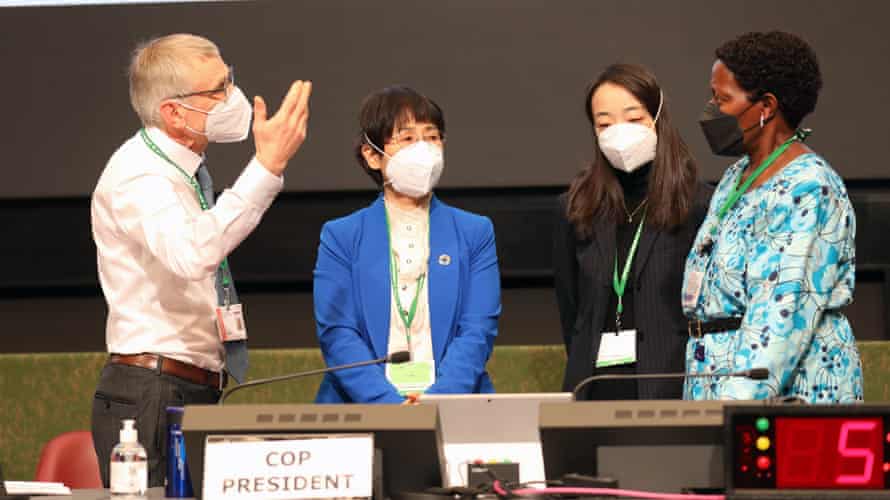
An opening session at the conference with delegates including China’s Zhou Guomei (2nd left), and the UN’s Elizabeth Maruma Mrema (right). Photograph: Mike Muzurakis/IISD/ENB
These concerns were echoed by Li Shuo, a policy adviser for Greenpeace China, who has been following the biodiversity negotiations closely. “Many of the issues, we simply don’t have enough time to deal with,” he said. “Several of the most important discussions have not happened yet and I don’t think there will be time in Geneva. I am worried watching the sessions and we can’t keep kicking the can down the road.”
Unlike its sister climate convention, which has one overarching aim, the CBD balances three main goals: conservation, sustainable use of biodiversity and the fair sharing of benefits from genetic resources. Its scope and complexity mean targets can sometimes compete with each other, and sources said another in-person meeting might be needed ahead of the final talks in China later this year.
Curbs on agricultural pollution and sharing the benefits of digital genetic resources are expected to be particularly controversial, but a recent decision by 173 governments to draw up a legally binding treaty on plastics pollution has bolstered negotiations.
Despite concerns about the speed of negotiations, UN diplomats leading the process said there were signs of hope. “I am cautiously optimistic,” said Basile van Havre, co-chair of the CBD working group responsible for drafting the agreement, from the talks in Geneva.
“We need to find the bliss point between ambition and resources. For example, there will be a good discussion here on 30 by 30 [the target to protect 30% of land and sea by 2030] with the provision that it will be approved if there is money on the table. I am interested to see how the discussion on pollution unfolds, particularly on pesticides and nutrients,” he said.
Last month, the UK, US, Canada and Argentina blocked proposals to halve nitrogen waste – commonly the result of intensive farming and fossil fuels – at the UN environment assembly in Nairobi, Kenya. The decision raised questions about a draft target to reduce nutrient runoff by at least 50% by 2030.
Advertisement
How this decade’s targets will be enforced and monitored is also under discussion in Geneva. Governments have never met a target to halt the destruction of nature.
“The previous targets didn’t inspire public and political action. I don’t think they were very well known,” said Bernadette Fischler Hooper, head of international advocacy at WWF UK. She said becoming “nature positive” by 2030 must become the north star for biodiversity, akin to the 1.5C and 2C targets in the Paris agreement.
“If we get an inspiring mission from this new framework, it will become a joint rallying cry like the one we have for climate,” she said.
Scientists and conservationists are proposing that up to half of Earth’s land and oceans be protected for nature. Is it a necessary step or a pipe dream?
A
As humans continue to rapidly expand the scope of their domination of nature – bulldozing and burning down forests and other natural areas, wiping out species, and breaking down ecosystem functions – a growing number of influential scientists and conservationists think that protecting half of the planet in some form is going to be key to keeping it habitable.
The idea first received public attention in 2016 when E.O. Wilson, the legendary 90-year-old conservation biologist, published the idea in his book Half Earth: Our Planet’s Fight for Life. “We now have enough measurements of extinction rates and the likely rate in the future to know that it is approaching a thousand times the baseline of what existed before humanity came along,” he told TheNew York Times in a 2016 interview.
Once thought of as aspirational, many are now taking these ideas seriously, not only as a firewall to protect biodiversity, but also to mitigate continued climate warming.
One of the major reasons for adoption of these extreme preservation goals is a 2019 report by the Intergovernmental Science-Policy Platform on Biodiversity and Ecosystem Services (IPBES), which found that more than 1 million species are at risk of extinction. Conducted by hundreds of researchers around the world, the study is considered the most comprehensive analysis of the state of the world’s biodiversity ever.
ADVERTISEMENT
That report concluded that it’s not only species that are at risk, however. The myriad life-support functions that these species and ecosystems provide also are threatened — everything from clean water and air to flood control and climate regulation, food and a host of other services.
Reserving large swathes of land can help to stabilise vital ecosystems, such as rainforests, that act as carbon sinks (Credit: Getty Images)
Moreover, some scientists are concerned that the face of the globe has been so altered that the global ecosystem could be near a tipping point that would disrupt the climate and biological systems that sustain life and cause widespread – and perhaps disastrous – environmental instability.
The ambitious goal of protecting and restoring natural systems on a large scale is shared by a number of groups and people. The Wyss Campaign for Nature is working in partnership with the National Geographic Society to support the goals of the so-called “30×30” movement, a highly ambitious initiative that aims to protect 30% of the planet, on land and at sea, by 2030.
Another organisation called Nature Needs Half has drawn in scientists and conservation groups, including the Sierra Club, that are pressing for the protection of 50% of the planet by 2030.
The European Parliament has pledged to protect 30% of European Union territory, restore degraded ecosystems, add biodiversity objectives into all EU policies, and earmark 10% of the budget for improvement of biodiversity. In the US, politicians working with conservation organisations recently introduced a resolution to drum up support for protection of 30% of the US’s land and marine areas.
The US alone loses a football field of nature every 30 seconds
All eyes are now on the Convention on Biological Diversity (CBD), a multilateral treaty created by the United Nations to write a 10-year biodiversity plan.
The 2010 CBD meeting called for 17% of the terrestrial planet to be protected in some form and 10% of the oceans by 2020. That goal was not reached – currently about 16% of the terrestrial planet has been protected, and less than 8% of marine ecosystems. So reaching the 2030 goal would require a near doubling of land protections and a quadrupling of ocean protections – all in the next decade.
It’s a daunting challenge, even if the will is there, with some countries – notably Brazil and the US – moving in the opposite direction. Brazilian President Jair Bolsonaro has opened up the Amazon rainforest to an onslaught of land-clearing, logging and agricultural development.
And last year the Trump Administration eliminated the Landscape Conservation Cooperative Network, an Obama-era program that created 22 research centres to tackle landscape-level conservation problems across the US. The Trump administration also is either opening up, or proposing to open up, large areas of protected federal lands to oil and gas drilling and other resource exploitation, including the vast Arctic National Wildlife Refuge in Alaska.
Upholding the rights of Indigenous people is crucial to issue of protecting some of the world’s most biodiverse habitats, such as the Brazilian Amazon (Credit: Getty Images)
It’s estimated that the US alone loses a football field of nature every 30 seconds. Far more natural lands are being lost in the Brazilian Amazon, with more than 10 square miles of rainforest being burned or cleared every day.
Still, there is optimism. Reports of large-scale climate changes, including the melting of Arctic sea ice, as well as the attention focused on 17-year-old Swedish climate activist Greta Thunberg, seem to have stirred some kind of awakening. “Younger people in general are focusing on environmental issues,” said Brian O’Donnell, director of the Campaign for Nature. “And we are seeing much less of a siloed approach, where those who work on climate and those who work on conservation are working together more.”
Some countries are already moving toward ambitious goals. In Canada, Prime Minister Justin Trudeau has committed the country to the Pathway to Canada Target 1 initiative, which aims to reach the 30×30 goals. (At the same time, Trudeau has committed the federal government to building the Trans Mountain pipeline to carry Alberta tar sands oil to Pacific ports, a move that has drawn fierce criticism from First Nations leaders and environmentalists.) Costa Rica, Colombia and others are also ramping up conservation efforts.
This is not just about saving species, it’s about maintaining ecological processes that underpin all life on Earth – Gary Tabor
The ambitious goals of campaigns like 30×30 and Half Earth have been met with criticism. Some question whether focusing on saving up to half of the land’s surface will do much for protecting the remaining biodiversity. In a 2018 paper, Stuart Pimm, a conservation biologist at Duke University, and others, argued that most biodiversity occurs in tropical regions, and much of it is already fragmented. They wrote how protecting broad swaths of nature in largely untouched regions – such as Canada’s boreal forest – has benefits. But the remaining large wild landscapes are mostly in temperate regions, which won’t do much for protecting biodiversity because by far most of the world’s species are in the tropics. “This begs our question of how much biodiversity will we protect if the trend to protect wild places continues,” says Pimm.
In a paper published last year in Nature Sustainability, a team of researchers argued that protecting vast swaths of the Earth could, conservatively, affect 1 billion people and in some cases increase poverty. “Social issues must play a more prominent role if we want to deliver effective conservation that works for both the biosphere and the people who inhabit it,” said Judith Schleicher, a University of Cambridge researcher who led the study.
While conservation has tremendous positive aspects, she said, “certain forms of ‘fortress’ conservation can see people displaced from their ancestral home and denied access to resources they rely on for their survival.”
Some dispute that argument. “When IPBES came out it said 1 million species are at risk,” said Gary Tabor, president of the Center for Large Landscape Conservation in Bozeman, Montana. “But this is not just about saving species, it’s about maintaining ecological processes that underpin all life on Earth. It’s 1 million species interacting with each other that clean your water, give you good soil, that scrub the air of CO2 – that’s what you lose.”
Disease prevention, for example, is a major ecosystem service of intact natural systems. As people clear wild lands or eat wild animals, the diseases that these creatures carry can jump the species barrier and spill over into human societies. The ongoing coronavirus outbreak, for example, may have originated in bats.
Finding ways for people to live inside nature reserves, rather than trying to keep people out with walls, can help preserve biodiverse habitats overall (Credit: Getty Images)
Nature must also be integrated into the places where people live, says Tabor. “The biggest misconception about Half Earth is that there is going to be a bizarre construction where people live on one side and nature lives on the other,” he said. “That doesn’t work in terms of ecological function, and it doesn’t work because there is conservation value outside of protected areas.”
Conservationists also say that a major part of reaching the 30 or 50% goals is supporting indigenous lands and community conservation areas. Indigenous peoples occupy or manage 28% of the planet’s land, but more than 40% of protected areas, according to the IPBES report, co-chaired by Sandra Díaz, a professor of ecology at the National University of Córdoba in Argentina.
What are the biggest barriers to setting aside 30%, and perhaps 50%, of the planet for nature, even as the global population continues to grow rapidly? “The way our world agricultural system works,” said O’Donnell of the Wyss Campaign for Nature. “It encourages lots of encroaching on more and more land for cattle and farming. That’s a key one.”
The number of paved roads is expected to double in the next 25 years, opening up large areas to illegal resource exploitation, poaching, and other threats
The Wyss Campaign for Nature is prioritising solutions for financing protection. “We’re studying the cost of protection and also looking at what would be the cost if you didn’t protect this amount of land, in terms of lost ecosystem services, clean waters, and fisheries,” said O’Donnell. “There’s a cost of conserving land, and a cost if we don’t.”
And setting aside lands for protection is by no means the end of the story. The Campaign for Nature is studying possible sources of funding so countries can pay for the cost of managing and protecting these lands.
Among the many threats facing large tracts of land, including those ostensibly under protection, are road building and fragmentation. The number of paved roads is expected to double in the next 25 years, opening up large areas to illegal resource exploitation, poaching, and other threats, says Tabor.
“People will go first to the boreal [forest] or Central Africa,” for protecting large tracts of nature, says Tabor. “But most of where the biodiversity exists is in fragmented areas. To have effective nature in those areas we will have to have a connectivity strategy.”
O’Donnell agrees that there are huge challenges. “Just as the climate crisis requires major systematic change in the coming decades, it’s the same with biodiversity,” he says. “There are a lot of other things competing for money and attention.”
—
Correction
This article originally stated that the International Union for Conservation of Nature was working with Nature Needs Half; we have been informed that this is not the case and have updated accordingly. We apologise for the error.
—
This article was originally published by Yale e360, and is republished with permission – read the original story here. This is also why this story does not have an estimate for its carbon emissions, as Future Planet stories usually do.