Minnesota’s busiest wildlife rehabber will stop admitting and treating bird species that are susceptible to the H5N1 avian flu.
The Wildlife Rehabilitation Center of Minnesotaannounced the temporary policy change over the weekend, calling it a “grave decision” the organization will reevaluate once the Highly Pathogenic Avian Influenza (HPAI) “has run its course.”
This means that, for the time being, the rehab center will not take in:
Any ducks or diving birds
Geese
Pelicans
Raptors (including hawks, eagles, vultures and owls)
Gulls
Tundra swans
Great blue herons
“As you can imagine, this is not a decision made lightly,” said WRC’s communications director Tami Vogel on a Minnesota birding message board. “We are so sad to see HPAI moving through the wild populations this…
A U.S. official tells Fox News that “any movement of Russian forces from around Kyiv is a redeployment, not a withdrawal, and the world should be prepared for a major offensive against other areas of Ukraine.” The remark comes after Russia claimed it was withdrawing forces there in hopes of laying the groundwork for a peace deal with Ukraine.
The White House said Tuesday that President Joe Biden will “convene a call with President Macron of France, Chancellor Scholz of Germany, Prime Minister Draghi of Italy, Prime Minister Johnson of the United Kingdom to discuss the latest developments regarding Russia’s invasion of Ukraine.”
Ukraine’s military said Tuesday that Russian forces have destroyed at least 60 religious buildings since their invasion…
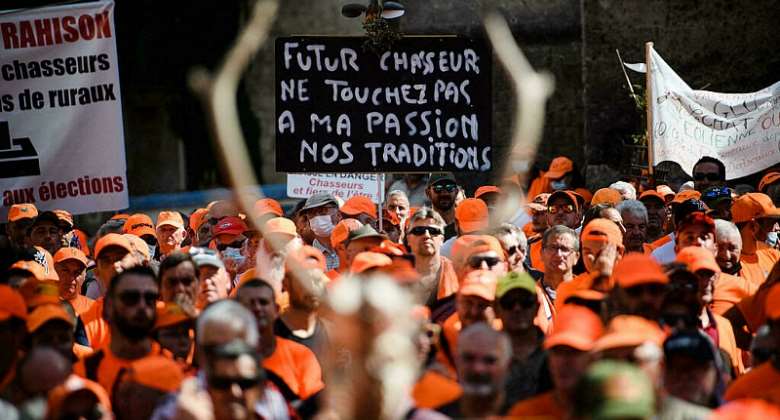
Hunting is France’s most popular pastime after fishing and football, but a series of recent shooting accidentshas put its many enthusiasts in the firing line themselves. As presidential candidates fish for votes, the hunters see an opportunity to go on the offensive to defend a popular tradition dating back to the revolution.
Some four million people hold alicence to hunt in France, and 1.1 million activate them each year.
“We’re a political force,” William Schraen, president of theNational Federation of Hunters(FNC), confidently told a number of presidential candidates at a meeting in Paris last week.
The hunting lobby is strongand even if the majority of French people live in urban areas, no politician with an eye on the Elysée can afford to neglect the rural vote.
If the United States and Russia were to engage in direct air, land, and sea conflict, the risk ofnuclear warwould become much more likely.
An all-out nuclear war would likely involve more than 3,000 warheads used by both sides, killing well over 100 million Americans and Russians.
Russia’s invasion of Ukraine is already one of the most destructive and lethal wars in recent memory, from the shelling of cities to the use of thermobaric“vacuum weapons.” That’s led experts and civilians, alike, to wonder what—if NATO and the U.S. become directly involved in the conflict—a nuclear war between Washington and Moscow might look like.
Here,Popular Mechanicsexamines two classic nuclear attack scenarios: a counterforce strike and a countervalue strike. The counterforce scenario…
The N.C. Wildlife Resources Commission will open more than 92,500 acres in threebear sanctuaries in Western North Carolina to hunting, after voting Feb. 24toallow permit hunting there and change thenames to “management areas.”
At its February meeting, the commission unanimously supported the rule change for the 2022-23 season after considerablepublic input and opposition, a move toward the state’s goal of managing bear populations and human-bear interactions.
The rule change received “significant public comment,” according to a wildlife commission announcement. “After careful consideration, the rule passed unanimously. The Commission also voted to amend the name of these areas from Designated Bear Sanctuaries to Designated Bear Management Areas.”
Critics have pushed back against the rule change, questioning whether there is a population or interaction problem, the data used to justify the change, and how effective the hunting will be in accomplishing the…
JEFFERSON CITY- The Missouri Department of Conservation will offer five bull elk permits and another 400 permits for hunting up to 40 black bears this fall.
The application period begins on May 1, and residents have until May 31 to apply. All permits will be given by a random drawing. There will be a $10 fee for each applicant in both permits.
At least one permit for the bull elk is designated for qualifying area landowners while the remaining permits for the general public, MDC said. At least 10% of black bear permits will be allocated to qualifying area landowners.
Only Missouri residents who will be at least 11 years of age by the first day of the hunt for which they are applying are eligible to apply for elk and bear…
US President Joe Biden and his son Hunter Biden depart after a pre-inauguration church service in Washington, US, January 18, 2009. PHOTO: REUTERS
Russia’s claim that United States President Joe Biden’s son Hunter Biden helped finance a US research programme dedicated to ‘bio-weapons’ in Ukraine may be partially true, as per new emails providing insights to the development.
The Russian Defence Ministry had claimed on Thursday that Hunter Biden, the son of the US president, was directly involved in financing biological laboratories in Ukraine.
Igor Kirillov, the head of the Russian Radiation, Chemical and Biological Protection Force, presented documents at a news conference in Moscow, allegedly of Ukrainian and US origin, seized in battles in Ukraine.
While intelligence experts termed the allegations a brazen propaganda to justify the Ukraine’s invasion…
Twenty people were shot and killed in central Mexico on Sunday, the State Attorney General’s Office (FGE) said in a statement. Authorities were called to the scene at around 10:30 pm following reports of an attack on a venue often used for hosting illegal betting on cockfights in the town of Las Tinajas, Michoacan state.
The attorney general’s office said the “lifeless bodies” of 16 men and three women were found at the scene, all bearing gunshot wounds. It later said an additional person had died en route to hospital, while another five were being treated for injuries.
Authorities did not give a reason for the shooting.
But Michoacan and neighboring Guanajuato are two of Mexico’s most violent states, due to turf wars between rival gangs involved in drug trafficking and other illegal activities — including trade in stolen fuel.
Earlier this month, gunmen killed the mayor of a town in Michoacan. Aguililla Mayor Cesar Valencia was shot dead by unknown attackers while traveling in a city hall vehicle near a soccer field in the town, officials said.
Michoacan is also the world’s biggest avocado-producing region and threats against a U.S. inspector working there last month prompted the United States to suspend Mexican exports of the fruit for more than a week.
Last month, an armed attack in the state believed to be the result of a gang dispute was reported to have killed up to 17 people at a wake.
The attack was believed to be motivated by “revenge” by one cell of the Jalisco New Generation Cartel against another, deputy security minister Ricardo Mejia said.
The government said it was unable to confirm the death toll because no bodies were found, although DNA samples of 11 possible victims were collected at the site.
The Department of Justice considers the Jalisco cartel to be “one of the five most dangerous transnational criminal organizations in the world.”
Mexico has been trapped in a spiral of cartel-related violence since 2006, when the government launched a controversial anti-drug operation with federal troops.
There have been more than 340,000 murders since then, most of them blamed on fighting between criminals, according to official figures.
Earlier this month, gunmen killed nine people in an attack on a house in central Mexico, in an “execution” of six men and three women that shook a middle-class area of the usually peaceful town of Atlixco.
Puebla state governor Miguel Barbosa said that the attack had been on “a place for the sale and distribution of drugs” and that the victims’ identities were unknown.
Throughout their coverage of Russia’s invasion of Ukraine, mainstream media and political commentators in America have framed the conflict as an earth-shattering violation of international norms in our modern era. “The Russia-Ukraine crisis is about whether the world will operate according to rules or whether anarchy will prevail,” Richard Haass, the president of the Council on Foreign Relations, tweeted the day of the invasion. “World order is the oxygen for all else, for whether and how we live.” Reporters and commentators have described Russia’s invasion as a moral atrocity without any kind of recent precedent: “medieval”; comparable to Adolf Hitler; marking the “first” test of the post-1945 “rules-based” global order; or triggering the advent of a new one entirely.
For those of us who closely observe U.S. conduct on the world stage, the self-sanitizing and ahistorical nature of many of these narratives has been head-spinning. Not too long ago the U.S. knowingly deceived the global community before entering a war of choice and a neocolonial nation-building project in Iraq that killed hundreds of thousands of civilians. President Joe Biden and much of our commentariat claim standing up to “bullies” is “who we are.” Yet the U.S. has actively aided Saudi Arabia in its brutal, ongoing war and blockade against Yemen, which human rights watchdogs say has involved Saudi Arabia taking actions that are similar to or worse than Russia’s in Ukraine and created one of the world’s worst humanitarian crises. (Notably this has not deterred Biden from trying to cozy up to the country for help in dealing with the Russia crisis.) This is just to list two of countless examples of the U.S. being a bully, or siding with bullies, after World War II and disregarding a rules-based order.
A truthful account of the world is a precondition for understanding it.
Pointing out this inconsistency and self-flattering omission of history is often to enter a conversational minefield. But the value of this exercise is not to play some abstract game of whose hands are dirtier. It’s about combating imperial blindness — American society’s endless capacity for self-delusion about how and why it conducts itself as a hegemon in the global arena. By cloaking its geopolitical goals in the language of moralism and sweeping contradictions beneath the rug, the U.S. is able to behave recklessly and brutally without taking accountability for its behavior or learning lessons from it. And refusing to understand that only sows the seeds for further misbehavior and poor decision-making.
A truthful account of the world is a precondition for understanding it. And understanding the real world, rather than living in a world of idealized self-image or visceral feeling, is a precondition for behaving morally and effectively. The myth of Russia’s actions as entirely singular — as a kind of satanic force that has caused a rupture in the progress of human civilization — increases the odds that American society develops a mandate for a rash intervention such as a no-fly zone that could spark a war with Russia. (Stopping evil incarnate would seem to be a worthy reason to risk World War III.) But a more accurately contextualized account of what’s happening and recently happened in the world can act as a source of humility and restraint. At a time when belligerence surrounding the Russia-Ukraine crisis is intensifying, it couldn’t be more urgent.
Russia’s military operation in Ukraine — an act of aggression and a war of choice — is heinous. Russian President Vladimir Putin is not just conducting an unjustifiable war, he’s waging it brutally. Human rights watchdogs say that Russia has used indiscriminate cluster bombs, and it’s clear that Russia is targeting areas that are densely populated with civilians. Aiding Ukraine’s suffering population and surprisingly well-performing military is a moral and, as far as I can tell, strategically sound thing to do.
But the Biden administration’s aid to Ukraine was not fueled by moral imperatives. The U.S. is not a country that gazes upon the world with an altruistic eye, but a state which, like any other, pursues its own interests. Moreover, in its quest to be the world’s sole superpower, it has acted ruthlessly for decades. Which is why the U.S. painting its involvement on behalf of Ukraine as a pure extension of defend-the-underdog principles is nonsense.
javascript:void(0)
Pause
Ad 00:29 – Up Next “Here’s what Putin will do if he can’t take Ukraine”
Loaded: 0.00%Unmute
Here’s what Putin will do if he can’t take Ukraine
The chief reason that U.S. policymakers are so attentive to Ukraine’s welfare and need for aid is because Russia is a huge, nuclear-armed and powerful adversary of the U.S., and they’re concerned about the instability and precedent set by the invasion, particularly in immediate proximity to NATO countries. Because of this invasion’s geopolitical significance — and the racialized assumption that Europe is not a place where war belongs, in contrast to the Middle East or Central Asia — the media has focused on this with extraordinary intensity, and in the process reshaped our national consciousness.
It makes sense that a war that matters a lot to the U.S.’s core geopolitical interests would be huge news. What doesn’t follow is that that war in and of itself elevates the U.S.’s moral sensibilities.
Stephen Wertheim, a senior fellow in the American Statecraft Program at the Carnegie Endowment for International Peace, told me the U.S. seems to be seizing an opportunity to reclaim a moral high ground. “In this moment there is a real danger that American leaders will use this moment to reclaim a sense of moral purity that the U.S. has lost domestically and internationally as a result of the war on terror and post- 9/11 military operations,” he told me. “This attempt seems to take the form of ‘Russia is a terrible actor’ — which is true, and ‘Therefore the U.S. is more virtuous than it was a month ago’ — which is false.”
The U.S. cannot cleanse itself using Putin’s unconscionable actions.
The U.S. cannot cleanse itself using Putin’s unconscionable actions. And the more it tries to do that, and the more it tries to erase every other conflict in recent world history in order to single him out in the process, the easier it becomes to go to war. The urge to enter war will increase if the entire country buys into its own propagandistic moralizing and is convinced that Russia’s actions constitute an entirely unique threat to humanity. Growing pressure from the public, Congress, and our hawkish press could put pressure on the Biden administration, which has generally been very clear about wanting to avoid military intervention against Russia, to act imprudently if Russia does something like uses chemical weapons or accidentally hits a NATO target.
Consistency in describing the world creates a foundation for more careful behavior: If people remember that Russia is one of many actors that are doing horrific things internationally then people will breathe before deciding what kind of action should be taken. (Note that one does not have to ignore the political and moral differences between Russia and other countries to note the fact that some of Russia’s actions are not unique.) Considering that the stakes are a possible confrontation between the world’s two biggest nuclear powers, thinking about the civilizational long game in this situation is rather important.
And consistency in describing the world is a prerequisite for any agenda to try to behave consistently in the world — and reckon with how radical of a task it is. Seeking a consistently morally upstanding foreign policy would require confronting and clashing with some longtime allies, thawing tensions with some adversaries and making all kinds of decisions on whether to intervene in every armed conflict in the world. Naturally any serious exercise of this kind raises questions of constraints on national resources and practical concerns about international stability and access to trade routes and energy. And if it truly is serious, it would require confronting the reality that much of the global economy and security are not based on noble and democratic principles but shaped by power structures led by the West and capital.
Calling for consistency is a demand for honesty about what’s really driving the events of the world. It prevents the public from fooling itself with self-flattering illusions. And it’s a critical part of any agenda to truly better the world.


 4 HOURS AGOLISTEN