What’s the best way to honor and celebrate the birds?
United Poultry Concerns and Chicken Run Rescue want to hear YOUR ideas for ways to inspire compassion and action for chickens. Winning entries will receive prizes and be publicized by UPC and CRR!
Winners Receive: First Place: Personally inscribed copy of For The Birds by author Karen Davis Second Place: Set of notecard portraits by artist Mary Britton Clouse and a coupon for 2023 CRR calendar Third Place: Life-sized huggable chicken sculpture by artist Melissa Swanson
The US intelligence community believes that Russian President Vladimir Putin views the conflict in Ukraine as a “war he cannot afford to lose,” suggesting he is likely to escalate the conflict without any concern for the number of civilians killed, the US’s top intelligence chiefs told Congress.
Director of National Intelligence Avril Haines said at a congressional hearing Tuesday that US intelligence assesses Putin is unlikely to be deterred by the setbacks the Russian military has faced in Ukraine, suggesting he is doubling down on his campaign to keep Ukraine from joining NATO.
Since pheasants are commonly raised in outdoor flight pens and it’s not feasible to raise them indoors, producers face a unique risk when it comes to avian influenza.Tom Venesky, tvenesky@lancasterfarming.com
As cases of highly pathogenic avian influenza turn up inNew York,New Jersey and Delaware, poultry and game bird producers in Pennsylvania worry their state could be next.
The threat of the disease was a major focus at the 2022 Pennsylvania Game Breeders and Hunting Preserves Conference held Feb. 28 in State College.
While much of the disease concern centers on commercial poultry farms and backyard chicken flocks, those who raise game birds such as pheasants, quail and chukars need to be equally vigilant, according to Megan Lighty, an avian diagnostic and outreach veterinarian with Penn State Extension.
That may be a surprise to Russia as its invasion grinds toward a third destructive week. Not only has it seemingly underestimated its neighbor’s resolve, but now its ability to wage — let alone win — a prolonged conflict has come into question.
Between the stiffer-than-expected Ukrainian resistance,Russia’s early military woesand theexpansive penaltiesthat have roiled Moscow’s economy, could President Vladimir Putin look for an early offramp to end the war?
Ukrainian officials and Russia experts did not express much optimism.
“Maybe there’s more happening there than meets the eye, but the Kremlin has gone all in on this invasion — a major war of a kind Russia has not fought since 1945,” said…
In the long run, no substantial benefits will result from the further growth of America’s population. The gradual stabilization of the U.S. population through voluntary means would contribute significantly to America’s ability to solve its problems.
That statement from a half-century ago was the unequivocal central finding of the groundbreaking report by the U.S. Commission on Population Growth and the American Future, submitted to the president and Congress on March 27, 1972.
However, rather than moving toward a gradual stabilization, as was clearly recommended, America’s population over the past 50 years has grown to 334 million, an increase of 123 million (about 60 percent) since 1972.
In addition, America’s population is projected to continue growing over the coming decades. According to its main projection series, the Census Bureau expects the nation’s population to be close to 400 million around mid-century.
Preceding the commission’s establishment by several years, former President Richard M. Nixon remarked that “One of the most serious challenges to human destiny in the last third of this century will be the growth of the population… Whether man’s response to that challenge will be a cause for pride or for despair in the year 2000 will depend very much on what we do today.”
Nixon’s observations are even more prescient today. Given climate change, environmental degradation, biodiversity loss, pollution and congestion, population growth in America and the rest of the world remains among the serious challenges to human destiny in the 21st century.
Similarly and more recently, naturalist Sir David Attenborough remarked, “It’s not just climate change; it’s sheer space, places to grow food for this enormous horde. Either we limit our population growth, or the natural world will do it for us, and the natural world is doing it for us right now.”
Without a doubt, America’s population growth is a major factor affecting domestic demand for resources, including water, food and energy, and the worsening of the environment and climate change. There is hardly any major problem facing America with a solution that would be easier if the nation’s population were larger. On the contrary, population stabilization would help to resolve several.
Stabilizing the population would reduce pressures on the environment, climate and the depletion of resources and gain time for America to find solutions to its pressing issues. If the United States intends to address climate change, biodiversity loss, pollution, etc., it must consider how its population affects each issue.
In contrast to the commission’s central finding, some do not recognize the need to stabilize the population. Their reasons are largely based on profit, politics and power. They give little attention to the consequences of population growth on the nation’s future.
For instance, many economists contend that continued population growth is needed to fuel economic growth. Their “bigger-is-better” arguments simply ignore or dismiss the negative consequences for the country, which are threats to the wellbeing of today’s Americans as well as the long-term sustainability of the nation.
Others argue the nation would be “more happy” with more people. Slow population growth, they claim, hurts not only America’s economic growth but also the national mood. Concerns about climate change and the environment are omitted from their rhetoric.
Some advance nationalistic appeals for continued population growth, maintaining that the more patriotic one is the more one ought to believe in a large and growing America.
Another argument is the view that “America isn’t full” and can accommodate many more people, particularly more immigrants. Those advocates, however, rarely ever specify how large the population must become to be considered full nor do explain why America needs to be full.
Thousands of scientists worldwide take an opposing view. Among their major recommendations for governments to address the climate emergency is a call for the stabilization of the world population, or ideally, a gradually reduced population within a framework that ensures social integrity.
Gradually stabilizing America’s population will provide an exemplary model for other countries to emulate. Rather than racing to increase the size of their respective populations in a world with 8 billion humans and growing, nations would see America moving away from the unsustainable demographic strategy.
As American couples are having fewer children than in the past for a host of social, economic and personal reasons, the nation’s fertility rate is unlikely to return to the replacement level any time soon. And pro-growth calls for Congress or the administration to establish pro-natalist policies to raise fertility appear unlikely to be adopted.
So, with the nation’s fertility below the replacement level, stabilizing America’s population will necessarily involve substantially reducing immigration levels, estimated at approximately 1.1 million per year. If immigration levels were, for example, close to zero, America’s projected population in 2060 would be 320 million versus 405 million if immigration continued at the same pace.
After 50 years since the commission presented its central finding, it is well past the time for the White House, Congress and the American public to embrace the gradual stabilization of the population, which is essential for ensuring the country’s vitality, prosperity and sustainability.
Joseph Chamie is a consulting demographer, a former director of the United Nations Population Division and author of numerous publications on population issues, including his recent book, “Births, Deaths, Migrations and Other Important Population Matters.”
The US Department of Agriculture reported outbreaks of a highly lethal type of bird flu in commercial flocks in Maryland and South Dakota over the weekend, adding to concerns that wild birds are spreading the disease across the country.
Farmers are ordered to kill their flocks after the disease is detected, and importing countries including Mexico, China and Korea have imposed state-specific import restrictions in response.
Thebird flu outbreakis the worst since 2015, when nearly 50 million birds, mostly turkeys and egg-laying…
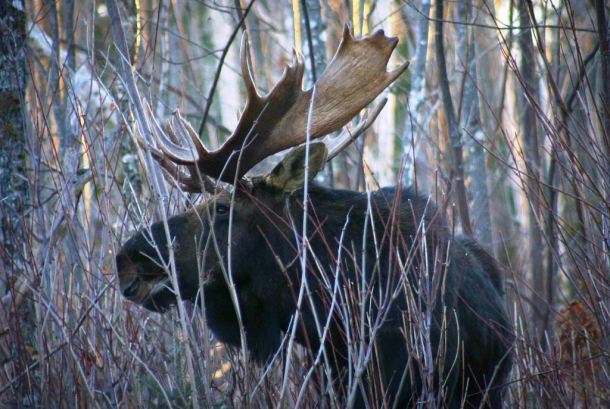
A bull moose patrols the Northeast Kingdom. Photo by Wayne LaRouche
Covered in thousands of blood-draining ticks, Vermont moose are struggling to survive.
Based on continuedstudiesconducted by the University of Vermont and the Vermont Fish & Wildlife Department on moose health, officials hope that decreasing the number of moose could reduce tick transmission and stabilize the population.
To that end, the department plans to issue another 100 moose-hunting permits this October.
Get all of VTDigger’s daily news.
You’ll never miss a story with our daily headlines in your inbox.
The Vermont Fish & Wildlife Board approved the proposal last month, with plans to issue “60 either-sex moose hunting permits and 40 antlerless moose permits.”
In 2021, the program drew almost 6,000 applicants for the 100 permits. A total of 62…
North Carolina’s Wildlife Resources Commission voted tooverturn the state’s bear hunting banthat was first enacted in 1971 when the black bear population was fewer than 1,000.
By
Shirin Ali | March 7, 2022
A black bear walking down a gravel road in the Alligator River National Wildlife Refuge near Manteo, North Carolina.Greg Meland/ iStock
Less than two weeks into Russia’s invasion of Ukraine and the country’s people and armed forces have mounted a staunch resistance against Russia’s forces.
Russia is seen as having made less progress than it expected.
Still, analysts say Russia is likely to “win” in Ukraine, and have drawn out various scenarios for what comes next.
As many as 1.5 million people have fled to neighboring countries in Europe for safety.
Less than two weeks intoRussia’s invasion of Ukraineand the country’s people and armed forces continue to mount a staunch — and undeniably brave — resistance against Russian forces.
But for all of Ukraine’s heart and courage in facing down multiple, sustained attacks from Russia’s military in the north, east and…
Minutes before the Ukraine invasion, the Russian presidentwarnedof “consequences that you have never experienced in your history.”
“Yes, Putin might do the unthinkable,”saidJames Clapper, the former director of national intelligence, toBusiness Insider.
For almost a decade, Russian doctrine has been to “escalate to deescalate,” to threaten or even to use nuclear weapons early in a conventional conflict or crisis…