Analysis by the Marine Conservation Society shows dredging at England’s Dogger Bank site has increased despite government pledge to ban the practice
Mermaid’s fingers and Flustra foliacea (hornwrack) at the Dogger Bank in the North Sea, a vital breeding ground for cod and whiting.Photograph: JNCC/PA
The government is under pressure to safeguard Britain’s marine conservation areas after analysis showed the Dogger Bank protected site has seen a threefold increase in destructive bottom trawling sinceBrexit.
A year ago, conservationists welcomed governmentproposals to ban trawling and dredgingfishing practices, which involve dragging weighted nets over the seabed, in 14,030 sq km (5,400 sq miles) of English waters, an area equivalent to the size of Northern Ireland. The area includes Dogger Bank and three other marine protected areas…
It took a lot of left turns to afford this swish spread.
Three-time NASCAR Cup Series champion,Tony Stewart, nicknamed “Smoke,” is listing his Indiana luxury log hunting ranch for a whopping $30 million, which makes it the most expensive listing in the state.
Located in Columbus, less than an hour from the Indianapolis International Airport, the home is made up of six bedrooms and 11 bathrooms and is situated on a colossal 415 acres of land.
METHOW, Wash. — If the environment is the spine for the Methow Valley, it almost had its back broken in the past year. While it is still standing, the threat has made residents here start to think about an uncomfortable truth.
“Do you believe in climate change? I said, ‘I don’t have to believe, it’s here. I know it’s here. I’ve got the evidence, belief has nothing to do with it,'” said an adamant Alan Fahnestock on a recent February day while he stood outside a Mazama fire station. “Climate change is clearly a huge issue.”
Fahnestock is a long-time Methow Valley resident and volunteer firefighter who watched as the Cedar Creek and Cub Creek fires combined to burn more than 125,000 acres in the summer of 2021. It’s more square mileage than Seattle and Tacoma combined. The fire lapped up at the Freestone Inn nearby and perilously close to the Sun Mountain Lodge as well, two year-round destinations.
But it also damaged the lifeblood of this region’s winter tourism season, the cross country ski trails. The Methow Trails is the largest Nordic system in America. It’s a pristine, groomed, outdoor wonderland that has been the training grounds for dozens of elite athletes and novices as well.
The summer made this place where people chase their chance for Olympic rings looks more like a scene from “The Lord of the Rings.” National news outlets compared the air quality to Mordor because the sky was so black and the air stagnant. Trees that lined the trails burned and yet others near the Chickadee trailhead were wiped out.
“The urgency is a lot more when fire touches half your network. It’s real. It’s here. It’s consistent each year. It’s a consistent presence in our community,” says Methow Trails Executive Director James DeSalvo. “It’s not just the lack of snow, it’s more extreme summers.” DeSalvo calls the trails-related tourism the “cog and hub to not just recreation here, but also the economy and helps how people can benefit and survive here.” He said it accounts for close to $8 million annually in the valley of roughly 2,000 full-time residents. He has already begun working with the forest service to try and figure out whether trails can be rerouted to higher elevations.
Over at the Loup Loup Ski Bowl, which has been around since 1958, this snow season has been nothing short of horrific. The Bowl, fifteen minutes outside Twisp, advertises it gets 150″ of snow a year. This season, there has only been one-third of that, according to their official register. “I cannot remember a February this warm,” admitted Executive Director Brent Nourse, who stood near an open grassy patch at the bottom of the bowl.
“It’s coming into stark focus now,” he said. “I think in order for us, as an organization to continue, we definitely need to expand and make sure that we’re offering activities and experiences all year round. So, we are working with some other organizations to expand the mountain biking opportunities here.” Those long-range plans are in development right now, he says, which would create an all-seasons configuration of the Bowl for the first time in history.
But that’s the reality of the situation, he said. The conditions have changed.
It may be the biggest fight for survival here since the late 1970s when residents helped block the development of a major downhill ski resort near Mazama, citing the environmental impacts. Instead, it turned into a Nordic paradise butted up against the annual closure of Highway 20 to the north.
Fahnestock said he also believes there will be a lack of water to go around if the summer fires continue to be as severe. That’s why he’s posting signs and publicly pushed for $100,000 to activate a well near Mazama so firefighters don’t have to travel into Winthrop to reload water during a crisis.
Right now, Fahnestock said he’s met about half that goal but wants to get it done by May before the next wildfire season as the landscape continues to warm up. He said, “It’s very clearly changing.”
Watch: Standing ovation for Ukrainian ambassador at Biden speech
US President Joe Biden has told Congress that Vladimir Putin badly misjudged how the West would hit back once he invaded Ukraine.
In a primetime speech, Mr Biden vowed “an unwavering resolve that freedom will always triumph over tyranny”.
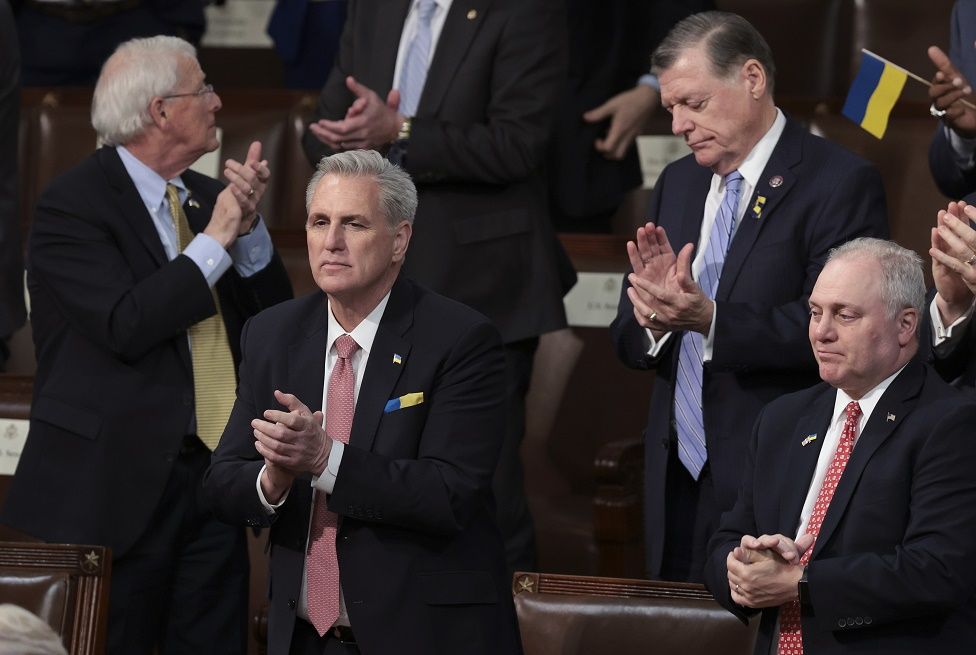
Democrats and Republicans reacted to Mr Biden’s appeal to show support for Ukraine by rising in unison to applaud.
His State of the Union address came as pandemic-weary Americans grapple with galloping inflation.
In an hour-long address to lawmakers on Tuesday night, the Democratic president said: “Putin’s war was premeditated and unprovoked. He rejected repeated efforts at diplomacy.
“He thought the West and Nato wouldn’t respond. And he thought he could divide us here at home.”
Mr Biden – whose chaotic withdrawal last year from Afghanistan damaged his popularity among Americans – added: “Putin was wrong. We were ready.”
He announced that the US would ban Russian aircraft from American airspace, following similar bans by Canadian and European authorities.
The US and it allies have launched a barrage of sanctions against Russia’s economy and financial system and Mr Putin himself. In his speech Mr Biden deviated from his prepared remarks by vowing further economic retaliation, warning Mr Putin: “He has no idea what’s coming.”
The US president also welcomed Ukrainian Ambassador Oksana Markarova, who received a standing ovation as she sat in US First Lady Jill Biden’s VIP box.
Hours before his address, Mr Biden spoke to Ukrainian President Volodymyr Zelensky to discuss what help the US could give his country after six days of the Russian assault.
“Let each of us… stand and send an unmistakable signal to Ukraine and to the world,” Mr Biden told his audience in the chamber of the House of Representatives.
It was one of the few moments in the speech where members of both deeply polarised parties rose together to clap and cheer for Ukraine, many of them waving Ukrainian flags that had been passed out before the president arrived.
Mr Biden’s first formal State of the Union speech, an annual event pushing a president’s agenda, came as his approval rating languishes.
Just 40.6% of Americans are happy with his job performance, according to the RealClearPolitics polling average.
After addressing his biggest foreign policy crisis, the invasion of Ukraine, Mr Biden confronted a host of domestic troubles dogging his presidency, from the enduring pandemic, to soaring consumer prices, to a wave of violent crime.
Image caption,Ukraine flags and badges were in evidence
Although the US jobless rate has sunk to 4%, inflation has hit a 40-year high.
The president sought on Tuesday night to empathise with hard-pressed working families, saying: “I get it.”
He promised a plan for “building a better America”.
Mr Biden argued the best way to counter rocketing consumer prices was to boost domestic production of cars and semiconductors and rebuild the nation’s roads and bridges.
Opinion polls show Americans are also unhappy with Mr Biden’s handling of the coronavirus pandemic.
But on Tuesday, members of Congress who attended the speech were not required to wear masks for the first time in months.
Mr Biden said: “Last year Covid-19 kept us apart. This year we are finally together again.”
More than 2,000 Americans are still dying daily of Covid, according to the latest figures, the highest official tally of any country in the world.
With the nation’s homicide rate having hit a 25-year high, Mr Biden rejected calls to defund the police that were taken up by a wide spectrum of his fellow Democrats.
“The answer is not to defund the police,” said the president. “The answer is to fund them.”
Iowa Governor Kim Reynolds delivered the Republican response to Mr Biden’s speech.
She sought to portray a presidency that had sent America back to the late ’70s “when runaway inflation was hammering families, a violent crime wave was crashing on our cities, and the Soviet army was trying to redraw the world map”.
Joe Biden46th and current president of the United States
A member of Ukraine’s parliament called President Joe Biden’s State of the Union speech “a total disappointment” on TODAY Wednesday, as she called for a no-fly zone to protect her country from Russian airstrikes.
Oleksandra Ustinova expressed frustration with Biden and the international community for not offering more protection to Ukraine, specifically against Russia’s military aircraft. She said “the whole of Ukraine” was watching Biden’s speech on Tuesday night.
“To be honest, it was a total disappointment for us,” she told Savannah Guthrie. “I can explain why. Today, the whole world is watching Ukrainians being executed. I cannot name it the other way around.
“The right definition is an execution because we see bombs going into our civilian houses every day, we see children dying every day on the streets or in their houses if they didn’t make it to the bomb shelter, we see bombs coming to the orphanages, to the schools. And we had been promised a protection by the international community. We gave up our nuclear weapons.”
Ukraine once possessed the world’s third-largest arsenal of nuclear weapons following the breakup of the Soviet Union in 1991.
However, the sovereign nation signed the Budapest Memorandum in 1994 in which Russia, Britain and the U.S. committed to refrain from attacking Ukraine in exchange for the country turning over its nuclear arsenal to Russia to be dismantled.
On TODAY Wednesday, Vice President Kamala Harris reiterated Biden’s State of the Union comments that the U.S. will not send troops to Ukraine to fight against Russia. Biden said the U.S. will “defend every inch” of NATO territory, but that does not include Ukraine because it is not a member of NATO.
“And today when I see President Biden saying that we’re going to protect every inch of the NATO territory, excuse me, we’ve been promised the same thing when we gave up our nuclear weapons,” Ustinova said. “The Russians have totally destroyed all of the airports in Ukraine, the majority of the roads. We are grateful for help, but we need protection in our sky.”Story continues
The Biden administration has said it will not send military aircraft to enforce a no-fly zone over Ukraine because that would amount to a direct confrontation with Russian forces.
“We have been protecting ourselves on the ground, but if we do not protect our sky, if there is (not) a no-fly zone or if there is no dome to protect it with the air defense, we will all go down,” Ustinova said. “People will literally die.”
Ustinova wanted to know what it would take for the U.S. to heighten its involvement beyond economic sanctions and military assistance of NATO countries bordering Ukraine.
“What is the red line that (Vladimir) Putin has to cross for NATO and the U.S. to step in?” she said. “We’re not asking for boots on the ground. We’re asking for the iron dome or for the no-fly zone.
“We need the protection of the sky so that the bombs and the missiles do not hit our children. Every time I hear about the possible provocation from Putin — Putin is a psycho. He doesn’t need to be provoked. We did not do anything. We didn’t do anything in 2014, we did not provoke him now. He still invaded, and he’s bombing the cities, he’s bombing the civilians.”
Ustinova also expressed doubt that NATO would come to the military defense of members like Poland or the Baltic countries if Putin decided to invade them.
She questioned the use of sanctions that do not include targeting Russia’s massive oil and gas industry, which is the nerve center of its economy.
Earlier, Harris said on TODAY that the U.S. has taken steps to “mitigate the impact on the American consumer” of any disruption in the global oil supply that could result from the backlash against Russia.
“Then we have to go and tell every American that the president of the United States is protecting them from paying an extra 20, 30 cents for a gallon of gas and that’s why so many Ukrainians have to die,” Ustinova said.
A new report released this week by the UN’s Intergovernmental Panel on Climate Change (IPCC) looks at the causes, impacts and solutions to climate change.
The reportgives the clearest indication to date of how a warmer world is affecting all living things on Earth.
Here are five things we learnt from it.
1- Things are way worse than we thought
From the melting of the Greenland ice sheet to the destruction of coral reefs, climate related impacts are hitting the world at the high end of what modellers once expected. And much more quickly than previously assessed by the IPCC.
Right now, as the new report makes clear, around 40% of the world’s population is “highly vulnerable” to the impacts of climate change.
But the burden is falling mainly on those who did the least…
De-extinction scientists are hoping to bring back a long lost “tiger” back to life, almost 100 years after the last of its kind died. Researchers are planning to use stem cells to create an embryo of the Tasmanian tiger that they can implant into a surrogate animal.
Tasmanian tigers, or thylacines were a type of marsupial that went extinct in mainland Australia around 3,000 years ago. They lived on in Tasmania until European settlers wiped them out in the wild through hunting. The last living Tasmanian tiger died in captivity in 1936.
Scientists with the University of Melbourne, Australia, have been working on a project to “de-extinct” the animals for years and new funding for a state-of-the-art laboratory has brought them to the brink of resurrecting this lost species.
A philanthropic donation of over $3.6m USD made to the university is expected to go to towards the Thylacine Integrated Genetic Restoration Research (TIGRR) Lab.
Tasmanian tigers, also known as Tasmanian wolves, were a predatory marsupial that shared some characteristics with modern-day dingoes or wild dogs in Australia. They were visually striking animals with distinctive stripes similar to zebras on their hindlegs.
Scientists working at the lab said the funding be used in three main areas in their de-extinction efforts: Greater understanding of the Tasmanian tiger’s genome, using the stem cells from other marsupials to make a thylacine embryo, and transferring it to a surrogate animal such as the mouse-like dunnart.
“The level of support we have for this project now I think it is conceivable that we could a thylacine-like cell within 10 years,” Professor Andrew Pask, from the School of BioSciences at the University of Melbourne, told Newsweek.
“It’s a big job and it needs some significant support to drive it. Fortunately we now have that. It is a bit like Jurassic park—we start with a living cell from a closely related species, in this case the dunnart—and we edit that cell to turn it genome into that of the thylacine. Once you have your ‘thylacine’ cell, you can use cloning technology to turn that cell into a living animal.”
Pask said that the donation would provide 10 years of funding for the TIGRR lab. Pask and his team helped sequence the Tasmanian tiger genome in 2017. This mapped out the DNA blueprint of the animal and provided a crucial first step on the road to bringing it back to life.
Stock image of Thylacine in captivity. The animals were hunted to near extinction by European settlers in Tasmania and the last one died in captivity in the 1930s.TOPICAL PRESS AGENCY / STRINGER/GETTY IMAGES
Pask said that Tasmanian tigers were a good candidate for de-extinction as they played a crucial role in balancing Tasmania’s ecosystems and could do so again if they were reintroduced.
“The thylacine was our only apex predator and its loss from the ecosystem destabilizes everything that sits beneath it,” Pask said. “A great example of this is Tasmanian devil facial tumour disease, which nearly wiped [that species] out. If you have these apex predators around like the thylacine—they pick off and eat the sick animals controlling the spread of diseases.”
He said that the gene-editing technologies advanced at the lab could also help protect other key marsupial species in Australia threatened by ecosystem changes and recent wildfires because they help safeguard biodiversity from being lost in the region.
The donation came from the Wilson Family Trust.
Russel Wilson told the University of Melbourne about the decision to fund the research: “We came across Professor Pask’s incredible work, believe it or not, via some YouTube clips on him talking about his research and passion for the thylacine and Australian marsupials. We realise that we are on the verge of a great breakthrough in science through improvements in technology and its application to the genome.”
This article has been updated to include quotes from Andrew Pask.
Ukraine’s defense ministry confirmed the arrival of Russian airborne troops on Telegram, though it is unclear if they are involved in a ground battle just yet. “There is an ongoing fight between the invaders and the Ukrainians,” they said. Authorities confirmed Wednesday midday that “massive shelling…
Environmental Violations, Animal Cruelty and Threat to Wolves Cited in New Lawsuit
Quincy, Calif. — Feather River Action! and Project Coyote jointly filed a lawsuit yesterday against Plumas and Sierra counties for violating the California Environmental Quality Act (CEQA) to stop the illegal killing of wildlife without the legally required environmental review.
The lawsuit challenges the county’s failure to conduct the CEQA review of its $76,623 taxpayer-funded contract with the U.S. Department of Agriculture (USDA) Wildlife Services program. This contract authorizes Wildlife Services, a highly controversial federal program, to kill hundreds of animals in these counties every year without assessing the ecological impacts of widespread killing and without considering alternative non-lethal management strategies.
Each year, Wildlife Services indiscriminately kills millions of animals nationwide — approximately 80,000 in California alone — largely at the behest of commercial agriculture. Wolves, a protected species in California, are particularly at risk from USDA Wildlife Services’ activities, which killed 1,921 coyotes and thousands of other animals in Plumas and Sierra counties over the past decade.
Records indicate that in just one year, USDA Wildlife Services killed more than 1,100 muskrats in Plumas and Sierra counties. Muskrats play a similar ecological role to beavers, 247 of whom were killed by local Wildlife Services employees over the past ten years. Wildlife Services operates across 35 of 52 California counties.
Across the country, Wildlife Services’ outdated program continues to rely on the use of indiscriminate and often inhumane tools to kill native wildlife including snares, poisons and aerial gunning. Condemned by professional scientists with the American Society of Mammalogists since the early 20th century, this taxpayer-subsidized program continues to focus on lethal and non-selective killing practices despite widespread availability and efficacy of non-lethal methods and husbandry practices.
“In all my years of trying to work with Wildlife Services, I have yet to encounter any willingness from the program to consider the best available science demonstrating that nonlethal is the most effective way to protect livestock,” said Michelle Lute, PhD in wildlife management and national carnivore conservation manager for Project Coyote. “Instead, they consistently insist on retaining every archaic tool in their lethal arsenal even when it repeatedly endangers people’s children and companion animals and does little to protect livestock. Fortunately, California has CEQA, a law that protects people and the environment from a rogue program that should be named Wildlife Disservices.”
Wildlife Services spends more than $100 million annually nationwide in taxpayer dollars to kill over one million animals, including birds, beavers, coyotes, mountain lions, bears, wolves and other animals. These killings occur despite peer-reviewed research showing that reckless slaughter of native carnivores causes broad ecological destruction and is not proven to protect livestock or reduce human conflicts with wildlife.
In 2016, wildlife advocates, including Project Coyote, successfully sued Mendocino County, requiring the county to perform a full Environmental Impact Report of their contract with Wildlife Services pursuant to CEQA. Last year, Mendocino County ultimately chose to end its contract with Wildlife Services and instead pursue non-lethal strategies for wildlife management.
This follows on the heels of Marin County, which ended its contract with Wildlife Services in 2000 and adopted a non-lethal cost-share program to assist ranchers with implementation of non-lethal methods, such as fencing and guardian animals, to reduce conflicts between wildlife and livestock. Non-lethal methods precipitated a 62% decline in coyote predation on sheep in Marin from 2002 to 2011, according to the Marin County Department of Agriculture.
Despite efforts by Project Coyote and Feather River Action! to urge the Plumas and Sierra County Board of Supervisors to follow a similar path and comply with CEQA by considering the destructive ecological impacts of their contract with Wildlife Services, the board chose instead to renew their contract with no environmental review and little to no consideration of effective nonlethal alternatives.
“Many of us were horrified to learn that our local taxes were funding this cruel and unnecessary killing program,” said Joshua Hart, spokesperson for Feather River Action! “While Plumas County is losing county staff due to stagnant wages, a publicly-funded killing program for private ranching interests continues to be fully funded by the Board of Supervisors year after year. Wildlife Services’ methods are cruel, unjust and harm the ecological fabric of the Lost Sierra. Enough is enough.”
In the last decade, indiscriminate killing methods used by Wildlife Services have also killed more than 50,000 “non-target” animals, including wolves, companion animals, endangered California condors, bald eagles and other birds. Studies show such mass killing negatively impacts the biodiversity, health and function of ecosystems.
Russia’s invasion of Ukraine took much of the world by surprise. It is an unprovoked and unjustified attack that will go down in history as one of the major war crimes of the 21st century, argues Noam Chomsky in the exclusive interview for Truthout that follows. Political considerations, such as those cited by Russian President Vladimir Putin, cannot be used as arguments to justify the launching of an invasion against a sovereign nation. In the face of this horrific invasion, though, the U.S. must choose urgent diplomacy over military escalation, as the latter could constitute a “death warrant for the species, with no victors,” Chomsky says.
Noam Chomsky is internationally recognized as one of the most important intellectuals alive. His intellectual stature has been compared to that of Galileo, Newton and Descartes, as his work has had tremendous influence on a variety of areas of scholarly and scientific inquiry, including linguistics, logic and mathematics, computer science, psychology, media studies, philosophy, politics and international affairs. He is the author of some 150 books and the recipient of scores of highly prestigious awards, including the Sydney Peace Prize and the Kyoto Prize (Japan’s equivalent of the Nobel Prize), and of dozens of honorary doctorate degrees from the world’s most renowned universities. Chomsky is Institute Professor Emeritus at MIT and currently Laureate Professor at the University of Arizona.
C.J. Polychroniou: Noam, Russia’s invasion of Ukraine has taken most people by surprise, sending shockwaves throughout the world, although there were plenty of indications that Putin had become quite agitated by NATO’s expansion eastward and Washington’s refusal to take seriously his “red line” security demands regarding Ukraine. Why do you think he decided to launch an invasion at this point in time?
Never miss another story
Get the news you want, delivered to your inbox every day.
Email
Noam Chomsky: Before turning to the question, we should settle a few facts that are uncontestable. The most crucial one is that the Russian invasion of Ukraine is a major war crime, ranking alongside the U.S. invasion of Iraq and the Hitler-Stalin invasion of Poland in September 1939, to take only two salient examples. It always makes sense to seek explanations, but there is no justification, no extenuation.
Turning now to the question, there are plenty of supremely confident outpourings about Putin’s mind. The usual story is that he is caught up in paranoid fantasies, acting alone, surrounded by groveling courtiers of the kind familiar here in what’s left of the Republican Party traipsing to Mar-a-Lago for the Leader’s blessing.
The flood of invective might be accurate, but perhaps other possibilities might be considered. Perhaps Putin meant what he and his associates have been saying loud and clear for years. It might be, for example, that, “Since Putin’s major demand is an assurance that NATO will take no further members, and specifically not Ukraine or Georgia, obviously there would have been no basis for the present crisis if there had been no expansion of the alliance following the end of the Cold War, or if the expansion had occurred in harmony with building a security structure in Europe that included Russia.” The author of these words is former U.S. ambassador to Russia, Jack Matlock, one of the few serious Russia specialists in the U.S. diplomatic corps, writing shortly before the invasion. He goes on to conclude that the crisis “can be easily resolved by the application of common sense…. By any common-sense standard it is in the interest of the United States to promote peace, not conflict. To try to detach Ukraine from Russian influence — the avowed aim of those who agitated for the ‘color revolutions’ — was a fool’s errand, and a dangerous one. Have we so soon forgotten the lesson of the Cuban Missile Crisis?”The options that remain after the invasion are grim. The least bad is support for the diplomatic options that still exist.
Matlock is hardly alone. Much the same conclusions about the underlying issues are reached in the memoirs of CIA head William Burns, another of the few authentic Russia specialists. [Diplomat] George Kennan’s even stronger stand has belatedly been widely quoted, backed as well by former Defense Secretary William Perry, and outside the diplomatic ranks by the noted international relations scholar John Mearsheimer and numerous other figures who could hardly be more mainstream.
None of this is obscure. U.S. internal documents, released by WikiLeaks, reveal that Bush II’s reckless offer to Ukraine to join NATO at once elicited sharp warnings from Russia that the expanding military threat could not be tolerated. Understandably.
We might incidentally take note of the strange concept of “the left” that appears regularly in excoriation of “the left” for insufficient skepticism about the “Kremlin’s line.”
The fact is, to be honest, that we do not know why the decision was made, even whether it was made by Putin alone or by the Russian Security Council in which he plays the leading role. There are, however, some things we do know with fair confidence, including the record reviewed in some detail by those just cited, who have been in high places on the inside of the planning system. In brief, the crisis has been brewing for 25 years as the U.S. contemptuously rejected Russian security concerns, in particular their clear red lines: Georgia and especially Ukraine.
There is good reason to believe that this tragedy could have been avoided, until the last minute. We’ve discussed it before, repeatedly. As to why Putin launched the criminal aggression right now, we can speculate as we like. But the immediate background is not obscure — evaded but not contested.
It’s easy to understand why those suffering from the crime may regard it as an unacceptable indulgence to inquire into why it happened and whether it could have been avoided. Understandable, but mistaken. If we want to respond to the tragedy in ways that will help the victims, and avert still worse catastrophes that loom ahead, it is wise, and necessary, to learn as much as we can about what went wrong and how the course could have been corrected. Heroic gestures may be satisfying. They are not helpful.
As often before, I’m reminded of a lesson I learned long ago. In the late 1960s, I took part in a meeting in Europe with a few representatives of the National Liberation Front of South Vietnam (“Viet Cong,” in U.S. parlance). It was during the brief period of intense opposition to the horrendous U.S. crimes in Indochina. Some young people were so infuriated that they felt that only a violent reaction would be an appropriate response to the unfolding monstrosities: breaking windows on Main Street, bombing an ROTC center. Anything less amounted to complicity in terrible crimes. The Vietnamese saw things very differently. They strongly opposed all such measures. They presented their model of an effective protest: a few women standing in silent prayer at the graves of U.S. soldiers killed in Vietnam. They were not interested in what made American opponents of the war feel righteous and honorable. They wanted to survive.
It’s a lesson I’ve often heard in one or another form from victims of hideous suffering in the Global South, the prime target of imperial violence. One we should take to heart, adapted to circumstances. Today that means an effort to understand why this tragedy occurred and what could have been done to avert it, and to apply these lessons to what comes next.
The question cuts deep. There is no time to review this critically important matter here, but repeatedly the reaction to real or imagined crisis has been to reach for the six-gun rather than the olive branch. It’s almost a reflex, and the consequences have generally been awful — for the traditional victims. It’s always worthwhile to try to understand, to think a step or two ahead about the likely consequences of action or inaction. Truisms of course, but worth reiterating, because they are so easily dismissed in times of justified passion.Of course, it is true that the U.S. and its allies violate international law without a blink of an eye, but that provides no extenuation for Putin’s crimes.
The options that remain after the invasion are grim. The least bad is support for the diplomatic options that still exist, in the hope of reaching an outcome not too far from what was very likely achievable a few days ago: Austrian-style neutralization of Ukraine, some version of Minsk II federalism within. Much harder to reach now. And — necessarily — with an escape hatch for Putin, or outcomes will be still more dire for Ukraine and everyone else, perhaps almost unimaginably so.
Very remote from justice. But when has justice prevailed in international affairs? Is it necessary to review the appalling record once again?
Like it or not, the choices are now reduced to an ugly outcome that rewards rather than punishes Putin for the act of aggression — or the strong possibility of terminal war. It may feel satisfying to drive the bear into a corner from which it will lash out in desperation — as it can. Hardly wise.
Meanwhile, we should do anything we can to provide meaningful support for those valiantly defending their homeland against cruel aggressors, for those escaping the horrors, and for the thousands of courageous Russians publicly opposing the crime of their state at great personal risk, a lesson to all of us.
And we should also try to find ways to help a much broader class of victims: all life on Earth. This catastrophe took place at a moment where all of the great powers, indeed all of us, must be working together to control the great scourge of environmental destruction that is already exacting a grim toll, with much worse soon to come unless major efforts are undertaken quickly. To drive home the obvious, the IPCC just released the latest and by far most ominous of its regular assessments of how we are careening to catastrophe.
Meanwhile, the necessary actions are stalled, even driven into reverse, as badly needed resources are devoted to destruction and the world is now on a course to expand the use of fossil fuels, including the most dangerous and conveniently abundant of them, coal.
A more grotesque conjuncture could hardly be devised by a malevolent demon. It can’t be ignored. Every moment counts.
The Russian invasion is in clear violation of Article 2(4) of the UN Charter, which prohibits the threat or use of force against the territorial integrity of another state. Yet Putin sought to offer legal justifications for the invasion during his speech on February 24, and Russia cites Kosovo, Iraq, Libya and Syria as evidence that the United States and its allies violate international law repeatedly. Can you comment on Putin’s legal justifications for the invasion of Ukraine and on the status of international law in the post-Cold War era?
There is nothing to say about Putin’s attempt to offer legal justification for his aggression. Its merit is zero.
Of course, it is true that the U.S. and its allies violate international law without a blink of an eye, but that provides no extenuation for Putin’s crimes. Kosovo, Iraq and Libya did, however, have direct implications for the conflict over Ukraine.
The Iraq invasion was a textbook example of the crimes for which Nazis were hanged at Nuremberg, pure unprovoked aggression. And a punch in Russia’s face.Contestation is a death warrant for the species, with no victors. We are at a crucial point in human history.
In the case of Kosovo, NATO aggression (meaning U.S. aggression) was claimed to be “illegal but justified” (for example, by the International Commission on Kosovo chaired by Richard Goldstone) on grounds that the bombing was undertaken to terminate ongoing atrocities. That judgment required reversal of the chronology. The evidence is overwhelming that the flood of atrocities was the consequence of the invasion: predictable, predicted, anticipated. Furthermore, diplomatic options were available, [but] as usual, ignored in favor of violence.
High U.S. officials confirm that it was primarily the bombing of Russian ally Serbia — without even informing them in advance — that reversed Russian efforts to work together with the U.S. somehow to construct a post-Cold War European security order, a reversal accelerated with the invasion of Iraq and the bombing of Libya after Russia agreed not to veto a UN Security Council Resolution that NATO at once violated.
Events have consequences; however, the facts may be concealed within the doctrinal system.
The status of international law did not change in the post-Cold War period, even in words, let alone actions. President Clinton made it clear that the U.S. had no intention of abiding by it. The Clinton Doctrine declared that the U.S. reserves the right to act “unilaterally when necessary,” including “unilateral use of military power” to defend such vital interests as “ensuring uninhibited access to key markets, energy supplies and strategic resources.” His successors as well, and anyone else who can violate the law with impunity.
That’s not to say that international law is of no value. It has a range of applicability, and it is a useful standard in some respects.
The aim of the Russian invasion seems to be to take down the Zelensky government and install in its place a pro-Russian one. However, no matter what happens, Ukraine is facing a daunting future for its decision to become a pawn in Washington’s geostrategic games. In that context, how likely is it that economic sanctions will cause Russia to change its stance toward Ukraine — or do the economic sanctions aim at something bigger, such as undermining Putin’s control inside Russia and ties with countries such as Cuba, Venezuela and possibly even China itself?
Ukraine may not have made the most judicious choices, but it had nothing like the options available to the imperial states. I suspect that the sanctions will drive Russia to even greater dependency on China. Barring a serious change of course, Russia is a kleptocratic petrostate relying on a resource that must decline sharply or we are all finished. It’s not clear whether its financial system can weather a sharp attack, through sanctions or other means. All the more reason to offer an escape hatch with a grimace.
Western governments, mainstream opposition parties, including the Labour Party in U.K., and corporate media alike have embarked on a chauvinistic anti-Russian campaign. The targets include not only Russia’s oligarchs but musicians, conductors and singers, and even football owners such as Roman Abramovich of Chelsea FC. Russia has even been banned from Eurovision in 2022 following the invasion. This is the same reaction that the corporate media and the international community in general exhibited towards the U.S. following its invasion and subsequent destruction of Iraq, wasn’t it?
Your wry comment is quite appropriate. And we can go on in ways that are all too familiar.
Do you think the invasion will initiate a new era of sustained contestation between Russia (and possibly in alliance with China) and the West?
It’s hard to tell where the ashes will fall — and that might turn out not to be a metaphor. So far, China is playing it cool, and is likely to try to carry forward its extensive program of economic integration of much of the world within its expanding global system, a few weeks ago incorporating Argentina within the Belt and Road initiative, while watching rivals destroy themselves.
As we’ve discussed before, contestation is a death warrant for the species, with no victors. We are at a crucial point in human history. It cannot be denied. It cannot be ignored.