University researchers confirm disputed World Wildlife Fund estimate of 68% decline in vertebrate numbers over past 50 years, say drop was likely even higher
Image: Some of the extremely declining species in the Living Planet Report. Top Left- The Mountain Nyala (photo credit: Charles J Sharp – link), Top right – The Yosemite Toad (photo credit: Maierpa – link), Bottom left – The White-rumped Vulture (photo credit: Ravi Sangeetha- link), and bottom right – The Gharial (photo credit: Charles J Sharp – link). All images from Wikimedia Commons via Ben Gurion University of the Negev)
A new paper by Israeli researchers has not only confirmed a disputed estimate that wildlife populations have declined by over two-thirds in the past 50 years, but showed that the true drop may have been even more severe, according to a Monday statement.
Montana wildlife commissioners are shutting down gray wolf hunting and trapping in areas bordering Yellowstone National Park amid criticism over 23 wolves being killed after roaming from the park in recent several monthsBy MATTHEW BROWN Associated PressJanuary 28, 2022, 4:47 PM• 4 min read
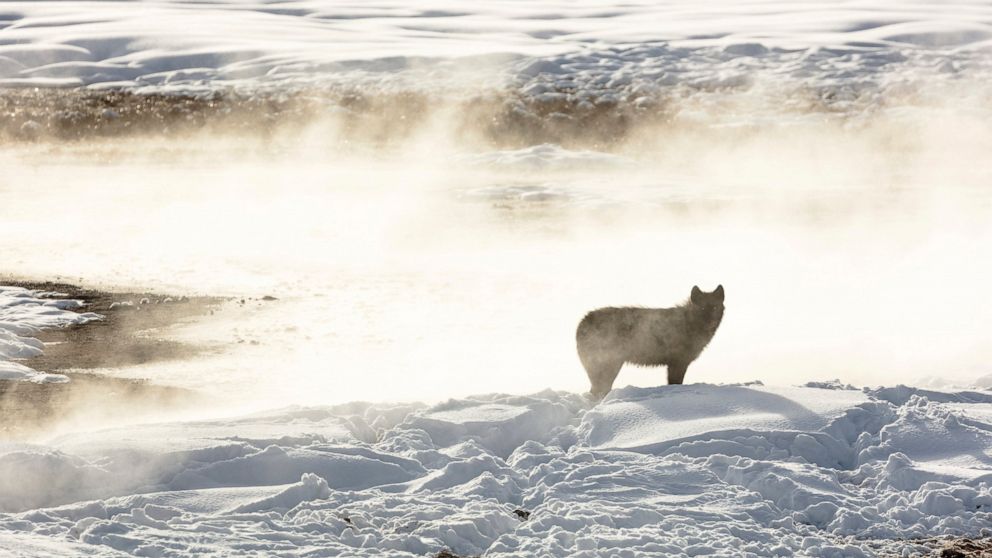
The Associated PressThis Jan. 24, 2018, photo released by the National Park Service shows a wolf from the…Read More
BILLINGS, Mont. — Montana wildlife commissioners on Friday moved to shut down gray wolf hunting in a portion of the state around Yellowstone National Park, amid mounting criticism over a record number of the animals shot or trapped after roaming across the park boundary this winter.
But commissioners rejected calls to revive quotas that would limit the number of wolves killed along Yellowstone’s northern border to just a few annually. Those longstanding quotas were lifted last year after Republican lawmakers passed laws intended to drive down the wolf…
The Arizona Game and Fish Department is updating key hunting guidelines that will set the tone for wildlife management in the state for the next five years.
The process is raising questions among some conservation groups aboutwhat hunters are allowed to huntand how many individual animals can be killed within a given season.
Traditionally, the guidelines review process has been an opportunity to maximize hunting based on hunters’ input. But a coterie ofgroups are hoping theirconcerns about the way native carnivores are managed will also be considered and given equal weight alongside consumptive users.
Three species fall into thiscategory in Arizona: mountain lions, bobcats, and black bears. According to the groups focused on these species, these animals are mostly hunted for sport, with bobcats an exception. Trappers prize their winter belly fur for sale in the fur trade.
TheCriticalMindCommunity(This content is not subject to review by Daily Kos staff prior to publication.)Saturday January 29, 2022·3:36 PM PST333231Comments231 New
OnAugust 9, 2021, Washington governor, Jay Insley, signed aproclamationmandating all state employees be fully vaccinated against COVID by October 18. The order survived legal challenges. And vaccination became a condition for state employment.
Two days before the proclamation went into effect, State Trooper Robert LaMay, resigned after 22 years as a cop. LaMay was an anti-vaxxer who refused to save his job by getting a vaccination that could save his life. On Friday, hediedfrom COVID-19.
I am sure that when he signed offfor the final time,sitting in the driver’sseat of his patrol car,speaking into the copradio,and demandingGovernor Jay Inslee “kiss myass”, he felt the…
Credit:Adobe stock. May not be republished without license.
Nearly 30% of the national park’s wolves have been killed since the start of the 2021-2022 hunting season.byAmanda Eggert01.28.2022
The state Fish and Wildlife Commission voted today to close wolf trapping and hunting in southwestern Montana if or when six more wolves are killed by hunters or trappers in the region.
The meat counter at an Iowa grocery store. Around one third of food produced in the US is wasted. Reducing that figure could also reduce the number of animals bred for factory farms.
This story is part of a group of stories called
Finding the best ways to do good.
You may have heard the grim statistic by now: Around one-third of food produced in the US is never consumed, ending up in landfills as waste.
The biggest benefit of reducing food waste is self-evident — over 10 percent of US households experience food insecurity, and diverting food that’s safe and edible but destined for those landfills to those in need could help millions lead healthier, better lives.
But there’s another benefit of reducing food waste that’s starting to get more attention, and the EPA recently shined a spotlight on it in a new report: “Farm to Kitchen: The Environmental Impacts of U.S. Food Waste.”
“This uneaten food results in a ‘waste’ of resources—including agricultural land, water, pesticides, fertilizers, and energy—and the generation of environmental impacts—including greenhouse gas emissions and climate change,” the authors write in the report.
Want to eat less meat but don’t know where to start? Sign up for Vox’s 5-day newsletter full of practical tips — and food for thought — to incorporate more plant-based food into your diet.
According to the EPA, food waste accounts for 2 percent of US greenhouse gas emissions — about half that of aviation. While meat, dairy, and eggs compose just a little over a quarter of US food waste by weight, the EPA report authors argue that there are disproportionate environmental benefits to reducing animal product waste. That’s because animal products typically require much more land, water, and energy — and emit more of the greenhouse gases carbon and methane — than plant-based foods.
But there’s another potential major benefit to reducing animal product wastage: preventing hundreds of millions of animals from entering factory farms in the first place.
The animals we raise and kill — only to throw away
According to USDA data from 2010, Americans throw out 26 percent of meat, poultry, and fish at the retail and consumer level. Harish Sethu, a data scientist and author of the blog Counting Animals, says America’s meat waste problem means we’re raising about a billion chickens, more than 100 million other land animals (mostly turkeys, pigs, and cows), as well as capturing around 25 billion fish and 15 billion shellfish (mostly shrimp), only to have them wind up in a landfill.
In 2015, the USDA and EPA set a goal of halving food waste by 2030 from 2010 levels. If the US can hit this target, it could help reduce the number of land animals condemned to a lifetime of suffering on a factory farm each year, and the number of fish and shellfish whose lives end in capture and slaughter — though the full extent of the benefit will require more research.
Claudia Fabiano, an environmental protection specialist on food waste at the EPA, told me that reducing US food waste likely wouldn’t cause a drop in US food production, in part because American farmers would compensate by exporting more of their product abroad.
According to Bruce Taylor, however — a chemical engineer and the president of food waste consultancy Enviro-Stewards — reducing meat waste should have some effect on domestic meat production. He pointed to his work with the major pork producer Smithfield Foods as an example. In one processing facility, Taylor figured out how to reduce the amount of pork going to rendering — to be used for other purposes, like pet food — by 30 percent.
Taylor says that if sausage demand goes up as a result, then it’s a wash. “But if people eat the same amount of sausage, thenless animals are required to make the same amount of sausage, andeventually the market would correct itself,” he added. “Somebody would end up selling less.”
WRAP, a food waste nonprofitbased in the UK, found that when British households reduced food and drink waste 21 percent from 2007 to 2012, they also purchased less food and drink.
A bulldozer moves trash at a landfill refuse site in Utah. Around one-third of US food is never consumed, ending up in landfills as waste.
“Reducing the amount of food people in the UK waste in their homes appears to have had a knock-on effect in reducing the amount of food people need to purchase,” Tom Quested, lead analyst at WRAP, told me in email. “Furthermore, research focusing on the EU suggests that this effect could ripple all the way up the supply chain, reducing the amount of food we need to grow.”
We hear a lot about eating less meat — I even wrote a newsletter series about how to do it. But I think it’s time for an additional slogan to enter the conversation: Waste less meat.
How to waste less meat at home
While cutting food waste at the production level is themost important step, reducing food waste at the consumer level is also critical because it accounts for about half of all food waste, andonce food has reached the consumer, emissions from production, processing, packaging, and shipping are baked into the product.
So how can you waste less meat and other animal products? Understand when your food will actually go bad, use your freezer liberally, and plan ahead.
“A lot of people think their food is bad when it’s actually still perfectly good to eat,” Dana Gunders, executive director of food waste nonprofitReFED, told me. “The dates on food are really an indicator of when something is of top quality or it’s freshest, but they’re not telling you the food is bad or that you can’t eat it.”
Her general rule of thumb? “If it looks fine, smells fine, and tastes fine, it’s okay to eat.” She encourages readers to visit SaveTheFood.com, a consumer guide from environmental nonprofit Natural Resources Defense Council, for more information. (I also recommend this backgrounder by Vox’s Alissa Wilkinson on sell-by and best-by dates.)
Can’t eat it soon? Put it in the freezer. “Freezers are a magic pause button,” Gunders said.
“A lot of people are in the habit of freezing meat but you can freeze milk if you’re going away on vacation — it may separate a little but it’ll be okay. Eggs you can freeze if you crack them out of their shell and scramble them but don’t cook them.” When it comes to cheese, it’s best to shred it before freezing and then use it in cooking after thawing.
Lastly, plan ahead. “If you can, sketch out an accurate plan of your week and when you’ll eat at home, and have that in mind when you’re shopping,” Gunders said. “That’s really critical because shopping is where you commit to the food regardless of whether you eat it or not.”
Preventing food waste on the farm
Reducing waste at the farm level is vital because if meat companies can reduce their mortality rates — the percent of farm animals that die before they can be slaughtered — then they can conceivably reduce the number of animals they need to breed in the first place.
The biggest impact can be made in the chicken industry, simply because of its scale. Five percent of the 9 billion chickens raised for meat in the US — around450 million chickens — die on the farm or in transportation on the way to the slaughterhouse.Two of the biggest solutions to bring that number down are changing breeding and transportation practices.
Nearly all the chickens raised for food in the US come from a handful of breeds that grow incredibly large, incredibly fast, which not only means the birds are in constant pain, but it can also lead to leg deformities and other health issues that cause premature death, like heart attacks and starvation or dehydration due to the inability to walk and get feed and water.
The left-hand chicken is a breed from 1957. The middle chicken is a breed from 1978. The right-hand one is a breed from 2005. They were all raised in the same manner for this paper and were photographed at the same age. Vox added the dates to this image.
“Slower-growing breeds usually are more robust and have lower mortality figures,” Ingrid de Jong, a senior scientific researcher of poultry behavior and welfare at Wageningen Livestock Research in the Netherlands, told me in email.
After they leave the farm, millionsof chickens in the USdie on the way to the slaughterhouse. They’re often overcrowded into trucks, which can cause life-ending injuries, as can exposure to weather extremes on the road. Under the federal “28-hour law,” these trucks can move farmedanimals across state lines for 28 consecutive hours without having to unload them for rest, water, or food. As bad as that is, the law is weakly enforced by federal agencies, exempts poultry, and only covers the length of transport, not transport conditions, according to Dena Jones of the nonprofit Animal Welfare Institute.
Jones reviewed USDA records and found one cold-related transport incident from poultry company Pilgrim’s Pride that resulted inthe death of more than 34,000 birds — the largest she had ever seen.“Because so many birds are raised for meat in the US — and the life of a single bird has almost no value to the industry — even 34,000 is viewed as inconsequential,” Jones told me in email. “I’ve monitored these records for more than a decade, and I’ve not noticed any improvement in the situation.”
Chickens en route to slaughter.
Despite lack of progress on reducing the waste and suffering of animals in transport, there has been some movement on changing breeding practices. Over 200 food businesses, including Burger King, Starbucks, and Subway, have pledged to source chicken from poultry companies that use slower-growing breeds. However, only two of the top 10 chicken companies — Perdue Farms and Wayne Farms — say they’ll supply it.
Preventing food waste in the store and in the factory
Grocery stores, restaurants, and food manufacturers can also do a lot to reduce food waste.
Federal legislation to standardize expiration labeling — which is done by retailers and manufacturers — would go a long way to reduce consumer confusion and waste.Harvard’s Food Law and Policy Clinic recommends requiring manufacturers that choose to use a date label for quality reasons to use the phrase “best if used by,” and reserve “expires on” for more high-risk foods.
Gunders of ReFED says getting food companies to use new technologies that more accurately predict consumer demand would help prevent surplus purchasing. Passing laws that ban food from entering landfills would be a big lever for change, and seven states and several municipalities have put in place such policies to varying degrees. This incentivizes businesses to donate more unsold food and work harder to prevent waste.
Fabiano of the EPA told me there’s one thing grocers could do to reduce seafood waste specifically. “We are so used to seeing these decadent displays of seafood on ice, but that seafood was generally shipped frozen and is just sitting there and defrosting,” she said. “So once you buy it that way, you do not have very long to consume that fish.” The solution? Selling more seafood frozen, which would make it last longer.
Bruce Taylor of Enviro-Stewards chalks up a lot of food waste in processing facilities to sheer inertia. Employees become used to inefficient processes and faulty machinery, and it can take an objective observer — him, in this example — to come in and notice waste, put a dollar value on it, and suggest small engineering changes that can save companies money and improve efficiency. In one example, his employees at a lobster processing factory pulled what was left off each lobster at the end of the processing line, which amounted to around $350,000 a year of edible meat being wasted.
“Everyone can see what’s happening, they just don’t know what it’s costing them,” he said.
Cutting food waste will be an increasingly critical part of reaching the world’s climate goals as the global population is expected to surpass 9 billion by 2050, requiring a projected 50 percent increase in food production from 2010 levels. Decreasing food waste should help reduce the need for increased production and slow down deforestation, biodiversity loss, and other environmental challenges.
That growing global population will also likely be eating more meat, and in the short term at least, much of it will likely come from factory farms. Food waste reduction will be an important tool in mitigating the number of animals churned through the system — and the system’s immense environmental and ethical toll.
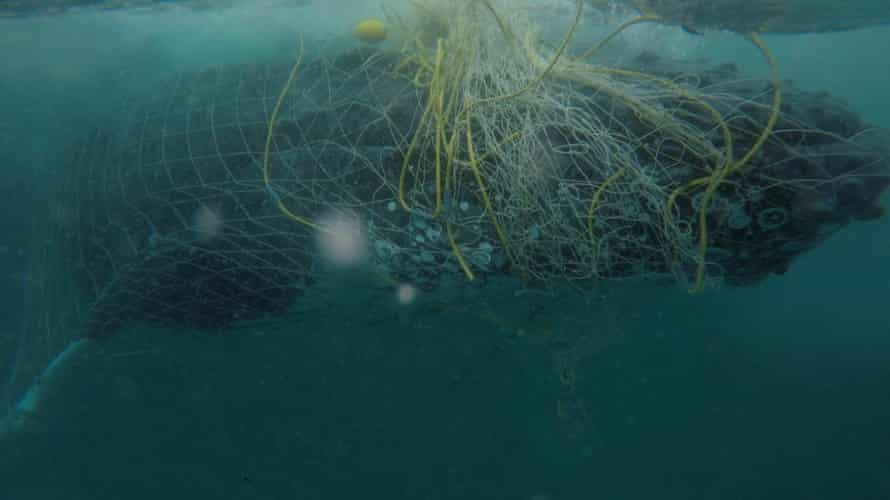
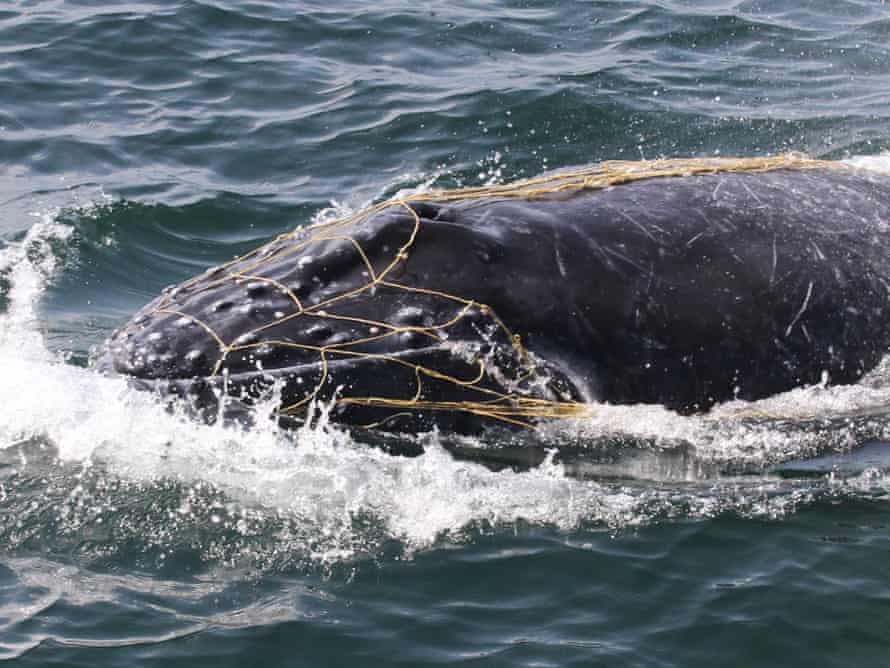
A fishing net caught on the tail of a whale. ‘It’s like a ball and a chain …. a slow death for the animals,’ Wayne Phillips says. Photograph: Todd Burrows
A fishing net caught on the tail of a whale. ‘It’s like a ball and a chain …. a slow death for the animals,’ Wayne Phillips says. Photograph: Todd Burrows
The humpback population has recovered miraculously from near extinction, but increasing numbers – and climate change – mean more tragic encounters with the snares left by humans
Wayne Phillips has both feet firmly on dry land as he acts out cutting a whale loose from fishing gear.
The 51-year-old head of marine sciences at SeaWorld in Queensland oversees the park’s marine rescue team – four cutters, a coordinator, a captain and a videographer – who untangle humpback whales that have become bound up in rope and net.
The cutters, he explains, are armed with a gaff – a graphite pole similar to a fishing rod but topped with a reverse knife that doesn’t cut into the whale if it connects – and work in pairs to combat muscle fatigue.
‘It’s an exhausting process’: Wayne Phillips on rescuing tangled whales. Photograph: David Kelly/The Guardian
Out on the water, with a 27-tonne giant in distress, the purpose-built rubber boat used by the team pitches and rocks on the waves. The goal for the cutters is to aim the gaff to hook the correct rope before pulling it back hard to sever it clean.
“You reach out, lunge out and pull back – and all that’s based on where the tail is,” Phillips says. “You might get one or two shots at it, then the whale might divert or dive.
“It’s an exhausting process. By the end of the day, you’re buggered.”
Phillips has worked in marine rescue for the better part of 28 years, helping dolphins, seals, turtles and other animals when entangled, stranded or sick. Now a growing part of the work involves disentangling humpback whales.
Humpback numbers have bounced back from near extinction to about 30,000 in what is widely considered a triumph of conservation. But now the species faces a new human threat: climate change.
As the world’s oceans warm and acidify, humpback whales – like other marine species – are altering their ancient migration patterns in search of food and shelter.
A whale entangled in netting Photograph: Sea WorldA whale calf entangled in a shark net at Coolangatta Photograph: Sea World
And as they are wander into new areas along Australia’s coast, the growing overlap with the human world can be lethal.
An invisible problem
Globally it is estimated 300,000 large whales and dolphins die in entanglements each year, though only a fraction are ever recorded.
As definitions vary by jurisdiction, what counts as an entanglement and what gets included in official reports often masks the scale of the problem.
According to records collected by the International Union for Conservation of Nature and the International Whaling Commission, Australia recorded just 436 whale entanglements between 1887 and 2016.
However these records do not include sightings of whales towing gear reported by the public, or whales that have become tangled in crab pot lines. By contrast, Queensland’s shark control program alone recorded 80 humpback whales snagged in its nets between 1992 and 2020.
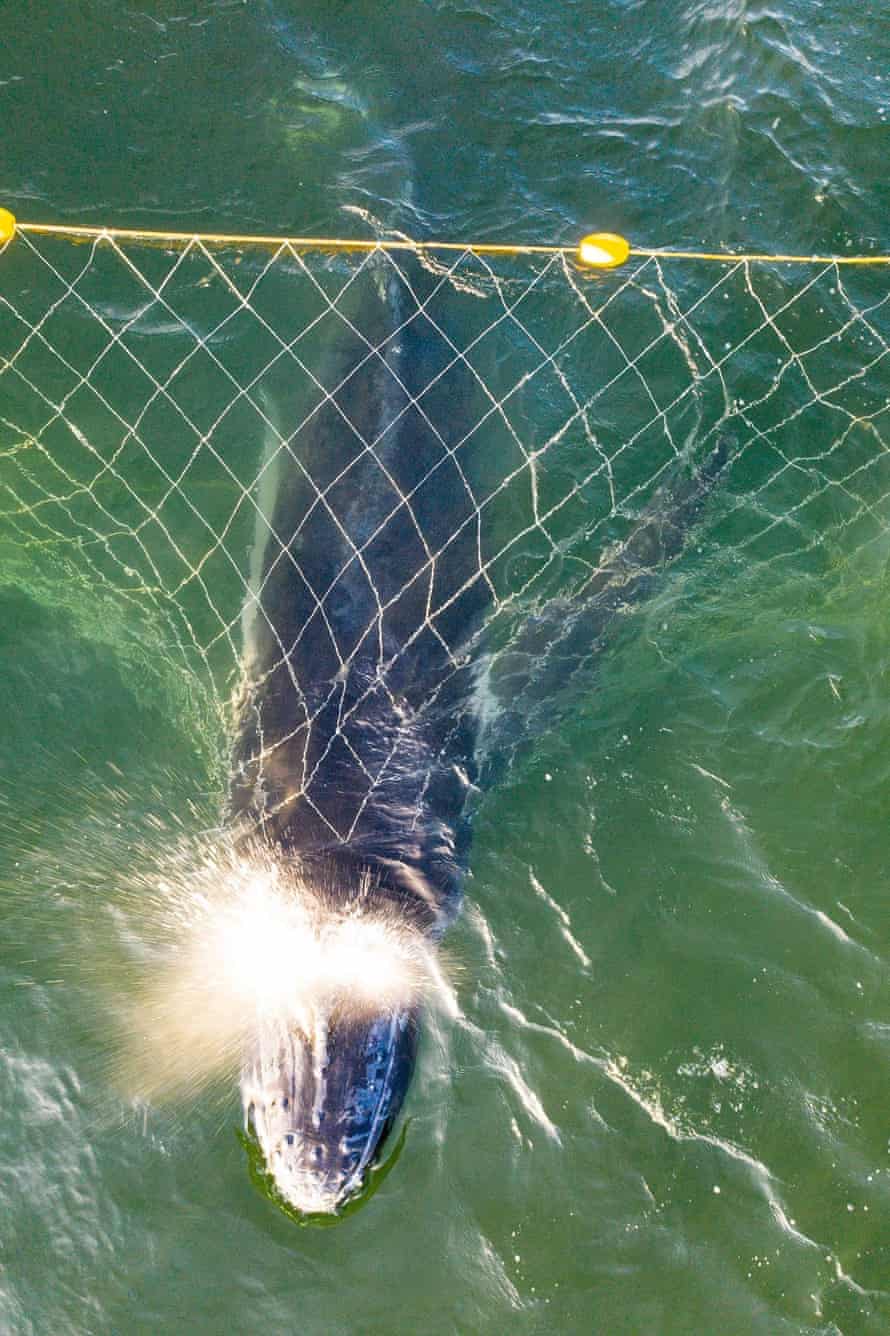
A whale caught in a shark net at Burleigh Heads. ‘It’s like a ball and a chain,’ Phillips says. Photograph: Blaze Parson
Phillips says there were 28 reports of entangled whales along Australia’s east coast last year, of which his team was able to assist in two. He estimates that despite the best efforts of marine rescue outfits around the coast, only one in five reports are acted upon.
Across the country a mix of government agencies and private organisations operate marine rescue teams, each with responsibility for a different area. SeaWorld’s team covers an area that spans south-east Queensland and the northern New South Wales coast as far as Evans Head.
Their work generally begins from June, a few months after the first humpback whales are spotted off Sydney on their annual migration north, when the first reports trickle in of whales towing gear – sometimes many metres in length.
They will continue until November when the animals leave on their long journey back south, travelling 10,000km to the Antarctic.
Phillips says the worst material he has come across is nets that include chain, as it is impossible to cut away the material – though these are rare.
By far the most common entanglement are those from crab pots and the ropes that connect the cage on the seafloor to a float on the surface.
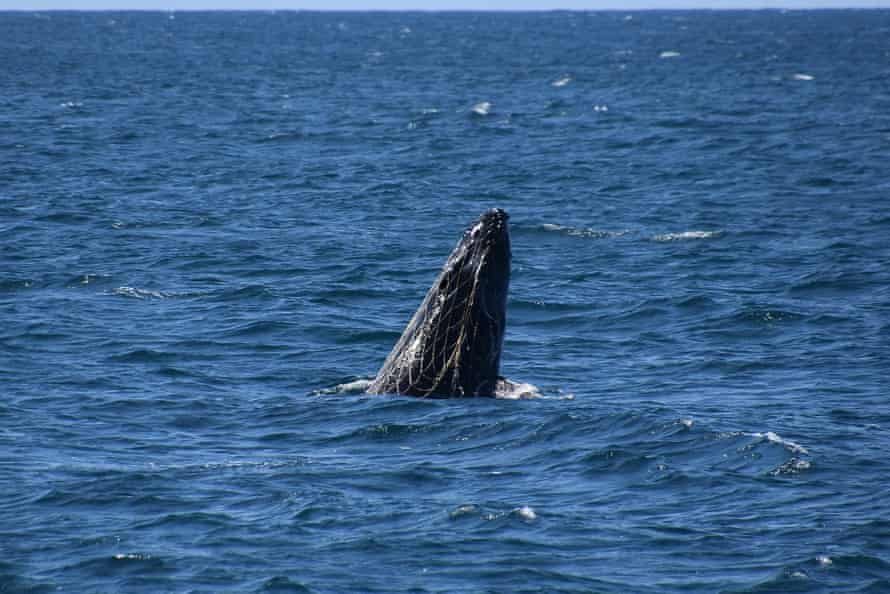
A fishing net on a young whale calf at Coffs Harbour. Photograph: Olaf Meynecke
As whales don’t navigate by echolocation, they will pass through the area and catch rope as they go. Many will try to wriggle free by thrashing or rolling, but often this only binds the ropes tighter.Advertisementhttps://7bf2a2b945fc8df9511d34d2c39f984f.safeframe.googlesyndication.com/safeframe/1-0-38/html/container.html
With time the material collects around the whale’s fluke – its tail – stopping it from hunting effectively as it drags the rope material over thousands of kilometres. One juvenile whale was spotted in Antarctic waters trailing gear in early January, having travelled down the South American coast.
“It’s like a ball and a chain,” Phillips says. “Imagine dragging that around while you’re swimming.
“And then imagine somebody continuously pulling at it because of the drag the water places on that equipment. These animals are so streamlined, they’re built to cut right through the water. Any drag makes it so much harder for them.
“It really is a slow death for the animals.”
‘They see us as part of the problem’
The first step in removing gear is counterintuitive. To cut it off, the team needs to slow the whale down by attaching floats or buoys to the netting it is trailing.
It is a tactic that echoes those used by whalers, and from the perspective of the whale the sound of an approaching engine is still cause for alarm.
“They’re not always happy we’re trying to help them, that’s for sure,” Phillips says. “They see us as part of the problem initially. And at times we have a very predator-prey relationship with the whale.
“He thinks we’re trying to hurt him, so he thinks we’re the predator.”
This relationship makes each rescue extremely dangerous. A spooked whale may attempt to roll, dive, thrash or smack its tail, and escort animals, such as adult whales protecting a calf, may attempt to fend off the approaching boats.
Phillips has worked in marine rescue for nearly 30 years Photograph: David Kelly/The Guardian
At least three deaths have been documented among whale rescuers worldwide. Among the earliest was Tom Smith, who died in 2003 while attempting to free a humpback whale in waters off Kaikoura in New Zealand. His body was never recovered.
Phillips says members of the public should never attempt their own rescue. Even if it does not end in tragedy, it often only makes things worse for the animal.
“Their hearts are in the right place, but if they don’t cut it all off it actually makes our job harder,” he says. “When they cut off some of the net, the whale will swim off quite nicely but unfortunately it’s still a death sentence.
“Any material around that fluke means the whale will end up succumbing.”
The effect of climate change
Dr Olaf Meynecke, a whale researcher at Griffith University and the Whales & Climate program – a collaborative research project between six universities – says climate change is already having an indirect impact on the number of entanglements.
“It’s the food source that drives everything in the whales’ lives, and they’re migrating for six months at a time each year. That requires a lot of energy,” Meynecke says.
“Their advantage is they can store energy in their blubber as fat, but that also means there’s a short amount of time to eat.”
Climate change is affecting the location and amount of available food.
Meynecke says other whale species have been pushing into waters close to humans, and it is expected the same is happening with humpbacks in Australia.
A young whale calf tangled in a fishing net. Researchers say whales are venturing closer to humans amid climate change. Photograph: Olaf Meynecke
The most at-risk of entanglement are “overwintering” whales – usually young, non-breeding females that stay in Australian coastal waters through summer and end up trying to opportunistically feed near commercial fishing grounds.
Meynecke’s research aims to forecast how these changes will occur until 2050 by comparing whale movements today with those from hundreds of years ago.
He says there are signs whale populations are already starting to arrive earlier than expected and are not always travelling as far north as they used to. If confirmed, there may be steps that can be taken to prevent more animals being lost.
But that would require coordination between governments, science, industry and the whale-watching public to create more centralised reporting systems, change fishing practices, introduce ropeless fishing gear and ban the use of material such as chain in nets.
This might seem a tall order, but Meynecke says the legacy of anti-whaling efforts in the past is a generational shift that has made humpback whales a sacrosanct part of Australian culture.
“It’s been a complete shift in society,” he says. “Our society has gone from ‘I appreciate whaling’ to ‘I appreciate taking photos of whales and paying for it’.
“No one in Australia – not one politician – would ever today come and say let’s kill the whales. This gives me great hope. It shows a capacity for change.”Topics
Even if the Paris agreement is successfully implemented, the planet could still heat up by 5 degrees Celsius, scientists warn. This “hothouse” climate would make parts of the world uninhabitable.
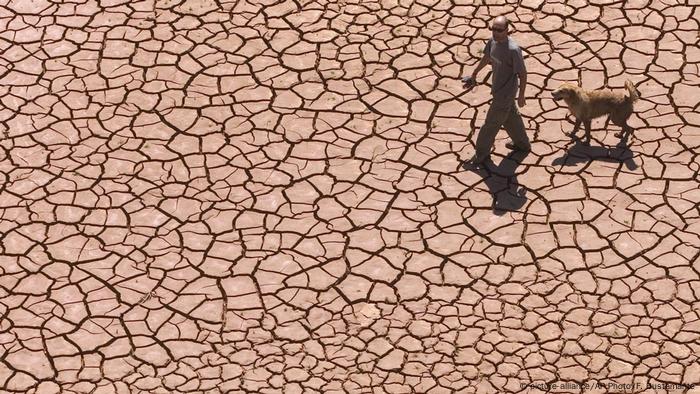
A joint study by international climate scientists from Germany, Sweden, Denmark and Australia presents a bleak prognosis: Even if the goals of the Paris climate agreement are achieved and global warming is limited to maxiumum2 degrees Celsius (3.6 degrees Fahrenheit) compared to pre-industrial levels, the climate system could still passa devastating tipping point.
“Human emissions of greenhouse gas are not the sole determinant of temperature on Earth,”saidWill Steffen, lead author of the study and climate researcher at the Australian National University and the Swedish research institute Stockholm Resilience Centre.
“Our study suggests that human-induced global warming of 2 degrees Celsiusmay trigger other Earth system processes, often called ‘feedbacks,’ that can drive further warming — even if we stop emitting…
Tanzania is seeking to attract well-off Americans as it targets the growing game hunting tourism market.
Last week, Tanzania Tourism Minister Damas Dumbaro was in Las Vergas to market the country’s hunting safaris at the 50th Annual Hunting Convention.
Dodoma said the tour was meant to ‘market Tanzania’s hunting blocks before the rich American hunting tourists and other trophy hunting investors around the world’.
Dr Ndumbaro led a delegation of tourism officials to the World Hunting Association meeting, which brought together 870 exhibitors showcasing trophy wildlife parts from several countries.
“We will market hunting blocks then attract international hunting companies, while learning about new strategies that would make hunting safaris more profitable to earn more revenues to the government,” the minister said.
Tanzania is focusing on attracting high-spending tourists such as those who can afford a 21-day hunting safari that cost about $60,000, excluding flights, gun import permits and trophy…
Police say more than 200 charges have been filed involving at least 27 bucks taken illegally in Mineral, Grant and Hampshire counties. (Sinclair Broadcast Group)
ROMNEY, W.Va. (AP) —Two former sheriff’s deputies and an emergency services chief are among eight people charged with illegal hunting in West Virginia.
West Virginia Division of Natural Resources Police Lt. Timothy L. White says the agency filed 223 charges involving at least 27 antlered bucks taken illegally in Mineral, Grant and Hampshire counties.
He says some of the charges include spotlighting deer and carrying loaded weapons in their vehicles from September through December.
Two Mineral County deputies and an emergency services official in Allegany County, Maryland, were charged in the case.
Officials say the deputies resigned after the investigation began, and the Maryland official has been suspended.


 The Associated PressThis Jan. 24, 2018, photo released by the National Park Service shows a wolf from the…Read More