
Read Next

We Need to End Octopus Farming Before It Starts
The Truth About Duck Farming: What Happens Behind Closed Doors
Like cats, ducks love to keep themselves clean. Yet the photos, videos, and written accounts from people who have visited duck farms consistently show ducks in dirty, unhygienic settings. Farmed animal advocates around the world have recently been telling the stories of farmed ducks, who suffer similar plights to other factory-farmed animals. Yet unlike other birds confined by the poultry industry, ducks have a unique experience of being waterfowl in industrial settings that remove them from their natural, water-based habitats.
Is a Duck a Farm Animal?
Ducks are part and parcel of imagined pastoral farm scenes, and thus are considered “farm animals,” but a better term for the ducks we’ll be discussing is “farmed animals.” Mckenzee Griffler of the Open Sanctuary Project, an information resource that focuses on the needs of farmed animal sanctuaries, writes that domesticated ducks are quite different from wild breeds of ducks. The Open Sanctuary Project defines a “farmed animal” as “a species or specific breed of animal that is raised by humans for the use of their bodies or what comes from their bodies.”
How Are Ducks Farmed?
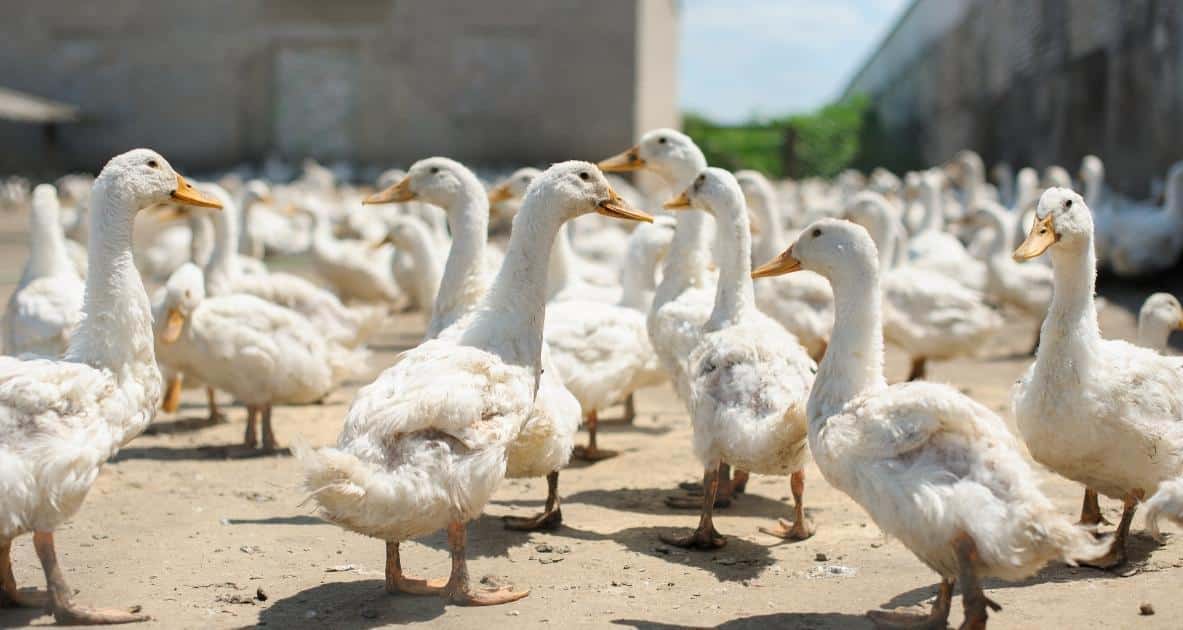
Ducks are farmed in overcrowded indoor sheds with little or no access to open water for swimming, bathing, preening, dabbling, and head-bobbing. Usually, thousands of ducks are confined together without natural light. As is the case in most of today’s backyard and industrial animal farms, the ducks’ health needs are almost never taken care of.
How Long Do Ducks Live?
In nature, free ducks can live to be about 15 to 20 years old, and their lives “revolve around water.” A duck’s body has adapted to live in and near water, with webbed feet, a way to waterproof their own feathers, and “down” feathers to keep themselves warm in the winter.
How Long Do Domestic Ducks Live?
Domestic ducks can live to be six to ten years old. The ideal life for domestic ducks would give them plenty of space in which they could roam and explore with a group of other ducks, including open waters for them to splash, bathe, and swim in. Ducks need a pool, pond, puddles, or other bodies of water to allow them to wash and to get messy in.
Domestic ducks also need an indoor space to protect them from harsh weather. Depending on who you’re talking to, the indoor space would give each bird about 4 to 16 square feet to walk around, sleep, nest and roost in.
A living space for ducks should have more than one place where ducks can get food and water, as well as areas of grass, bushes, and duck-safe plants. Ducks also enjoy building their own nests from straw, hay, leaves, and duck-safe mulch.
How Long Do Farmed Ducks Live?
The lives of farmed ducks last only a fraction of their natural lifespan. By the time they are six or seven weeks old, ducks raised for their meat have typically reached their “slaughter weight,” or 90 percent of their adult weight. Egg-laying ducks are generally killed at about 18 months old when their ability to lay begins to decline. Farmed ducks’ quality of life is poor. They are crammed into confined, dimly-lit, indoor barns for their whole lives, without adequate access to open water.
Are Ducks Easy to Farm?
Working in duck farms is a physically demanding and dangerous job. Poultry farmworkers are at risk for exposure to infectious diseases from birds and “significant levels of agricultural dust and toxic gases,” according to the International Labor Organization.
Water Deprivation
To be happy and healthy, ducks need water to swim in, and for much else besides. One of the many natural behaviors of ducks in water is bathing: it is “crucial for maintaining healthy body temperatures, good feather conditions, and to keep their nostrils and eyes clean.”
Farmed ducks typically have to drink water from small pipes that dispense the water in drops. Without being able to immerse themselves in water puddles or pools, ducks feel frustrated and are also more likely to get eye infections that may lead to blindness. The ducks can also experience heat stress, as reported in a Mercy for Animals investigation of one of the largest duck farms in the United States.
Toxic Living Conditions
Farmed ducks live surrounded by thousands of ducks, with poor ventilation, breathing in the ammonia fumes from their own waste. The high moisture of duck droppings means that ducklings produce about four times more ammonia than broiler chickens. When ammonia lingers in the air for a long time it inflames birds’ air sacs, and irritates their eyes, causing them to get swollen and crusty, and even making the ducks blind.
Ammonia is particularly harmful to birds because when they breathe their bodies absorb about twice as much gas as mammals. But government regulations for how much ammonia is allowed in poultry farms are based on what is safe for humans—who can wear respirators and do not have to spend their whole lives inside poultry barns—not the birds who live there.
In 2020 Sentient Media interviewed animal rights activist Jenny McQueen, who described having to wear “biosecurity gear” while investigating a Canadian duck farm, including “good foot coverings,” “thick masks to cover our faces in case any of us struggle with the air, which is generally full of ammonia,” and gloves.
Animal Abuse
Farmed ducks are not protected by law in the U.S., and legal definitions of animal abuse typically exclude farmed animals. The living conditions of farmed ducks mirror the experiences of other animals suffering in factory farms. An account from the Catskill Animal Sanctuary describes how four domestic ducks were found in a crate that had fallen off a truck near foie gras production facilities: the ducks were “filthy and covered with abrasions and sadly one was already dead.” One surviving duck was rushed to get medical care for a beak that “was split in half and bent gruesomely backwards, abuse that probably happened during forced feeding.”
Physical and Psychological Effects on Workers
The unpleasant aspects of poultry workers’ jobs have been documented, especially via descriptions of the roles of processing plant workers and chicken catchers. But there has been little public information about farmworkers dealing with ducks. An Animal Justice Project investigation found that the work in a duck slaughterhouse in the U.K. is fast-paced: “workers are tense and under the observation of a supervisor who constantly reminds them of the clock. There is no time to breathe—all the ducks have to be shackled as fast as possible. And the screams of distressed ducks become background noise to frequent outbursts among the workers.” The video showed blatant interpersonal racism directed at workers. Meanwhile, workers were typically immigrants or people with felony records, making them more vulnerable to employer retaliation if they complain.
In the U.S., poultry workers are fearful of speaking up about their employers to the government when they are denied restroom breaks and have other workplace safety concerns. Throughout the COVID-19 pandemic, poultry workers have contended with employers that are reluctant to protect them and their families from a deadly virus.
Because of their exposure to gases and dust from fecal matter, feed, feathers, and other particles, farmers and agricultural workers are more likely to have chronic bronchitis, asthma, runny noses, and irritated eyes. Another source of irritated eyes is ammonia. Ammonia irritates your upper respiratory tract and makes you more susceptible to airborne pathogens. Yet the level of ammonia in poultry houses can be hard to detect, and “many poultry growers who have worked in an ammonia-laden environment for years are unable to detect” levels of ammonia that are above the recommended level for worker safety.
Unsustainable Weight Gain
Due to selective breeding and the way they are kept, farmed ducks’ bodies grow too large, too quickly for their legs to support them, leading to injuries and other problems with their feet, including difficulty in walking. Part of this difficulty in walking is also due to the wire mesh floors they must waddle on, and the lack of water to swim and bathe in—water that makes their weight easier for their legs to support. Animal advocates have described seeing ducks with body parts stuck in wire, or stuck on their backs and unable to right themselves.
Debeaking
Baby ducks get their bills “trimmed” without anesthesia, causing both acute and chronic pain. The term “trim” doesn’t mean how you would clip your nails. The bills are cut cold or with a cautery blade—burning the tips of ducklings’ sensitive beaks with searing hot metal.
Life of a Breeder Duck
The term “breeder duck” is not one you’ll find animal advocates using much, but within the industry it means a female duck, or a hen, who is valued for their egg-laying abilities. The number of eggs that a breeder duckling produces is a key number for the duck farming industry. To maximize this number, farmers can restrict food and manipulate lighting conditions to stimulate egg production and fertility. Egg-laying ducks are killed after their bodies are worn down from constant reproduction.
Macerating Ducklings
In the foie gras industry, female ducklings are chucked into an electric mincer, which can be seen in a video report of an investigation by L214, an animal protection group in France. Female ducks do not gain weight as quickly as their male counterparts, so their remains are used for cat food and fertilizers, and in the pharmaceutical industry. Sometimes a macerator is used instead of a mincer.
How Ducks Are Killed
Once they have grown to the size at which they will be slaughtered, the ducks also experience stress and injury in the process of getting caught and transported to the slaughterhouse. The process of being shackled, stunned, and getting their throats slit is a series of frightening and pain-filled experiences.
How Are Farmed Ducks Exploited?
Industrial farming practices take advantage of the easy-going nature of ducks as well as the human-animal divide as a way to make money.
Duck Farming for Meat
The ducks who are selectively bred for their meat are known as Pekin. Pekin ducks grow faster than other types of ducks and have larger breast muscles.
Duck Farming for Eggs
As a result of selective breeding, egg-laying ducks lay 200 to 300 eggs per year. This rate is more than twice that of some more traditional breeds.
Duck Farming for Foie Gras
Ducks are “force-fed via long tubes” to fatten their livers to make foie gras. The delicacy has been banned in many countries, and animal advocates are still trying to end the practice completely.
Is Duck Farming Profitable?
Duck farming, as with other forms of factory farming, has evolved to maximize profits at the expense of the welfare of the animals being raised for human consumption. As Jesse Tandler explains in a blog post for the Factory Farming Awareness Coalition, “Factory farming has enabled us to produce lots of animal products efficiently and cheaply—until you include all the externalized costs, such as environmental degradation, carbon and water footprint, and increased healthcare costs.”
Duck Farming Facts and Statistics
- One market research company cited the rise of veganism as a potential threat to the otherwise growing duck meat market.
- In 2019, about 27.5 million ducks were slaughtered for meat in the U.S. In 2020, that number was 22.5 million.
- Of this total, 0.5 percent of ducks by weight were condemned in the U.S. before they were slaughtered in 2019, and 2.48 percent were condemned afterward due to disease or mishandling.
- Most duck farms in the U.S. are in Wisconsin and Indiana.
- See The Humane Society of the United States’ report on duck welfare for more facts and statistics.
How You Can Help
Sanctuaries throughout the U.S. have stepped up to rehabilitate and rehome farmed ducks. Through their websites and other programs, they also educate the public about the harms of duck farming. Barbara Hengstenberg of the Piedmont Farm Animal Refuge writes that you can choose alternatives to duck down, duck meat, and foie gras. Sanctuaries such as the Refuge allow visitors to “experience the peace of the duck and goose ponds. You will soon find yourself smiling as you watch them chase one another around the pond’s edge. And you will find glee as they joyfully jump into the water and splash about, soon to do their headstand forage with their butts up in the air.”
The Road Ahead
Ducks are swimmers, bathers, preeners, and cleanliness-oriented beings who thrive in environments where they have access to open water. The duck industry removes ducks from water and places them in large sheds, with thousands of other ducks, breathing poor air. It breeds them to the point where their reproductive systems are exhausted, and selects for ducks whose legs are too weak to hold them upright. We can work to end these practices by deprioritizing profit and lifting up community and relationships. As Kamekə Brown writes in her chapter in “Veganism of Color,” “Farmed animal sanctuaries are powerful counter-capitalist spaces in the ways that they seek to transform the relationships of commodification and exploitation that we have with farmed animals under capitalism in the U.S. to relationships of care—relationships that respect and affirm an individual’s right to their body and life, regardless of that individual’s species.”Read More
How Many Animals Are Killed for Food Every Day?
Poultry Farming: What You Need to Know About This Highly Secretive Industry




 Updated: 11:10 AM EST Jan 31, 2022Infinite Scroll Enabled


