How will humanity endure the climate crisis? I asked an acclaimed sci-fi writer

Daniel Aldana Cohen

https://www.theguardian.com/commentisfree/2021/dec/09/climate-crisis-kim-stanley-robinson

In Kim Stanley Robinson’s novel The Ministry for the Future, climate disasters kill tens of millions of people – and that’s a scenario he portrays as relatively optimistic
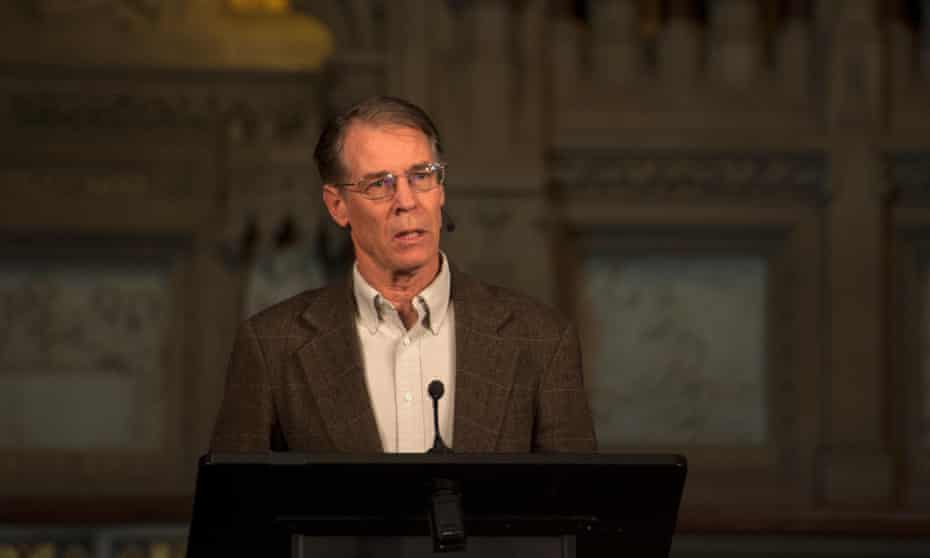
‘Robinson’s books slow down the apocalyptic highlight reel, letting the story play in human time for years, decades, centuries. … We watch people keep dying, and coping, and struggling to shape a future – often gloriously.’
‘Robinson’s books slow down the apocalyptic highlight reel, letting the story play in human time for years, decades, centuries. … We watch people keep dying, and coping, and struggling to shape a future – often gloriously.’ Photograph: Terese Loeb Kreuzer/Alamy

Thu 9 Dec 2021 06.30 EST

154

To really grasp the present, we need to imagine the future – then look back from it to better see the now. The angry climate kids do this naturally. The rest of us need to read good science fiction. A great place to start is Kim Stanley Robinson.

Robinson is one of the most brilliant writers of the genre. During Covid quarantine, I read 11 of his books, culminating in his instant classic The Ministry for the Future, which imagines several decades of climate politics starting this decade.

The first lesson of his books is obvious: climate is the story. Compared with the magnitude of the crisis, this year’s United Nations climate summit, Cop26, was a poorly planned pool party where half the guests were sweating in jeans, having forgotten their swimming suits. If you’re reading this, you probably know what climate science portends – and that nothing discussed in Glasgow was within rocket range of adequate. What Ministry and other Robinson books do is make us slow down the apocalyptic highlight reel, letting the story play in human time for years, decades, centuries. The screen doesn’t fade to black; instead we watch people keep dying, and coping, and struggling to shape a future – often gloriously.

I spoke to Robinson recently for an episode of the podcast The Dig. He told me that he wants leftists to set aside their differences, and put a “time stamp on [their] political view” that recognizes how urgent things are. Looking back from 2050 leaves little room for abstract idealism. Progressives need to form “a united front,” he told me. “It’s an all-hands-on-deck situation; species are going extinct and biomes are dying. The catastrophes are here and now, so we need to make political coalitions.”

The point of Robinson’s decades of sci-fi isn’t to simply counsel “vote blue no matter who.” He told me he remains a proud and longtime member of the Democratic Socialists of America (DSA). But he does want leftists – and everyone else – to take the climate emergency more seriously. He thinks every big decision, every technological option, every political opportunity, warrants climate-oriented scientific scrutiny. Global justice demands nothing less.

Robinson believes every big decision, every technological option, warrants climate-oriented scientific scrutiny

Robinson’s “all-hands” call is even more challenging on technology and economics than on electoral campaigns. He wants to legitimize geoengineering, even in forms as radical as blasting limestone dust into the atmosphere for a few years to temporarily dim the heat of the sun. As Ministry dramatizes, and as he reminded me, there’s a good chance that a country being devastated by climate breakdown will try this, whether it’s authorized by the international community or not.AdvertisementThe New Face of Small BusinessREAD MOREAn ice‑cream sundae infused with Black history: howRabia Kamara is changing the dessert worldhttps://imasdk.googleapis.com/js/core/bridge3.491.0_en.html#goog_1600649852https://imasdk.googleapis.com/js/core/bridge3.491.0_en.html#goog_2123201798https://imasdk.googleapis.com/js/core/bridge3.491.0_en.html#goog_1957012076

More broadly, Robinson seems to be urging all of us to treat every possible technological intervention – from expanding nuclear energy, to pumping meltwater out from under glaciers, to dumping iron filings in the ocean – from a strictly scientific perspective: reject dogma, evaluate the evidence, ignore the profit motive.

It’s an admirable view. And Robinson is no blinkered techno-optimist: some of the most compelling characters in his novels use science to reject swaths of technological development. He doesn’t necessarily want to pursue every form of geoengineering that we investigate, but he wants us to debate them.

As he put it to me: “science good, capitalism bad”. He sees the development of the scientific method as a phenomenon as universal to the human condition as art. In his ice age novel Shaman, one character invents a new kind of ankle brace while another invents a new kind of cave painting.

I’m attracted to this vision. But I’m not convinced that the science v capitalism binary is as clear in practice as Robinson asserts. We live in a world where capitalist states and giant companies largely control science. (Just consider the moral insanity and capitalist logic of global vaccine apartheid.) Some of the biggest backers of technology to capture carbon and store it underground are oil companies like Exxon. Yes, we need to consider technologies with an open mind. That includes a frank assessment of how the interests of the powerful will shape how technologies develop. Robinson could learn from the positions of activists of color, especially Indigenous and environmental justice groups, who fight against “false solutions” based on centuries of exploitation and sacrifice.

Robinson’s imagined future suggests a short-term solution that fits his dreams of a democratic, scientific politics: planning, of both the economy and planet. It’s a grandiose imperative, but the underlying insight is sound, and it’s borrowed from Robinson’s reading of ecological economics. That field’s premise is that the economy is embedded in nature – that its fundamental rules aren’t supply and demand, but the laws of physics, chemistry, biology. The upshot of Robinson’s science fiction is understanding that grand ecologies and human economies are always interdependent.

Robinson believes that once progressives internalize the insight that the economy is a social construct just like anything else, they can determine – based on the contemporary balance of political forces, ecological needs, and available tools – the most efficient methods for bringing carbon and capital into closer alignment. Success will snowball; we’ll democratically plan more and more of the eco-economy.

Seen from Mars, then, the problem of 21st-century climate economics is to sync public and private systems of capital with the ecological system of carbon. Robinson’s elegant solution, as rendered in Ministry, is carbon quantitative easing. The idea is that central banks invent a new currency; to earn the carbon coins, institutions must show that they’re sucking excess carbon down from the sky. In his novel, this happens thanks to a series of meetings between United Nations technocrats and central bankers. But the technocrats only win the arguments because there’s enough rage, protest and organizing in the streets to force the bankers’ hand.

Robinson thus gets that climate politics are fundamentally the politics of investment – extremely big investments. As he put it to me, carbon quantitative easing isn’t the “silver bullet solution,” just one of several green investment mechanisms we need to experiment with.

In his political economy, Robinson tries to think like a bench scientist – an experimentalist, wary of unifying theories

Robinson shares the great anarchist dream. “Everybody on the planet has an equal amount of power, and comfort, and wealth,” he said. “It’s an obvious goal” but there’s no shortcut. Moving in that direction, he argues, requires radical pragmatism – preventing ecological collapse, while ratcheting up public control of investment. We just can’t know in advance what works best.

In his political economy, like his imagined settling of Mars, Robinson tries to think like a bench scientist – an experimentalist, wary of unifying theories, eager for many groups to try many things.

And there’s something liberating about Robinson’s commitment to the scientific method: reasonable people can shed their prejudices, consider all the options and act strategically. This blurring of science and politics is what draws me to his work, even when I (often) disagree with his conclusions. Like the great socialist film-maker Ken Loach, Robinson is a leftist who portrays debate as one of the greatest activities in organized social life. It’s in that sense that Robinson’s optimistic opposition between science and capitalism is most compelling: not beakers versus banks, but social action based on thoughtful discussion of social and ecological needs instead of the murderous supremacy of profit.

Of course, there are limits to people’s good sense. Robinson gets that too. The years ahead will be brutal. In Ministry, tens of millions of people die in disasters – and that’s in a scenario that Robinson portrays as relatively optimistic. And when things get that bad, people take up arms. In Ministry’s imagined future, the rise of weaponized drones allows shadowy environmentalists to attack and kill fossil capitalists. Many – including myself – have used the phrase “eco-terrorism” to describe that violence. Robinson pushed back when we talked. “What if you call that resistance to capitalism realism?” he asked. “What if you call that, well, ‘Freedom fighters’?”

There will be escalating violence, escalating state repression and increasing political instability. We must plan for that too

To be clear, Robinson insists that he doesn’t condone the violence depicted in his book; he simply can’t imagine a realistic account of 21st century climate politics in which it doesn’t occur. He has spoken approvingly of Andreas Malm’s book How to Blow Up a Pipeline, which urges sabotage against the fossil fuel industry. Malm writes that it’s shocking how little political violence there has been around climate change so far, given how brutally the harms will be felt in communities of color, especially in the global south, who bear no responsibility for the cataclysm, and where political violence has been historically effective in anticolonial struggles.

In Ministry, there’s a lot of violence, but mostly off-stage. We see enough to appreciate Robinson’s consistent vision of most people as basically thoughtful: the armed struggle is vicious, but its leaders are reasonable, strategic. And the implications are straightforward: there will be escalating violence, escalating state repression and increasing political instability. We must plan for that too.

And maybe that’s the tension that is Ministry’s greatest lesson for climate politics today. No document that could win consensus at a UN climate summit will be anywhere near enough to prevent catastrophic warming. We can only keep up with history, and clearly see what needs to be done, by tearing our minds out of the present and imagining more radical future vantage points. If millions of people around the world can do that, in an increasingly violent era of climate disasters, those people could generate enough good projects to add up to something like a rational plan – and buy us enough time to stabilize the climate, while wresting power from the 1%.

Robinson’s optimistic view is that human nature is fundamentally thoughtful, and that it will save us – that the social process of arguing and politicking, with minds as open as we can manage, is a project older than capitalism, and one that will eventually outlive it. It’s a perspective worth thinking about – so long as we’re also organizing.

  • Daniel Aldana Cohen is assistant professor of sociology at the University of California, Berkeley, where he directs the Socio-Spatial Climate Collaborative. He is the co-author of A Planet to Win: Why We Need a Green New Deal


Spain Passes New Law Recognizing Animals As Sentient Beings And Not “Objects”

0SHARES Share on Facebook Share on TwitterPLANTS AND ANIMALS

https://www.iflscience.com/plants-and-animals/animal-sentience-law-passes-in-spain-affording-new-civil-protections/

Spain Passes New Law Recognizing Animals As Sentient Beings And Not “Objects”

THE NEW ANIMAL SENTIENCE BILL MEANS ANIMALS WON’T BE HANDLED LIKE OBJECTS IN CIVIL DISPUTES. IMAGE CREDIT: PROSTOCK STUDIO / SHUTTERSTOCK.COM

By Rachael Funnell

06 DEC 2021, 14:47

The Congress of Deputies in Spain passed a new bill on animal sentience last Thursday, ruling that animals in the country should be afforded the protections of “sentient beings” by law. With it will come new sanctions on the seizure, mistreatment, and abandonment of domestic and wild animals, including the way in which custody of pets is decided post-divorce.

While the Spanish Criminal Code already had legislation relating to animal sentience, this new ruling adds an animal rights string to the Spanish Civil Code’s bow. It will add legal guidance to civil spats regarding property, family, and divorce so that decisions are ruled in the best interests of the animals, as well as their humans. Before now, “animals were not considered different from a television” in such legal battles, said Guillermo Díaz of the Citizens Spanish political party, reports El Pais.Why Do Boxers Have That Hole In The Front? Underwear Brand Explains - IFLScienceCannabis Use Linked To Worse Sleep, Study Finds - IFLScienceSay Hello To Midas, The Four-Eared Cat - IFLSciencePfizer Boosters Show Some Benefit Against Omicron, Initial Data Suggests - IFLScienceNew Zealand To Outlaw Smoking For All Future Adults - IFLScience'Suicide Pod' Passes Legal Review In Switzerland, May Be Available Next Year - IFLSciencehttps://imasdk.googleapis.com/js/core/bridge3.491.0_en.html#goog_737650297https://imasdk.googleapis.com/js/core/bridge3.491.0_en.html#goog_499335349https://imasdk.googleapis.com/js/core/bridge3.491.0_en.html#goog_1972560195javascript:false

“It’s a step forward and it says that in separations and divorces, the arrangement that will be applied to the animals will take into account not only the interests of the humans, but also of the animal,” said animal rights advocate María González Lacabex from INTERcids.

The positive move for animal rights was met with widespread support, only being contested by Ángel López Maraver of the far-right political party Vox, former president of the Spanish Hunting Federation, who branded it “insanity, nonsense, stupidity. It humanizes animals and dehumanizes man.”

HOW IS ANIMAL SENTIENCE RECOGNIZED ELSEWHERE?

Animal sentience has been a hot topic in the UK this year. In May, 50 animal charities inspired the UK Government to formally recognize animals as sentient beings in domestic law.

Since its introduction, octopuses, squid, and lobsters have also joined the sentience crew, animals that had previously struggled to fall under this category owing to their lack of backbones and bizarre neural blueprints. The review will change commercial practices such as live boiling without stunning, extreme slaughter methods, transporting the animals in icy water, and the sale of live decapod crustaceans to untrained handlers.

WHAT IS SENTIENCE?

“Animal sentience refers to the ability of animals to feel and experience emotions such as joy, pleasure, pain and fear,” reads a 2013 review titled Searching for Animal Sentience: A Systematic Review of the Scientific Literature.

“It is animals’ capacity to feel both positive and negative states that drives the animal welfare movement and is the reason why animal protection laws exist.”

As humans, we have historically found it easier to apply the concept of sentience to closely related species such as primates. For some of Earth’s less familiar subjects, we’ve been more reserved. Lawmakers in the US are currently fighting the good fight on behalf of cephalopods including octopuses, who currently aren’t even classified as animals when it comes to federal research. This leaves them vulnerable to mistreatment that multiple studies and organizations have found them to be both capable of experiencing and vulnerable to.

MO: 14-year-old with ‘infectious smile’ dies in hunting accident, Missouri officials say

Exposing the Big Game's avatarCommittee to Abolish Sport Hunting Blog

https://www.heraldsun.com/news/nation-world/national/article256423266.html

BY MIKE STUNSON UPDATED DECEMBER 08, 2021 4:04 PM Play VideoDuration 1:52 Hunters: Know the rules of firearm safety Texas Parks and Wildlife hunter education specialist Heidi Rao reviews the four rules of firearm safety. BY TEXAS PARKS AND WILDLIFE DEPARTMENT A high school freshman was killed last weekend after he accidentally shot himself while hunting, Missouri officials told news outlets. Jordan Griffey, a 14-year-old student at Clark County R-1 High School in northeast Missouri, tripped while he was hunting on Dec. 3, causing his rifle to fire at him, WGEM reported. Jordan was shot in the shoulder and died of “massive blood loss,” the coroner said, according to KHQA. TOP VIDEOS Continue watching Video: Better yet, here’s how to compost yard, food waste for a better garden after the ad × The teenager was known “as a kind and loving person,” his obituary states. “He had a passion…

View original post 130 more words

Second hunter found dead days after boat capsized near Whittier

Exposing the Big Game's avatarCommittee to Abolish Sport Hunting Blog

By Sabine Poux, KDLL – Soldotna -December 6, 2021

A town in the mountains and near water.
The port of Whittier. (Sabine Poux/KDLL)

The body of Luki Akelkok III was found Saturday, ending a multi-day search for the 28-year-old Dillingham man who went missing after his boat sank near Whittier in bad weather, according to Alaska State Troopers.

Akelkok was on the boat with 28-year-old Anchorage man Stefan Weingarth. Weingarth was found dead Wednesday night. The two men had been returning to Whittier from a hunt on Esther Islandearlier that daywhen they encountered rough seas and high winds. Weingarth contacted another group of boaters to report that they were five minutes outside of Whittier and sinking, said troopers. Bad weather hampered the rescue.

On Saturday, Aklelkok’s family and the boat’s owner were in Whittier to retrieve the capsized skiff.

Around noon, they found the boat about…

View original post 65 more words

HUNTING ACCIDENTS MAR OPENING OF SHOTGUN DEER SEASON

Exposing the Big Game's avatarCommittee to Abolish Sport Hunting Blog

https://kscj.com/2021/12/07/hunting-accidents-mar-opening-of-shotgun-deer-season/

IOWA DEPARTMENT OF NATURAL RESOURCES SAYS IT WAS AN ACCIDENT FILLED WEEKEND AS THE FIRST DEER SHOTGUN HUNTING SEASON OPENED.

D-N-R OFFICERS RESPONDED TO FOUR DEER HUNTING INCIDENTS OVER THE WEEKEND, INCLUDING ONE THAT RESULTED IN A FATALITY.

A HUNTER WAS KILLED AFTER BEING STRUCK IN THE TORSO WHILE HUNTING IN THE RED ROCK WILDLIFE AREA IN MARION COUNTY.

IT’S THE FIRST HUNTING RELATED FATALITY OF 2021 AND THE INCIDENT REMAINS UNDER INVESTIGATION.

AN INDIVIDUAL WAS SHOT IN THE MIDSECTION BY A MEMBER OF HIS PARTY WHO WAS SHOOTING AT A RUNNING DEER IN SOUTHERN MUSCATINE COUNTY.

ANOTHER INDIVIDUAL WAS TREATED AND RELEASED FROM THE HOSPITAL IN WAUKON AFTER A SLUG GRAZED HIS RIGHT HAND AND FOREARM DURING A DEER DRIVE NEAR LANSING.

A HOUSE WAS STRUCK BY AN UNKNOWN SHOOTER NEAR THE HOWARD COUNTY TOWN OF ELMA.

FINALLY, A PHEASANT HUNTER RECEIVED FOUR PELLETS TO THE NECK AND…

View original post 21 more words

Our Statement on yet another Deer Cull in Short Hills Provincial Park

Deer are again being hunted – killed and sometimes left wounded – in Ontario’s smallest provincial park, Short Hills. Again we stand in opposition to this cull. And that’s what this is. A cull. Ontario Parks wants to reduce the number of deer in Short Hills to 40 – 50 animals as stated publicly for the first time by the park biologist. 


Wildlife management agencies like Ontario Parks and Parks Canada claim that only humans can keep the natural world in balance. The natural world with its millennia of evolution wherein animal populations have adapted to their available habitats cannot be trusted, they seem to believe. Only they, the ‘managers’, complete with their biases that see wild animals as either resources to be exploited or as impediments to be removed, know what’s best. To achieve the artificial concept of ‘balance’ they will engage in the constant killing of wild animals. The yearly killing of white-tailed deer in Short Hills is just that kind of ministry-cull, taking place in a provincial park where wild animals and plants should be protected. And that is the basis for our opposition to this hunt.
 
For decades this small park provided refuge for wild animals from hunting in surrounding areas. Ontario sport hunters kill thousands of deer each year. It’s reported that in 2019 the Ministry sold 186,384 licenses (tags) to hunters. Sadly, there is no shortage of opportunities to kill deer. So why open up hunting in a provincial park, a small park also used by hikers and those just wanting to spend peaceful time in a natural area? Because the Ministry believes there are too many deer. They wrongly believe that deer populations do not exist in balance with available food sources. They wrongly believe that only they can determine the appropriate number of deer. How do we know that they are wrong?  Because when there are too many deer competing for too little food, the population shows signs of stress including weight loss and starvation. The deer killed in the hunt who were examined by park biologists over the past 9 years were considered healthy and in good body condition.

Ontario Parks staff knows that Animal Alliance and the dedicated people opposing the hunt will document its failures to protect the park ecosystem and the animals and plants who depend on it. Parks should be places free from violence, places of peace and refuge for wildlife as well as people, places where plants and animals can escape human exploitation.

Ontario Parks’ mandate is to protect significant natural and cultural resources in a system of parks and protected areas that is sustainable, and that provides opportunities for inspiration, enjoyment and education: now and for future generations.

In reality, Ontario Parks staff manages according to pre-existing ideas of what a park should look like and how many animals should be allowed to live there. The Ministry target in Short Hills to a total of just 40 to 50 deer, means that hundreds of animals are to be killed to reach that goal. Hence the cull.

So once again the controversy continues between those who want to participate in the kill and those who want the park and its inhabitants protected. No one but those of us who stand in opposition to the cull will speak for the animals.  No one else will expose the cruelty of hunting.  No one else will document those deer who were wounded and left to die.  No one else will expose the damage done by the trucks that are allowed to drive into the park and by the ATVs used to pick up dead deer.

We stand for the idea that there should be places of refuge, lands that are safe for animals and humans to share, where non-violence and peace prevail. We cannot stop all hunting but we can fight for the protection of provincial parks and the inhabitants that call the parks their home.

You may also like:

Wildlife officials move to feed Florida’s starving manatees

Lori Rozsa – Yesterday 11:10 AMFollowReactComments|23

WEST PALM BEACH, Fla. — A record manatee die-off in Florida this year has become so dire that federal officials are taking a once unthinkable step — feeding the wild marine mammals to help them survive the winter.© Eva Marie Uzcategui/AFP/Getty ImagesWildlife officials move to feed Florida’s starving manatees

More than 1,000 manatees, about 15 percent of the state’s total population, have died this year. But even with a supplemental feeding program — delivering heads of lettuce and cabbage as the manatees gather in their traditional warm-water wintering spots — biologists predict that hundreds more of the iconic species are likely to perish.Women’s Wicked Good Sheepskin Shearling Lined Slippers, Squam Lake Brown 7 M(B) | L.L.BeanAdL.L.Bean

Manatees rely mainly on seagrass, beds of which have been smothered by pollutants along with outbreaks of toxic algae blooms intensified by climate change.

“They’re having a very hard time finding food,” said Patrick Rose, executive director of the Save the Manatee Club. “The majority are quite malnourished.”

A subspecies of the West Indian manatee, Florida manatees were among the first animals to be listed as an endangered species by the federal government in 1967. Numbers had dipped to about 1,000 when Rose and other biologists began a public campaign to save the manatee.

Since then, the manatees have become Florida celebrities. The Florida legislature designated the manatee the state’s official marine mammal; it appears on nearly 50,000 specialty license plates; hundreds of miles of waterways have no-wake zones to slow down boats and guard against collisions with the animals; and manatee observation decks built around power plants attract thousands of tourists every winter. Nearly 40,000 manatees have been “adopted” through the Save the Manatee Club, which was founded in 1981 by singer Jimmy Buffet and then-Gov. Bob Graham (D), who went on to become a U.S. senator.How the U.S. government declared 23 species extinct, in a single day

The U.S. Fish and Wildlife Service will target an area south of the Kennedy Space Center on the state’s central Atlantic coast: the Indian River Lagoon, where more than 500 manatees have died this year. The problem is especially acute in the northern Indian River Lagoon, where roughly 96 percent of 77,000 acres of seagrass have disappeared.© Mark Conlin/VW PICS/UIG/Getty ImagesA group of manatees rests near the warm water effluent of a power plant in Florida.

Manatees flock to the warm water discharged by power plants like the one at Indian River because they don’t survive in water colder than 68 degrees. Historically, they spend winters near springs in Florida where the water temperature doesn’t dip below 68 degrees.

Video: Swim With Manatees at This Florida Resort Every Winter (Travel + Leisure)PauseLoaded: 100.00%UnmuteLQCaptionsFullscreen

“The question is, how do we get them through this winter?” Rose said. “Because there’s no reasonable amount of food available for them within the vicinity of the power plant where they go this time of year to stay warm. So they have this miserable choice between staying warm and forgoing food, or go out and try to find it and essentially die of cold stress.”

While boat strikes have ranked as the main cause of death among Florida manatees, starvation has outpaced boating accidents this year.

The plan approved by the Fish and Wildlife Service would allow limited feeding in the Indian River Lagoon. Rose and others have been asking for permission to feed the animals since early in the year, when emaciated manatees began showing up around the state.

Fish and Wildlife Service officials declined to comment on the plan, which they will announce on Wednesday. At that point, they will outline several key details, including how food will be delivered to manatees without any human interaction. It remains illegal for members of the public to feed the marine mammals.

Manatees can weigh up to 1,200 pounds and measure as long as 14 feet. Rose said the animals need to eat about 10 percent of their body weight every day, and many have been trying to survive on algae.

They’ve also been seen trying to propel themselves so they can eat grass on land along canal banks.

“They’re grazing on any low mangrove leaves they can find, and if there’s a lawn somewhere near where they happen to be in a canal system, they’re trying to eat grass off the bank,” Rose said. “They are struggling.”

Beth Brady, a manatee researcher at the Mote Marine Laboratory and Aquarium in Sarasota, said the feeding program could help save the lives of malnourished and emaciated manatees and guide future recovery efforts.

“I think it’s a good idea,” Brady said. “This is a man-made problem, and it’s not going to go away quickly. It will be nice to supplement them at least a little bit. This experiment is important to see how manatees are going to respond.”© Joe Raedle/Getty ImagesA manatee swims among sea grass in the Homosassa River in Homosassa, Fla.© Joe Raedle/Getty ImagesSea grass in the Homosassa River. Conservationists, including those from the Homosassa River Restoration Project, plant sea grass in the area to help restore the natural habitat for manatees and provide a feeding ground for the mammals, following a record year in manatee deaths in Florida.

After decades of recovery efforts, the number of manatees in Florida waters reached an estimated 6,620 in 2017, and federal scientists projected they would survive there for another 100 years. That same year, the Trump administration shifted the manatee from an endangered to a threatened species, over the objections of many biologists and environmentalists.

“That signaled to people that the manatee was on the path to recovery, and that it doesn’t need all the help that it once did,” said Jaclyn Lopez, Florida director of the Center for Biological Diversity, an advocacy group. “That was done in spite of significant opposition from the conservation community that predicted this type of catastrophe. We had waterways that were in crisis as result of water pollution. So the down-listing in 2017 was premature. And here we are, four years later, and we lost 20 percent of the Atlantic population in just one season.”

The popularity of manatees may help push policymakers to act, Lopez said, but they must move soon.

“You look at a manatee, and it’s like you’re looking at a golden retriever; it looks familiar, it feels safe. They really are just gentle giants,” Lopez said. “But when they’re starving, and you can see their bones, you shouldn’t be able to see their bones. They’re supposed to be chubby, not emaciated.”

Endangered whale gives birth while entangled in fishing rope

By RUSS BYNUM, Associated Press – MondayFollowReactComments|74

https://www.msn.com/en-us/news/us/endangered-whale-gives-birth-while-entangled-in-fishing-rope/ar-AARwRA9?ocid=msedgntp

SAVANNAH, Ga. (AP) — Scientists spotted an endangered right whale dragging a length of fishing rope caught in its mouth as it swam with a newborn calf off the Georgia coast, a rare confirmation of a birth by an entangled whale that experts determined they can’t safely attempt to help.© Provided by Associated PressThis Dec. 2, 2021, photo provided by the Georgia Department of Natural Resources shows an endangered North Atlantic right whale entangled in fishing rope being sighted with a newborn calf in waters near Cumberland Island, Ga. (Georgia Department of Natural Resources/NOAA Permit #20556 via AP)

The baby whale appeared healthy and uninjured when an aerial survey team spotted it Thursday alongside its ensnared mother near Cumberland Island, Georgia, said Clay George, a wildlife biologist with the Georgia Department of Natural Resources.Men’s Bean Boots By L.L.Bean, Rubber Moc Tan/Brown 7(EE) | L.L.BeanAdL.L.Bean

It was the second newborn right whale confirmed in the Atlantic waters of the Southeastern U.S. during the species’ calving season that typically runs from December through March.

North Atlantic right whales are critically endangered, with scientists estimating that fewer than 350 survive. Adult females migrate to warmer waters off Georgia and Florida each winter to give birth. George said he’s only aware of one other confirmed report, from January 2011, of an entangled right whale being seen with a newborn — and that one ultimately managed to free itself.

The female whale spotted last week, identified by the unique markings on its head, has been dragging fishing rope at least since March. That’s when it was first reported entangled in Cape Cod Bay, off the coast of Massachusetts. Wildlife experts managed to shorten the rope before the whale headed south, but weren’t able to free it.

Video: Male seahorse gives birth at U.S. zoo (Reuters)ReplayCurrent Time 0:42/Duration 0:42Loaded: 100.00%Unmute0SDCaptionsFullscreenNicole Kidman’s Strapless Tulle Ballgown Was Super Low Cut

“We haven’t seen a chronically entangled whale come down here from up north and have a calf,” George said, adding: “It’s amazing. But on the other hand, it could ultimately be a death sentence for her.”

That’s because the mother whale may struggle both to nurse her calf and still have the energy needed to keep dragging the fishing line while also trying to recover from potential injuries to its mouth, George said. Female right whales typically gorge themselves in the waters where they feed and mate off New England and Canada before heading south to give birth. They won’t eat again until they return — a round trip that can take three months or longer.

Trained responders in a boat approached the mother whale and calf on Thursday. After consulting with other experts, George said, the response team concluded any attempt to remove or further shorten the fishing rope would pose too great a risk to both the whales and the boat crew.

Spotters who scan the waters daily for whales and their babies during the calving season plan to keep an eye out for the pair.

“My concern is she’s still got two pieces of rope, about 20 feet, coming out from the left side of her mouth,” George said. “If those two pieces of rope ended up getting knotted around each other and there’s a loop, you could imagine that calf could end up becoming entangled.”

Scientists and advocates with the North Atlantic Right Whale Consortium said in October they suspect the marine mammals lost nearly 10% of their population last year, with their overall number falling to an estimated 336.

Right whales were decimated during the commercial whaling era, when they were hunted for their oil. Now scientists say entanglement with fishing gear and collisions with ships are killing right whales faster than they can reproduce.

Father and son charged in death of mother grizzly bear

Exposing the Big Game's avatarCommittee to Abolish Sport Hunting Blog

Eric Grossarth, EastIdahoNews.com

Crime Watch

  Published at 10:58 am, December 6, 2021

SHARE THIS

Grizzly Bear
Stock image

ST. ANTHONY — Prosecutors have charged a father and son for allegedly poaching a momma grizzly bear in Fremont County.

Idaho Fish and Game conservation officers discovered a dead mother grizzly bear shot several times near Little Warm River in April. Jared and Rex Baum of Ashton are charged with felony unlawful killing possessing or wasting wildlife for killing the grizzly bear.

Officers discovered the bear had 10 bullets inside. Fish and Game had monitored the bear and knew it had a den with a cub nearby. Fish and Game went to the den and found the dead cub. To build a better timeline, officers looked at a trail camera that showed the grizzly bear left the den on March 14 but did not return.

View original post 266 more words

Headed for a sixth mass extinction? MIT geophysicist warns oceans are on the brink

Exposing the Big Game's avatarThe Extinction Chronicles

Daniel Rothman says carbon in the atmosphere may push our seas past a tipping point, triggering a cascading catastrophe for global ecosystems that we do not yet fully understand

By LUKE TRESSToday, 4:57 am

https://www.timesofisrael.com/headed-for-a-sixth-mass-extinction-mit-geophysicist-warns-oceans-are-on-the-brink/

A diver works at an underwater coral nursery inside the Oracabessa Fish Sanctuary in Jamaica, on February 12, 2019. (AP Photo/David J. Phillip)

Earth’s skin already bears the scars of the climate crisis. Fires ravage forests, hurricanes swamp coastlines, floods drown city blocks and entire species disappear. But beneath the surface layer, in the planet’s rocks, lies evidence of past catastrophes much more severe.

Daniel Rothman, a professor of geophysics at Massachusetts Institute of Technology, believes we may be creeping toward a calamity for Earth’s life system as a whole — the planet’s sixth mass extinction event.

The staggering amount of carbon humans are pumping into the atmosphere and the oceans may soon cross…

View original post 1,905 more words