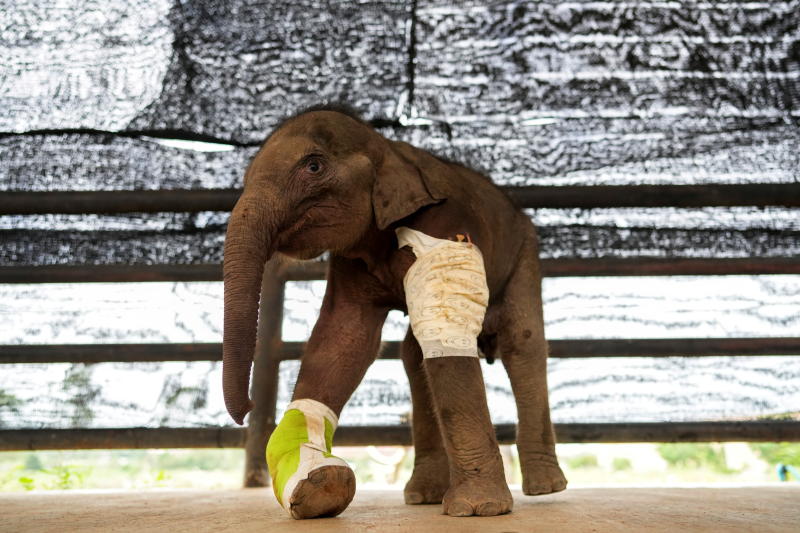
A three-month-old baby elephant saved from a hunter’s trap and sent for medical treatment for its mangled right front leg and recovery process is seen in Nong Nooch Tropical Garden in Chonburi on Thursday. (Reuters photo)
CHONBURI: A three-month-old baby elephant was recovering in this eastern province on Thursday following lifesaving treatment after being shot several times and caught in a hunter’s trap.
The elephant, whom rescuers have named “Fahsai”, meaning “clear sky”, was found by passers-by on Sunday with her right foot caught in a trap and gunshot wounds to her shoulder.
A lawsuitfiled in the U.S. District Court in Missoula seeks to overturn aTrump-era ruleexpanding hunting and fishing within the National Wildlife Refuge system. The lawsuit argues the expansion will harm endangered species like grizzly bears.
The lawsuit filed by the Center for Biological Diversity says the U.S. Fish and Wildlife Service didn’t properly assess the impact of a rule opening 2.3 million acres in the National Wildlife Refuge system to hunting and fishing. The rule includes the Swan River National Wildlife Refuge in northwest Montana.
The advocacy groupin a press releasesays that the rule will increase the amount of lead in the ecosystem from ammunition and fishing tackle, harming endangered waterfowl and will pose a risk to threatened grizzly bears due to hunters mistaking them…
BEAUFORT COUNTY, S.C. (WTGS) —The Beaufort County Sheriff’s Office said it is investigating an animal cruelty case in Burton.
Officials said it started with a call to the county’s animal services on November 23, 2021 about a stray cat at the Magnolia Park Apartments on Laurel Bay Road.
Animal control officers said they set a trap for the cat, but when they returned to retrieve the trap the next day it was missing.
Beaufort County Sheriff’s deputies then responded to the apartment complex. They said along with animal control officers they found the trap submerged in a pond on the property and the stray cat was found dead inside the trap.
(WHDH) — A mother accused of fatally shooting her 6-year-old son with a rifle following a hunting trip on Thanksgiving “wanted to send the victim to heaven,” law enforcement officials said.
Mary Amelia Rosborough, 31, of Chester, South Carolina, was arrested Thursday on charges including murder and possession of a weapon during a violent crime,the Rock Hill Herald reported.
Deputies responding to a report of a shooting at Rosborough’s Old Douglas Road home learned that she had shot her son, who later died at a local hospital, Fairfield County Sheriff Will Montgomery said.
An investigation revealed that Rosborough had shot a deer with the same .243 caliber rifle about an hour before she shot her son, according to the news outlet.
Rosborough allegedly tried to reload the rifle after firing at her son but she was reportedly tackled by a…
KILLBUCK — A Kill Buck man faces a reckless endangerment charge after the Cattaraugus County Sheriff’s Office allege he was involved in a hunting accident in November.
Jacob F. White, 29, of 3605 S. Authority Road, was charged at 6:08 p.m. Nov. 2 with second-degree reckless endangerment, a class A misdemeanor.
Deputies state the charge was the result of an investigation into a reported hunting incident off Route 417 in Great Valley.
Details of the incident were not available Thursday.
White was processed and released with an appearance ticket.
Deputies were assisted in their investigation by the New York State Department of Environmental Conservation and the Seneca Nation Conservation Department.
A series of recent accidents and deaths has reignited the hunting debate in France, with some calling for partial bans and more regulationPic:Scharfsinn / ShutterstockByHannah Thompson
An 82-year-old hunter has been killed in a hunting accident in Brittany, in the latest high-profile incident during a time of intense debate about the sport in France.
The man died on Thursday, December 2, after having been accidentally shot during a game hunt on private land in Tourc’h, in Finistère,gendarmerie reported.
The shooter, a fellow hunter in his fifties, is now in custody. He accidentally hit the octogenarian from the opposite side of a pond.
BLOUNT COUNTY, Ala. (WIAT) – The Blount County Sheriff’s Office is investigating after two dogs were stolen from a Locust Fork home, shot and killed, then left on the side of a rural county road for dead. Sheriff Mark Moon said this was not a hunting accident.
“I thought they were just out running around because they’ve been out late before and then come back later like 9 o’clock at night,” O’Keefe said. “But something just felt off and I was questioning it.”
Max was O’Keefe’s best friend, a rescue dog.
“You could give him any command and he would know exactly what it was,” Yarbrough said.
But Max was getting older, O’Keefe got Bo to help with his transition coming home after serving in South Korea for a year in the Army.Rare piebald deer spotted in Madison County
“I wanted to give him a companion as he was getting older, somebody he could be with when I’m at work and so he could teach his way so they would learn from him,” O’Keefe said.
After days of searching, they got tipped off where the dogs might be. Yarbrough said she found them both by a field off of Deaver Walker Rd., side-by-side, shot to death.
“Why was it just Blake’s dogs that were taken and killed?” She asked.
“I don’t know anybody that’s mad at me. I don’t know anybody I’ve made enemies with,” O’Keefe said.
Yarbrough said she is hopeful sharing their story will stop this from happening to anyone again.
“The person or persons who did it will hopefully see this and have some kind of heart to never ever do that again and to maybe even come forward, get help, something.”
O’Keefe gave Bo his name because it stands for his initials, B.O., and it is the name of his photography and videography company, Bo Productions.
This is not the first time O’Keefe has had a dog shot.
The family’s offering a $1,000 reward for anyone who can help police find out who is responsible for the crime.
A fire burned through the Gibson Flats area south of Great Falls, Mont., on Wednesday, Dec. 1, 2021, destroying 11 homes, seven garages and 11 outbuildings, fire officials said. The fire was one of three wind-driven fires on Wednesday that forced evacuations in Montana. A fire near Denton led hundreds of residents to flee the central Montana town on Wednesday. Some buildings in the town were on fire. Another grass fire forced temporary evacuations near Browning, east of Glacier National Park.
Rion Sanders
A fire burned through the Gibson Flats area south of Great Falls, Mont., on Wednesday, Dec. 1, 2021, destroying 11 homes, seven garages and 11 outbuildings, fire officials said. The fire was one of three wind-driven fires on Wednesday that forced evacuations in Montana. A fire near Denton led hundreds of residents…
Dec. 2—An online petition urging Washington State wildlife commissioners to reinstate the spring black bear hunt is gaining traction online, but it’s unlikely to affect any change.
“I wonder if it is too little too late,” said Marie Neumiller, the executive director of the Inland Northwest Wildlife Council. “I’m not sure that the commission will take up the spring bear topic again until next year.
“We tried to motivate our members to participate in the commission process, but unfortunately, we were unable to generate interest until after the vote took place.”- ADVERTISEMENT -https://s.yimg.com/rq/darla/4-6-0/html/r-sf-flx.html
As of Tuesday, more than 8,000 people had signed the Change.org petition asking the state to reinstate the hunting season, which was suspended on Nov. 19 by the Washington Department of Fish and Wildlife Commission in a tied vote.
The petition — which is addressed to Gov. Jay Inslee and the U.S. Fish and Wildlife Service — is unlikely to change anything. Gov. Inslee appoints the nine-person commission and the U.S. Fish and Wildlife Service does not manage or regulate state hunting seasons.
The Washington Department of Fish and Wildlife commission voted 4-4 on the proposed 2022 spring bear hunt on Nov. 19. The nine-person commission is appointed by the governor to oversee WDFW. Since January, however, one of the commission’s three Eastern Washington seats has been vacant.
WDFW staff had recommended the commission approve the permit-only hunt, which has occurred in one form or another since 1999. Biologists said the hunt was a useful management tool and would not hurt the overall black bear population.
There was substantial public backlash against the hunt, however, which some call unethical as it targets bears in the spring, when they are weak and groggy after a winter of hibernation.
Although the petition is unlikely to change anything, it does highlight how few hunters participated in the various public meetings and comment sessions the commission held leading up to the vote, Neumiller said.
“Hopefully, this petition will show the commission that there is interest in the season,” she said. “Maybe if enough hunters speak up the commission will be more likely to follow the department’s science next time … if they feel that people are truly interested in the season.”
For example, during one October public meeting, 50 people gave public testimony against the proposal while only two supported it. According to a staff presentation during Friday’s vote, WDFW received more than 5,000 comments on the proposed season. National advocacy groups like the Humane Society of the United States urged its members to oppose the hunt.
The commission has said it will reconsider the spring bear hunt next year.
Per state law, citizens can also petition the commission directly to repeal state administrative rules. Agencies “will give full consideration” and respond within 60 days.
One of the ocean’s most fearsome predators is muscling into new parts of the icy Arctic Ocean.
Orcas, also known as killer whales, are showing up in places they’ve never been spotted before. Scientists believe melting sea ice is to blame.
“[Killer whales] will normally avoid ice to avoid entrapment and suffocating,” said Brynn Kimber, a research scientist at the Cooperative Institute for Climate, Ocean and Ecosystem Studies, at a press conference Wednesday hosted by the Acoustical Society of America. “But with less ice, of course there’s less of a risk to them, so they’re able to venture further into the Arctic.”https://9fa9d70f3f5058315049842620c54de6.safeframe.googlesyndication.com/safeframe/1-0-38/html/container.htmlADVERTISEMENT
Kimber has been tracking the movements of killer whales through the Alaskan Arctic using underwater recorders, which pick up the sounds made by marine animals as they swim. Orcas have a very distinctive call, so they’re easy to recognize on the recordings.
Kimber presented her findings yesterday at the Acoustical Society of America’s annual conference in Seattle. The study draws on eight years of acoustic data, from 2012 to 2019, collected by recorders operated by NOAA’s Marine Mammal Laboratory.
The conclusions: Orcas are moving in as ice is moving out.
Data from the Bering Strait, which runs between Alaska and Russia, suggests that killer whales are moving into the area earlier in the year as time goes by. Killer whales are typically seasonal visitors in this area, migrating in during the summer when the sea ice melts away and moving back out when the water begins to freeze.
Recording stations farther north picked up even more surprising information.
A station in the northern Chukchi Sea recorded orcas in 2018 and 2019, in a place where they hadn’t previously been detected. The ice there would typically be too thick.
“We were seeing killer whales there where we really didn’t expect to see them,” Kimber said in an interview with E&E News.
It’s unclear why the killer whales are moving in. But Kimber suspects they’re probably following prey.
Killer whales often feed on gray whales, bowhead whales and various kinds of seals, all of which frequent the Arctic Ocean. These animals are adapted to the cold climate, and they’re able to easily navigate through the icy waters. Killer whales, on the other hand, find it difficult to swim through ice-covered sea—the tall dorsal fins on their backs make it difficult for them to crunch through the ice.https://9fa9d70f3f5058315049842620c54de6.safeframe.googlesyndication.com/safeframe/1-0-38/html/container.htmlADVERTISEMENT
As the sea ice disappears, killer whales may find it easier to follow their prey farther north into the Arctic Ocean.
Their presence in these northern waters is a possible cause for concern, Kimber pointed out—at the least, it’s worth keeping an eye on. Killer whales are skilled hunters, and they could have cascading consequences for the delicate Arctic food web.
There could also be consequences for nearby human communities, she added. Bowhead whales, for instance, are also a key source of subsistence for some Indigenous communities in places like Alaska and Siberia.
It’s not the first study to suggest that killer whales are migrating into the Arctic. Others have also found that orca sightings have increased over time, mainly in the Canadian Arctic.
And other studies have also warned of orcas’ potential impact on the Arctic ecosystem. One recent study, published last year in the journal Global Change Biology, found killer whales in the Canadian Arctic—a seasonal population of probably around 160 orcas or so—can consume more than a thousand narwhals each year.ADVERTISEMENT
Narwhals, like bowhead whales, are an important traditional food source for some communities in the Canadian Arctic.
Much more monitoring is needed to fully understand the consequences of the changing Arctic ecosystem. Research specifically focused on orcas and climate change is still relatively limited.
But “because killer whales are so good at hunting things … I think it is very important to keep an eye on,” Kimber said.