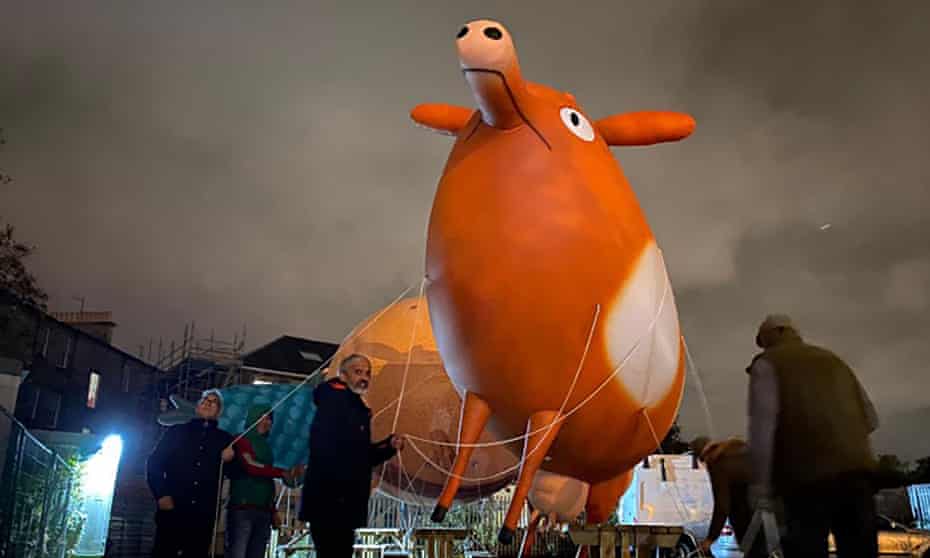
Activists parade with a giant inflatable cow to highlight the problem of methane emissions at a Cop26 march in Glasgow on Saturday. Photograph: Climate Healers
“The cow in the room is being ignored at this Cop,” says Carl Le Blanc of Climate Healers. “Animal agriculture has been taken off the agenda and put on the menu.”
Le Blanc was one of a number of campaigners who joined climate marches on Saturday in Glasgow to demand action for a new sustainable food system. They fought strong gales to make their point with four giant inflatable animals tethered on ropes above their heads or strapped to the ground. Each symbolised a different problem of the livestock industry: a 40ft cow for methane, a chicken for Covid and health, a fish for microplastics, and a pig for obesity.
Many industry representatives and campaigners feel not enough attention has been paid to food and farming at Cop26, despite it being one of the keys to cutting emissions over the next few decades. Food served at the canteen has been criticised – nearly 60% of dishes contain meat or dairy, which campaign group Animal Rebellion described as the equivalent of “serving cigarettes at a lung cancer conference”.Advertisement
During the two weeks of the conference, themes such as finance, energy and transport have been allocated their own days, but there has been no dedicated day for agriculture or food systems. Farming was included in Nature day on Saturday, where there was a lot of talk about protecting forests but less about cutting meat consumption, food waste and firm pledges to change farming subsidy systems.
Farming is a complex issue on the journey to net zero, as it is both a source and sink for emissions. About 20% of global emissions come from agriculture and land use, and this rises to more than 25% for the food system as a whole, which includes processing, packaging and transport. Yet huge amounts of carbon can be sequestered by modifying farmland, with the creation of more forests, healthier peatlands and wetlands. Although some argue that we should stop consuming animal livestock altogether, others believe that low densities of grazing animals such as cattle are an important part of creating farmland habitats that produce food and also provide a home for wildlife.
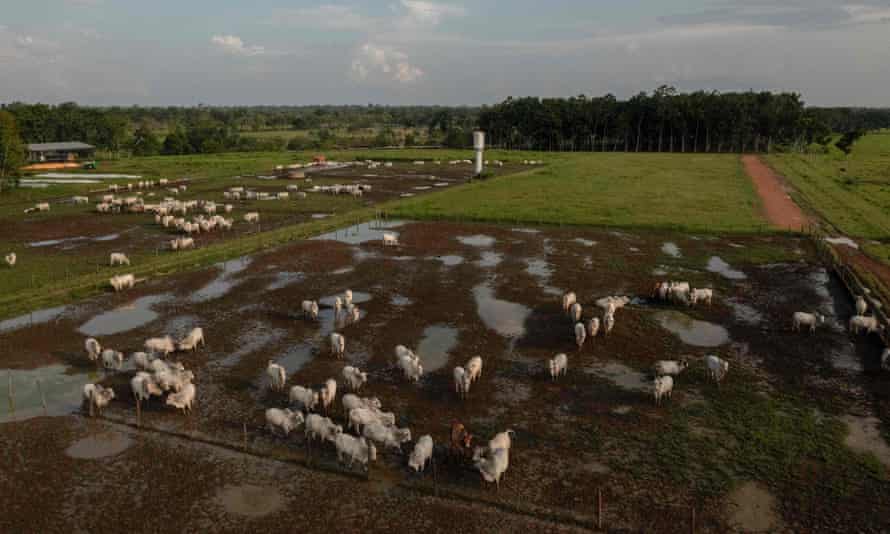
Cattle in Para state, Brazil, where the destruction of the Amazon has accelerated, in part due to illegal deforestation to clear land for intensive farms. Photograph: Mauro Pimentel/AFP/Getty Images
In terms of individual action, moving to a more plant-based diet is one of the single most effective ways to reduce emissions, but the UK government appears to be unwilling to put the science on this issue into policy. It quickly deleted research alongside its net zero strategy that encouraged levies on high-carbon foods, such as meat.
None of the presidents of the UK’s four farming unions present at Cop26 believe they should reduce livestock numbers in their respective countries, or that people need to reduce their meat consumption. They told the Guardian methane emissions could be dealt with through new technologies rather than reducing the number of cows on farms. Thomas Vilsack, the US secretary of agriculture says he believes Americans can carry on eating the same amount of meat while keeping the world within safe limits on global heating.
AN OBSCURE DARWIN IDEA COULD BE KEY TO SOLVING THE CLIMATE CRISIS
It has taken a century and a half to make people take Darwin’s proposal seriously and apply it to trees.
Grafissimo/DigitalVision Vectors/Getty ImagesROB MACKENZIE AND CHRISTINE FOYER11.14.2021 12:00 PM
MORE THAN 150 years ago Victorian biologist Charles Darwin made a powerful observation: that a mixture of species planted together often grows more strongly than species planted individually.
There is no human technology that can compete with forests for the take-up of atmospheric carbon dioxide and its storage. Darwin’s idea of growing lots of different plants together to increase the overall yield is now being explored by leading academics, who research forests and climate change.
Scientists and policymakers from Australia, Canada, Germany, Italy, Nigeria, Pakistan, Sweden, Switzerland, the UK, and the US came together recently to discuss if Darwin’s idea provides a way to plant new forests that absorb and store carbon securely.
WHY WE SHOULD PLANT MORE FORESTS
Planting more forests is a potent tool for mitigating the climate crisis, but forests are like complex machines with millions of parts. Tree planting can cause ecological damage when carried out poorly, particularly if there is no commitment to diversity of planting. Following Darwin’s thinking, there is growing awareness that the best, healthiest forests are ones with the greatest variety of trees — and trees of various ages.
Images showing how trees grow more strongly when planted in diverse forests, compare the size of the trees at 11-years-old. The trees are oak (left) and larch (right). The tree half-disc on the right of each image was planted in a more diverse area. All trees come from the same estate and were grown under otherwise similar conditions.Author provided
In mixed forests, each species accesses different sources of nutrients from the others, leading to higher yields overall. And those thicker stems are made mostly of carbon.
Mixed forests are also often more resilient to disease by diluting populations of pests and pathogens, organisms that cause disease.
Darwin’s prescient observation is tucked away in chapter four of his 1859 famous book On the Origin of the Species. Studies of this “Darwin effect” have spawned vast ecological literature. Yet it is still so outside of the mainstream thinking on forestry that, until now, little major funding has been available to prompt the use of this technique.
Darwin also famously described evolution by natural selection, a process by which genes evolve to be fit for their environment. Unfortunately for the planet, human-induced environmental change outstrips the evolution of genes for larger, slower reproducing, organisms, like trees.
A man studies an exhibit on Charles Darwin and the history of science at Darwin’s home in Kent.Vicky Jirayu/Shutterstock
Modern gene-editing techniques — direct DNA surgery — can help speed things up once careful laboratory work identifies the key genes. But only the evolution of human practice — that is, changing what we do — is fast and far-reaching enough to rebalance the carbon cycle and bring us back within safe planetary limits.
HEALTHIER TREES CAPTURE MORE CARBON
At our meeting we discussed a study of Norbury Park estate in central England, which describes how — using the Darwin effect and other climate-sensitive measures — the estate now captures over 5,000 tonnes of carbon dioxide per year, making it quite possibly the most carbon-negative land in the UK. Such impressive statistics don’t happen by accident or by sticking some trees in the ground and hoping; care and ecological nous are needed.
Trees of different ages also continuously provide harvestable timber and so steady jobs, in stark contrast to the other methods of forestry, where large areas are felled and cleared at the same time.
The UK government, like other administrations, has laid down requirements for responsible large-scale tree planting. These requirements continue to be revised and improved. There are still vital questions about which trees we should plant, where we should plant them, and what to do with them once they’ve grown.
It has been said that it is impossible to plant a forest, but it should certainly be possible to design a plantation that will blossom into a forest for future generations. We need forests to be a practical, dependable, and just response to our climate and biodiversity crises, and Darwin has shown us the way.
The idea came from Gov. Mike Dunleavy: “Establish a huntable population of Sitka black-tailed deer in the Mat-Su,” according to the first page of an internal state report.
In a populous part of Alaska that climate change will warm in the decades ahead, an established deer population might provide a new source of food and wildlife viewing for residents without the means to fly or boat around the islands and coastlines where the elusive ungulates live, according to the administration.
“The governor has directed his commissioners and other officials to look into a host of game enhancement opportunities, including the relocation of species for hunting,” said a statement emailed from deputy press secretary Patty Sullivan. “The creation of new hunting opportunities is a priority of the governor’s.”
“While many Americans see food security strictly through food charities, Gov. Dunleavy believes the opportunity for Alaskans to obtain food through traditional means, such as hunting, is just as important,” Sullivan wrote.
Plenty of species have been relocated all over Alaska to advance hunting and food security: musk oxen, moose, wood bison, reindeer, elk and many of the Sitka black-tailed deer that have lived for decades on Kodiak Island and in Prince William Sound. Wildlife relocations are a normal enough management policy to have a lengthy bureaucratic review process within the Department of Fish and Game, one weighing ecological risks, community benefits and other factors.
As an initial step in that process, Fish and Game staff developed a scoping report this year laying out the feasibility of deer relocation. The Dunleavy administration denied a public records request for the proposal, deeming the documents “predecisional and deliberative,” and as such “protected from disclosure under the deliberative process privilege.”
But a copy of the report obtained by the Anchorage Daily News described bleak prospects for any deer moved into the Matanuska or Susitna valleys. What’s more, according to the report’s authors, even if millions of dollars in public money are spent and the deer come to thrive in a populous area crisscrossed with roads, farms and established wildlife populations, they may ultimately mean more problems than benefits.
A short history of progress
Many wild animals taken for granted as historic local stocks in Alaska were in fact moved there to propagate and hopefully one day be eaten.
“Translocating and reintroducing animals in Alaska is not an uncommon policy. Sitka black-tailed deer have been translocated throughout Alaska,” wrote Sullivan.
The moose living around Berners Bay, about 40 miles north of Juneau, were transplanted from Southcentral Alaska in 1959 and 1961. Musk oxen were entirely killed off in Alaska by 1900, and the herds that now huddle in the hills through Western Alaska winters are descendants of Greenlandic stocks brought to Nunivak Island in the 1930s and gradually reintroduced to the mainland in the decades since. Both species are now harvested by Alaskans for food.
Sitka black-tailed deer have long been a popular pick for relocation projects. As early as 1916, the Cordova Chamber of Commerce moved a number of deer into the Prince William Sound region, and nearly two decades later the animals’ presence was robust enough to allow for hunting. Deer introduced to the Kodiak Archipelago in 1934 survived. A hunt was opened there 19 years after the introduction.
Plenty of other deer relocation projects, however, have failed or are viewed as partial successes, according to a section of the scoping document dedicated to the history of shuffling deer around the state. The animals were brought into areas around Skagway, Yakutat and Petersburg with limited success, and harvest limits remain low to nonexistent. In 1923, according to the report, “Seven (Sitka black-tailed deer) were released on the Homer Spit, but the animals disappeared and the transplant failed.” Starting in 1973, the state looked at moving deer to the southern tip of the Kenai Peninsula. The proposal moved through the public process for more than a decade but eventually stalled because state wildlife officials had to focus on the Exxon-Valdez oil spill.
Nowhere that deer have been transplanted is as cold in winter as the Matanuska and Susitna valleys, which is the most likely obstacle to the animals’ survival.
“All ADF&G deer managers and biologists agree that an SBD (Sitka black-tailed deer) introduction is unlikely to succeed in the Mat-Su,” according to the scoping report.
“The Mat-Su is far colder than anywhere within the SBD’s current winter range with mean daily maximum temperatures far below freezing from November through February,” it adds. “It is unlikely SBD can live in the Mat-Su under normal winter conditions.”
The report goes on to explain how deer survive winters in mountainous coastal environments: forest canopies prevent snow from deeply covering forage, and after big snow events the deer can descend toward shore areas to look for more food, even eating kelp on Kodiak beaches to avoid starvation.
“Kelp is rare to nonexistent in the Mat-Su valley,” the authors note.
What’s more, deep snow pack and relatively spare tree cover is likely to leave the deer’s main food supplies buried too long for them to survive through the year.
There is also the question of predators: The valleys of Southcentral Alaska have a lot of them: “Wolves, black bears, brown bears, coyotes and others (e.g. lynx, wolverines, and feral or free-roaming dogs),” the document says. “In years of heavy snow, limited mobility of SBD could lead to higher predation rates by wolves or coyotes.”
The risks of success
Even if a translocated deer population survives, they may create a number of new problems for the humans and animals already living there.
The report notes it would probably take “two or more decades before a harvestable surplus exists.”
During that time, along the roads and highways, there will likely be more roadkill.
“Abundant deer would increase the potential and number of wildlife-vehicle and train collisions in the Mat-Su, which is an ongoing issue in the Mat-Su with moose-vehicle collisions,” according to the report, which notes elsewhere that the area already sees upward of 300 moose-vehicle collisions a year. “Dark winter days combined with the crepuscular activity pattern (active at dawn and dusk) of SBD means the highest density of deer and deer activity will occur when drivers have limited visibility.”
The other consequence for moose would be more competition for food.
LOCAL NEWSPosted:Nov 14, 2021 / 03:01 PM EST/Updated:Nov 14, 2021 / 03:28 PM EST
Family members started to take the girl to the hospital but an ambulance arrived and took over mid-trip, attempting lifesaving efforts. The girl was pronounced dead at the hospital. (Getty Images)
ALLEN COUNTY, Ind. (WANE) – A hunter was hospitalized after an accident involving a gun Sunday morning.
Indiana Conservation Officers are investigating the incident. Around 9 a.m., responders were dispatched to private property near the 3900 block of Felger Road for a person possibly shot in a hunting-related accident.
Charles Spicer, 57, of Arcola was deer hunting on private property with three other hunters when he was hit in the chest by either a bullet or bullet fragment fired from another hunter in his party.ADVERTISINGMan in serious condition after shooting in downtown neighborhood
As a tour bus driver in Yellowstone National Park all summer, Randall Champion saw his share of tourists acting stupid by disregarding park guidelines on viewing wildlife from a safe distance.
The latest example was a man who thought it was a good idea to film a scene unfolding in front of the hotel at Mammoth Hot Springs where three bull elk were competing for the same group of females grazing on the lawn.
“Everyone’s attention was on this bull as he and another bull were bugling at each other,” Champion explained to USA Today/For The Win. “I saw this idiot walk out onto the lawn to film the bull without realizing he was now between the bull and the cows. You can see when the bull turns his head back, he sees the idiot and slowly starts lowering his head and moving towards him. The guy just keeps filming. The bull picks up speed and now everyone is seeing what is about to happen—except the idiot.”
“They start yelling at him, and at the last instance, he realizes he is in trouble, and in a panic he tries to run but can’t coordinate his limbs and down he goes,” Champion continued. “He scrambles up and almost gets hit by a car.”
As he hurried across the road, he is seen laughing.
While viewing wildlife in Yellowstone, the guidelines say to stay at least 100 yards away from bears and wolves, and at least 25 yards away from other large animals like bison, elk, bighorn sheep, deer, moose and coyotes. And petting wildlife is strictly prohibited, though apparently that commonsense guideline fails to register with some people.
Champion shared with For The Win Outdoors some examples of what he’s heard from tourists: “Like the father telling his kids to go sit on the back of an elk that was lying down so he could get that photo, or the lady that was trying to pet the 2,000-pound bison, or the teenage girls who thought the little bear cubs were cute and wanted to go pick one up while the mother bear was standing on hind legs getting ready to charge.”https://af98be9335db2b338787b29db65fe1e0.safeframe.googlesyndication.com/safeframe/1-0-38/html/container.html
As for the elk charging the man in this story? “Instances like this happened almost every day the whole time I was there,” Champion told For The Win Outdoors.”
Creating green technologies like batteries and solar panels requires a lot of minerals, and a lot of mining. The challenge now is to extract what we need without destroying the environment
IF THE unofficial rallying cry of the fossil fuel lobby is “drill, baby, drill”, renewable energy should have one too: “dig, baby, dig”. If we are going tohit our climate targets, the world is going to need a lot of new mines.
“Minerals are essential ingredients of the future clean energy system,” saysFatih Birol, executive director of the International Energy Agency (IEA). “If we try to visualise our future clean energy systems – millions of electric vehicles, cars, buses, windmills, solar panels – they need minerals to build. Huge amounts of minerals.”
He isn’t exaggerating. According to arecent IEA report, if the world is…
US agriculture secretary Tom Vilsack. He told the Guardian: ‘If we are going to feed 9 billion people, you need meat protein. We will need plant, animal and fish protein.’ Photograph: Jim Lo Scalzo/UPI/Rex/Shutterstock
Americans can carry on eating meat while keeping the world within safe limits on global heating, the US secretary of agriculture has insisted.
Thomas Vilsack said: “I do not think we have to reduce the amount of meat or livestock produced in the US. And a significant percentage is exported. It’s not a question of eating more or less or producing more or less. The question is making production more sustainable.”
He told the Guardian in an interview at the Cop26 summit in Glasgow that livestock production could be made more efficient, and the amount of methane produced by farm animals reduced, which along with other measures to reduce greenhouse gas emissions from agriculture would be enough to reduce carbon from farming.
Ruminants such as cattle and sheep produce methane, as does animal manure. The potent greenhouse gas has a heating effect about 80 times greater than carbon dioxide in the atmosphere, though it breaks down sooner. Meat accounts for about 60% of greenhouse gas production from agriculture, which itself is one of the highest carbon-producing sectors globally.
The US, the EU and scores of other countries signed a deal at Cop26 to reduce global methane emissions by 30% by 2030, though none of the countries have taken on a firm national reduction goal under the deal. If the target is reached, global heating could be reduced by about 0.2C.Advertisement
Vilsack said: “If you reduce methane by livestock by 30%, by food additives or different feed, or you capture the methane to biogas – take the manure and use it as biofuel – then you have made livestock production more sustainable. I do not think you need to reduce meat consumption to get that.”
He added: “If we are going to feed 9 billion people, you need meat protein. We will need plant, animal and fish protein.”
He said the US was financing demonstration projects for new technology and farming methods that would reduce methane.
Green campaigners have focused on meat eating as a key source of greenhouse gas emissions around the world, but particularly in the US where a meat-heavy diet has become the norm over decades. People in the US eat close to 100kg of meat a year, more than any other country, although there has been a trend towards healthier eating among younger people in recent years.
Meat-eating is also a driver of deforestation around the world, as rainforest in countries such as Brazil is cleared for cattle ranches and to produce animal feed.
John Sauven, executive director of Greenpeace UK, said: “It’s time politicians stopped giving cover to the industrial meat industry. At the moment they get a free ride and we pay the price for their huge health and environmental impacts.”
Vilsack said greenhouse gas emissions from agriculture could be substantially reduced by new technology and employing different methods, but that it was also vital to look at how agriculture must adapt to become more resilient against the impact of a changing climate.
“The climate crisis threatens to disrupt food systems around the globe, exacerbate food insecurity and negatively impact farmers’ livelihoods. We must invest in innovative, science-based solutions to help agriculture mitigate and adapt to climate change,” he said.
To that end, the US is one of the main investors, alongside the United Arab Emirates, in the $4bn Agriculture Innovation Mission. Backed by more than 30 countries and more than 40 civil society groups, the project will encompass new technology, including artificial intelligence programmes and research, to adapting growing techniques in the field, gathering data on weather impacts, ways to nurture soils better, and a “greener cattle initiative” to change the diets of cows to produce less methane.
Man fined $7,500 for killing black bear on cultivated land
The offender was also slapped with a two-year hunting banbyMartin DunphyonNovember 13th, 2021at7:00 AM
2 of 2
The B.C. Conservation Officer Service posted this picture of a cultivated area after a man pleaded guilty to two charges under the B.C. Wildlife Act after the shooting death of a black bear near Pemberton last year.BCCOS
A man who shot and killed a black bear on cultivated landwithout permission last year has been hit with a $7,500 fine in Pemberton Provincial Court this week.about:blank
The Lower Mainland resident also received a two-year hunting ban for the incident, which took place near Pemberton in May 2020.
Information about the case was posted by the B.C. Conservation Officer Service (BCCOS) on itsFacebook pageon November 10. A written decision for the case has not yet been…
ContactPublished Saturday, November 13, 2021 7:19AM EST
A caribou grazes on Baffin Island in a 2008 file photo. The Quebec government’s caribou management plan to potentially shoot wolves that get too close to an endangered woodland caribou herd is drawing criticism from environmentalists. THE CANADIAN PRESS/AP-Kike Calvo via AP Images
MONTREAL — The Quebec government’s decision to fence in another endangered caribou herd and to kill any wolves that approach the animals is worrying environmentalists, who say the province is again delaying a long-promised plan to re-establish the species.
After putting a fence around the habitat of the seven animals that remain in a herd in Val d’Or, Que., the government says herds in the Charlevoix and Gaspe regions will be next to live behind enclosures.
The Wildlife Department confirmed that construction is underway to fence in…
Perdue’s company logo is seen on a building on the parking lot outside the Perdue Farms Chicken and poultry processing factory on May 2, 2020, in Salisbury, Maryland.
At least 59,000 workers at the nation’s five largest meatpackers were infected with COVID-19 and at least 269 died during the first year of the pandemic, a new investigation from the House Select Subcommittee on the Coronavirus Crisis has found. That’s almost three times the number of both infections and deaths known from previous estimates based on publicly available data collected by the Food and Environment Reporting Network (FERN).
The actual number of COVID cases and deaths among workers in these facilities was likely even higher, because the data provided by companies to the subcommittee excludes cases discovered in off-site testing or self-reported by employees.
Tyson Foods, based in Springdale, Arkansas, reported the most worker cases — 29,462 — and deaths — 151 — of the five companies. The others are JBS (12,859 employee infections and 62 deaths), Smithfield (9,666 infections and 25 deaths), Cargill (4,690 infections and 25 deaths), and National Beef (2,470 infections and six deaths). The subcommittee noted that the full extent of infections and deaths at these companies was likely much worse as the data they provided to investigators in many instances excluded cases confirmed by offsite testing or self-reported by employees. Tyson did not respond to a request for comment.
Uncompromised, uncompromising news
Get reliable, independent news and commentary delivered to your inbox every day.
Email
“It’s shocking for people to realize that companies don’t have to report to anyone how many of their workers tested positive for COVID, or how many workers in their plants died of COVID,” Debbie Berkowitz, a former senior Occupational Safety and Health Administration official under President Obama, told Facing South.
The subcommittee found that infections were particularly high at certain plants, including a Tyson plant in Amarillo, Texas, where 49.8% of the workforce contracted the virus. A memo from the Centers for Disease Control and Prevention and Texas health authorities to Tyson obtained by the subcommittee said that workers at the plant were wearing masks “saturated” with sweat and were separated by only “plastic bags on frames.” The report also said that OSHA staff told the subcommittee that the agency’s decision not to issue a regulatory standard on protective measures for workers was a “political decision.”
Workers and their families called attention to lack of safety measures in poultry plants almost immediately once the pandemic began, as reporting by Facing South and other outlets documented. But, the subcommittee report noted, company executives and even the government spent months claiming that plants weren’t a source of infection — and blaming outbreaks in their workforce on “community spread.” The meat and poultry processing workforce is largely composed of non-white workers, and the industry relies heavily on immigrant labor. In Arkansas, as Facing South reported, two mayors worked with Tyson to tout safety measures inside the company’s plants and claim that the virus’s spread was mostly due to community behavior.
But the data obtained by the subcommittee showed a decline in infections among meatpacking workers as companies began implementing safety measures. “For example, Tyson’s monthly employee infections from its 15 facilities with the highest aggregate team member positive case counts have decreased from counts as high as 1,672 in April 2020 and 1,242 in March 2020 to counts as low as ten and seven in July 2020,” the report states.
The report confirmed what workers and advocates had been claiming all along, said Magaly Licolli, the co-founder of Arkansas workers’ justice group Venceremos. “It was not shocking,” she said.
Berkowitz and Licolli both testified at the subcommittee hearing on the report held Oct. 27. They were joined by Martin Rosas, the president of the United Food and Commercial Workers Union Local 2 in Kansas, and Rose Godinez, the interim legal director of the ACLU of Nebraska and the daughter of former meatpacking workers. Three representatives from Southern states serve on the subcommittee: Chairman Jim Clyburn, a South Carolina Democrat, and Republicans Steve Scalise of Louisiana and Mark Green of Tennessee. None of the states they represent are in the top five for meat or poultry processing by number of workers.
Rep. Mariannette Miller-Meeks of Iowa, a physician, was the subcommittee’s only Republican member to use their speaking time to address the substance of the report. Scalise, the ranking member, spent his time calling for a hearing into the origins of COVID-19 and talking about inflation and the Biden administration’s economic policies, as did the remaining Republicans.
“They were purposely, obviously trying to deviate from the subject, to not pay attention to it,” Licolli told Facing South.
In her testimony, Licolli recalled the early days of the pandemic, when she said she was “receiving many daily calls from workers, letting me know how terrified they were to see how fast their co-workers were getting infected with COVID.” The subcommittee’s report did not break down cases and deaths by state, but incomplete FERN data collected through Sept. 2 shows nearly 7,000 cases and more than 20 deaths in Arkansas meat and poultry processing plants.
Three testimonies submitted to the committee by Tyson workers in Arkansas using pseudonyms also recalled the consequences of being exposed to COVID on the job. “My life has changed completely after I contracted COVID,” wrote a former Tyson mechanic who says he contracted COVID while working in the plant. “I currently only have 45% of my lung capacity. I lost my job and I’m unable to find other jobs because of my health condition.”
Another worker at Tyson’s plant in Green Forest, Arkansas, wrote that the dividers installed by the company didn’t do much to protect workers. “The reality was that we were still working shoulder to shoulder. Our head came out of those dividers to be able to process chicken properly,” she wrote. She contracted COVID and came to work while symptomatic, she said, because she was afraid she would be fired. Her husband also contracted the disease and died.
Witnesses called for policy changes at the federal and state level to protect workers and provide more avenues for employees to combat unsafe working conditions.
“We really need to look at passing state laws that give workers a way to take employers into court when they just willfully decide that they’re not going to protect workers,” said Berkowitz. “There needs to be better protection in state laws, and federal laws, from retaliation for workers who speak up.”
A major focus of the report was OSHA’s absence during the pandemic, from conducting inspections to levying fines. The agency did not issue an Emergency Temporary Standard for meatpacking plants, which the report says OSHA staff called a “political decision.” Such a standard would have required companies to take specific steps to protect workers and given OSHA greater enforcement power. In 2020, as thousands of meatpacking workers were sickened and hundreds died, the agency issued just nine citations to meatpacking plants. The agency received hundreds of complaints in that time period.
“OSHA under Trump was really hollowed out, was sort of shut down,” said Berkowitz. “And it’s going to take a while to turn the agency back on.” She called for major budget increases to the agency that would allow it to rebuild.
“We need OSHA more than ever to function as it should be functioning,” said Licolli.